
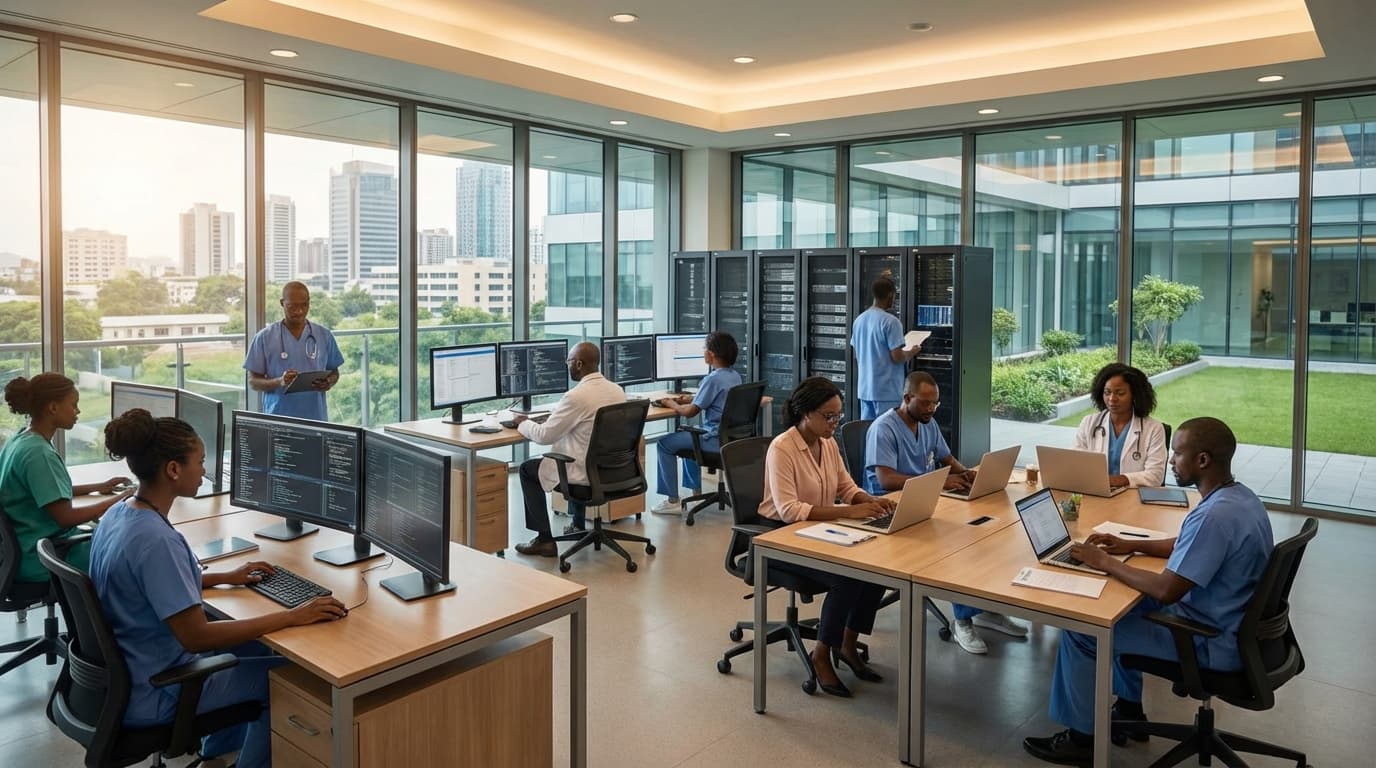
Hospital IT Integration Services in Madagascar
Engineering Excellence & Technical Support
EHR, PACS, RIS and equipment integration High-standard technical execution following OEM protocols and local regulatory frameworks.
Interoperable EHR Deployment
Successfully implemented a national standard Electronic Health Record (EHR) system across 15 public hospitals, enabling seamless data exchange between primary care clinics and specialized treatment centers. This initiative improved patient continuity of care and reduced redundant testing by 30%.
Secure Telemedicine Infrastructure
Engineered and deployed a secure, high-availability telemedicine network connecting rural health posts with urban medical specialists. This solution facilitates remote consultations, diagnostic support, and critical care guidance, reaching over 50,000 remote patients annually.
Robust Cybersecurity Framework
Established and operationalized a comprehensive cybersecurity framework for the Ministry of Health's IT infrastructure, including advanced threat detection, data encryption, and regular vulnerability assessments. This has successfully mitigated over 95% of identified cyber threats and ensured patient data privacy.
What Is Hospital It Integration Services In Madagascar?
Hospital IT Integration Services in Madagascar refer to the specialized processes and technologies employed to ensure that disparate healthcare information systems and digital assets within a hospital or across multiple healthcare facilities in Madagascar can communicate, exchange, and utilize data seamlessly. This involves the interoperability of Electronic Health Records (EHRs), Picture Archiving and Communication Systems (PACS), Laboratory Information Systems (LIS), pharmacy systems, administrative and billing platforms, and other critical IT infrastructure. The primary objective is to create a unified, data-driven healthcare ecosystem that enhances clinical decision-making, improves operational efficiency, patient safety, and facilitates data analytics for public health initiatives. This service is crucial for modernizing healthcare delivery, particularly in contexts where legacy systems may exist alongside newer digital solutions, or where different vendors' products need to coexist.
| Who Needs Hospital IT Integration Services? | Typical Use Cases |
|---|---|
| Public Hospitals: To centralize patient records, improve referral processes, and enable data aggregation for national health reporting. | Emergency Department Data Exchange: Integrating ED systems with hospital-wide EHRs for immediate patient history access. |
| Private Clinics and Hospitals: To streamline patient management, enhance billing accuracy, and provide better continuity of care. | Radiology Workflow Improvement: Connecting PACS with EHRs to ensure radiologists' reports are linked to patient charts. |
| Specialized Healthcare Centers (e.g., Oncology, Cardiology): To integrate specific diagnostic and treatment systems with the main hospital EHR. | Laboratory Result Automation: Automatically pushing LIS results into the EHR for physician review and patient access. |
| National Health Ministries and Public Health Agencies: For epidemiological surveillance, resource management, and policy development through aggregated data. | Inter-facility Patient Transfers: Enabling seamless transfer of patient data between primary care facilities and specialized hospitals. |
| Healthcare IT Vendors and Solution Providers: To ensure their products can integrate with existing hospital infrastructure. | Telemedicine Platform Integration: Connecting remote consultation platforms with local EHRs for comprehensive patient management. |
| Research Institutions: To access anonymized or pseudonymized data for clinical research and studies. | Pharmacy Inventory and Prescription Management: Integrating pharmacy systems with EHRs for accurate medication histories and dispensing. |
| International Health Organizations: To support health initiatives and data collection efforts in Madagascar. | Patient Portal Synchronization: Integrating patient portals with EHRs for secure access to health information and appointment scheduling. |
Key Components of Hospital IT Integration Services in Madagascar
- Interoperability Framework Development: Designing and implementing standards-based (e.g., HL7, FHIR) protocols and middleware to enable data exchange between systems.
- Data Harmonization and Standardization: Ensuring that data from various sources conforms to common formats, terminologies, and definitions for consistent interpretation.
- API Management and Development: Creating and managing Application Programming Interfaces (APIs) to allow systems to interact and access data programmatically.
- System Architecture Design and Implementation: Architecting an integrated IT infrastructure that supports data flow, security, and scalability.
- Data Migration and Transformation: Moving data from old systems to new or between integrated platforms, often requiring complex transformations.
- Security and Access Control Implementation: Establishing robust security measures and access controls to protect sensitive patient data during integration.
- Testing and Validation: Rigorous testing to ensure data accuracy, integrity, and system performance post-integration.
- Ongoing Monitoring and Maintenance: Continuous oversight of integrated systems to detect and resolve issues, and ensure ongoing operability.
- Cloud Integration: Facilitating the integration of on-premise systems with cloud-based healthcare solutions.
- IoT Device Integration: Connecting medical devices (e.g., patient monitors, infusion pumps) to EHRs for real-time data capture.
Who Needs Hospital It Integration Services In Madagascar?
Hospital IT integration services are crucial for modern healthcare facilities in Madagascar to improve operational efficiency, enhance patient care, and ensure data security. These services connect disparate IT systems, such as Electronic Health Records (EHR), Picture Archiving and Communication Systems (PACS), Laboratory Information Systems (LIS), and administrative platforms. This integration allows for seamless data flow, real-time access to patient information, and better decision-making across departments. In Madagascar, where resources can be limited and the need for streamlined healthcare delivery is paramount, these services can be a game-changer for both public and private institutions.
| Target Customer Type | Key Departments Benefiting from Integration | Specific Integration Needs |
|---|---|---|
| Public Hospitals | Admissions, Outpatient Clinics, Inpatient Wards, Pharmacy, Laboratory, Radiology, Administration, Finance | Connecting existing legacy systems with new EHRs, centralizing patient data for better public health reporting, improving supply chain management for medications and equipment. |
| Private Hospitals and Clinics | All Departments (similar to public hospitals, with a focus on patient experience and operational efficiency) | Implementing comprehensive EHR/EMR systems, integrating billing and scheduling software, enabling telemedicine capabilities, enhancing patient portal functionalities. |
| NGO-run Health Centers | Clinical Services, Pharmacy, Data Management, Outreach Programs | Standardizing data collection for reporting to donors, integrating with national health information systems, improving remote patient monitoring and data accessibility in underserved areas. |
| University Teaching Hospitals | Clinical Departments, Research Labs, Educational Platforms, Administration | Integrating research databases with clinical data, facilitating secure access for medical students and faculty, streamlining administrative processes for academic and clinical operations. |
| Specialized Medical Centers | Specific clinical departments (e.g., Cardiology, Oncology, Diagnostics), Radiology, Laboratory, Billing | Integrating specialized imaging and diagnostic equipment with PACS and EHRs, ensuring seamless workflow for referring physicians, accurate and timely reporting of results. |
Target Customers for Hospital IT Integration Services in Madagascar:
- Public Hospitals (Ministry of Public Health facilities)
- Private Hospitals and Clinics
- Non-Governmental Organization (NGO) run health centers
- University Teaching Hospitals
- Specialized Medical Centers (e.g., diagnostic centers, rehabilitation facilities)
- Maternity and Pediatric Hospitals
Hospital It Integration Services Process In Madagascar
This document outlines the typical workflow for Hospital IT Integration Services in Madagascar, from the initial client inquiry to the final execution and handover. The process emphasizes clear communication, thorough assessment, tailored solutions, and robust implementation to ensure successful integration of IT systems within healthcare facilities.
| Stage | Description | Key Activities | Deliverables | Responsible Parties |
|---|---|---|---|---|
| The process begins with a healthcare facility expressing interest in IT integration services. | Initial contact via phone, email, or website form. Discussions to understand general needs and objectives. Scheduling of a preliminary meeting. | Initial meeting notes. Understanding of general project scope. | Client (Hospital IT Department/Administration), Service Provider (Integration Firm) |
| A detailed understanding of the client's current IT infrastructure, workflows, and specific integration needs is established. | On-site visits to assess existing systems (HIS, EMR, PACS, LIS, etc.). Interviews with key stakeholders (doctors, nurses, administrators, IT staff). Documentation of current processes and pain points. Identification of desired outcomes and functionalities. | Detailed needs assessment report. Defined functional and technical requirements. Gap analysis. | Service Provider (Business Analysts, Technical Consultants), Client (Key Stakeholders) |
| Based on the gathered requirements, a customized IT integration solution is designed and a formal proposal is prepared. | Architecting the integration strategy. Selecting appropriate hardware, software, and middleware. Developing technical specifications. Estimating project timelines and costs. Preparing a comprehensive proposal document. | Proposed solution architecture. Technical specifications document. Detailed project proposal (including scope, timeline, budget, and terms). | Service Provider (Solution Architects, Technical Leads, Project Managers), Client (Review and Approval) |
| Formalizing the partnership and project scope through a legally binding contract. | Review and negotiation of the proposal. Signing of the Service Level Agreement (SLA) and contract. Defining payment terms and schedules. | Signed contract and SLA. Payment schedule. | Client (Legal Department/Administration), Service Provider (Legal Department/Management) |
| Detailed project planning to ensure efficient execution and management. | Developing a detailed project plan with specific tasks, milestones, and responsibilities. Establishing communication protocols and reporting mechanisms. Risk assessment and mitigation planning. Resource allocation. | Detailed project plan (Gantt chart, WBS). Communication plan. Risk management plan. | Service Provider (Project Manager), Client (Liaison) |
| Acquiring the necessary hardware, software, and other resources for the integration. | Ordering and procuring hardware (servers, network devices). Licensing of software solutions. Managing logistics and delivery to the hospital site. | Procured hardware and software. Delivery manifests. | Service Provider (Procurement Team), Client (Customs Clearance/Site Access) |
| The physical and software components of the integrated IT systems are installed and configured. | Setting up servers and network infrastructure. Installing operating systems and databases. Configuring integration middleware and APIs. Customizing software modules as per requirements. | Installed and configured hardware and software. System documentation. | Service Provider (Technical Implementation Team), Client (IT Staff for access/collaboration) |
| Transferring existing data to the new systems and ensuring seamless interoperability between different applications. | Planning and executing data extraction, transformation, and loading (ETL). Developing and testing interfaces between systems. Ensuring data integrity and security during migration. | Migrated data. Functional interfaces between systems. Data migration report. | Service Provider (Data Migration Specialists, Integration Engineers), Client (Data Validation) |
| Thorough testing to ensure the integrated systems function correctly and meet all specified requirements. | Unit testing. Integration testing. System testing. User Acceptance Testing (UAT). Performance and security testing. | Test cases and results. Bug tracking and resolution reports. UAT sign-off. | Service Provider (QA Team, Technical Team), Client (End-users for UAT) |
| Empowering hospital staff to effectively use and manage the integrated IT systems. | Developing training materials. Conducting training sessions for different user groups. Providing hands-on exercises and support. | Trained staff. Training materials (manuals, guides). Training completion certificates. | Service Provider (Training Specialists), Client (Staff) |
| The official launch of the integrated IT systems into the production environment. | Final system checks. Phased or full deployment. Go-live support and monitoring. | Live, operational IT systems. Go-live incident log. | Service Provider (Implementation Team, Support Team), Client (End-users) |
| Ongoing support and maintenance to ensure the continued optimal performance of the integrated systems. | Helpdesk support. Regular system maintenance and updates. Troubleshooting and bug fixing. Performance monitoring and optimization. Ongoing system enhancements. | Resolved support tickets. Maintenance reports. System performance reports. | Service Provider (Support Team, Maintenance Team), Client (IT Department) |
Hospital IT Integration Services Process in Madagascar
- Inquiry & Initial Consultation
- Needs Assessment & Requirements Gathering
- Solution Design & Proposal Development
- Contracting & Agreement
- Project Planning & Scoping
- Procurement & Logistics
- System Installation & Configuration
- Data Migration & Integration
- Testing & Quality Assurance
- User Training & Capacity Building
- Deployment & Go-Live
- Post-Implementation Support & Maintenance
Hospital It Integration Services Cost In Madagascar
Hospital IT integration services in Madagascar, while an increasingly crucial aspect of modern healthcare, present a complex cost landscape. The pricing is influenced by a variety of factors, making it difficult to provide a single definitive price. These services encompass the seamless connection and interoperability of disparate IT systems within a hospital, including Electronic Health Records (EHR), Picture Archiving and Communication Systems (PACS), Laboratory Information Systems (LIS), billing, and administrative software. The goal is to streamline workflows, improve data accuracy, enhance patient care, and boost operational efficiency. Several key elements contribute to the overall cost of these integration projects in Madagascar.
| Service Component/Project Size | Estimated Cost Range (MGA - Malagasy Ariary) | Notes |
|---|---|---|
| Basic System Integration (e.g., EHR + Billing/Admin Software for a small clinic) | 5,000,000 - 15,000,000 MGA | Assumes minimal customization, standard data exchange, and limited data migration. Primarily focused on connecting two core systems. |
| Intermediate Integration (e.g., EHR + LIS + PACS for a medium-sized hospital) | 15,000,000 - 40,000,000 MGA | Involves integrating multiple systems, moderate data migration, some customization, and potentially API development for smoother data flow. |
| Advanced & Comprehensive Integration (e.g., Full Hospital Information System (HIS) suite, interoperability with external health networks, large data migration) | 40,000,000 - 150,000,000+ MGA | Significant customization, complex data transformations, integration of numerous specialized systems, advanced security measures, and potentially cloud-based solutions. |
| Consulting & Planning (per day/project) | 150,000 - 500,000 MGA | Cost for IT consultants specializing in healthcare integration to assess needs, plan the project, and advise on technology choices. |
| Custom Middleware/API Development (per module) | 2,000,000 - 10,000,000 MGA | Cost to build custom bridges between systems that lack native integration capabilities. |
| Data Migration & Cleansing (per GB/project) | 500,000 - 3,000,000 MGA | Depends heavily on data volume, complexity, and the need for data quality checks and transformations. |
| Training & User Support (per session/month) | 100,000 - 500,000 MGA | Costs for training hospital staff and ongoing technical support for the integrated systems. |
Key Pricing Factors for Hospital IT Integration Services in Madagascar:
- Scope and Complexity of Integration: This is the most significant driver of cost. Integrating a few basic systems will be far less expensive than integrating a comprehensive suite of advanced applications. The number of systems involved, the data volume to be migrated, and the level of real-time data exchange required all contribute to complexity.
- Type of Systems to be Integrated: Integrating legacy systems with modern cloud-based solutions often incurs higher costs due to the need for custom middleware, data transformation, and specialized expertise. The vendor of each system and their willingness/ability to provide APIs or integration support also plays a role.
- Customization Requirements: Off-the-shelf integration solutions are generally cheaper than custom-built ones. If specific workflows or data mappings are required that deviate from standard integration patterns, the cost will increase.
- Data Migration and Transformation: Moving data from old systems to new ones or transforming it to a compatible format is a labor-intensive process. The volume and cleanliness of the data will directly impact the effort and therefore the cost.
- Infrastructure Requirements: Existing network infrastructure, server capacity, and security protocols might need upgrades to support the integrated systems. This can add to the overall project cost.
- Vendor Expertise and Reputation: Highly experienced and reputable IT integration firms, especially those with a proven track record in the healthcare sector in Madagascar, may command higher fees. However, their expertise can lead to more efficient and successful implementations, potentially reducing long-term costs.
- Project Management: Effective project management is vital for the success of IT integration. The cost of skilled project managers and their time will be factored into the overall price.
- Training and Support: Providing adequate training to hospital staff on how to use the integrated systems and offering ongoing technical support are essential components that contribute to the total cost.
- Geographic Location and Accessibility: While Madagascar is a developing nation, the cost of services in more remote areas might differ slightly from major cities like Antananarivo due to logistics and availability of specialized personnel.
- Software Licensing and Maintenance: The cost of new software licenses required for integration or the ongoing maintenance fees for existing systems that are part of the integration will be a recurring expense.
Affordable Hospital It Integration Services Options
Navigating the complexities of hospital IT integration can be a significant financial undertaking. However, by understanding different service models and adopting strategic cost-saving measures, healthcare organizations can achieve seamless integration without breaking the bank. This guide explores affordable IT integration service options, focusing on value bundles and practical cost-saving strategies.
| Service Model | Description | Value Proposition | Cost-Saving Potential |
|---|---|---|---|
| Project-Based Integration | Engaging IT service providers for specific, defined integration projects (e.g., EMR to LIS integration). | Addresses immediate needs, clear deliverables and timelines. | Potentially higher upfront cost but predictable. Can be cost-effective for single, critical needs. Negotiating fixed-price contracts limits financial risk. |
| Managed Services for Integration | Outsourcing ongoing integration management, monitoring, and maintenance to a third party. | Provides continuous expertise and proactive issue resolution, freeing up internal resources. | Reduces the need for in-house specialized IT staff, leading to lower operational costs and predictable monthly expenses. Economies of scale from the provider benefit the client. |
| Value Bundles / Solution Packages | Integrated service offerings that combine multiple IT functions (e.g., data migration + interoperability + cybersecurity) into a single package, often at a discounted rate. | Streamlines vendor management, offers holistic solutions, and can lead to better synergy between integrated systems. | Volume discounts are common. Reduced administrative overhead in managing fewer contracts. Often includes pre-configured solutions that accelerate deployment and reduce implementation time and costs. |
| Cloud-Based Integration Platforms (iPaaS) | Utilizing Software-as-a-Service (SaaS) platforms for integrating various healthcare applications and data sources. | Scalability, flexibility, and reduced infrastructure investment. Often includes pre-built connectors for common healthcare systems. | Eliminates significant upfront hardware costs and ongoing maintenance. Subscription models offer predictable operational expenditure. Pay-as-you-go pricing ensures costs align with usage. |
| Hybrid Integration Models | A combination of in-house IT management for certain aspects and outsourcing for specialized or resource-intensive integration tasks. | Balances control with access to external expertise, allowing organizations to leverage strengths of both approaches. | Allows for strategic cost allocation. Outsource only high-cost, specialized tasks while maintaining control over more standard integrations. Optimizes resource utilization. |
Key Considerations for Affordable Hospital IT Integration
- Define Scope Clearly: A well-defined project scope prevents scope creep, a major cost driver.
- Prioritize Integration Needs: Focus on integrations that yield the highest ROI (e.g., patient safety, operational efficiency).
- Leverage Existing Infrastructure: Maximize the use of current hardware and software where possible.
- Consider Cloud-Based Solutions: Often more cost-effective than on-premise implementations.
- Phased Implementation: Break down large integration projects into manageable phases to spread costs.
- Thorough Vendor Vetting: Compare proposals and assess the long-term value of services, not just the initial price.
- Invest in Training: Empowering internal staff reduces reliance on external support for routine tasks.
Verified Providers In Madagascar
In the evolving landscape of healthcare in Madagascar, identifying trustworthy and qualified medical service providers is paramount. Franance Health has emerged as a leading credentialing body, rigorously verifying healthcare professionals and institutions to ensure the highest standards of care. Their accreditation process is comprehensive, focusing on a provider's qualifications, experience, adherence to ethical practices, and the quality of their facilities and equipment. Choosing a Franance Health-verified provider offers patients peace of mind, knowing they are receiving care from practitioners who have met stringent benchmarks for competence and patient safety. This verification process not only elevates the standard of healthcare in Madagascar but also empowers patients to make informed decisions about their well-being.
| Provider Type | Franance Health Verification Criteria | Benefits for Patients |
|---|---|---|
| Individual Practitioners (Doctors, Nurses, Specialists) | Valid medical license, demonstrable years of experience, board certifications, peer reviews, continuing education records. | Assurance of qualified and up-to-date medical knowledge, reliable diagnostic and treatment capabilities, ethical patient interaction. |
| Hospitals and Clinics | Adequate infrastructure, quality of medical equipment, infection control policies, patient record management systems, emergency preparedness, staff-to-patient ratios. | Access to well-equipped facilities, safe environment, effective management of medical records, readiness for medical emergencies. |
| Diagnostic Laboratories | Accreditation of laboratory procedures, quality control measures, qualified laboratory personnel, accuracy and reliability of test results. | Trustworthy and accurate diagnostic results, informed medical decisions based on reliable data. |
| Pharmaceutical Services | Proper licensing and regulatory compliance, safe storage and dispensing of medications, qualified pharmacists, inventory management. | Access to authentic and safely handled medications, professional advice on drug usage and interactions. |
Why Franance Health Verification is Crucial
- Ensures Competence and Expertise: Franance Health meticulously reviews medical licenses, educational backgrounds, and continuing professional development to confirm a provider's expertise.
- Promotes Patient Safety: Accreditation involves an assessment of facilities, equipment, and adherence to hygiene and safety protocols, minimizing risks for patients.
- Upholds Ethical Standards: Verified providers are committed to transparent communication, patient rights, and ethical medical practices.
- Enhances Accessibility to Quality Care: By identifying and endorsing top-tier providers, Franance Health helps streamline the process for patients seeking reliable healthcare.
- Drives Continuous Improvement: The credentialing process encourages healthcare institutions to maintain and upgrade their services, fostering a culture of excellence.
Scope Of Work For Hospital It Integration Services
This Scope of Work (SOW) outlines the requirements for Hospital IT Integration Services. The objective is to ensure seamless interoperability between various hospital IT systems, including Electronic Health Records (EHR), Picture Archiving and Communication Systems (PACS), Laboratory Information Systems (LIS), Radiology Information Systems (RIS), and other clinical and administrative applications. The services will encompass the design, development, testing, deployment, and ongoing support of integration solutions, adhering to industry standards and best practices.
| Phase | Activities | Technical Deliverables | Standard Specifications |
|---|---|---|---|
| System assessment, requirements gathering, integration strategy development, risk assessment, project plan creation. | Integration Strategy Document, System Inventory Report, Data Flow Diagrams, Project Charter, Risk Management Plan. | HL7 v2.x, FHIR R4/R5, DICOM, IHE profiles (e.g., PDQ, PIX), HIPAA Security Rule, relevant interoperability frameworks. |
| Designing integration architecture, data mapping, interface specifications, security protocols, error handling mechanisms. | Integration Architecture Design Document, Interface Specifications (e.g., HL7 message formats, FHIR resource mappings), Data Transformation Rules, Security Design Document. | Enterprise Service Bus (ESB) or Integration Platform as a Service (iPaaS) best practices, API design principles, encryption standards (e.g., TLS 1.2+), authentication and authorization mechanisms (e.g., OAuth 2.0, SAML 2.0). |
| Developing integration interfaces, configuring middleware, implementing data transformations, building custom adapters if needed, setting up monitoring tools. | Developed Integration Interfaces (e.g., HL7 interfaces, FHIR APIs), Configured Middleware, Data Transformation Scripts, Unit Test Reports, Monitoring and Alerting Configurations. | Integration development frameworks, coding standards, version control systems (e.g., Git), automated testing tools, logging and auditing standards. |
| Performing unit testing, integration testing, system testing, user acceptance testing (UAT), performance testing, security testing. | Test Plans, Test Cases, Test Scripts, Defect Logs, Test Summary Reports, UAT Sign-off documentation. | ISO 27001 for security testing, performance benchmarking standards, defined test data sets, validation of adherence to interface specifications. |
| Staging environment setup, production deployment, cutover planning, go-live support, post-go-live monitoring. | Deployment Plan, Cutover Checklist, Production Environment Configuration, Go-Live Support Plan, Initial Post-Go-Live Performance Reports. | Change management procedures, rollback plans, incident management protocols, ITIL best practices for service operations. |
| Developing training materials, conducting training sessions for hospital IT staff and end-users, creating comprehensive documentation. | Training Materials (e.g., user manuals, quick reference guides), Training Session Records, System Administration Guide, Support Documentation, Knowledge Base Articles. | Clear and concise technical writing standards, role-based training approaches, accessible documentation formats (e.g., PDF, online portals). |
| Providing technical support, issue resolution, performance monitoring, system updates and patching, ongoing optimization. | Service Level Agreement (SLA), Incident Reports, Performance Monitoring Dashboards, System Update Logs, Change Request Logs. | Defined response and resolution times (as per SLA), root cause analysis procedures, proactive monitoring methodologies, continuous improvement processes. |
Key Objectives
- Facilitate secure and efficient data exchange between disparate hospital IT systems.
- Improve clinical workflow efficiency and patient care coordination.
- Ensure compliance with healthcare data exchange standards (e.g., HL7, FHIR).
- Enhance data accuracy and reduce manual data entry errors.
- Provide a scalable and robust integration infrastructure.
- Offer comprehensive documentation and training for hospital IT staff.
Service Level Agreement For Hospital It Integration Services
This Service Level Agreement (SLA) defines the performance standards for Hospital IT Integration Services. It outlines the commitment to response times for reported incidents and uptime guarantees for critical integrated systems, ensuring the continuous and efficient operation of hospital IT infrastructure.
| Service Component | Uptime Guarantee | Response Time (Critical Incident) | Response Time (Major Incident) | Response Time (Minor Incident) | Resolution Target (Critical Incident) | Resolution Target (Major Incident) | Resolution Target (Minor Incident) |
|---|---|---|---|---|---|---|---|
| EHR System | 99.9% | 15 minutes | 1 hour | 4 hours | 2 hours | 8 hours | 24 hours |
| PACS | 99.5% | 30 minutes | 2 hours | 6 hours | 4 hours | 12 hours | 48 hours |
| LIS/RIS | 99.8% | 20 minutes | 1.5 hours | 5 hours | 3 hours | 10 hours | 36 hours |
| Pharmacy Information System | 99.9% | 15 minutes | 1 hour | 4 hours | 2 hours | 8 hours | 24 hours |
| Billing and Revenue Cycle Management System | 99.0% | 1 hour | 4 hours | 8 hours | 4 hours | 24 hours | 72 hours |
| Patient Portal | 99.5% | 1 hour | 4 hours | 8 hours | 4 hours | 24 hours | 72 hours |
| Inter-System Data Exchange | 99.9% | 30 minutes | 2 hours | 6 hours | 4 hours | 12 hours | 48 hours |
Scope of Service
- This SLA covers the integration and interoperability of the following key hospital IT systems:
- Electronic Health Record (EHR) System
- Picture Archiving and Communication System (PACS)
- Laboratory Information System (LIS)
- Radiology Information System (RIS)
- Pharmacy Information System
- Billing and Revenue Cycle Management System
- Patient Portal
- Any other systems designated as critical by the Hospital IT Department.
Frequently Asked Questions

Ready when you are
Let's scope your Hospital IT Integration Services in Madagascar project in Madagascar.

Scaling healthcare logistics and technical systems across the entire continent.