
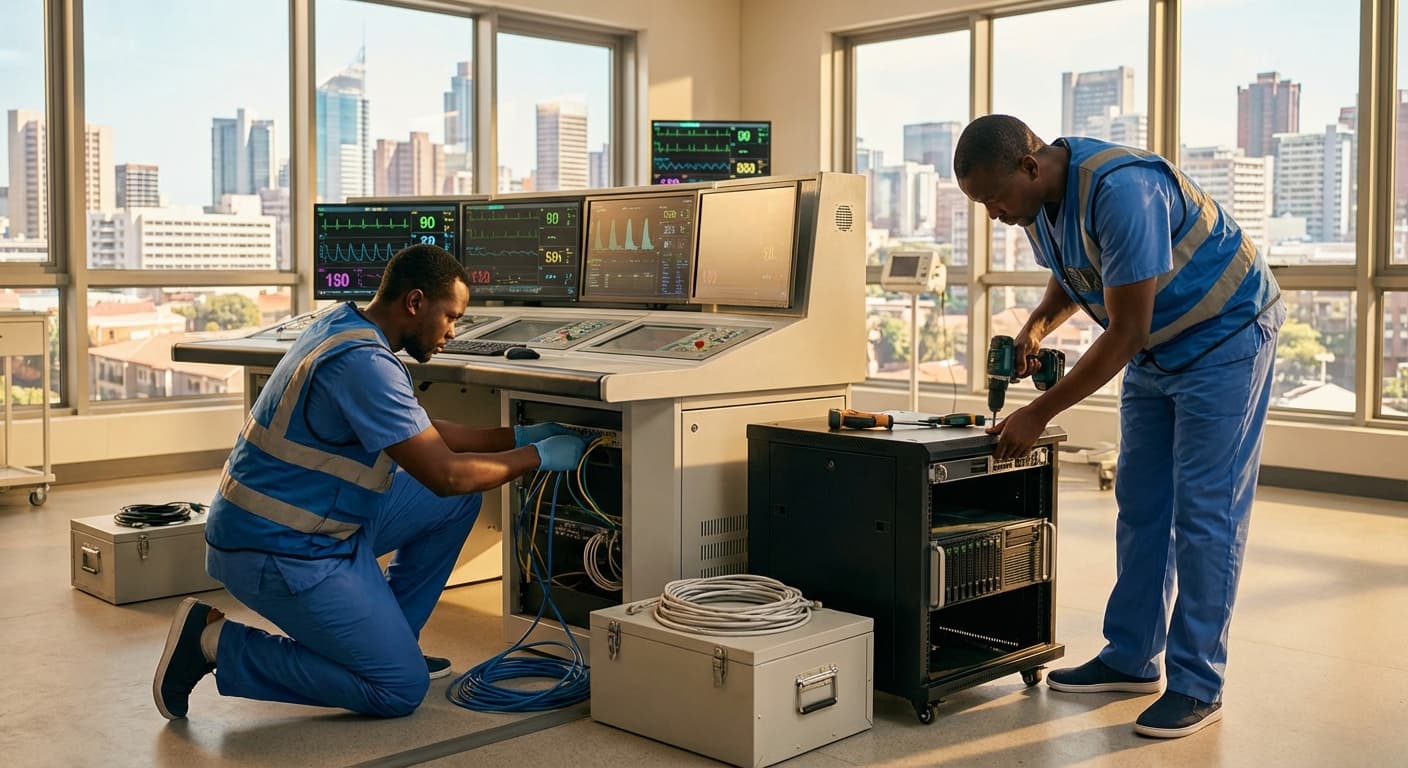
ICU Central Monitoring Station Installation Service in Madagascar
Engineering Excellence & Technical Support
ICU Central Monitoring Station Installation Service High-standard technical execution following OEM protocols and local regulatory frameworks.
Robust Network Infrastructure for Uninterrupted Data Flow
We design and implement high-availability network architectures using redundant cabling, managed switches, and secure data pathways, ensuring real-time, reliable transmission of vital patient data from bedside monitors to the central console. Our expertise guarantees seamless integration and minimal latency, even in challenging Madagascar environments.
Scalable Server & Software Solutions for Enhanced Patient Oversight
Our installation services include the deployment of powerful, enterprise-grade servers and advanced monitoring software. We configure systems for optimal performance, scalability, and cybersecurity, enabling your ICU to efficiently manage a growing number of patient beds and access comprehensive diagnostic tools and historical data analysis.
Certified Electrical & Power Redundancy for Critical Uptime
Ensuring continuous operation is paramount. We provide expert installation of uninterruptible power supplies (UPS), backup generators, and meticulously managed electrical distribution systems, adhering to international safety standards. This guarantees uninterrupted power to your monitoring station, safeguarding critical patient care during any power fluctuations in Madagascar.
What Is Icu Central Monitoring Station Installation Service In Madagascar?
ICU Central Monitoring Station Installation Service in Madagascar refers to the comprehensive process of establishing and configuring a centralized system for the real-time surveillance and data acquisition of critically ill patients within an Intensive Care Unit (ICU) in Madagascar. This service encompasses the procurement, installation, integration, and initial setup of specialized hardware and software designed to aggregate physiological data from multiple bedside patient monitoring devices to a central console or server. The objective is to enhance patient safety, improve clinical workflow efficiency, and facilitate timely medical interventions through continuous, consolidated oversight of patient status. The service adheres to international medical equipment standards and local regulatory requirements applicable in Madagascar.
| Requirement Category | Target Users/Entities | Typical Use Cases |
|---|---|---|
| Healthcare Facilities in Madagascar | Public and private hospitals, clinics, and medical centers with Intensive Care Units (ICUs). | Enhancing Patient Safety: Providing continuous, consolidated visibility of patient physiological parameters, enabling early detection of deterioration and prompt intervention to prevent adverse events. Optimizing Clinical Workflow: Reducing the need for frequent physical checks at each bedside, allowing nurses to monitor multiple patients simultaneously from a central location, thereby improving staff efficiency. Data Acquisition and Analysis: Collecting, storing, and analyzing patient data for clinical decision-making, research, and quality improvement initiatives. Telemedicine and Remote Consultation: Facilitating remote review of patient data by specialists, especially in underserved or remote areas of Madagascar. Compliance and Accreditation: Meeting national and international standards for critical care monitoring and patient safety requirements. |
| Government Health Ministries and Agencies | National and regional health authorities responsible for healthcare infrastructure development and quality standards in Madagascar. | Standardization of Critical Care: Implementing uniform critical care monitoring standards across public health facilities. Resource Allocation: Identifying needs for critical care equipment and infrastructure in different regions. Public Health Monitoring: Potentially aggregating anonymized data for epidemiological surveillance of critical conditions. |
| International Aid Organizations and NGOs | Organizations providing medical support and infrastructure development assistance in Madagascar. | Capacity Building: Equipping and training healthcare professionals in critical care settings. Disaster Preparedness: Establishing or upgrading ICU monitoring capabilities in response to public health emergencies or natural disasters. |
Key Components of ICU Central Monitoring Station Installation Service:
- Site Assessment and Planning: Evaluating the physical infrastructure, network topology, and existing medical equipment to determine optimal placement for the central monitoring station, cabling requirements, and power considerations.
- Hardware Procurement and Installation: Acquiring and physically installing the central monitoring server, workstations, displays, network switches, cabling (network, power, alarm), and associated peripherals.
- Software Installation and Configuration: Deploying and configuring the central monitoring software, including user interfaces, data management modules, alarm management systems, and potential integration with Electronic Health Records (EHR) systems.
- Network Integration: Establishing secure and reliable network connectivity between bedside patient monitors (e.g., vital signs monitors, ventilators, ECG monitors) and the central monitoring station. This often involves configuring IP addresses, subnets, and ensuring adherence to healthcare network security protocols.
- Device Integration and Calibration: Connecting and integrating individual patient monitoring devices to the central system. This may involve proprietary protocols, HL7 interfaces, or custom integration solutions. Calibration and testing of data acquisition are critical steps.
- Alarm Management System Setup: Configuring alarm thresholds, priority levels, audible and visual notifications, and escalation protocols to ensure prompt awareness of critical patient events.
- User Training: Providing comprehensive training to ICU clinicians (physicians, nurses), biomedical engineers, and IT support staff on the operation, maintenance, and troubleshooting of the central monitoring system.
- System Testing and Validation: Conducting rigorous testing of all system functionalities, data accuracy, alarm reliability, and network performance to ensure optimal operation and patient safety compliance.
- Documentation and Handover: Providing detailed system documentation, including installation guides, user manuals, network diagrams, and maintenance procedures, along with a formal handover to the healthcare facility's technical team.
Who Needs Icu Central Monitoring Station Installation Service In Madagascar?
The installation of ICU Central Monitoring Station services in Madagascar is crucial for healthcare facilities aiming to enhance patient care, optimize resource allocation, and improve overall operational efficiency. This advanced technology allows for the real-time, remote monitoring of multiple critically ill patients, enabling quicker responses to emergencies and better-informed clinical decision-making. Demand for these services is driven by the increasing need for sophisticated medical infrastructure to manage complex patient conditions, especially in the context of developing healthcare systems.
| Customer Type | Key Departments/Units | Specific Needs/Benefits |
|---|---|---|
| Large Public Hospitals | Intensive Care Unit (ICU), Coronary Care Unit (CCU), Emergency Department (ED) | Managing high patient volumes, standardizing critical care, enabling remote oversight by senior physicians, improving staff efficiency in resource-constrained environments. |
| Major Private Hospitals | ICU, Surgical ICUs (SICUs), Medical ICUs (MICUs), Neonatal ICU (NICU) | Providing high-quality, advanced patient care, attracting specialized medical talent, offering premium services, enhancing patient safety and outcomes. |
| Specialized Cardiac Centers | CCU, Cardiac Catheterization Lab, Post-Intervention Recovery Units | Continuous monitoring of hemodynamics, immediate alerts for arrhythmias or critical changes, integration with diagnostic imaging and intervention data. |
| Trauma and Emergency Centers | Emergency Department (ED), Trauma ICU | Rapid assessment and stabilization of critically injured patients, continuous monitoring of vital signs during transport and initial treatment, proactive management of shock and respiratory failure. |
| Pediatric and Neonatal Facilities | Pediatric ICU (PICU), Neonatal ICU (NICU) | Monitoring vulnerable populations with specific physiological needs, early detection of sepsis or respiratory distress, ensuring precise titration of medications and interventions. |
| Healthcare Facilities Supported by International Aid/NGOs | ICU, Operating Theatres, General Wards with High-Risk Patients | Upgrading infrastructure to meet international standards, improving patient safety and survivability, facilitating remote training and support for local medical staff. |
| Teaching Hospitals/Medical Schools | ICU, Research Departments | Providing a platform for medical education and training in critical care, facilitating clinical research on patient outcomes and treatment efficacy, generating data for academic purposes. |
Target Customers and Departments Requiring ICU Central Monitoring Station Installation Service in Madagascar
- Hospitals with Intensive Care Units (ICUs)
- Specialized Cardiac Care Centers
- Trauma and Emergency Centers
- Pediatric ICUs (PICUs)
- Neonatal ICUs (NICUs)
- Government-funded National Hospitals
- Private Healthcare Institutions
- International Aid-funded Medical Facilities
- Research and Teaching Hospitals
Icu Central Monitoring Station Installation Service Process In Madagascar
This document outlines the comprehensive workflow for the installation service of an ICU Central Monitoring Station in Madagascar, covering the entire process from initial inquiry to successful execution and handover. This structured approach ensures efficiency, clarity, and adherence to all necessary protocols and standards.
| Phase | Step | Description | Key Activities | Responsible Parties | Timeline (Estimated) |
|---|---|---|---|---|---|
| Phase 1: Pre-Installation & Planning | 1.1 Inquiry & Needs Assessment | Initial contact from the client (hospital/clinic in Madagascar) to inquire about ICU Central Monitoring Station installation services. Detailed understanding of the client's specific requirements, existing infrastructure, and desired system capabilities. | Initial consultation, site survey (virtual or physical if possible), requirement gathering, proposal generation. | Client, Service Provider Sales/Consulting Team | 1-2 Weeks |
| Phase 1: Pre-Installation & Planning | 1.2 Proposal & Contract Negotiation | Presentation of a detailed proposal outlining the scope of work, system configuration, timeline, costs, and terms. Negotiation and finalization of the service contract. | Proposal presentation, cost estimation, contract drafting, legal review, signature. | Service Provider, Client Legal/Procurement Team | 1-3 Weeks |
| Phase 1: Pre-Installation & Planning | 1.3 Project Planning & Design | Development of a comprehensive project plan, including detailed system design, network architecture, power requirements, and installation strategy. Identification of potential challenges and mitigation strategies. | Detailed system design, network topology mapping, Bill of Materials (BOM) finalization, risk assessment, scheduling. | Service Provider Project Manager, Technical Team, Client IT/Biomedical Engineering | 2-4 Weeks |
| Phase 1: Pre-Installation & Planning | 1.4 Procurement & Logistics | Ordering of all necessary equipment, software, and materials. Planning for transportation, customs clearance, and delivery to Madagascar, considering local import regulations and potential delays. | Equipment ordering, supplier coordination, shipping arrangements, customs documentation, local transportation planning. | Service Provider Procurement & Logistics Team, Client Import/Customs Agent | 4-12 Weeks (depending on lead times and shipping) |
| Phase 2: Site Preparation & Infrastructure Setup | 2.1 Site Readiness Assessment | Verification of the physical site conditions based on the approved design. Ensuring adequate space, environmental controls (temperature, humidity), and accessibility for installation. | Final site inspection, confirmation of space, power outlet availability, and network port locations. | Service Provider Project Manager, Technical Lead, Client Facility Management | 1 Week (concurrent with procurement) |
| Phase 2: Site Preparation & Infrastructure Setup | 2.2 Electrical & Network Infrastructure | Installation or modification of electrical wiring, power outlets, and network cabling to meet the specific requirements of the central monitoring station and connected bedside monitors. Ensuring compliance with local electrical codes and safety standards. | Electrical wiring, grounding, power outlet installation, network cable pulling and termination, network switch installation. | Certified Electricians, Network Technicians, Service Provider Technical Team | 1-3 Weeks |
| Phase 2: Site Preparation & Infrastructure Setup | 2.3 Mounting & Shelving Installation | Installation of any necessary mounting structures, shelves, or racks for the central monitoring station displays, servers, and related hardware. | Wall mounting, rack installation, shelf assembly. | Service Provider Technical Team, Client Maintenance Staff | 2-5 Days |
| Phase 3: Equipment Installation & Integration | 3.1 Central Monitoring System Installation | Installation of the central monitoring server, workstations, displays, and associated software. Configuration of the system to receive data from bedside monitors. | Server rack mounting, workstation setup, display installation, operating system and application software installation. | Service Provider Technical Team | 1-2 Weeks |
| Phase 3: Equipment Installation & Integration | 3.2 Bedside Monitor Integration | Connection and configuration of existing or newly installed bedside patient monitors to the central monitoring system. Ensuring seamless data flow and communication. | Connection of bedside monitors to network, configuration of communication protocols, data stream verification. | Service Provider Technical Team, Client Biomedical Engineering | 1-3 Weeks (depends on the number of beds) |
| Phase 3: Equipment Installation & Integration | 3.3 Network Configuration & Security | Configuration of the network infrastructure to ensure reliable and secure data transmission between bedside monitors and the central station. Implementation of necessary security measures. | IP address assignment, firewall configuration, network security protocols, remote access setup (if applicable). | Service Provider Network Specialist, Client IT Department | 3-7 Days |
| Phase 4: Testing, Calibration & Commissioning | 4.1 System Functionality Testing | Thorough testing of all components and functionalities of the central monitoring system. Verification of data display, alarm functions, data logging, and patient information management. | Unit testing, integration testing, simulated patient scenarios, alarm testing, data integrity checks. | Service Provider Technical Team, Client Biomedical Engineering | 1-2 Weeks |
| Phase 4: Testing, Calibration & Commissioning | 4.2 Calibration & Optimization | Calibration of any measurement parameters and optimization of system settings to ensure accurate readings and efficient operation. | Parameter calibration, alarm threshold adjustment, display configuration. | Service Provider Technical Team, Client Biomedical Engineering | 2-4 Days |
| Phase 4: Testing, Calibration & Commissioning | 4.3 User Acceptance Testing (UAT) | Involvement of key clinical personnel from the ICU to test the system in real-world scenarios and confirm it meets their operational needs. | Clinical user testing, feedback collection, issue resolution. | Client Clinical Staff, Service Provider Project Manager | 3-7 Days |
| Phase 4: Testing, Calibration & Commissioning | 4.4 Commissioning Report | Preparation of a formal commissioning report detailing the successful installation, testing, and validation of the ICU Central Monitoring Station. | Documentation of test results, confirmation of successful installation, sign-off by client. | Service Provider Project Manager, Client Representative | 1-2 Days |
| Phase 5: Training & Handover | 5.1 Technical Staff Training | Training for the hospital's biomedical engineering and IT staff on system maintenance, troubleshooting, and basic administration. | Hands-on training sessions, system administration modules, troubleshooting guides. | Service Provider Technical Trainer, Client Biomedical Engineering & IT Staff | 2-4 Days |
| Phase 5: Training & Handover | 5.2 Clinical Staff Training | Training for ICU nurses and physicians on how to effectively use the central monitoring station for patient monitoring, alarm management, and data interpretation. | User interface navigation, alarm management protocols, data review, common use cases. | Service Provider Clinical Application Specialist, Client Clinical Staff | 3-5 Days |
| Phase 5: Training & Handover | 5.3 Documentation Handover | Provision of all relevant documentation, including user manuals, technical manuals, service guides, and warranty information. | Compilation and delivery of documentation packages. | Service Provider Project Manager | 1 Day |
| Phase 5: Training & Handover | 5.4 Final Handover & Sign-off | Formal handover of the fully operational ICU Central Monitoring Station to the client, with final sign-off confirming successful completion of the project. | Final system demonstration, review of documentation, formal acceptance. | Service Provider Project Manager, Client Project Lead/Hospital Management | 1 Day |
| Phase 6: Post-Installation Support | 6.1 Warranty Period & Service Agreement | Provision of post-installation support and maintenance as per the agreed-upon warranty period and service level agreement (SLA). | Remote monitoring, troubleshooting assistance, on-site visits for repairs (if necessary). | Service Provider Technical Support Team, Client Biomedical Engineering | Ongoing (as per contract) |
| Phase 6: Post-Installation Support | 6.2 System Updates & Upgrades | Planning and implementation of software updates and hardware upgrades as required to maintain optimal system performance and security. | Scheduled maintenance, patch management, upgrade planning and execution. | Service Provider Technical Team, Client Biomedical Engineering | As needed/scheduled |
ICU Central Monitoring Station Installation Service Process in Madagascar
- Phase 1: Pre-Installation & Planning
- Phase 2: Site Preparation & Infrastructure Setup
- Phase 3: Equipment Installation & Integration
- Phase 4: Testing, Calibration & Commissioning
- Phase 5: Training & Handover
- Phase 6: Post-Installation Support
Icu Central Monitoring Station Installation Service Cost In Madagascar
The cost of installing an ICU central monitoring station in Madagascar is a complex equation, heavily influenced by several critical factors. These installations require specialized medical equipment, skilled labor, and adherence to stringent healthcare infrastructure standards, all of which contribute to the overall investment. The pricing is typically presented in Malagasy Ariary (MGA), and the range can be quite broad, from lower-end setups with essential functionalities to comprehensive, state-of-the-art systems. It's crucial for healthcare facilities to obtain detailed quotes from reputable medical equipment suppliers and installation services operating within Madagascar, as these prices can fluctuate based on the specific project scope, location within Madagascar, and the current economic climate. Local availability of components and technicians also plays a significant role.
| Service Component | Estimated Cost Range (MGA) |
|---|---|
| Basic ICU Central Monitoring System (e.g., 4-6 beds, essential monitoring parameters) | 15,000,000 - 40,000,000 |
| Mid-Range ICU Central Monitoring System (e.g., 8-12 beds, advanced parameters, basic data management) | 40,000,000 - 80,000,000 |
| High-End/Comprehensive ICU Central Monitoring System (e.g., 12+ beds, all parameters, advanced analytics, HIS integration) | 80,000,000 - 200,000,000+ |
| Installation Labor & Engineering Services (per system/per technician) | 3,000,000 - 10,000,000 |
| Training for Medical Staff (per session/per group) | 1,000,000 - 5,000,000 |
| Ancillary Equipment (e.g., specialized sensors, additional cabling) | Variable (dependent on needs) |
Key Pricing Factors for ICU Central Monitoring Station Installation in Madagascar:
- Equipment Sophistication and Brand: The number and type of patient monitors (ECG, SpO2, NIBP, respiration, invasive pressure, temperature, etc.), the central console's capabilities (number of beds supported, data management features, alarm customization), and the chosen brands significantly impact cost. Premium brands often come with a higher price tag.
- Scope of Installation: This includes the number of ICU beds to be monitored, the complexity of the existing infrastructure (e.g., need for new wiring, network setup), and any integration with existing hospital information systems (HIS).
- Hardware and Software Requirements: Beyond monitors, this can include servers, network switches, cabling, software licenses for data analysis, and reporting tools.
- Installation Labor and Expertise: The cost of qualified biomedical engineers and technicians for installation, calibration, and initial setup. This can vary based on their experience and availability within Madagascar.
- Training: The provision of training for medical staff on operating the central monitoring system and its associated software is often included in the service cost.
- Project Management and Site Preparation: Costs associated with planning, coordinating the installation, and any necessary modifications to the ICU environment (e.g., power outlets, ventilation).
- Location within Madagascar: Costs can differ between major cities like Antananarivo and more remote regions due to logistics, transportation of equipment, and potentially higher labor rates for specialized personnel in less accessible areas.
- Warranty and Maintenance Packages: Extended warranties and ongoing maintenance contracts are often factored into the initial installation cost or offered as separate, but related, expenses.
- Import Duties and Taxes: For imported equipment, applicable customs duties and taxes in Madagascar will add to the final price.
Affordable Icu Central Monitoring Station Installation Service Options
Establishing an Intensive Care Unit (ICU) Central Monitoring Station (CMS) is crucial for real-time patient observation and timely interventions. This service focuses on providing cost-effective installation options, ensuring high-quality infrastructure without compromising patient care. We offer flexible solutions tailored to various hospital budgets and needs, emphasizing value through comprehensive packages and strategic cost-saving measures.
| Value Bundle | Description | Included Services | Estimated Cost Range (USD) | Cost-Saving Strategies |
|---|---|---|---|---|
| Essential Care Bundle | A foundational package designed for smaller ICUs or those with budget constraints. Focuses on core monitoring functionalities. | Basic CMS console, bedside monitor integration for up to 10 beds, standard network setup, basic training. | $15,000 - $30,000 | Utilize existing hospital network infrastructure where possible, opt for essential monitoring parameters, phased rollout. |
| Advanced Health Bundle | A comprehensive solution for medium-sized ICUs, offering enhanced features and scalability. Balances cost with advanced capabilities. | High-definition CMS console, bedside monitor integration for up to 20 beds, advanced network security, remote access capabilities, extended training. | $30,000 - $60,000 | Bundle hardware and software licenses, negotiate bulk purchase discounts, leverage cloud-based storage for historical data (if applicable). |
| Premier Patient Safety Bundle | The most robust option for large or specialized ICUs, incorporating cutting-edge technology and maximum redundancy. Prioritizes comprehensive patient safety. | Redundant CMS consoles, integration for 30+ beds, advanced analytics, EMR integration, high-availability network, on-site support, custom training modules. | $60,000 - $100,000+ | Long-term service contracts with discounted rates, explore refurbished high-quality equipment for non-critical components, phased upgrades to existing systems. |
Key Components of ICU Central Monitoring Station Installation:
- Hardware Integration: Installation and configuration of bedside monitors, central consoles, network infrastructure, and any necessary data servers.
- Software Setup & Configuration: Deployment and customization of the CMS software, including alarm management, data trending, and user interface setup.
- Network & Cabling: Ensuring robust and secure network connectivity throughout the ICU, including necessary cabling and patch panel installation.
- Power & UPS Solutions: Implementing reliable power backup systems (Uninterruptible Power Supplies) to guarantee continuous operation during outages.
- Training & Support: Providing comprehensive training for clinical staff and IT personnel, along with ongoing technical support and maintenance options.
Verified Providers In Madagascar
Finding reliable and credentialed healthcare providers is paramount for ensuring quality medical care. In Madagascar, the landscape of healthcare providers can be diverse, and identifying those with verified credentials offers peace of mind and a guarantee of professional standards. Franance Health stands out as a leading platform that rigorously vets and showcases healthcare professionals, making them the best choice for patients seeking trusted medical expertise.
| Credential Type | Verification by Franance Health | Significance for Patients |
|---|---|---|
| Medical Licenses | Confirmed and active with relevant authorities | Ensures legal authorization to practice medicine |
| Specialty Certifications | Validated against recognized board standards | Confirms expertise in a specific medical field |
| Educational Degrees | Authenticity verified from accredited institutions | Guarantees foundational medical knowledge |
| Professional Experience | Documented and references checked where applicable | Indicates practical application of skills and knowledge |
| Clean Disciplinary Records | Checked against professional regulatory bodies | Assures adherence to ethical and professional conduct |
Why Franance Health Credentials Matter:
- Rigorous Verification Process: Franance Health employs a stringent vetting process that goes beyond basic qualifications. They meticulously check licenses, certifications, educational backgrounds, and professional experience of every provider listed on their platform.
- Commitment to Quality: The credentialing process is designed to identify providers who demonstrate a commitment to ethical practices, patient safety, and continuous professional development.
- Transparency and Trust: By clearly displaying verified credentials, Franance Health fosters transparency, allowing patients to make informed decisions and build trust with their chosen healthcare professionals.
- Access to Specialized Expertise: The platform facilitates access to a wide range of specialists, ensuring that patients can find the right expertise for their specific medical needs.
- Enhanced Patient Safety: Partnering with Franance Health-verified providers significantly reduces the risk of encountering unqualified practitioners, thereby enhancing overall patient safety and well-being.
Scope Of Work For Icu Central Monitoring Station Installation Service
This Scope of Work (SOW) outlines the services required for the installation of an Intensive Care Unit (ICU) Central Monitoring Station (CMS). The project encompasses the entire process from initial site assessment and cabling to system configuration, testing, and final handover, ensuring a fully functional and integrated CMS. The objective is to provide healthcare professionals with a reliable and comprehensive view of patient vital signs and alarms within the ICU.
| Technical Deliverable | Description | Standard Specifications / Requirements | Acceptance Criteria | ||||||||||||||||||||||||||||||||||||||||||||
|---|---|---|---|---|---|---|---|---|---|---|---|---|---|---|---|---|---|---|---|---|---|---|---|---|---|---|---|---|---|---|---|---|---|---|---|---|---|---|---|---|---|---|---|---|---|---|---|
| Site Assessment Report | Detailed report of the existing ICU environment, including network readiness, power availability, space allocation, and any potential challenges for CMS installation. | Includes floor plans, network topology diagrams, power outlet availability, environmental data (temperature, humidity). | Report submitted within 5 business days of site visit, approved by the client. | Network Cabling Infrastructure | Installation of all necessary network cabling (e.g., Cat6a or higher) to connect patient monitors, central server, and workstations within the ICU. | Adherence to TIA/EIA-568-C standards. Minimum 1Gbps Ethernet connectivity. All cables to be clearly labeled at both ends. | All connections tested for continuity and signal integrity. Cable length and bend radius adherence verified. Network patch panel termination completed. | Central Monitoring Station Server | Installation and configuration of the central server hardware and operating system for the CMS. | Server specifications to meet or exceed manufacturer's recommendations for performance, storage, and redundancy. Operating system to be current and stable. | Server powered on, OS installed, basic network configuration applied, and successful diagnostic tests performed. | Workstation Hardware and Software | Installation and configuration of dedicated workstations for nurses' stations and physician viewing rooms. | Workstations to meet minimum hardware requirements for CMS software. Latest stable version of CMS client software installed. | Workstations booted, CMS client software launched successfully, and able to connect to the central server. | Network Switch and Connectivity | Installation and configuration of network switches to facilitate communication between all CMS components. | Managed switches with sufficient port density and PoE (if required). VLAN configuration for network segmentation as per client's IT policy. | Switches powered on, configured, and able to establish network connectivity between all CMS devices. | System Software Installation and Configuration | Installation and configuration of the core CMS software, including patient data management, alarm management, and reporting modules. | Software licensed and installed as per vendor specifications. All modules enabled and configured with default parameters. | CMS software launched, accessible from all workstations, and initial system parameters verified. | Patient Monitor Integration | Configuration of patient monitors to transmit vital sign data to the CMS. | Compatibility with existing patient monitor models. Secure data transmission protocols (e.g., HL7). | Data from a minimum of 5 patient monitors successfully received and displayed in real-time on the CMS. | Alarm Management Configuration | Setup and configuration of alarm parameters, thresholds, and notification rules for critical patient events. | Configurable alarm levels (e.g., high, medium, low). Audible and visual alarm notifications. Escalation pathways defined. | All defined alarm types are triggered and produce the expected audible and visual alerts. | Data Archiving and Retrieval | Configuration of data archiving and retrieval mechanisms for historical patient data. | Adequate storage capacity for the defined retention period. Secure and accessible data retrieval methods. | Successful retrieval of historical data for a specified patient over a defined period. | System Testing and Validation | Comprehensive testing of all CMS functionalities, including data accuracy, alarm response, and system reliability. | Includes functional testing, performance testing, and user acceptance testing (UAT). | Successful completion of all test cases defined in the test plan. Client sign-off on UAT. | User Training Manuals and Sessions | Development of user training materials and delivery of training sessions for clinical staff and IT administrators. | Comprehensive manuals covering all CMS features. Tailored training sessions based on user roles. | Training attendance records. Post-training assessments confirming user competency. | As-Built Documentation | Provision of detailed 'as-built' documentation, including network diagrams, hardware inventory, software configurations, and cabling layouts. | Accurate and up-to-date documentation reflecting the final installed system. | Documentation reviewed and approved by the client. |
Project Phases and Key Activities
- Site Survey and Assessment
- Cabling Infrastructure Installation
- Hardware Installation and Configuration
- Software Installation and Configuration
- System Integration and Testing
- User Training
- Documentation and Handover
Service Level Agreement For Icu Central Monitoring Station Installation Service
This Service Level Agreement (SLA) outlines the response times and uptime guarantees for the installation service of an ICU Central Monitoring Station. This SLA is intended to ensure minimal disruption and optimal performance during and after the installation process.
| Service Component | Response Time Target | Resolution Time Target | Uptime Guarantee |
|---|---|---|---|
| Initial On-site Response (Critical Issue) | Within 4 hours of ticket submission during business hours (9 AM - 5 PM, Monday-Friday, excluding public holidays). | Within 24 hours of initial response. | N/A (focus on rapid resolution during installation). |
| Initial On-site Response (Non-Critical Issue) | Within 8 business hours of ticket submission during business hours. | Within 48 business hours of initial response. | N/A |
| Remote Technical Support (Pre-Installation) | Within 2 business hours of ticket submission during business hours. | N/A (support for queries and guidance). | N/A |
| Remote Technical Support (During Installation) | Immediate (within 30 minutes) during scheduled installation windows. | N/A (focus on real-time issue resolution). | N/A |
| System Uptime (Post-Installation, during Warranty Period) | N/A (focus is on preventative measures and immediate fixes). | N/A. | 99.5% during the initial 90-day warranty period following successful installation and acceptance. |
| Scheduled Maintenance | Notification at least 7 days in advance. | N/A. | Downtime for scheduled maintenance is excluded from the uptime guarantee. |
Scope of Service
- On-site installation of ICU Central Monitoring Station hardware and software.
- Configuration and testing of the monitoring system.
- Integration with existing ICU equipment (as specified in the project scope).
- User training for key personnel on system operation and basic troubleshooting.
- Post-installation support for a defined period.
Frequently Asked Questions

Ready when you are
Let's scope your ICU Central Monitoring Station Installation Service in Madagascar project in Madagascar.

Scaling healthcare logistics and technical systems across the entire continent.