
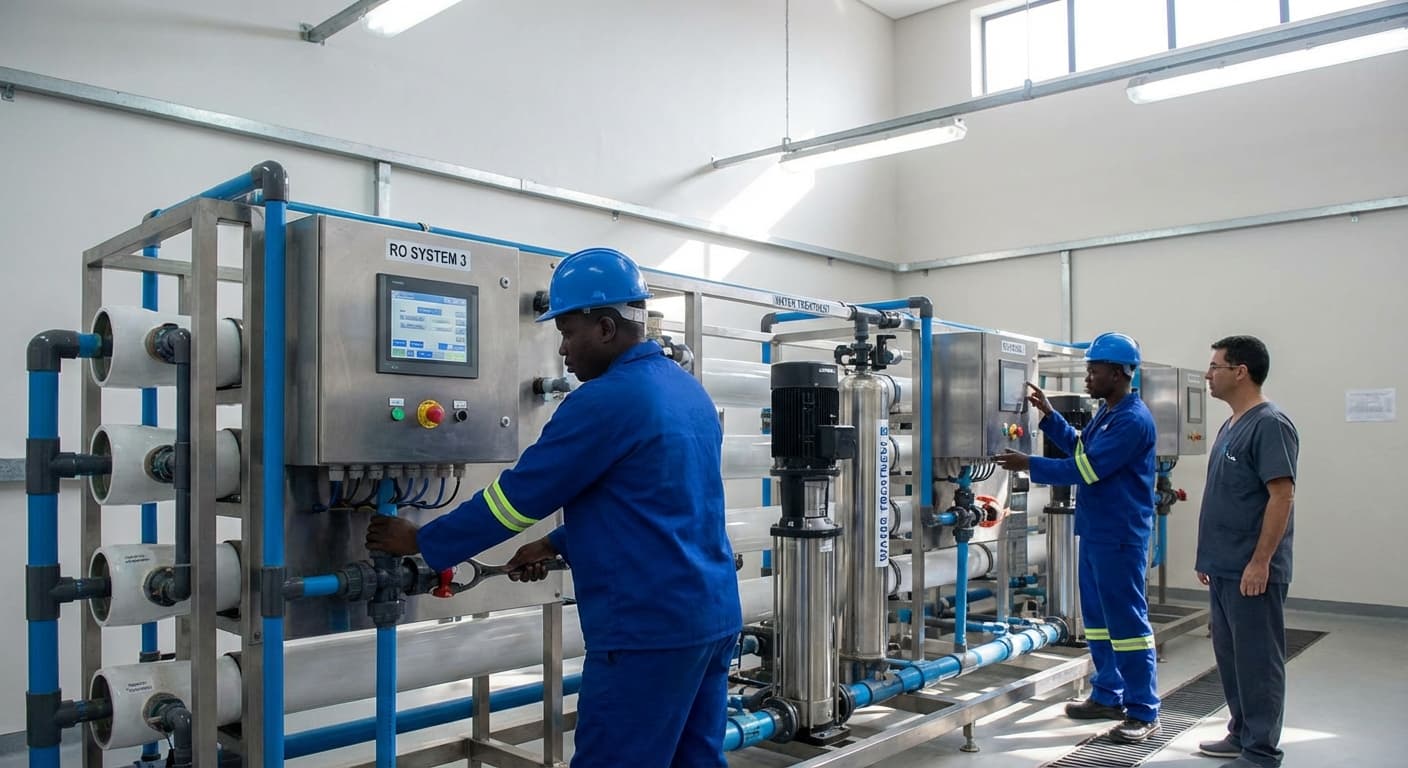
Dialysis RO/Water Treatment Plant Installation Service in Madagascar
Engineering Excellence & Technical Support
Dialysis RO/Water Treatment Plant Installation Service High-standard technical execution following OEM protocols and local regulatory frameworks.
Advanced Reverse Osmosis Technology
We deploy cutting-edge Reverse Osmosis (RO) systems, meticulously engineered to deliver ultra-pure water essential for dialysis. Our installations prioritize efficiency, reliability, and compliance with international quality standards, ensuring the highest level of patient safety.
Customized Plant Design & Integration
Understanding Madagascar's unique infrastructure and water profiles, we offer bespoke RO water treatment plant designs. Our expert engineers seamlessly integrate these solutions, optimizing for local conditions, resource availability, and specific dialysis unit needs, guaranteeing a perfect fit.
On-Site Installation & Commissioning Experts
Our certified technicians provide comprehensive on-site installation and commissioning services across Madagascar. We ensure swift, professional setup, rigorous testing, and thorough operator training, empowering local healthcare facilities with a fully functional and sustainable dialysis water treatment solution.
What Is Dialysis Ro/water Treatment Plant Installation Service In Madagascar?
Dialysis RO/Water Treatment Plant Installation Service in Madagascar refers to the comprehensive process of designing, procuring, constructing, commissioning, and maintaining Reverse Osmosis (RO) and associated water treatment systems specifically for dialysis facilities in Madagascar. This service ensures the availability of high-purity water, a critical and non-negotiable component for hemodialysis procedures, safeguarding patient health by removing impurities, endotoxins, and microorganisms that could otherwise lead to serious complications such as infections, pyrogenic reactions, and cardiovascular events. The service encompasses the entire lifecycle of the water treatment plant, from initial site assessment and water quality analysis to the final handover and ongoing operational support.
| Recipient of Service | Need for Service | Typical Use Cases |
|---|---|---|
| New Dialysis Centers: Facilities being established for the first time in Madagascar. | To meet the fundamental requirement of supplying ultrapure water for all dialysis treatments, ensuring patient safety and compliance with international healthcare standards. | Setting up a primary water purification system for a greenfield dialysis clinic. |
| Existing Dialysis Centers with Outdated or Malfunctioning Systems: Centers with aging infrastructure or systems that are no longer meeting performance or safety benchmarks. | To upgrade or replace inadequate water treatment systems to comply with current regulations, improve reliability, and reduce the risk of patient adverse events. | Replacing an old RO unit that is experiencing frequent breakdowns or failing to meet endotoxin limits. |
| Expansion or Increased Capacity Dialysis Centers: Centers requiring increased water production to accommodate a larger patient load or additional dialysis machines. | To scale up water treatment capacity efficiently and effectively without compromising water quality standards. | Installing a larger RO system or adding a duplicate system to handle increased patient throughput. |
| Remote or Underserved Areas: Dialysis facilities in regions with unreliable municipal water supplies or limited access to technical expertise for water treatment maintenance. | To establish self-sufficient and robust water purification solutions that can operate reliably with minimal external intervention. | Deploying a self-contained RO unit with robust pre-treatment for a clinic in a rural area with a variable raw water source. |
| Governmental and Non-Governmental Health Organizations: Entities responsible for establishing or managing public health infrastructure, including dialysis services. | To ensure the availability of safe and compliant dialysis water for national healthcare initiatives and to meet public health objectives. | Implementing a standardized water treatment solution across multiple government-funded dialysis units. |
Key Components of Dialysis RO/Water Treatment Plant Installation Service:
- System Design and Engineering: Tailoring the RO system specifications, flow rates, redundancy, and ancillary treatment units (e.g., pre-filtration, water softening, UV disinfection, post-treatment polishing) to meet the specific needs of the dialysis center, regulatory requirements, and local water source characteristics.
- Equipment Procurement and Supply: Sourcing and supplying all necessary components, including RO membranes, pumps, filters, storage tanks, piping, instrumentation, control systems, and disinfection units, from reputable manufacturers.
- On-site Installation and Construction: Assembling, integrating, and physically installing the water treatment plant within the dialysis facility, adhering to engineering standards and safety protocols.
- Plumbing and Electrical Integration: Connecting the water treatment plant to the facility's water supply and electrical grid, ensuring proper functionality and compliance with local codes.
- Commissioning and Validation: Thoroughly testing the entire system to verify its performance against design specifications. This includes performance testing, sanitization, microbial challenge testing, and potentially initial dialysate conductivity and endotoxin testing to confirm water quality meets stringent dialysis standards (e.g., AAMI, ISO).
- Operator Training: Providing comprehensive training to facility staff on the operation, routine maintenance, troubleshooting, and water quality monitoring procedures for the installed system.
- Documentation and Handover: Supplying all relevant technical documentation, including design schematics, operating manuals, maintenance logs, validation reports, and warranty information.
- Ongoing Maintenance and Support: Offering planned preventative maintenance, emergency repair services, spare parts management, and ongoing technical consultation to ensure the long-term reliability and performance of the water treatment system.
Who Needs Dialysis Ro/water Treatment Plant Installation Service In Madagascar?
In Madagascar, the installation of Dialysis RO/Water Treatment Plant services is crucial for healthcare facilities to ensure the provision of safe, purified water essential for hemodialysis. This service caters to institutions that operate or plan to operate dialysis centers, requiring a reliable and consistent supply of medical-grade water. The effectiveness of dialysis treatment directly correlates with the quality of water used, making specialized treatment plants indispensable. This need is driven by the growing demand for dialysis services across the country and the imperative to adhere to international healthcare standards.
| Customer Type | Primary Need | Key Departments Involved |
|---|---|---|
| Public Hospitals | Ensuring safe water for a high volume of dialysis patients, cost-effectiveness | Nephrology, Dialysis Unit, Administration, Procurement, Biomedical Engineering, Finance |
| Private Hospitals | High-quality water for patient safety, competitive advantage, regulatory compliance | Nephrology, Dialysis Unit, Administration, Procurement, Biomedical Engineering, Quality Assurance |
| Specialized Dialysis Centers | Core business requirement, operational efficiency, patient satisfaction | Dialysis Unit Management, Administration, Procurement, Biomedical Engineering, Infection Control |
| Medical Tourism Facilities | International quality standards, patient safety, brand reputation | Administration, Procurement, Biomedical Engineering, Quality Assurance, Dialysis Unit Management |
| NGOs/Charitable Organizations | Affordable and reliable water treatment solutions to serve underserved populations | Project Management, Procurement, Biomedical Engineering, Facility Management |
| Government Health Ministries | National healthcare infrastructure development, standardization, public health initiatives | Planning Department, Procurement, Technical Committees, Finance |
Target Customers and Departments for Dialysis RO/Water Treatment Plant Installation Service in Madagascar
- {"items":["Public Hospitals with Nephrology/Dialysis Units","Private Hospitals with Nephrology/Dialysis Units","Specialized Dialysis Centers (independent or part of larger medical groups)","Medical Tourism Facilities","NGOs and Charitable Organizations operating healthcare facilities with dialysis capabilities","Government Health Ministries (for national dialysis initiatives and infrastructure projects)","Research Institutions with clinical dialysis programs"],"title":"Target Customers"}
- {"items":["Nephrology Department","Dialysis Unit Management","Hospital Administration/Management","Procurement/Purchasing Department","Biomedical Engineering Department","Infection Control Department","Quality Assurance Department","Facility Management/Maintenance Department","IT Department (for system integration and monitoring)","Finance Department"],"title":"Key Departments Involved in Decision-Making/Implementation"}
Dialysis Ro/water Treatment Plant Installation Service Process In Madagascar
This document outlines the comprehensive workflow for Dialysis RO/Water Treatment Plant Installation Services in Madagascar, from the initial customer inquiry to the final execution and handover. The process is designed to ensure efficient project management, adherence to quality standards, and client satisfaction within the Malagasy context.
| Stage | Description | Key Activities | Deliverables | Responsible Party |
|---|---|---|---|---|
| The process begins with a potential client expressing interest in a dialysis RO/water treatment plant installation. | Receive and acknowledge inquiry, discuss client's needs (capacity, water quality requirements, existing infrastructure), provide preliminary information. | Initial understanding of client requirements. | Client, Sales/Business Development Team |
| A detailed evaluation of the installation site is crucial for accurate planning and design. | On-site visit, water quality testing, assessment of available space, power supply, plumbing, and access routes for equipment. | Site survey report, water analysis results. | Technical Team, Project Manager |
| Based on the site assessment, a detailed proposal and cost estimate are prepared. | Develop technical specifications, equipment selection, cost breakdown (equipment, installation, labor, transportation), project timeline. | Formal proposal, detailed quotation, project plan outline. | Technical Team, Project Manager, Sales/Business Development Team |
| Formalizing the project scope, terms, and conditions. | Review and negotiation of the proposal, contract signing, payment schedule agreement. | Signed contract, Purchase Order (PO). | Client, Sales/Business Development Team, Legal Department |
| Detailed engineering design of the RO/water treatment plant and its integration with existing infrastructure. | System design, P&ID (Piping and Instrumentation Diagram) development, electrical schematics, civil/structural requirements, layout drawings. | Approved design documents, engineering drawings. | Engineering Team |
| Acquiring all necessary equipment, materials, and managing their transportation to Madagascar. | Ordering components, quality control of procured items, customs clearance, inland transportation arrangements. | All necessary equipment and materials on-site. | Procurement Team, Logistics Coordinator |
| Certain components may be fabricated or pre-assembled off-site to minimize on-site work. | Manufacturing of skid-mounted units, testing of sub-assemblies. | Pre-assembled modules, completed fabrication components. | Fabrication Workshop, Engineering Team |
| Ensuring the installation site is ready for the equipment. | Foundation work, electrical and plumbing connections, civil works, ensuring safe working environment. | Prepared installation area. | Site Supervisors, Local Contractors |
| The physical installation of the RO/water treatment plant and its subsequent testing. | Assembly of components, electrical and plumbing connections, system startup, performance testing, water quality verification. | Fully operational RO/water treatment plant, performance test reports. | Installation Team, Commissioning Engineers |
| Training the client's personnel on the operation and maintenance of the plant. | Conducting theoretical and practical training sessions, providing operation and maintenance manuals, formal handover of the plant. | Trained personnel, comprehensive documentation, signed handover certificate. | Training Specialists, Project Manager |
| Providing ongoing support to ensure the plant's optimal performance. | Troubleshooting, routine maintenance services, spare parts supply, warranty support. | Continued plant functionality, client satisfaction. | After-Sales Service Team, Maintenance Technicians |
Key Stages of the Dialysis RO/Water Treatment Plant Installation Service Process
- Inquiry and Initial Consultation
- Site Survey and Assessment
- Proposal and Quotation Development
- Contract Negotiation and Agreement
- Design and Engineering
- Procurement and Logistics
- Plant Fabrication and Pre-assembly (if applicable)
- Site Preparation
- Installation and Commissioning
- Training and Handover
- Post-Installation Support and Maintenance
Dialysis Ro/water Treatment Plant Installation Service Cost In Madagascar
Installing a Reverse Osmosis (RO) and Water Treatment Plant for dialysis facilities in Madagascar involves a range of costs influenced by several critical factors. The complexity of the water source, the required water purity standards for dialysis, the capacity of the plant, and the specific technologies employed all contribute to the final price. Additionally, logistics, import duties on specialized equipment, and the availability of skilled labor in Madagascar play significant roles in determining the overall installation service cost. Local currency (Malagasy Ariary - MGA) pricing will fluctuate based on the exchange rate and the sourcing of components. A comprehensive approach to water treatment is paramount to ensure patient safety and the efficient operation of dialysis machines, making this investment a crucial one for healthcare providers.
| Component/Service Area | Estimated Cost Range (MGA) | Notes |
|---|---|---|
| Pre-Treatment Systems (Filters, Softeners) | 5,000,000 - 25,000,000 | Depends on raw water quality and complexity. |
| Reverse Osmosis (RO) Unit (Core System) | 15,000,000 - 70,000,000 | Capacity and membrane quality are key drivers. |
| Post-Treatment & Sterilization (UV, Polishing) | 7,000,000 - 30,000,000 | Essential for dialysis-grade water. |
| Storage Tanks & Distribution System | 5,000,000 - 20,000,000 | Material (e.g., stainless steel) and volume impact cost. |
| Piping, Valves & Electrical Components | 8,000,000 - 35,000,000 | Material quality and system complexity. |
| Installation Labor & Commissioning | 10,000,000 - 50,000,000 | Based on project duration, expertise, and travel. |
| Water Quality Monitoring & Control | 3,000,000 - 15,000,000 | Includes sensors and control panels. |
| Logistics, Shipping & Import Duties | 10,000,000 - 60,000,000+ | Highly variable depending on equipment origin and Madagascar's import policies. |
| Ancillary Equipment (Pumps, Control Panels) | 4,000,000 - 20,000,000 | Specific requirements for the setup. |
| Contingency (10-15%) | Calculated on subtotal | Recommended for unforeseen expenses. |
| Estimated Total Installation Service Cost (Excluding Building Modifications) | 57,000,000 - 325,000,000+ MGA | This is a broad estimate. A detailed site assessment is required for accurate quoting. |
Key Pricing Factors for Dialysis RO/Water Treatment Plant Installation in Madagascar
- Water Source Quality: The initial quality of the raw water (e.g., well water, municipal supply) dictates the extent of pre-treatment required, impacting the number and type of filters and stages needed.
- Required Water Purity Standards: Dialysis-grade water demands extremely high purity to prevent complications. Meeting these stringent standards often necessitates advanced RO membranes, sterilization units (UV or ozonation), and polishing filters.
- Plant Capacity: The number of dialysis stations or the total volume of purified water required per day directly influences the size and complexity of the system, thus affecting the cost.
- Technology and Equipment Selection: The choice between different RO systems, filtration media (e.g., activated carbon, ion exchange resins), disinfection methods, and monitoring systems will vary the price significantly.
- Installation Labor and Expertise: The cost of skilled technicians for assembly, pipework, electrical connections, and commissioning of the plant. Specialized knowledge in water treatment for medical applications is essential.
- Ancillary Equipment: This includes storage tanks, pumps, piping, valves, electrical control panels, and water quality monitoring instruments.
- Logistics and Transportation: Costs associated with shipping equipment to Madagascar and then to the specific installation site, especially in remote areas.
- Import Duties and Taxes: Applicable tariffs and taxes on imported water treatment equipment and components can add a substantial percentage to the overall cost.
- Permitting and Regulatory Compliance: Obtaining necessary permits and ensuring compliance with local health and environmental regulations.
- Maintenance and Training: While not strictly installation cost, initial training for facility staff on operation and maintenance is often bundled or considered during the procurement phase.
- Contingency: It is advisable to include a contingency fund for unforeseen challenges during installation.
Affordable Dialysis Ro/water Treatment Plant Installation Service Options
Finding affordable dialysis RO (Reverse Osmosis) and water treatment plant installation services is crucial for dialysis centers to ensure patient safety and operational efficiency while managing costs. This service involves the design, supply, installation, and commissioning of sophisticated water purification systems that meet stringent dialysis standards. Key considerations for affordability include the scope of the project, the quality and brand of equipment, the complexity of the installation, and ongoing maintenance agreements. Many providers offer a range of options to cater to different budgets and needs. Value bundles and cost-saving strategies are essential for dialysis centers to optimize their investment.
| Cost-Saving Strategy | Description | Potential Benefits |
|---|---|---|
| Phased Installation/Upgrades | Install a basic system initially and plan for future upgrades as budget allows or patient volume increases. | Reduces initial capital outlay, allows for gradual investment, and minimizes disruption. |
| Bulk Purchasing of Consumables | Negotiate discounted rates for filters, membranes, and other consumables when purchased in larger quantities or through long-term supply agreements. | Lowers ongoing operational expenses, ensures availability of critical parts. |
| Energy-Efficient Equipment | Opt for RO units and pumps with high energy efficiency ratings to reduce electricity consumption. | Significant long-term savings on utility bills, contributes to environmental sustainability. |
| Preventative Maintenance Programs | Invest in comprehensive preventative maintenance to avoid costly breakdowns and premature equipment failure. | Extends equipment lifespan, minimizes downtime, reduces emergency repair costs. |
| Remote Monitoring & Diagnostics | Utilize systems that allow for remote monitoring of water quality and system performance, enabling early detection of issues. | Reduces the need for on-site visits, allows for proactive troubleshooting, minimizes downtime. |
| Negotiate Installation Contracts Carefully | Obtain multiple quotes, clearly define the scope of work, and scrutinize contract terms related to warranties, support, and liabilities. | Secures competitive pricing, avoids hidden costs, ensures clear expectations. |
| Consider Refurbished or Certified Pre-Owned Equipment | For non-critical components or in budget-constrained situations, explore certified refurbished equipment from reputable suppliers. | Lower initial equipment cost, though careful due diligence on warranty and condition is essential. |
| Local vs. National Installers | Evaluate if a local installer can offer comparable expertise and pricing for installation and ongoing support, potentially reducing travel costs. | Potentially lower installation and travel costs, faster response times for local support. |
Value Bundles for Dialysis RO/Water Treatment Plant Installation:
- Basic Package: Includes essential RO unit, pre-treatment filters, basic piping, and standard installation. Often suitable for smaller clinics or those with existing infrastructure.
- Standard Package: Adds more advanced pre-treatment (e.g., softener, carbon filters), a more robust RO membrane, UV sterilization, and potentially basic remote monitoring. Offers a good balance of quality and cost.
- Premium Package: Encompasses high-capacity RO units, multiple stages of purification (e.g., double pass RO), advanced disinfection (e.g., ozonation), comprehensive monitoring systems, remote diagnostics, and extended warranty. Ideal for larger centers prioritizing maximum reliability and compliance.
- Modular/Scalable Solutions: Systems designed to be expanded or upgraded as the center's needs grow, allowing for phased investment.
- Integrated Systems: Bundles that include not only the RO plant but also ancillary equipment like storage tanks, distribution loops, and even dialysate production units, simplifying procurement and installation.
- Maintenance & Service Contracts: Often bundled with installation to ensure long-term system performance and predictable operating costs. These can include preventative maintenance, emergency repair response, and water quality testing.
Verified Providers In Madagascar
In Madagascar's evolving healthcare landscape, identifying reliable and trustworthy medical providers is paramount for individuals seeking quality care. Verified providers, particularly those with strong credentials like those of Franance Health, offer a significant advantage. Franance Health's commitment to stringent vetting processes ensures that their affiliated medical professionals meet high standards of expertise, ethical practice, and patient safety. This rigorous credentialing process not only builds trust but also contributes to better patient outcomes by connecting individuals with competent and reputable healthcare practitioners. Choosing a provider associated with Franance Health signifies a commitment to receiving care from professionals who have demonstrated their dedication to excellence and patient well-being.
| Credential/Aspect | Franance Health Verification Standard | Benefit to Patients |
|---|---|---|
| Medical Licensing and Registration | Ensures all practitioners hold valid and up-to-date licenses from relevant Malagasy authorities. | Guarantees that providers are legally permitted to practice medicine and meet basic professional requirements. |
| Professional Experience and Specialization | Verifies the practitioner's educational background, years of practice, and documented specialization in their field. | Connects patients with doctors who have the specific expertise needed for their condition. |
| Continuous Professional Development (CPD) | Confirms ongoing training and participation in educational programs to stay current with medical advancements. | Ensures patients receive care informed by the latest medical knowledge and techniques. |
| Patient Feedback and Reputation Management | Incorporates a system for gathering and reviewing patient feedback to ensure high satisfaction and address concerns. | Promotes accountability and encourages providers to maintain excellent patient care standards. |
| Ethical Practice and Code of Conduct | Adheres to a strict code of medical ethics, including patient confidentiality and non-discrimination. | Upholds the highest standards of professional integrity and patient rights. |
Key Benefits of Choosing Verified Providers like Franance Health
- Enhanced Patient Safety and Trust
- Access to Qualified and Competent Professionals
- Improved Healthcare Outcomes
- Peace of Mind and Reduced Healthcare Navigation Stress
- Adherence to Ethical Medical Practices
Scope Of Work For Dialysis Ro/water Treatment Plant Installation Service
This Scope of Work (SOW) outlines the requirements for the installation of a Dialysis Reverse Osmosis (RO)/Water Treatment Plant. It details the technical deliverables, standard specifications, and the responsibilities of the service provider to ensure a fully functional and compliant system meeting all relevant healthcare and water quality standards.
| Category | Item | Description | Standard Specifications/Requirements | Deliverable |
|---|---|---|---|---|
| Site Preparation | Space Allocation | Designated area for the RO/Water Treatment Plant. | Adequate space for equipment, maintenance access, and ventilation. Compliance with local building codes and healthcare facility layout. | Site survey report with recommended layout. |
| Site Preparation | Utilities Access | Provision of necessary water, power, and drainage connections. | Potable water inlet connection point (specified pressure and flow rate). Electrical power supply (voltage, phase, amperage) as per equipment specifications. Drainage point for reject water and backwash. | Confirmation of utility readiness. |
| Equipment Installation | RO/Water Treatment Unit | Unpacking, positioning, and securing of the main RO unit, pre-treatment filters, post-treatment systems, and storage tanks. | Manufacturer's installation guidelines to be strictly followed. Proper alignment and leveling. Secure mounting. | Physically installed and secured RO/Water Treatment Plant. |
| Equipment Installation | Pre-treatment System | Installation of sediment filters, carbon filters, water softeners, or other necessary pre-treatment components. | Correct sequence of filtration as per design. Secure connections and leak-free joints. Proper backwashing setup. | Fully installed and connected pre-treatment system. |
| Equipment Installation | Post-treatment System | Installation of any post-treatment units (e.g., UV sterilizers, polishing filters). | Correct integration into the main system. Ensuring operational readiness. | Fully installed and connected post-treatment system. |
| Piping & Electrical | Product Water Piping | Installation of piping from the RO unit to the dialysis machines or distribution manifold. | Sanitary grade piping (e.g., SS316L, CPVC, PEX) with smooth internal surfaces. Proper slope for drainage. Leak-proof connections. Point-of-use connection for each dialysis machine. | Completed and tested product water distribution network. |
| Piping & Electrical | Reject Water Piping | Installation of piping for waste brine and backwash water. | Appropriate material to handle brine. Connection to the designated drainage point. Compliance with local environmental regulations. | Completed reject water disposal piping. |
| Piping & Electrical | Electrical Wiring | Connection of all plant components to the main power supply. | Qualified electrician to perform all wiring. Use of appropriate gauge wiring, conduits, and junction boxes. Safety interlocks and emergency stop buttons to be functional. | Electrically connected and functional RO/Water Treatment Plant. |
| Piping & Electrical | Control Panel Integration | Integration of the RO plant's control panel with electrical supply and sensors. | Proper wiring of sensors, pumps, valves, and control logic. Functional indicator lights and alarm systems. | Functional control panel with all systems integrated. |
| Commissioning & Testing | System Startup | Initial startup of the RO/Water Treatment Plant. | Gradual pressurization. Monitoring of pump and motor operation. Verification of flow rates. | System successfully powered on and running. |
| Commissioning & Testing | Water Quality Testing | Comprehensive testing of purified water quality at various stages and points of use. | Testing parameters include Total Dissolved Solids (TDS), conductivity, pH, microbial count (total aerobic count, endotoxins), and chlorine residual. Compliance with AAMI, ISO, or relevant local standards. Multiple test cycles as required. | Certified water quality test reports. |
| Commissioning & Testing | Performance Validation | Verification of the plant's operational parameters and output capacity. | Testing at various load conditions. Verification of recovery rate and permeate flow. Pressure and temperature monitoring. | Performance validation report. |
| Commissioning & Testing | Sanitization | Thorough sanitization of the entire water system. | Use of approved sanitizing agents and procedures. Post-sanitization water quality testing to confirm effectiveness. | Sanitized and validated water system. |
| Training & Handover | Operator Training | Comprehensive training for facility maintenance and technical staff. | Training on plant operation, routine maintenance, troubleshooting, alarm management, and sanitization procedures. Hands-on sessions included. | Trained personnel and signed training attendance sheets. |
| Training & Handover | System Handover | Formal handover of the installed and commissioned RO/Water Treatment Plant. | Demonstration of all functionalities. Confirmation of all deliverable items being met. | Signed handover certificate. |
| Documentation | As-Built Drawings | Detailed drawings reflecting the final installed configuration. | Piping and instrumentation diagrams (P&IDs), electrical schematics, layout drawings. | Set of as-built drawings. |
| Documentation | Operation & Maintenance Manuals | Comprehensive manuals for operation, maintenance, and troubleshooting. | Manufacturer's manuals, site-specific operational procedures, preventive maintenance schedules. | Complete O&M manuals. |
| Documentation | Test Reports | All generated test reports from commissioning and validation. | Water quality reports, performance validation reports, sanitization reports. | Compilation of all test reports. |
| Documentation | Warranty Information | Details of manufacturer and installation warranty. | Duration of warranty, covered components, contact information for claims. | Warranty certificates and documentation. |
Key Project Stages & Deliverables
- Site Assessment and Preparation
- Equipment Delivery and Offloading
- Installation of RO/Water Treatment Plant
- Piping and Electrical Connections
- System Commissioning and Testing
- Training and Handover
- Documentation and Reporting
Service Level Agreement For Dialysis Ro/water Treatment Plant Installation Service
This Service Level Agreement (SLA) outlines the response times and uptime guarantees for the installation service of Dialysis Reverse Osmosis (RO)/Water Treatment Plants. This agreement is between [Client Name] (hereinafter referred to as "Client") and [Service Provider Name] (hereinafter referred to as "Provider").
| Issue Severity | Response Time (Business Hours) | Resolution Time Target (Business Hours) | Uptime Guarantee (Post-Installation, during warranty period) |
|---|---|---|---|
| Critical Malfunction | 1 Hour (acknowledgement) | 4 Hours (restoration) | 98% (monthly average, excluding scheduled maintenance) |
| Major Malfunction | 2 Business Hours (acknowledgement) | 8 Business Hours (restoration) | 98% (monthly average, excluding scheduled maintenance) |
| Minor Malfunction | 4 Business Hours (acknowledgement) | 2 Business Days (restoration) | 99% (monthly average, excluding scheduled maintenance) |
| Installation Support Request (Non-malfunction) | 8 Business Hours (acknowledgement) | 1 Business Day (resolution/guidance) | N/A |
Key Definitions
- Installation Service: The complete process of setting up, commissioning, and initial testing of the Dialysis RO/Water Treatment Plant at the Client's designated facility.
- Critical Malfunction: A failure of the RO/Water Treatment Plant that completely prevents the supply of purified water for dialysis, posing an immediate risk to patient care.
- Major Malfunction: A failure of the RO/Water Treatment Plant that significantly degrades the quality or quantity of purified water, impacting the ability to provide safe and effective dialysis for a portion of patients.
- Minor Malfunction: An issue with the RO/Water Treatment Plant that does not immediately compromise patient safety but requires attention to maintain optimal performance and longevity.
- Scheduled Downtime: Pre-approved and communicated periods for routine maintenance, upgrades, or planned shutdowns.
- Unscheduled Downtime: Any period when the RO/Water Treatment Plant is non-operational due to a malfunction or unexpected issue, excluding Scheduled Downtime.
- Response Time: The maximum time allowed for the Provider to acknowledge a reported issue and initiate troubleshooting or dispatch a technician.
- Resolution Time: The maximum time allowed for the Provider to rectify a reported issue and restore the RO/Water Treatment Plant to its operational state.
Frequently Asked Questions

Ready when you are
Let's scope your Dialysis RO/Water Treatment Plant Installation Service in Madagascar project in Madagascar.

Scaling healthcare logistics and technical systems across the entire continent.