
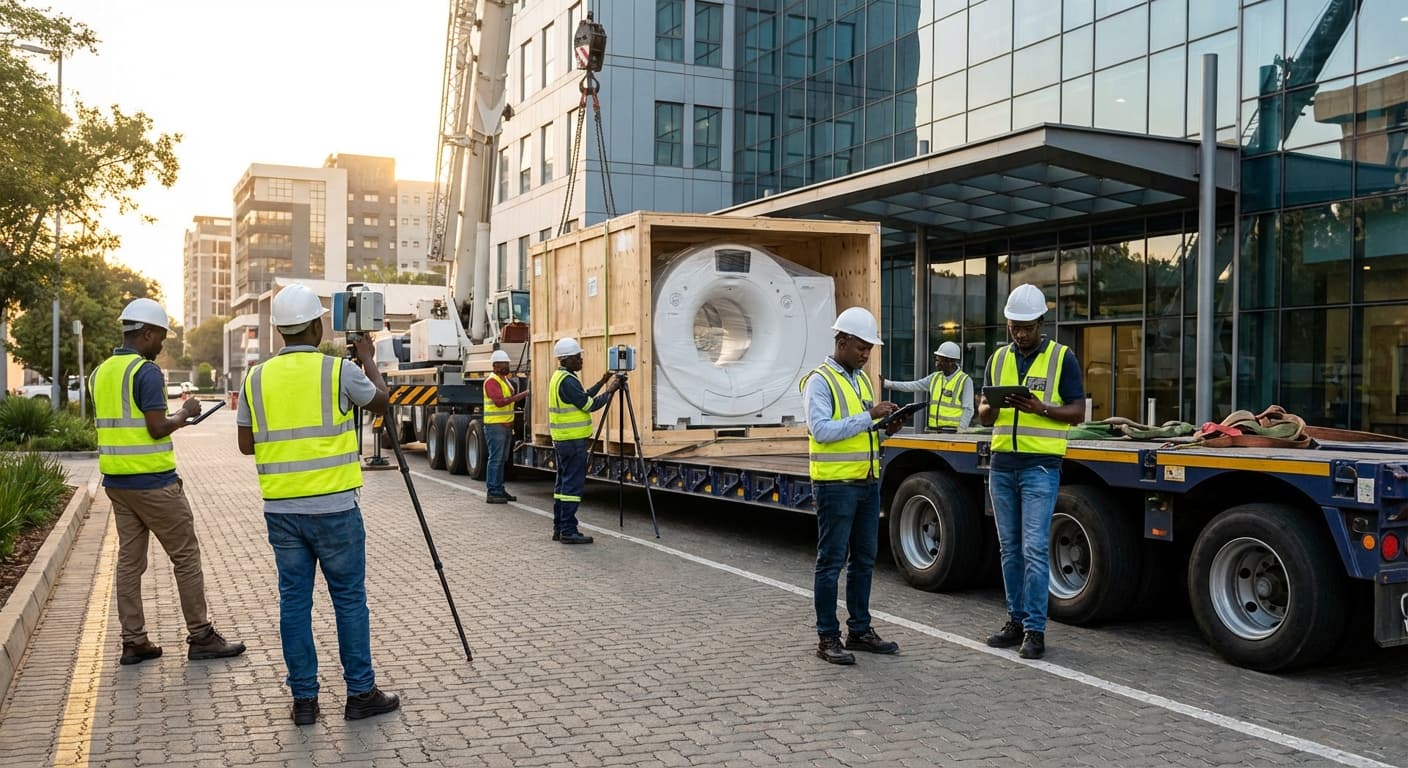
Route Survey & Rigging Plan Service for Heavy Medical Equipment in Madagascar
Engineering Excellence & Technical Support
Route Survey & Rigging Plan Service for Heavy Medical Equipment High-standard technical execution following OEM protocols and local regulatory frameworks.
Precise Route Survey & 3D Mapping
Leveraging advanced GPS and LiDAR technology, we conduct meticulous route surveys to identify optimal transport paths for heavy medical equipment in Madagascar's diverse terrain. Our detailed 3D mapping ensures accurate visualization of obstacles, road conditions, and potential challenges, enabling proactive risk mitigation.
Customized Rigging & Load Securing Solutions
We design bespoke rigging plans tailored to the unique weight, dimensions, and fragility of each medical equipment piece. Our expertise in selecting appropriate lifting gear, securing methods, and specialized transport vehicles guarantees safe and stable transit across challenging Malagasy infrastructure.
Comprehensive Risk Assessment & Compliance
Our service includes thorough risk assessments, identifying potential hazards from logistical, environmental, and infrastructural factors specific to Madagascar. We ensure all rigging and transport plans adhere to international safety standards and local regulations, providing peace of mind and minimizing the likelihood of damage or delays.
What Is Route Survey & Rigging Plan Service For Heavy Medical Equipment In Madagascar?
Route Survey & Rigging Plan Service for Heavy Medical Equipment in Madagascar refers to a specialized engineering and logistical process focused on the safe, efficient, and compliant transportation and installation of oversized, heavy, or sensitive medical apparatus within Madagascar. This service is critical for medical facilities, logistics providers, and equipment manufacturers who are introducing, relocating, or decommissioning such specialized equipment. It encompasses detailed planning, assessment, and execution strategies to mitigate risks associated with confined spaces, infrastructure limitations, and environmental conditions prevalent in Madagascar. The objective is to ensure the integrity of the equipment, the safety of personnel and the public, and the minimal disruption to ongoing medical operations or public thoroughfares.
| Who Needs This Service? | Typical Use Cases |
|---|---|
| Hospitals and Medical Centers: Acquiring new large-scale diagnostic imaging equipment (MRI, CT scanners), radiotherapy units, surgical robots, or modular operating theaters. Relocating existing heavy equipment within a facility or to a new hospital campus. Decommissioning and disposal of outdated heavy medical apparatus. | Medical Equipment Manufacturers & Distributors: Ensuring their complex and high-value equipment can be reliably delivered and installed in Madagascar. Providing comprehensive installation services that include pre-installation planning. |
| Logistics and Heavy Haulage Companies: Partnering with specialized engineering firms to undertake the transport and rigging of medical equipment. Developing logistical solutions for large medical projects. | Government Health Agencies: Facilitating the deployment of advanced medical technology to underserved regions. Overseeing large-scale medical infrastructure projects. |
| Construction and Engineering Firms: Involved in building or renovating healthcare facilities where heavy medical equipment needs to be integrated. Managing the structural and logistical aspects of equipment installation. | Research Institutions and Specialized Clinics: Importing or moving specialized laboratory equipment, advanced analytical instruments, or large-scale medical research apparatus. |
Key Components of Route Survey & Rigging Plan Service
- Route Assessment: Detailed analysis of the transportation path, including road network integrity, bridge load capacities, turning radii, overhead clearances (power lines, building overhangs), and potential ground bearing pressures.
- Site Survey: In-depth evaluation of the origin and destination points, focusing on access points, internal pathways, structural integrity of floors and walls, ceiling heights, and proximity to existing medical infrastructure.
- Risk Identification & Mitigation: Proactive identification of potential hazards (e.g., weather, traffic, security, technical challenges) and development of comprehensive strategies to prevent or minimize their impact.
- Equipment Characterization: Precise measurement and weight distribution analysis of the medical equipment to inform rigging, lifting, and transportation requirements.
- Rigging & Lifting Plan Development: Engineering design of lifting schemes, selection of appropriate lifting equipment (cranes, gantries, hoists), and definition of rigging configurations (slings, shackles, spreader bars) to ensure safe load handling.
- Transportation Plan: Specification of suitable transport vehicles, route optimization, traffic management protocols, permits acquisition, and escort requirements.
- Method Statement Creation: Comprehensive documentation detailing all procedures, safety precautions, personnel roles and responsibilities, and contingency plans for each stage of the operation.
- Decommissioning & Installation Support: Planning for the safe dismantling, removal, and subsequent reassembly and commissioning of the equipment at its new location.
- Regulatory Compliance: Ensuring adherence to all relevant Malagasy transportation, construction, and safety regulations, as well as international best practices.
Who Needs Route Survey & Rigging Plan Service For Heavy Medical Equipment In Madagascar?
Navigating the complexities of transporting and installing heavy medical equipment in Madagascar demands specialized expertise. Route Survey & Rigging Plan services are crucial for ensuring the safe, efficient, and compliant movement of these vital assets. This service is particularly vital for organizations and facilities within Madagascar that are acquiring, relocating, or installing large-scale medical machinery.
| Customer Type | Key Departments Involved | Specific Needs Addressed | Examples of Heavy Medical Equipment |
|---|---|---|---|
| Hospitals & Healthcare Facilities | Procurement, Biomedical Engineering, Facility Management, Administration | Safe transport, site accessibility, structural load bearing, installation feasibility, compliance with regulations. | MRI scanners, CT scanners, linear accelerators, X-ray machines (large format), surgical robots, hospital beds (heavy duty), large laboratory analyzers. |
| Specialized Clinics & Diagnostic Centers | Owners/Directors, Technical Managers | Efficient delivery, precise positioning, minimal disruption to operations, integration into existing space. | Advanced imaging equipment, specialized surgical tables, high-volume diagnostic systems. |
| Government Health Ministries & Public Health Agencies | Procurement & Logistics, Infrastructure Development, Project Management | Nationwide distribution, accessibility to remote areas, cost-effectiveness, adherence to national standards. | Ambulances (equipped), mobile clinics, large-scale sterilization units, hospital generators. |
| NGOs & International Aid Organizations | Logistics & Operations, Program Managers | Delivery to challenging locations, rapid deployment, security of assets, integration into aid projects. | Field hospitals, portable X-ray units, essential medical supply storage systems. |
| Medical Equipment Manufacturers/Suppliers | Installation & Service Teams, Project Managers | Accurate site surveys for planning, risk mitigation during transport and installation, adherence to manufacturer specifications. | All types of heavy medical equipment requiring specialized installation. |
| Construction & Engineering Firms | Project Managers, Site Supervisors | Coordination with construction schedules, ensuring building readiness (floor loading, door widths, ceiling heights), integration of utility connections. | Any medical equipment requiring structural considerations during building construction or renovation. |
Target Customers and Departments for Route Survey & Rigging Plan Services for Heavy Medical Equipment in Madagascar:
- Hospitals and Healthcare Facilities:
- Procurement/Logistics Departments: Responsible for acquiring new equipment and managing its delivery and installation.
- Biomedical Engineering/Technical Departments: Oversee the technical installation, maintenance, and operational readiness of medical equipment.
- Facility Management/Infrastructure Departments: Concerned with the physical space, building integrity, and accessibility for large equipment.
- Hospital Administration/Management: Ultimately responsible for the successful implementation of new medical technologies and ensuring patient care continuity.
- Specialized Medical Clinics and Diagnostic Centers:
- Owners/Directors: Often involved in all aspects of operations, including equipment acquisition and installation.
- Technical Managers: Similar to hospital biomedical departments, they handle the technical aspects of equipment setup.
- Government Health Ministries and Public Health Agencies:
- Procurement and Logistics Units: Responsible for equipping public health facilities across the nation.
- Infrastructure Development Departments: Involved in building and upgrading healthcare infrastructure that houses heavy equipment.
- Project Management Offices: Overseeing large-scale health initiatives that include equipment deployment.
- Non-Governmental Organizations (NGOs) and International Aid Organizations:
- Logistics and Operations Managers: In charge of delivering and installing medical equipment for humanitarian projects.
- Program Managers: Ensuring the successful implementation of health programs reliant on specific medical technologies.
- Medical Equipment Manufacturers and Suppliers (Local & International):
- Installation and Service Teams: Require detailed route and rigging plans to execute their contractual obligations.
- Project Managers: Coordinating the delivery and setup of complex medical systems for their clients.
- Construction and Engineering Firms (involved in healthcare projects):
- Project Managers: Integrating the installation of medical equipment into larger construction timelines and ensuring structural suitability.
- Site Supervisors: Overseeing the physical movement and placement of equipment on construction sites.
Route Survey & Rigging Plan Service For Heavy Medical Equipment Process In Madagascar
This document outlines the comprehensive workflow for our Route Survey & Rigging Plan Service, specifically tailored for the transportation and installation of heavy medical equipment in Madagascar. Our process is designed to ensure the safe, efficient, and compliant movement of critical medical assets from arrival in Madagascar to their final operational placement within healthcare facilities.
| Stage | Description | Key Activities | Deliverables | Timeline (Indicative) |
|---|---|---|---|---|
| Inquiry & Initial Consultation | Understanding the client's needs and project scope. | Receive and review client request; initial discussion of equipment type, destination, timelines, and any known site constraints; proposal generation. | Service Proposal, Preliminary Cost Estimate. | 1-3 Business Days |
| Pre-Survey & Information Gathering | Collecting essential data before physical survey. | Obtain detailed equipment specifications (dimensions, weight, center of gravity, handling points); acquire site layout plans, access routes, and facility drawings; identify key stakeholders (customs agents, port authorities, facility managers). | Equipment Specifications Document, Site Plan Collection, Stakeholder Contact List. | 2-5 Business Days |
| Detailed Route Survey | Assessing the physical transportation path. | On-site inspection of port/arrival point, road network (including bridges, tunnels, turning radii, road conditions), and final destination access. Identification and documentation of any potential obstacles, height/width restrictions, weight limits, and necessary permits. GPS mapping of the chosen route. | Route Survey Report (including maps, photographs, identified risks, proposed solutions), Preliminary Roadworthy Assessment. | 5-15 Business Days (depending on route complexity and geographical spread) |
| Rigging Plan Development | Creating a detailed plan for lifting, moving, and positioning. | Based on survey findings and equipment specifications, design detailed rigging methodologies, select appropriate lifting equipment (cranes, forklifts, dollies), determine lifting points, calculate load capacities, plan for stabilization and securing, develop step-by-step operational procedures, and create visual aids (drawings, schematics). | Comprehensive Rigging Plan (including Method Statements, Risk Assessments, Equipment Schedules, Safety Procedures, Detailed Drawings). | 5-10 Business Days |
| Client Review & Approval | Ensuring client satisfaction and buy-in. | Presenting the Route Survey Report and Rigging Plan to the client for review and feedback. Incorporating any necessary revisions. Obtaining formal written approval of the plans. | Approved Route Survey Report, Approved Rigging Plan. | 2-5 Business Days |
| Execution & On-Site Management | Implementing the approved plans. | Coordinating logistics, securing necessary permits and escorts, managing all on-site rigging and transportation operations, ensuring adherence to the approved plan and safety protocols. On-site supervision by experienced personnel. | Successful movement and positioning of the medical equipment. | Duration varies based on equipment, route, and complexity of operations (can range from days to weeks). |
| Post-Execution & Reporting | Finalizing project documentation and client handover. | Conducting a post-operation review, documenting any deviations or lessons learned, providing a final project report to the client, including completion certificates and photographic evidence of the completed work. | Final Project Report, Completion Certificates. | 3-5 Business Days post-execution |
Workflow Stages
- Inquiry & Initial Consultation
- Pre-Survey & Information Gathering
- Detailed Route Survey
- Rigging Plan Development
- Client Review & Approval
- Execution & On-Site Management
- Post-Execution & Reporting
Route Survey & Rigging Plan Service For Heavy Medical Equipment Cost In Madagascar
The cost of route survey and rigging plan services for heavy medical equipment in Madagascar can vary significantly due to several factors. These services are critical for ensuring the safe and efficient transportation and installation of large, sensitive equipment like MRI machines, CT scanners, or large-scale laboratory systems. The complexity of the route, the weight and dimensions of the equipment, the accessibility of the final destination, and the specific expertise required all contribute to the overall pricing. Local market conditions, availability of specialized equipment, and the experience of the service providers also play a crucial role.
| Service Component | Estimated Cost Range (MGA) | Notes |
|---|---|---|
| Initial Route Survey & Assessment | 200,000 - 1,500,000 | Varies based on route length, complexity, and need for on-site investigations. |
| Detailed Rigging Plan Development | 300,000 - 2,000,000 | Depends on equipment size, weight, complexity of installation, and engineering requirements. |
| Site Access & Obstacle Analysis | 100,000 - 750,000 | Includes feasibility of entry points, maneuvering space, and structural checks. |
| Permit Application & Acquisition Fees | 150,000 - 1,000,000+ | Can be highly variable depending on the authorities involved and specific permit types. |
| Specialized Equipment Rental (Cranes, Trucks, etc.) | 500,000 - 5,000,000+ (per day/use) | Highly dependent on the type and capacity of equipment needed. |
| Skilled Labor & Supervision | 200,000 - 1,000,000+ (per person, per day) | Includes riggers, supervisors, and logistics coordinators. |
| Total Project Cost (Comprehensive Service) | 2,000,000 - 15,000,000+ | This is a broad estimate for a complete service package, from planning to initial site preparation. Extremely complex projects can exceed this range. |
Key Pricing Factors for Route Survey & Rigging Plan Services in Madagascar:
- Equipment Specifications: The weight, dimensions (height, width, length), and fragility of the medical equipment are primary determinants. Heavier, larger, or more delicate items require more robust planning and specialized handling.
- Route Complexity & Distance: The length and nature of the transportation route are significant. This includes the condition of roads, presence of bridges with weight limits, narrow passages, traffic congestion, and potential obstacles (e.g., low-hanging wires, street furniture). Longer distances and more challenging terrains will increase costs.
- Site Accessibility: The ease of access to the final installation site is critical. This encompasses factors like the availability of loading/unloading zones, the presence of elevators or stairwells that can accommodate the equipment's size, and the structural integrity of the building at the point of entry and installation.
- Specialized Equipment & Personnel: The need for specific lifting gear (cranes, forklifts), specialized transport vehicles (low-bed trailers), and highly skilled rigging and logistics personnel will directly impact costs. Unique challenges might require custom solutions.
- Permits & Authorizations: Obtaining necessary permits for oversized or overweight transport, road closures, or specific site access can incur administrative fees and require time, adding to the overall expense.
- Risk Assessment & Contingency Planning: Comprehensive route surveys and rigging plans include detailed risk assessments and contingency measures. The level of detail and the associated planning effort will influence the price.
- Service Provider Experience & Reputation: Established companies with a proven track record in handling heavy and sensitive equipment often command higher prices due to their expertise, reliability, and insurance coverage.
- Time Sensitivity & Urgency: Rush projects or tight deadlines may incur premium charges for expedited services.
- Geographic Location within Madagascar: Costs can differ between major urban centers (e.g., Antananarivo) and more remote or less developed regions, affecting transport availability and labor costs.
Affordable Route Survey & Rigging Plan Service For Heavy Medical Equipment Options
Our Affordable Route Survey & Rigging Plan Service is designed to provide comprehensive planning and execution for the safe and efficient transport of heavy medical equipment. We understand the critical nature of these installations and the potential for significant costs associated with unforeseen challenges. Our service minimizes these risks through meticulous planning, expert advice, and a commitment to cost-effectiveness. We offer flexible value bundles and implement strategic cost-saving measures to ensure you receive the best possible service at a competitive price.
| Value Bundle | Included Services | Key Benefits | Estimated Price Range (USD) |
|---|---|---|---|
| Basic Essentials Bundle | Single-item route survey (standard route), basic rigging plan (standard lift points), risk identification. | Cost-effective for straightforward moves, foundational safety planning. | $500 - $1,200 |
| Standard Protection Bundle | Multi-location route survey, detailed rigging plan (including custom bracing if needed), preliminary risk mitigation strategies, permit guidance. | Enhanced safety, preparedness for moderate complexities, efficient permit process. | $1,000 - $2,500 |
| Comprehensive Care Bundle | In-depth route survey (including contingency routes), highly detailed rigging plan (specialized equipment, multiple lift points), full risk assessment & mitigation plan, on-site consultation during critical phases (optional), permit acquisition assistance. | Maximum safety assurance, peace of mind for complex or high-value equipment, minimized project delays, dedicated expert support. | $2,000 - $5,000+ |
Key Features of Our Service
- Comprehensive Route Survey: Detailed assessment of transport routes, including potential obstacles, load restrictions, and necessary permits.
- Expert Rigging Plan Development: Customized plans for lifting, moving, and securing heavy medical equipment, ensuring safety and minimizing damage.
- Risk Assessment & Mitigation: Identification of potential challenges and development of proactive solutions.
- Dedicated Project Management: Single point of contact for seamless coordination and communication.
- Compliance Assurance: Adherence to all relevant safety regulations and industry standards.
- Cost-Effective Solutions: Focus on optimizing resources and minimizing expenses without compromising safety.
Verified Providers In Madagascar
Finding reliable and verified healthcare providers is paramount for ensuring quality care, especially when navigating a new healthcare system. In Madagascar, the landscape of healthcare services offers a range of options, but identifying those that consistently meet high standards can be challenging. Franance Health has emerged as a trusted name, rigorously vetting and certifying healthcare providers across the nation. Their credentialing process goes beyond basic licensing, focusing on a comprehensive evaluation of clinical expertise, ethical practices, patient safety protocols, and adherence to international quality benchmarks. This commitment to thorough verification is what sets Franance Health-credentialed providers apart, offering patients peace of mind and a guarantee of competent, compassionate care. Choosing a Franance Health verified provider means opting for transparency, accountability, and a commitment to excellence in healthcare delivery within Madagascar.
| Credentialing Area | Franance Health Verification Focus |
|---|---|
| Clinical Expertise | Assessment of specialized skills, continuous professional development, and up-to-date knowledge. |
| Ethical Practices | Scrutiny of professional conduct, patient rights advocacy, and adherence to medical ethics. |
| Patient Safety | Evaluation of infection control, emergency preparedness, and risk management protocols. |
| Facility Standards | Inspection of infrastructure, equipment, and hygiene to meet recognized benchmarks. |
| Patient Feedback Mechanisms | Inclusion of systems for collecting and acting upon patient satisfaction and experience. |
Why Choose Franance Health Verified Providers?
- Rigorous Vetting Process: Goes beyond standard licensing to assess clinical skills, ethical conduct, and patient safety.
- Commitment to Quality: Ensures providers adhere to international standards of healthcare excellence.
- Enhanced Patient Safety: Focuses on providers with robust safety protocols and practices.
- Transparency and Accountability: Offers clear information about provider qualifications and performance.
- Peace of Mind: Guarantees competent and compassionate care from trusted professionals.
- Access to Best-in-Class Healthcare: Connects you with leading healthcare providers in Madagascar.
Scope Of Work For Route Survey & Rigging Plan Service For Heavy Medical Equipment
This Scope of Work (SOW) outlines the services required for the comprehensive route survey and rigging plan development for the transportation and installation of heavy medical equipment. The objective is to ensure safe, efficient, and compliant movement and placement of critical medical assets from their origin to their final destination within the healthcare facility. This document details the technical deliverables, standard specifications, and methodologies to be employed. The services encompass pre-transportation planning, on-site assessment, detailed route analysis, development of a tailored rigging and installation plan, and final documentation.
| Phase | Description of Activities | Technical Deliverables | Standard Specifications/Methodologies |
|---|---|---|---|
| Initial assessment of equipment specifications, destination, origin, and preliminary route considerations. Review of site layouts and access points. | Equipment Data Sheet Compilation (weights, dimensions, center of gravity, fragility), Preliminary Route Assessment Report, Stakeholder Identification Matrix. | Manufacturer's Equipment Manuals, Site Blueprints/CAD Drawings, International Standards (e.g., ISO, ASME) for lifting and rigging, OSHA Safety Guidelines. |
| Physical inspection and measurement of the proposed transportation route. Identification of all potential obstructions, obstacles, and structural limitations (doorways, corridors, elevators, stairwells, turns, ramps, floor loading capacities). | Detailed Route Survey Report (including photos, measurements, and identified constraints), Obstruction Log, Critical Path Analysis Report. | On-site measurements using laser distance meters, tape measures, and inclinometers. Structural integrity assessment reports (if required), Traffic flow analysis (if applicable). |
| Design of the lifting, moving, and placement strategy for the equipment. Selection of appropriate rigging equipment (cranes, hoists, dollies, skates, ramps), identification of anchor points, and detailed sequence of operations. Consideration of environmental factors and facility-specific constraints. | Comprehensive Rigging & Installation Plan Document (including diagrams, load calculations, equipment specifications, personnel roles and responsibilities, emergency procedures, and detailed step-by-step instructions). | ASME B30 Standards for Cranes and Rigging, Manufacturer's Installation Guidelines, Fall Protection Standards, Load Chart analysis, Risk Assessment Matrix. |
| Compilation and submission of all final reports and documentation. This includes the finalized route survey, rigging plan, and any required sign-offs or approvals. | Final Route Survey Report, Final Rigging & Installation Plan, Equipment Placement Report, Post-Installation Inspection Checklist, Project Close-out Report. | Industry Best Practices for Technical Documentation, Client-Specific Reporting Templates, Quality Assurance/Quality Control (QA/QC) procedures. |
Key Objectives
- Identify and mitigate all potential risks associated with the transportation and rigging of heavy medical equipment.
- Develop a detailed, step-by-step rigging and installation plan, including precise equipment, personnel, and timeline.
- Ensure compliance with all relevant safety regulations, industry standards, and manufacturer recommendations.
- Provide clear and actionable documentation for all phases of the operation.
- Minimize disruption to ongoing healthcare operations during the transportation and installation process.
Service Level Agreement For Route Survey & Rigging Plan Service For Heavy Medical Equipment
This Service Level Agreement (SLA) outlines the response times and uptime guarantees for the Route Survey & Rigging Plan Service provided by [Your Company Name] for the transportation of heavy medical equipment. This SLA is a commitment to our clients, ensuring timely and reliable support for critical logistical operations.
| Service Component | Response Time (Business Hours) | Uptime Guarantee |
|---|---|---|
| Initial Consultation & Proposal Submission | Within 4 business hours of initial request | N/A (Service is project-based) |
| Route Survey Report Delivery | Within 3 business days of site visit completion | N/A (Service is project-based) |
| Rigging Plan Draft Submission | Within 5 business days of route survey completion | N/A (Service is project-based) |
| Final Rigging Plan Approval & Delivery | Within 2 business days of client feedback on draft | N/A (Service is project-based) |
| Emergency Support (for active rigging operations) | Within 1 business hour for critical issues | N/A (Service is project-based) |
| System Availability (for access to digital documentation/plans) | 99.5% during business hours (09:00 - 17:00 Local Time, Mon-Fri) | 99.5% |
Key Service Components
- Route Survey: Comprehensive assessment of transportation routes, including road conditions, bridge clearances, turning radii, and potential obstructions.
- Rigging Plan Development: Detailed plan outlining the safe and efficient lifting, securing, and placement of heavy medical equipment at the destination.
- On-site Supervision (Optional): Presence of a qualified technician during rigging operations to ensure adherence to the plan and address unforeseen issues.
- Contingency Planning: Identification of potential risks and development of mitigation strategies for the transportation and rigging process.
Frequently Asked Questions

Ready when you are
Let's scope your Route Survey & Rigging Plan Service for Heavy Medical Equipment in Madagascar project in Madagascar.

Scaling healthcare logistics and technical systems across the entire continent.