
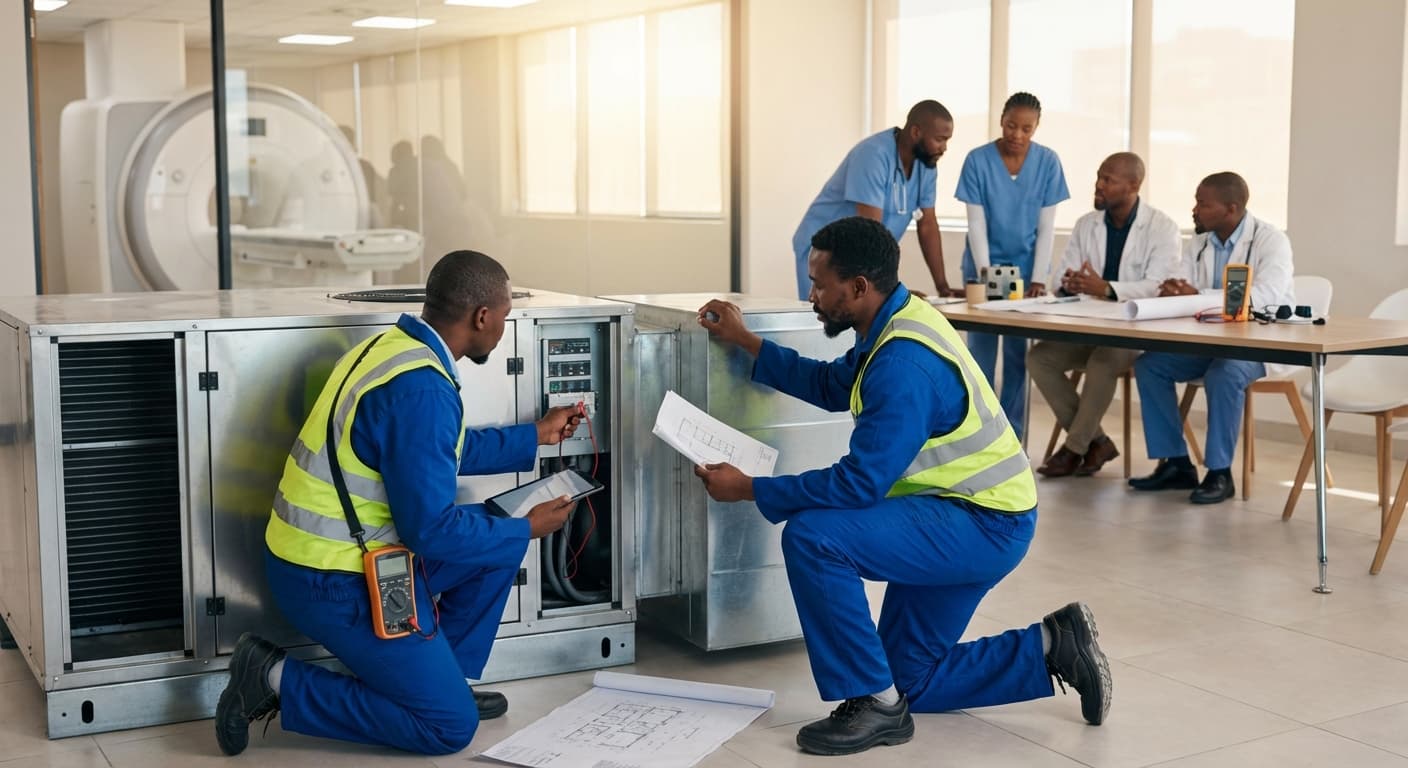
Site Readiness Assessment Service (Space/Access/HVAC/Power/Shielding) in Madagascar
Engineering Excellence & Technical Support
Site Readiness Assessment Service (Space/Access/HVAC/Power/Shielding) High-standard technical execution following OEM protocols and local regulatory frameworks.
Strategic Site Selection for Telecommunications Infrastructure
Our Site Readiness Assessment service in Madagascar leverages advanced geospatial analysis and local environmental data to identify optimal locations for satellite ground stations and network expansion. We meticulously evaluate factors like signal propagation, potential interference, accessibility for maintenance, and regulatory compliance, ensuring your infrastructure is positioned for maximum coverage and reliability across the island.
Power & HVAC Infrastructure Optimization for Mission-Critical Facilities
For critical facilities in Madagascar, our service provides a comprehensive assessment of existing and required power generation, distribution, and HVAC systems. We analyze load capacities, redundancy needs, generator fuel availability, and cooling efficiency to ensure uninterrupted operations, even in remote or challenging environments. This includes recommendations for resilient power solutions and climate-appropriate environmental controls.
EMI/RFI Shielding and Security Readiness for Sensitive Installations
We conduct in-depth evaluations of electromagnetic interference (EMI) and radio frequency interference (RFI) potential, alongside physical security assessments, for sensitive installations in Madagascar. Our experts identify sources of interference, assess shielding effectiveness of existing structures, and recommend solutions to safeguard data integrity and operational security, ensuring compliance with international standards for protected environments.
What Is Site Readiness Assessment Service (Space/access/hvac/power/shielding) In Madagascar?
The Site Readiness Assessment Service (SRAS) for Space, Access, HVAC, Power, and Shielding in Madagascar is a comprehensive technical evaluation process designed to determine the suitability and capacity of a proposed or existing site for the deployment of critical infrastructure, typically related to telecommunications, data centers, renewable energy installations, or sensitive electronic equipment. This service quantifies the existing environmental, structural, and utility conditions against the specific technical requirements of the intended application, identifying potential deficiencies, risks, and mitigation strategies to ensure successful and reliable operation. The assessment focuses on five key pillars:
- Space: Evaluation of physical dimensions, layout, and environmental factors (temperature, humidity, dust) of the designated area to ensure it meets the spatial and environmental requirements for equipment installation, operation, and maintenance, including clearances for cabling, access pathways, and future expansion.
- Access: Verification of physical access routes to the site and within the site for personnel, equipment, and materials. This includes assessing road conditions, load-bearing capacity of bridges, site gate sizes, internal pathways, and security protocols required for secure and unhindered delivery and installation.
- HVAC (Heating, Ventilation, and Air Conditioning): Assessment of existing or required cooling and ventilation systems to maintain optimal operating temperatures and humidity levels for sensitive electronic equipment. This involves calculating heat loads, evaluating existing system capacity, and recommending necessary upgrades or new installations to prevent thermal runaway and equipment failure.
- Power: Comprehensive analysis of the available electrical power supply, including capacity, reliability, voltage stability, and grounding. This includes evaluating grid connection points, substations, transformer capacities, backup power solutions (generators, UPS), and recommending the necessary infrastructure modifications or additions to meet the project's power demands safely and efficiently.
- Shielding: Assessment of electromagnetic interference (EMI) and radiofrequency interference (RFI) shielding requirements, particularly for sensitive electronic equipment or telecommunication antennas. This involves identifying potential sources of interference and evaluating the site's existing shielding properties or recommending the implementation of shielding measures to ensure signal integrity and operational reliability.
| Use Case | Specific Assessment Focus | Typical Outcome |
|---|---|---|
| Deployment of a new 4G/5G Base Station | Space: Footprint for cabinets, antenna mounting. Access: Route for transport of equipment. HVAC: Cooling for electronics. Power: Stable supply and backup. Shielding: EMI/RFI from surrounding sources. | Confirmation of site suitability, identification of required generator capacity, recommendation for structural reinforcement if needed. |
| Establishment of a Tier III Data Center | Space: Floor load capacity, seismic considerations, expansion room. Access: Heavy equipment transport, secure entry. HVAC: Redundant cooling systems, humidity control. Power: High-capacity, redundant utility feeds, UPS, generators. Shielding: Prevention of external EMI/RFI. | Detailed engineering plans for power and cooling infrastructure, confirmation of structural integrity, site security plan development. |
| Installation of a large-scale Solar Farm | Space: Land area, topography, shading analysis. Access: Heavy vehicle access to all areas, inverter/transformer placement. HVAC: (Less critical for solar panels, but for inverters/control rooms). Power: Grid interconnection capacity, grounding. Shielding: (Generally not a primary concern for solar panels themselves). | Assessment of land suitability, interconnection point feasibility, required civil works for mounting structures and access roads. |
| Deployment of a Satellite Ground Station | Space: Clear sky view, antenna placement area. Access: Equipment transport to antenna mount. HVAC: Environmental control for sensitive electronics. Power: Stable, low-noise power. Shielding: Protection from terrestrial RFI. | Verification of line-of-sight, assessment of potential RFI sources, recommendation for grounding and power conditioning. |
Who Needs Site Readiness Assessment Service?
- Telecommunications operators planning new base stations or network infrastructure upgrades.
- Data center developers and operators seeking to establish new facilities or expand existing ones.
- Companies deploying large-scale renewable energy projects (e.g., solar farms, wind farms) requiring robust power infrastructure and stable environmental conditions.
- Organizations installing sensitive electronic equipment, scientific instruments, or research facilities.
- Government agencies and defense contractors requiring secure and reliable operational sites.
- Businesses undertaking critical infrastructure projects with specific environmental or utility dependencies.
Who Needs Site Readiness Assessment Service (Space/access/hvac/power/shielding) In Madagascar?
In Madagascar, businesses and organizations undertaking projects that require a new or upgraded physical site for IT infrastructure, data centers, or specialized technical equipment can significantly benefit from a comprehensive Site Readiness Assessment Service. This service meticulously evaluates the existing or proposed location for critical factors such as available space, access for equipment and personnel, robust HVAC systems for climate control, reliable power supply and distribution, and necessary shielding (e.g., for electromagnetic interference, radiation, or security). Identifying potential deficiencies early in the planning phase prevents costly delays, overruns, and operational risks.
| Customer Segment | Relevant Departments | Key Needs Addressed |
|---|---|---|
| Telecommunications | Network Operations, Infrastructure Planning, Engineering | Space for equipment, reliable power for continuous operation, access for maintenance, climate control for hardware longevity. |
| Financial Services | IT Infrastructure, Security, Operations, Business Continuity/Disaster Recovery | Secure access, stable power, precise environmental controls, physical space for servers and network gear, potential shielding for sensitive financial data systems. |
| Government | IT Departments, Public Works, Defense/Security Agencies, Research Ministries | Secure and accessible sites, robust power for essential services, HVAC for critical systems, space for national infrastructure, potential shielding for sensitive government communications. |
| Cloud Providers | Data Center Operations, Real Estate, Engineering, Network Infrastructure | Scalable space, high-density power distribution, advanced cooling, secure access, reliable grid connection with redundancy. |
| Industrial Enterprises | Operations, IT, Engineering, Facilities Management | Space for automation/control systems, power for heavy machinery integration, climate control in varied environments, physical access for technical teams. |
| Healthcare | IT Infrastructure, Biomedical Engineering, Facilities Management, Research & Development | Space for imaging/data equipment, clean and controlled environments, reliable power for patient-critical systems, potential for radiation shielding. |
Target Customers and Departments in Madagascar for Site Readiness Assessment Services:
- Telecommunications Companies: Planning for new base stations, data centers, or network Points of Presence (PoPs).
- Financial Institutions: Establishing or expanding data centers, disaster recovery sites, or secure transaction processing hubs.
- Government Agencies: Deploying critical IT infrastructure for public services, defense, or research, including potential applications for satellite ground stations or secure communication facilities.
- Cloud Service Providers: Setting up or scaling data center facilities to serve the Malagasy market.
- Large Industrial Enterprises: Implementing on-site data processing, automation systems, or specialized control rooms requiring stable environmental and power conditions.
- Healthcare Providers: Building or upgrading facilities for advanced medical imaging, patient data management systems, or research laboratories.
- Research and Development Institutions: Establishing labs or facilities requiring controlled environments, specialized power, and shielding for sensitive equipment.
- Mining and Energy Companies: Setting up operational control centers, remote monitoring stations, or data processing hubs in potentially challenging locations.
- Educational Institutions: Developing or expanding IT infrastructure for research, administration, or student services.
- **Any organization planning a new physical site for critical technology infrastructure.
Site Readiness Assessment Service (Space/access/hvac/power/shielding) Process In Madagascar
This document outlines the workflow for our Site Readiness Assessment Service in Madagascar, covering Space, Access, HVAC, Power, and Shielding. The process is designed to be transparent and efficient, ensuring clients receive a comprehensive evaluation of their proposed site's suitability for their specific needs, from initial inquiry to the final execution of the assessment.
| Phase | Description | Key Activities | Deliverables | Typical Timeline (in Madagascar context) |
|---|---|---|---|---|
| Phase 1: Inquiry & Initial Consultation | The client expresses interest in the Site Readiness Assessment Service. This phase involves understanding the client's project scope and requirements. | Receive client inquiry via email/phone. Schedule initial virtual or phone consultation. Discuss project goals, site location, specific needs (e.g., data center, manufacturing, research facility), and budget. Gather preliminary site information. | Initial project understanding documentation. Confirmation of service scope. | 1-2 business days |
| Phase 2: Site Visit & Data Collection | A qualified assessor visits the proposed site in Madagascar to gather detailed information across all assessed parameters. | Travel to the specified site in Madagascar. Conduct thorough physical inspection of the space (dimensions, layout, potential constraints). Assess access routes (road conditions, entry/exit points, security). Evaluate existing HVAC capacity, condition, and potential for upgrade. Analyze existing power infrastructure (capacity, reliability, distribution, backup options). Assess shielding requirements (EMF, RF, radiation) and current site conditions. Take photographs and measurements. Interview site personnel if available. | Comprehensive site data log. Photographic evidence. Site sketch/layout. Raw data on HVAC, power, and structural elements. | 2-5 business days (depending on site complexity and travel time within Madagascar) |
| Phase 3: Analysis & Reporting | The collected data is analyzed by our experts to identify potential issues and suitability for the client's requirements. | Review and analyze all collected data. Compare site conditions against client's specified requirements. Identify any gaps, deficiencies, or potential risks related to space, access, HVAC, power, and shielding. Quantify capacity and performance where applicable. Develop preliminary recommendations. | Preliminary findings report. Identification of critical issues. | 3-7 business days |
| Phase 4: Client Review & Feedback | The preliminary findings are presented to the client for their review and feedback. | Share the preliminary findings report with the client. Schedule a follow-up meeting to discuss the report in detail. Address any client questions or concerns. Gather client feedback and any additional information they might have. | Updated understanding of client priorities based on feedback. | 1-3 business days |
| Phase 5: Recommendation & Planning | Based on the analysis and client feedback, a detailed report with actionable recommendations is generated. This phase may also include preliminary planning for any necessary remediation. | Finalize the Site Readiness Assessment Report, including detailed findings and clear recommendations for each parameter (Space, Access, HVAC, Power, Shielding). Outline potential solutions, upgrade paths, and estimated costs for remediation if required. Provide a final verdict on site suitability. If remediation is needed, begin preliminary planning for those activities. | Final Site Readiness Assessment Report. Recommendations for remediation (if applicable). | 2-4 business days |
| Phase 6: Execution of Recommended Works (if applicable) | If the client decides to proceed with remediation based on the recommendations, this phase involves the implementation of those works. | Contractor selection and mobilization. Procurement of materials. On-site execution of required upgrades or modifications to HVAC, power, or structural elements. Implementation of shielding solutions. Project management and quality control during execution. | Completed remediation works. Progress reports during execution. | Varies significantly based on the scope of works (weeks to months) |
| Phase 7: Final Verification & Sign-off | A final assessment is conducted to verify that all recommended works have been completed to standard and the site is fully ready. | Conduct a final site inspection to verify the successful completion of any remediation works. Perform testing and validation of upgraded systems (HVAC, power). Confirm all shielding requirements are met. Issue final sign-off and confirmation of site readiness. Provide a final report summarizing the verification. | Final Verification Report. Certificate of Site Readiness. | 1-3 business days (post-completion of remediation) |
Site Readiness Assessment Service Workflow in Madagascar
- Inquiry & Initial Consultation
- Site Visit & Data Collection
- Analysis & Reporting
- Client Review & Feedback
- Recommendation & Planning
- Execution of Recommended Works (if applicable)
- Final Verification & Sign-off
Site Readiness Assessment Service (Space/access/hvac/power/shielding) Cost In Madagascar
Assessing site readiness for projects, particularly those requiring specialized infrastructure like space, access, HVAC, power, and shielding, is crucial for successful implementation. In Madagascar, the cost of such a Site Readiness Assessment Service can vary significantly due to a multitude of factors. These factors include the complexity and scale of the project, the geographical location within Madagascar, the experience and reputation of the assessment firm, and the specific components of the assessment required. Local economic conditions, availability of specialized equipment and personnel, and transportation logistics also play a significant role. Therefore, providing exact figures without detailed project specifications is challenging, but we can outline the typical pricing factors and estimated ranges in Malagasy Ariary (MGA).
| Assessment Component | Estimated Cost Range (MGA) | Notes |
|---|---|---|
| Basic Site Readiness Assessment (General Purpose) | 500,000 - 2,000,000 MGA | Covers general site suitability, basic access, and utility availability. Typically for smaller commercial or residential projects. |
| Detailed Site Readiness Assessment (Industrial/Commercial) | 2,000,000 - 10,000,000 MGA | Includes in-depth analysis of space, access for heavy machinery, preliminary HVAC/power load assessment, and general infrastructure review. Suitable for manufacturing plants, large retail spaces. |
| Specialized Infrastructure Assessment (e.g., Data Centers, Medical Facilities) | 5,000,000 - 25,000,000+ MGA | This is a broad range encompassing: <br> <strong>Space & Access:</strong> Precise dimensional checks, load-bearing capacity, specialized entry/exit points. <br> <strong>HVAC:</strong> Detailed environmental control requirements, redundancy, air purity. <br> <strong>Power:</strong> Redundant power sources, UPS, generator capacity, voltage stability. <br> <strong>Shielding:</strong> EMI, RF, or radiation shielding analysis and verification. <br> Costs heavily depend on the specific technology and criticality. |
| Remote Site Assessment (e.g., Mining, Agriculture) | 3,000,000 - 15,000,000 MGA | Factor in significant travel and logistical costs for remote locations. Scope might focus on access, power generation feasibility, and local resource availability. |
| Additional Fees (per component, can be added to above) | 500,000 - 5,000,000 MGA | Specific detailed analysis for each component, e.g., structural integrity for heavy equipment access, detailed HVAC load calculation, power quality testing, shielding effectiveness measurement. |
Key Pricing Factors for Site Readiness Assessment in Madagascar
- Project Scope and Scale: Larger or more complex projects requiring extensive data collection, analysis, and reporting will naturally incur higher costs. This includes the number of sites to be assessed, the size of the facilities, and the number of individual assessment components (Space, Access, HVAC, Power, Shielding).
- Geographical Location: Assessments in remote or less accessible regions of Madagascar will likely be more expensive due to increased travel time, accommodation, and logistical challenges. Major cities like Antananarivo might have more readily available service providers, potentially leading to competitive pricing.
- Number of Assessment Components: While the request specifies Space/Access/HVAC/Power/Shielding, the depth of assessment for each component influences cost. For instance, a basic access assessment will be cheaper than a detailed structural analysis for heavy equipment access.
- Shielding Requirements: Shielding assessments, particularly for sensitive equipment (e.g., medical imaging, data centers), can be highly specialized and costly. This might involve specialized personnel and equipment for electromagnetic interference (EMI) or radiation shielding verification.
- Firm Experience and Reputation: Established and reputable firms with proven track records and specialized expertise will generally command higher fees than newer or less specialized consultancies.
- Data Collection Methods: The methods used for data collection (e.g., on-site surveys, drone imaging, advanced sensor deployment) will impact the cost. More sophisticated methods often require specialized equipment and trained personnel.
- Reporting and Documentation: The level of detail and format of the final report can affect the price. Comprehensive reports with detailed recommendations, blueprints, and technical specifications will be more expensive.
- Logistics and Travel: Costs associated with travel, accommodation, meals, and local transportation for the assessment team are significant, especially for assignments outside major urban centers.
- Urgency of the Assessment: Expedited assessment services often come with a premium.
- Regulatory Compliance: If the assessment needs to verify compliance with specific Malagasy regulations or international standards, this can add complexity and cost.
Affordable Site Readiness Assessment Service (Space/access/hvac/power/shielding) Options
Our Affordable Site Readiness Assessment service provides comprehensive evaluations of key infrastructure components to ensure your facility is optimally prepared for your specific needs. We specialize in assessing Space suitability, Access logistics, HVAC capacity, Power reliability, and Shielding requirements. Our goal is to identify potential bottlenecks and offer cost-effective solutions, saving you time and money before critical installations or expansions.
| Value Bundle | Included Assessments | Key Benefits | Estimated Price Range (USD) |
|---|---|---|---|
| Foundation Bundle | Space, Access | Ensures physical suitability and operational flow for basic installations. | $750 - $1,500 |
| Operational Essentials Bundle | Space, Access, HVAC | Optimizes physical space, workflow, and environmental controls for standard operations. | $1,200 - $2,500 |
| Critical Infrastructure Bundle | Space, Access, HVAC, Power | Comprehensive readiness for demanding operations requiring stable power and controlled environments. | $1,800 - $3,500 |
| Advanced Protection Bundle | Space, Access, HVAC, Power, Shielding | Full-spectrum assessment for highly sensitive or regulated environments requiring robust infrastructure and shielding. | $2,500 - $5,000+ |
Key Assessment Areas and Their Value:
- {"title":"Space Assessment","description":"Evaluates existing floor plans, layout efficiency, and future expansion potential. Ensures adequate room for equipment, operations, and personnel, preventing costly retrofits."}
- {"title":"Access Assessment","description":"Analyzes ingress/egress routes, loading docks, elevator capacity, and internal movement pathways. Guarantees smooth and efficient delivery, installation, and maintenance processes, minimizing operational disruptions."}
- {"title":"HVAC Assessment","description":"Determines current heating, ventilation, and air conditioning capabilities, temperature/humidity control, and air filtration. Identifies needs for upgrades or adjustments to maintain optimal environmental conditions for sensitive equipment or operations."}
- {"title":"Power Assessment","description":"Reviews electrical load capacity, distribution systems, backup power availability (UPS/generators), and surge protection. Ensures a stable and sufficient power supply to prevent equipment damage and downtime."}
- {"title":"Shielding Assessment","description":"Evaluates existing RF, EMI, radiation, or other necessary shielding. Assesses structural integrity and material effectiveness to meet compliance and operational requirements."}
Verified Providers In Madagascar
Ensuring access to quality healthcare is paramount, especially in regions where reliable medical services can be challenging to identify. In Madagascar, understanding and verifying healthcare providers is crucial for individuals seeking safe and effective treatments. Franance Health has emerged as a leading force in this regard, establishing a robust system for credentialing and verifying healthcare professionals and facilities. Their rigorous vetting process ensures that only competent and ethical providers meet their standards, offering a significant advantage to patients.
| Type of Provider | Key Verification Criteria | Franance Health Assurance |
|---|---|---|
| Doctors & Specialists | Medical Degree, Board Certification, Specialty Training, License to Practice, Clean Disciplinary Record | Verified qualifications, demonstrated expertise in their field, commitment to patient well-being. |
| Hospitals & Clinics | Accreditation, Facility Standards, Equipment Availability, Staffing Ratios, Infection Control Protocols | Ensures high-quality infrastructure, well-equipped facilities, and adherence to stringent safety and hygiene standards. |
| Diagnostic Laboratories | Technological Capabilities, Quality Control Measures, Staff Expertise, Accreditation | Guarantees accurate and reliable diagnostic results through advanced technology and stringent quality assurance. |
| Pharmacies | Pharmacy License, Drug Sourcing and Storage Standards, Pharmacist Registration | Confirms the availability of legitimate medications, proper storage conditions, and qualified pharmacists. |
Why Franance Health Credentials Matter
- Expertise Verification: Franance Health meticulously checks the qualifications, licenses, and professional history of all listed providers, guaranteeing their medical expertise.
- Ethical Standards Compliance: Providers undergo scrutiny to ensure adherence to ethical medical practices and patient care standards.
- Patient Safety Focus: The credentialing process prioritizes patient safety through background checks and reviews of past performance.
- Accessibility and Trust: Franance Health simplifies the process of finding trusted healthcare providers, fostering greater confidence and reducing anxiety for patients.
- Continuous Monitoring: Beyond initial verification, Franance Health maintains ongoing oversight of its accredited providers to uphold quality.
Scope Of Work For Site Readiness Assessment Service (Space/access/hvac/power/shielding)
This Scope of Work (SOW) outlines the services to be provided for a comprehensive Site Readiness Assessment. The assessment will evaluate the suitability of the proposed site for [Project Name/Type] by examining key infrastructure components: Space Availability, Access Logistics, HVAC Systems, Power Infrastructure, and Shielding Requirements. The objective is to identify potential gaps, risks, and necessary upgrades to ensure a successful project deployment and operation.
| Assessment Area | Objective | Scope of Work | Technical Deliverables | Standard Specifications/Considerations |
|---|---|---|---|---|
| Space Availability & Layout | Determine if the available space meets the project's physical footprint requirements and assess the proposed layout's efficiency for operations and future expansion. | Review architectural drawings, site surveys, and operational flow diagrams. Conduct on-site measurements and walk-throughs. Assess room dimensions, ceiling heights, floor loading capacity, and proximity to other critical infrastructure. | Site Layout Diagram (showing proposed equipment placement, access paths, and utility connections). Space Utilization Report (highlighting available vs. required space, any constraints). | ANSI/ASHRAE/IES Standard 90.1 (Energy Standard for Buildings Except Low-Rise Residential Buildings) for general building design. Local building codes and fire safety regulations. Project-specific equipment footprint and clearance requirements. |
| Access Logistics (Personnel & Equipment) | Evaluate the ease and feasibility of transporting personnel and equipment to and within the site, considering all phases of the project lifecycle (installation, maintenance, operations). | Assess building entry points, elevator capacities, corridor widths, loading dock availability, and internal movement pathways. Identify any restrictions for large equipment or hazardous materials. | Access and Logistics Report (detailing ingress/egress routes, potential bottlenecks, and required permits/arrangements). Equipment Delivery Plan (preliminary). | Local zoning regulations. OSHA safety guidelines for material handling. Project-specific equipment dimensions and weight. Transportation routes and availability of specialized transport. |
| HVAC System Capacity & Performance | Verify if the existing HVAC system can maintain the required environmental conditions (temperature, humidity, air filtration) for the proposed equipment and operations. | Review HVAC system design specifications, current load calculations, and maintenance records. Measure current temperature, humidity, and air exchange rates. Assess redundancy and emergency power for HVAC. | HVAC Assessment Report (including current performance data, projected load calculations, and identified deficiencies). Recommendations for system upgrades or modifications. | ASHRAE Standards (e.g., 55 for thermal comfort, 62.1 for ventilation). Project-specific environmental requirements (e.g., cleanroom standards, data center environmental specifications). Manufacturer's recommended operating ranges for equipment. |
| Power Infrastructure & Redundancy | Assess the adequacy of the existing power supply, distribution, and backup systems to meet the project's power demands and ensure high availability. | Review electrical schematics, power meter readings, and UPS/generator specifications. Calculate current and projected power loads. Evaluate grounding and surge protection. Assess power quality. | Power Assessment Report (detailing available capacity, projected loads, UPS/generator capacity and runtime, and identified risks). Electrical Single-Line Diagram (updated). | NEC (National Electrical Code) Standards. IEEE Standards (e.g., for power quality). Project-specific power density requirements. N+1 or 2N redundancy requirements. Utility provider service agreements. |
| Shielding Requirements (Electromagnetic, RF, Radiation, etc.) | Determine if the site's existing shielding or lack thereof meets the project's specific needs for electromagnetic interference (EMI), radio frequency (RF) interference, or radiation protection. | Identify project requirements for shielding. Conduct site surveys for existing shielding materials and construction. Assess potential sources of interference within and around the site. Evaluate the need for specific shielding solutions. | Shielding Assessment Report (identifying required shielding types, effectiveness of existing measures, and recommendations for improvements). Site Shielding Plan (preliminary). | MIL-STD-285 (Method of Attenuation Measurement for Enclosures, Electronic Shielding), FCC regulations (for RF emissions), Project-specific equipment susceptibility and emission levels, health and safety regulations for radiation protection. |
Key Areas of Assessment:
- Space Availability & Layout
- Access Logistics (Personnel & Equipment)
- HVAC System Capacity & Performance
- Power Infrastructure & Redundancy
- Shielding Requirements (Electromagnetic, RF, Radiation, etc.)
Service Level Agreement For Site Readiness Assessment Service (Space/access/hvac/power/shielding)
This Service Level Agreement (SLA) outlines the terms and conditions governing the provision of the Site Readiness Assessment Service. This service encompasses evaluation of critical infrastructure components including Space, Access, HVAC, Power, and Shielding, to ensure readiness for client deployments. The SLA details response times for reported issues and uptime guarantees for the assessment platform.
| Service Component | Response Time Objective (Initial Contact) | Resolution Time Objective (Best Effort) |
|---|---|---|
| Site Readiness Assessment (Overall Report) | 2 Business Days | 5 Business Days (dependent on site complexity and client cooperation) |
| Urgent Site Readiness Issue (e.g., critical finding impacting deployment timeline) | 4 Business Hours | 1 Business Day (dependent on nature of issue and required external validation) |
Service Components
- Space Assessment: Evaluation of physical space suitability, dimensions, and potential environmental factors.
- Access Assessment: Verification of physical and logical access routes, security protocols, and ingress/egress capabilities.
- HVAC Assessment: Review of Heating, Ventilation, and Air Conditioning systems for capacity, redundancy, and environmental controls.
- Power Assessment: Analysis of power supply, distribution, UPS, and generator capabilities, including load balancing and redundancy.
- Shielding Assessment: Evaluation of electromagnetic, RF, and other forms of shielding requirements and existing measures.
Frequently Asked Questions

Ready when you are
Let's scope your Site Readiness Assessment Service (Space/Access/HVAC/Power/Shielding) in Madagascar project in Madagascar.

Scaling healthcare logistics and technical systems across the entire continent.