
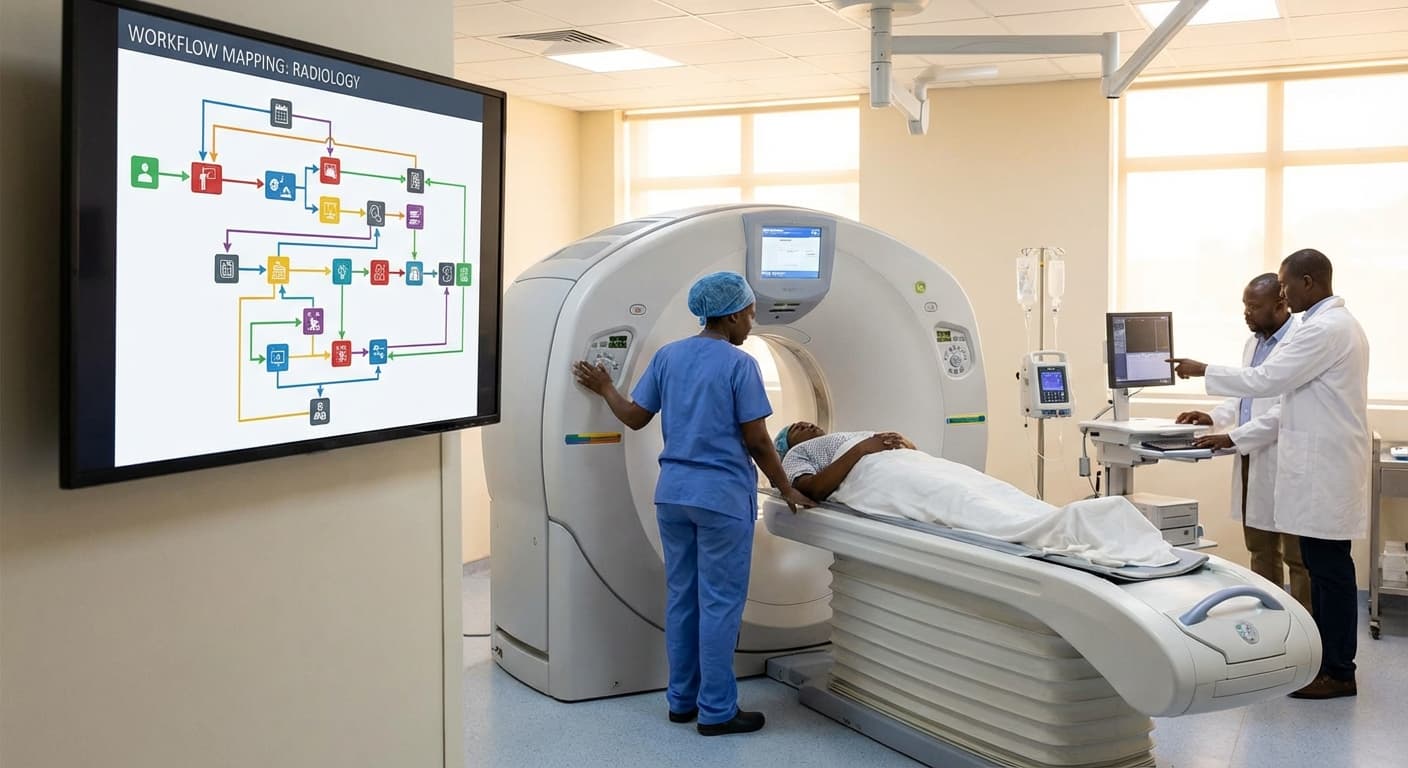
Department Workflow Mapping Service (Radiology/ICU/OT/Lab/Dialysis) in Madagascar
Engineering Excellence & Technical Support
Department Workflow Mapping Service (Radiology/ICU/OT/Lab/Dialysis) High-standard technical execution following OEM protocols and local regulatory frameworks.
Streamlined Patient Flow in Radiology
Our workflow mapping service visualizes and optimizes the entire patient journey in Radiology departments across Madagascar, from patient registration and imaging requests to report generation and archiving. This leads to reduced wait times, improved resource utilization, and enhanced diagnostic accuracy, ensuring timely and effective patient care even in remote areas.
Enhanced Critical Care Coordination in ICU
We map the intricate workflows within Intensive Care Units, identifying bottlenecks in patient monitoring, treatment protocols, and interdisciplinary communication. Our solutions empower ICUs in Madagascar with clearer operational pathways, facilitating faster decision-making, improved staff collaboration, and ultimately, better patient outcomes in critical situations.
Optimized Surgical Suite Efficiency in OT
Our service dissects the complex workflows within Operating Theaters, focusing on pre-operative preparation, surgical team coordination, instrument sterilization, and post-operative recovery. By mapping these processes, we help healthcare facilities in Madagascar achieve greater surgical efficiency, minimize scheduling conflicts, and ensure the highest standards of patient safety during procedures.
What Is Department Workflow Mapping Service (Radiology/icu/ot/lab/dialysis) In Madagascar?
Department Workflow Mapping Service in Madagascar, specifically for departments such as Radiology, Intensive Care Units (ICU), Operating Theaters (OT), Laboratories, and Dialysis, refers to a systematic process of documenting, analyzing, and optimizing the sequence of activities, information flow, and resource utilization within these critical healthcare units. This service aims to identify bottlenecks, redundancies, and inefficiencies in current operational processes to enhance patient care delivery, improve resource allocation, and ensure adherence to best practices and regulatory standards within the Malagasy healthcare context.
| Who Needs This Service? | Typical Use Cases |
|---|---|
| Hospital Administration & Management (Public & Private): Seeking to improve operational efficiency, reduce costs, and enhance patient satisfaction. | Radiology: Streamlining patient imaging requests, scheduling, image acquisition, interpretation, and reporting to reduce turnaround times and improve diagnostic accuracy. |
| Department Heads & Clinical Leads (Radiology, ICU, OT, Lab, Dialysis): Aiming to optimize patient flow, resource utilization, and clinical outcomes within their specific domains. | ICU: Enhancing critical care pathways, patient monitoring, medication administration, and interdisciplinary team communication to improve patient survival rates and reduce length of stay. |
| Healthcare IT Departments: Requiring clear understanding of existing processes to inform the design and implementation of new or integrated information systems (e.g., Picture Archiving and Communication Systems (PACS), Laboratory Information Systems (LIS), Electronic Health Records (EHR)). | OT: Optimizing surgical scheduling, patient preparation, operating room turnover, instrument sterilization, and post-operative care to maximize surgical throughput and minimize delays. |
| Quality Improvement & Patient Safety Officers: Focusing on identifying and mitigating risks, standardizing procedures, and ensuring compliance with national and international healthcare standards. | Laboratory: Improving sample processing, testing workflows, quality control procedures, and report generation to ensure timely and accurate diagnostic results. |
| External Consultants & Project Managers: Engaged in healthcare infrastructure development, organizational restructuring, or implementation of specific medical technologies in Madagascar. | Dialysis: Streamlining patient scheduling, treatment protocols, equipment maintenance, and staff allocation to ensure efficient and safe delivery of dialysis services. |
| Ministry of Public Health (Madagascar): For national-level policy development, resource allocation strategies, and standardization of healthcare services across different regions. | Cross-Departmental Coordination: Identifying and resolving inter-departmental dependencies and communication breakdowns to create seamless patient journeys across multiple units. |
Key Components of Department Workflow Mapping Service:
- Process Identification & Documentation: Detailed mapping of all steps involved in patient care pathways, from admission/request to discharge/reporting.
- Stakeholder Analysis: Identification of all personnel, equipment, and systems involved in each workflow.
- Data Flow Mapping: Visual representation of information transfer and communication channels.
- Resource Allocation Assessment: Evaluation of staffing, equipment, and material utilization.
- Bottleneck & Redundancy Identification: Pinpointing areas of delay, duplication, or inefficiency.
- Performance Measurement: Defining key performance indicators (KPIs) for workflow efficiency and effectiveness.
- Optimization & Redesign: Developing recommendations for process improvement, automation, and standardization.
- Implementation Support: Assisting in the rollout of redesigned workflows and associated training.
Who Needs Department Workflow Mapping Service (Radiology/icu/ot/lab/dialysis) In Madagascar?
Department workflow mapping is a critical process for optimizing operational efficiency, identifying bottlenecks, and improving patient care within specialized hospital departments. In Madagascar, where healthcare resources can be stretched and efficiency is paramount, such a service offers significant benefits. This service is designed for healthcare facilities seeking to streamline their processes, reduce errors, enhance staff productivity, and ultimately improve patient outcomes in high-demand and complex clinical environments.
| Target Customer Type | Specific Institutions | Key Benefits of Workflow Mapping |
|---|---|---|
| Public Hospitals | University Hospitals, Central Hospitals, Regional Hospitals | Improve patient flow, optimize resource allocation, reduce waiting times, enhance diagnostic accuracy, increase staff efficiency, and ensure compliance with national healthcare standards. |
| Private Hospitals | Large Private Hospital Networks, Specialized Private Clinics | Enhance patient satisfaction, gain competitive advantage through efficient service delivery, reduce operational costs, attract and retain top medical talent, and implement best practices for specialized care. |
| Non-Governmental Organizations (NGOs) / International Health Organizations | Healthcare facilities supported by NGOs, organizations implementing health improvement projects | Maximize the impact of limited resources, ensure sustainable and efficient service delivery, build local capacity for process improvement, and achieve project objectives related to healthcare access and quality. |
| Government Health Ministries / Agencies | Ministries of Health, Regional Health Directorates | Develop and implement national healthcare strategies, establish performance benchmarks for healthcare facilities, identify areas for policy intervention, and facilitate the adoption of efficient operational models across the public healthcare system. |
Target Departments and Their Needs
- {"title":"Radiology Department","description":"Radiology departments face challenges with patient scheduling, image acquisition times, report turnaround, and equipment utilization. Workflow mapping can identify delays in patient throughput, optimize technician scheduling, and ensure efficient integration of new imaging technologies. It also helps in managing the flow of patients from referral to final report delivery."}
- {"title":"Intensive Care Unit (ICU)","description":"ICUs are characterized by high patient acuity, complex care protocols, and rapid decision-making. Workflow mapping can enhance communication between multidisciplinary teams, standardize critical care pathways, optimize patient monitoring, and reduce the risk of medical errors. It's crucial for managing the flow of patients, resources (like ventilators and beds), and staff assignments."}
- {"title":"Operating Theater (OT)","description":"Operating theaters require meticulous coordination of staff, equipment, and patient preparation. Workflow mapping can improve surgical scheduling, optimize room turnover times, ensure sterile supply chain efficiency, and enhance communication among surgical teams. It helps in minimizing delays and maximizing the utilization of valuable surgical resources."}
- {"title":"Laboratory Department","description":"Lab departments are responsible for timely and accurate diagnostic testing. Workflow mapping can identify inefficiencies in sample collection, processing, analysis, and reporting. It can lead to reduced turnaround times for results, improved quality control, and better management of laboratory reagents and equipment."}
- {"title":"Dialysis Unit","description":"Dialysis units manage a continuous flow of patients requiring regular treatments. Workflow mapping can optimize patient scheduling for dialysis sessions, improve the management of dialysis machines and consumables, and ensure efficient patient monitoring and care during and after treatment. It also focuses on patient comfort and safety throughout the dialysis process."}
Department Workflow Mapping Service (Radiology/icu/ot/lab/dialysis) Process In Madagascar
This document outlines the typical workflow for a Department Workflow Mapping Service, specifically focusing on departments such as Radiology, Intensive Care Unit (ICU), Operating Theatre (OT), Laboratory, and Dialysis within the context of Madagascar. The service aims to analyze, document, and optimize existing processes to improve efficiency, reduce errors, and enhance patient care.
| Stage | Description | Key Activities | Deliverables | Responsible Parties | Madagascar Context Considerations |
|---|---|---|---|---|---|
| Inquiry & Initial Consultation | The process begins when a healthcare institution in Madagascar expresses interest in the workflow mapping service. | Initial contact, understanding the institution's needs and challenges, preliminary discussion of service benefits. | Initial understanding of requirements, agreement to proceed with a proposal. | Client (Department Head/Administrator), Service Provider. | Establishing clear communication channels, understanding local healthcare priorities and existing infrastructure limitations. |
| Scope Definition & Proposal | Formalizing the engagement and outlining the specific areas and objectives of the workflow mapping. | Detailed discussion of the target department(s) (Radiology, ICU, OT, Lab, Dialysis), defining objectives (e.g., reduce patient wait times, improve inventory management), estimating timelines and costs. | Detailed Project Proposal, including scope, methodology, timeline, budget, and terms of engagement. | Service Provider, Client. | Considering the availability of specific departmental data, potential for language barriers (French/Malagasy), and the need for culturally sensitive approaches. |
| Data Collection & Analysis | Gathering comprehensive information about the current processes within the specified departments. | Observation of daily operations, interviews with staff at all levels (doctors, nurses, technicians, administrative staff), review of existing SOPs, patient flow records, equipment logs, and supply chain data. | Raw data, interview transcripts, observation notes, existing documentation. | Service Provider, with active participation from Client staff. | Ensuring access to all relevant areas and personnel, obtaining necessary permissions, adapting data collection methods to local resources and technological capabilities. |
| Workflow Mapping & Documentation | Visually representing the current state of the workflows and creating clear documentation. | Utilizing flowcharts, process diagrams (e.g., BPMN), swimlane diagrams to illustrate step-by-step processes, documenting roles, responsibilities, inputs, outputs, and decision points. | Current State Workflow Diagrams, Detailed Process Narratives. | Service Provider. | Ensuring diagrams are intuitive and easy to understand for staff, using standardized notation where appropriate but also allowing for adaptation. |
| Identification of Bottlenecks & Opportunities | Analyzing the documented workflows to pinpoint inefficiencies, redundancies, and areas for improvement. | Identifying delays, errors, unnecessary steps, communication breakdowns, resource underutilization, and compliance issues. Brainstorming potential solutions and best practices. | List of identified bottlenecks, areas for improvement, and potential solution categories. | Service Provider, with input from Client. | Prioritizing improvements based on impact on patient safety and operational efficiency, considering the financial and human resource constraints common in Madagascar. |
| Recommendation Development | Formulating concrete and actionable recommendations to address the identified issues and optimize workflows. | Proposing revised process steps, new SOPs, technology integration suggestions, training needs, changes in resource allocation, and performance indicators. | Detailed Recommendation Report, including proposed future state workflows. | Service Provider. | Tailoring recommendations to the specific context of Madagascar, considering affordability of new technologies or processes, and the availability of skilled personnel for implementation and maintenance. |
| Presentation & Validation | Presenting the findings and recommendations to the client for feedback and validation. | Formal presentation of the workflow analysis, documented workflows, identified bottlenecks, and proposed recommendations. Facilitating discussions and incorporating client feedback. | Validated Workflow Maps, Approved Recommendation Report. | Service Provider, Client Leadership and Staff. | Ensuring clear and transparent communication, addressing concerns and adapting recommendations based on validation, potentially conducting smaller validation sessions with key stakeholders. |
| Implementation Support (Optional) | Providing assistance to the client in putting the recommendations into practice. | Developing implementation plans, facilitating training sessions, assisting with the adoption of new processes or technologies, monitoring initial implementation phases. | Implementation Plan, Training Materials, Progress Reports. | Service Provider (if contracted). | Focusing on sustainable implementation, providing practical training that can be delivered locally, and ensuring that any new systems are maintainable within the local context. |
| Follow-up & Review | Assessing the effectiveness of implemented changes and providing ongoing support. | Periodic review of the implemented workflows, measuring performance against defined indicators, identifying any new challenges, and providing further optimization suggestions. | Post-Implementation Review Report, Ongoing Support Recommendations. | Service Provider, Client. | Establishing a mechanism for ongoing support that is feasible within the Malagasy healthcare system, ensuring knowledge transfer to local staff for long-term sustainability. |
Workflow Stages
- Inquiry & Initial Consultation
- Scope Definition & Proposal
- Data Collection & Analysis
- Workflow Mapping & Documentation
- Identification of Bottlenecks & Opportunities
- Recommendation Development
- Presentation & Validation
- Implementation Support (Optional)
- Follow-up & Review
Department Workflow Mapping Service (Radiology/icu/ot/lab/dialysis) Cost In Madagascar
The cost of Department Workflow Mapping Services for key hospital departments like Radiology, Intensive Care Units (ICU), Operating Theatres (OT), Laboratories, and Dialysis in Madagascar is influenced by several factors, leading to a range of pricing. These services are crucial for identifying inefficiencies, optimizing resource allocation, improving patient flow, and enhancing overall service delivery within these critical areas. The price will vary based on the complexity of the department, the scope of the mapping exercise, the expertise of the consulting firm, and the duration of the project.
Key Pricing Factors:
- Department Size and Complexity: Larger departments with more intricate processes and a higher volume of patient traffic will naturally command higher fees. For instance, an ICU with multiple specialized units or a busy OT schedule will require more in-depth analysis than a smaller, more straightforward laboratory section.
- Scope of Work: The level of detail in the workflow mapping is a primary cost driver. This can range from a high-level overview of patient journeys to granular analysis of individual task sequences, equipment utilization, staff movements, and information flow. Including diagnostic assessment, recommendation development, and implementation support will also increase costs.
- Consulting Firm Expertise and Reputation: Established firms with a proven track record in healthcare workflow optimization, particularly within the Malagasy context, may charge premium rates due to their specialized knowledge and credibility. Local vs. international consultants can also present different cost structures.
- Duration of Engagement: The time required to conduct interviews, observe processes, analyze data, and produce reports directly impacts the overall cost. Longer projects naturally incur higher expenses.
- Data Collection Methods: The intensity and type of data collection (e.g., direct observation, staff surveys, patient record analysis, time-motion studies) will influence the resources and time needed.
- Deliverables: The specific outputs required, such as detailed process maps, bottleneck analysis reports, optimization recommendations, training materials, and implementation plans, will affect the pricing.
- Geographic Location within Madagascar: While less of a primary driver for the service itself, travel and accommodation costs for consultants to reach facilities in remote areas of Madagascar can add to the overall project expense.
Estimated Cost Ranges (in Malagasy Ariary - MGA):
It's important to note that these are estimated ranges and actual quotes can vary significantly. These figures are based on general understanding of consulting fees and the Malagasy economic landscape. For precise pricing, direct consultation with service providers is essential.
- Basic Workflow Mapping (e.g., single process in a lab section): 2,000,000 MGA - 6,000,000 MGA
- Standard Workflow Mapping (e.g., entire Radiology department or OT unit): 5,000,000 MGA - 15,000,000 MGA
- Comprehensive Workflow Mapping and Optimization Study (e.g., ICU or multiple departments): 10,000,000 MGA - 30,000,000 MGA or more, depending on complexity and duration.
These costs are for the mapping and analysis phase. Implementation support, training, and ongoing monitoring would typically be quoted separately.
| Service Scope | Estimated Cost Range (MGA) |
|---|---|
| Basic Workflow Mapping (e.g., single process in a lab section) | 2,000,000 - 6,000,000 |
| Standard Workflow Mapping (e.g., entire Radiology department or OT unit) | 5,000,000 - 15,000,000 |
| Comprehensive Workflow Mapping and Optimization Study (e.g., ICU or multiple departments) | 10,000,000 - 30,000,000+ |
Key Departments for Workflow Mapping in Madagascar
- Radiology
- Intensive Care Unit (ICU)
- Operating Theatre (OT)
- Laboratory
- Dialysis
Affordable Department Workflow Mapping Service (Radiology/icu/ot/lab/dialysis) Options
Our Affordable Department Workflow Mapping Service offers comprehensive solutions to optimize operations within your Radiology, ICU, OT (Operating Theatre), Lab, and Dialysis departments. We specialize in identifying bottlenecks, streamlining processes, and enhancing efficiency, leading to significant cost savings and improved patient care. Our service is designed to be accessible and provide tangible value, regardless of your department's size or current operational maturity.
| Service Component | Description | Potential Cost Savings Areas | Typical Return on Investment (ROI) Focus |
|---|---|---|---|
| Process Bottleneck Identification | Pinpointing areas where work slows down or stops, causing delays. | Reduced overtime, decreased patient wait times, improved staff utilization. | Increased throughput, enhanced patient satisfaction. |
| Redundant Task Elimination | Identifying and removing unnecessary or duplicated steps in a workflow. | Reduced staff time spent on non-value-added activities, lower operational costs. | Improved staff productivity, faster process completion. |
| Standard Operating Procedure (SOP) Development | Creating clear, concise guides for standardized processes. | Reduced errors, consistent quality of service, less training time for new staff. | Enhanced quality control, improved compliance. |
| Resource Allocation Optimization | Ensuring staff, equipment, and materials are used efficiently. | Lower equipment downtime, better utilization of specialized personnel, reduced inventory waste. | Maximized asset utilization, operational efficiency. |
| Technology Integration Recommendations | Suggesting appropriate technology solutions to automate or improve workflows. | Reduced manual data entry errors, faster information retrieval, improved communication. | Digital transformation, enhanced data accuracy and accessibility. |
| Patient Flow Improvement | Mapping and optimizing the patient's journey through the department. | Shorter patient wait times, reduced length of stay (where applicable), improved patient experience. | Increased patient capacity, higher patient satisfaction scores. |
Value Bundles for Workflow Mapping Services
- Core Workflow Analysis & Documentation: Basic mapping of key processes, identification of major inefficiencies, and creation of visual workflow diagrams.
- Optimized Workflow Design & Implementation Support: Includes Core Analysis plus recommendations for process improvements, development of standard operating procedures (SOPs), and initial guidance for implementation.
- Advanced Workflow Integration & Technology Assessment: Encompasses Optimized Design plus an assessment of existing technology, recommendations for technology adoption to further enhance workflows, and integration strategies.
- Department-Specific Bundles: Tailored packages for Radiology (imaging throughput, report turnaround), ICU (patient flow, resource allocation), OT (scheduling, sterilization processes), Lab (sample handling, test turnaround), and Dialysis (patient scheduling, equipment utilization).
Verified Providers In Madagascar
In Madagascar, navigating the healthcare landscape to find reliable and skilled providers can be a challenge. Ensuring you are accessing services from verified professionals is paramount for your well-being and peace of mind. Franance Health stands out as a leading credentialing body, rigorously vetting healthcare providers across the nation. Their comprehensive evaluation process guarantees that practitioners meet high standards of education, training, ethical conduct, and patient care. Choosing a Franance Health-credentialed provider means opting for expertise, safety, and a commitment to quality healthcare.
| Provider Type | Franance Health Verification Focus | Benefits to Patients |
|---|---|---|
| Doctors (General Practitioners & Specialists) | Medical school accreditation, residency completion, board certifications, ongoing professional development, licensure, and disciplinary history review. | Access to qualified and up-to-date medical expertise, reduced risk of misdiagnosis or improper treatment. |
| Nurses (RNs, LPNs, Nurse Practitioners) | Nursing program accreditation, state licensure, relevant certifications (e.g., critical care, pediatrics), and background checks. | Safe and effective patient care delivery, skilled support services, and personalized attention. |
| Dentists | Dental school graduation, state licensure, specialized training in dentistry and oral surgery, and adherence to infection control protocols. | Quality oral health care, preventive services, and effective treatment for dental conditions. |
| Pharmacists | Pharmacy degree, state licensure, knowledge of drug interactions and dosages, and commitment to patient counseling. | Safe and accurate dispensing of medications, expert advice on drug usage and potential side effects. |
| Allied Health Professionals (e.g., Physical Therapists, Radiologists) | Specific degree programs, relevant certifications, and demonstration of competency in their respective fields. | Comprehensive rehabilitation services, accurate diagnostic imaging, and specialized therapeutic interventions. |
Why Franance Health Credentials Matter
- Ensures adherence to stringent quality and safety standards.
- Confirms professional qualifications and ongoing competency.
- Promotes ethical practices and patient-centered care.
- Provides a reliable benchmark for healthcare excellence.
- Empowers patients to make informed decisions about their care.
Scope Of Work For Department Workflow Mapping Service (Radiology/icu/ot/lab/dialysis)
This Scope of Work (SOW) outlines the services for conducting a comprehensive workflow mapping for designated departments within a healthcare facility. The objective is to analyze, document, and optimize existing processes to improve efficiency, reduce errors, and enhance patient care. This SOW covers the technical deliverables and standard specifications required for the successful execution of this service.
| Department | Primary Workflow Focus | Key Processes to Map | Potential Output Metrics |
|---|---|---|---|
| Radiology | Patient imaging and reporting lifecycle | Patient registration, scheduling, image acquisition (X-ray, CT, MRI, Ultrasound), image processing, radiologist interpretation, report generation, PACS integration. | Turnaround time (TAT) for reports, patient waiting times, equipment utilization rates, error rates in image acquisition/labeling. |
| ICU (Intensive Care Unit) | Patient care and monitoring in critical condition | Patient admission and transfer, vital sign monitoring, medication administration, ventilator management, nurse-physician communication, documentation, discharge planning. | Length of stay (LOS), readmission rates, adverse event rates, nurse-patient ratios, adherence to critical care protocols. |
| OT (Operating Theatre) | Surgical procedure execution and patient management | Pre-operative patient assessment, scheduling, patient preparation, surgical team coordination, anesthesia administration, surgical procedure, post-operative care in recovery, instrument sterilization and management. | Surgical case turnaround time, OR utilization rates, infection rates (surgical site), procedure completion times, patient satisfaction scores. |
| Lab (Clinical Laboratory) | Sample processing and diagnostic testing | Sample collection, accessioning and tracking, specimen preparation, analytical testing (biochemistry, hematology, microbiology, etc.), quality control, result reporting, Laboratory Information System (LIS) integration. | TAT for test results, sample rejection rates, instrument downtime, quality assurance metrics, billing accuracy. |
| Dialysis | Patient dialysis treatment and management | Patient scheduling, pre-dialysis assessment, dialysis machine setup and priming, patient connection and monitoring, post-dialysis care, documentation, scheduling follow-up appointments. | Dialysis session duration, patient access site complications, treatment efficacy metrics, patient satisfaction scores, adherence to dialysis schedules. |
Scope of Work Deliverables
- Detailed workflow diagrams for each specified department (Radiology, ICU, OT, Lab, Dialysis).
- Process analysis reports identifying bottlenecks, inefficiencies, and areas for improvement.
- Recommendations for process optimization and technology integration.
- A final consolidated report summarizing findings and proposed solutions.
- Training materials and sessions for key personnel on the new or optimized workflows.
Service Level Agreement For Department Workflow Mapping Service (Radiology/icu/ot/lab/dialysis)
This Service Level Agreement (SLA) outlines the performance standards and responsibilities for the Department Workflow Mapping Service. This service is designed to improve efficiency and understanding of operational processes within the Radiology, Intensive Care Unit (ICU), Operating Theatre (OT), Laboratory, and Dialysis departments. It covers response times for requests and uptime guarantees for the workflow mapping tools and consultation sessions.
| Service Component | Uptime Guarantee | Response Time for Initial Inquiry | Response Time for Urgent Request | Response Time for Report/Map Delivery (Post-Consultation) |
|---|---|---|---|---|
| Workflow Mapping Platform/Tools | 99.5% Uptime (excluding scheduled maintenance) | N/A (This is a continuous service) | N/A (This is a continuous service) | N/A (This is a continuous service) |
| Consultation for New Workflow Mapping | N/A (Service is provided via scheduled sessions) | 1 business day | 4 business hours (for critical process analysis) | 5 business days (following final consultation) |
| Consultation for Workflow Map Update/Revision | N/A (Service is provided via scheduled sessions) | 1 business day | 4 business hours (for critical process analysis) | 3 business days (following final consultation) |
| Support for Understanding Existing Maps | N/A (Service is provided via scheduled sessions) | 1 business day | 4 business hours (for critical process analysis) | 2 business days (following initial contact) |
Scope of Service
- Development and maintenance of detailed workflow maps for Radiology.
- Development and maintenance of detailed workflow maps for Intensive Care Unit (ICU).
- Development and maintenance of detailed workflow maps for Operating Theatre (OT).
- Development and maintenance of detailed workflow maps for Laboratory.
- Development and maintenance of detailed workflow maps for Dialysis.
- Providing consultation and support for understanding and implementing workflow maps.
- Regular review and updates of workflow maps based on departmental changes.
Frequently Asked Questions

Ready when you are
Let's scope your Department Workflow Mapping Service (Radiology/ICU/OT/Lab/Dialysis) in Madagascar project in Madagascar.

Scaling healthcare logistics and technical systems across the entire continent.