
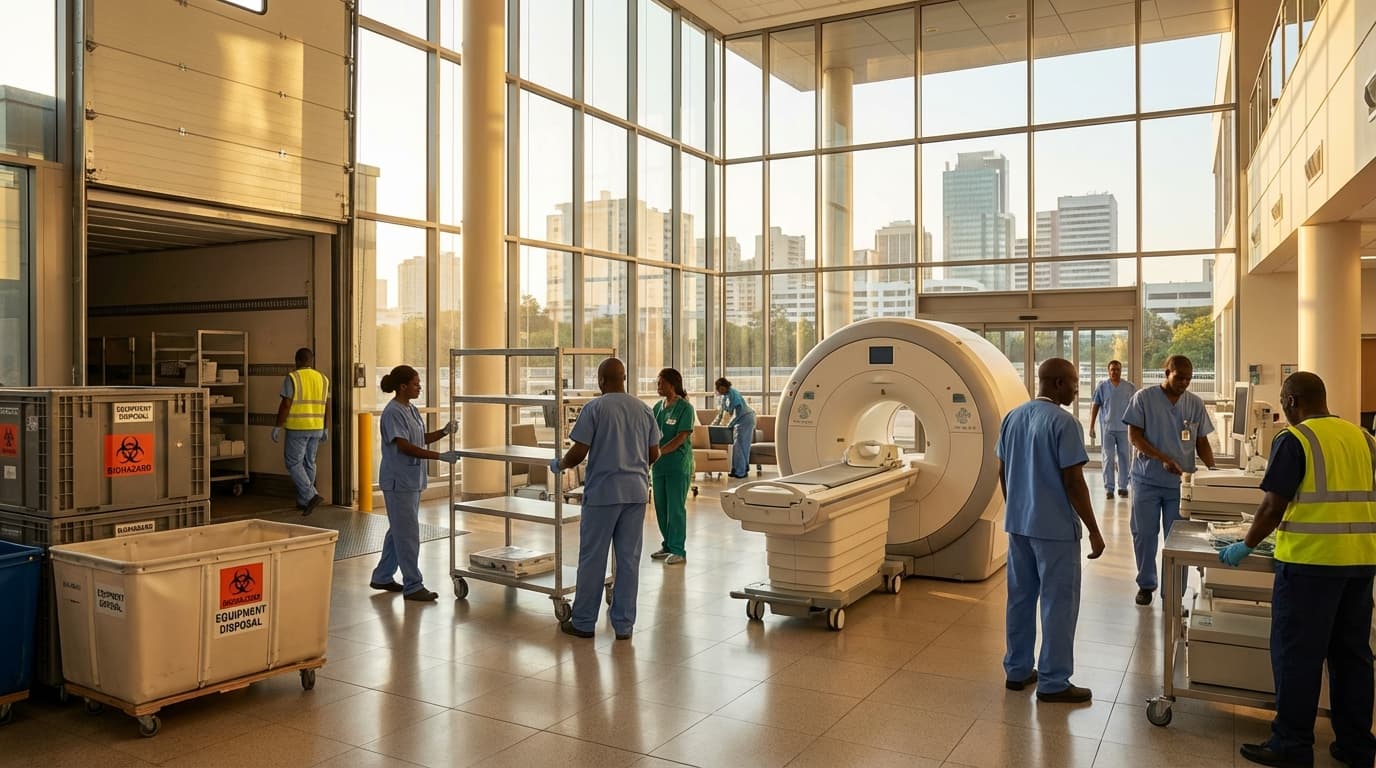
Medical Equipment Relocation Service (Move & Re-Install) in Libya
Engineering Excellence & Technical Support
Medical Equipment Relocation Service (Move & Re-Install) High-standard technical execution following OEM protocols and local regulatory frameworks.
Specialized Medical Transport
Our fleet is equipped with climate-controlled, shock-absorbent vehicles, ensuring the integrity of sensitive medical equipment like MRI machines, CT scanners, and surgical lasers during transit across Libya. We adhere to strict handling protocols to prevent damage and maintain operational readiness.
Certified Re-Installation & Calibration
Our team of certified technicians possesses deep expertise in re-installing a wide range of medical equipment. We perform meticulous calibration and rigorous testing post-installation to guarantee full compliance with manufacturer specifications and regulatory standards, ensuring immediate and safe operation.
Comprehensive Risk Management & Security
We implement robust risk assessment and mitigation strategies, including secure packaging, dedicated logistics planning, and trained personnel, to safeguard your valuable medical assets throughout the relocation process in Libya. Our service prioritizes operational continuity and minimizes downtime for your healthcare facility.
What Is Medical Equipment Relocation Service (Move & Re-install) In Libya?
Medical Equipment Relocation Service (Move & Re-Install) in Libya refers to the specialized process of safely transporting, setting up, and commissioning medical devices and machinery within or between healthcare facilities in Libya. This service is critical for ensuring the continuity of patient care and operational efficiency when facilities are being renovated, expanded, consolidated, or relocated. It encompasses the entire logistical chain, from meticulous planning and disconnection to secure transit and precise reassembly and calibration.
| Who Needs This Service? | Typical Use Cases |
|---|---|
| Hospitals and Clinics (public and private) | Renovation or expansion projects requiring temporary or permanent relocation of departments or entire facilities. |
| Diagnostic Imaging Centers (e.g., MRI, CT scan facilities) | Upgrading or replacing existing equipment, necessitating the removal and reinstallation of heavy and sensitive machinery. |
| Laboratories and Research Facilities | Consolidation of multiple labs, relocation to new research complexes, or the transfer of specialized analytical instrumentation. |
| Government Health Ministries and Agencies | Transfer of equipment between government-owned healthcare facilities or during national health initiatives. |
| Medical Equipment Manufacturers and Distributors | Relocating demonstration units, service centers, or fulfilling large-scale equipment deployment contracts. |
| Emergency and Disaster Relief Organizations | Setting up temporary medical facilities or relocating essential equipment in response to crises. |
Key Components of Medical Equipment Relocation Service
- Pre-Relocation Assessment & Planning: Site surveys, inventory of equipment, risk assessment, development of detailed relocation plans, and coordination with facility management and technical staff.
- Decommissioning & Disconnection: Safe and systematic disconnection of power, data, and fluid lines, adhering to manufacturer specifications and safety protocols.
- Specialized Packing & Handling: Utilization of custom-designed crates, anti-static materials, shock-absorbent packaging, and climate-controlled transport solutions to protect sensitive medical equipment.
- Secure Transportation: Employing trained personnel and appropriate vehicles (e.g., climate-controlled, air-ride suspension trucks) to ensure the integrity of equipment during transit within Libya, considering geographical and infrastructure challenges.
- Re-Installation & Reconnection: Precise reassembly and reconnection of all components, followed by rigorous functional testing and system integration.
- Calibration & Commissioning: Verification of equipment performance against original specifications, recalibration by certified technicians, and final commissioning to ensure operational readiness.
- Documentation & Training: Provision of updated manuals, service logs, and basic operational training for end-users on the re-installed equipment.
- Regulatory Compliance: Adherence to Libyan health regulations, safety standards, and any specific requirements for medical device handling and transport.
Who Needs Medical Equipment Relocation Service (Move & Re-install) In Libya?
Medical equipment relocation and re-installation services are crucial for a range of organizations in Libya that require the safe and efficient transfer of sensitive and often complex medical devices. These services ensure that vital healthcare operations can continue with minimal disruption, maintaining patient care standards.
| Department/Facility Type | Key Equipment Requiring Relocation | Reason for Relocation |
|---|---|---|
| Radiology Department (Hospitals/Clinics) | MRI machines, CT scanners, X-ray machines, Ultrasound machines | Renovations, upgrades, departmental moves, new facility setup |
| Operating Theaters (Hospitals) | Surgical tables, anesthesia machines, C-arms, surgical lights | Theater expansion, refurbishment, cross-facility transfers |
| Intensive Care Units (ICUs) (Hospitals) | Ventilators, patient monitors, infusion pumps, dialysis machines | Departmental reconfiguration, pandemic response, facility modernization |
| Laboratory Services (Hospitals/Research Centers) | Automated analyzers, centrifuges, incubators, microscopes | Lab expansion, new research projects, inter-departmental transfers |
| Cardiology Departments (Hospitals/Clinics) | ECG machines, stress test equipment, echocardiogram machines | Facility upgrades, new service offerings, departmental consolidation |
| Government Health Facilities | A wide range of general and specialized medical equipment | Establishment of new public health centers, infrastructure upgrades, disaster relief |
Target Customers and Departments in Libya Requiring Medical Equipment Relocation Services:
- {"title":"Hospitals (Public and Private)","description":"Hospitals are the primary users of medical equipment and frequently undergo renovations, expansions, or departmental reorganizations. This necessitates moving large, heavy, and delicate equipment like MRI machines, CT scanners, X-ray units, and operating room equipment."}
- {"title":"Clinics and Diagnostic Centers","description":"Smaller healthcare facilities that specialize in specific diagnostic services (e.g., radiology, cardiology, ophthalmology) need to relocate their specialized equipment when changing locations or upgrading facilities."}
- {"title":"Government Health Ministries and Agencies","description":"National and regional health authorities responsible for public healthcare infrastructure may require relocation services during national healthcare projects, disaster recovery efforts, or the establishment of new health facilities."}
- {"title":"Research and Development Institutions","description":"Universities and research centers with medical departments or laboratories often possess sophisticated research equipment that needs to be moved between labs or buildings."}
- {"title":"Non-Governmental Organizations (NGOs) and Humanitarian Organizations","description":"Organizations providing healthcare in remote or underserved areas of Libya, or those responding to emergencies, may need to establish or relocate medical facilities, requiring the movement of their equipment."}
- {"title":"Medical Equipment Suppliers and Manufacturers","description":"Companies that sell, distribute, or maintain medical equipment may require relocation services for showroom setups, demonstration units, or when fulfilling large-scale delivery and installation contracts."}
- {"title":"Emergency Services and Disaster Management Agencies","description":"During emergencies or natural disasters, temporary medical facilities may need to be set up quickly, requiring the swift relocation and re-installation of essential medical equipment."}
Medical Equipment Relocation Service (Move & Re-install) Process In Libya
This document outlines the comprehensive workflow for a Medical Equipment Relocation Service (Move & Re-Install) operating within Libya. It covers the entire process from the initial customer inquiry to the final successful re-installation and handover of medical equipment. The service emphasizes safety, compliance with local regulations, and minimal disruption to healthcare operations.
| Phase | Step | Description | Key Activities | Deliverables/Outcomes | Responsible Parties |
|---|---|---|---|---|---|
| Initial Inquiry | Customer expresses interest in relocating medical equipment. | Receive contact from potential client (phone, email, website). | Acknowledgement of inquiry, preliminary information gathering. | Client, Service Provider Sales Team |
| Needs Assessment & Consultation | Understand the scope, types of equipment, origin, and destination. | Detailed discussion with client about equipment inventory, timeline, and specific requirements. Site visit scheduling if necessary. | Understanding of client's needs, identification of potential challenges. | Service Provider Sales Team, Client | |
| Origin Site Assessment | Evaluate the current location for access, space, and logistical constraints. | Physical inspection of the origin site. Assess pathways, doorways, elevators, loading docks. Identify any structural limitations. | Detailed site report, identification of risks and necessary equipment for move. | Service Provider Logistics Team, Site Surveyors |
| Destination Site Assessment | Evaluate the new location for suitability and readiness. | Physical inspection of the destination site. Assess access, space, power availability, environmental controls (if applicable). | Confirmation of destination suitability, identification of any required modifications. | Service Provider Logistics Team, Site Surveyors | |
| Relocation Planning | Develop a comprehensive plan for the entire relocation process. | Create a detailed project plan including timelines, equipment list, packing strategy, transportation routes, personnel allocation, and risk mitigation strategies. Obtain necessary permits. | Detailed relocation plan, risk assessment matrix, permit applications. | Service Provider Project Manager, Logistics Team | |
| Quotation Generation | Provide a detailed cost estimate based on the assessment. | Compile a comprehensive quotation including all services, materials, transportation, insurance, and labor costs. Specify inclusions and exclusions. | Formal quotation document. | Service Provider Sales/Estimating Team |
| Contract Negotiation & Signing | Formalize the agreement between the service provider and the client. | Review and negotiate terms, conditions, payment schedules, and service level agreements (SLAs). Sign the service agreement. | Signed service agreement/contract. | Client, Service Provider Management | |
| Equipment Preparation | Ensure equipment is ready for safe dismantling and transport. | Communicate with client regarding shutdown procedures, power off, disconnection of utilities. Service provider may offer specialized disconnection services. | Equipment ready for safe handling. Disconnection protocols followed. | Client, Service Provider Technical Team |
| Material & Resource Allocation | Gather all necessary packaging materials and personnel. | Procure specialized packing materials (e.g., anti-static wraps, custom crates, shock-absorbing foam). Assign trained technicians and movers. | All required materials and personnel on standby. | Service Provider Logistics & Operations Team | |
| Dismantling | Carefully disassemble complex medical equipment. | Trained technicians meticulously dismantle equipment according to manufacturer guidelines and safety protocols. Label all parts and cables for reassembly. | Components safely detached, all parts and cables clearly labeled and organized. | Service Provider Technical Team |
| Packaging | Protect equipment from damage during transit. | Use appropriate packaging methods based on equipment type and sensitivity. Securely pack components in custom crates, anti-static bags, or protective wrapping. Ensure proper cushioning. | Equipment securely and safely packaged. Moisture and shock protection applied. | Service Provider Technical & Logistics Team | |
| Loading | Safely load packaged equipment onto transport vehicles. | Utilize appropriate lifting equipment (cranes, forklifts) and secure all items to prevent movement during transit. Ensure weight distribution is optimized. | All equipment loaded securely and safely. | Service Provider Logistics Team |
| Transit | Transport equipment to the destination in Libya. | Utilize specialized, climate-controlled, and GPS-tracked vehicles where necessary. Adhere to all traffic laws and safety regulations in Libya. Manage customs clearance and any necessary permits. | Equipment transported safely and efficiently to the destination. Real-time tracking available. | Service Provider Transportation Team, Customs Brokers | |
| Arrival & Unloading | Safely unload equipment at the destination site. | Careful unloading of equipment using appropriate lifting and handling techniques. Verify delivery against the inventory list. | Equipment successfully delivered and unloaded. Inventory check completed. | Service Provider Logistics Team |
| Unpacking & Staging | Remove packaging and prepare equipment for re-installation. | Carefully unpack all components. Stage equipment in designated areas according to the re-installation plan. | Equipment unpacked and ready for re-installation. Components correctly staged. | Service Provider Technical & Logistics Team | |
| Re-assembly | Re-assemble dismantled medical equipment. | Skilled technicians re-assemble equipment using labels and documentation from the dismantling phase. Ensure all connections are secure. | Equipment fully re-assembled to its original configuration. | Service Provider Technical Team |
| Installation & Connection | Install and connect equipment to power and other necessary utilities. | Connect equipment to power sources, network, and other required infrastructure at the new location. Ensure compliance with local electrical and safety standards. | Equipment connected and ready for functional checks. | Service Provider Technical Team, Facility Management (Client) | |
| Calibration & Alignment | Ensure equipment operates at optimal performance levels. | Perform necessary calibration and alignment procedures as per manufacturer specifications. This may involve specialized testing equipment. | Equipment calibrated to manufacturer standards. Optimal performance verified. | Service Provider Technical Team, Manufacturer Representatives (if required) | |
| Functional Testing | Verify that all equipment functions correctly. | Conduct a series of tests to confirm operational integrity of all features and functions. Document test results. | All equipment functions as intended. Test reports generated. | Service Provider Technical Team, Client Representative |
| Performance Verification | Ensure equipment meets performance benchmarks. | Validate that the equipment meets specified performance parameters and is ready for clinical use. | Equipment meets all performance requirements. Ready for handover. | Service Provider Technical Team, Client Representative | |
| Documentation Update | Provide all relevant documentation. | Compile and provide updated user manuals, maintenance records, calibration certificates, and test reports. Hand over any newly generated documentation. | Complete and accurate documentation package. | Service Provider Technical & Administration Team |
| Client Sign-off & Handover | Formal handover of relocated equipment to the client. | Client representative inspects the re-installed equipment and signs off on the successful completion of the relocation project. Briefing on any changes or new operational aspects. | Client formally accepts the relocated equipment. Project completion recorded. | Client, Service Provider Project Manager | |
| Follow-up Support | Provide assistance post-relocation. | Address any immediate questions or minor issues that may arise after handover. Offer warranty or service agreements for ongoing support. | Client satisfaction confirmed. Any initial queries resolved. | Service Provider Customer Service Team |
| Feedback Collection | Gather feedback for service improvement. | Solicit feedback from the client regarding the relocation process to identify areas for improvement in future services. | Client feedback collected. Service improvement insights gained. | Service Provider Quality Assurance Team |
Medical Equipment Relocation Service (Move & Re-Install) Process in Libya
- Inquiry and Initial Consultation
- Site Assessment and Planning
- Quotation and Agreement
- Pre-Relocation Preparation
- Equipment Dismantling and Packaging
- Transportation
- On-Site Arrival and Unpacking
- Equipment Re-installation and Calibration
- Testing and Quality Assurance
- Documentation and Handover
- Post-Relocation Support
Medical Equipment Relocation Service (Move & Re-install) Cost In Libya
Relocating medical equipment in Libya involves a specialized service that goes beyond standard moving. It requires careful handling, specialized packing, transportation adhering to specific environmental controls, and precise re-installation and calibration. The cost of such a service is influenced by a variety of factors, making it challenging to provide a fixed price. Understanding these factors is crucial for obtaining accurate quotes and budgeting effectively.
| Equipment Category | Estimated Cost Range (Libyan Dinar - LYD) | Notes |
|---|---|---|
| Small Diagnostic Devices (e.g., ECG machines, blood pressure monitors) | 500 - 2,500 LYD | Includes basic packing and standard transportation. Re-installation is usually straightforward. |
| Mid-Sized Lab Equipment (e.g., centrifuges, incubators, basic microscopes) | 2,000 - 7,000 LYD | May require specialized packing and careful handling. Re-installation might involve some basic setup. |
| Large Imaging Equipment (e.g., X-ray machines, ultrasound machines) | 10,000 - 50,000 LYD | Significant costs for professional dismantling, crating, specialized transport, and complex re-installation/calibration by certified technicians. Distance is a major factor. |
| High-End Imaging & Surgical Equipment (e.g., MRI, CT scanners, Robotic Surgery Systems) | 50,000 - 200,000+ LYD | Extremely high cost due to the need for highly specialized dismantling, custom transport solutions, environmental controls, and extensive calibration by expert engineers. This can vary greatly based on the specific model and complexity. |
| Specialized Surgical & Anesthesia Equipment | 5,000 - 30,000 LYD | Depends on the complexity, need for calibration, and specific handling requirements. Shorter distances and simpler re-installation will be at the lower end. |
Key Pricing Factors for Medical Equipment Relocation in Libya:
- Type and Size of Equipment: Larger, more complex, and highly sensitive equipment (e.g., MRI machines, CT scanners, surgical robots) will naturally incur higher costs due to specialized handling, crating, and transportation requirements. Smaller items like monitoring devices or basic lab equipment will be less expensive.
- Distance of Relocation: The geographical distance between the origin and destination within Libya is a primary cost driver. Longer distances mean more fuel, labor hours, and potential for extended transport times.
- Accessibility of Locations: Difficult access at either the pickup or delivery site (e.g., narrow corridors, upper floors without elevators, remote areas) can significantly increase labor and equipment needs, thus raising the price.
- Dismantling and Re-installation Complexity: The extent to which the equipment needs to be dismantled for transport and the complexity of its re-assembly and calibration at the new location are critical. Highly technical recalibration by certified technicians adds to the cost.
- Specialized Packing and Crating: Medical equipment often requires custom-built crates, shock-absorbent materials, and climate-controlled packaging to prevent damage during transit. This specialized packing adds to the overall expense.
- Insurance Coverage: Adequate insurance for the high-value medical equipment during transit is essential and will be factored into the service cost. The level of coverage required will influence the premium.
- Urgency of the Move: Expedited relocation services, especially those requiring immediate attention or out-of-hours work, will typically come with a premium charge.
- Manpower and Expertise Required: The number of trained technicians and movers required, as well as their specific expertise (e.g., biomedical engineers for calibration), directly impacts labor costs.
- Logistical Challenges: Unexpected logistical issues, such as customs clearance delays (if applicable for imported/exported equipment), road conditions, or permit requirements, can add to the final cost.
- Ancillary Services: Any additional services requested, such as temporary storage, disposal of old equipment, or IT integration for networked devices, will incur separate charges.
Affordable Medical Equipment Relocation Service (Move & Re-install) Options
Relocating medical equipment requires specialized care, expertise, and adherence to strict protocols to ensure patient safety and equipment integrity. Our Affordable Medical Equipment Relocation Service (Move & Re-Install) offers comprehensive solutions designed to minimize disruption and maximize value. We understand the critical nature of medical devices and provide a seamless transition, from initial packing and transport to professional re-installation and calibration. This service is ideal for hospitals, clinics, research facilities, and individual practitioners looking to move equipment within a facility, between branches, or to a new location. We focus on cost-effective solutions without compromising on quality or safety.
| Service Component | Description | Value Bundles | Cost-Saving Strategies |
|---|---|---|---|
| Initial Consultation & Assessment | On-site evaluation of equipment, facility layout, and logistical requirements. | Included in all bundles. Early assessment helps prevent unforeseen costs. | Comprehensive site surveys reduce last-minute changes and associated expenses. |
| De-installation & Packing | Careful disconnection, disassembly, and protective packaging of medical devices. | Basic Packing included. Premium packing with specialized materials available. | Opting for standard packing when equipment is less sensitive. DIY packing for non-critical items (with guidance) can save money, but professional packing is recommended for high-value or sensitive equipment. |
| Transportation | Secure transport using specialized vehicles and trained personnel. | Standard Transport. Expedited or Climate-Controlled Transport as add-ons. | Scheduling moves during off-peak hours or combining multiple relocations to the same destination. |
| Re-installation & Setup | Professional reassembly, connection, and basic setup of equipment at the new location. | Standard Re-installation. Advanced Setup & Integration included in premium bundles. | Ensuring the new location is prepped and ready for equipment installation to avoid delays. |
| Testing & Calibration | Functional testing and calibration to verify equipment performance post-relocation. | Basic Testing. Full Calibration & Certification available as an add-on. | Clarifying the level of testing required for each device. Some equipment may only need basic functional checks. |
| Value Bundle 1: Basic Relocation | Includes essential de-installation, standard transport, basic re-installation, and basic testing for non-critical equipment. | Ideal for routine moves of less sensitive devices. | Bundled pricing offers a discount compared to individual service calls. |
| Value Bundle 2: Standard Relocation | Includes professional de-installation with standard packing, standard transport, standard re-installation, and basic testing for a wider range of equipment. | Our most popular option, balancing cost and comprehensive care. | Pre-booking and scheduling flexibility can lead to better rates. |
| Value Bundle 3: Premium Relocation | Includes expert de-installation with premium packing, climate-controlled/expedited transport options, advanced re-installation & integration, and full testing & calibration for high-value, sensitive, or mission-critical equipment. | Comprehensive coverage for the most demanding relocation needs. | Negotiate package deals for large-scale or recurring relocation projects. |
| Add-on Services & Cost-Saving Strategies | Optional services like storage, disposal, IT integration, or specialized calibration. | Can be added à la carte to customize your bundle. | Inquire about long-term service agreements for ongoing relocation needs. Utilize our network for sourcing spare parts or compatible accessories to avoid costly replacements. |
Key Features of Our Affordable Medical Equipment Relocation Service
- Specialized handling and packing for delicate and high-value medical equipment.
- Secure, climate-controlled transportation options to protect sensitive devices.
- Experienced technicians for professional de-installation and re-installation.
- On-site assessment and planning to minimize downtime.
- Compliance with all relevant safety and regulatory standards.
- Post-installation testing and calibration to ensure full functionality.
- Flexible scheduling to accommodate your operational needs.
Verified Providers In Libya
Navigating healthcare in a foreign country can be challenging, and for those seeking reliable medical services in Libya, identifying verified providers is paramount. Franance Health stands out as a leading entity, distinguished by its rigorous credentialing process and commitment to quality patient care. This document outlines why Franance Health credentials signify the best choice for healthcare services in Libya.
| Credential Verification Area | Franance Health's Standard | Benefit to Patients |
|---|---|---|
| Medical Licenses and Certifications | Verified authenticity and current validity of all professional licenses and board certifications. | Ensures providers are legally qualified and have met recognized professional standards. |
| Professional Experience and Training | Thorough review of educational background, postgraduate training, and years of practical experience. | Guarantees that providers have the necessary skills and experience for complex medical needs. |
| Reputation and Ethical Conduct | Checks for disciplinary actions, malpractice history, and positive professional references. | Protects patients from unethical practices and ensures a trustworthy healthcare experience. |
| Facility Accreditation and Standards | Verification of healthcare facility accreditations, adherence to safety protocols, and quality management systems. | Confirms that facilities are equipped and managed to provide safe and effective care. |
| Specialty Competency | Confirmation of specific areas of expertise and advanced training within medical specialties. | Enables patients to find specialists best suited for their unique health conditions. |
Why Franance Health Credentials Represent the Best Choice:
- Rigorous Vetting Process: Franance Health employs a multi-layered vetting system that scrutinizes the qualifications, experience, and ethical standing of all healthcare professionals and facilities seeking to be listed on their platform.
- Emphasis on Specialization and Expertise: Credentials verified by Franance Health ensure that providers possess the necessary specialized training and proven expertise in their respective medical fields.
- Commitment to International Standards: Franance Health prioritizes providers who adhere to or exceed international best practices and quality benchmarks in healthcare delivery.
- Patient Safety and Trust: The verification process directly translates to enhanced patient safety and builds a foundation of trust, assuring individuals that they are engaging with reputable and competent medical professionals.
- Streamlined Access to Quality Care: By offering a curated list of verified providers, Franance Health simplifies the process for patients to find and access high-quality medical services, saving time and reducing uncertainty.
- Continuous Monitoring and Feedback: Franance Health's commitment extends beyond initial verification, often including ongoing monitoring and incorporating patient feedback to maintain the highest standards.
Scope Of Work For Medical Equipment Relocation Service (Move & Re-install)
This Scope of Work (SOW) outlines the requirements for a professional Medical Equipment Relocation Service, encompassing the de-installation, safe transportation, and re-installation of specified medical equipment. The objective is to ensure minimal disruption to clinical operations, maintain equipment integrity, and adhere to all relevant safety and technical standards.
| Section | Description | Standard Specifications/Technical Deliverables |
|---|---|---|
| Detailed site survey at both origin and destination. Identification of equipment to be moved, access routes, potential hazards, and specialized requirements. Development of a detailed move plan and schedule. | Site survey report including photographic evidence. Detailed equipment inventory list. Risk assessment and mitigation plan. Finalized move schedule and communication protocol. Floor plans indicating placement of equipment at the destination. |
| Careful disconnection and disassembly of medical equipment by qualified technicians. Proper labeling of all components and cables. | Adherence to manufacturer's de-installation guidelines. Use of manufacturer-approved tools and procedures. All connections clearly labeled with corresponding origin and destination points. Photographic documentation of de-installation. |
| Dismantled equipment components to be securely packed using appropriate materials to prevent damage during transit. Use of specialized crates or containers for sensitive items. | Use of anti-static packaging for electronic components. Shock-absorbent materials and padding. Custom-built crates for fragile or high-value equipment. All items clearly marked with destination room and identifier. |
| Safe and secure loading, transit, and unloading of packed equipment. Use of climate-controlled and secure transport vehicles where necessary. | Vehicles equipped with appropriate securing mechanisms (straps, tie-downs). GPS tracking of the transport vehicle. Insurance coverage for the full value of the equipment in transit. Compliance with transportation regulations for medical devices. |
| Reassembly and reconnection of equipment at the destination site. Installation in accordance with manufacturer specifications and site requirements. | Adherence to manufacturer's installation and re-installation guidelines. Verification of all connections. Use of manufacturer-approved tools and calibration equipment. Site-specific installation checklists. |
| Comprehensive testing of all equipment functions to ensure proper operation. Verification of calibration settings. | Pre-defined functional test procedures provided by the client or manufacturer. Calibration certificates to be provided where applicable. Report detailing all tests performed and their outcomes. Any deviations from expected performance to be immediately reported. |
| Final inspection of all relocated equipment with the client representative. Sign-off on successful relocation and re-installation. | Walk-through with client representative. Completion of a formal handover document. Provision of all relevant documentation (test reports, calibration certificates, etc.). |
| Provision of comprehensive reports and documentation throughout the project lifecycle. | Pre-move survey report. Daily progress reports (if applicable). Post-move summary report including all testing and calibration results. Photographic and video documentation of key stages. |
| All personnel involved must be trained, experienced, and possess the necessary qualifications for handling medical equipment. | Technicians certified by relevant manufacturers or industry bodies. Evidence of background checks and security clearances for personnel. Proof of insurance (liability and workers' compensation). |
| Strict adherence to all occupational health and safety regulations and environmental compliance standards. | Compliance with OSHA (or equivalent) regulations. Proper waste disposal procedures for packaging materials. Infection control protocols to be observed. |
Key Objectives of the Relocation Service:
- Safe and secure de-installation of all designated medical equipment at the origin site.
- Appropriate packing, crating, and protective measures for transit.
- Secure and insured transportation of equipment to the destination site.
- Safe and precise re-installation of equipment at the destination site.
- Functional testing and calibration verification to ensure operational readiness.
- Minimizing downtime for clinical services.
- Adherence to all manufacturer specifications and regulatory requirements.
- Clear and timely communication with all stakeholders throughout the process.
Service Level Agreement For Medical Equipment Relocation Service (Move & Re-install)
This Service Level Agreement (SLA) outlines the guaranteed response times and uptime expectations for the Medical Equipment Relocation Service (Move & Re-Install), provided by [Your Company Name] to [Client Name]. This agreement is effective from [Start Date] to [End Date].
| Service Component | Response Time Guarantee | Uptime Guarantee (Post-Re-Installation) | Remedy for Failure |
|---|---|---|---|
| Scheduled Relocation & Re-Installation Initiation | Within [Number] business hours of confirmed scheduling. | N/A | Rescheduling at the earliest mutually convenient time without additional charge. Client may be eligible for a [Percentage]% discount on the relocation fee for delays exceeding [Number] business days beyond the agreed-upon schedule. |
| On-Site Technician Arrival (Scheduled) | Within [Number] minutes of the scheduled arrival window. | N/A | A [Percentage]% discount on the relocation fee for each hour of delay beyond the scheduled window. Client may elect to reschedule the service without penalty. |
| Post-Re-Installation Functionality Verification | Within [Number] hours of completing the re-installation. | N/A | Immediate dispatch of a qualified technician to rectify any identified issues. Client may be eligible for a [Percentage]% discount on the relocation fee if resolution takes longer than [Number] hours. |
| Critical Equipment Downtime (Post-Re-Installation) | Immediate response, technician dispatched within [Number] hours of reported downtime for critical equipment. | Critical equipment (as defined in Service Order Form) will be guaranteed to be fully operational for [Percentage]% of the operational hours during the first [Number] days post-re-installation. | For each hour of downtime exceeding the guarantee for critical equipment: a credit of [Dollar Amount] per hour, capped at [Percentage]% of the total relocation fee. For non-critical equipment: a credit of [Dollar Amount] per hour, capped at [Percentage]% of the total relocation fee. |
| Non-Critical Equipment Downtime (Post-Re-Installation) | Technician dispatched within [Number] business hours of reported downtime for non-critical equipment. | Non-critical equipment will be guaranteed to be fully operational for [Percentage]% of the operational hours during the first [Number] days post-re-installation. | For each hour of downtime exceeding the guarantee for non-critical equipment: a credit of [Dollar Amount] per hour, capped at [Percentage]% of the total relocation fee. |
Key Service Components
- Equipment Scope: This SLA covers the relocation and re-installation of specified medical equipment as detailed in the accompanying Service Order Form.
- Service Hours: Standard service hours are [Start Time] to [End Time], [Days of the Week] (excluding public holidays). Emergency services outside these hours may incur additional charges.
- Contact Information: For service requests and inquiries, please contact [Support Contact Name] at [Support Phone Number] or [Support Email Address].
- Escalation Path: For unresolved issues, escalate to [Escalation Contact Name] at [Escalation Phone Number] or [Escalation Email Address].
Frequently Asked Questions

Ready when you are
Let's scope your Medical Equipment Relocation Service (Move & Re-Install) in Libya project in Libya.

Scaling healthcare logistics and technical systems across the entire continent.