
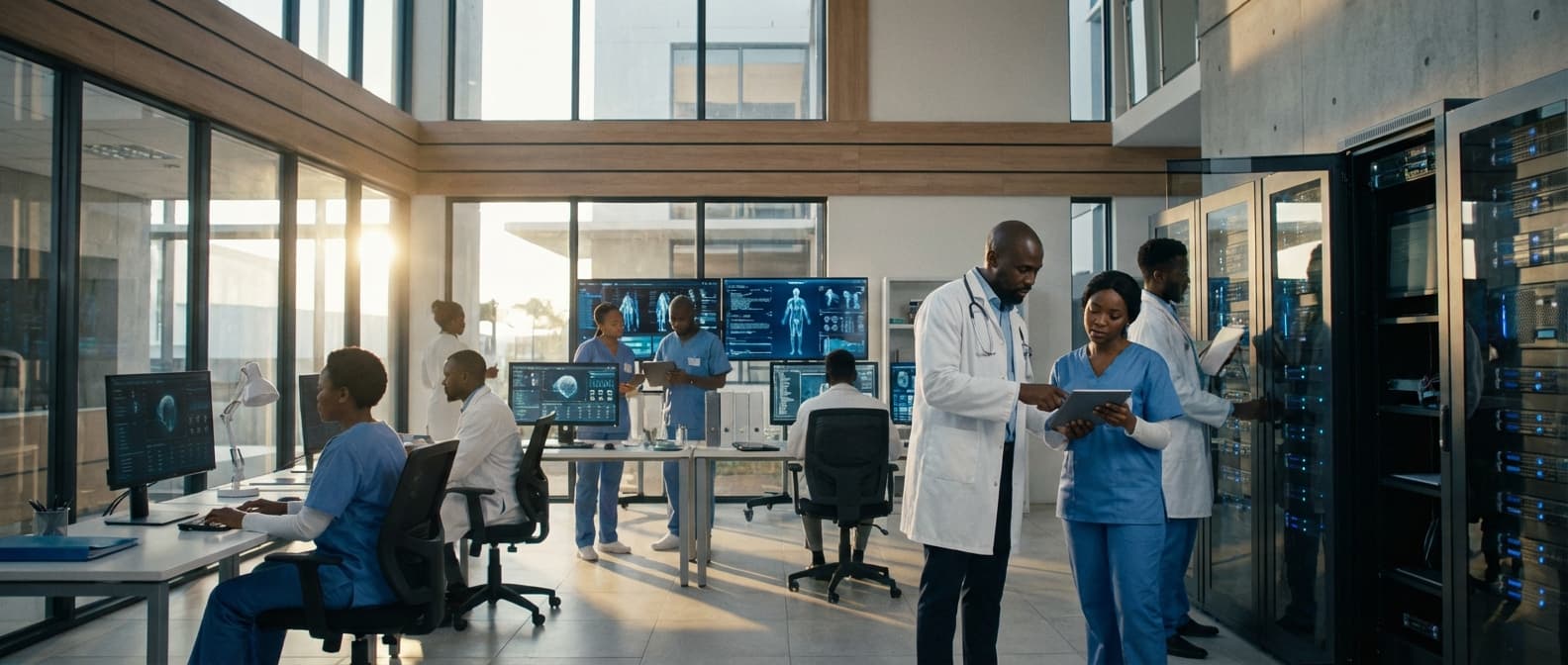
Medical IT Consultation in Libya
Engineering Excellence & Technical Support
Strategic technology consulting to optimize healthcare operations, streamline workflows, and integrate cutting-edge medical information systems. High-standard technical execution following OEM protocols and local regulatory frameworks.
Fortified Healthcare Infrastructure Security
We implement robust cybersecurity strategies, including advanced threat detection, data encryption, and access control protocols, to safeguard sensitive patient information and ensure compliance with international healthcare data privacy standards within Libya's unique regulatory landscape.
Seamless Telehealth Platform Integration
Our expertise lies in designing and deploying scalable telehealth solutions, enabling remote patient monitoring, virtual consultations, and secure electronic health record (EHR) access, bridging geographical barriers and improving healthcare accessibility across Libya.
Strategic Digital Transformation for Libyan Healthcare
We provide end-to-end IT strategy development and implementation, focusing on optimizing hospital operations, streamlining administrative processes, and leveraging data analytics for evidence-based decision-making, tailored to the specific needs and challenges of the Libyan medical sector.
What Is Medical It Consultation In Libya?
Medical IT Consultation in Libya refers to the provision of specialized expertise and strategic guidance concerning the planning, implementation, optimization, and management of information technology within healthcare organizations in the Libyan context. This service encompasses a broad spectrum of IT-related challenges and opportunities faced by healthcare providers, aiming to enhance operational efficiency, improve patient care delivery, ensure data security and privacy, and facilitate regulatory compliance. Consultants leverage their understanding of both healthcare workflows and technological capabilities to develop bespoke IT solutions tailored to the unique operational, economic, and regulatory landscape of Libya's healthcare sector. This includes assessing existing IT infrastructure, identifying gaps, recommending appropriate technologies (e.g., Electronic Health Records - EHR, Picture Archiving and Communication Systems - PACS, hospital information systems - HIS, telemedicine platforms), and assisting with procurement, deployment, and ongoing support. Emphasis is placed on interoperability, scalability, and the adoption of international best practices within the constraints of the local environment.
| Stakeholder Group | Primary Needs | Typical Use Cases |
|---|---|---|
| Hospitals (Public and Private) | Enhancing patient record management, improving operational efficiency, optimizing resource allocation, ensuring data security, enabling digital transformation. | Implementing EHR/EMR systems, deploying HIS, setting up PACS, migrating to cloud-based solutions, developing telemedicine capabilities, cybersecurity assessments. |
| Clinics and Polyclinics | Streamlining patient registration and scheduling, managing patient data, improving diagnostic capabilities, reducing administrative overhead. | Adopting practice management software, implementing basic EHR functionalities, integrating with laboratory systems, setting up secure patient portals. |
| Diagnostic Centers (Laboratories, Imaging Facilities) | Improving workflow automation, ensuring accurate data transmission, integrating with hospital systems, enhancing reporting and archiving. | Implementing LIS/RIS, integrating with PACS, developing secure data transfer protocols, cloud-based storage solutions for medical images. |
| Ministry of Health and Public Health Authorities | Facilitating national health data management, enabling public health surveillance, standardizing healthcare IT practices, supporting digital health initiatives. | Developing national health information exchanges, implementing public health databases, establishing IT infrastructure for public health programs, cybersecurity policy development. |
| Pharmaceutical Companies and Medical Device Manufacturers | Facilitating clinical trial data management, enhancing post-market surveillance, ensuring secure data sharing for research and development. | Implementing clinical trial management systems (CTMS), secure data platforms for pharmacovigilance, IT solutions for medical device integration and data collection. |
| Healthcare Startups and Innovators | Leveraging technology for new service delivery models, scaling operations, ensuring regulatory compliance for innovative solutions. | Developing and deploying telemedicine platforms, AI-driven diagnostic tools, mobile health applications, secure data infrastructure for startups. |
Key Components of Medical IT Consultation in Libya
- Needs Assessment and Gap Analysis: Evaluating current IT infrastructure, workflows, and identifying discrepancies against desired state or industry benchmarks.
- Technology Strategy and Planning: Developing long-term IT roadmaps aligned with organizational goals, including selection of hardware, software, and network solutions.
- EHR/EMR Implementation and Optimization: Guiding the adoption, customization, and effective utilization of Electronic Health Records and Electronic Medical Records systems.
- Data Management and Analytics: Establishing robust data governance frameworks, ensuring data integrity, and enabling data-driven decision-making through analytics.
- Cybersecurity and Data Privacy: Implementing measures to protect sensitive patient data (PHI) against breaches and ensuring compliance with local and international privacy regulations (e.g., GDPR principles where applicable).
- Telemedicine and Remote Healthcare Solutions: Designing and deploying platforms for remote patient monitoring, virtual consultations, and telehealth services.
- Infrastructure Design and Network Optimization: Architecting secure, reliable, and scalable IT infrastructure, including networking, server management, and cloud integration.
- Interoperability and Health Information Exchange (HIE): Facilitating seamless data exchange between different healthcare systems and providers.
- IT Project Management and Implementation Support: Overseeing the successful deployment of new IT systems and solutions.
- Training and Change Management: Equipping healthcare staff with the necessary skills and fostering adoption of new technologies.
- Regulatory Compliance Advisory: Assisting organizations in adhering to relevant Libyan healthcare and data protection regulations.
Who Needs Medical It Consultation In Libya?
Medical IT consultation in Libya is crucial for a range of healthcare organizations striving to modernize their operations, enhance patient care, and ensure data security. The evolving landscape of healthcare technology presents both opportunities and challenges, making expert guidance indispensable for navigating these complexities.
| Customer Type | Key Departments/Functions Benefiting |
|---|---|
| Hospitals and Medical Centers | IT Department, Administration, Clinical Departments (e.g., Radiology, Cardiology, Pathology), Pharmacy, Billing & Finance, Records Management, Patient Services |
| Specialty Clinics and Diagnostic Centers | IT Management, Clinic Administration, Medical Staff (e.g., Radiologists, Lab Technicians), Patient Scheduling, Billing |
| Public Health Organizations | IT & Data Management, Health Informatics, Epidemiology, Disease Surveillance, Public Health Programs, Administration |
| Pharmaceutical and Medical Device Companies | IT Infrastructure, Research & Development (R&D), Clinical Trials Management, Regulatory Affairs, Sales & Marketing (for tech-enabled solutions), Supply Chain Management |
| Research and Academic Institutions | IT Services, Research Departments (medical, scientific), Data Analytics Teams, Academic Administration, Library Services (digital resources) |
Target Customers and Departments for Medical IT Consultation in Libya
- Hospitals and Medical Centers
- Specialty Clinics and Diagnostic Centers
- Public Health Organizations
- Pharmaceutical and Medical Device Companies
- Research and Academic Institutions
Medical It Consultation Process In Libya
This document outlines the typical workflow for a Medical IT consultation process in Libya, from the initial inquiry to the final execution of services. This process is designed to ensure clarity, efficiency, and successful outcomes for healthcare organizations seeking IT solutions and support.
| Stage | Description | Key Activities | Deliverables/Outcomes |
|---|---|---|---|
| The prospective client reaches out to the Medical IT consultancy to express interest in their services. | Initial phone call or email communication, scheduling a preliminary meeting. | Confirmed interest, basic understanding of client's general needs. |
| A detailed understanding of the client's current IT infrastructure, challenges, and objectives is gathered. | On-site visits (if applicable), interviews with stakeholders, review of existing systems, documentation analysis. | Detailed requirements document, gap analysis report, preliminary scope definition. |
| Based on the needs assessment, a tailored proposal outlining recommended solutions, timelines, and costs is prepared. | Solution design, cost estimation, resource allocation, risk assessment, timeline projection. | Formal proposal document with detailed scope, proposed solutions, pricing, and implementation plan. |
| The client reviews and accepts the proposal, leading to a formal contract. | Negotiation of terms, review of legal clauses, signing of Service Level Agreement (SLA) and Master Service Agreement (MSA). | Signed contract, formal agreement to proceed with the project. |
| A detailed project plan is created, and the project officially commences with a kick-off meeting. | Task breakdown, resource assignment, communication plan, risk management strategy, setting up project management tools. | Detailed project plan, established project team, agreed-upon communication protocols. |
| The agreed-upon IT solutions are installed, configured, and integrated into the client's environment. | Hardware installation, software deployment, system configuration, data migration, network setup. | Functional IT system components, integrated infrastructure. |
| The implemented solutions are rigorously tested to ensure they meet requirements and function correctly. | Unit testing, integration testing, user acceptance testing (UAT), performance testing, security audits. | Test reports, bug tracking logs, UAT sign-off. |
| Client staff are trained on how to use and manage the new IT systems effectively. | Development of training materials, conducting training sessions, providing user manuals, Q&A sessions. | Trained end-users and IT staff, comprehensive documentation. |
| The new IT systems are officially launched and made available for operational use. | Final checks, system switch-over, live monitoring, immediate issue resolution. | Operational IT system, transitioned workflow. |
| Ongoing support is provided to address any issues and ensure the system's smooth operation. | Helpdesk support, system monitoring, performance tuning, proactive maintenance, regular check-ins. | Stable and optimized IT system, resolved user issues, ongoing client satisfaction. |
| The project is formally closed, and a review is conducted to evaluate success and identify lessons learned. | Final project report, client feedback collection, lessons learned documentation, final invoicing. | Project closure report, documented lessons learned, client satisfaction survey results. |
Medical IT Consultation Process Workflow in Libya
- Inquiry & Initial Contact
- Needs Assessment & Scoping
- Proposal Development
- Contracting & Agreement
- Project Planning & Kick-off
- Implementation & Configuration
- Testing & Quality Assurance
- Training & Knowledge Transfer
- Go-Live & Deployment
- Post-Implementation Support & Monitoring
- Project Closure & Review
Medical It Consultation Cost In Libya
Consulting on Medical IT in Libya involves a complex interplay of factors that influence pricing. These include the specific scope of the project, the complexity of the medical systems involved, the expertise of the IT consultant, and the duration of the engagement. Libyan Diinar (LYD) is the local currency for pricing these services. The market is still developing, meaning pricing can be less standardized than in more established regions, and often subject to negotiation. Smaller clinics might require basic network setup and software installation, while larger hospitals could need comprehensive EMR/EHR implementation, cybersecurity audits, or cloud migration strategies. Geopolitical stability and the availability of skilled local IT professionals also play a role in the cost. Emerging technologies and specialized services will naturally command higher rates. Remote consultations might be more affordable than on-site visits due to travel and accommodation expenses being eliminated.
| Service Category | Estimated Range (LYD per hour/project) |
|---|---|
| Basic IT Setup & Support (e.g., network, workstations) | 200 - 600 LYD (hourly) |
| EHR/EMR System Consultation (e.g., selection, implementation planning) | 400 - 1200 LYD (hourly) or 5,000 - 30,000+ LYD (project-based, depending on scale) |
| Cybersecurity Assessment & Implementation | 500 - 1500 LYD (hourly) or 7,000 - 40,000+ LYD (project-based) |
| Cloud Integration & Migration | 600 - 1800 LYD (hourly) or 8,000 - 50,000+ LYD (project-based) |
| Data Management & Analytics Consultation | 700 - 2000 LYD (hourly) or 10,000 - 60,000+ LYD (project-based) |
| Specialized Medical Device IT Integration | 800 - 2500 LYD (hourly) |
| IT Strategy & Digital Transformation Planning | 1000 - 3000 LYD (hourly) or 15,000 - 80,000+ LYD (project-based) |
Key Pricing Factors for Medical IT Consultation in Libya
- Scope of Work (e.g., network setup, EMR/EHR implementation, cybersecurity, cloud migration)
- Complexity of Medical Systems (e.g., basic clinic vs. multi-specialty hospital)
- Consultant's Expertise and Experience (e.g., years of experience, certifications, specialization)
- Duration of Engagement (e.g., project-based, hourly, retainer)
- Geographical Location within Libya (e.g., major cities vs. remote areas)
- Technology Stack Involved (e.g., specific EHR software, hardware requirements)
- On-site vs. Remote Consultation
- Urgency and Timeliness of the Project
- Need for Specialized Skills (e.g., data analytics, AI in healthcare)
- Market Demand and Availability of Local IT Talent
Affordable Medical It Consultation Options
Navigating the complexities of medical IT can be a significant investment for healthcare organizations. Fortunately, there are affordable consultation options available, often structured around value bundles and implemented with cost-saving strategies. Value bundles consolidate services into a package, providing comprehensive support at a predictable price. This approach eliminates the uncertainty of hourly billing and allows practices to budget more effectively. Cost-saving strategies often involve leveraging remote support, focusing on preventative maintenance, and prioritizing essential upgrades over immediate full-scale overhauls.
| Value Bundle Type | Typical Services Included | Cost-Saving Advantage |
|---|---|---|
| Basic Support Bundle | Help desk access, basic troubleshooting, software updates, security monitoring. | Predictable monthly cost, reduces emergency support fees, proactive issue resolution. |
| Comprehensive Management Bundle | Includes basic support plus network management, hardware maintenance, vendor management, strategic IT planning. | Holistic IT oversight, optimized system performance, reduced downtime, potential for vendor discounts. |
| EMR/EHR Implementation Bundle | Needs assessment, system selection, data migration, user training, ongoing support. | Streamlined implementation process, phased cost allocation, dedicated expertise to avoid costly mistakes. |
| Cybersecurity Bundle | Risk assessment, firewall management, antivirus deployment, security awareness training, incident response planning. | Protection against costly data breaches and ransomware attacks, compliance assurance. |
Key Components of Affordable Medical IT Consultation
- Value Bundles: Pre-packaged service offerings designed to meet common healthcare IT needs.
- Subscription Models: Regular, predictable monthly or annual fees for ongoing support and maintenance.
- Project-Based Pricing: Fixed costs for specific IT projects (e.g., EMR implementation, network upgrades).
- Tiered Service Levels: Options ranging from basic support to comprehensive IT management, allowing for scalability.
- Remote Support: Utilizing secure remote access for diagnostics, troubleshooting, and software updates, reducing on-site visit costs.
- Preventative Maintenance: Proactive monitoring and maintenance to identify and resolve issues before they cause downtime.
- Phased Implementation: Breaking down large IT projects into smaller, manageable phases to spread costs and minimize disruption.
- Vendor Negotiation: Leveraging IT consultants' expertise to negotiate favorable pricing with hardware and software vendors.
- Cloud-Based Solutions: Exploring cost-effective cloud services for data storage, software hosting, and disaster recovery.
- Staff Training & Empowerment: Investing in staff training to handle basic IT tasks and reduce reliance on external support for simple issues.
Verified Providers In Libya
In the complex landscape of healthcare in Libya, identifying and trusting verified providers is paramount for ensuring quality care and patient safety. Franance Health stands out as a leading organization committed to upholding the highest standards in the Libyan healthcare sector. Their rigorous credentialing process and dedication to excellence make them the best choice for individuals and institutions seeking reliable healthcare services.
| Franance Health Credentialing Criteria | Description | Benefits for Patients/Institutions |
|---|---|---|
| Licensure and Accreditation Verification | Ensuring all providers and facilities possess valid and current operating licenses and accreditations from relevant Libyan authorities and recognized international bodies. | Guarantees that providers meet minimum legal and operational requirements for safe practice. |
| Professional Qualifications and Experience | Thoroughly vetting the educational background, specialized training, and practical experience of all medical professionals. | Ensures patients receive care from competent and experienced practitioners in their respective fields. |
| Background Checks and Disciplinary History | Conducting comprehensive checks to identify any past disciplinary actions, malpractice claims, or ethical violations. | Mitigates risk by ensuring providers have a clean professional record and uphold ethical standards. |
| Quality of Care Assessment | Implementing ongoing assessments of patient outcomes, adherence to best practices, and facility infrastructure to maintain high standards of care. | Promotes consistent delivery of high-quality, safe, and effective medical services. |
| Patient Feedback and Satisfaction | Incorporating mechanisms for collecting and analyzing patient feedback to identify areas for improvement and ensure patient satisfaction. | Drives continuous improvement based on the direct experiences and needs of patients. |
Why Franance Health is the Top Choice for Verified Providers in Libya:
- Unwavering commitment to stringent credentialing and verification processes.
- Extensive network of highly qualified and licensed medical professionals and facilities.
- Emphasis on ethical practices, patient-centered care, and medical integrity.
- Proactive approach to continuous quality improvement and adherence to international healthcare standards.
- Dedicated to fostering trust and transparency within the Libyan healthcare ecosystem.
Scope Of Work For Medical It Consultation
This Scope of Work (SOW) outlines the technical deliverables and standard specifications for a Medical IT Consultation. The consultation will focus on assessing, planning, and recommending improvements for the client's medical IT infrastructure and systems to enhance efficiency, security, and compliance with relevant healthcare regulations.
| Deliverable | Description | Standard Specifications / Format | Timeline |
|---|---|---|---|
| Current IT Infrastructure Assessment Report | Detailed analysis of existing hardware, software, network, and security components. | PDF document; includes network diagrams, asset inventory, SWOT analysis. | Week 2 |
| EHR System Optimization Recommendations | Evaluation of current EHR performance, user satisfaction, and feature utilization. Recommendations for upgrades, integrations, or alternative solutions. | PDF document; includes comparative analysis, cost-benefit projection, implementation roadmap. | Week 3 |
| Data Security and Compliance Audit Report | Assessment of HIPAA compliance, data privacy measures, access controls, and vulnerability management. | PDF document; includes gap analysis, risk assessment, actionable recommendations for remediation. | Week 4 |
| Network Performance and Optimization Plan | Analysis of network speed, reliability, and bandwidth. Recommendations for upgrades or configuration changes. | PDF document; includes network topology, performance metrics, proposed configuration changes. | Week 5 |
| Telehealth/Remote Access Strategy Document | Assessment of current telehealth capabilities and recommendations for implementing or enhancing secure remote access solutions. | PDF document; includes platform evaluation, security protocols, user access policies. | Week 6 |
| IT Budget and Resource Allocation Proposal | Development of a proposed IT budget for the next fiscal year, including staffing, hardware, software, and maintenance costs. | Microsoft Excel or Google Sheets; includes detailed cost breakdown, ROI projections. | Week 7 |
| Vendor Management and Procurement Guidelines | Recommendations for managing IT vendors and establishing best practices for procurement of IT services and solutions. | PDF document; includes vendor evaluation criteria, SLA templates, procurement process flow. | Week 8 |
| Disaster Recovery (DR) and Business Continuity (BC) Plan Outline | High-level outline of DR/BC strategies to ensure operational continuity in case of disruptions. | PDF document; includes RTO/RPO targets, backup strategy, communication plan. | Week 9 |
| Staff Training and Support Model Recommendations | Suggestions for enhancing IT support for medical staff and recommended training programs for new systems and security best practices. | PDF document; includes training modules, support ticketing system evaluation, user guides. | Week 10 |
| Final Consultation Report and Presentation | Comprehensive summary of all findings, recommendations, and the overall strategic IT roadmap. Presentation of the report to stakeholders. | PDF document and PowerPoint presentation (PPTX); includes executive summary, detailed findings, actionable next steps. | Week 11 |
Key Areas of Consultation
- Current IT Infrastructure Assessment
- Electronic Health Record (EHR) System Evaluation
- Data Security and Compliance Strategy
- Network Infrastructure and Performance Optimization
- Telehealth and Remote Access Solutions
- IT Budgeting and Resource Planning
- Vendor Management and Procurement Strategy
- Disaster Recovery and Business Continuity Planning
- Staff Training and Support Model
Service Level Agreement For Medical It Consultation
This Service Level Agreement (SLA) outlines the response times and uptime guarantees for Medical IT Consultation services provided by [Your Company Name] to [Client Name]. This SLA is an addendum to the Master Service Agreement (MSA) dated [MSA Date].
| Service Category / Priority Level | Response Time Target | Target Resolution Time (Business Hours) | Uptime Guarantee (Monthly) | Description |
|---|---|---|---|---|
| Critical (System Outage, Patient Safety Risk) | 15 Minutes | 2 Hours | 99.9% | Issues that severely impact patient care or disrupt essential IT services. |
| High (Major Service Disruption, Significant Impact) | 30 Minutes | 4 Business Hours | 99.8% | Issues that cause significant operational disruptions but do not pose an immediate patient safety risk. |
| Medium (Moderate Service Degradation, Affecting Workflow) | 2 Business Hours | 1 Business Day | 99.5% | Issues that negatively affect user productivity or workflows but do not cause major service disruptions. |
| Low (Minor Issues, Feature Requests, General Inquiries) | 4 Business Hours | 3 Business Days | 99.0% | Routine requests, minor bugs, or inquiries that do not impact critical operations. |
Key Performance Indicators (KPIs)
- Response Time: The maximum time allowed for [Your Company Name] to acknowledge and begin working on a reported issue or request.
- Resolution Time: The maximum time allowed for [Your Company Name] to fully resolve an issue, depending on its severity and complexity.
- System Uptime: The percentage of time that critical IT systems are operational and accessible to [Client Name].
Frequently Asked Questions

Ready when you are
Let's scope your Medical IT Consultation in Libya project in Libya.

Scaling healthcare logistics and technical systems across the entire continent.