
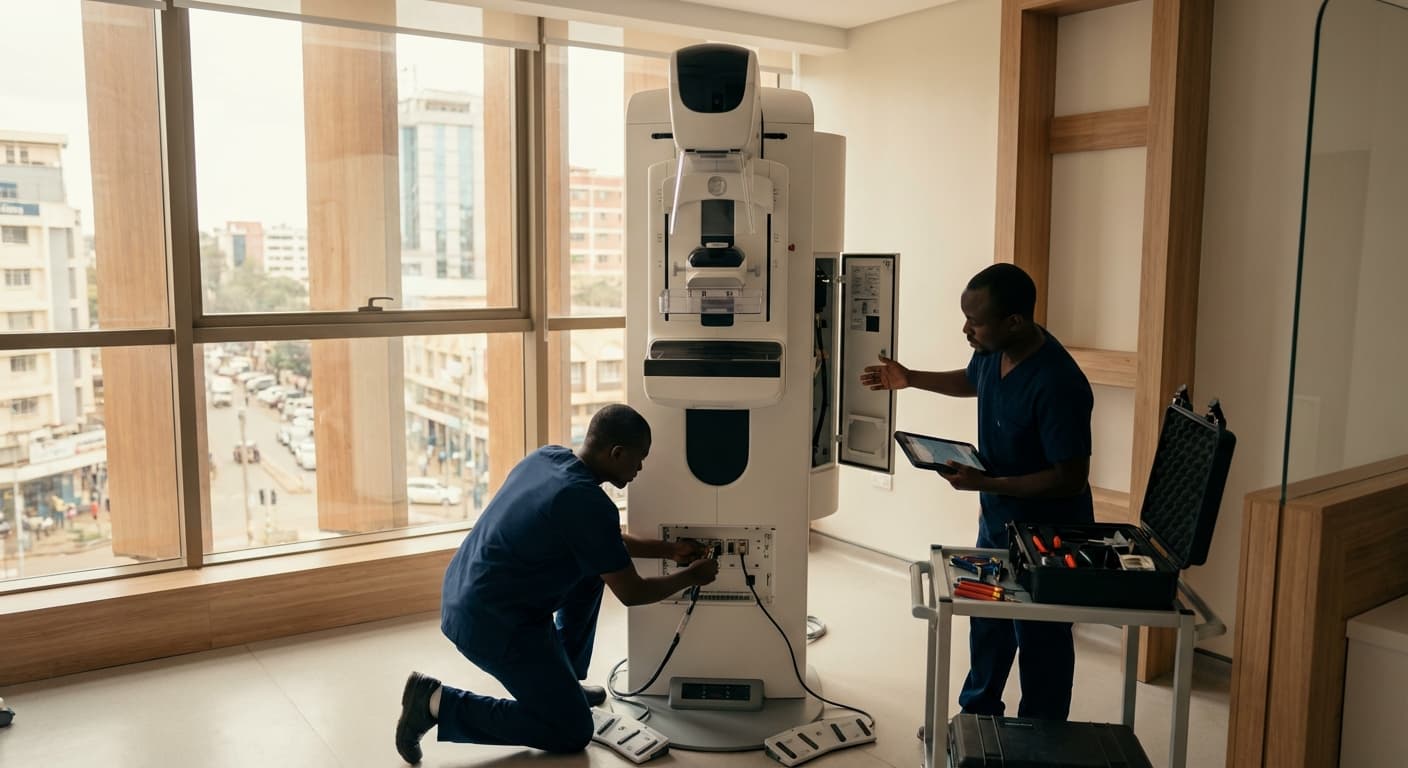
Mammography Installation Service in Libya
Engineering Excellence & Technical Support
Mammography Installation Service High-standard technical execution following OEM protocols and local regulatory frameworks.
Nationwide Installation Network
Leveraging a robust network of certified technicians across Libya, we ensure prompt and professional mammography equipment installation, regardless of your facility's location. Our localized expertise guarantees efficient deployment and minimal disruption to your operations.
Advanced Calibration & QA
Our installations go beyond basic setup. We employ state-of-the-art calibration tools and adhere to stringent Quality Assurance (QA) protocols to optimize image quality, ensuring diagnostic accuracy and compliance with international medical standards.
Turnkey Project Management
From site assessment and initial planning to final testing and operator training, our comprehensive turnkey project management approach handles every aspect of your mammography installation. We provide a seamless, end-to-end solution designed for maximum efficiency and client satisfaction.
What Is Mammography Installation Service In Libya?
Mammography Installation Service in Libya refers to the comprehensive process of setting up, calibrating, and commissioning mammography equipment within healthcare facilities across Libya. This service ensures that the sophisticated imaging devices are optimally positioned, functionally verified, and integrated into the clinical workflow to facilitate accurate diagnostic procedures. The service encompasses a range of technical and logistical tasks, from site preparation and equipment delivery to post-installation testing and initial operator training. The objective is to establish a reliable and high-performing mammography unit capable of meeting the diagnostic demands for breast cancer screening and detection in the Libyan population.
| Who Needs Mammography Installation Service? | Typical Use Cases | |||
|---|---|---|---|---|
| Public and Private Hospitals: Healthcare institutions in Libya requiring dedicated mammography units for diagnostic imaging services. | Specialized Diagnostic Imaging Centers: Facilities focused on breast health and oncology requiring advanced mammography capabilities. | Government Health Clinics and Rural Health Centers: Locations needing to establish or upgrade breast imaging services to improve access to screening and diagnosis. | New Healthcare Facility Developments: Greenfield projects in Libya requiring the complete installation of medical imaging equipment, including mammography. | Existing Facilities Upgrading Equipment: Hospitals and centers replacing older mammography machines with newer, more advanced digital systems. |
| Breast Cancer Screening Programs: Implementing routine mammography for asymptomatic women to detect early signs of breast cancer. | Diagnostic Mammography: Evaluating patients presenting with palpable breast lumps, nipple discharge, or other breast-related symptoms. | Follow-up Imaging: Monitoring patients with a history of breast cancer or those undergoing treatment. | Biopsy Guidance: Utilizing mammography for the precise localization of suspicious lesions for biopsy procedures. | Research and Development: Establishing mammography units for clinical studies and advancements in breast imaging technology. |
Key Components of Mammography Installation Service
- Site Assessment and Preparation: Evaluating the designated installation area for structural integrity, power supply, environmental controls (temperature, humidity), radiation shielding requirements, and network connectivity. This includes verifying that the room dimensions and layout are compliant with mammography equipment specifications and regulatory standards.
- Equipment Delivery and Unpacking: Coordinating the safe and secure transportation of the mammography system and its associated components from the manufacturer or distributor to the installation site in Libya. This involves careful handling to prevent damage during transit.
- Physical Installation: The precise placement and mounting of the mammography unit, including the X-ray tube, detector (digital or film-screen), compression device, control console, and any ancillary equipment. This phase requires adherence to manufacturer guidelines and engineering best practices.
- Electrical and Data Connectivity: Establishing secure and stable connections to the facility's power grid, ensuring appropriate grounding and surge protection. Integration with Picture Archiving and Communication Systems (PACS) and Radiology Information Systems (RIS) is also a critical component, requiring network cable installation and configuration.
- Calibration and Quality Assurance (QA): Performing rigorous calibration procedures to ensure the accuracy of X-ray output, image acquisition parameters, and detector performance. This includes performing a series of tests to verify image quality, dose consistency, and compliance with international imaging standards.
- Radiation Safety Testing: Verifying that the installed unit meets all local and international radiation safety regulations, including shielding effectiveness and leakage radiation levels. This often involves independent dosimetry surveys.
- System Integration and Testing: Ensuring all components of the mammography system function harmoniously. This includes testing the imaging chain from X-ray generation to image display and archival.
- Initial Operator Training: Providing fundamental training to radiographers and technologists on the operation, basic maintenance, and quality control procedures for the newly installed mammography system.
- Documentation and Handover: Providing comprehensive documentation, including installation reports, calibration certificates, user manuals, and maintenance logs. A formal handover process confirms the successful completion of the installation.
- Post-Installation Support: Offering initial troubleshooting and support to address any emergent issues after the system becomes operational.
Who Needs Mammography Installation Service In Libya?
Mammography installation services are crucial for a variety of healthcare facilities and organizations in Libya aiming to provide advanced diagnostic imaging for breast health. These services are essential for ensuring that mammography equipment is set up correctly, calibrated to optimal performance, and integrated seamlessly into existing medical workflows. Proper installation is vital for accurate diagnoses, patient safety, and compliance with regulatory standards.
| Department | Role in Mammography Installation |
|---|---|
| Radiology Department | Primary user and operator of mammography equipment. Responsible for workflow integration and image quality assurance. |
| Biomedical Engineering Department | Oversees the technical aspects of equipment installation, calibration, maintenance, and integration with hospital IT systems. |
| Information Technology (IT) Department | Manages Picture Archiving and Communication Systems (PACS) and Electronic Health Records (EHR) integration, ensuring seamless data flow. |
| Facilities Management/Estates Department | Ensures appropriate space, power, shielding, and environmental conditions are met for the installation. |
| Procurement Department | Manages the acquisition of the mammography equipment and the selection of installation service providers. |
| Infection Control Department | Ensures that installation procedures adhere to hygiene and safety protocols to prevent cross-contamination. |
| Quality Assurance Department | Monitors and verifies that the installed equipment meets all performance and safety standards for diagnostic accuracy. |
Target Customers for Mammography Installation Services in Libya
- Public Hospitals (Government-funded facilities offering a range of medical services).
- Private Hospitals (Privately owned and operated medical institutions).
- Radiology Clinics and Diagnostic Centers (Specialized centers focused on imaging services).
- Women's Health Clinics (Facilities dedicated to women's specific health needs, including screening).
- Medical Research Institutions (Organizations involved in breast cancer research and diagnosis).
- Government Health Ministries and Public Health Programs (For nationwide screening initiatives and public health infrastructure).
- International Aid Organizations and NGOs (Operating in Libya to improve healthcare access and quality).
- New Medical Facility Developments (Construction of new hospitals or clinics requiring complete imaging suite installations).
Mammography Installation Service Process In Libya
This document outlines the comprehensive Mammography Installation Service Process for clients in Libya, from the initial inquiry to the final execution and handover. Our aim is to provide a clear, efficient, and transparent workflow ensuring optimal setup of your mammography equipment.
| Phase | Stage | Key Activities | Client Involvement | Service Provider Role | Deliverables |
|---|---|---|---|---|---|
| Pre-Installation | Initial Inquiry & Consultation | Client expresses interest, discusses needs, and requests a quotation. Initial technical consultations. | Provide basic site information, define requirements, discuss budget. | Respond to inquiry, schedule initial consultation, provide preliminary information and quotation. | Quotation, preliminary project scope. |
| Pre-Installation | Detailed Site Survey & Assessment | On-site visit to evaluate the installation location, power supply, environmental conditions, and access. | Grant site access, provide existing facility layouts, identify any specific site constraints. | Conduct thorough site assessment, identify all technical requirements and potential challenges, finalize installation plan. | Detailed site survey report, confirmed installation plan. |
| Pre-Installation | Logistics & Scheduling | Arranging equipment transport to Libya, customs clearance, and scheduling the installation dates. | Provide necessary import documentation and contacts for customs clearance. | Coordinate equipment shipping, manage customs procedures, confirm installation timeline with client. | Confirmed delivery schedule, customs clearance status. |
| Execution | Equipment Delivery & Unpacking | Receiving the mammography equipment at the designated facility and carefully unpacking it. | Ensure secure and accessible delivery point, be present during unloading. | Oversee safe transport and unloading, perform initial visual inspection of equipment. | Equipment received at site. |
| Execution | Installation & Integration | Physically installing the mammography unit, connecting all necessary components, and integrating with existing IT infrastructure. | Ensure access to installation area, provide power and network connections as per site survey. | Perform precise installation according to manufacturer specifications, establish all connections. | Mammography unit physically installed and connected. |
| Execution | Calibration & Commissioning | Fine-tuning the equipment's parameters to ensure optimal image quality and performance. | Provide necessary access and supervision during calibration. | Perform rigorous calibration procedures, ensuring all technical specifications are met. | Calibrated mammography system. |
| Execution | Testing & Quality Assurance | Conducting comprehensive tests to verify functionality, safety, and adherence to regulatory standards. | Observe testing procedures, provide any necessary input. | Execute a battery of tests, including image quality assessment, radiation safety checks, and system performance verification. | Quality assurance report, test results. |
| Execution | User Training | Training clinical staff on the operation, maintenance, and basic troubleshooting of the mammography system. | Ensure relevant personnel are available for training, provide a suitable training environment. | Deliver comprehensive, hands-on training sessions, answer user queries. | Trained clinical staff, training materials. |
| Post-Installation | Documentation & Handover | Providing all necessary documentation, including manuals, warranty information, and service history. | Review and sign off on handover documents. | Compile and deliver comprehensive documentation package, formally hand over the installed system. | Signed handover certificate, complete documentation set. |
| Post-Installation | Post-Installation Support & Follow-up | Offering initial support, addressing any immediate concerns, and scheduling future maintenance. | Report any initial issues, cooperate with scheduled follow-up visits. | Provide prompt technical support for initial operational issues, establish a service contract for ongoing maintenance. | Resolved initial issues, scheduled maintenance plan. |
Mammography Installation Service Process in Libya
- Pre-Installation Phase
- Site Survey & Preparation
- Equipment Delivery & Unpacking
- Installation & Calibration
- Testing & Quality Assurance
- Training
- Documentation & Handover
- Post-Installation Support
Mammography Installation Service Cost In Libya
Installing mammography equipment is a specialized service requiring trained technicians and adherence to stringent medical safety standards. The cost of mammography installation services in Libya can vary significantly due to several factors. These include the complexity of the equipment being installed, the specific location within Libya (urban vs. remote areas), the existing infrastructure at the healthcare facility, and the chosen service provider. For accurate pricing, it's recommended to obtain quotes directly from reputable medical equipment installation companies operating in Libya. Prices are generally quoted in Libyan Dinar (LYD).
| Service Component | Estimated Price Range (LYD) |
|---|---|
| Basic Installation (Simple Digital Mammography) | 1,000 - 3,000 LYD |
| Complex Installation (3D Mammography, advanced features) | 3,000 - 7,000 LYD |
| Site Preparation & Modifications (variable) | 500 - 5,000+ LYD |
| Ancillary Software/PACS Integration | 500 - 2,500 LYD |
| Testing, Calibration & Training | 300 - 1,500 LYD |
| Total Estimated Installation Cost | 2,300 - 16,000+ LYD |
Key Pricing Factors for Mammography Installation in Libya:
- Type and Model of Mammography Unit: Advanced 3D mammography or digital systems will generally incur higher installation costs than older analog models.
- Site Preparation Requirements: This includes any necessary structural modifications, electrical upgrades, radiation shielding, and HVAC adjustments at the installation site.
- Location and Accessibility: Installations in major cities like Tripoli or Benghazi might have different pricing than those in more remote or less accessible regions.
- Service Provider's Expertise and Reputation: Established companies with specialized certifications and a proven track record may charge more for their services.
- Ancillary Equipment and Software Installation: Costs can increase if integration with PACS (Picture Archiving and Communication System) or other imaging software is required.
- Post-Installation Testing and Calibration: Thorough quality assurance and calibration are crucial and are part of the overall service cost.
- Travel and Accommodation: If technicians need to travel from outside the immediate area, these costs will be factored in.
Affordable Mammography Installation Service Options
Installing mammography equipment is a significant investment that requires careful consideration of cost and value. Affordable mammography installation services aim to make this crucial medical technology accessible while ensuring optimal functionality and long-term reliability. This involves understanding various service options, exploring value bundles, and implementing cost-saving strategies throughout the process. By choosing the right provider and planning effectively, healthcare facilities can secure high-quality installation without compromising their budget. This guide outlines key aspects of affordable mammography installation, focusing on how to maximize value and minimize expenses.
| Value Bundle Component | Description | Cost-Saving Potential |
|---|---|---|
| Basic Installation Package | Includes essential services like equipment delivery, physical installation, and initial calibration. Often the most budget-friendly option. | Lower upfront cost compared to premium bundles. Suitable for facilities with in-house IT and basic training capabilities. |
| Standard Installation Package | Builds upon the basic package by adding more comprehensive technical training for staff and extended post-installation support for a defined period (e.g., 3-6 months). | Reduces the need for external training services and minimizes early-stage troubleshooting costs. Better prepared staff lead to less downtime. |
| Premium/All-Inclusive Installation Package | The most comprehensive option, often including site assessment, all installation aspects, extensive staff training, long-term technical support contracts, and even initial consumables (e.g., phantoms). | Can be more cost-effective in the long run by preventing major issues, maximizing equipment lifespan, and reducing operational disruptions. Bundled pricing often offers a discount over individual services. |
| Extended Warranty Integration | Negotiating the inclusion of an extended warranty as part of the installation service package. | Covers unexpected repair costs and maintenance after the initial warranty period, preventing large, unplanned expenses. |
| Training & Support Bundles | Bundling technical training and ongoing support services at a reduced rate when purchased with the installation. | Acquiring these services together is typically cheaper than purchasing them separately, ensuring staff proficiency and minimizing system downtime. |
Key Components of Affordable Mammography Installation Services
- Comprehensive Site Assessment: Thorough evaluation of the installation site to identify potential challenges, infrastructure needs (e.g., power, cooling, shielding), and architectural modifications required. This prevents costly surprises later in the process.
- Equipment Delivery and Logistics: Efficient and secure transportation of the mammography unit from the manufacturer or vendor to the installation site. Includes specialized handling and insurance to protect the equipment.
- Professional Installation and Calibration: Expert technicians meticulously install the mammography system according to manufacturer specifications and industry standards. Precise calibration ensures accurate imaging results and patient safety.
- Technical Training and Support: Providing comprehensive training for radiographers and support staff on the operation, maintenance, and troubleshooting of the new mammography system. Ongoing technical support is crucial for minimizing downtime.
- Radiation Shielding and Safety Compliance: Ensuring the installation meets all local and national radiation safety regulations. This may involve installing lead-lined walls or other shielding measures.
- Integration with Existing Systems: Seamless integration of the new mammography unit with Picture Archiving and Communication Systems (PACS) and other hospital IT infrastructure.
- Post-Installation Verification and Testing: Thorough testing of all system functions and imaging performance after installation to confirm optimal operation and compliance with quality standards.
Verified Providers In Libya
Navigating healthcare in Libya can present challenges, making it crucial to identify and engage with verified providers. These providers have undergone rigorous checks and adhere to high standards of care, ensuring patient safety and effective treatment. Franance Health stands out as a premier choice due to its unwavering commitment to quality, ethical practices, and a comprehensive network of accredited medical facilities and specialists.
| Franance Health Credentialing Process | Key Benefits for Patients |
|---|---|
| Verification of Medical Licenses and Certifications | Ensures providers are legally qualified and have legitimate credentials. |
| Background Checks and Professional Reputation Assessment | Guarantees providers have a history of ethical practice and positive patient feedback. |
| Evaluation of Facility Standards and Equipment | Confirms that healthcare facilities are safe, well-equipped, and adhere to hygiene protocols. |
| Ongoing Performance Monitoring and Patient Feedback Integration | Maintains consistently high standards of care and addresses any patient concerns promptly. |
| Adherence to Ethical Medical Practices and Data Privacy | Protects patient rights and ensures confidentiality of medical information. |
Why Franance Health is the Best Choice for Verified Providers in Libya:
- Uncompromising Quality Standards: Franance Health meticulously vets all its partner providers, ensuring they meet stringent international and local healthcare benchmarks.
- Extensive Network of Specialists: Access a wide array of medical professionals across various disciplines, all pre-qualified and ready to serve your needs.
- Patient-Centric Approach: Franance Health prioritizes your well-being, offering personalized care plans and seamless access to top-tier medical services.
- Transparency and Trust: We provide clear information about our verified providers, fostering confidence and peace of mind for our patients.
- Technological Integration: Leveraging modern healthcare technologies, Franance Health facilitates efficient appointment scheduling, medical record management, and communication.
Scope Of Work For Mammography Installation Service
This Scope of Work (SOW) outlines the technical deliverables and standard specifications for the Mammography Installation Service. It details the requirements for the successful installation, testing, and commissioning of a new mammography system at the designated healthcare facility. The objective is to ensure the system is installed correctly, meets all performance standards, and is ready for clinical use in compliance with regulatory requirements and manufacturer guidelines.
| Specification Category | Standard Specification | Compliance Requirement |
|---|---|---|
| Environmental Conditions | Temperature: 15°C - 25°C (59°F - 77°F) | Humidity: 30% - 60% non-condensing | Ambient Light: Minimized during installation and QC | Installation environment must meet manufacturer's specified range. Verification through site survey and environmental monitoring tools. |
| Electrical Requirements | Dedicated circuit (20A, 240V single phase recommended) | Stable power supply with surge protection and UPS | Grounding resistance < 1 Ohm | Compliance with local electrical codes and manufacturer's power specifications. Verified by licensed electrician and installation technician. |
| Network Connectivity | Gigabit Ethernet connection | Static IP address (or DHCP reservation) | Network security protocols (e.g., WPA2/3, TLS 1.2) | Reliable and secure network connection to facility's IT infrastructure. Verified by IT department and installation technician. Bandwidth testing may be required. |
| Physical Space & Layout | Minimum clear floor space as per manufacturer's diagram | Adequate clearance for doors, equipment movement, and maintenance access | Radiation shielding requirements met (if applicable) | Installation site must accommodate the system dimensions and operational needs. Verified through site survey and adherence to provided architectural drawings. |
| System Calibration & QC | Performed according to manufacturer's protocols and regulatory standards (e.g., ACR, FDA) | Baseline QC performed and documented | System must achieve optimal performance and image quality as defined by manufacturer and regulatory bodies. Verified by certified medical physicist or trained technician. |
| Radiation Safety | Compliance with ALARA principle | Leakage radiation within regulatory limits | Proper shielding and interlocks operational | Ensuring patient and staff safety from radiation exposure. Verified by qualified radiation safety officer or medical physicist. |
| Software & Firmware | Latest stable version of system software and firmware installed | All necessary licenses activated | Ensuring full functionality and support. Verified by installation technician and client IT. |
| Integration (PACS/RIS) | DICOM conformance for image transfer and retrieval | HL7 interface for patient/study information (if applicable) | Seamless data exchange with existing Picture Archiving and Communication System (PACS) and Radiology Information System (RIS). Verified by IT and PACS/RIS administrator. |
| Documentation | Comprehensive installation report | Calibration and QC reports | User manuals | As-built drawings | Training materials | All required documentation must be provided in electronic and/or hard copy format. Reviewed and accepted by the client. |
Key Technical Deliverables
- Site Preparation and Readiness Report
- System Unpacking and Physical Inspection Report
- Component Installation and Connection Verification
- Electrical and Network Connectivity Report
- System Power-Up and Initial Configuration
- Calibration and Quality Control (QC) Test Results
- Image Acquisition and Display Performance Report
- Integration with PACS/RIS (if applicable) Verification
- User Training Completion Confirmation
- Final System Acceptance and Handover Document
- As-Built Drawings and Documentation Package
- Post-Installation Support Plan
Service Level Agreement For Mammography Installation Service
This Service Level Agreement (SLA) outlines the response times and uptime guarantees for the Mammography Installation Service provided by [Your Company Name]. This SLA is effective from [Start Date] and will remain in effect until terminated as per the terms of the Master Service Agreement (MSA).
| Service Component | Response Time Target | Uptime Guarantee | Notes |
|---|---|---|---|
| Emergency Installation Support (Critical Equipment Failure during installation) | Within 4 business hours of notification. | Not Applicable (focus is on resolution) | A critical equipment failure is defined as a failure preventing the completion of the planned installation or causing significant delays impacting patient care. |
| Scheduled Installation Support (Standard Installation Procedure) | Within 1 business day of scheduled start time. | Not Applicable (focus is on timely completion) | Standard installation includes all steps outlined in the Scope of Service. |
| Post-Installation Support (Immediate Issues) | Within 2 business hours of notification within the first 7 days post-installation. | Not Applicable (focus is on initial functionality) | This covers issues directly related to the installation process that were not apparent during initial testing. |
| System Uptime Guarantee (Post-Successful Installation) | N/A | 98% Uptime | This guarantee applies to the operational readiness of the installed mammography equipment. It excludes scheduled maintenance, planned upgrades, and issues arising from the client's infrastructure or operational errors. Uptime is calculated monthly. |
Scope of Service
- Installation and setup of new mammography equipment.
- Decommissioning and removal of old mammography equipment (if applicable).
- Initial calibration and testing of installed equipment.
- On-site training for designated personnel on basic operation and troubleshooting.
Frequently Asked Questions

Ready when you are
Let's scope your Mammography Installation Service in Libya project in Libya.

Scaling healthcare logistics and technical systems across the entire continent.