
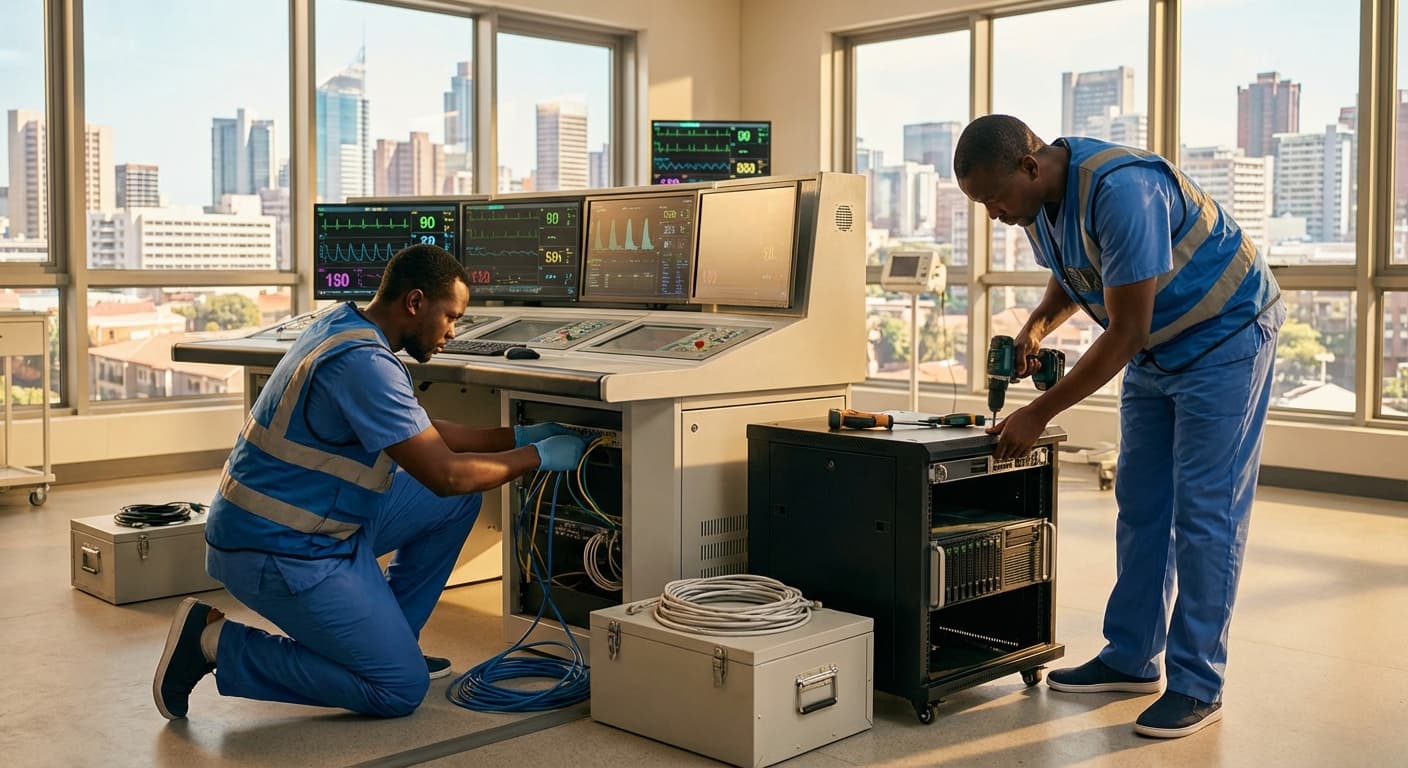
ICU Central Monitoring Station Installation Service in Libya
Engineering Excellence & Technical Support
ICU Central Monitoring Station Installation Service High-standard technical execution following OEM protocols and local regulatory frameworks.
Secure & Reliable Network Infrastructure
Our installations prioritize robust, secure network architectures designed for the critical demands of a Libyan ICU. We implement redundant pathways and advanced encryption to ensure uninterrupted data flow and complete patient privacy.
Real-Time, High-Fidelity Data Transmission
Leveraging state-of-the-art protocols and hardware, we guarantee the real-time transmission of vital patient data from bedside monitors to the central station. This ensures immediate alerts and precise clinical decision-making.
Seamless Integration with Existing Systems
Our expert technicians are adept at integrating new central monitoring systems with existing hospital IT infrastructure, including EMR/EHR platforms, ensuring a cohesive and efficient clinical workflow tailored to Libyan healthcare needs.
What Is Icu Central Monitoring Station Installation Service In Libya?
ICU Central Monitoring Station Installation Service in Libya refers to the comprehensive process of designing, procuring, deploying, integrating, and commissioning a centralized monitoring system for Intensive Care Units (ICUs) within healthcare facilities across Libya. This service ensures continuous, real-time surveillance of critical patient physiological parameters, enabling rapid intervention and improved patient outcomes by consolidating data from multiple bedside monitors and devices into a single, accessible interface for clinicians.
| Requirement | Description | Example Applications |
|---|---|---|
| Healthcare Facilities in Libya: | Hospitals, medical centers, and critical care units requiring enhanced patient surveillance and management. | Public Hospitals: National and regional hospitals in Tripoli, Benghazi, Misrata, and other major cities. Private Hospitals: Leading private healthcare providers seeking to upgrade their critical care infrastructure. Specialized Clinics: Facilities with dedicated ICU departments. Emergency Medical Services (EMS) Hubs: Potential integration for monitoring patients transferred from remote locations. |
| Clinical Need for Enhanced Monitoring: | Situations demanding constant vigilance over multiple critically ill patients, enabling early detection of deterioration and coordinated care. | Post-Surgical Recovery: Continuous monitoring of patients in the immediate post-operative period. Severe Respiratory Distress: Patients on mechanical ventilation requiring close hemodynamic and respiratory parameter tracking. Sepsis Management: Real-time monitoring of vital signs to identify and manage organ dysfunction. Cardiovascular Emergencies: Patients with complex cardiac conditions requiring continuous ECG and hemodynamic monitoring. Neurological Critical Care: Patients with traumatic brain injury or stroke needing constant neurological parameter surveillance. |
| Regulatory and Compliance Requirements: | Adherence to national and international standards for medical device interoperability, data security, and patient safety. | Libyan Ministry of Health Directives: Ensuring compliance with local healthcare regulations. International Standards (e.g., IEC 60601): Meeting safety and performance standards for medical equipment. Data Privacy and Security: Implementing robust measures to protect sensitive patient health information (PHI). |
Service Inclusions and Components
- Site Assessment and Design: Evaluating existing ICU infrastructure, network capabilities, power supply, and space requirements to design a scalable and compliant central monitoring system architecture.
- Hardware Procurement and Installation: Sourcing and installing central monitoring workstations, servers, network switches, cabling, and any necessary interface modules.
- Software Configuration and Integration: Installing and configuring central monitoring software, integrating it with existing bedside patient monitors (e.g., from various manufacturers like Philips, GE Healthcare, Mindray), ventilators, and other critical care devices.
- Network Infrastructure Setup: Establishing a robust and secure network (wired or wireless) to facilitate reliable data transmission between bedside devices and the central station.
- System Testing and Validation: Conducting comprehensive testing of all components, data flow, alarms, and system functionalities to ensure optimal performance and accuracy.
- User Training: Providing in-depth training to medical staff (physicians, nurses, technicians) on the operation, interpretation of data, and alarm management features of the central monitoring system.
- Documentation and Handover: Delivering detailed system documentation, including design specifications, user manuals, maintenance guides, and warranty information.
- Ongoing Support and Maintenance (Optional): Offering post-installation support, software updates, and hardware maintenance services to ensure continued system reliability.
Who Needs Icu Central Monitoring Station Installation Service In Libya?
ICU Central Monitoring Station Installation Service in Libya is a critical need for healthcare facilities aiming to enhance patient care, improve response times, and optimize resource allocation. These advanced systems centralize the monitoring of multiple ICU patients, allowing a dedicated team to observe vital signs, alarms, and trends from a single location.
| Target Customer Type | Key Departments Benefiting | Specific Needs Addressed |
|---|---|---|
| Public Hospitals | Intensive Care Unit (ICU), Emergency Department, Cardiology, Neurology, Surgical Wards | Improving patient outcomes, enabling efficient staff allocation, enhancing data collection for research and quality improvement, ensuring compliance with modern healthcare standards. |
| Private Hospitals | ICU, Neonatal Intensive Care Unit (NICU), Cardiac Care Unit (CCU), Post-Anesthesia Care Unit (PACU) | Competitive advantage through advanced technology, enhanced patient safety, efficient workflow for critical care teams, potential for remote patient monitoring solutions. |
| Specialty Clinics (with critical care capabilities) | ICU, Post-operative recovery units | Centralized oversight for complex cases, early detection of patient deterioration, improved communication between medical staff. |
| Military Hospitals | ICU, Trauma units | Rapid response capabilities, management of mass casualty incidents, sophisticated monitoring for critically injured personnel. |
| Educational and Research Hospitals | ICU, Research departments | Data acquisition for clinical research, training of future intensivists and critical care nurses, implementation of evidence-based practices. |
Target Customers and Departments for ICU Central Monitoring Station Installation Service in Libya
- {"title":"Hospitals and Healthcare Facilities","description":"Any hospital in Libya with an Intensive Care Unit (ICU) or a High Dependency Unit (HDU) is a primary target. This includes both public and private healthcare institutions."}
- {"title":"Government and Public Health Organizations","description":"National health ministries and public health bodies responsible for equipping and upgrading public hospitals across Libya."}
- {"title":"Large Private Healthcare Groups","description":"Companies that own and operate multiple hospitals or clinics, seeking to standardize and improve their ICU capabilities."}
- {"title":"Newly Constructed Hospitals","description":"New medical facilities being built in Libya will require state-of-the-art ICU technology from the outset."}
- {"title":"Hospitals Undergoing Renovation or Expansion","description":"Existing hospitals that are upgrading their ICU infrastructure to incorporate modern monitoring solutions."}
Icu Central Monitoring Station Installation Service Process In Libya
This document outlines the comprehensive workflow for the installation service of ICU Central Monitoring Stations in Libya, covering the entire process from initial client inquiry to final project execution and handover. The service aims to ensure a seamless and efficient implementation of critical healthcare infrastructure, adhering to international standards and local regulations.
| Phase | Stage | Key Activities | Deliverables | Responsible Parties |
|---|---|---|---|---|
| Phase 1: Pre-Installation |
| Client contacts service provider. Discussion of requirements, scope of work, and expected outcomes. Understanding existing infrastructure and operational needs. | Inquiry confirmation, initial needs document. | Client, Service Provider Sales/Consultant |
| Phase 1: Pre-Installation |
| On-site visit to assess the physical space, power requirements, network infrastructure, environmental conditions, and existing systems. Identification of potential challenges and solutions. | Site survey report, technical feasibility assessment. | Service Provider Technical Team, Client Facility Management |
| Phase 1: Pre-Installation |
| Based on the needs assessment and site survey, a detailed proposal outlining the scope of work, equipment specifications, installation plan, timeline, and cost is prepared. Formal quotation is provided. | Detailed proposal, formal quotation. | Service Provider Sales/Project Management |
| Phase 1: Pre-Installation |
| Review and negotiation of contract terms, including payment schedules, warranties, service level agreements (SLAs), and liabilities. Finalization and signing of the service agreement. | Signed service agreement. | Client Legal/Procurement, Service Provider Legal/Management |
| Phase 2: Installation & Execution |
| Detailed project plan creation, including work breakdown structure, resource allocation, detailed installation schematics, and risk management strategies. Finalization of system architecture and integration points. | Project plan, installation schematics, risk assessment. | Service Provider Project Manager, Technical Team |
| Phase 2: Installation & Execution |
| Ordering and sourcing of all necessary equipment and materials. Management of customs clearance, shipping, and delivery to the Libyan site, considering local import regulations. | Procured equipment, logistics plan, delivery confirmation. | Service Provider Procurement/Logistics, Client Import Facilitators |
| Phase 2: Installation & Execution |
| Preparation of the installation area, including any necessary electrical, network, or structural modifications. Ensuring a safe and conducive working environment. | Prepared installation site, completed infrastructure upgrades. | Client Facility Management, Service Provider Installation Team |
| Phase 2: Installation & Execution |
| Installation of the central monitoring station hardware and software. Configuration of network settings, user accounts, and alarm parameters according to agreed specifications. | Installed and configured hardware and software. | Service Provider Installation Technicians, Network Engineers |
| Phase 2: Installation & Execution |
| Integration of the central monitoring station with existing bedside monitors and other hospital systems. Comprehensive testing of all functionalities, data flow, and alarm systems to ensure optimal performance and reliability. | Integrated system, test reports, performance validation. | Service Provider Integration Specialists, Quality Assurance Team |
| Phase 3: Post-Installation |
| Training of clinical and technical staff on the operation, maintenance, and troubleshooting of the central monitoring station. Hands-on sessions and provision of user manuals. | Trained staff, user manuals, training certificates. | Service Provider Trainers, Client Clinical/IT Staff |
| Phase 3: Post-Installation |
| Final system verification and commissioning by the project manager. Formal handover of the installed system to the client, including all documentation and keys. | Commissioning report, official handover document. | Service Provider Project Manager, Client Project Lead |
| Phase 3: Post-Installation |
| Provision of ongoing technical support, software updates, and preventive maintenance services as per the service agreement. Monitoring system performance and addressing any issues that may arise. | Ongoing support, maintenance reports, resolved issues. | Service Provider Support Team, Client IT/Biomedical Engineering |
ICU Central Monitoring Station Installation Service Process in Libya
- Initial Inquiry & Needs Assessment
- Site Survey & Technical Feasibility Study
- Proposal Development & Quotation
- Contract Negotiation & Agreement
- Project Planning & Design
- Procurement & Logistics
- Site Preparation & Infrastructure
- Equipment Installation & Configuration
- System Integration & Testing
- Staff Training & Familiarization
- Commissioning & Handover
- Post-Installation Support & Maintenance
Icu Central Monitoring Station Installation Service Cost In Libya
The installation of an ICU Central Monitoring Station (CMS) in Libya is a critical undertaking for any healthcare facility aiming to provide advanced patient care. The cost of such a service is influenced by a variety of factors, leading to a broad pricing range in Libyan Dinar (LYD). These factors include the scale and complexity of the ICU, the number of patient monitoring units required, the specific features and technologies of the chosen CMS, the vendor's experience and reputation, and the logistical challenges of installation within Libya.
| Service Component | Estimated Cost Range (LYD) | Notes |
|---|---|---|
| Consultation and Site Survey | 5,000 - 20,000 LYD | Initial assessment of ICU needs, infrastructure, and system design. |
| CMS Hardware (Central Server & Workstations) | 150,000 - 700,000+ LYD | Highly variable based on brand, features, and capacity (e.g., number of simultaneous patient streams). |
| Patient Monitoring Unit Integration (per unit) | 15,000 - 50,000 LYD | Includes cabling, network connectivity, software configuration, and initial testing for each bedside monitor. |
| Network Infrastructure & Cabling | 50,000 - 250,000 LYD | Depends on existing infrastructure and the extent of new cabling required for data transmission. |
| Software Licenses and Configuration | 30,000 - 150,000 LYD | Includes operating system, CMS software, and any necessary integration modules. |
| Installation and Labor Costs | 75,000 - 300,000 LYD | Covers skilled technicians, engineers, and project management time. |
| Commissioning and System Testing | 20,000 - 80,000 LYD | Thorough validation of all system components and functionalities. |
| Staff Training | 15,000 - 60,000 LYD | Training for clinical and IT staff on system operation and basic troubleshooting. |
| Travel, Logistics, and Accommodation (if applicable) | 20,000 - 100,000+ LYD | Especially relevant for international vendors or remote installations. |
| Contingency (10-15%) | Varies based on total project cost | Recommended to cover unforeseen issues. |
| Total Estimated Project Cost (Small to Medium ICU) | 380,000 - 1,500,000+ LYD | This is a general range; specific quotes will vary significantly. |
| Total Estimated Project Cost (Large or High-Complexity ICU) | 1,500,000 - 5,000,000+ LYD | Can exceed this range for highly advanced systems or extensive infrastructure requirements. |
Key Pricing Factors for ICU Central Monitoring Station Installation in Libya:
- ICU Size and Scope: Larger ICUs with more beds requiring continuous monitoring will naturally incur higher costs due to more extensive cabling, network infrastructure, and hardware deployment.
- Number of Patient Monitoring Units: The core of the CMS is the connection of individual patient monitors. The more monitors to be integrated, the higher the installation cost.
- CMS Hardware and Software: The choice of CMS brand and model significantly impacts price. Advanced features like remote access, data analytics, predictive algorithms, and integration with Electronic Health Records (EHRs) will increase costs.
- Integration with Existing Infrastructure: If the hospital has existing network infrastructure, it might reduce installation time and costs. However, if significant upgrades or new infrastructure are needed, expenses will rise.
- Vendor Selection and Expertise: Reputable vendors with proven experience in complex medical equipment installations in Libya may command higher fees but often offer greater reliability and support. Local vs. international vendors can also have different pricing structures.
- Project Complexity and Customization: The need for custom configurations, specialized interfaces, or integration with other hospital systems will add to the overall cost.
- Installation and Commissioning Time: The duration of the installation and commissioning process, including testing and staff training, directly affects labor costs.
- Travel and Logistics: For international vendors or specialized local teams, travel, accommodation, and the logistics of transporting sensitive equipment within Libya can add significant expenses.
- Training and Support: Comprehensive training for clinical and IT staff on operating and maintaining the CMS is usually included in the installation package but contributes to the overall price.
- Warranty and Maintenance Agreements: While not strictly installation costs, initial warranty periods and ongoing maintenance contracts are often bundled or factored into the initial project scope.
- Regulatory Compliance and Certifications: Ensuring the installation meets local Libyan healthcare regulations and any international standards can involve additional costs for compliance checks and documentation.
Affordable Icu Central Monitoring Station Installation Service Options
Installing an Intensive Care Unit (ICU) central monitoring station is a critical investment for any healthcare facility. Ensuring continuous patient surveillance and efficient data management requires a robust and reliable system. This guide explores affordable installation service options, highlighting value bundles and cost-saving strategies to help you make an informed decision without compromising patient care quality.
| Value Bundle Option | Description | Typical Components Included | Potential Cost Savings | Considerations | |||||||||||||||||||||||||
|---|---|---|---|---|---|---|---|---|---|---|---|---|---|---|---|---|---|---|---|---|---|---|---|---|---|---|---|---|---|
| Basic Connectivity Bundle | Focuses on essential real-time data transmission from bedside monitors to the central station. Ideal for facilities with existing infrastructure or a phased approach. | Central monitoring software, network interface cards, basic cabling, initial configuration, and staff training on viewing data. | Lower upfront cost, modular expansion possible, leverages existing network. | May require separate purchase of bedside monitors and servers. Limited advanced features. | Cloud-Based Software Integration | Utilizes cloud-hosted patient data management and monitoring software, reducing the need for on-premise server hardware and simplifying IT management. | Subscription to cloud monitoring platform, integration of existing or new bedside monitors, data backup and security, remote access capabilities. | Reduced hardware investment, scalable resources, easier updates and maintenance, potentially lower total cost of ownership. | Requires reliable internet connectivity, data security and privacy concerns need careful evaluation, long-term subscription costs. | Turnkey Solution | A comprehensive package offering end-to-end installation, including all hardware, software, networking, configuration, and initial training. Provides a streamlined and efficient deployment. | Bedside monitors, central station hardware and software, network installation, full system configuration, on-site training, basic warranty. | Simplified procurement process, reduced project management overhead, predictable costs, faster deployment. | Higher upfront cost compared to modular options, may have less flexibility in component selection. | Refurbished Equipment Package | Leverages certified pre-owned or refurbished medical equipment and network components to significantly reduce acquisition costs. | Refurbished bedside monitors, central station hardware, tested and warrantied networking equipment, installation and configuration. | Significant upfront cost reduction, environmentally friendly option. | Warranty terms may differ from new equipment, availability of specific models can vary, requires thorough vendor vetting. | Phased Implementation | Breaks down the installation into manageable stages, allowing for budget allocation and operational adjustment over time. Can start with essential functions and expand. | Initial phase: core monitoring and data display. Subsequent phases: advanced analytics, EMR integration, additional monitor types. | Spreads costs over time, allows for learning and adaptation, minimizes disruption to existing workflows. | Requires careful planning to ensure interoperability between phases, potential for temporary integration challenges. | Value-Added Service Bundle | Bundles installation with extended warranties, proactive maintenance plans, and advanced staff training sessions to enhance long-term system reliability and user proficiency. | Standard installation plus 2-3 year extended warranty, remote monitoring for hardware, quarterly maintenance checks, specialized training modules. | Reduced downtime, improved staff confidence and efficiency, predictable long-term operational expenses. | Higher initial cost for the bundle, ensure the included services align with actual needs. |
Key Components of an ICU Central Monitoring Station Installation
- Bedside Patient Monitors (e.g., vital signs, ECG, SpO2, NIBP)
- Central Monitoring Station Hardware (servers, workstations, displays)
- Network Infrastructure (cabling, switches, routers)
- Software (patient data management, alarm handling, reporting)
- Installation & Configuration Services
- Training for Clinical Staff
- Ongoing Maintenance & Support
Verified Providers In Libya
In Libya's evolving healthcare landscape, identifying reliable and credentialed healthcare providers is paramount for individuals seeking quality medical services. Franance Health stands out as a leader, offering a meticulously vetted network of professionals. Their rigorous credentialing process ensures that all affiliated providers meet the highest standards of expertise, ethics, and patient care, making them the premier choice for your health needs in Libya.
| Credentialing Aspect | Franance Health Standard | Patient Benefit |
|---|---|---|
| Medical Licensing & Certification | Verified with Libyan Ministry of Health and relevant international bodies. | Ensures providers meet legal and educational requirements. |
| Educational Background | Thorough verification of degrees, diplomas, and postgraduate training from accredited institutions. | Confirms in-depth theoretical knowledge and specialized training. |
| Professional Experience | Verification of work history, including previous roles and responsibilities, through peer references and employer checks. | Guarantees practical experience and familiarity with diverse patient cases. |
| Ethical Conduct & Disciplinary History | Comprehensive background checks for any past disciplinary actions or malpractice claims. | Protects patients from providers with questionable ethical standards. |
| Specialty-Specific Competencies | Assessment of specific skills and knowledge relevant to their chosen specialization. | Ensures providers possess the precise expertise required for your condition. |
| Continuing Medical Education (CME) | Requirement for ongoing participation in accredited CME programs. | Ensures providers remain current with the latest medical research and techniques. |
Why Franance Health is Your Best Choice for Verified Providers in Libya:
- Uncompromising Credentialing Standards: Franance Health employs a multi-faceted verification process that goes beyond basic licensing. This includes background checks, peer reviews, verification of educational and professional histories, and ongoing performance assessments.
- Specialized Expertise: Our network comprises specialists across a wide range of medical disciplines, ensuring you can find the right expert for your specific condition, from routine check-ups to complex surgical procedures.
- Commitment to Patient Safety & Ethics: Every Franance Health provider is held to a strict code of ethical conduct and patient safety protocols. This dedication guarantees a secure and trustworthy healthcare experience.
- Accessibility & Convenience: We streamline the process of finding and accessing top-tier medical professionals, saving you time and effort in a challenging healthcare environment.
- Continuous Quality Improvement: Franance Health actively monitors the performance of its providers and encourages continuous professional development, ensuring you always receive care that is up-to-date with the latest medical advancements.
Scope Of Work For Icu Central Monitoring Station Installation Service
This Scope of Work (SOW) outlines the requirements for the installation service of a new Central Monitoring Station (CMS) for the Intensive Care Unit (ICU). The service includes the delivery, setup, configuration, and testing of all hardware and software components required for the CMS. The objective is to establish a reliable and efficient system for real-time monitoring of patient vital signs and other critical data from ICU beds, enabling prompt clinical intervention and improved patient care.
| Technical Deliverable | Description | Standard Specification |
|---|---|---|
| Central Monitoring Workstation(s) | High-performance computers equipped with large, high-resolution displays to receive and visualize patient data. | Minimum 27-inch LED/LCD displays with 1920x1080 resolution. Latest generation Intel Core i5 or equivalent processor, 16GB RAM, 512GB SSD. Supports multiple simultaneous data streams. Ergonomic design with adjustable monitor stands. |
| Network Infrastructure (Cabling and Switches) | Installation of new or upgrade of existing network cabling and network switches to support high-bandwidth data transmission from bedside monitors to the CMS. | Cat6a or higher Ethernet cabling. Managed Gigabit Ethernet switches with sufficient port density and Quality of Service (QoS) capabilities. Redundant network paths where feasible. Compliance with relevant healthcare network security standards (e.g., HIPAA). |
| Server Infrastructure (if applicable) | Installation and configuration of servers for data storage, processing, and management, if required by the CMS software architecture. | Rack-mountable servers meeting enterprise standards. Appropriate RAID configuration for data redundancy. Sufficient processing power and RAM to handle peak data loads. Dedicated storage for historical patient data. |
| CMS Software Suite | Installation and configuration of the core CMS software, including patient data visualization, alarm management, and historical data retrieval modules. | Latest stable version of the vendor-provided CMS software. Configuration of user roles and permissions. Setup of alarm thresholds and notification rules as per clinical protocols. Integration with existing Electronic Health Record (EHR) system if specified. |
| Integration with Bedside Monitors | Establishing seamless data flow from existing ICU bedside monitors to the CMS. | Compatibility with existing bedside monitor models and communication protocols (e.g., HL7, proprietary protocols). Successful transmission of vital sign parameters (ECG, SpO2, NIBP, Respiration, Temperature, etc.). |
| Alarm Notification System | Configuration of audible and visual alarm alerts on the CMS workstations and potentially to designated mobile devices or pagers. | Configurable alarm sounds and visual cues. Integration with hospital's existing alarm notification system if applicable. Escalation protocols for critical alarms. |
| Data Backup and Recovery Solution | Implementation of a robust system for backing up CMS data and ensuring rapid recovery in case of system failure. | Automated daily backups. Offsite or cloud backup solutions. Regular testing of backup restoration procedures. Compliance with data retention policies. |
| System Testing and Validation Report | Comprehensive testing of all CMS functionalities, including data accuracy, alarm response, and system stability. Formal documentation of test results. | Unit testing, integration testing, and user acceptance testing (UAT) completed successfully. Test cases covering all critical functionalities. Sign-off by clinical stakeholders. |
| User Training Materials and Sessions | Provision of comprehensive training manuals and hands-on training sessions for ICU nursing and medical staff on CMS operation. | Training manuals in clear, concise language. Tailored training sessions based on user roles. Post-training support and Q&A sessions. |
| As-Built Documentation and System Handover | Delivery of detailed documentation outlining the final installed system configuration, network diagrams, and operational procedures. Formal handover of the operational CMS. | Detailed network topology diagrams. Hardware and software inventory. Configuration settings. Maintenance procedures. Warranty information. |
Key Stages of the Installation Service
- Site Preparation and Infrastructure Assessment
- Hardware Delivery and Installation
- Software Installation and Configuration
- System Integration and Testing
- User Training
- Documentation and Handover
Service Level Agreement For Icu Central Monitoring Station Installation Service
This Service Level Agreement (SLA) outlines the performance standards for the installation of the ICU Central Monitoring Station. It defines the response times to critical incidents and the uptime guarantees for the installed system post-completion.
| Service Component | Response Time (for Critical Incidents) | Resolution Target (for Critical Incidents) | Uptime Guarantee (Post Go-Live) |
|---|---|---|---|
| Installation Completion | N/A (Focus on project timeline) | N/A (Focus on project timeline) | N/A (Service begins post-Go-Live) |
| Critical System Failure | 15 minutes | 4 hours | 99.9% (monthly) |
| Major System Malfunction | 30 minutes | 8 hours | 99.9% (monthly) |
| Minor System Issue | 1 hour | 24 hours | 99.9% (monthly) |
| Software Updates & Patches (scheduled) | As per scheduled maintenance window | As per scheduled maintenance window | N/A (System is expected to be available before/after) |
Key Definitions
- Installation Service: The complete process of setting up and configuring the ICU Central Monitoring Station hardware and software as per the agreed-upon specifications.
- Go-Live Date: The official date when the ICU Central Monitoring Station is fully operational and in use for patient monitoring.
- Downtime: Any period where the ICU Central Monitoring Station is unavailable or not functioning as intended, preventing the monitoring of vital patient data.
- Critical Incident: An event that renders the entire ICU Central Monitoring Station inoperable or significantly impairs its core functionality, posing an immediate risk to patient care.
- Major Incident: An event that affects a significant portion of the ICU Central Monitoring Station's functionality, impacting multiple monitoring capabilities or users, but not rendering the entire system inoperable.
- Minor Incident: An event that affects a single component or a limited functionality of the ICU Central Monitoring Station, with minimal impact on overall patient care.
Frequently Asked Questions

Ready when you are
Let's scope your ICU Central Monitoring Station Installation Service in Libya project in Libya.

Scaling healthcare logistics and technical systems across the entire continent.