
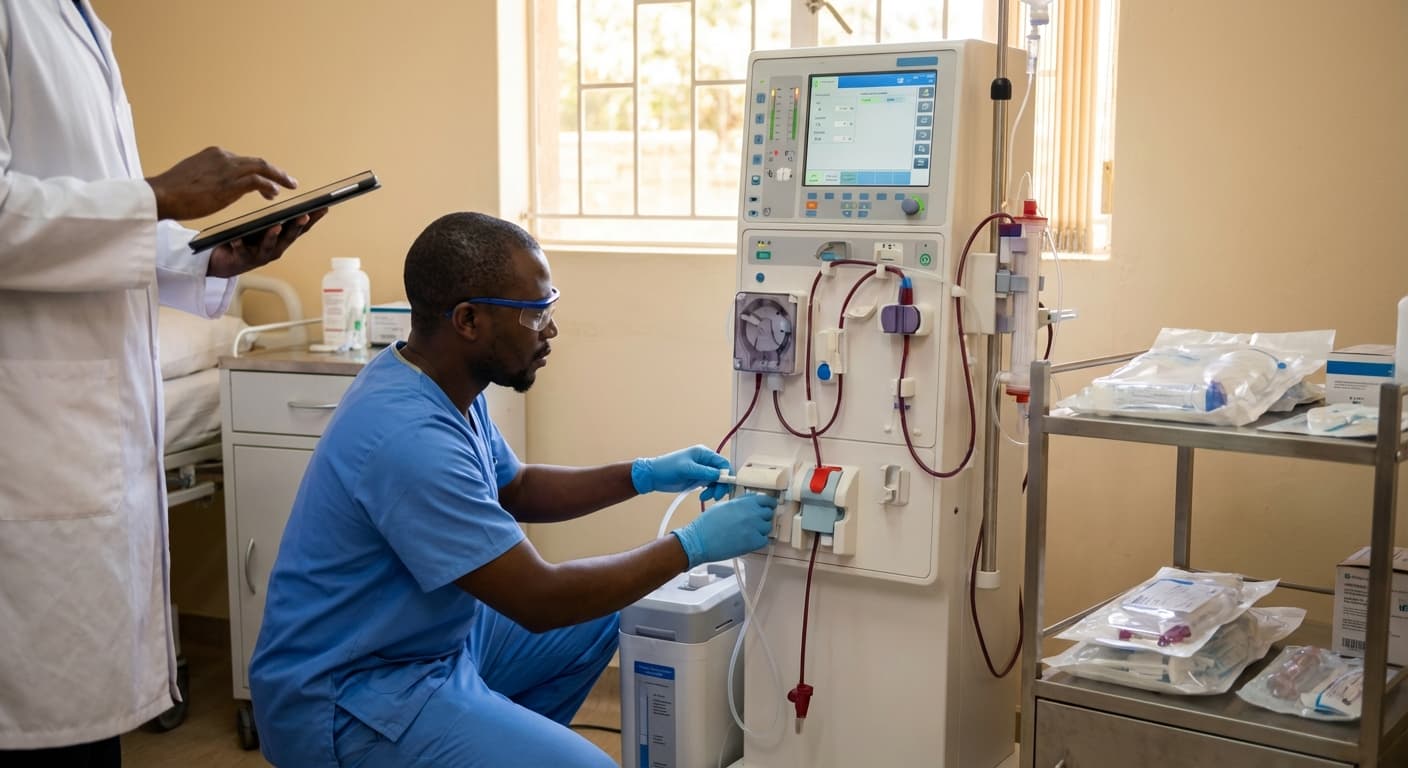
Hemodialysis Machine Installation Service in Libya
Engineering Excellence & Technical Support
Hemodialysis Machine Installation Service High-standard technical execution following OEM protocols and local regulatory frameworks.
Expert On-Site Installation & Calibration
Our certified technicians provide meticulous on-site installation and calibration of hemodialysis machines across Libya, ensuring optimal performance and adherence to international standards.
Comprehensive Training & Support
We offer thorough training for your medical staff on machine operation and maintenance, complemented by ongoing technical support and troubleshooting services to guarantee uninterrupted patient care.
Compliance & Safety Assurance
Our installation services prioritize patient safety and regulatory compliance, ensuring all hemodialysis machines meet Libyan healthcare regulations and are integrated seamlessly into your facility's workflow.
What Is Hemodialysis Machine Installation Service In Libya?
Hemodialysis machine installation service in Libya refers to the specialized process of setting up, configuring, and validating hemodialysis equipment within healthcare facilities across Libya. This service ensures that the machines are operational, safe, and meet stringent medical and regulatory standards for patient care. It encompasses the physical placement of the machine, the connection to necessary utilities (water, electricity, medical gases if applicable), the calibration of internal systems, and testing to confirm proper functioning.
| Who Needs Hemodialysis Machine Installation Service? | Typical Use Cases | |
|---|---|---|
| Nephrology Centers and Clinics: Facilities specializing in kidney disease treatment requiring dedicated hemodialysis units. | Establishment of new hemodialysis departments within existing hospitals. | Upgrading or replacing outdated hemodialysis machines with newer models. |
| Hospitals (General and Specialized): Medical institutions with a need for renal replacement therapy services. | Expansion of existing dialysis capacity to meet growing patient demand. | Setting up temporary dialysis units during medical emergencies or public health crises. |
| Dialysis Service Providers: Companies that own and operate dialysis machines in various healthcare settings. | Deployment of new machines to client facilities as part of service contracts. | Relocation or reinstallation of machines within the same or different facilities. |
| Government Health Ministries and Public Health Agencies: Overseeing and equipping public healthcare infrastructure. | Implementing national dialysis programs and ensuring availability of treatment across the country. | Supporting rural or underserved areas with essential medical equipment. |
Key Components of Hemodialysis Machine Installation Service:
- Site Assessment and Preparation: Evaluating the designated installation area to ensure it meets power, water, drainage, and environmental requirements. This includes assessing space, ventilation, and structural integrity.
- Equipment Unpacking and Physical Placement: Carefully unpacking the hemodialysis machine and its accessories, followed by precise positioning according to manufacturer guidelines and facility layout.
- Utility Connections: Connecting the machine to the facility's water treatment system (e.g., reverse osmosis unit), electrical power outlets (with appropriate grounding and surge protection), and any required medical gas lines.
- System Configuration and Calibration: Programming the machine's parameters, including flow rates, pressures, temperatures, and dialysate composition, according to pre-defined protocols and physician orders. This also involves calibrating sensors and alarms.
- Disinfection and Sterilization: Performing thorough disinfection and sterilization of all internal components and external surfaces of the machine to prevent microbial contamination.
- Functional Testing and Validation: Conducting a series of rigorous tests to verify all machine functions, including blood pump operation, dialysate delivery, ultrafiltration control, and alarm systems. This culminates in a validation report confirming the machine's readiness for clinical use.
- User Training: Providing initial training to the healthcare staff (nephrologists, nurses, technicians) responsible for operating and maintaining the hemodialysis machine.
- Documentation: Generating comprehensive installation reports, validation certificates, and user manuals, which are crucial for compliance and future servicing.
Who Needs Hemodialysis Machine Installation Service In Libya?
The demand for reliable and professional hemodialysis machine installation services in Libya is driven by the critical need to maintain and expand life-saving renal care facilities. These services are essential for ensuring that dialysis units operate efficiently, safely, and comply with all necessary medical and technical standards. The ongoing prevalence of kidney disease and the government's commitment to healthcare infrastructure development create a consistent and growing market for specialized installation expertise.
| Customer Type | Primary Departments Involved | Specific Needs/Reasons for Installation |
|---|---|---|
| Public Hospitals and Healthcare Centers | Nephrology Department, Biomedical Engineering Department, Procurement Department | Establishing new dialysis units, replacing outdated equipment, expanding existing capacity, ensuring compliance with national healthcare standards. |
| Private Hospitals and Clinics | Nephrology Department, Biomedical Engineering/Technical Services, Administration | Offering specialized dialysis services, attracting patients, upgrading to advanced technology, competitive service provision. |
| Dialysis Centers (Public and Private) | Center Management, Biomedical Technicians, Clinical Staff (Nurses, Nephrologists) | Setting up new centers, replacing end-of-life machines, increasing patient throughput, ensuring uninterrupted service delivery, adherence to infection control protocols. |
| Military and Governmental Medical Facilities | Medical Command, Biomedical Engineering Units, Logistics Departments | Providing comprehensive healthcare for military personnel and their families, ensuring operational readiness, specialized medical support. |
| Non-Governmental Organizations (NGOs) providing healthcare | Project Managers, Healthcare Coordinators, Technical Liaisons | Establishing or supporting dialysis services in underserved areas, disaster relief efforts requiring temporary dialysis solutions, long-term healthcare initiatives. |
Target Customers and Departments Requiring Hemodialysis Machine Installation in Libya:
- Public Hospitals and Healthcare Centers
- Private Hospitals and Clinics
- Dialysis Centers (Public and Private)
- Military and Governmental Medical Facilities
- Non-Governmental Organizations (NGOs) providing healthcare
Hemodialysis Machine Installation Service Process In Libya
This document outlines the typical workflow for Hemodialysis Machine Installation Services in Libya, covering the process from initial client inquiry to the successful execution and handover of the installed equipment. The process is designed to ensure proper assessment, secure logistics, professional installation, and client satisfaction.
| Stage | Key Activities | Responsible Parties | Documentation/Deliverables | Key Considerations for Libya |
|---|---|---|---|---|
| Client contacts service provider with a need for hemodialysis machine installation. Discussion of requirements, machine type, quantity, and desired timeline. | Client (Hospital/Clinic), Service Provider Sales Team | Initial inquiry form, meeting minutes, preliminary requirements list. | Language proficiency (Arabic, English). Understanding of local healthcare infrastructure and existing equipment. |
| On-site visit to evaluate the installation location. Assessment of space, power supply, water quality and availability, drainage, ventilation, and any necessary structural modifications. Development of a detailed installation plan. | Service Provider Technical Team, Client Facilities/Biomedical Engineering Department | Site survey report, detailed installation plan, risk assessment, list of required ancillary equipment/materials. | Availability of reliable power and water sources. Compliance with local building codes and healthcare facility standards. Security of the site. |
| Preparation of a comprehensive quotation based on the site assessment and client requirements. Negotiation of terms and conditions. Signing of the installation service contract. | Service Provider Sales/Contracts Department, Client Procurement Department | Formal quotation, detailed scope of work, contract agreement, payment schedule. | Clear payment terms. Understanding of import duties and taxes for equipment and materials. |
| Ordering of the hemodialysis machine(s) and any necessary ancillary equipment/consumables. Arranging for safe transportation and customs clearance in Libya. | Service Provider Procurement Team, Shipping/Logistics Partners | Purchase orders, shipping documents (Bill of Lading, Air Waybill), customs clearance forms, insurance certificates. | Navigating Libyan customs regulations and import procedures. Reliable and secure transportation routes. Potential delays due to port operations or border controls. |
| Ensuring the installation site is ready according to the plan. Completing any necessary structural modifications, electrical upgrades, or plumbing work. Ensuring all necessary tools and materials are on-site. | Client Facilities/Biomedical Engineering Department, Service Provider Installation Team | Confirmation of site readiness, list of prepared utilities, availability of tools and equipment. | Coordination with local contractors if modifications are needed. Ensuring availability of qualified local technicians for support. |
| Safe delivery of the hemodialysis machine(s) to the installation site. Careful unpacking and initial inspection for any visible damage during transit. | Service Provider Installation Team, Logistics Personnel | Delivery confirmation note, initial inspection report. | Handling of sensitive medical equipment. Ensuring secure transfer from vehicle to the installation area. |
| Physical installation of the machine, connecting it to power, water, and drainage systems. Configuration of machine settings according to manufacturer specifications and clinical requirements. | Service Provider Certified Technicians | Installation checklist, configuration log, preliminary setup report. | Adherence to manufacturer's installation protocols. Ensuring proper grounding and electrical safety. |
| Comprehensive testing of all machine functions, including dialysate preparation, blood pump, ultrafiltration, and alarm systems. Calibration of sensors and flow rates. Performing simulated dialysis runs. | Service Provider Certified Technicians, Client Biomedical Engineering Staff | Test results report, calibration certificates, quality control logs. | Verification of water quality parameters. Ensuring accuracy of all readings and settings. |
| Training of clinical and biomedical staff on the operation, basic maintenance, and troubleshooting of the hemodialysis machine. Emphasis on safety procedures and emergency protocols. | Service Provider Training Specialist, Client Clinical and Biomedical Staff | Training attendance records, training material (manuals, presentations), competency assessment results. | Tailoring training content to the specific needs and experience levels of the staff. Providing training in the local language. |
| Joint inspection of the installed and tested machine by the service provider and the client. Addressing any final concerns. Formal handover of the machine and documentation. | Service Provider Project Manager, Client Representative | Final acceptance certificate, signed handover documents, complete user and service manuals. | Ensuring all client requirements have been met. Clear understanding of warranty terms. |
| Provision of ongoing technical support, maintenance services, and spare parts as per the service contract. Emergency response for technical issues. | Service Provider Technical Support and Service Department, Client Biomedical Engineering Department | Service reports, maintenance logs, warranty documentation. | Establishment of a reliable communication channel for support. Availability of spare parts locally or prompt delivery. |
Hemodialysis Machine Installation Service Workflow in Libya
- Inquiry and Initial Consultation
- Site Assessment and Planning
- Quotation and Contract Agreement
- Procurement and Logistics
- Pre-Installation Preparation
- Machine Delivery and Unpacking
- Installation and Configuration
- Testing and Calibration
- Staff Training
- Final Inspection and Handover
- Post-Installation Support
Hemodialysis Machine Installation Service Cost In Libya
Installing a hemodialysis machine is a critical process that requires specialized expertise and adherence to stringent safety and functionality standards. The cost of this service in Libya can vary significantly due to several factors. These include the type and complexity of the hemodialysis machine, the accessibility of the installation site, the existing infrastructure at the healthcare facility, the need for specialized training for staff, and the service provider's own operational costs and profit margins. Furthermore, regulatory requirements and any necessary certifications or inspections can also impact the overall price. Given the specialized nature of the equipment and the potential need for imported parts or highly skilled technicians, pricing is typically provided on a case-by-case basis.
| Service Component | Estimated Cost Range (Libyan Dinar - LYD) |
|---|---|
| Basic Machine Installation (excluding water treatment) | 1,500 - 5,000 LYD |
| Installation with Integrated Water Treatment System | 5,000 - 15,000+ LYD |
| Site Preparation & Infrastructure Upgrades (variable) | 1,000 - 10,000+ LYD |
| Staff Training (per session/module) | 500 - 2,000 LYD |
| Testing, Calibration & Commissioning | 500 - 1,500 LYD |
| Consultation & Site Assessment Fee | 200 - 500 LYD |
Key Factors Influencing Hemodialysis Machine Installation Costs in Libya:
- Type and Model of Hemodialysis Machine: Different machines have varying complexities and features, affecting installation requirements and time.
- Site Assessment and Preparation: The existing infrastructure (power supply, water purification systems, drainage) at the healthcare facility needs to be evaluated and potentially upgraded.
- Accessibility of the Installation Location: Remote or difficult-to-access locations may incur higher transportation and logistical costs.
- Specialized Infrastructure Requirements: This can include dedicated electrical circuits, specific plumbing, ventilation, and waste disposal systems.
- Water Treatment and Purification Systems: Hemodialysis requires highly purified water, and the installation of or integration with a suitable water treatment system is often a significant cost component.
- Ancillary Equipment Installation: This may involve the installation of associated equipment such as dialysis chairs, monitors, and backup power generators.
- Technical Expertise and Labor Costs: The cost of skilled technicians and engineers with specific experience in medical equipment installation is a primary driver.
- Training for Healthcare Staff: Post-installation training for nurses and technicians on machine operation, maintenance, and troubleshooting is often included or offered as an add-on service.
- Testing, Calibration, and Commissioning: Thorough testing and calibration are essential to ensure the machine operates correctly and safely.
- Permits, Licenses, and Regulatory Compliance: Any required government permits, inspections, or certifications add to the overall cost.
- Warranty and After-Sales Service Agreements: The terms of the warranty and any ongoing maintenance contracts will influence the initial installation package price.
- Geographical Location within Libya: Costs can vary between major cities and more rural or less developed areas due to logistical considerations and local market rates.
Affordable Hemodialysis Machine Installation Service Options
Installing a hemodialysis machine is a critical step for healthcare facilities aiming to provide life-sustaining treatment. This service involves not just the physical placement of the machine but also ensuring proper plumbing, electrical, water purification, and waste management systems are in place and compliant with all regulatory standards. Choosing an affordable installation service doesn't mean compromising on quality or safety. By understanding value bundles and implementing smart cost-saving strategies, facilities can significantly reduce the overall expenditure while ensuring a reliable and functional dialysis unit.
| Cost-Saving Strategy | Description | Potential Savings Impact |
|---|---|---|
| Bundle Negotiation & Customization | Actively negotiate prices with providers. Inquire about customizing standard bundles to exclude services you already have in-house or can source more affordably elsewhere. For example, if your facility has an existing, compliant water treatment system, see if that cost can be deducted from the bundle price. | Moderate to High: Can reduce overall package cost by 10-25% depending on customization. |
| Phased Installation | For larger facilities or those with budget constraints, consider a phased installation approach. Install the core machine and essential plumbing first, then budget for advanced water purification or specialized waste management in a subsequent phase. This spreads the cost over time. | Moderate: Spreads capital expenditure, can improve cash flow. May lead to slightly higher long-term costs if phased components are less efficient. |
| Leveraging In-House Expertise | If your facility has qualified in-house plumbers, electricians, or IT personnel, discuss with the installation service provider whether they can oversee or collaborate on certain aspects. This could reduce the labor costs charged by the external provider. | Low to Moderate: Savings depend on the scope of in-house involvement, potentially reducing labor costs by 5-15%. |
| Bundling with Machine Purchase | Often, purchasing the hemodialysis machine directly from a manufacturer or authorized dealer comes with options for discounted or bundled installation services. Explore these package deals thoroughly. | Moderate: Can offer significant discounts on installation when bundled with equipment purchase, often 10-20% off standard installation rates. |
| Seeking Multiple Quotes & Comparing Apples-to-Apples | Obtain detailed quotes from at least three reputable installation service providers. Ensure each quote clearly outlines all included components and services to allow for an accurate comparison of value and cost. | Moderate: Helps identify the best value for money and avoid overpaying, potentially saving 5-10% through competitive pricing. |
| Long-Term Service Agreements | While an upfront cost, some providers offer installation at a reduced rate when paired with a long-term service and maintenance contract. This can be cost-effective over the lifespan of the equipment, ensuring reliable operation and predictable costs. | Low upfront, Moderate long-term: Reduced installation cost, but commitment to ongoing service fees. |
| Consider Refurbished or Certified Pre-owned Equipment | For facilities with very tight budgets, installing a certified pre-owned or refurbished hemodialysis machine can significantly reduce capital outlay. Installation services for these machines may also be more competitively priced. | High: Can reduce overall project cost by 20-50% by lowering equipment and potentially installation costs. |
Understanding Value Bundles in Hemodialysis Machine Installation
- Basic Installation: This typically includes the physical setup of the machine, initial connection to power and water, and basic testing. It's the most cost-effective option but may require separate arrangements for water purification or waste disposal.
- Standard Installation Bundle: This package usually encompasses basic installation plus essential components like a portable water purification unit, basic plumbing modifications, and connection to a designated waste disposal system. It offers a good balance of cost and essential functionality.
- Comprehensive Installation Package: This premium bundle includes all aspects of the standard package, plus more advanced water treatment systems (e.g., reverse osmosis with full redundancy), specialized electrical work, complete waste management solutions, integration with existing facility infrastructure, and potentially initial staff training on machine operation. This is a higher upfront investment but can save on future integration issues and training needs.
- Turnkey Solutions: These are the most inclusive options, often managed by the manufacturer or a specialized third-party. They cover everything from site assessment, design, all installation components, water treatment, waste management, regulatory compliance checks, and full staff training. While the most expensive upfront, they offer the highest level of convenience and assurance.
Verified Providers In Libya
Finding verified healthcare providers in Libya is crucial for ensuring quality and trustworthy medical services. Franance Health stands out as a premier choice due to its rigorous credentialing process and commitment to patient well-being. Their network comprises highly qualified medical professionals and facilities that meet international standards, offering a range of specialized care. Choosing Franance Health provides access to a reliable healthcare system, peace of mind, and a commitment to excellence in patient outcomes. This dedication to verification and quality makes them the best choice for your healthcare needs in Libya.
| Provider Type | Verification Criteria | Franance Health Assurance |
|---|---|---|
| Doctors & Specialists | Medical license, board certifications, proven clinical experience, adherence to ethical guidelines. | Franance Health verifies all credentials, conducts background checks, and monitors patient feedback. |
| Hospitals & Clinics | Accreditation, compliance with health and safety regulations, quality of infrastructure and equipment, patient care protocols. | Franance Health partners with facilities that meet stringent operational and quality standards. |
| Diagnostic Centers | Qualified technicians, calibrated equipment, adherence to quality control measures, accurate reporting. | Franance Health ensures that partner diagnostic centers maintain high accuracy and reliability. |
| Therapy & Rehabilitation Services | Licensed therapists, specialized training, evidence-based treatment methodologies, patient progress tracking. | Franance Health connects patients with certified therapists committed to recovery and well-being. |
Why Franance Health is the Best Choice for Verified Providers in Libya:
- Rigorous Credentialing Process: Franance Health meticulously vets all its healthcare providers, ensuring they meet high professional and ethical standards.
- Access to Qualified Professionals: Their network includes experienced doctors, specialists, and allied health professionals with proven expertise.
- International Standard Facilities: Partnered facilities adhere to strict safety and quality protocols, often aligning with international benchmarks.
- Comprehensive Range of Services: From general practice to specialized treatments, Franance Health connects patients with the appropriate providers.
- Patient-Centric Approach: The organization prioritizes patient safety, satisfaction, and positive health outcomes.
- Trust and Reliability: Their verification process instills confidence in the quality of care received.
- Commitment to Excellence: Franance Health is dedicated to continuously improving healthcare accessibility and standards in Libya.
Scope Of Work For Hemodialysis Machine Installation Service
This Scope of Work (SOW) outlines the services required for the installation of new hemodialysis machines at [Hospital/Clinic Name], [Location]. The objective is to ensure the safe, efficient, and compliant installation of [Number] hemodialysis machines, making them fully operational for patient use. This SOW details the technical deliverables, standard specifications, and responsibilities of all parties involved. The contractor shall provide all necessary labor, materials, tools, and equipment to perform the installation in accordance with manufacturer guidelines, relevant healthcare regulations, and best industry practices.
| Section | Description | Technical Deliverables | Standard Specifications |
|---|---|---|---|
| Detailed planning, site assessment, and preparation of designated installation areas. This includes verifying utility availability and ensuring adequate space. | Site survey report, detailed installation schedule, confirmation of utility readiness (power, water, drainage, medical gases). | Installation areas must meet manufacturer's spatial requirements, environmental conditions (temperature, humidity), and ergonomic considerations. Electrical outlets must be dedicated and meet voltage/amperage requirements. Water supply must meet purity and pressure specifications. Adequate ventilation and lighting are essential. |
| Unpacking, assembly, physical placement, and secure mounting of the hemodialysis machines. | Installed hemodialysis machines, all associated plumbing and electrical connections, system self-tests successfully completed. | Machines to be installed on level, stable surfaces. All connections (power, water, drainage, air) must be secure, leak-free, and compliant with local codes and manufacturer guidelines. Medical gas connections (if applicable) must be performed by certified technicians. |
| Connection and integration of the hemodialysis machines with the facility's existing or new water treatment system. | Successful integration and operational testing of water supply to each machine, verified by water quality testing. | Water supply must meet AAMI/ISO standards for hemodialysis water. Flow rates, pressure, and dialysate conductivity must be within manufacturer-specified ranges. All connections to the water treatment system must be secure and sanitary. |
| Installation and verification of all necessary electrical and plumbing connections for the hemodialysis machines and associated equipment. | Completed and tested electrical and plumbing hookups, documented with relevant certifications. | Electrical connections must be to dedicated, grounded circuits with appropriate surge protection. Plumbing connections must utilize approved materials, prevent cross-contamination, and meet local plumbing codes. Drainage must be adequate to prevent backflow. |
| Comprehensive calibration of all machine parameters and functional testing to ensure optimal performance. | Fully calibrated machines, functional test reports, pass/fail results for all tests, pre-use safety checks completed. | Calibration must adhere strictly to manufacturer's recommended procedures and tolerances. All safety features (e.g., air embolism detection, pressure monitors) must be verified. Alarm systems must be tested and functional. |
| Performing initial disinfection and sterilization cycles on the installed machines as per manufacturer recommendations. | Machines ready for operational use following approved disinfection/sterilization protocols. | Disinfection and sterilization procedures must be conducted using manufacturer-approved chemicals and methods. Verification of successful disinfection/sterilization cycles. |
| Providing comprehensive training to designated clinical and technical staff on the operation, basic maintenance, and troubleshooting of the hemodialysis machines. | Training materials (manuals, presentations), attendance records, competency assessments, post-training support plan. | Training content must cover machine setup, patient connection/disconnection, alarm management, basic troubleshooting, cleaning, and disinfection. Training should be hands-on and tailored to the skill level of the staff. |
| Providing all necessary documentation, including installation reports, test results, warranty information, and user manuals, and formally handing over the operational machines. | Complete installation package, including signed handover forms, operation and maintenance manuals, warranty certificates, and final inspection reports. | All documentation must be accurate, complete, and readily accessible. Warranty information must be clearly outlined, including duration and coverage. User manuals should be the latest versions provided by the manufacturer. |
| Providing limited post-installation support to address any immediate issues or questions arising after handover. | Defined period of post-installation support, contact information for support personnel. | Support period typically ranges from [Number] to [Number] days/weeks. Support should be responsive and cover initial operational challenges. |
Key Objectives
- To successfully install and commission [Number] new hemodialysis machines.
- To ensure all installations meet manufacturer specifications and performance standards.
- To provide comprehensive training to hospital/clinic staff on the operation and maintenance of the installed machines.
- To ensure compliance with all relevant healthcare facility regulations and safety standards.
- To minimize disruption to existing patient care services during the installation process.
Service Level Agreement For Hemodialysis Machine Installation Service
This Service Level Agreement (SLA) outlines the guaranteed response times and uptime for the Hemodialysis Machine Installation Service provided by [Your Company Name] to [Client Name]. This SLA is an appendix to the Master Service Agreement (MSA) dated [Date of MSA].
| Service Level | Response Time Target | Uptime Guarantee | Remedy for Failure |
|---|---|---|---|
| Emergency | 1 Hour (during 24/7 Support) | Not Applicable (focus on immediate resolution) | Expedited on-site technician dispatch, priority support. If resolution is delayed beyond 8 hours for an Emergency, a credit of [X]% of the installation fee will be applied for each subsequent 4-hour block of unresolved Emergency Downtime. |
| Urgent | 4 Business Hours (during Business Hours) | Not Applicable (focus on prompt resolution) | Dedicated support engineer assigned. If resolution is delayed beyond 24 hours for an Urgent issue, a credit of [Y]% of the installation fee will be applied for each subsequent 8-hour block of unresolved Urgent Downtime. |
| Standard | 8 Business Hours (during Business Hours) | N/A (as this is a one-time installation service) | N/A (as this is a one-time installation service) |
Key Definitions
- Service: The professional installation of one or more hemodialysis machines, including setup, testing, and initial calibration, as specified in the accompanying Purchase Order.
- Downtime: A period during which the installed hemodialysis machine(s) are not operational due to issues directly attributable to the installation service (e.g., improper connection, faulty initial setup). This excludes issues arising from the machine's inherent defects, client-side infrastructure problems (power, water, plumbing), or planned maintenance.
- Emergency: A critical failure of the installed hemodialysis machine(s) that prevents immediate and safe patient treatment.
- Urgent: A significant issue impacting the functionality of the installed hemodialysis machine(s) but not posing an immediate threat to patient safety, potentially allowing for temporary workarounds.
- Standard: A non-critical issue or request related to the installation service.
- Business Hours: 9:00 AM to 5:00 PM [Client's Time Zone], Monday through Friday, excluding public holidays observed by [Your Company Name].
- 24/7 Support: Availability of support personnel outside of Business Hours, including weekends and public holidays.
Frequently Asked Questions

Ready when you are
Let's scope your Hemodialysis Machine Installation Service in Libya project in Libya.

Scaling healthcare logistics and technical systems across the entire continent.