
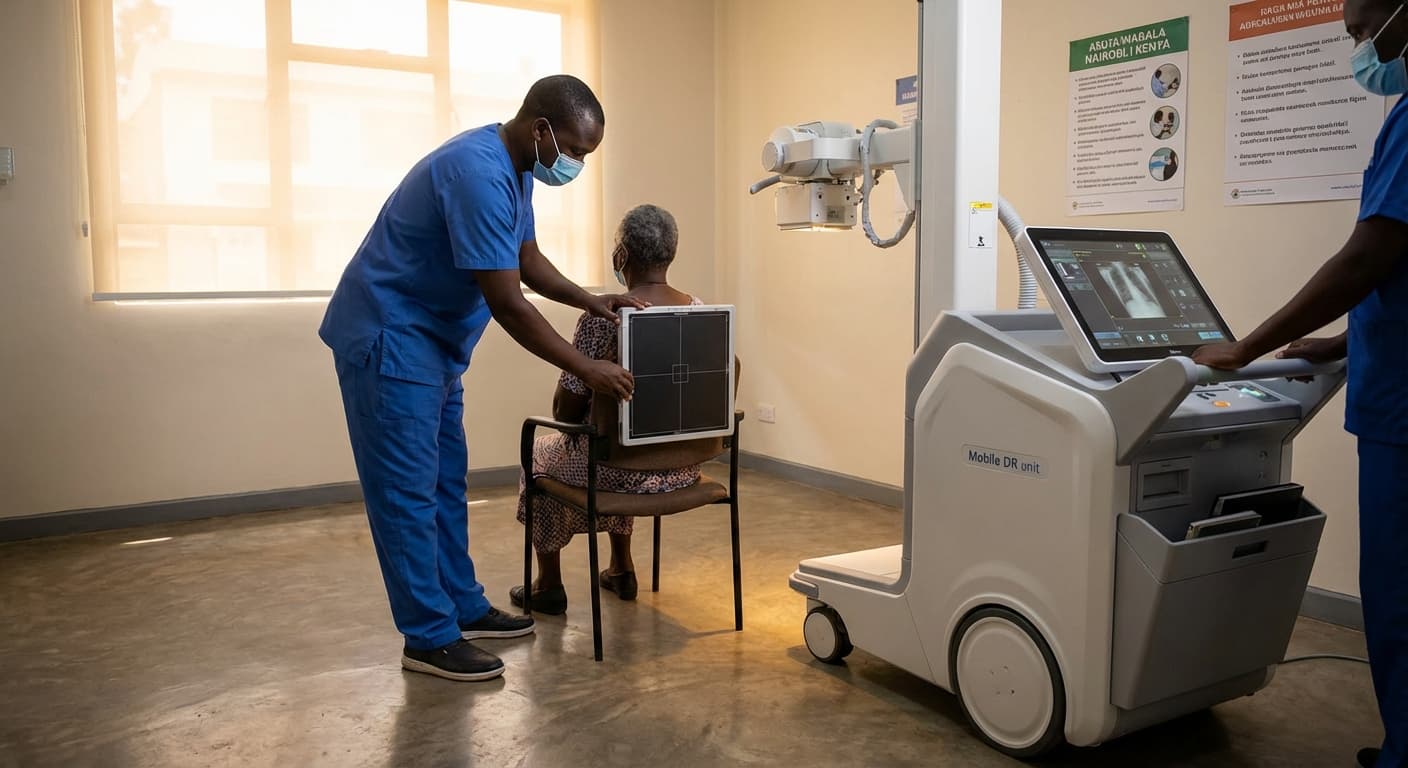
Digital X-Ray Installation Service (Mobile DR) in Libya
Engineering Excellence & Technical Support
Digital X-Ray Installation Service (Mobile DR) High-standard technical execution following OEM protocols and local regulatory frameworks.
On-Site Mobile DR Deployment
Rapid, on-location installation of cutting-edge Mobile DR systems across Libya, ensuring minimal downtime for critical imaging services. Our specialized technicians bring advanced diagnostic capabilities directly to your healthcare facility or remote site.
Seamless System Integration & Calibration
Expert integration of Mobile DR units with existing hospital IT infrastructure, PACS, and HIS. We provide precise calibration and testing to guarantee optimal image quality and workflow efficiency, adhering to Libyan healthcare standards.
End-to-End Installation & Training
Comprehensive service from initial site assessment and setup to thorough user training for your medical staff. Our Libya-based installation teams are equipped to handle all aspects of Mobile DR deployment, empowering your personnel with the skills to operate advanced imaging technology.
What Is Digital X-ray Installation Service (Mobile Dr) In Libya?
Digital X-Ray Installation Service (Mobile DR) in Libya refers to the comprehensive process of deploying and integrating mobile digital radiography (DR) systems within healthcare facilities and mobile units across Libya. This service encompasses the physical installation, network configuration, software setup, calibration, and initial user training for these advanced imaging devices. Mobile DR systems offer portability, enabling diagnostic imaging at the point of care, which is particularly valuable in remote areas, emergency situations, and for patients with mobility issues. The service aims to ensure these systems are fully operational, compliant with relevant medical and technical standards, and capable of delivering high-quality diagnostic images efficiently.
| Target Audience | Primary Need | Typical Use Cases |
|---|---|---|
| Hospitals and Clinics (Urban & Rural) | Enhancing diagnostic capabilities, reducing patient wait times, improving workflow efficiency, and providing on-demand imaging services. | Emergency department imaging, bedside X-rays for immobile patients, outpatient diagnostic services, and interventional radiology support. |
| Field Hospitals and Disaster Response Units | Rapid deployment of diagnostic imaging in remote or temporary settings, facilitating immediate medical assessment and treatment during emergencies. | Triage and assessment of casualties in mass casualty incidents, battlefield medicine, and humanitarian aid operations. |
| Mobile Medical Units and Diagnostic Vans | Extending healthcare services to underserved populations, screening programs, and remote communities lacking fixed imaging facilities. | Mobile mammography and general radiography screening, industrial health check-ups, and outreach programs in remote Libyan regions. |
| Specialized Medical Centers (e.g., Orthopedics, Cardiology) | Acquiring high-resolution images for specific diagnostic and interventional procedures where portability and precision are critical. | Intraoperative imaging, interventional cardiology suites, and specialized orthopedic assessments. |
Key Components of Digital X-Ray Installation Service (Mobile DR) in Libya
- Site Assessment and Planning: Evaluating existing infrastructure, power availability, space requirements, and network connectivity to determine optimal placement and configuration of the mobile DR unit.
- Hardware Installation: Physical mounting, connection of power and data cables, and integration of the X-ray generator, detector (flat panel), workstation, and any ancillary equipment.
- Software Configuration and Integration: Installation and setup of the Digital Imaging and Communications in Medicine (DICOM) compliant Picture Archiving and Communication System (PACS) or integration with existing PACS, and the X-ray acquisition software.
- Network Connectivity: Establishing secure and reliable network connections for image transfer, PACS integration, and remote diagnostics, adhering to cybersecurity protocols.
- System Calibration and Quality Assurance: Performing precise calibration of the X-ray generator, detector response, and image processing parameters to ensure accurate and consistent image quality and adherence to radiation safety standards.
- Radiation Shielding and Safety Compliance: Verifying and implementing appropriate radiation shielding measures and ensuring compliance with Libyan nuclear and radiological safety regulations.
- User Training and Handover: Providing comprehensive training to radiographers, technicians, and IT personnel on system operation, image acquisition, post-processing, troubleshooting, and maintenance procedures.
- Post-Installation Support and Warranty: Offering initial technical support, system validation, and warranty management to ensure sustained operational performance.
Who Needs Digital X-ray Installation Service (Mobile Dr) In Libya?
Mobile Digital Radiography (DR) units offer advanced imaging capabilities that can be particularly beneficial in Libya's diverse healthcare landscape. These portable systems eliminate the need to transport unstable patients to fixed X-ray rooms, providing on-demand diagnostic imaging where it's needed most. This is especially relevant in a country facing infrastructure challenges and a dispersed population.
| Department/Facility Type | Key Needs Addressed by Mobile DR | Specific Applications |
|---|---|---|
| Emergency Departments (EDs) | Rapid diagnosis of trauma, acute conditions, and patient stabilization without moving critical patients. | Chest X-rays for respiratory distress, limb X-rays for fractures, abdominal X-rays for suspected internal injuries. |
| Intensive Care Units (ICUs) | Imaging critically ill patients at the bedside, reducing infection risk and patient discomfort. | Ventilator checks, line and tube placements, pneumonia detection, cardiac assessments. |
| Surgical Departments | Intraoperative imaging for verification and post-operative assessment. | Checking implant placement, confirming reduction of fractures, assessing for complications. |
| Orthopedic Departments | Imaging patients with suspected fractures, dislocations, or post-surgical follow-ups. | Fracture assessment, joint alignment checks, implant integrity. |
| Pulmonary/Respiratory Departments | Diagnosing and monitoring respiratory illnesses, especially in patients with limited mobility. | Pneumonia, tuberculosis (TB) screening, COPD exacerbations, lung consolidation detection. |
| Pediatric Departments | Minimizing patient movement and distress for young patients, especially newborns and infants. | Congenital abnormalities, respiratory distress in neonates, fracture assessment in children. |
| Ambulance Services | On-scene diagnostics to guide immediate treatment and destination decisions. | Initial assessment of major trauma, chest pain evaluation, suspected pneumothorax. |
| Field Hospitals/Mobile Clinics | Providing essential imaging services in areas lacking fixed infrastructure or during public health crises. | General diagnostic imaging for a wide range of conditions, disaster response. |
| Remote Healthcare Posts | Extending advanced diagnostic capabilities to underserved populations. | Screening for common ailments, injury assessment, basic diagnostic imaging. |
Target Customers for Mobile DR Installation Service in Libya
- Hospitals (both public and private)
- Clinics and Diagnostic Centers
- Emergency Medical Services (EMS) and Ambulance Services
- Field Hospitals and Mobile Medical Units
- Military and Defense Medical Facilities
- Remote Healthcare Facilities
- Trauma Centers
- Specialized Medical Centers (e.g., orthopedic, respiratory)
Digital X-ray Installation Service (Mobile Dr) Process In Libya
This document outlines the typical workflow for a Digital X-Ray Installation Service (Mobile DR) in Libya, from the initial client inquiry to the successful execution and handover of the system. The process is designed to ensure a smooth and efficient installation, minimizing disruption and maximizing client satisfaction.
| Phase | Key Activities | Responsible Party | Deliverables |
|---|---|---|---|
| Inquiry & Needs Assessment | Client contact, information gathering, preliminary consultation | Client, Service Provider | Understanding of client requirements, initial solution overview |
| Site Survey & Technical Feasibility | On-site visit, infrastructure assessment, risk analysis | Service Provider (Technical Team) | Site survey report, technical recommendations |
| Proposal & Quotation | Solution design, cost estimation, contract negotiation | Service Provider (Sales & Technical Teams), Client | Formal proposal, quotation, signed service agreement |
| Procurement & Logistics | Equipment ordering, importation, transportation | Service Provider (Procurement & Logistics Teams) | Delivered Mobile DR system at client site |
| Pre-Installation Preparation | Site modifications (if needed), equipment staging | Client (for modifications), Service Provider | Prepared installation site, unpacked equipment |
| Installation & Configuration | Physical installation, software setup, integration | Service Provider (Installation Technicians) | Fully installed and configured Mobile DR system |
| Testing & Quality Assurance | Image quality tests, performance verification, UAT | Service Provider (QA Team), Client (UAT) | Test reports, successful QA sign-off |
| Training & Handover | User training, documentation provision, formal handover | Service Provider (Training Specialists), Client | Trained staff, handover documentation, client acceptance |
| Post-Installation Support & Maintenance | Follow-up support, warranty service, ongoing maintenance | Service Provider (Support & Maintenance Teams) | Ongoing system functionality, reduced downtime |
Digital X-Ray Installation Service (Mobile DR) Workflow in Libya
- 1. Initial Inquiry & Needs Assessment:
- Client Contact: The process begins when a healthcare facility in Libya (hospital, clinic, imaging center) expresses interest in acquiring and installing a Mobile DR (Digital Radiography) system.
- Information Gathering: The service provider receives the inquiry and initiates contact to understand the client's specific needs. This includes:
- **Type of Facility:** (e.g., hospital ward, emergency room, remote clinic)- **Intended Use:** (e.g., bedside imaging, trauma, general radiography)- **Budgetary Constraints:**- **Existing Infrastructure:** (power, network, space)- **Desired Features & Capabilities:**- **Timeline for Installation:**- Preliminary Consultation: A preliminary discussion, possibly a virtual meeting or phone call, to clarify requirements and provide initial information about available Mobile DR solutions.
- 2. Site Survey & Technical Feasibility Study:
- On-Site Visit: A qualified technician or engineer from the service provider visits the client's facility in Libya.
- Assessment of Installation Site: Detailed evaluation of the designated installation area, considering:
- **Space Availability & Layout:**- **Power Supply & Connectivity:** (outlets, grounding, voltage stability)- **Environmental Factors:** (temperature, humidity, dust control)- **Structural Integrity:** (for mounting or positioning)- **Network Infrastructure:** (for PACS integration, if applicable)- **Security Measures:**- Risk Assessment: Identification of any potential challenges or modifications needed for successful installation.
- Technical Report Generation: A comprehensive report detailing the site conditions, any required modifications, and technical recommendations.
- 3. Proposal & Quotation:
- Customized Solution Design: Based on the needs assessment and site survey, a tailored Mobile DR solution is proposed, including the specific equipment model, software, accessories, and any necessary site modifications.
- Detailed Quotation: A formal quotation is provided to the client, outlining the costs for the equipment, installation, training, and any additional services. This includes:
- **Equipment Cost:**- **Installation Labor:**- **Site Preparation/Modification Costs:**- **Software & Licensing Fees:**- **Training Fees:**- **Warranty & Support Costs:**- Contract Negotiation: Discussion and finalization of the terms and conditions of the service agreement.
- 4. Procurement & Logistics:
- Equipment Order: Upon client approval and signing of the contract, the Mobile DR system and associated components are ordered from the manufacturer or supplier.
- Importation & Customs Clearance: Handling all necessary procedures for importing the equipment into Libya, including customs documentation and duty payments.
- Transportation & Delivery: Arranging secure and timely transportation of the equipment to the client's facility in Libya.
- 5. Pre-Installation Preparation:
- Site Modifications: If required by the site survey, any necessary electrical, structural, or network modifications are carried out by authorized personnel.
- Equipment Staging: Unpacking and initial inspection of the delivered equipment to ensure all components are present and undamaged.
- 6. Installation & Configuration:
- On-Site Installation: A team of certified technicians performs the physical installation of the Mobile DR system, including positioning the unit, connecting power and network cables, and setting up accessories.
- Software Installation & Configuration: Installation and configuration of the DR imaging software, including calibration and system parameter setup.
- Integration (if applicable): Integration with existing Picture Archiving and Communication Systems (PACS) or hospital information systems (HIS).
- Initial System Testing: Performing basic functional tests to ensure all components are operational and communicating correctly.
- 7. Testing & Quality Assurance (QA):
- Image Quality Testing: Conducting a series of tests to evaluate the image quality, resolution, and contrast of the DR system using phantoms and test objects.
- Performance Verification: Checking the system's performance against manufacturer specifications, including exposure times, processing speeds, and detector responsiveness.
- User Acceptance Testing (UAT): Involving key client personnel to test the system in real-world scenarios and confirm it meets their operational requirements.
- Troubleshooting & Adjustments: Addressing any issues or anomalies identified during testing and making necessary adjustments.
- 8. Training & Handover:
- User Training: Comprehensive training sessions for the client's radiographers, technicians, and relevant medical staff. Training covers:
- **System Operation:**- **Image Acquisition Protocols:**- **Image Post-Processing:**- **Basic Troubleshooting:**- **System Maintenance:**- Documentation Handover: Providing all relevant user manuals, technical documentation, warranty information, and service records.
- Formal Handover: A formal handover of the installed and tested Mobile DR system to the client, signifying project completion.
- 9. Post-Installation Support & Maintenance:
- Initial Follow-up: A period of follow-up support to address any immediate user queries or minor issues.
- Warranty Service: Providing ongoing warranty support as per the contract.
- Preventive Maintenance: Offering scheduled preventive maintenance services to ensure the long-term optimal performance of the system.
- Technical Support: Providing ongoing technical support for any operational or repair needs.
- Software Updates: Managing and installing software updates as released by the manufacturer.
Digital X-ray Installation Service (Mobile Dr) Cost In Libya
The cost of installing a Digital X-Ray (Mobile DR) system in Libya can vary significantly based on several factors. These factors influence the overall price, making it crucial for healthcare providers to understand them before making an investment. Libya's economic conditions, import duties, and the specific logistical challenges of the region can also play a role in the final quotation.
| Cost Component | Estimated Range (Libyan Dinar - LYD) | Notes |
|---|---|---|
| Mobile DR System Unit (Excluding Installation) | 80,000 - 300,000+ | Varies greatly by brand, specifications, and detector size. Entry-level to high-end systems. |
| Installation & Site Preparation | 10,000 - 50,000+ | Depends on existing infrastructure, electrical work, and any necessary modifications. May be included in system price by some vendors. |
| Logistics, Shipping & Customs Duties | 15,000 - 70,000+ | Highly variable based on origin country, shipping method, and import regulations in Libya. |
| Training & Initial Support | 5,000 - 20,000 | Covers initial user and technical training. May be bundled. |
| Warranty (Standard 1-2 Years) | Often included in the initial system price | Extended warranties will incur additional costs. |
| Optional Accessories (e.g., PACS integration, extra workstations) | 10,000 - 50,000+ | Depends on the specific requirements. |
| Total Estimated Installation Cost (All-Inclusive) | 120,000 - 500,000+ LYD | This is a broad estimate. Actual costs will depend on the specific choices and negotiations. |
Key Pricing Factors for Mobile DR Installation in Libya
- Brand and Model of the Mobile DR System: Different manufacturers offer varying levels of technology, image quality, portability, and software features. Premium brands with advanced capabilities will naturally command higher prices.
- System Specifications and Features: Factors like detector size, wireless vs. wired connectivity, built-in software for image processing and reporting, and battery life contribute to the cost. Systems with higher resolution detectors or advanced AI-driven analysis tools will be more expensive.
- Installation Complexity and Site Preparation: The existing infrastructure of the healthcare facility plays a significant role. If significant electrical upgrades, structural modifications, or specialized shielding are required for the installation area, costs will increase.
- Logistics and Transportation: Importing medical equipment into Libya can involve substantial shipping, customs duties, and potential insurance costs. The remoteness of the installation site within Libya can also add to transportation expenses.
- Training and After-Sales Support: The package often includes initial training for radiographers and technicians. The extent and duration of this training, along with the provider's after-sales support package (maintenance, software updates), will impact the overall price.
- Warranty and Service Agreements: Extended warranties and comprehensive service agreements for a specified period will add to the initial investment but provide long-term cost predictability.
- Supplier and Negotiating Power: The reputation and established presence of the supplier in Libya, along with the negotiating skills of the buyer, can influence the final price. Local distributors might offer more competitive pricing or flexible payment terms.
- Additional Accessories and Peripherals: This could include specialized trolleys, docking stations, PACS (Picture Archiving and Communication System) integration, or additional workstations.
Affordable Digital X-ray Installation Service (Mobile Dr) Options
Navigating the acquisition and installation of a new digital X-ray system, particularly a Mobile Digital Radiography (DR) unit, can seem daunting. However, by understanding available options, value bundles, and cost-saving strategies, healthcare providers can make informed decisions that optimize both patient care and financial investment. This guide explores affordable installation services, focusing on Mobile DR systems, and outlines how to maximize value.
| Value Bundle Components | Description | Cost-Saving Implications |
|---|---|---|
| Hardware & Software Package: | Includes the Mobile DR unit, acquisition workstation, and necessary imaging software. Often bundled with essential accessories. | Negotiating a package deal can lead to volume discounts compared to purchasing components separately. Pre-negotiated pricing reduces the need for individual vendor research. |
| Installation & Training: | Comprehensive on-site setup, calibration, and basic operational training for radiology staff. May include initial IT integration. | Bundled installation often comes at a reduced rate than standalone services. Training ensures immediate proficiency, reducing downtime and the need for costly follow-up training. |
| Extended Warranty & Maintenance: | Post-installation support, including extended warranty periods and scheduled preventative maintenance services. | Bundled maintenance contracts can offer lower annual costs and priority service, preventing expensive emergency repairs and maximizing equipment uptime. |
| PACS/RIS Integration Support: | Assistance with connecting the new DR system to your existing PACS or RIS for seamless image workflow. | Integrated support streamlines the process, reducing IT labor costs and potential delays in image accessibility. |
| Financing & Leasing Options: | Often, bundled deals can be structured with favorable financing or leasing terms, spreading the cost over time. | Leasing can preserve capital, while attractive financing can lower the overall interest paid, making the acquisition more manageable. |
Understanding Mobile DR Installation Services
- What is Mobile DR? Mobile DR units offer flexibility, allowing for imaging at the patient's bedside or in various locations within a facility. This is crucial for patients with limited mobility, in intensive care units, or during emergencies.
- Installation Service Scope: Professional installation typically includes site assessment, equipment setup, calibration, basic user training, and integration with existing PACS (Picture Archiving and Communication System) or RIS (Radiology Information System). It ensures the system operates safely and efficiently.
- Why Professional Installation is Crucial: Improper installation can lead to image quality issues, equipment malfunctions, safety hazards, and voided warranties. Certified technicians ensure optimal performance and compliance with regulatory standards.
Verified Providers In Libya
In Libya's evolving healthcare landscape, identifying trustworthy and credentialed providers is paramount for ensuring quality patient care. Franance Health stands out as a beacon of reliability, offering a network of verified healthcare professionals and facilities. This commitment to verification underscores their dedication to patient safety, ethical practices, and clinical excellence. Choosing Franance Health means opting for a healthcare experience that prioritizes competence, transparency, and superior patient outcomes.
| Credential Type | Franance Health Verification Standard | Benefit to Patients |
|---|---|---|
| Medical Licenses & Certifications | Valid and current licenses/certifications from recognized Libyan and international bodies. | Ensures practitioners are legally authorized and meet minimum competency standards. |
| Educational Background | Verification of degrees and diplomas from accredited medical institutions. | Confirms foundational knowledge and specialized training. |
| Professional Experience | Thorough review of past work history, including references where applicable. | Assesses practical application of knowledge and clinical judgment. |
| Specialty Training & Fellowships | Confirmation of advanced training and board certifications in specific medical disciplines. | Guarantees access to highly skilled specialists for complex conditions. |
| Adherence to Ethical Standards | Background checks for any disciplinary actions or ethical violations. | Promotes a safe and trustworthy patient-provider relationship. |
| Facility Accreditation (for partner institutions) | Partnership with facilities holding recognized accreditation for quality and safety. | Ensures a safe and well-equipped environment for treatment. |
Why Franance Health Credentials Matter:
- Rigorous Vetting Process: Franance Health employs a stringent credentialing process that goes beyond basic licensing. This includes verifying educational backgrounds, professional experience, specialized training, and adherence to ethical standards.
- Commitment to Quality: Their verified providers are committed to delivering high-quality medical services, employing evidence-based practices, and staying abreast of the latest advancements in healthcare.
- Patient Safety First: Verification ensures that all partnered providers meet stringent safety protocols and maintain up-to-date certifications, directly contributing to a safer patient experience.
- Transparency and Trust: By clearly outlining their verification process and partnering with accredited institutions, Franance Health builds trust and provides patients with confidence in the care they receive.
- Access to Specialized Expertise: Franance Health's network includes specialists across various medical fields, all meticulously vetted to ensure they possess the necessary expertise and qualifications.
Scope Of Work For Digital X-ray Installation Service (Mobile Dr)
This Scope of Work (SOW) outlines the requirements for the installation of a Mobile Digital Radiography (DR) X-ray system. The service encompasses all necessary activities to ensure the successful integration, testing, and handover of the mobile DR unit within the client's facility. This includes site preparation, equipment installation, system configuration, calibration, user training, and documentation. The objective is to provide a fully functional and compliant mobile DR solution meeting all specified technical requirements and performance standards.
| Category | Specification/Requirement | Details/Notes | Compliance Standard |
|---|---|---|---|
| Mobile DR Unit | Mobility | Battery-powered with sufficient operational time for a full shift; Easy maneuverability in patient rooms and corridors; Obstacle detection/avoidance system (optional but preferred). | Manufacturer Specifications |
| Mobile DR Unit | X-ray Generator | kVp Range: 40-150 kVp; mA Range: 10-500 mA; Exposure Time: 0.003-10 sec; Power Output: 15-50 kW (min); Dual focus tube. | IEC 60601-2-7, IEC 60601-1 |
| Detector | Type | Wireless or Tethered; Cesium Iodide (CsI) or Gadolinium Oxysulfide (GOS) scintillator; Flat panel detector. | Manufacturer Specifications |
| Detector | Active Area | Minimum 14"x17" (35x43 cm). | Manufacturer Specifications |
| Detector | Pixel Pitch | Maximum 150 microns. | Manufacturer Specifications |
| Detector | Image Acquisition Time | Less than 5 seconds from exposure to image display. | Manufacturer Specifications |
| Workstation | Processing Power | Minimum Intel Core i5/i7 or equivalent; 8GB RAM (minimum). | Manufacturer Specifications |
| Workstation | Display | Minimum 21-inch medical-grade diagnostic monitor; Resolution: 1920x1080 or higher; DICOM GSDF compliant. | DICOM Part 14 |
| Networking | DICOM Compliance | Support for DICOM 3.0; Ability to send images to PACS/RIS; Support for C-FIND, C-MOVE, WADO. | DICOM Part 3, 11, 12, 14 |
| Networking | Connectivity | Gigabit Ethernet; Wi-Fi (802.11ac or higher). | IEEE 802.3, IEEE 802.11 |
| Software | Image Processing | Advanced image enhancement algorithms (e.g., noise reduction, contrast adjustment); Anatomical program selection. | Manufacturer Specifications |
| Software | User Interface | Intuitive and user-friendly; Customizable protocols; Patient data entry and management. | Manufacturer Specifications |
| Safety | Radiation Shielding | Integrated shielding for operator and patient safety; Dose monitoring and reporting. | IEC 60601-1-3, IEC 60601-2-17 |
| Safety | Interlocks | Safety interlocks on all moving parts and X-ray emission. | IEC 60601-1 |
| Installation | Site Survey | Pre-installation site assessment to confirm power, space, and network requirements. | N/A |
| Installation | System Integration | Installation and configuration of all components; Integration with existing hospital IT infrastructure (PACS/RIS). | N/A |
| Installation | Calibration | Full system calibration to ensure optimal image quality and dose accuracy. | Manufacturer Specifications |
| Testing | Performance Testing | Image quality assessment (spatial resolution, contrast, noise); Dose accuracy verification; Workflow testing. | N/A |
| Testing | Acceptance Testing | Formal acceptance testing by client representatives; Sign-off on completion of all deliverables. | N/A |
| Training | Operator Training | Comprehensive training for radiographers and other relevant staff on system operation, image acquisition, and basic troubleshooting. | N/A |
| Documentation | User Manuals | Complete set of operating and service manuals. | N/A |
| Documentation | Installation Report | Detailed report of installation activities, configuration settings, and test results. | N/A |
Key Technical Deliverables
- Mobile DR Unit with Detector and X-ray Generator
- Workstation for Image Acquisition and Processing
- DICOM Networking and Integration (PACS/RIS)
- User Interface Software
- Power Supply and Cabling
- Shielding and Safety Features
- Installation Report
- System Configuration and Calibration Documentation
- User Training Manuals
- Acceptance Testing and Sign-off Report
Service Level Agreement For Digital X-ray Installation Service (Mobile Dr)
This Service Level Agreement (SLA) outlines the performance standards for the installation of Mobile Digital Radiography (DR) systems. It defines the agreed-upon response times for technical support and the guaranteed uptime for the installed system after successful activation.
| Service Component | SLA Commitment | Measurement Period | Remedy for Non-Compliance |
|---|---|---|---|
| Installation Support Response Time (Critical Incident) | Within 2 Business Hours | From Activation Date to [e.g., 30 days] | 10% discount on the next service contract renewal per incident. |
| Installation Support Response Time (Major Incident) | Within 4 Business Hours | From Activation Date to [e.g., 30 days] | 5% discount on the next service contract renewal per incident. |
| Installation Support Response Time (Minor Incident) | Within 8 Business Hours | From Activation Date to [e.g., 30 days] | Acknowledgement only, no financial remedy unless issue escalates. |
| System Uptime Guarantee (Post-Installation) | 99.5% Uptime | Monthly (after the initial [e.g., 30 day] post-installation support period) | For every 1% of uptime missed below the guaranteed 99.5% in a given month, a credit of 2% of the monthly service fee will be applied to the subsequent invoice. |
| Scheduled Maintenance Notification | Minimum 48 hours' notice | Prior to any scheduled maintenance impacting system availability | N/A (This is a notification requirement, not a performance metric with a direct financial remedy, but failure to notify may lead to service credits if client incurs costs due to lack of notice). |
Key Definitions
- Installation Service: The complete process of setting up, configuring, and activating a Mobile DR system at the client's designated facility, including initial training for designated personnel.
- Activation Date: The date on which the Mobile DR system is officially declared operational and accepted by the client.
- Downtime: Any period during which the Mobile DR system is not operational due to issues directly attributable to the installation or the core system functionality (excluding scheduled maintenance, client-induced errors, or force majeure events).
- Response Time: The maximum time allowed from the reporting of an issue until a technician or support representative acknowledges the issue and begins active troubleshooting.
- Resolution Time: The maximum time allowed from the acknowledgment of an issue until the Mobile DR system is restored to full operational status. (Note: This is often a target and may vary based on issue complexity).
- Business Hours: Typically Monday to Friday, 9:00 AM to 5:00 PM local time, excluding public holidays.
- Critical Incident: An issue that renders the Mobile DR system completely inoperable and prevents any image acquisition or processing.
- Major Incident: An issue that significantly degrades the performance of the Mobile DR system or affects a primary function, but does not render it completely inoperable.
- Minor Incident: An issue that affects a non-critical function or causes minor performance degradation, but does not significantly impact overall operation.
Frequently Asked Questions

Ready when you are
Let's scope your Digital X-Ray Installation Service (Mobile DR) in Libya project in Libya.

Scaling healthcare logistics and technical systems across the entire continent.