
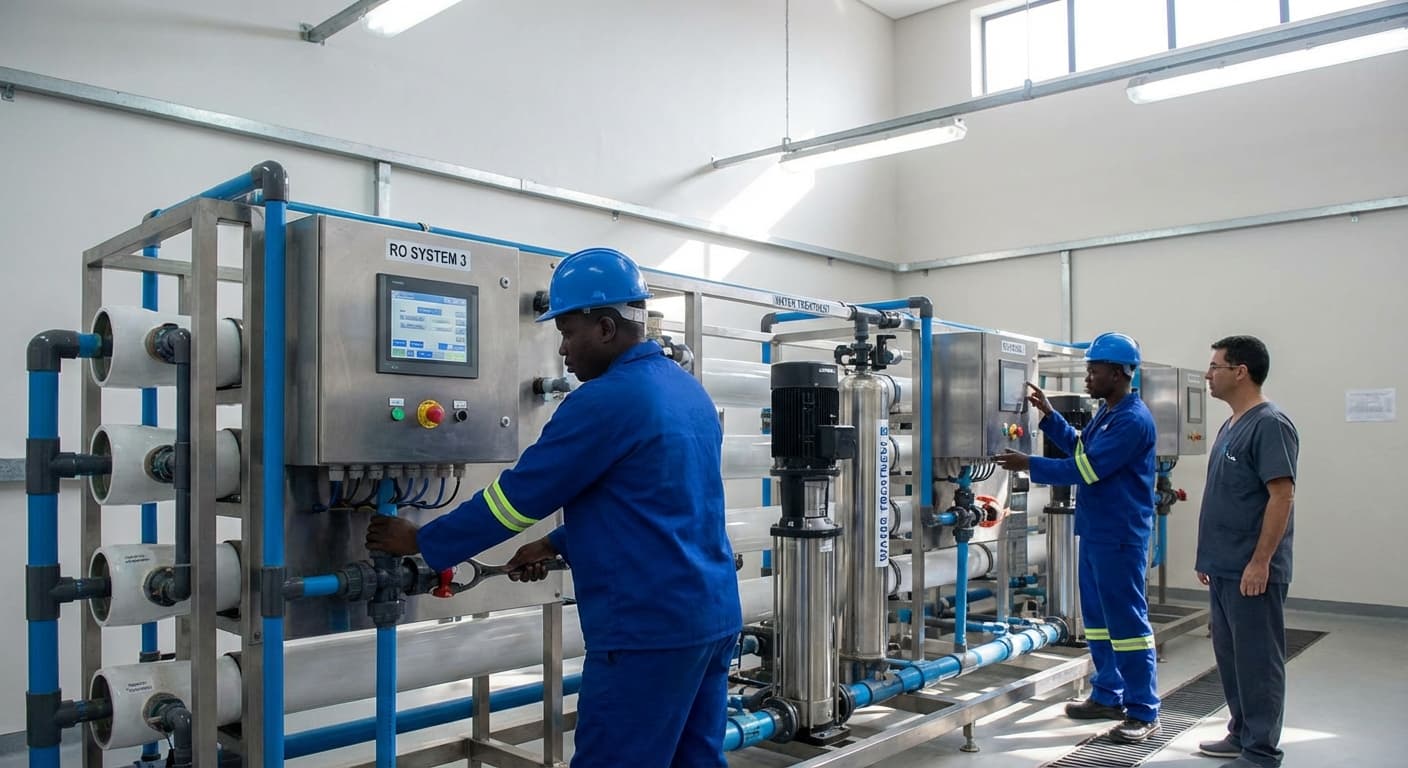
Dialysis RO/Water Treatment Plant Installation Service in Libya
Engineering Excellence & Technical Support
Dialysis RO/Water Treatment Plant Installation Service High-standard technical execution following OEM protocols and local regulatory frameworks.
Turnkey RO Plant Installation & Commissioning
Comprehensive end-to-end solutions for dialysis water treatment facilities in Libya, from initial site assessment and design to full system installation, rigorous testing, and expert commissioning to ensure optimal performance and regulatory compliance.
Advanced Multi-Stage RO Systems
We specialize in installing state-of-the-art Reverse Osmosis (RO) systems with advanced pre-treatment, micron filtration, and post-treatment stages, guaranteeing ultra-pure water essential for safe and effective hemodialysis treatments in Libya's demanding environment.
Expert Project Management & Technical Support
Leveraging extensive experience in water treatment infrastructure, our Libyan-based technical teams provide meticulous project management, ensuring timely delivery, seamless integration of components, and ongoing technical support for your RO plant's sustained operational excellence.
What Is Dialysis Ro/water Treatment Plant Installation Service In Libya?
Dialysis RO/Water Treatment Plant Installation Service in Libya refers to the specialized engineering and construction process of establishing facilities designed to produce ultra-pure water essential for hemodialysis procedures. This service encompasses the design, procurement, installation, commissioning, and initial operational support of Reverse Osmosis (RO) and advanced water purification systems tailored to meet the stringent purity standards required for medical applications, specifically dialysis. The generated water must be free from pyrogens, endotoxins, bacteria, dissolved solids, and other contaminants that could pose significant health risks to dialysis patients. The service ensures that the installed plant adheres to international medical water standards and local Libyan regulations, guaranteeing the safety and efficacy of the dialysis treatment.
| Requirement | Description | Typical Use Cases |
|---|---|---|
| Who Needs It? | Dialysis centers, hospitals, and healthcare facilities in Libya that perform hemodialysis procedures. This includes both public and private healthcare providers. | Establishment of new dialysis units. Upgrade or replacement of existing, outdated water treatment systems. Ensuring compliance with evolving medical water quality standards. |
| Typical Use Cases | Production of ultrapure water for hemodialysis machines. The water is mixed with a concentrated dialysate to create the dialysis fluid that removes waste products and excess fluid from the patient's blood. | Chronic kidney disease (CKD) management. Acute kidney injury (AKI) treatment. Support for organ transplant recipients requiring dialysis. Emergency dialysis services during outbreaks or natural disasters. |
Key Components and Stages of Dialysis RO/Water Treatment Plant Installation:
- System Design and Engineering: Site assessment, water quality analysis, system sizing, process flow diagram (PFD) and piping and instrumentation diagram (P&ID) development, selection of appropriate technologies (e.g., pre-filtration, RO, deionization, UV sterilization, filtration), and compliance with medical standards (e.g., AAMI, ISO).
- Equipment Procurement and Fabrication: Sourcing and purchasing of all necessary components, including pumps, membranes, filters, tanks, piping, control systems, instrumentation, and sterilization units. This may also involve the fabrication of skid-mounted units for ease of installation.
- Site Preparation and Civil Works: Preparation of the installation site, including foundation work, utility connections (power, drainage), and potentially construction of dedicated housing for the plant.
- Installation and Assembly: Physical installation of all equipment, interconnecting piping, electrical wiring, and control systems according to design specifications. This phase requires skilled technicians and adherence to safety protocols.
- System Commissioning and Validation: Comprehensive testing of the entire system to ensure it functions as designed. This includes performance testing, water quality analysis at various stages, and microbial challenge testing to validate the output water meets all purity requirements.
- Operator Training: Training of medical and technical staff on the operation, maintenance, and basic troubleshooting of the installed water treatment plant.
- Documentation and Handover: Provision of detailed operation and maintenance manuals, as-built drawings, validation reports, and certificates of conformity.
- After-Sales Support: Initial operational support, troubleshooting assistance, and potentially ongoing maintenance contracts.
Who Needs Dialysis Ro/water Treatment Plant Installation Service In Libya?
In Libya, the need for professional dialysis RO/water treatment plant installation services is critical for a variety of healthcare facilities and organizations. These services are essential for ensuring the production of ultrapure water, a fundamental requirement for safe and effective hemodialysis. The installation of these plants guarantees that medical centers can meet the stringent water quality standards necessary for patient treatment, thereby preventing complications and improving patient outcomes. The demand is driven by the ongoing need for reliable dialysis treatment across the country, supporting both existing and expanding healthcare infrastructure.
| Customer Segment | Key Departments Involved | Specific Needs |
|---|---|---|
| Public Hospitals and Healthcare Centers | Nephrology Department, Biomedical Engineering Department, Procurement Department, Facilities Management | Ensuring consistent supply of dialysis-grade water for large patient volumes, adherence to national health standards, cost-effective solutions. |
| Private Hospitals and Clinics | Clinical Operations, Administration, Engineering Services, Purchasing Department | High-quality water for specialized treatments, advanced technology integration, premium patient care, potential for expansion. |
| Specialized Kidney Disease Treatment Centers | Medical Director, Head of Nursing, Technical Operations Manager, Quality Assurance | Dedicated and highly reliable RO systems, meeting international standards, customized solutions for specific patient populations, ongoing maintenance and support. |
| Non-Governmental Organizations (NGOs) | Program Managers, Logistics Department, Medical Coordinators | Installation in remote or underserved areas, robust and durable systems, training for local staff, humanitarian aid-focused projects. |
| Medical Equipment Suppliers and Distributors | Sales Department, Technical Support, Project Management | Partnering for integrated solutions, offering turnkey installation services to their clients, ensuring compatibility with dialysis machines. |
| Government Health Ministries and Agencies | Planning Department, Public Health Infrastructure Division, Procurement Committee | Nationwide rollout of dialysis facilities, standardizing water treatment across public health sector, large-scale infrastructure projects, budget allocation. |
Target Customers for Dialysis RO/Water Treatment Plant Installation in Libya
- Public Hospitals and Healthcare Centers
- Private Hospitals and Clinics
- Specialized Kidney Disease Treatment Centers
- Non-Governmental Organizations (NGOs) involved in healthcare
- Medical Equipment Suppliers and Distributors (for their clients)
- Government Health Ministries and Agencies (for national projects)
Dialysis Ro/water Treatment Plant Installation Service Process In Libya
This document outlines the comprehensive workflow for Dialysis RO/Water Treatment Plant Installation Services in Libya, from initial client inquiry to successful project execution. The process is designed to be transparent, efficient, and tailored to the specific needs of healthcare facilities.
| Phase | Key Activities | Description | Deliverables |
|---|---|---|---|
| Phase 1: Inquiry & Initial Consultation | Receive client inquiry, understand requirements, initial discussion. | Client contacts service provider with a need for a dialysis RO/water treatment plant. Discussions focus on facility type, existing infrastructure, patient capacity, and specific water quality standards. | Initial understanding of project scope, preliminary requirements list. |
| Phase 2: Site Assessment & Needs Analysis | On-site visit, detailed assessment of existing facilities and water sources. | Technical team visits the client's facility to evaluate space availability, power supply, plumbing, water source quality (testing may be required), and identify any site-specific challenges. | Detailed site assessment report, identification of potential issues, refined technical specifications. |
| Phase 3: Proposal & Quotation | Develop a customized proposal with technical specifications, timeline, and cost. | Based on the needs analysis, a comprehensive proposal is prepared. This includes proposed plant design, key components, performance guarantees, installation schedule, and a detailed cost breakdown. | Formal proposal document, detailed quotation, preliminary project timeline. |
| Phase 4: Contracting & Agreement | Negotiation of terms, signing of contract. | Client reviews the proposal. Discussions on payment terms, warranties, responsibilities, and any necessary amendments. Upon agreement, a formal contract is signed. | Signed contract, payment schedule, agreed-upon terms and conditions. |
| Phase 5: Design & Engineering | Detailed engineering design of the RO/water treatment plant. | Once the contract is in place, the engineering team finalizes the detailed design, including flow diagrams, P&ID (Piping and Instrumentation Diagrams), electrical schematics, and selection of specific equipment models. | Final engineering drawings, equipment specifications, bill of materials (BOM). |
| Phase 6: Procurement & Logistics | Ordering of equipment, shipping, and customs clearance. | All necessary components and equipment are sourced from reputable suppliers. Logistics are managed to ensure timely delivery to the installation site in Libya, including handling customs procedures. | Procured equipment and materials, shipping documentation, customs clearance. |
| Phase 7: Pre-installation Preparations | Site preparation, utility connections, structural modifications (if needed). | The client's site is prepared for installation. This may involve ensuring adequate power supply, water inlet/outlet points, drainage, and any minor structural modifications required to accommodate the plant. | Prepared installation site, confirmed utility availability. |
| Phase 8: Installation & Commissioning | Assembly of the plant, rigorous testing, and performance verification. | Experienced technicians install the RO/water treatment plant according to the engineering drawings. Once installed, the plant undergoes thorough commissioning tests to ensure it operates according to specifications and produces water of the required quality for dialysis. | Fully installed and functional RO/water treatment plant, commissioning report, water quality test results. |
| Phase 9: Training & Handover | Comprehensive training for facility staff, formal project handover. | The client's technical and operational staff receive detailed training on the plant's operation, routine maintenance, troubleshooting, and safety procedures. A formal handover of the plant and all relevant documentation is conducted. | Trained facility staff, operation and maintenance manuals, warranty documents, project completion certificate. |
| Phase 10: Post-installation Support & Maintenance | Ongoing support, preventive maintenance, and spare parts availability. | The service provider offers ongoing technical support, including scheduled preventive maintenance services, emergency troubleshooting, and readily available spare parts to ensure the long-term, reliable operation of the dialysis water treatment system. | Maintenance contracts, support service agreements, accessible spare parts. |
Dialysis RO/Water Treatment Plant Installation Service Process in Libya
- Inquiry & Initial Consultation
- Site Assessment & Needs Analysis
- Proposal & Quotation
- Contracting & Agreement
- Design & Engineering
- Procurement & Logistics
- Pre-installation Preparations
- Installation & Commissioning
- Training & Handover
- Post-installation Support & Maintenance
Dialysis Ro/water Treatment Plant Installation Service Cost In Libya
The cost of installing a Dialysis Reverse Osmosis (RO) and Water Treatment Plant in Libya can vary significantly based on several key factors. These factors influence the overall price, from the initial consultation and design to the final commissioning and training. Understanding these elements is crucial for healthcare facilities and investors planning such an installation. Generally, the investment is substantial, reflecting the critical nature of purified water for dialysis patients and the complexity of the equipment. Prices are typically quoted in Libyan Dinar (LYD).
| System Size/Capacity (LPH) | Estimated Installation Cost Range (LYD) | Notes |
|---|---|---|
| 500 - 1000 | 150,000 - 350,000 | Suitable for smaller dialysis units or satellite clinics. Basic pre-treatment, single/double pass RO. May exclude extensive storage. |
| 1000 - 3000 | 300,000 - 700,000 | Standard for medium-sized dialysis centers. Comprehensive pre-treatment, double pass RO, UV disinfection, basic monitoring. Includes adequate storage. |
| 3000 - 5000+ | 600,000 - 1,500,000+ | For larger hospitals or high-volume dialysis centers. Advanced pre-treatment, high-efficiency double pass RO, multiple disinfection stages, sophisticated monitoring and automation. May involve custom design and significant infrastructure integration. |
Key Pricing Factors for Dialysis RO/Water Treatment Plant Installation in Libya
- System Capacity and Flow Rate: The volume of purified water required per hour or per day is a primary driver of cost. Larger dialysis centers with higher patient throughput will necessitate larger, more robust systems, consequently increasing the price. This is often measured in liters per hour (LPH) or cubic meters per hour (CMH).
- Type and Quality of RO System: The choice between single-pass, double-pass, or even triple-pass RO systems impacts cost. Double-pass RO, which offers higher purity, is more expensive but often required for stringent dialysis standards. The brand and manufacturer's reputation also play a role, with premium brands commanding higher prices.
- Pre-treatment Stages: The complexity and number of pre-treatment stages required depend on the quality of the incoming raw water in Libya. This can include sediment filtration, activated carbon filtration, water softeners, and ultrafiltration. More extensive pre-treatment adds to the overall system cost.
- Post-treatment and Monitoring: Deionization (DI) polishing, UV disinfection, and advanced monitoring systems (like conductivity meters and TOC analyzers) are essential for meeting dialysis water standards. These components add to the initial investment and ongoing operational costs.
- Installation Complexity and Site Conditions: The physical location, accessibility of the site, and the existing infrastructure (space, power, drainage) influence installation costs. Modifications to the building, specialized foundations, or difficult access can escalate expenses.
- Ancillary Equipment and Infrastructure: This includes storage tanks for purified water, distribution piping, pumps, electrical panels, control systems, and potentially a dedicated room or building for the plant. The scope of these additions will affect the total price.
- Brand and Manufacturer: Reputable international brands often come with higher price tags due to their established quality, reliability, and after-sales support. Local assembly or less-known brands might offer lower upfront costs.
- Service Provider's Expertise and Reputation: The experience and track record of the installation company are critical. A highly skilled and reputable provider may charge more but offers greater assurance of a properly functioning and compliant system. This includes design, installation, commissioning, and training.
- Warranty and After-Sales Support: The duration and scope of the warranty, along with the availability and cost of ongoing maintenance and support services, should be factored into the overall cost of ownership.
- Regulatory Compliance and Certifications: Ensuring the system meets Libyan and international dialysis water standards (e.g., AAMI, ISO) may require specific components or testing, adding to the cost.
Affordable Dialysis Ro/water Treatment Plant Installation Service Options
Seeking affordable dialysis RO/Water Treatment Plant installation services? This guide explores cost-effective options and strategies to help you secure a reliable and budget-friendly solution. We'll break down the value of different service bundles and highlight key cost-saving measures.
| Value Bundle Type | Included Services | Potential Cost-Saving Aspect | Ideal For |
|---|---|---|---|
| Basic Installation Package | Plant equipment setup, piping, electrical connections. | Lower upfront cost, focuses on core installation. | Clients with existing plant designs and sourced equipment. |
| Standard Installation & Commissioning | Basic installation + system testing, calibration, and initial run. | Reduces risk of post-installation issues, ensures operational readiness. | Most common scenario, ensures functionality. |
| Design, Supply & Install (DSI) | System design, equipment procurement, installation, and commissioning. | Economies of scale for provider in sourcing, streamlined project. | New facilities or complete system overhauls. |
| Comprehensive Turnkey Solution | Full project management: design, supply, install, commission, initial training, and potentially a short-term maintenance plan. | Single point of responsibility, maximizes efficiency and reduces coordination overhead. | Clients seeking minimal involvement and a fully operational system. |
| Retrofit & Upgrade Bundle | Assessment of existing system, proposed upgrades, installation of new components, and system integration. | Cost savings by leveraging existing infrastructure, targeted improvements. | Facilities looking to modernize or improve efficiency of current systems. |
Understanding Value Bundles and Cost-Saving Strategies
- What are Value Bundles? Value bundles are pre-packaged service offerings that combine multiple components of RO/Water Treatment Plant installation at a potentially discounted price compared to purchasing each service individually. These can range from basic installation to comprehensive packages including plant design, equipment sourcing, installation, commissioning, and even initial maintenance.
- Benefits of Value Bundles:
- Cost Predictability: Bundles often offer a fixed price, making budgeting easier.
- Streamlined Process: A single point of contact for multiple services can simplify project management.
- Potential Savings: Bundling can leverage economies of scale for the provider, leading to lower overall costs.
- Comprehensive Solutions: Bundles are designed to cover essential aspects of the installation, reducing the risk of overlooking critical steps.
- Key Cost-Saving Strategies:
- Obtain Multiple Quotes: Never settle for the first quote. Contact several reputable providers to compare pricing and offerings.
- Consider Off-Peak Installation: If your timeline allows, inquire about discounts for installation during less busy periods.
- Leasing vs. Purchasing Equipment: Explore options for leasing RO membranes and other components, which can reduce upfront capital expenditure.
- Phased Installation: For larger projects, consider a phased approach if immediate full capacity isn't essential.
- Negotiate Contract Terms: Don't be afraid to negotiate pricing, payment schedules, and warranty periods.
- Local vs. National Providers: Local providers might offer lower travel costs, but national providers might have better bulk purchasing power for equipment.
- Focus on Essential Features: Prioritize the core functionality of the RO system and avoid unnecessary add-ons unless they offer significant long-term benefits.
- Long-Term Maintenance Contracts: While an upfront cost, a well-negotiated maintenance contract can prevent costly breakdowns and extend equipment life.
Verified Providers In Libya
In the challenging landscape of healthcare access in Libya, identifying trustworthy and competent medical providers is paramount. Franance Health stands out as a premier network of verified healthcare professionals, offering a beacon of reliability and quality for individuals seeking medical services. This commitment to verification ensures that every provider within the Franance Health network has undergone a rigorous vetting process, encompassing qualifications, experience, and adherence to ethical standards. Choosing Franance Health means opting for peace of mind, knowing you are engaging with professionals dedicated to delivering exceptional care.
| Franance Health Credential | What it Means for You | Benefit to Patients |
|---|---|---|
| Verified Medical License & Qualifications | Confirms the provider has the necessary legal authorization and educational background to practice medicine. | Ensures you are treated by a legitimately qualified and trained professional. |
| Documented Clinical Experience | Demonstrates a track record of practical application of medical knowledge and skills. | Increases confidence in the provider's ability to handle your specific medical needs. |
| Professional Reputation & References | Involves checks with professional bodies and potentially other healthcare providers. | Provides an added layer of assurance regarding the provider's professional conduct and patient interactions. |
| Adherence to Ethical Guidelines | Confirms commitment to patient confidentiality, informed consent, and professional ethics. | Guarantees respectful and principled treatment throughout your healthcare journey. |
| Ongoing Professional Development | Indicates a commitment to staying current with advancements in medical knowledge and practices. | Ensures you receive care based on the latest medical evidence and techniques. |
Why Franance Health is Your Best Choice:
- Uncompromising Verification Standards: Franance Health meticulously vets all its practitioners, ensuring they meet stringent criteria for expertise and ethical conduct.
- Access to Qualified Specialists: Our network comprises highly skilled doctors, nurses, and allied health professionals across various medical disciplines.
- Enhanced Patient Safety: The verification process significantly reduces the risk of encountering unqualified or fraudulent practitioners, prioritizing your well-being.
- Streamlined Healthcare Navigation: Franance Health simplifies the process of finding the right medical professional, saving you time and reducing stress.
- Commitment to Quality Care: Our providers are dedicated to offering compassionate, effective, and up-to-date medical treatments.
- Building Trust in Libyan Healthcare: By upholding the highest standards, Franance Health aims to foster greater confidence and trust in the healthcare system within Libya.
Scope Of Work For Dialysis Ro/water Treatment Plant Installation Service
This Scope of Work (SOW) outlines the requirements for the installation of a Dialysis Reverse Osmosis (RO) and Water Treatment Plant. It details the technical deliverables and standard specifications necessary to ensure the successful and compliant operation of the system, meeting the stringent demands of medical-grade water production for dialysis procedures. The SOW covers all phases from site preparation and equipment installation to commissioning, testing, and final handover.
| Phase | Activity | Key Considerations/Specifications | Deliverables |
|---|---|---|---|
| Site assessment and preparation | Adequate space, ventilation, power, and drainage. Compliance with local building codes and healthcare facility standards. Structural integrity for equipment weight. Water inlet and outlet points identified. | Site readiness report |
| Receipt and inspection of RO/Water Treatment Plant components | Verification of all ordered equipment against packing lists. Inspection for physical damage during transit. Compliance with manufacturer's specifications. | Equipment receipt and inspection report |
| Mechanical and electrical installation of the RO/Water Treatment Plant | Installation according to approved engineering drawings and manufacturer's guidelines. Proper pipework (materials: NSF-certified, lead-free copper, or approved plastics), welding, and jointing. Electrical wiring adhering to IEC standards and local electrical codes. Secure mounting and alignment of all components. Isolation valves for each stage. Pressure relief valves installed. | Installed RO/Water Treatment Plant, installation logs |
| System flushing, leak testing, and initial checks | Thorough flushing with deionized water to remove debris. Pressure testing of all lines and vessels. Verification of electrical connections and instrumentation. Check of all moving parts and safety features. | Pre-commissioning report |
| System startup, operational adjustments, and water quality testing | Gradual startup of the system. Adjustment of flow rates, pressures, and chemical dosages. Extensive testing of treated water quality against AAMI/ISO standards for conductivity, TOC, endotoxins, bacteria, and other critical parameters. Daily monitoring and recording of key performance indicators (KPIs) for a defined period. | Commissioning report, PQ test results, water quality reports |
| Operator and maintenance staff training | Comprehensive training on system operation, routine maintenance, troubleshooting, and emergency procedures. Hands-on practical sessions. Training on water quality monitoring and record-keeping. | Training attendance register, training certificates |
| Final system handover and provision of all required documentation | Submission of all technical deliverables. Final inspection and acceptance by the client. Provision of warranty documentation and service contracts. Transfer of ownership and operational responsibility. | As-built drawings, O&M manuals, warranty documents, final acceptance certificate |
Technical Deliverables
- Detailed Engineering Design Drawings (P&ID, layout, electrical schematics)
- Equipment Installation and Assembly Documentation
- Pre-Commissioning and Commissioning Reports
- Performance Qualification (PQ) Test Reports
- User Training Manuals and Certificates
- As-Built Drawings
- Warranty and Service Agreements
- Operation and Maintenance (O&M) Manuals
- Material Safety Data Sheets (MSDS) for all chemicals used
Service Level Agreement For Dialysis Ro/water Treatment Plant Installation Service
This Service Level Agreement (SLA) outlines the agreed-upon standards for the installation services of a Dialysis Reverse Osmosis (RO) / Water Treatment Plant. It defines the expected response times for critical issues and the uptime guarantees for the installed system during the warranty and post-warranty periods. The objective is to ensure minimal disruption to dialysis operations and maintain the highest quality of water for patient safety.
| Service Level | Definition | Response Time (Business Hours) | Resolution Target (Business Hours) | Uptime Guarantee |
|---|---|---|---|---|
| Installation Commencement | Time from contract signing to the physical start of installation. | 2 Business Days | N/A | N/A |
| Critical System Failure (Post-Installation, during Warranty) | Complete loss of purified water production impacting immediate patient care. | 1 Hour | 4 Business Hours | 98% uptime for the RO/Water Treatment Plant (excluding scheduled maintenance and planned outages). |
| Major System Malfunction (Post-Installation, during Warranty) | Significant degradation in water quality (e.g., exceeding key parameter limits) or partial loss of production impacting multiple patients. | 2 Business Hours | 8 Business Hours | 98% uptime for the RO/Water Treatment Plant (excluding scheduled maintenance and planned outages). |
| Minor System Issue (Post-Installation, during Warranty) | Non-critical alarms or minor performance degradation not immediately impacting patient care. | 4 Business Hours | 24 Business Hours | 98% uptime for the RO/Water Treatment Plant (excluding scheduled maintenance and planned outages). |
| Scheduled Maintenance (Post-Installation) | Planned service visits for preventative maintenance, filter changes, etc. | As per agreed schedule | N/A | N/A |
| Emergency Repair (Post-Warranty - Optional Service) | Response to critical system failures requiring immediate attention. | 2 Hours (Premium Service) | 6 Business Hours (Premium Service) | Uptime guarantee subject to agreed-upon post-warranty service contract. |
Scope of Service
- Installation of new Dialysis RO/Water Treatment Plant.
- Decommissioning and removal of old RO/Water Treatment Plant (if applicable).
- System testing, commissioning, and validation.
- Operator training on system operation and basic maintenance.
- Preventative maintenance services (as per separate agreement).
- Emergency repair services.
Frequently Asked Questions

Ready when you are
Let's scope your Dialysis RO/Water Treatment Plant Installation Service in Libya project in Libya.

Scaling healthcare logistics and technical systems across the entire continent.