
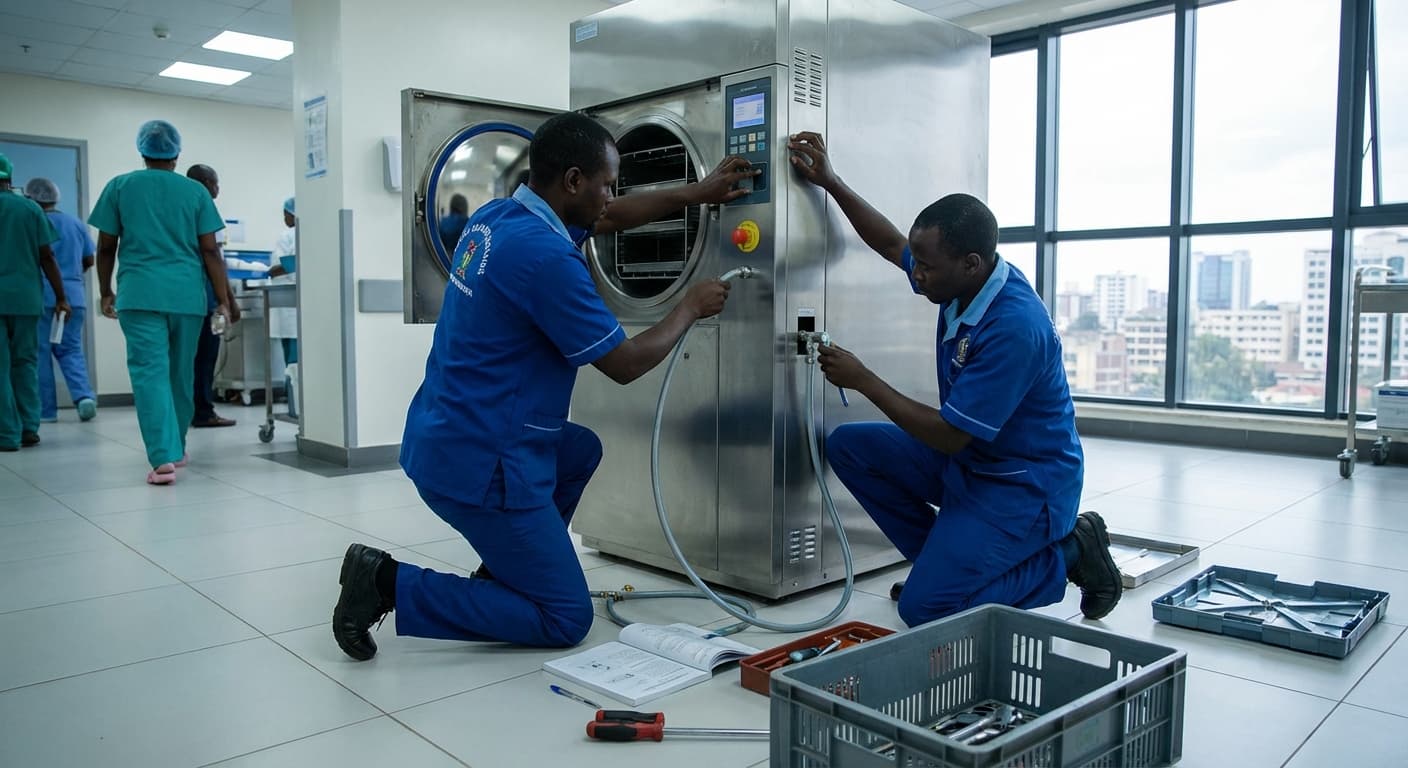
Autoclave & Sterilizer Installation Service in Libya
Engineering Excellence & Technical Support
Autoclave & Sterilizer Installation Service High-standard technical execution following OEM protocols and local regulatory frameworks.
Precision Installation & Calibration
Our expert technicians in Libya ensure your autoclave and sterilizer are installed to the highest industry standards, followed by meticulous calibration for optimal performance and sterilization efficacy, guaranteeing compliance with Libyan health regulations.
Seamless System Integration
We specialize in integrating your new sterilization equipment into your existing medical or laboratory infrastructure. Our team manages all utility connections (steam, water, power, drainage) and ventilation requirements, ensuring a smooth and efficient workflow across Libya.
Validation & Commissioning Excellence
Upon installation, our Libyan-based engineers conduct comprehensive validation and commissioning tests. We provide detailed documentation and performance reports, confirming your autoclave or sterilizer meets all critical parameters for safe and reliable operation.
What Is Autoclave & Sterilizer Installation Service In Libya?
Autoclave & Sterilizer Installation Service in Libya refers to the professional provision of services related to the procurement, setup, calibration, testing, and commissioning of steam sterilizers (autoclaves) and other sterilization equipment within the geographical region of Libya. This service ensures that these critical medical and industrial devices are installed correctly, meeting manufacturer specifications, regulatory requirements, and operational readiness to achieve effective sterilization of instruments and materials. The service encompasses a range of activities from site assessment and equipment integration to user training and documentation, aiming to guarantee the safety, efficacy, and longevity of the sterilization equipment.
| Who Needs Autoclave & Sterilizer Installation Service in Libya? | Typical Use Cases | |||
|---|---|---|---|---|
| Healthcare Facilities: Hospitals, clinics, dental offices, veterinary practices, and diagnostic laboratories requiring sterilization of surgical instruments, medical devices, laboratory consumables, and waste. | Sterilization of surgical tools (scalpels, forceps, retractors). | Disinfection of dental instruments (handpieces, probes). | Sterilization of glassware and media in microbiology labs. | Decontamination of biohazardous waste before disposal. |
| Pharmaceutical and Biotechnology Companies: For sterilizing manufacturing equipment, media, filters, and packaging materials to maintain aseptic conditions. | Sterilization of bioreactors and associated piping. | Autoclaving of culture media for cell growth. | Sterilization of pharmaceutical packaging components. | |
| Research and Development Institutions: Universities, research centers, and private R&D labs utilizing autoclaves for sterilizing equipment, glassware, and biological materials. | Sterilization of lab equipment (e.g., Petri dishes, flasks). | Autoclaving of waste from biological research experiments. | ||
| Food and Beverage Industry: For sterilization of equipment, packaging, and some food products to ensure shelf-life and safety. | Sterilization of canning equipment. | Aseptic processing of certain food items. | ||
| Cosmetic and Personal Care Manufacturers: For sterilizing production equipment and packaging to meet hygiene standards. | Sterilization of production lines and filling equipment. | |||
| Government and Military Organizations: For sterilization needs in medical units, research facilities, and defense-related laboratories. | Setting up sterilization capabilities in field hospitals. | Sterilization of equipment for biological defense research. | ||
| New Facility Construction or Renovation: Any organization establishing new sterile processing departments or renovating existing ones. | Integration of new autoclaves into a hospital's central sterile supply department (CSSD). | Upgrading sterilization equipment in a research laboratory. |
Key Components of Autoclave & Sterilizer Installation Service in Libya:
- Site Assessment and Planning: Evaluating the installation site for adequate space, ventilation, power supply, water connectivity, drainage, and compliance with safety regulations.
- Equipment Delivery and Placement: Managing the safe transportation and precise positioning of the autoclave or sterilizer within the designated installation area.
- Mechanical and Electrical Connections: Connecting the unit to necessary utilities, including water, steam (if applicable), drainage, and power sources, adhering to electrical and plumbing codes.
- Piping and Venting: Installing appropriate piping for steam, water, and exhaust, ensuring proper venting to prevent pressure buildup and facilitate safe operation.
- Calibration and Validation: Performing initial calibration of critical parameters such as temperature, pressure, and time. Conducting performance qualification (PQ) and operational qualification (OQ) to verify that the sterilizer meets predefined performance standards and is suitable for its intended use.
- Functional Testing and Commissioning: Conducting comprehensive tests under various load conditions to confirm proper operation, cycle completion, and safety features. This culminates in the official commissioning of the equipment.
- User Training and Familiarization: Providing instruction to operating personnel on the correct usage, routine maintenance, troubleshooting, and safety protocols associated with the installed equipment.
- Documentation and Certification: Supplying detailed installation reports, calibration certificates, validation reports, and user manuals to ensure compliance and facilitate future maintenance and audits.
- Post-Installation Support: Offering initial troubleshooting assistance and ensuring a smooth transition into routine operation.
Who Needs Autoclave & Sterilizer Installation Service In Libya?
Maintaining sterile environments is paramount across various critical sectors in Libya. Organizations that rely on infection control and the safe handling of sensitive materials require professional autoclave and sterilizer installation services to ensure their equipment is set up correctly, efficiently, and meets all relevant safety and regulatory standards. This ensures optimal performance, longevity of the equipment, and most importantly, the safety of patients, staff, and research integrity.
| Customer Type | Key Departments/Applications | Specific Needs/Reasons for Installation Service |
|---|---|---|
| Hospitals & Clinics | Operating Theatres, Central Sterile Supply Departments (CSSD), Emergency Rooms, Outpatient Clinics, Dental Units, Laboratories | Sterilization of surgical instruments, medical devices, glassware, and patient care equipment to prevent hospital-acquired infections (HAIs). Ensuring compliance with healthcare regulations. |
| Diagnostic Laboratories | Microbiology Labs, Pathology Labs, Blood Banks, Biochemistry Labs | Sterilization of culture media, glassware, instruments, and specimen containers for accurate and reliable diagnostic testing. Preventing cross-contamination. |
| Pharmaceutical & Biotech Companies | Research & Development (R&D), Quality Control (QC), Manufacturing | Sterilization of laboratory equipment, glassware, media, and components used in drug development, production, and quality assurance. Maintaining aseptic conditions for sensitive processes. |
| Food & Beverage Industry | Quality Control, Product Development, Packaging | Sterilization of equipment and materials used in product testing, pilot studies, and for ensuring the sterility of packaging to extend shelf life and prevent spoilage. |
| Research Institutions & Universities | Biology, Chemistry, Medicine, Biotechnology Departments | Sterilization of laboratory equipment, glassware, media, and samples for a wide range of research experiments, preventing contamination and ensuring data integrity. |
| Veterinary Clinics & Animal Research | Surgical Suites, Examination Rooms, Laboratories | Sterilization of surgical instruments, dental tools, and laboratory equipment used in animal healthcare and research to prevent the spread of zoonotic diseases and infections. |
| Cosmetic & Beauty Salons | Treatment Rooms, Sterilization Areas | Sterilization of reusable tools and instruments (e.g., tweezers, nail files, tattoo needles) to maintain hygiene and prevent the transmission of infections among clients. |
| Medical Device Manufacturers | Production Lines, Quality Assurance | Sterilization of manufactured medical devices prior to packaging or for testing purposes, ensuring product safety and efficacy. |
Target Customers and Departments for Autoclave & Sterilizer Installation Service in Libya:
- Healthcare Facilities (Hospitals, Clinics, Dental Offices, Diagnostic Labs)
- Pharmaceutical Manufacturing & Research Laboratories
- Food & Beverage Processing Plants
- Veterinary Clinics & Animal Research Facilities
- Research Institutions & Universities (especially those with biology, chemistry, and medical departments)
- Cosmetic & Beauty Salons (for sterilization of instruments)
- Medical Device Manufacturers & Suppliers
- Government Health Agencies & Public Health Laboratories
Autoclave & Sterilizer Installation Service Process In Libya
This document outlines the standard workflow for Autoclave & Sterilizer Installation Services in Libya, covering the process from the initial client inquiry to the final execution and handover. The aim is to ensure a clear, efficient, and transparent service delivery, adhering to best practices and safety standards.
| Stage | Description | Key Activities | Deliverables | Responsible Party |
|---|---|---|---|---|
| The client expresses interest in autoclave or sterilizer installation services. | Receive client request, understand basic requirements (type of equipment, intended use), schedule initial consultation. | Understanding of client needs, preliminary equipment type identification. | Client, Service Provider Sales/Technical Team |
| On-site evaluation to determine feasibility and technical requirements. | Visit client premises, assess space, power supply, water, drainage, ventilation, existing infrastructure, safety regulations, and access routes. | Detailed site report, technical feasibility assessment, identification of any required modifications. | Service Provider Technical Team |
| Based on the site assessment, a detailed quote and proposal are prepared. | Compile costs for equipment (if applicable), labor, materials, permits, travel, and any necessary modifications. Develop a comprehensive installation plan. | Detailed quotation, technical proposal outlining scope of work, timeline, and cost breakdown. | Service Provider Sales/Technical Team |
| Formalization of the service agreement between the client and the service provider. | Review and finalize contract terms, pricing, payment schedule, warranty, and liabilities. Obtain signatures from both parties. | Signed contract agreement. | Client, Service Provider Management |
| Acquisition and transportation of equipment and materials to the site. | Order equipment and necessary parts, arrange for transportation to Libya (including customs clearance if required), ensure all materials meet specifications. | Procured equipment and materials, scheduled delivery. | Service Provider Logistics & Procurement Team |
| Ensuring the installation site is ready for the equipment. | Perform any necessary civil works (e.g., concrete bases, wall modifications), electrical wiring, plumbing connections, ventilation setup, and ensure all safety measures are in place. | Site prepared for installation, all utilities connected and functional. | Service Provider Technical Team, Client (for site access/approvals) |
| The physical installation of the autoclave/sterilizer and its initial setup. | Unpack and position the equipment, connect all utilities (power, water, steam, drainage), assemble components, and perform initial system checks. | Fully installed autoclave/sterilizer unit. | Service Provider Technical Team |
| Verifying the correct operation and performance of the installed equipment. | Conduct functional tests, calibration, cycle testing, and performance validation according to manufacturer specifications and relevant standards. May include IQ (Installation Qualification), OQ (Operational Qualification), and PQ (Performance Qualification) if required. | Test reports, validation certificates, performance verification. | Service Provider Technical Team |
| Educating the client's personnel on the operation and maintenance of the equipment. | Provide comprehensive training on equipment operation, basic maintenance, troubleshooting, and safety procedures. | Trained client personnel, training materials. | Service Provider Technical Team |
| Formal transfer of the installed equipment and associated documents to the client. | Present final system, provide operation manuals, maintenance logs, warranty certificates, test reports, and any relevant certifications. Obtain client acceptance. | Complete documentation package, client acceptance form. | Service Provider Project Manager/Technical Lead, Client |
| Ongoing support and maintenance after the installation is complete. | Provide warranty service, scheduled preventive maintenance, technical support, and spare parts as needed. | Continued operational efficiency, client satisfaction. | Service Provider Technical & Support Team |
Autoclave & Sterilizer Installation Service Workflow in Libya
- Inquiry & Initial Consultation
- Site Assessment & Technical Survey
- Quotation & Proposal Generation
- Contract Agreement
- Logistics & Procurement
- Pre-Installation Preparations
- Installation & Commissioning
- Testing & Validation
- Client Training
- Handover & Documentation
- Post-Installation Support
Autoclave & Sterilizer Installation Service Cost In Libya
The cost of autoclave and sterilizer installation services in Libya can vary significantly based on several factors. These include the type and size of the equipment, the complexity of the installation, the location within Libya, and the specific service provider. Prices are typically quoted in Libyan Dinar (LYD).
Key Pricing Factors:
- Equipment Type and Size: Larger, more complex autoclaves (e.g., medical-grade, high-capacity industrial units) will naturally incur higher installation costs than smaller, simpler tabletop sterilizers.
- Site Preparation: If the installation site requires modifications such as electrical upgrades, plumbing work, ventilation adjustments, or structural modifications, these will add to the overall cost.
- Complexity of Installation: Installations requiring specialized connections (e.g., steam, specialized gas lines), intricate piping, or integration with existing systems will be more expensive.
- Location: Installation costs can differ between major cities like Tripoli and Benghazi, and more remote or less developed regions, due to logistical challenges and labor availability.
- Service Provider: Different companies and individual technicians will have varying pricing structures based on their reputation, experience, overhead, and the comprehensiveness of their service package.
- Ancillary Services: Some installations may include commissioning, calibration, training, or extended warranty services, which will influence the total price.
- Urgency: Rush installations or those requiring immediate service outside of standard business hours may command higher fees.
| Factor | Impact on Cost | Estimated Range (LYD) |
|---|---|---|
| Small/Tabletop Sterilizer | Lower complexity, minimal site prep | 300 - 700 |
| Medium Autoclave (Dental, Lab) | Moderate complexity, potential plumbing/electrical | 800 - 2,000 |
| Large/Industrial Autoclave | High complexity, significant site prep, specialized connections | 2,500 - 8,000+ |
| Extensive Site Preparation (e.g., electrical, plumbing upgrades) | Adds significantly to base cost | Varies widely, could add 500 - 3,000+ LYD |
| Specialized Connections (e.g., steam, gas) | Requires skilled labor and specific materials | Adds 300 - 1,500+ LYD |
| Remote Location Surcharge | Covers travel and logistical challenges | Could add 10-20% to the total cost |
Typical Cost Ranges (Illustrative - LYD)
- Basic tabletop sterilizer installation: 300 - 700 LYD
- Medium-sized autoclave installation (e.g., dental, small laboratory): 800 - 2,000 LYD
- Large or industrial autoclave installation: 2,500 - 8,000+ LYD
Affordable Autoclave & Sterilizer Installation Service Options
Finding an affordable autoclave and sterilizer installation service doesn't have to mean compromising on quality or safety. Our service focuses on providing reliable installation with transparent pricing, offering various options to fit your budget. We understand that different practices have unique needs, which is why we've developed value bundles and cost-saving strategies to ensure you get the most for your investment. From basic setup to comprehensive integration, we're here to make the process smooth and cost-effective.
| Value Bundle | Description | Ideal For | Estimated Price Range (USD) | Cost-Saving Strategies Included | |
|---|---|---|---|---|---|
| Essential Setup | Covers the core installation and essential utility connections. Focuses on getting your unit operational safely and efficiently. | Small clinics, individual practices with existing utility access, budget-conscious clients. | $400 - $750 | Bundled services, efficient scheduling, DIY preparation of site. | DIY preparation of site (clearing space, ensuring utility access points are clear). |
| Standard Integration | Includes essential setup plus more in-depth system testing, calibration, and extended user training. | Medium-sized practices, dental offices, veterinary clinics requiring a more thorough handover. | $650 - $1100 | Bundled services, potential for off-peak scheduling, advice on energy-efficient operation. | Advice on energy-efficient operation. |
| Premium Package | Comprehensive installation including site assessment, full utility hookups (if needed), advanced calibration, in-depth training, and initial maintenance plan setup. | Larger facilities, new practice setups, specialized medical environments requiring strict compliance. | $1000 - $1800+ | Discounted rates for bundled services, upfront quoting for all potential costs, recommendations for long-term maintenance savings. | Upfront quoting for all potential costs, recommendations for long-term maintenance savings. |
Key Installation Service Components
- Professional site assessment to determine optimal placement and utility requirements.
- Secure mounting and anchoring of the autoclave/sterilizer unit.
- Connection to essential utilities (water, electricity, drainage, ventilation, gas - where applicable).
- System testing and calibration to ensure proper functionality and safety standards.
- Basic user training on operation and routine maintenance.
- Post-installation support and troubleshooting.
Verified Providers In Libya
In the challenging healthcare landscape of Libya, identifying reliable and credentialed healthcare providers is paramount for ensuring quality patient care. Franance Health stands out as a premier choice for patients and organizations seeking verified and reputable medical services. Our rigorous vetting process and commitment to excellence distinguish us from the competition.
| Feature | Franance Health's Advantage | Why it Matters for Patients |
|---|---|---|
| Provider Vetting | Rigorous, multi-stage credential verification | Ensures you receive care from legitimate, qualified, and ethical professionals. |
| Quality Assurance | Adherence to international best practices and safety standards | Minimizes risks and maximizes the effectiveness of your medical treatment. |
| Network Scope | Extensive network across various medical specialties | Provides access to the right specialist for your specific health condition. |
| Information Clarity | Transparent provider profiles and qualification details | Empowers you to choose the best provider based on accurate information. |
| Local & Global Integration | Combines local market knowledge with global medical standards | Offers culturally sensitive care that meets international benchmarks for quality. |
Why Franance Health is the Best Choice for Verified Providers in Libya:
- Unparalleled Verification Process: Franance Health employs a multi-stage verification system that scrutinizes the credentials, licenses, and professional history of every provider. This ensures that only qualified and ethically sound medical professionals are part of our network.
- Commitment to Quality and Safety: We prioritize patient safety and optimal health outcomes. Our providers are selected based on their adherence to international best practices and their demonstrable commitment to high-quality care.
- Comprehensive Range of Services: From primary care to specialized treatments, Franance Health connects you with a diverse network of verified providers across various medical disciplines, catering to a wide spectrum of healthcare needs.
- Transparency and Trust: We believe in fostering trust through transparency. Our platform provides clear information about provider qualifications and areas of expertise, empowering patients to make informed decisions.
- Local Expertise with Global Standards: Franance Health combines in-depth understanding of the Libyan healthcare system with adherence to globally recognized medical standards, offering a unique blend of localized and internationally benchmarked care.
- Patient-Centric Approach: Our mission is to simplify access to quality healthcare. We are dedicated to ensuring a seamless and supportive experience for every patient seeking medical assistance through our verified network.
Scope Of Work For Autoclave & Sterilizer Installation Service
This Scope of Work outlines the requirements for the installation of an autoclave and sterilizer unit. It details the technical deliverables, standard specifications, and the responsibilities of both the client and the service provider to ensure a successful and compliant installation. The project aims to integrate a new autoclave/sterilizer into the existing facility infrastructure, ensuring proper functionality, safety, and adherence to relevant industry standards.
| Category | Technical Deliverable/Specification | Description | Compliance/Reference Standard |
|---|---|---|---|
| Site Assessment | Site Survey Report | Detailed report of existing infrastructure (power, water, drainage, ventilation, space) and identification of any potential challenges. | Internal Checklist, Manufacturer Guidelines |
| Site Assessment | Installation Plan & Schedule | Document outlining the step-by-step installation process, timelines, required resources, and key milestones. | Project Management Best Practices |
| Equipment | Autoclave/Sterilizer Unit | New, fully functional autoclave/sterilizer unit as per client's purchase order. Includes all standard accessories and components. | Manufacturer's Specifications, Client PO |
| Installation | Mechanical Installation | Secure mounting of the unit, connection to water supply, drainage, and any required ventilation systems. | ANSI/AAMI ST55, ISO 13485 (for medical devices) |
| Installation | Electrical Installation | Connection of the unit to the facility's power supply, ensuring compliance with local electrical codes and load requirements. | NEC (National Electrical Code), Local Building Codes |
| Installation | Plumbing & Drainage | Proper connection to potable water supply and waste drainage system, ensuring no leaks and adequate flow rates. | Local Plumbing Codes, Manufacturer Guidelines |
| Installation | Ventilation Integration | Connection to existing or new ventilation system as required by the sterilizer's operational needs (e.g., steam exhaust). | ASHRAE Standards, Manufacturer Guidelines |
| Testing | Functional Testing | Verification of all operational modes, cycle parameters, safety features, and alarm systems. | Manufacturer's Test Protocols, Internal QA |
| Testing | Performance Validation | Demonstration of the unit's ability to achieve specified sterilization parameters (temperature, pressure, time) under simulated load conditions. | ANSI/AAMI ST55, ISO 17665 |
| Testing | Calibration Certification | Calibration of critical parameters (temperature sensors, pressure gauges) by a qualified technician, with traceable certificates. | ISO/IEC 17025, Manufacturer Specifications |
| Training | Operator Training | Comprehensive training for designated personnel on the safe operation, routine maintenance, and troubleshooting of the autoclave/sterilizer. | Manufacturer's Training Manual |
| Documentation | Installation & Test Report | Detailed report documenting all installation activities, test results, calibration data, and any deviations encountered. | Project Management Standards |
| Documentation | As-Built Drawings | Updated drawings of the installation, including electrical, mechanical, and plumbing connections, reflecting the final setup. | Industry Standards, Client Requirements |
| Documentation | User Manual & Maintenance Log | Provision of the manufacturer's user manual and a blank maintenance logbook for recording service and repairs. | Manufacturer's Documentation |
| Support | Warranty & Service Plan (Optional) | Details of the warranty period for installed components and any offered post-installation service or maintenance plans. | Service Level Agreement (SLA) |
Project Phases & Key Activities
- Site Assessment & Planning
- Equipment Delivery & Unpacking
- Installation & Integration
- Testing & Calibration
- Client Training & Handover
- Documentation & As-Built Drawings
- Post-Installation Support (Optional)
Service Level Agreement For Autoclave & Sterilizer Installation Service
This Service Level Agreement (SLA) outlines the performance standards and guarantees for the installation of Autoclaves and Sterilizers provided by [Your Company Name]. It defines the responsibilities of both [Your Company Name] and the Client, and establishes the metrics for service delivery, including response times and uptime guarantees related to the installation process itself and immediate post-installation support. Please note: Uptime guarantees for the operational performance of the installed equipment after the warranty period are typically covered by a separate equipment manufacturer's warranty and maintenance agreement.
| Service Element | Target | Guarantee | Measurement |
|---|---|---|---|
| Initial Site Assessment & Planning Response Time | Acknowledgement within 1 business day | 1 business day | Time from Client request to initial confirmation/scheduling |
| Installation Service Completion Time | As per agreed project timeline | On-time completion (barring unforeseen site issues or client delays) | Date of project commencement vs. date of final sign-off |
| Post-Installation Support - Critical Issue Response Time | Acknowledgement and initiation of remote diagnostics within 2 business hours | 2 business hours | Time from Service Request submission to initiation of diagnostic action |
| Post-Installation Support - Non-Critical Issue Response Time | Acknowledgement within 1 business day | 1 business day | Time from Service Request submission to acknowledgement |
| Installation Readiness (Uptime Guarantee) | Unit functional and ready for immediate use upon sign-off | 100% readiness within the Post-Installation Support Period for installation-related defects | Confirmation of functionality by Client at handover, and resolution of any installation-related defects within the support period |
Key Definitions
- Installation Service: The physical setup, connection, and initial testing of the Autoclave or Sterilizer unit at the Client's premises as per the manufacturer's specifications and agreed-upon scope of work.
- Service Request: Any communication from the Client to [Your Company Name] regarding an issue or question directly related to the installation service or immediate post-installation support.
- Response Time: The maximum time within which [Your Company Name] will acknowledge a Service Request and initiate diagnostic or remedial action.
- Critical Issue: An issue that prevents the immediate successful completion of the installation or renders the unit unusable for its intended sterilization purpose during the defined post-installation support period.
- Non-Critical Issue: An issue that does not prevent the successful completion of the installation or the unit's immediate use, but requires attention.
- Post-Installation Support Period: The period of [Number] days/weeks immediately following the successful completion and sign-off of the installation service, during which [Your Company Name] provides support for installation-related issues.
- Uptime Guarantee (Installation): Refers to the guarantee that the installation process itself will be completed within the agreed-upon timeframe and that the equipment, upon successful installation and within the Post-Installation Support Period, will be ready for its intended initial function, free from installation-related defects.
Frequently Asked Questions

Ready when you are
Let's scope your Autoclave & Sterilizer Installation Service in Libya project in Libya.

Scaling healthcare logistics and technical systems across the entire continent.