
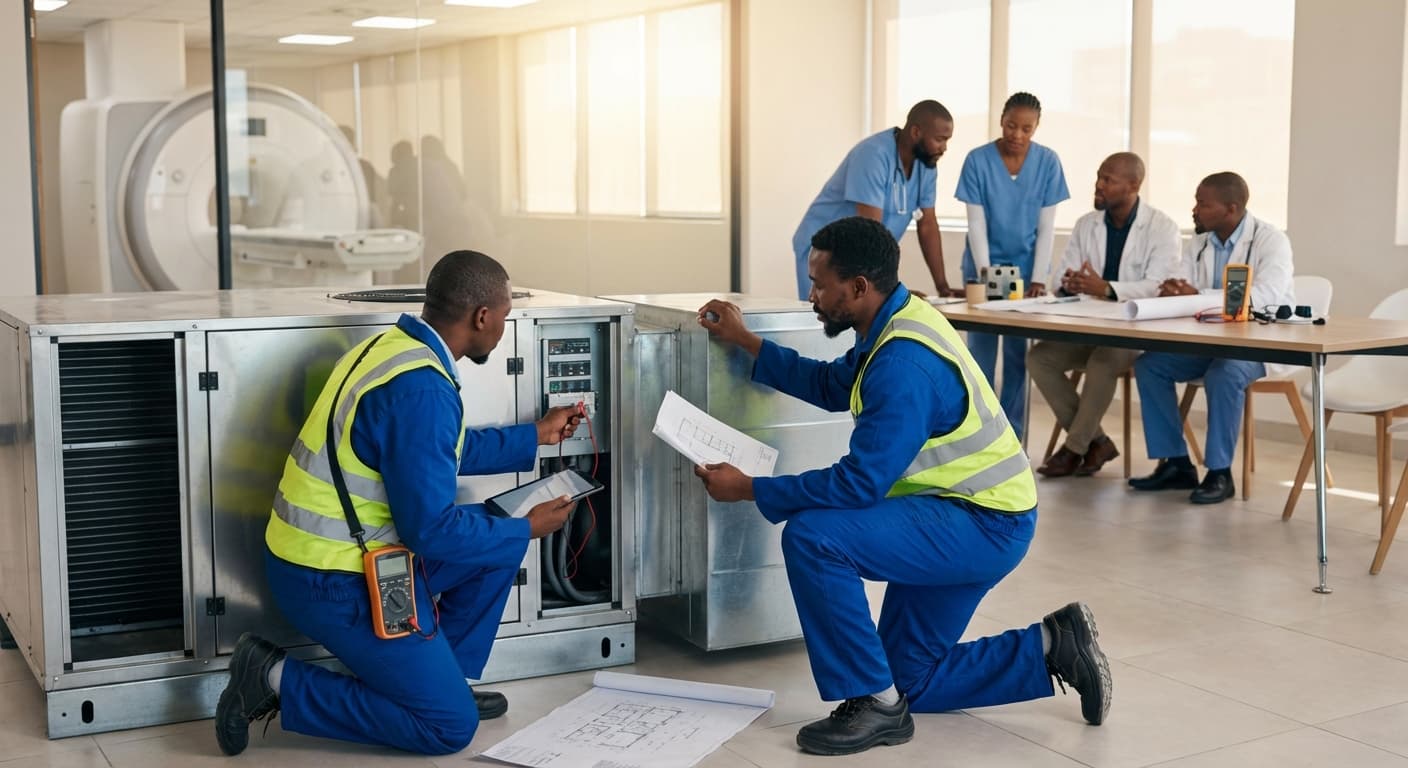
Site Readiness Assessment Service (Space/Access/HVAC/Power/Shielding) in Libya
Engineering Excellence & Technical Support
Site Readiness Assessment Service (Space/Access/HVAC/Power/Shielding) High-standard technical execution following OEM protocols and local regulatory frameworks.
Remote Site Survey & Access Planning
Leveraging advanced GIS and satellite imagery, we conduct pre-feasibility site assessments in remote Libyan locations, meticulously evaluating terrain, existing infrastructure, and identifying optimal access routes to minimize deployment time and logistical challenges for your mission-critical infrastructure.
Environmental & Infrastructure Readiness Analysis
Our service rigorously assesses existing HVAC, power generation, and grid stability in Libya's diverse climatic zones. We provide detailed reports on capacity, reliability, and potential upgrade requirements to ensure your sensitive equipment operates within optimal environmental parameters, mitigating risks of thermal failure or power disruption.
Shielding & Security Infrastructure Verification
We conduct thorough evaluations of existing or required shielding solutions for electromagnetic interference (EMI) and radio frequency interference (RFI), crucial for sensitive communications and data centers in Libya. Our assessments cover structural integrity, material compliance, and integration with power and grounding systems for comprehensive site security and operational integrity.
What Is Site Readiness Assessment Service (Space/access/hvac/power/shielding) In Libya?
The Site Readiness Assessment Service (SRAS) in Libya, encompassing Space, Access, HVAC, Power, and Shielding, is a critical pre-construction and pre-deployment evaluation designed to determine the suitability of a proposed or existing site for specific infrastructure or operational requirements. This comprehensive service meticulously analyzes the physical environment, utilities, and structural integrity to identify potential challenges, risks, and necessary modifications. It ensures that a site can adequately support the intended application, be it for data centers, telecommunication towers, industrial facilities, or specialized research installations, by verifying its capacity to meet stringent technical and logistical demands. The assessment is crucial for minimizing project delays, cost overruns, and operational failures by providing actionable data for informed decision-making.
| Who Needs Site Readiness Assessment Service (SRAS)? | Typical Use Cases |
|---|---|
| Telecommunications Providers | Deployment of new mobile base stations, data centers, and network infrastructure in remote or urban areas of Libya. |
| Data Center Operators | Establishing new data centers or expanding existing ones to ensure adequate power, cooling, and physical space for servers and networking equipment. |
| Industrial and Manufacturing Companies | Setting up new production facilities or expanding existing ones, requiring assessment of space, power, and access for heavy machinery and raw materials. |
| Government and Defense Organizations | Establishing command centers, secure communication facilities, or critical infrastructure requiring specialized power, access, and shielding. |
| Research and Development Institutions | Deploying sensitive scientific equipment or laboratories that necessitate precise environmental controls (HVAC) and protection from external interference (Shielding). |
| Energy Sector Companies (Oil & Gas, Renewables) | Installing operational facilities, control rooms, or substations requiring robust power, reliable access, and adherence to strict safety and environmental standards. |
| Real Estate Developers | Assessing the suitability of land or existing structures for specialized commercial or industrial developments. |
Components of Site Readiness Assessment Service (SRAS) in Libya:
- Space Assessment: Evaluation of available physical footprint, layout, ceiling heights, floor loading capacities, and potential for expansion to accommodate equipment racks, server rooms, office spaces, or specialized operational areas.
- Access Assessment: Examination of ingress/egress routes for personnel, equipment, and vehicles, including road conditions, bridge load limits, site entry points, security checkpoints, and the feasibility of transporting large or sensitive components.
- HVAC Assessment: Analysis of existing heating, ventilation, and air conditioning systems, or the requirements for new installations. This includes evaluating cooling capacity, humidity control, air filtration, redundancy, and compliance with environmental specifications for sensitive equipment.
- Power Assessment: Verification of available electrical power capacity, reliability of the grid connection, voltage stability, frequency, and the potential need for backup power solutions such as Uninterruptible Power Supplies (UPS) and generators. This also includes assessing the existing electrical infrastructure and distribution.
- Shielding Assessment: Determination of the need for and feasibility of electromagnetic interference (EMI) shielding, radio frequency (RF) shielding, or other forms of environmental shielding to protect sensitive equipment from external interference or to contain internal emissions, as required by regulations or operational integrity.
Who Needs Site Readiness Assessment Service (Space/access/hvac/power/shielding) In Libya?
Site readiness assessment is a critical pre-construction or pre-deployment step that ensures a location is adequately prepared to host specific infrastructure or equipment. In Libya, various entities and projects stand to benefit significantly from such a comprehensive service. This assessment typically evaluates key aspects like available space, physical access for equipment and personnel, HVAC capabilities for environmental control, power supply reliability and capacity, and shielding requirements for sensitive equipment or operations. Understanding these elements upfront minimizes risks, prevents costly delays, and ensures the long-term operational success of any installation.
| Target Customer/Sector | Key Departments/Functions Benefiting | Specific Needs Addressed by Assessment |
|---|---|---|
| Telecommunications Companies | Network Operations, Infrastructure Planning, Site Acquisition | Space for base stations/data hubs, access for technicians, power for equipment, potential shielding for sensitive electronics. |
| Oil and Gas Industry Operators | Project Management, Operations & Maintenance, HSE (Health, Safety, Environment) | Access to remote sites, space for control rooms/labs, reliable power for instrumentation, HVAC for harsh environments, shielding for control systems. |
| Data Center Developers and Operators | IT Infrastructure, Facilities Management, Business Development | Ample space, secure access, robust HVAC for cooling, significant and stable power supply, EMI/RFI shielding for servers. |
| Government and Public Sector Institutions | IT Departments, Public Works, Security Agencies | Space for new offices/secure facilities, access for construction, power for IT systems, HVAC for comfort and equipment, shielding for sensitive communication/data. |
| Renewable Energy Project Developers | Engineering, Project Management, Operations | Space for control centers/substations, access to installation sites, power grid integration studies, environmental considerations for equipment. |
| Industrial Manufacturing Companies | Production Management, Engineering, Facilities | Space for machinery, access for large equipment, adequate power for industrial processes, HVAC for climate-controlled production, vibration/noise shielding. |
| Research and Development Facilities | Lab Management, IT Infrastructure, Facilities | Specialized lab space, controlled environmental conditions (HVAC), reliable power for sensitive instruments, shielding for experiments (e.g., electromagnetic). |
| Healthcare Providers | IT Departments, Biomedical Engineering, Facilities Management | Space for imaging equipment (MRI, CT scanners), access for installation, precise HVAC for medical devices, stable power, RF shielding for MRI. |
| Defense and Security Agencies | Logistics, IT Security, Facilities Management | Secure site selection, controlled access, robust power, environmental control, specialized shielding for communication and surveillance equipment. |
| Construction and Engineering Firms | Project Management, Site Surveyors, Civil Engineers | Assessment of existing conditions to inform designs, identification of potential site constraints, ensuring client requirements are met from the outset. |
Target Customers in Libya Requiring Site Readiness Assessment Service
- Telecommunications Companies
- Oil and Gas Industry Operators
- Data Center Developers and Operators
- Government and Public Sector Institutions
- Renewable Energy Project Developers
- Industrial Manufacturing Companies
- Research and Development Facilities
- Healthcare Providers (for advanced medical equipment)
- Defense and Security Agencies
- Construction and Engineering Firms undertaking complex projects
Site Readiness Assessment Service (Space/access/hvac/power/shielding) Process In Libya
Our Site Readiness Assessment Service in Libya is a comprehensive process designed to ensure your chosen location is fully equipped to host your project, be it a data center, communication hub, or any facility requiring specific infrastructure. We meticulously evaluate key areas including Space, Access, HVAC (Heating, Ventilation, and Air Conditioning), Power, and Shielding. The workflow is structured to be transparent, efficient, and tailored to the unique challenges and opportunities present in Libya.
| Phase | Stage | Key Activities | Deliverables | Key Considerations (Libya Specific) |
|---|---|---|---|---|
| Phase 1 | Inquiry & Initial Consultation | Client Inquiry: Client contacts our service to request a site readiness assessment. Needs Assessment: We conduct an initial consultation to understand the project scope, technical requirements (e.g., power load, cooling needs, space dimensions), and desired location(s). Proposal Development: Based on the initial assessment, we prepare a detailed proposal outlining the scope of work, methodology, timeline, and cost. | Project Scope Document Service Proposal Non-Disclosure Agreement (if required) | Understanding local regulations and permits. Establishing clear communication channels with the client and local authorities. Initial assessment of potential logistical challenges. |
| Phase 2 | Site Survey & Data Collection | Site Access & Logistics: Arranging secure access to the proposed site(s) and planning logistical routes for survey teams. Space Assessment: Measuring available space, evaluating structural integrity, ceiling heights, and potential for expansion. Access Assessment: Evaluating physical access for construction, equipment delivery, and personnel, including road conditions and security. HVAC Assessment: Analyzing existing cooling capacity (if any), ventilation, and potential for new installations, considering ambient temperatures. Power Assessment: Evaluating the proximity and capacity of the local power grid, availability of stable power, and options for backup power generation. Shielding Assessment: Assessing the need for and feasibility of electromagnetic shielding, RF shielding, or physical security measures, considering local environmental factors. | Site Survey Checklist Photographic & Videographic Evidence Raw Data (measurements, utility readings, etc.) Preliminary Interviews with Site Representatives | Navigating local security protocols and obtaining necessary permissions for site visits. Dealing with potential infrastructure inconsistencies in power and cooling. Assessing availability of local skilled labor and construction materials. Understanding potential environmental hazards (e.g., dust, heat). |
| Phase 3 | Analysis & Reporting | Data Consolidation: Compiling all collected data from the site survey. Gap Analysis: Identifying discrepancies between project requirements and existing site capabilities in each assessment area. Risk Assessment: Evaluating potential risks associated with each identified gap. Report Generation: Producing a comprehensive Site Readiness Assessment Report, detailing findings, analysis, and preliminary recommendations. | Site Readiness Assessment Report Gap Analysis Matrix Risk Assessment Log | Interpreting data in the context of Libyan infrastructure standards and availability. Cross-referencing findings with local regulations and common practices. Ensuring cultural sensitivity in report interpretation and presentation. |
| Phase 4 | Recommendations & Planning | Solution Development: Proposing specific solutions to address identified gaps (e.g., HVAC upgrades, power augmentation, structural modifications, security enhancements). Cost Estimation: Providing estimated costs for proposed remediation and infrastructure development. Action Plan Creation: Developing a detailed action plan for site remediation and preparation, including timelines and responsible parties. Client Review & Approval: Presenting the report and recommendations to the client for discussion, feedback, and final approval. | Remediation Recommendations Document Cost Estimates Detailed Action Plan Client Approval Signature | Identifying reliable local vendors and contractors for remediation work. Budgeting for potential currency fluctuations and import duties. Considering lead times for specialized equipment and materials that may need to be imported. |
| Phase 5 | Execution Oversight & Verification | Implementation Support: Providing guidance and support during the execution of the recommended remediation and infrastructure upgrades. Quality Assurance: Conducting regular site visits to monitor progress and ensure adherence to specifications and quality standards. Verification & Sign-off: Final inspection and verification of all completed works to ensure the site meets readiness criteria. Final Report & Handover: Delivering a final report confirming site readiness and officially handing over the site to the client. | Progress Reports Quality Assurance Checklists Final Site Readiness Certificate Final Project Report | Managing the logistics of international teams or equipment if required. Ensuring compliance with local labor laws and safety regulations during execution. Facilitating clear communication between the client, contractors, and local stakeholders throughout the execution phase. |
Site Readiness Assessment Workflow in Libya
- Phase 1: Inquiry & Initial Consultation
- Phase 2: Site Survey & Data Collection
- Phase 3: Analysis & Reporting
- Phase 4: Recommendations & Planning
- Phase 5: Execution Oversight & Verification
Site Readiness Assessment Service (Space/access/hvac/power/shielding) Cost In Libya
Assessing site readiness for specialized infrastructure projects in Libya, particularly those requiring specific Space, Access, HVAC, Power, and Shielding considerations, involves a complex interplay of factors that influence pricing. These projects often cater to industries like telecommunications, data centers, research facilities, or even certain defense-related installations. The cost of such a Site Readiness Assessment Service in Libya can vary significantly due to the unique economic and logistical environment of the country. Factors include the project's scope and complexity, the specific requirements for each element (e.g., extreme HVAC precision, high-capacity power, specialized shielding materials), the geographical location within Libya (affecting logistics and security), the experience and reputation of the assessment firm, and the prevailing security situation and associated risks. Market demand for these specialized services also plays a role. It's crucial to understand that these are not standardized, off-the-shelf services, and each assessment is typically tailored to the client's exact needs.
| Assessment Component | Indicative Price Range (LYD) | Notes |
|---|---|---|
| Basic Site Survey (Space & Access) | 5,000 - 15,000 | Focuses on physical dimensions, accessibility for equipment, and basic layout evaluation. |
| HVAC Readiness Assessment | 7,000 - 25,000 | Includes evaluation of existing systems, load calculations, and recommendations for upgrades/new installations to meet specific environmental controls. |
| Power Infrastructure Assessment | 6,000 - 20,000 | Assesses existing power capacity, reliability, grounding, and potential needs for generators or UPS systems. |
| Shielding Requirements Assessment | 8,000 - 30,000+ | Highly variable based on the type and level of shielding required (e.g., electromagnetic interference, radio frequency, radiation). May involve specialized equipment and consultants. |
| Comprehensive Site Readiness Assessment (All Components) | 30,000 - 100,000+ | Encompasses all elements, often for complex projects like data centers or research facilities. Highly project-dependent. |
| Additional Costs (Logistics, Security, etc.) | Variable (can add 10-30% or more) | Dependent on geographical location, security situation, and transportation needs. |
Key Pricing Factors for Site Readiness Assessment in Libya:
- Project Scope & Complexity: The scale of the site, the number of systems to be assessed (Space, Access, HVAC, Power, Shielding), and the depth of the analysis required.
- Specific Technical Requirements: The stringency of HVAC specifications (e.g., temperature/humidity control), power demands (redundancy, capacity), type and level of shielding needed (e.g., EMI, RF, radiation), and unique access challenges.
- Geographical Location: Accessibility of the site within Libya, transportation costs for personnel and equipment, and any regional cost variations.
- Security Considerations: The prevailing security situation, requiring additional security personnel, risk assessments, and potentially insurance.
- Firm Experience & Expertise: The reputation, track record, and specialized knowledge of the consulting firm performing the assessment.
- Reporting & Documentation Depth: The level of detail, format, and types of deliverables (e.g., detailed reports, schematics, risk analyses).
- Time Constraints: Expedited assessment timelines may incur premium charges.
- Sub-consultant involvement: If specialized sub-consultants are required for specific aspects (e.g., radiation shielding experts).
- Market Conditions & Demand: The general availability of qualified assessment firms and the current demand for such services in Libya.
Affordable Site Readiness Assessment Service (Space/access/hvac/power/shielding) Options
Securing a reliable and cost-effective site for your next project is paramount. Our Affordable Site Readiness Assessment Service provides a comprehensive evaluation of key infrastructure elements, including Space, Access, HVAC, Power, and Shielding. We offer flexible options designed to fit various budgets, ensuring you get the insights you need without breaking the bank. Our value bundles combine essential services at a discounted rate, while our cost-saving strategies focus on leveraging existing resources and prioritizing critical assessments to maximize your investment.
| Value Bundle | Included Services | Benefits | Estimated Price Range (USD) | Cost-Saving Strategies |
|---|---|---|---|---|
| Essential Readiness Bundle | Space, Access, Basic Power (Capacity Check) | Covers foundational site requirements for initial planning and feasibility. | $750 - $1,500 | Focus on essential infrastructure first; defer non-critical assessments. |
| Integrated Infrastructure Bundle | Space, Access, HVAC (Basic Assessment), Power (Capacity & Reliability) | Provides a more in-depth view of critical operational systems. | $1,200 - $2,500 | Combine HVAC and Power assessments for efficiency; leverage existing building data. |
| Comprehensive Site Assurance Bundle | Space, Access, HVAC (Detailed), Power (Capacity, Reliability & Backup), Basic Shielding (Environment Scan) | Offers a holistic evaluation for mission-critical applications and robust planning. | $2,000 - $4,000 | Prioritize shielding assessment based on application sensitivity; phased assessment approach. |
| Customized Solutions | Tailored to specific project needs and budget constraints. | Maximum flexibility and targeted insights. | Variable (Based on scope) | Focus on only the most critical elements for your unique project requirements. |
Our Site Readiness Assessment Covers:
- Space Assessment: Evaluating available physical space, layout efficiency, and potential for expansion.
- Access Assessment: Analyzing ingress/egress routes, transportation links, and proximity to resources.
- HVAC Assessment: Reviewing existing heating, ventilation, and air conditioning systems for capacity and efficiency.
- Power Assessment: Determining available electrical capacity, grid reliability, and backup power options.
- Shielding Assessment: Evaluating environmental factors impacting data integrity, electromagnetic interference (EMI), and radio frequency interference (RFI).
Verified Providers In Libya
In the critical landscape of healthcare in Libya, identifying reliable and credentialed providers is paramount. Franance Health stands out as a premier choice, offering a robust network of verified medical professionals and facilities. Their commitment to rigorous credentialing ensures that patients receive the highest quality of care, backed by recognized expertise and ethical practice.
| Credentialing Aspect | Franance Health's Verification Process | Patient Benefit |
|---|---|---|
| Medical Licenses & Certifications | Thorough checks against national and international licensing bodies to ensure current and valid credentials. | Guarantees that providers are legally authorized to practice and possess the necessary qualifications. |
| Professional Experience & Training | Verification of educational background, residency, fellowships, and documented professional experience. | Ensures patients are treated by experienced professionals with specialized knowledge in their respective fields. |
| Reputation & Disciplinary History | Background checks for any past disciplinary actions or malpractice claims. | Provides an added layer of security and confidence in the provider's ethical standing and performance. |
| Specialty Competency | Assessment of specific competencies and ongoing professional development within their chosen specialties. | Confirms that providers have kept their skills up-to-date and are proficient in their area of practice. |
Why Franance Health is the Best Choice for Verified Providers in Libya
- Rigorous Credentialing Process: Franance Health employs a multi-faceted verification system that scrutinizes the qualifications, licenses, and experience of all affiliated healthcare providers.
- Commitment to Quality and Safety: Patients can be assured of a high standard of care, as Franance Health prioritizes safety protocols and adherence to international best practices.
- Extensive Network: Access a broad spectrum of medical specialties and healthcare services through their comprehensive network of verified doctors, specialists, and hospitals.
- Transparency and Trust: Franance Health fosters an environment of transparency, providing clear information about provider credentials and ensuring accountability.
- Patient-Centric Approach: The organization is dedicated to improving patient outcomes and experiences by connecting individuals with the most suitable and qualified healthcare professionals.
Scope Of Work For Site Readiness Assessment Service (Space/access/hvac/power/shielding)
This Scope of Work (SOW) outlines the services required for a comprehensive Site Readiness Assessment. The assessment will evaluate the existing conditions and suitability of a designated space for the intended purpose, focusing on critical infrastructure. The objective is to identify any deficiencies, potential risks, and necessary upgrades to ensure a successful deployment and operation. The assessment will cover the following key areas: Space Planning & Layout, Access & Egress, HVAC (Heating, Ventilation, and Air Conditioning), Power Distribution, and Shielding (if applicable). This SOW details the technical deliverables and standard specifications expected.
| Assessment Area | Description of Services | Technical Deliverables | Standard Specifications/Considerations |
|---|---|---|---|
| Space Planning & Layout | Assess the physical dimensions, layout, and utilization of the designated space. Evaluate potential for equipment placement, workflow, and future expansion. Identify any architectural constraints. | Detailed site survey report with measurements and photographic documentation. CAD drawings illustrating existing layout and proposed configurations. Space utilization matrix. | Building codes and regulations. Ergonomic principles. Equipment footprint requirements. Clearances for maintenance and operation. Future growth projections. |
| Access & Egress | Evaluate all points of entry and exit for personnel and equipment. Assess the width, height, and load-bearing capacity of doorways, corridors, and elevators. Review security access controls. | Report on access routes, including dimensions and load capacities. Identification of potential bottlenecks or obstructions. Recommendations for access improvements and security enhancements. | ADA compliance. Fire safety regulations (e.g., NFPA 101). Material handling equipment limitations. Security protocols and access control systems. |
| HVAC (Heating, Ventilation, and Air Conditioning) | Assess the current HVAC system's capacity, performance, and zoning. Evaluate temperature and humidity control capabilities, air filtration, and ventilation rates. Determine suitability for sensitive equipment or personnel comfort. | HVAC system performance report detailing current capacity (BTU/hr), airflow (CFM), and temperature/humidity readings. Analysis of ductwork, filtration, and control systems. Recommendations for upgrades or adjustments. | ASHRAE standards for environmental control. Equipment manufacturer specifications. Cleanliness requirements (e.g., ISO 14644 for cleanrooms). Redundancy and fail-safe mechanisms. |
| Power Distribution | Evaluate the existing electrical infrastructure, including power capacity, breaker panel configuration, and available outlets. Assess the suitability of the power supply for intended equipment and potential future loads. Review grounding and surge protection. | Power audit report detailing available voltage, amperage, and circuit breaker capacities. Single-line electrical diagrams. Identification of power quality issues. Recommendations for capacity upgrades, new circuits, or UPS installation. | NEC (National Electrical Code) compliance. UPS (Uninterruptible Power Supply) requirements. PDU (Power Distribution Unit) compatibility. Surge protection standards (e.g., IEEE C62.41). Generator backup considerations. |
| Shielding (if applicable) | Assess the need for and existing capabilities of any required shielding (e.g., RF, EMI, acoustic, radiation). Evaluate materials, construction, and effectiveness of current shielding measures. Identify any gaps or deficiencies. | Shielding assessment report detailing types of shielding present, materials used, and estimated effectiveness. Recommendations for remediation, enhancement, or installation of new shielding. | Relevant industry standards for shielding (e.g., FCC regulations for RF, MIL-STD-461 for EMI). Manufacturer specifications for shielding materials. Performance testing protocols. |
Scope of Work Objectives
- Evaluate existing site conditions for suitability.
- Identify deficiencies and potential risks.
- Determine necessary upgrades and modifications.
- Ensure compliance with operational and safety requirements.
- Provide detailed technical deliverables for informed decision-making.
Service Level Agreement For Site Readiness Assessment Service (Space/access/hvac/power/shielding)
This Service Level Agreement (SLA) outlines the performance standards and guarantees for the Site Readiness Assessment Service (SRAS). The SRAS covers the evaluation of critical infrastructure including Space, Access, HVAC, Power, and Shielding to ensure suitability for new deployments or upgrades. This SLA defines the expected response times for issues and the uptime guarantees for the assessment process itself.
| Service Component | Response Time (Business Hours) | Uptime Guarantee (Assessment Phase) |
|---|---|---|
| Initial Assessment Request | 4 Business Hours | N/A (One-time activity) |
| On-site Assessment Scheduling | 8 Business Hours | N/A (One-time activity) |
| Delivery of Preliminary Findings | 2 Business Days (Post On-site Assessment) | N/A (One-time activity) |
| Delivery of Final Report | 5 Business Days (Post On-site Assessment) | N/A (One-time activity) |
| Follow-up Clarification Requests | 1 Business Day | N/A (Ongoing support for report understanding) |
| Ad-hoc Site Readiness Consultation (if applicable) | 4 Business Hours | 99.5% during scheduled consultation window |
Scope of Site Readiness Assessment Service
- Space Availability and Configuration
- Physical Access and Security
- HVAC (Heating, Ventilation, and Air Conditioning) Capacity and Redundancy
- Power Infrastructure (Capacity, Redundancy, and Distribution)
- Shielding Requirements (EMI/RFI, Radiation, etc.)
Frequently Asked Questions

Ready when you are
Let's scope your Site Readiness Assessment Service (Space/Access/HVAC/Power/Shielding) in Libya project in Libya.

Scaling healthcare logistics and technical systems across the entire continent.