
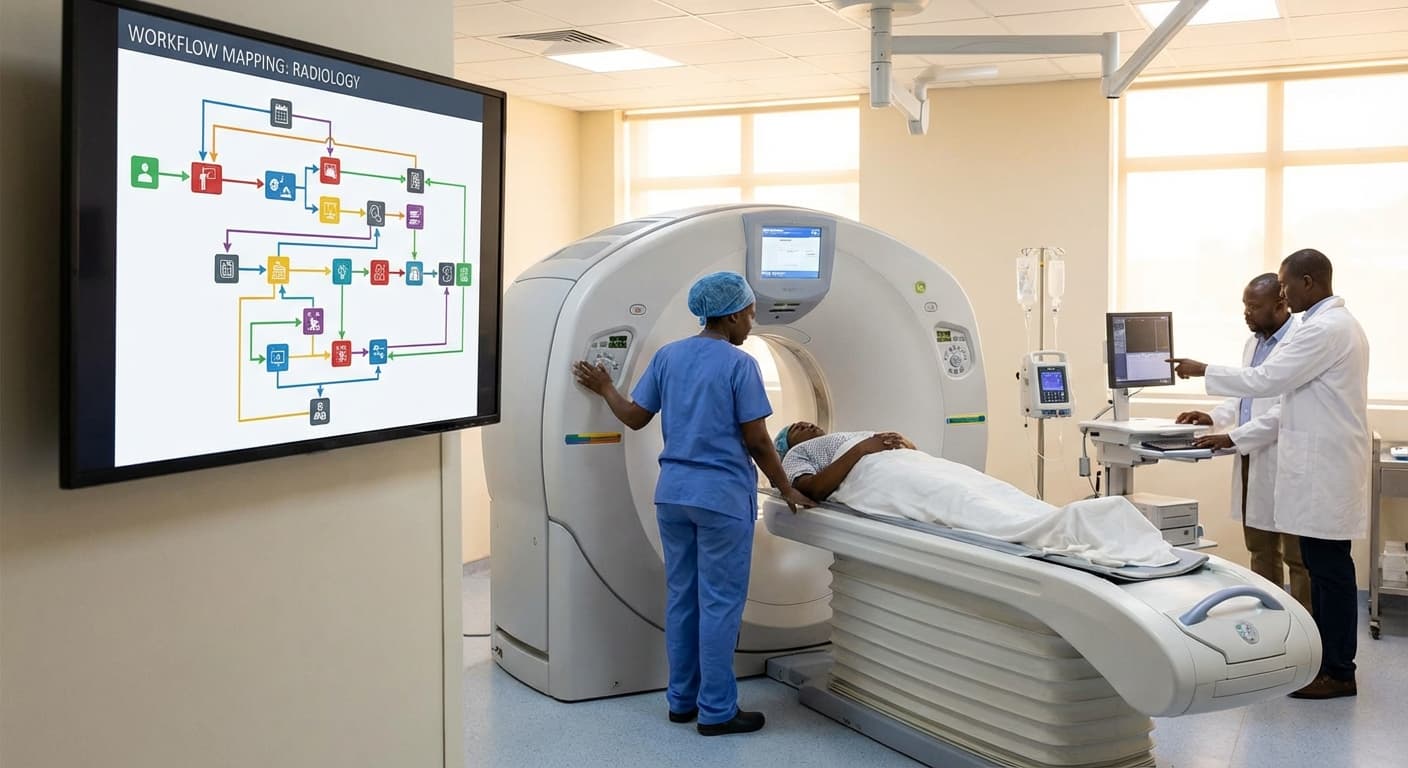
Department Workflow Mapping Service (Radiology/ICU/OT/Lab/Dialysis) in Libya
Engineering Excellence & Technical Support
Department Workflow Mapping Service (Radiology/ICU/OT/Lab/Dialysis) High-standard technical execution following OEM protocols and local regulatory frameworks.
Streamlined Radiology Image Ordering & Reporting
Visualize and optimize the entire radiology workflow, from patient registration and order placement to image acquisition, interpretation, and final report generation. Our service identifies bottlenecks and suggests improvements for faster turnaround times and enhanced diagnostic accuracy in Libyan hospitals.
Optimized ICU Patient Flow & Resource Allocation
Map critical care pathways in Libyan ICUs, from admission and stabilization to treatment protocols and discharge. We highlight opportunities for improved patient monitoring, efficient equipment utilization, and seamless inter-departmental communication to enhance patient outcomes and reduce resource strain.
Efficient Operating Theatre Scheduling & Resource Management
Gain a clear understanding of the surgical workflow in Libyan Operating Theatres, from pre-operative patient preparation to post-operative care. Our service pinpoints inefficiencies in scheduling, instrument management, and staffing, leading to reduced waiting times and maximized theatre utilization.
What Is Department Workflow Mapping Service (Radiology/icu/ot/lab/dialysis) In Libya?
Department Workflow Mapping Service (Radiology/ICU/OT/Lab/Dialysis) in Libya refers to the systematic analysis, documentation, and optimization of all sequential processes and activities within a specific hospital department. This service aims to enhance operational efficiency, reduce errors, improve patient throughput, and ensure adherence to quality standards and regulatory compliance. It involves identifying inputs, outputs, stakeholders, decision points, and communication channels for each task within the department's scope of operation. The methodologies employed are typically rooted in process engineering, lean management principles, and quality improvement frameworks.
| Department Type | Who Needs the Service | Typical Use Cases |
|---|---|---|
| Radiology | Hospital administration, Radiology department heads, Quality assurance teams, IT departments involved in PACS/RIS implementation. | Streamlining patient scheduling and imaging acquisition; optimizing image interpretation and reporting turnaround times; reducing equipment downtime; improving radiologist workflow and collaboration; managing contrast media inventory. |
| Intensive Care Unit (ICU) | Hospital administration, ICU directors, Nursing managers, Physicians, Quality improvement committees. | Improving patient admission and discharge processes; optimizing care delivery pathways for specific conditions (e.g., sepsis, post-operative care); enhancing interdisciplinary team communication and handoffs; managing critical equipment utilization; reducing medication errors. |
| Operating Theatre (OT) | Hospital administration, Surgical department heads, Anesthesiology department heads, Theatre managers, Perioperative nursing staff. | Optimizing surgical case scheduling and room allocation; streamlining patient preparation and anesthesia induction; improving surgical team coordination; managing instrument and supply chain logistics; reducing procedure cancellations and delays. |
| Laboratory | Hospital administration, Laboratory directors, Laboratory managers, Medical technologists, Quality control personnel. | Enhancing specimen collection and transport workflows; optimizing analytical testing processes; improving sample accessioning and reporting turnaround times; managing reagent inventory and quality control procedures; reducing sample rejections and errors. |
| Dialysis | Hospital administration, Nephrology department heads, Dialysis unit managers, Nursing staff, Biomedical engineers. | Streamlining patient scheduling and dialysis session management; optimizing dialysis machine preparation and cleaning protocols; improving fluid and medication administration workflows; managing patient monitoring and vital sign tracking; ensuring infection control compliance. |
Key Components of Department Workflow Mapping Service:
- Process Identification and Scoping: Defining the boundaries and objectives of the workflow analysis for a particular department (e.g., Radiology, ICU, OT, Lab, Dialysis).
- Data Collection: Gathering detailed information on existing workflows through observation, interviews with staff, review of existing documentation, and system logs.
- Process Modeling: Visually representing the current state of workflows using standardized notations such as Business Process Model and Notation (BPMN) or flowcharts.
- Bottleneck and Inefficiency Identification: Analyzing the mapped workflows to pinpoint areas of delay, redundancy, waste, and potential for errors.
- Root Cause Analysis: Investigating the underlying reasons for identified inefficiencies and bottlenecks.
- Optimization and Redesign: Developing and proposing improved workflow designs that enhance efficiency, reduce costs, minimize risks, and improve patient outcomes.
- Implementation Support: Assisting in the rollout of the redesigned workflows, including training and change management.
- Performance Monitoring and Continuous Improvement: Establishing metrics and mechanisms for ongoing evaluation and iterative refinement of the workflows.
Who Needs Department Workflow Mapping Service (Radiology/icu/ot/lab/dialysis) In Libya?
In Libya, healthcare facilities facing challenges with efficiency, patient flow, and resource allocation can significantly benefit from a Department Workflow Mapping Service. This service is crucial for optimizing operations within critical departments such as Radiology, Intensive Care Units (ICU), Operating Theatres (OT), Laboratories, and Dialysis Centers. By meticulously documenting, analyzing, and redesigning existing workflows, these departments can achieve greater accuracy, reduce delays, improve patient outcomes, and enhance overall operational effectiveness.
| Department | Why Workflow Mapping is Needed | Key Challenges Addressed |
|---|---|---|
Target Customers and Departments for Workflow Mapping Service in Libya
- {"items":["Public Hospitals (Central, Regional, and Specialized)","Private Hospitals and Clinics","Medical Centers","Diagnostic Imaging Centers","Clinical Laboratory Services","Dialysis Centers","Healthcare Administration and Management Bodies","Government Health Ministries and Departments"],"title":"Target Customers"}
- {"items":["Radiology Departments (X-ray, CT Scans, MRI, Ultrasound, Mammography)","Intensive Care Units (ICU) / Critical Care Units (CCU)","Operating Theatres (OT) / Surgical Suites","Clinical Laboratories (Pathology, Biochemistry, Hematology, Microbiology)","Dialysis Centers (Hemodialysis, Peritoneal Dialysis)"],"title":"Target Departments"}
Department Workflow Mapping Service (Radiology/icu/ot/lab/dialysis) Process In Libya
This document outlines the comprehensive workflow for the Department Workflow Mapping Service, specifically tailored for healthcare departments such as Radiology, Intensive Care Unit (ICU), Operating Theatre (OT), Laboratory, and Dialysis within Libya. The service aims to analyze, document, and optimize existing operational processes to enhance efficiency, reduce errors, and improve patient care. The workflow encompasses the entire journey from the initial inquiry from a healthcare facility to the final execution and delivery of the mapped processes and recommendations.
| Stage | Description | Key Activities | Deliverables | Responsible Party |
|---|---|---|---|---|
| The healthcare facility expresses interest in the workflow mapping service. | Initial contact, understanding of the facility's challenges, discussion of service benefits. | Preliminary understanding of needs, confirmation of service interest. | Client (Healthcare Facility), Service Provider |
| A detailed understanding of the specific department(s) and the desired outcomes is established. | On-site visits (if feasible), interviews with key stakeholders, defining the exact scope (e.g., specific processes within Radiology), identifying key performance indicators (KPIs). | Scope document, Statement of Work (SOW), agreed-upon KPIs. | Service Provider, Client |
| Gathering comprehensive information about the current state of the department's workflows. | Observation of processes, interviews with staff at all levels, review of existing SOPs, collection of relevant data (e.g., patient flow, turnaround times, resource utilization). | Raw data, interview notes, observation logs, existing documentation. | Service Provider |
| Visualizing and documenting the current processes in a clear and understandable format. | Creating process flow diagrams (e.g., using BPMN or similar standards), developing detailed process narratives, identifying roles and responsibilities, documenting decision points and handoffs. | Current State Process Maps, Detailed Process Narratives. | Service Provider |
| Identifying inefficiencies, bottlenecks, and areas for improvement within the current workflows. | Comparing current state maps against best practices and desired outcomes, identifying deviations, brainstorming potential solutions, prioritizing recommendations based on impact and feasibility. | Gap analysis report, list of identified inefficiencies, proposed recommendations. | Service Provider |
| Presenting the findings and recommendations to the client for feedback and validation. | Formal presentation of current state maps, gap analysis, and recommendations, interactive Q&A session, incorporating client feedback. | Validated Current State Maps, Approved Recommendations. | Service Provider, Client |
| Developing a strategic plan for the implementation of the approved recommendations. | Defining implementation steps, timelines, resource allocation, identifying potential risks and mitigation strategies, developing training plans. | Implementation Plan, Risk Assessment, Training Strategy. | Service Provider, Client |
| Putting the recommendations into practice and ensuring staff are equipped to follow the new workflows. | Implementing process changes, conducting staff training sessions, providing on-site support during the initial phase of implementation. | Implemented New Workflows, Trained Staff, New SOPs (if developed). | Service Provider, Client |
| Tracking the effectiveness of the implemented changes and making adjustments as needed. | Collecting data on new KPIs, observing new workflows in action, gathering feedback from staff, conducting periodic reviews. | Performance Monitoring Reports, Feedback Summaries. | Service Provider, Client |
| Documenting the entire project and formally handing over the final deliverables to the client. | Compiling a comprehensive final report including all process maps, analysis, recommendations, implementation details, and evaluation results. Transferring all project-related documentation. | Final Project Report, All Project Documentation, Knowledge Transfer. | Service Provider, Client |
Service Workflow Stages
- Inquiry & Initial Consultation
- Needs Assessment & Scope Definition
- Data Collection & Analysis
- Workflow Mapping & Documentation
- Gap Analysis & Recommendation Development
- Presentation & Validation
- Implementation Planning
- Execution & Training
- Monitoring & Evaluation
- Final Reporting & Handover
Department Workflow Mapping Service (Radiology/icu/ot/lab/dialysis) Cost In Libya
The cost of departmental workflow mapping services for specialized units like Radiology, ICU, OT (Operating Theatre), Lab (Laboratory), and Dialysis in Libya can vary significantly. These services involve analyzing existing processes, identifying bottlenecks, proposing improvements, and often implementing new workflows to enhance efficiency, patient safety, and resource utilization within these critical departments. The pricing is influenced by several key factors, making it difficult to provide a single, definitive cost. It's important for healthcare institutions in Libya to engage with specialized consulting firms or experienced healthcare management professionals to obtain tailored quotes.
| Department Type | Estimated Cost Range (LYD - Libyan Dinar) |
|---|---|
| Radiology Department (Basic Imaging) | 15,000 - 30,000 LYD |
| Radiology Department (Advanced Imaging & Interventional) | 25,000 - 50,000 LYD |
| ICU (Intensive Care Unit) | 20,000 - 45,000 LYD |
| OT (Operating Theatre) - Single OR | 18,000 - 35,000 LYD |
| OT (Operating Theatre) - Multiple ORs & Complex Surgeries | 30,000 - 60,000 LYD |
| Lab (Basic Pathology/Hematology) | 12,000 - 25,000 LYD |
| Lab (Comprehensive Diagnostics - Microbiology, Biochemistry, etc.) | 20,000 - 40,000 LYD |
| Dialysis Unit | 15,000 - 30,000 LYD |
Key Pricing Factors for Departmental Workflow Mapping in Libya
- Scope and Complexity of the Department: Larger, more complex departments with multiple sub-sections and intricate processes (e.g., a large hospital's ICU with advanced life support, a comprehensive diagnostic radiology department with interventional procedures) will naturally incur higher costs due to the extensive analysis required.
- Number of Departments to be Mapped: If an institution requires workflow mapping for multiple departments simultaneously, the overall project cost will increase, though potential economies of scale might be achievable.
- Consulting Firm's Reputation and Expertise: Well-established and highly reputable consulting firms with a proven track record in healthcare workflow optimization, particularly within the Libyan context, will typically command higher fees.
- Duration of the Project: The time required to complete the mapping, analysis, and recommendation phases directly impacts costs, as it's often billed on a time-and-materials basis or a fixed project fee.
- Deliverables Required: The extent of the deliverables is a major cost driver. This can range from a basic report with identified issues to a comprehensive implementation plan, including standard operating procedures (SOPs), training materials, and even IT system integration recommendations.
- On-site vs. Remote Consultation: The need for consultants to travel to Libya and conduct on-site assessments, interviews, and observations will significantly increase costs due to travel, accommodation, and per diem expenses. Remote consultations, while potentially cheaper, may not offer the same depth of insight.
- Level of Data Analysis and Technology Integration: If the service includes in-depth data analysis of patient flow, resource utilization, or requires the assessment and recommendation of technology solutions (e.g., PACS for radiology, EMR for ICU), the cost will be higher.
- Customization and Specificity: Highly customized workflow solutions tailored to the unique challenges and resources of a specific Libyan hospital will be more expensive than a standardized approach.
- Market Conditions and Demand: The overall demand for such services within Libya and the availability of specialized consultants can influence pricing.
Affordable Department Workflow Mapping Service (Radiology/icu/ot/lab/dialysis) Options
Our Affordable Department Workflow Mapping Service offers a comprehensive solution for optimizing operations in critical hospital departments including Radiology, ICU, Operating Theatre (OT), Laboratory, and Dialysis. By meticulously mapping your current workflows, we identify bottlenecks, inefficiencies, and areas for improvement, leading to enhanced patient care, reduced costs, and increased staff satisfaction. We understand that budget is a key consideration, which is why we've developed flexible value bundles and implemented strategic cost-saving measures to make this essential service accessible to all departments.
| Cost-Saving Strategy | Description | Benefit to Your Department |
|---|---|---|
| Leveraging Existing Data | We utilize your current electronic health records (EHRs), departmental logs, and existing documentation to minimize the need for extensive new data collection. | Reduces time and resources spent on initial information gathering. |
| Phased Implementation Approach | Our service can be implemented in stages, allowing your department to realize cost savings and benefits incrementally, easing the financial burden. | Distributes investment and allows for early ROI realization. |
| Technology Agnostic Recommendations | We recommend solutions based on your existing technological infrastructure and offer cost-effective, adaptable software and hardware suggestions. | Avoids unnecessary capital expenditure on proprietary or complex systems. |
| Standardized Process Templates | We utilize pre-developed workflow mapping templates and best practices, adapted to your specific department, speeding up the mapping process. | Reduces consultant hours and ensures efficient use of time. |
| Remote & On-Site Hybrid Model | A flexible engagement model allows for remote analysis and virtual collaboration, reducing travel and on-site costs where feasible. | Minimizes logistical expenses associated with consultant presence. |
| Focus on High-Impact Areas | Prioritizing workflow improvements that yield the most significant cost savings and efficiency gains, ensuring immediate return on investment. | Maximizes budget allocation for the greatest impact. |
Our Value Bundles:
- {"title":"Essential Streamline Package","description":"Ideal for departments seeking foundational workflow improvements. Includes core mapping, bottleneck identification, and basic recommendation report."}
- {"title":"Optimization Plus Package","description":"For departments ready for deeper analysis. Builds upon the Essential package with detailed process flow diagrams, risk assessment, and initial implementation strategy."}
- {"title":"Transformation Pro Package","description":"Our most comprehensive offering for departments aiming for significant operational transformation. Includes all features of Optimization Plus, plus advanced technology integration suggestions, change management planning, and post-implementation review."}
- {"title":"Custom Departmental Focus","description":"Tailored solutions designed to address the unique challenges of specific departments like Radiology (imaging throughput), ICU (patient flow management), OT (scheduling efficiency), Lab (turnaround times), and Dialysis (patient scheduling and resource utilization)."}
Verified Providers In Libya
In Libya, navigating the healthcare landscape to find trustworthy and credentialed providers is paramount. Franance Health stands out as a leading organization, committed to ensuring the highest standards of medical care. Their rigorous credentialing process for healthcare providers in Libya is designed to give patients peace of mind, knowing they are in the hands of qualified and experienced professionals. This dedication to quality and patient safety makes Franance Health the definitive choice for accessing reliable healthcare services in Libya.
| Credentialing Aspect | Franance Health's Approach | Patient Benefit |
|---|---|---|
| Licensure and Certification Verification | Thorough checks of all relevant medical licenses and board certifications issued by recognized authorities. | Ensures providers are legally qualified and have met stringent professional standards. |
| Education and Training Assessment | Verification of medical school diplomas, postgraduate training, and specialized certifications. | Confirms a strong foundation in medical knowledge and expertise. |
| Professional Experience Review | Scrutiny of past employment history, practice scope, and references. | Guarantees practical experience and a track record of competent patient care. |
| Background Checks | Comprehensive checks to ensure a clean professional record and ethical conduct. | Protects patients from unqualified or compromised practitioners. |
| Specialty Competency Validation | Assessment of specific skills and knowledge relevant to their declared medical specialties. | Ensures providers are equipped to handle complex cases within their field. |
Why Franance Health is the Best Choice for Verified Providers in Libya
- Uncompromising Credentialing Standards: Franance Health employs a multi-faceted approach to verify the qualifications, licenses, and experience of all affiliated healthcare professionals.
- Commitment to Patient Safety: The rigorous vetting process directly translates to enhanced patient safety and confidence.
- Access to Top Medical Talent: By partnering with Franance Health, patients gain access to a network of Libya's most skilled and reputable doctors, specialists, and facilities.
- Streamlined Healthcare Navigation: Franance Health simplifies the process of finding and engaging with verified medical practitioners.
- Continuous Quality Assurance: Beyond initial credentialing, Franance Health maintains ongoing oversight to ensure consistent high-quality care.
Scope Of Work For Department Workflow Mapping Service (Radiology/icu/ot/lab/dialysis)
This Scope of Work (SOW) outlines the services for conducting a comprehensive workflow mapping initiative across critical departments within a healthcare facility. The objective is to visually document, analyze, and identify opportunities for optimization within the Radiology, Intensive Care Unit (ICU), Operating Theatre (OT), Laboratory, and Dialysis departments. This will involve detailed process mapping, identification of bottlenecks, and recommendations for efficiency improvements. The technical deliverables will adhere to industry-standard specifications for clarity, accuracy, and usability.
| Deliverable | Description | Standard Specifications / Format | Target Audience |
|---|---|---|---|
| Current State Workflow Maps | Detailed visual representation of existing processes for each target department, including steps, decision points, roles, systems used, and data flow. | Visio, Lucidchart, or similar diagramming tool. BPMN 2.0 (Business Process Model and Notation) or a comparable standard for process modeling. High-resolution, easily navigable diagrams with clear labeling and legends. | Department Heads, Process Improvement Teams, IT Department, Clinical Staff |
| Bottleneck and Inefficiency Analysis Report | A written report detailing identified bottlenecks, time delays, areas of high error rate, and resource constraints within each workflow. | Microsoft Word or PDF format. Clear, concise language with data-driven evidence. Recommendations for immediate and short-term mitigation. | Management, Process Improvement Teams, Department Heads |
| Stakeholder Interview Summaries | Summarized notes and key takeaways from interviews conducted with relevant stakeholders (clinicians, technicians, administrators) within each department. | Microsoft Word or PDF format. Anonymized where appropriate, focusing on key insights and pain points. | Process Improvement Teams, Project Management |
| Recommendations for Optimization Report | A strategic report outlining actionable recommendations for improving efficiency, reducing costs, enhancing patient safety, and improving staff satisfaction. This may include process redesign, technology adoption, or training needs. | Microsoft Word or PDF format. Prioritized recommendations with estimated impact and feasibility. Potential future state workflow diagrams may be included. | Senior Management, IT Department, Department Heads, Process Improvement Teams |
| Final Project Presentation | A comprehensive presentation summarizing the project findings, analysis, and recommendations. Includes key workflow maps and proposed optimizations. | Microsoft PowerPoint or equivalent. Visual aids, concise data, and clear articulation of the value proposition. | Executive Leadership, Department Heads, Key Stakeholders |
| Metadata and Documentation Log | A log detailing all assumptions, definitions, data sources, and methodologies used during the workflow mapping process. | Microsoft Excel or CSV format. Ensures reproducibility and transparency of the analysis. | Project Management, Process Improvement Teams, Auditors |
Objectives of Workflow Mapping Service
- To gain a clear and detailed understanding of current departmental workflows.
- To identify inefficiencies, redundancies, and potential bottlenecks in existing processes.
- To facilitate communication and collaboration between departments.
- To provide a baseline for implementing process improvements and technological integrations.
- To support decision-making regarding resource allocation and staff training.
- To ensure compliance with relevant healthcare regulations and best practices.
Service Level Agreement For Department Workflow Mapping Service (Radiology/icu/ot/lab/dialysis)
This Service Level Agreement (SLA) outlines the guaranteed response times and uptime for the Department Workflow Mapping Service, specifically for Radiology, Intensive Care Unit (ICU), Operating Theatre (OT), Laboratory, and Dialysis departments. This service aims to ensure efficient and accurate mapping of departmental workflows, supporting operational improvements and patient care.
| Service Component | Response Time (Business Hours) | Uptime Guarantee (Monthly) |
|---|---|---|
| Initial Consultation & Requirement Gathering | 24 Business Hours | N/A (One-time setup) |
| Preliminary Workflow Diagram Submission | 3 Business Days | N/A (Project-based) |
| Revised Workflow Diagram based on Feedback | 2 Business Days | N/A (Project-based) |
| Final Workflow Documentation Delivery | 1 Business Day | N/A (Project-based) |
| System Availability (for accessing mapping tools/platforms) | 4 Business Hours (for critical issues) | 99.5% |
| Support & Clarification Requests (non-critical) | 8 Business Hours | N/A (Covered by System Availability) |
Scope of Service
- Workflow mapping for Radiology department procedures.
- Workflow mapping for Intensive Care Unit (ICU) patient journeys.
- Workflow mapping for Operating Theatre (OT) scheduling and processes.
- Workflow mapping for Laboratory sample processing and reporting.
- Workflow mapping for Dialysis patient treatment cycles.
Frequently Asked Questions

Ready when you are
Let's scope your Department Workflow Mapping Service (Radiology/ICU/OT/Lab/Dialysis) in Libya project in Libya.

Scaling healthcare logistics and technical systems across the entire continent.