
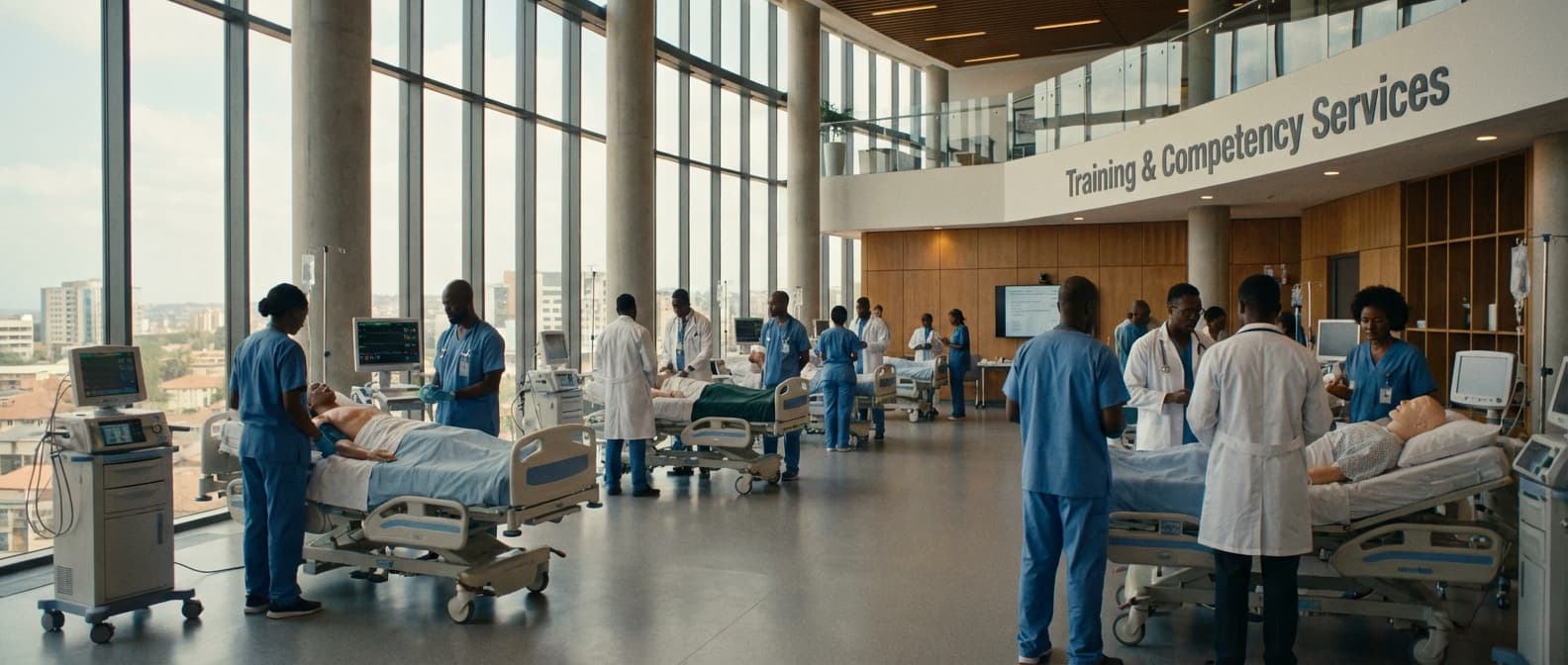
CT Operator Training Service (Radiographers) in Liberia
Engineering Excellence & Technical Support
CT Operator Training Service (Radiographers) High-standard technical execution following OEM protocols and local regulatory frameworks.
Expert CT Imaging Protocols
Master advanced CT imaging protocols for Liberia's diverse patient population, ensuring accurate diagnostic information while minimizing radiation exposure, guided by international best practices and local health needs.
Patient Safety & Contrast Administration
Gain proficiency in safe patient positioning, preparation, and precise intravenous contrast administration techniques, crucial for optimizing CT scan quality and mitigating adverse reactions within the Liberian healthcare context.
CT Equipment Operation & Maintenance
Develop hands-on skills in the operation, routine quality assurance, and basic troubleshooting of modern CT scanners, ensuring reliable and efficient service delivery in Liberian hospitals and clinics.
What Is Ct Operator Training Service (Radiographers) In Liberia?
CT Operator Training Service (Radiographers) in Liberia refers to specialized educational programs designed to equip radiographers with the knowledge and practical skills necessary to safely and effectively operate Computed Tomography (CT) scanners. This service is crucial for enhancing diagnostic imaging capabilities and ensuring patient safety within Liberian healthcare facilities. It encompasses theoretical instruction on CT physics, radiation safety principles, image acquisition protocols, contrast media administration, artifact recognition and mitigation, and quality assurance procedures. The practical component involves hands-on training with CT equipment, simulation exercises, and supervised patient scanning, focusing on accurate patient positioning, optimal parameter selection, and image post-processing techniques.
| Target Audience | Needs Addressed | Typical Use Cases |
|---|---|---|
| Newly graduated radiographers | Acquire foundational knowledge and practical skills for independent CT operation. | Introduction to diagnostic imaging departments, onboarding for new hires, establishing competency in basic CT examinations. |
| Experienced radiographers seeking specialization | Develop advanced proficiency in CT imaging and potentially specialized applications. | Transitioning to a CT-focused role, enhancing skills for complex examinations, preparing for advanced CT modalities. |
| Healthcare facilities acquiring new CT technology | Ensure staff competency and compliance with manufacturer guidelines and international standards. | Installation and commissioning of new CT scanners, staff retraining due to equipment upgrades or replacements. |
| Radiographers in remote or underserved areas | Bridge the gap in access to specialized CT training, enabling local expertise. | Maximizing the utilization of limited CT resources, improving regional diagnostic capabilities. |
| Healthcare institutions aiming for accreditation or certification | Demonstrate adherence to quality standards and best practices in CT imaging. | Meeting regulatory requirements, achieving quality benchmarks for diagnostic services. |
Key Components of CT Operator Training Service:
- CT Physics and Instrumentation: Understanding X-ray generation, detector technology, gantry mechanics, and image reconstruction algorithms.
- Radiation Protection and Safety: Principles of ALARA (As Low As Reasonably Achievable), dose monitoring, shielding, and emergency protocols.
- Patient Preparation and Positioning: Techniques for patient comfort, immobilization, and accurate anatomical alignment for optimal imaging.
- Imaging Protocols and Parameter Optimization: Selection of appropriate kVp, mA, slice thickness, pitch, and other parameters for diverse anatomical regions and pathologies.
- Contrast Media Administration: Knowledge of contrast agent types, indications, contraindications, potential adverse reactions, and administration techniques.
- Image Acquisition and Reconstruction: Understanding the workflow from scout images to volumetric data acquisition and image reconstruction processes.
- Artifact Recognition and Management: Identifying common artifacts (e.g., beam hardening, motion, metal) and implementing strategies for their reduction or elimination.
- Image Quality Assurance and Quality Control (QA/QC): Implementing regular checks and calibration procedures to maintain optimal scanner performance and image fidelity.
- Advanced CT Applications: Introduction to specialized techniques such as CT angiography, dual-energy CT, and interventional CT procedures (depending on the training level).
- Ethical and Legal Considerations: Patient rights, informed consent, data privacy, and professional responsibilities.
Who Needs Ct Operator Training Service (Radiographers) In Liberia?
CT Operator Training Service (Radiographers) in Liberia is crucial for advancing diagnostic imaging capabilities and ensuring patient safety. This specialized training equips radiographers with the necessary skills to operate CT scanners efficiently and effectively, interpret complex images, and adhere to radiation safety protocols. The demand for such services is driven by the increasing adoption of CT technology in healthcare facilities across the country and the need to maintain high standards of medical imaging expertise.
| Target Customer Type | Relevant Departments | Training Needs |
|---|---|---|
| Public Hospitals | Radiology Department, Diagnostic Imaging Unit, Emergency Department | Fundamental and advanced CT operation, image acquisition protocols, radiation safety, basic interpretation, quality assurance. |
| Private Hospitals | Radiology Department, Imaging Services, Outpatient Clinics | Efficient scanner operation, protocol optimization, advanced imaging techniques, patient care during CT procedures, interdepartmental collaboration. |
| Diagnostic Imaging Centers | Radiology Technologist Team, Lead Radiographer | Specialized CT applications (e.g., CT angiography, cardiac CT), workflow efficiency, advanced troubleshooting, compliance with regulatory standards. |
| University Teaching Hospitals | Radiology Department, Medical Education Unit, Research Departments | Advanced CT techniques for research, training of future radiographers, protocol development, peer-to-peer learning, integration of CT in multidisciplinary patient care. |
| NGO-funded Healthcare Facilities | Radiology Unit, Medical Support Services | Cost-effective CT operation and maintenance, essential CT imaging for primary diagnoses, basic radiation protection, training for generalist radiographers. |
| Ministry of Health and its regional offices | Public Health Division, Medical Services Directorate | Setting training standards, workforce development planning, ensuring quality across public healthcare facilities, capacity building initiatives. |
Target Customers for CT Operator Training Service (Radiographers) in Liberia:
- Public Hospitals
- Private Hospitals
- Diagnostic Imaging Centers
- University Teaching Hospitals
- NGO-funded Healthcare Facilities
- Ministry of Health and its regional offices
Ct Operator Training Service (Radiographers) Process In Liberia
This document outlines the workflow for CT Operator Training Services (Radiographers) in Liberia, detailing the process from initial inquiry to the successful execution of the training program. The service aims to enhance the skills and knowledge of radiographers in operating Computed Tomography (CT) scanners, thereby improving diagnostic imaging capabilities within the country.
| Stage | Description | Key Activities | Responsible Party(ies) | Deliverables/Outcomes |
|---|---|---|---|---|
| Initial contact from a potential client (e.g., Ministry of Health, hospital, training institution) expressing interest in CT operator training. | Receive inquiry, understand specific training needs (e.g., number of radiographers, experience level, specific CT scanner models, desired outcomes), clarify service scope. | Client, Training Service Provider (TSP) | Clear understanding of client's requirements, initial scope of work. |
| The TSP develops a tailored proposal based on the identified needs. | Develop a comprehensive proposal outlining training modules, duration, methodology, trainers' qualifications, equipment requirements, proposed schedule, budget, and terms and conditions. Negotiate proposal details with the client. | TSP, Client | Agreed-upon training proposal. |
| Formalization of the training service agreement. | Draft, review, and sign a formal contract or Memorandum of Understanding (MOU) detailing all agreed-upon aspects of the training, including payment schedules, responsibilities, and liabilities. | TSP, Client | Signed contract/MOU. |
| Detailed planning of the training content and timeline. | Finalize the detailed training curriculum, including theoretical lectures, practical hands-on sessions, case studies, and assessment methods. Develop a precise training schedule, including dates, times, and locations. | TSP, Client (for input/approval) | Approved training curriculum and schedule. |
| Setting up the necessary resources and logistical arrangements. | Procure/ensure availability of training materials (manuals, presentations), arrange for training venue(s), ensure access to CT scanners for practical sessions (if not provided by client), confirm trainer availability, coordinate participant registration and communication. | TSP, Client (for facility/equipment access) | Ready training environment, registered participants. |
| The core training phase where knowledge and skills are imparted. | Conduct theoretical lectures on CT physics, anatomy, image acquisition protocols, patient safety, quality assurance, and common pathologies. Provide hands-on practical training on CT scanner operation, image interpretation basics, and troubleshooting, using actual equipment or simulators. | TSP (Trainers) | Trained radiographers, enhanced CT operating skills. |
| Measuring the effectiveness of the training and the participants' learning. | Administer theoretical assessments (quizzes, written exams) and practical assessments (demonstration of skills, case study analysis). Gather feedback from participants on the training content, delivery, and trainers. | TSP, Participants | Assessment results, participant feedback data. |
| Formal recognition of training completion and review of outcomes. | Issue certificates of completion to successful participants. Provide a comprehensive report to the client detailing training outcomes, assessment results, and participant performance. Incorporate feedback for future training improvements. | TSP, Client | Certificates of completion, training report. |
| Ensuring sustained skill application and addressing ongoing needs. | Provide limited post-training support (e.g., Q&A sessions, access to online resources). Conduct follow-up assessments or site visits (if agreed) to monitor skill application and identify any further training needs or challenges. | TSP, Client | Sustained competency, identification of further training requirements. |
CT Operator Training Service Workflow
- Inquiry & Needs Assessment
- Proposal Development & Negotiation
- Contracting & Agreement
- Curriculum & Schedule Finalization
- Pre-Training Preparation
- Training Delivery (Theoretical & Practical)
- Assessment & Evaluation
- Certification & Feedback
- Post-Training Support & Follow-up
Ct Operator Training Service (Radiographers) Cost In Liberia
Providing accurate cost estimations for CT Operator Training (Radiographers) in Liberia requires a nuanced understanding of several key factors. These factors influence both the direct training expenses and indirect costs associated with delivering the service. The primary components influencing pricing include the duration and intensity of the training program, the qualifications and experience of the instructors, the type and availability of CT equipment used for hands-on practice, the training institution's reputation and accreditation, the number of trainees, and the inclusion of supplementary materials and assessments. Furthermore, logistical considerations such as venue rental, travel, accommodation for instructors (if applicable), and administrative overhead play a significant role in the final cost. Demand for such specialized training within Liberia, coupled with the scarcity of highly qualified local trainers, can also contribute to price variations. The local currency, the Liberian Dollar (LRD), is used for all transactions. Due to the inherent variability, providing a precise fixed price is challenging, but a general range can be estimated based on these influences. Factors like whether the training is a standalone course, part of a larger medical education program, or offered by an international organization will also significantly impact the pricing structure.
| Training Component/Factor | Estimated Cost Range (LRD) | Notes |
|---|---|---|
| Basic CT Operator Training (e.g., 2-4 weeks) | 250,000 - 700,000 LRD | Covers foundational theory and practical introduction. May vary based on hands-on time with equipment. |
| Advanced CT Operator Training (e.g., 4-8 weeks) | 600,000 - 1,500,000 LRD | Focuses on specialized protocols, advanced imaging techniques, and troubleshooting. Often includes more in-depth practical sessions. |
| Per-Trainee Fee (for group training) | 50,000 - 150,000 LRD | This is an average per-person cost within a larger group. Bulk discounts may apply. |
| Instructor Fees (Daily/Weekly Rate) | 30,000 - 70,000 LRD per day | Varies significantly based on the instructor's expertise and international vs. local origin. International trainers will be significantly more expensive. |
| Equipment Usage Fees (if applicable) | Negotiable/Included | Some institutions may charge separately for extensive CT scanner usage, especially for advanced or lengthy practical sessions. |
| Training Materials & Assessments | 20,000 - 50,000 LRD | Includes workbooks, manuals, and examination fees. |
| Venue Rental & Logistics | 50,000 - 150,000 LRD (total) | Depends on the duration and facilities required. May be integrated into the overall course fee. |
| Certification Fee | 10,000 - 30,000 LRD | Cost for issuing a recognized certificate upon successful completion. |
Key Pricing Factors for CT Operator Training in Liberia:
- Training Duration and Intensity
- Instructor Qualifications and Experience
- Access to CT Equipment for Practical Training
- Institution's Reputation and Accreditation Status
- Number of Trainees (Group vs. Individual Pricing)
- Inclusion of Supplementary Materials and Assessments
- Logistical Costs (Venue, Travel, Accommodation)
- Administrative Overhead and Operational Expenses
- Demand and Supply of Specialized Training Locally
- Level of Training (Basic, Advanced, Specialized Modules)
Affordable Ct Operator Training Service (Radiographers) Options
This document outlines affordable CT operator training service options for radiographers. We focus on value bundles and cost-saving strategies to make high-quality CT education accessible. Our goal is to equip radiographers with the necessary skills and knowledge to operate CT scanners effectively and safely, while respecting budgetary constraints.
| Training Option | Description | Value Bundle Components | Estimated Cost Range (USD) | Cost-Saving Strategies | |
|---|---|---|---|---|---|
| Online Self-Paced Module | Learn CT fundamentals and principles at your own pace via pre-recorded lectures, readings, and quizzes. | Access to online course materials, video library, self-assessment quizzes. | $250 - $500 per user | No travel costs, learn anytime/anywhere, bulk discounts for multiple users. | Includes foundational CT physics, image acquisition, safety protocols, and basic protocol selection. |
| Blended Learning Program | Combines online learning with live virtual or in-person instructor-led sessions for interactive learning and Q&A. | Online modules + scheduled live webinars/workshops, case study reviews. | $500 - $1,200 per user | Reduced travel and accommodation costs compared to fully on-site, focused live sessions maximize ROI. | Covers advanced protocols, troubleshooting, and image optimization. |
| On-Site Group Training | Instructor travels to your facility to deliver customized training to your staff. | On-site instructor, customized curriculum, on-site equipment simulation/demonstration (if possible). | $3,000 - $7,000 per session (up to 10 participants) | Cost-effective for training multiple staff members simultaneously, minimizes disruption to workflow, reduces individual travel expenses. | Ideal for introducing new equipment or specific advanced protocols. |
| Specialized Protocol Training | Focuses on specific CT applications (e.g., cardiac CT, neuro CT, interventional CT) for advanced skill development. | In-depth modules on specific protocols, advanced artifact reduction, and clinical application reviews. | Variable, often bundled with other training options or on a per-protocol basis. | Targeted training avoids unnecessary costs for general knowledge, can be integrated into existing training plans. | Can be delivered online or as part of a blended/on-site program. |
| Train-the-Trainer Program | Empowers experienced radiographers within your facility to become internal CT trainers. | Comprehensive instructor training, curriculum development guidance, assessment tools. | $1,500 - $3,000 per trainer | Long-term cost savings through in-house expertise, consistent training delivery within the organization. | Builds internal capacity for ongoing CT education. |
Key Features of Our Affordable CT Operator Training Services
- Flexible learning formats (online, blended, on-site)
- Experienced and certified CT instructors
- Comprehensive curriculum covering essential CT principles and protocols
- Hands-on simulation or clinical practicum opportunities (where applicable)
- Customizable training modules to meet specific institutional needs
- Post-training support and resources
Verified Providers In Liberia
Finding reliable and credentialed healthcare providers is paramount in Liberia. Franance Health stands out as a leading organization committed to ensuring that the medical professionals it endorses meet the highest standards of expertise, ethics, and patient care. This commitment translates into a network of verified providers who are not only skilled in their respective fields but are also dedicated to delivering compassionate and effective healthcare services to the Liberian population. By prioritizing rigorous credentialing processes, Franance Health provides a crucial layer of trust and assurance for individuals seeking medical assistance. Their dedication to excellence makes them the best choice for accessing trustworthy healthcare in Liberia.
| Provider Type | Franance Health Verification Focus | Benefits to Patients |
|---|---|---|
| General Practitioners | Valid medical license, board certification, clean professional record | Accurate diagnosis, primary care, referrals to specialists |
| Specialist Physicians (e.g., Surgeons, Pediatricians, Gynecologists) | Advanced degrees, specialized residency completion, peer reviews, ongoing education | Expert treatment for specific conditions, complex medical management |
| Nurses and Midwives | Accredited nursing school graduation, valid licensing, practical experience | Compassionate care, vital sign monitoring, patient education, safe childbirth services |
| Pharmacists | Pharmacy degree, licensed to practice, knowledge of drug interactions and dosages | Safe and accurate dispensing of medications, patient counseling on drug use |
| Laboratory Technicians | Certification in medical laboratory science, experience with diagnostic equipment | Accurate and timely diagnostic testing for effective treatment planning |
Why Franance Health Providers are the Best Choice:
- Rigorous Vetting Process: Franance Health employs a multi-faceted approach to verify the qualifications, licenses, and professional history of every provider.
- Commitment to Patient Safety: Ensuring providers adhere to strict ethical guidelines and best practices in patient care.
- Specialized Expertise: Access to a diverse range of medical professionals with specialized skills and experience.
- Trust and Reliability: A reputation built on consistently delivering high-quality and dependable healthcare services.
- Accessibility: Working to make verified healthcare more accessible across Liberia.
Scope Of Work For Ct Operator Training Service (Radiographers)
This Scope of Work (SOW) outlines the requirements for providing CT Operator Training Services specifically for Radiographers. The objective is to equip certified radiographers with the necessary theoretical knowledge and practical skills to proficiently operate Computed Tomography (CT) scanners, perform diagnostic imaging procedures, and ensure patient safety and image quality.
| Phase/Module | Description | Technical Deliverables | Standard Specifications/Requirements | ||||
|---|---|---|---|---|---|---|---|
| Phase 1: Theoretical Foundation | Comprehensive lectures covering CT physics, hardware, image formation, data acquisition, reconstruction, and radiation biology. | Training Manual (Digital/Printable) | Content aligned with international CT physics curricula (e.g., ARRT, UNSCEAR). | Clear explanations of X-ray generation, attenuation, beam hardening, noise, contrast, resolution, and artifacts. | Detailed overview of CT gantry, detector systems, and patient table mechanics. | Emphasis on dose optimization strategies. | |
| Phase 2: Scanner Operation & Protocoling | Hands-on training on CT scanner console, including patient positioning, selection of scan parameters, and protocol management. | Standard Operating Procedures (SOPs) for CT Equipment | Demonstration of various scanner models (if applicable). | Practical exercises in protocol selection for common anatomical regions (e.g., head, chest, abdomen, pelvis). | Understanding of kVp, mAs, pitch, slice thickness, and reconstruction algorithms. | Simulation of common operational scenarios. | |
| Phase 3: Image Quality & Artifact Management | Instruction on factors affecting image quality and methods for optimizing diagnostic images. Identification and correction of common artifacts. | Image Quality Assessment Checklist | Visual examples of optimal and suboptimal images. | Detailed explanation of motion artifacts, beam hardening, ring artifacts, etc. | Techniques for minimizing artifacts through patient preparation, scanning technique, and post-processing. | Introduction to contrast media administration and timing considerations. | |
| Phase 4: Radiation Safety & Patient Care | Focus on radiation protection principles for patients and staff, and essential patient care aspects during CT procedures. | Radiation Safety Guidelines Document | Adherence to national and international radiation protection standards (e.g., ICRP, NCRP). | Techniques for dose reduction (e.g., automated tube current modulation, iterative reconstruction). | Patient screening for contraindications (e.g., pregnancy, contrast allergies). | Management of claustrophobia and anxious patients. | Basic life support awareness in the CT suite. |
| Phase 5: Image Post-Processing & Reporting Basics | Introduction to basic image manipulation, windowing, level adjustments, and creation of multiplanar reconstructions (MPRs). | Post-Processing Guidebook | Demonstration of PACS (Picture Archiving and Communication System) integration. | Practical exercises in windowing and leveling for different tissue types. | Generation of basic MPRs (axial, sagittal, coronal). | Understanding of image annotation and basic reporting conventions. | |
| Phase 6: Assessment & Certification | Evaluation of trainee knowledge and practical skills through written examinations, practical assessments, and case studies. | Certificate of Completion | Written examination covering theoretical aspects. | Practical assessment demonstrating scanner operation and protocol selection. | Case study analysis requiring interpretation of images and identification of potential issues. | Minimum pass mark to be defined. |
Key Objectives of CT Operator Training
- Enhance understanding of CT physics and principles.
- Develop proficiency in CT scanner operation and protocol selection.
- Ensure adherence to radiation safety principles and ALARA (As Low As Reasonably Achievable) guidelines.
- Improve image acquisition techniques for optimal diagnostic quality.
- Introduce basic image post-processing and manipulation skills.
- Familiarize trainees with common CT artifacts and their mitigation.
- Cover emergency procedures and patient care relevant to CT examinations.
- Promote critical thinking and problem-solving skills in CT imaging.
Service Level Agreement For Ct Operator Training Service (Radiographers)
This Service Level Agreement (SLA) outlines the response times and uptime guarantees for the CT Operator Training Service provided to radiographers. It defines the expected performance standards and remedies in case of service degradation.
| Service Component | Service Level Objective (SLO) | Measurement Method | Remedy for Breach |
|---|---|---|---|
| Technical Support (Urgent Issues) | Initial response within 2 business hours. | Time from ticket submission to first agent acknowledgement. | 10% discount on the next training module fee for each incident of repeated breach. |
| Technical Support (Non-Urgent Issues) | Initial response within 8 business hours. | Time from ticket submission to first agent acknowledgement. | 5% discount on the next training module fee for each incident of repeated breach. |
| Training Platform Uptime | 99.5% uptime per calendar month, excluding scheduled maintenance. | Monitoring by third-party uptime service. Downtime measured from interruption of access to restoration of service. | For every 0.5% downtime below 99.5% in a month, a credit of 5% of the monthly training subscription fee will be applied. |
| Availability of Training Content | Training modules accessible 24/7, except during scheduled maintenance. | User-reported accessibility issues confirmed by service provider. | Service provider will endeavor to restore access within 4 business hours. No direct financial remedy, but service provider will offer extended access period to compensate for lost learning time. |
Key Performance Indicators (KPIs)
- Response Time for Technical Support
- Uptime Guarantee for Training Platform
- Availability of Training Content
Frequently Asked Questions

Ready when you are
Let's scope your CT Operator Training Service (Radiographers) in Liberia project in Liberia.

Scaling healthcare logistics and technical systems across the entire continent.