
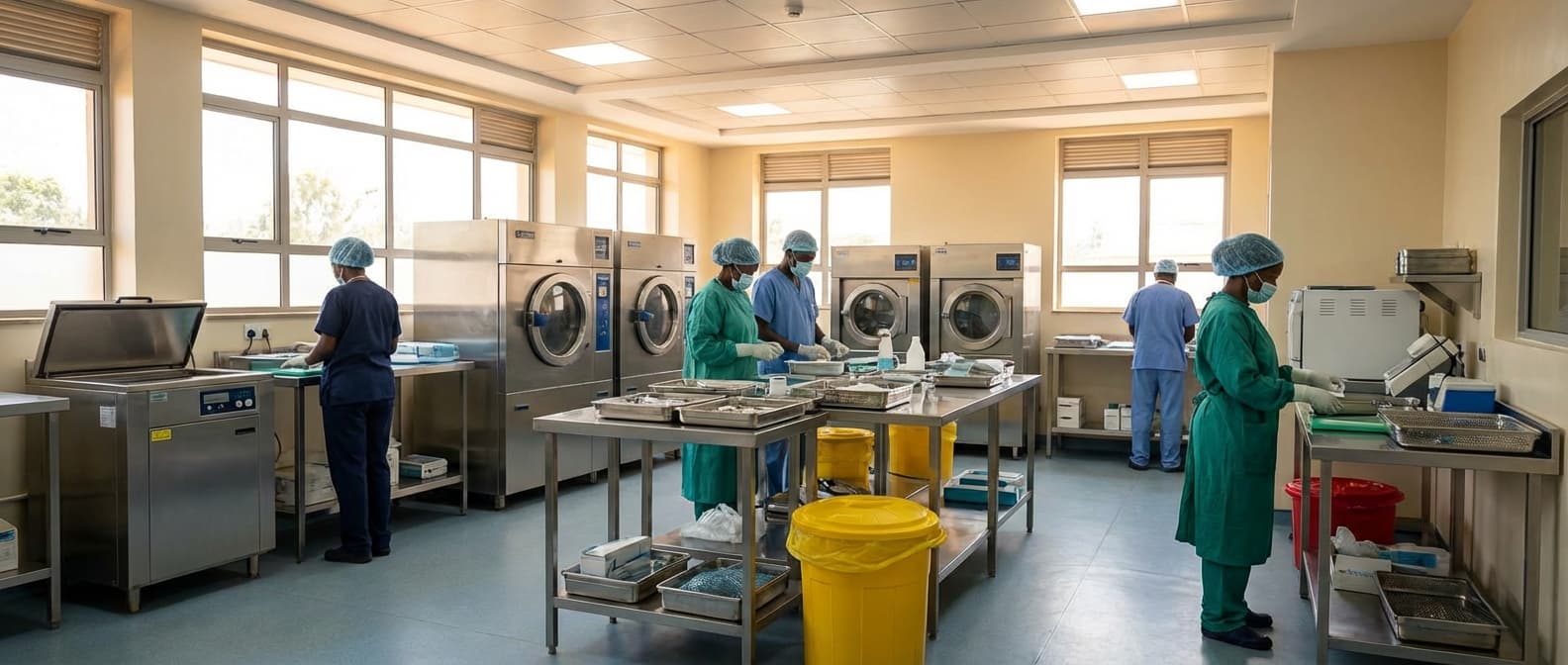
Infection-Control Readiness Support Service for Reusable Equipment in Liberia
Engineering Excellence & Technical Support
Infection-Control Readiness Support Service for Reusable Equipment High-standard technical execution following OEM protocols and local regulatory frameworks.
Advanced Sterilization Protocols
Implementing and auditing ISO-compliant sterilization processes for critical reusable medical equipment, ensuring validated efficacy against a broad spectrum of pathogens prevalent in Liberia's healthcare settings.
Capacity Building & Skills Enhancement
Delivering comprehensive, hands-on training modules for Liberian healthcare professionals on best practices for cleaning, disinfection, sterilization, and safe handling of reusable medical devices, fostering sustainable local expertise.
Robust Supply Chain Management
Establishing and optimizing supply chains for essential cleaning agents, disinfectants, sterilization consumables, and maintenance parts, guaranteeing consistent availability and preventing stockouts of critical infection control resources.
What Is Infection-control Readiness Support Service For Reusable Equipment In Liberia?
Infection-Control Readiness Support Service (ICRSS) for Reusable Equipment in Liberia is a comprehensive program designed to ensure that healthcare facilities possess and maintain the necessary resources, infrastructure, and human capacity to safely clean, disinfect, and sterilize reusable medical devices. This service aims to mitigate the risk of healthcare-associated infections (HAIs) transmitted through inadequately processed equipment, thereby enhancing patient safety and improving the quality of healthcare delivery in Liberia. It addresses critical gaps in equipment management and infection prevention and control (IPC) practices, particularly in resource-limited settings.
| Service Recipient | Needs Addressed | Typical Use Cases |
|---|---|---|
| Public Hospitals and Health Centers: | Limited financial resources for equipment upgrades, inconsistent supply chains for consumables, insufficient trained personnel, aging infrastructure. | Establishment of functional sterilization units in district hospitals, training of biomedical technicians and nurses on autoclave operation, development of SOPs for surgical instrument reprocessing, ensuring safe reprocessing of syringes and needles for vaccination campaigns. |
| Non-Governmental Organization (NGO) Healthcare Facilities: | Variable levels of funding and technical expertise, often operating in remote or underserved areas. | Implementing low-cost, effective disinfection methods for portable medical equipment, training local staff on safe reprocessing of diagnostic tools, establishing inventory management systems for sterilization consumables. |
| Private Clinics and Laboratories: | Potential for advanced equipment but may lack formal IPC training and standardized protocols, oversight may be less stringent. | Auditing reprocessing workflows for compliance with national guidelines, recommending appropriate HLDs for endoscopes, training laboratory technicians on safe processing of reusable glassware and diagnostic instruments. |
| Ministry of Health (MOH) and other Regulatory Bodies: | Need for national-level IPC guidelines, training frameworks, and capacity building initiatives to ensure consistent standards across the country. | Developing national training curricula for IPC professionals, establishing standards for equipment maintenance, supporting the development of national guidelines for reusable medical device reprocessing, assessing the readiness of facilities for public health emergencies. |
Key Components of ICRSS for Reusable Equipment:
- Needs Assessment and Gap Analysis: Evaluating existing infrastructure, equipment, consumables, and personnel training related to reusable equipment processing.
- Infrastructure Development and Renovation: Advising on and supporting the establishment or upgrade of dedicated reprocessing areas (e.g., decontamination, cleaning, disinfection, sterilization, storage).
- Equipment Procurement and Maintenance: Facilitating the acquisition of appropriate cleaning, disinfection, and sterilization equipment (e.g., ultrasonic cleaners, autoclaves, washer-disinfectors) and establishing robust maintenance protocols.
- Consumables Management: Ensuring the availability and appropriate use of high-level disinfectants (HLDs), sterilization agents, cleaning detergents, and personal protective equipment (PPE).
- Standard Operating Procedures (SOPs) Development and Implementation: Creating, adapting, and enforcing facility-specific SOPs for the safe handling, cleaning, disinfection, sterilization, and storage of all reusable medical devices.
- Training and Capacity Building: Providing comprehensive training to healthcare personnel involved in equipment reprocessing on best practices, technical operation of equipment, and adherence to SOPs.
- Monitoring and Evaluation (M&E): Establishing systems for continuous monitoring of reprocessing processes, equipment functionality, and adherence to IPC standards, with regular reporting and feedback mechanisms.
- Quality Assurance (QA) and Quality Improvement (QI): Implementing QA/QI processes to ensure the efficacy of sterilization cycles, proper disinfection levels, and overall safety of reusable equipment.
Who Needs Infection-control Readiness Support Service For Reusable Equipment In Liberia?
This document outlines the target customers and departments that would benefit from infection-control readiness support services for reusable medical equipment in Liberia. Ensuring the proper sterilization, maintenance, and handling of reusable medical devices is critical for preventing healthcare-associated infections (HAIs) and safeguarding patient health. This support is particularly vital in settings where resources and expertise may be limited.
| Customer Segment | Key Departments/Units Involved | Specific Needs/Challenges |
|---|---|---|
| Public Hospitals | CSSD, Operating Theaters, Maternity, ER, Inpatient Wards, IPC Committee | Limited funding for equipment upgrades, inadequate training for staff, inconsistent supply chains for sterilization consumables, lack of standardized protocols, potential for high patient volume leading to increased equipment turnover. |
| Private Hospitals/Clinics | CSSD, Operating Rooms, Dental Clinics, IPC Lead | Varying levels of infrastructure, need for specialized training on advanced sterilization technologies, adherence to national and international guidelines, staff retention challenges. |
| Primary Health Centers & Clinics | Nursing Staff, Clinical Officers, Laboratory Technicians (if applicable), Facility Managers | Limited access to sophisticated sterilization equipment (e.g., autoclaves), reliance on manual cleaning and disinfection methods, basic training needs, potential for high demand with minimal resources. |
| Ministry of Health (National/Regional) | IPC Unit, Public Health Programs, Procurement Department | Developing and enforcing national guidelines, capacity building for healthcare facilities, monitoring and evaluation of IPC practices, supporting resource-limited facilities, policy development. |
| NGO Healthcare Providers | Clinical Staff, Project Managers, IPC Focal Points | Implementing IPC standards across multiple project sites, adapting to diverse facility levels, ensuring sustainability of training and support, resource mobilization for equipment and consumables. |
| Medical Training Institutions | Faculty (Nursing, Medicine, Allied Health), Simulation Labs | Integrating IPC best practices into curriculum, hands-on training for students on sterilization and equipment handling, ensuring training facilities have adequate and functioning equipment. |
Target Customers and Departments
- Hospitals (Public and Private)
- Primary Health Centers
- Clinics and Health Posts
- Surgical Centers
- Maternity Wards
- Emergency Rooms/Departments
- Outpatient Departments
- Inpatient Wards (General and Specialized)
- Dental Clinics
- Laboratory Departments (for reusable diagnostic equipment)
- Central Sterile Supply Departments (CSSD) / Sterilization Units
- Infection Prevention and Control (IPC) Committees/Departments
- Ministry of Health and Social Welfare (MoH&SW) - National and Regional Offices
- Non-Governmental Organizations (NGOs) providing healthcare services
- Medical Training Institutions with clinical components
Infection-control Readiness Support Service For Reusable Equipment Process In Liberia
This document outlines the workflow for the Infection-Control Readiness Support Service for Reusable Equipment Process in Liberia, guiding stakeholders from initial inquiry to successful execution. The service aims to strengthen infection prevention and control (IPC) practices related to the safe reprocessing of reusable medical equipment in healthcare facilities across Liberia.
| Stage | Description | Key Activities | Responsible Parties | Deliverables/Outcomes |
|---|---|---|---|---|
| Inquiry & Initial Assessment | Healthcare facilities or relevant authorities express interest in the service or are identified for support. | Receive and acknowledge inquiry, conduct initial needs assessment (e.g., via questionnaire, preliminary site visit), and determine eligibility. | Ministry of Health (MoH) IPC Unit, Implementing Partner (IP), Facility Management | Confirmed interest, initial understanding of facility needs, preliminary assessment report. |
| Needs Identification & Planning | A detailed assessment of the facility's current reusable equipment reprocessing practices and IPC readiness. | Conduct comprehensive site assessments (observational, interviews, document review), identify specific gaps in infrastructure, supplies, training, and protocols, develop a tailored support plan. | MoH IPC Unit, IP Technical Experts, Facility IPC Committee, Healthcare Workers | Detailed needs assessment report, tailored Infection Control Readiness Support Plan, prioritized action points. |
| Resource Mobilization & Preparation | Gathering and preparing all necessary resources for the on-site support. | Procure and deliver required IPC supplies (e.g., disinfectants, cleaning agents, PPE), procure or ensure availability of essential reprocessing equipment, schedule training sessions, deploy technical support team. | IP Procurement & Logistics, MoH IPC Unit, IP Technical Team | Supplies and equipment delivered, training schedule finalized, technical team deployed. |
| On-site Support & Training Delivery | Direct engagement with the facility to implement the support plan and build capacity. | Conduct hands-on training for healthcare workers on standardized reprocessing procedures, provide technical guidance on equipment maintenance and troubleshooting, support the implementation of improved IPC protocols, conduct practical demonstrations and simulations. | IP Technical Experts, Facility IPC Committee, Healthcare Workers | Trained healthcare workers, improved reprocessing practices, established or strengthened IPC protocols, enhanced understanding of safe reusable equipment management. |
| Monitoring & Evaluation | Assessing the effectiveness of the support provided and the impact on IPC practices. | Conduct follow-up site visits, monitor adherence to new protocols, collect data on IPC indicators (e.g., incidence of infections related to reusable equipment), gather feedback from facility staff, prepare evaluation reports. | IP M&E Officer, MoH IPC Unit, Facility Management | Monitoring reports, evaluation findings, data on IPC improvements, lessons learned. |
| Follow-up & Sustainability | Ensuring the long-term sustainability of improved practices and providing ongoing support. | Develop strategies for ongoing mentorship and supervision, link facilities with national IPC resource networks, advocate for continued resource allocation by the MoH, facilitate knowledge sharing among facilities. | MoH IPC Unit, IP Leadership, Facility Management | Sustainable IPC practices, reduced risk of healthcare-associated infections, empowered healthcare facilities, integrated IPC into routine operations. |
Workflow Stages
- Inquiry & Initial Assessment
- Needs Identification & Planning
- Resource Mobilization & Preparation
- On-site Support & Training Delivery
- Monitoring & Evaluation
- Follow-up & Sustainability
Infection-control Readiness Support Service For Reusable Equipment Cost In Liberia
This document outlines the pricing factors and estimated cost ranges for an Infection-Control Readiness Support Service for Reusable Equipment in Liberia, presented in Liberian Dollars (LRD). The service aims to ensure that healthcare facilities have the necessary protocols, training, and resources to safely reprocess reusable medical equipment, thereby preventing healthcare-associated infections. Pricing is influenced by several key factors, including the scope of services, the size and complexity of the healthcare facility, the types and volume of reusable equipment requiring support, the duration of the engagement, and the specific training modules delivered.
| Service Component/Scope | Estimated Cost Range (LRD) | Notes |
|---|---|---|
| Initial Readiness Assessment (per facility) | 150,000 - 300,000 LRD | Includes site visit, interviews, document review, and initial report. |
| Protocol Development/Update (per facility) | 200,000 - 400,000 LRD | Tailored to facility needs and national guidelines. |
| On-site Staff Training (per training session/group) | 75,000 - 150,000 LRD | Covers trainers' fees, materials, and basic logistical support. Price varies by duration and number of participants. |
| Equipment Specific Training (e.g., Endoscope Reprocessing) | 100,000 - 250,000 LRD | Specialized training requiring expert instructors and potentially demonstration equipment. |
| Development of SOPs and Checklists | 50,000 - 150,000 LRD | Creation of standardized operating procedures and practical checklists. |
| Equipment Validation/Performance Testing (basic) | 80,000 - 200,000 LRD | Assesses functionality of reprocessing equipment (e.g., autoclaves, washer-disinfectors). Costs can escalate with complex equipment or extensive testing. |
| Monthly/Quarterly Monitoring and Support | 100,000 - 300,000 LRD | Includes remote and/or on-site follow-ups, data review, and advisory services. Dependent on frequency and intensity. |
| Comprehensive Package (Assessment, Protocol, Training, 3 Months Support) | 600,000 - 1,500,000 LRD | A bundled offering for significant readiness improvement. Likely higher for larger, complex facilities. |
Key Pricing Factors
- Scope of Services: Comprehensive readiness assessments, protocol development, training program delivery, equipment validation, and ongoing monitoring will impact costs.
- Facility Size and Complexity: Larger hospitals with multiple departments and higher patient volumes will generally incur higher costs than smaller clinics.
- Equipment Volume and Types: The number and diversity of reusable medical devices (e.g., surgical instruments, endoscopes, anesthesia equipment) needing support will influence pricing.
- Engagement Duration: The length of the contract, whether for an initial readiness assessment, a multi-month implementation phase, or an ongoing support agreement, is a significant driver.
- Training Modules: The depth and breadth of training provided, including on-site practical sessions versus remote workshops, will affect the overall cost.
- Geographic Location within Liberia: Travel and logistical expenses for service providers may vary based on the facility's location.
- Pre-existing Infrastructure and Staff Capacity: Facilities with some existing infection control knowledge or infrastructure may require less intensive support, potentially reducing costs.
- Level of Reporting and Documentation: The detail and frequency of reporting on readiness status and improvements will be factored in.
Affordable Infection-control Readiness Support Service For Reusable Equipment Options
Our Affordable Infection-Control Readiness Support Service for Reusable Equipment Options provides a crucial layer of protection for healthcare facilities, ensuring the safe and effective reprocessing of reusable medical devices. This service is designed to be cost-effective and customizable, offering value through comprehensive readiness assessments, training programs, and ongoing compliance monitoring. By proactively addressing potential infection risks associated with reusable equipment, facilities can significantly reduce the likelihood of healthcare-associated infections (HAIs), leading to improved patient outcomes and substantial cost savings.
| Cost-Saving Strategy | Description | Impact on Readiness |
|---|---|---|
| Reduced HAIs | Effective infection control protocols minimize the incidence of costly healthcare-associated infections, lowering patient treatment expenses and potential litigation. | Directly enhances patient safety and institutional reputation. |
| Optimized Reusable Equipment Utilization | Proper reprocessing extends the lifespan of reusable equipment, reducing the need for frequent replacements and capital expenditure. | Improves the efficiency and cost-effectiveness of equipment management. |
| Decreased Staff Training Costs | Standardized, efficient training programs reduce the time and resources required for onboarding and ongoing education of reprocessing staff. | Ensures a consistently skilled workforce, minimizing errors. |
| Minimized Equipment Downtime | Proactive identification and mitigation of reprocessing issues prevent equipment failures and associated downtime, ensuring availability for patient care. | Maximizes operational efficiency and patient throughput. |
| Streamlined Compliance and Auditing | Our service simplifies adherence to regulatory standards and accreditation requirements, reducing the risk of fines and improving audit outcomes. | Mitigates financial and reputational risks. |
| Leveraged Group Purchasing Discounts | As part of our service, we can facilitate access to potential discounts on reprocessing supplies and equipment through our network. | Reduces the direct cost of necessary consumables and capital. |
Value Bundles for Infection-Control Readiness Support
- Basic Readiness Bundle: Ideal for facilities seeking foundational support. Includes initial assessment of current reprocessing protocols, basic staff training on best practices, and a standardized documentation template.
- Enhanced Compliance Bundle: Builds upon the Basic Bundle with more in-depth protocol review, advanced training modules covering specific equipment types, and regular remote monitoring of compliance metrics. This bundle also includes a curated list of recommended supplies.
- Comprehensive Partnership Bundle: Our premium offering for facilities committed to excellence. Encompasses all features of the Enhanced Compliance Bundle, plus on-site staff training, personalized protocol development, regular audit support, and access to a dedicated infection control specialist. This bundle includes a quarterly review of operational efficiency and cost analysis.
- Customizable Solution: We understand that every facility has unique needs. Contact us to design a bespoke support package tailored to your specific equipment inventory, staff expertise, and budget constraints.
Verified Providers In Liberia
In Liberia, navigating the healthcare landscape to find reliable and credentialed providers is crucial for ensuring quality care. Franance Health stands out as a leading organization dedicated to connecting patients with verified healthcare professionals. This document outlines Franance Health's credentialing process and explains why their network represents the best choice for healthcare needs in Liberia.
| Benefit | Why Franance Health Excels | Patient Advantage |
|---|---|---|
| Trust and Reliability | Franance Health's stringent verification ensures that all listed providers meet high standards of competence and ethical practice. | Peace of mind knowing you are receiving care from qualified and vetted professionals. |
| Access to Quality Care | Our network comprises a diverse range of specialists and general practitioners, all credentialed by Franance Health. | Easier access to the right healthcare professional for your specific needs. |
| Enhanced Patient Safety | The credentialing process includes checks for malpractice and disciplinary actions, prioritizing patient well-being. | Reduced risk of encountering unqualified or problematic healthcare providers. |
| Professional Accountability | Franance Health holds its affiliated providers accountable for their performance and adherence to established medical protocols. | A system in place to address concerns and ensure continuous improvement in healthcare delivery. |
| Transparency and Information | We provide clear information about our credentialed providers, empowering patients to make informed decisions. | Empowerment to choose a provider based on verified credentials and expertise. |
Franance Health Credentialing Process:
- Rigorous Background Checks: Franance Health conducts thorough background checks on all prospective providers, including verification of their educational qualifications, licenses, and past professional conduct.
- Licensing and Certification Verification: We meticulously confirm the authenticity and validity of all medical licenses and certifications held by our affiliated practitioners.
- Peer Review and Reference Checks: A comprehensive peer review process and reference checks are conducted to assess the professional reputation and competency of each provider.
- Ongoing Performance Monitoring: Franance Health maintains a commitment to continuous quality improvement through ongoing performance monitoring and patient feedback mechanisms.
- Adherence to Ethical Standards: All Franance Health providers are required to adhere to strict ethical guidelines and professional codes of conduct.
Scope Of Work For Infection-control Readiness Support Service For Reusable Equipment
This Scope of Work (SOW) outlines the requirements for providing infection-control readiness support services for reusable medical equipment. The service aims to ensure that all reusable equipment is processed, maintained, and stored in a manner that minimizes the risk of healthcare-associated infections (HAIs). This SOW details the technical deliverables, standard specifications, and performance expectations for the service provider.
| Technical Deliverable | Description | Standard Specification / Requirement | Acceptance Criteria |
|---|---|---|---|
| Infection Control Readiness Assessment Report | A comprehensive report detailing the current state of infection control practices for reusable equipment, identifying gaps against national/international guidelines and best practices. | Must include an analysis of current workflows, staff training levels, equipment maintenance records, and environmental controls. | Report is factual, data-driven, and clearly outlines identified deficiencies and their potential impact on patient safety. |
| Standard Operating Procedures (SOPs) Manual | A documented set of detailed, step-by-step procedures for the cleaning, disinfection, and sterilization of all types of reusable medical equipment. | SOPs must align with current AAMI ST, CDC, and other relevant regulatory guidelines. Must be equipment-specific where applicable. | SOPs are clear, concise, easily understood by staff, and approved by the healthcare facility's infection control committee. |
| Staff Training Program & Competency Assessments | A structured training program designed to educate and assess the competency of personnel responsible for handling and processing reusable equipment. | Training content must cover SOPs, proper use of cleaning/disinfection/sterilization agents, equipment handling, safety protocols, and documentation. Competency assessments must be documented. | Training records demonstrate participation of all relevant staff. Competency assessments show satisfactory understanding and application of procedures. |
| Equipment Validation & Performance Logs | Confirmation that all processing equipment (e.g., washer-disinfectors, sterilizers) is functioning within manufacturer specifications and is properly validated. | Includes documented results of biological and chemical indicator tests, maintenance logs, and calibration records. Adherence to manufacturer's recommended maintenance schedules. | All processing equipment has current validation certificates and regular performance monitoring logs are maintained and demonstrate compliance. |
| Documentation & Record Keeping System | A robust system for documenting all aspects of reusable equipment processing, including traceability. | Includes logs for cleaning, disinfection, sterilization cycles, equipment maintenance, staff training, and incident reporting. Implementation of a system for tracking equipment from point of use to sterile storage. | Documentation is complete, accurate, legible, and readily accessible for audit purposes. Traceability system is functional and implemented. |
| Quality Assurance (QA) Plan | A plan outlining the methods and frequency for monitoring and evaluating the effectiveness of the infection control program for reusable equipment. | Includes regular audits of processes, review of incident reports, and feedback mechanisms. Defined KPIs for infection control performance related to reusable equipment. | QA plan is implemented and actively used to identify areas for improvement. Performance KPIs are met or improvements are demonstrated. |
| On-Site Support & Consultation | Provision of expert guidance and troubleshooting by infection control professionals during the implementation and ongoing management of the program. | Regular site visits, remote support availability, and participation in relevant facility meetings. Prompt response to queries and identified issues. | Support is responsive, knowledgeable, and contributes to the successful implementation and sustainability of the infection control program. |
Key Service Areas
- Assessment and Gap Analysis of Current Infection Control Practices for Reusable Equipment.
- Development and Implementation of Standard Operating Procedures (SOPs) for Cleaning, Disinfection, and Sterilization.
- Training and Competency Assessment for Staff Involved in Reusable Equipment Processing.
- Equipment Validation and Performance Monitoring.
- Documentation and Record Keeping.
- Quality Assurance and Continuous Improvement.
Service Level Agreement For Infection-control Readiness Support Service For Reusable Equipment
This Service Level Agreement (SLA) outlines the response times and uptime guarantees for the Infection-Control Readiness Support Service for Reusable Equipment. This service is critical for ensuring that all reusable medical equipment is properly disinfected and safe for patient use, minimizing the risk of healthcare-associated infections.
| Service Level | Description | Response Time (Target) | Uptime Guarantee |
|---|---|---|---|
| Critical Equipment Downtime (Disinfection Failure) | Complete failure of a primary disinfection unit impacting immediate patient care. | 15 minutes (from alert generation) | 99.5% |
| Non-Critical Equipment Alert (Minor Malfunction) | Issue with a secondary disinfection unit or a non-urgent monitoring alert. | 60 minutes (from alert generation) | 98.0% |
| Consultation & Reporting Request | Requests for expert consultation on infection control practices or scheduled report generation. | 4 business hours (for acknowledgment, resolution may vary) | N/A (Availability during business hours) |
| System-Wide Outage (Disinfection Process Interruption) | A widespread issue affecting multiple disinfection units or the entire system. | 30 minutes (from alert generation) | 99.0% |
Key Service Components
- Proactive monitoring of disinfection cycles and equipment availability.
- Immediate alert and response to any deviations from standard disinfection protocols.
- On-demand support for troubleshooting and remediation of disinfection equipment issues.
- Regular reporting on equipment readiness and infection control compliance.
- Access to expert consultation for infection control best practices related to reusable equipment.
Frequently Asked Questions

Ready when you are
Let's scope your Infection-Control Readiness Support Service for Reusable Equipment in Liberia project in Liberia.

Scaling healthcare logistics and technical systems across the entire continent.