
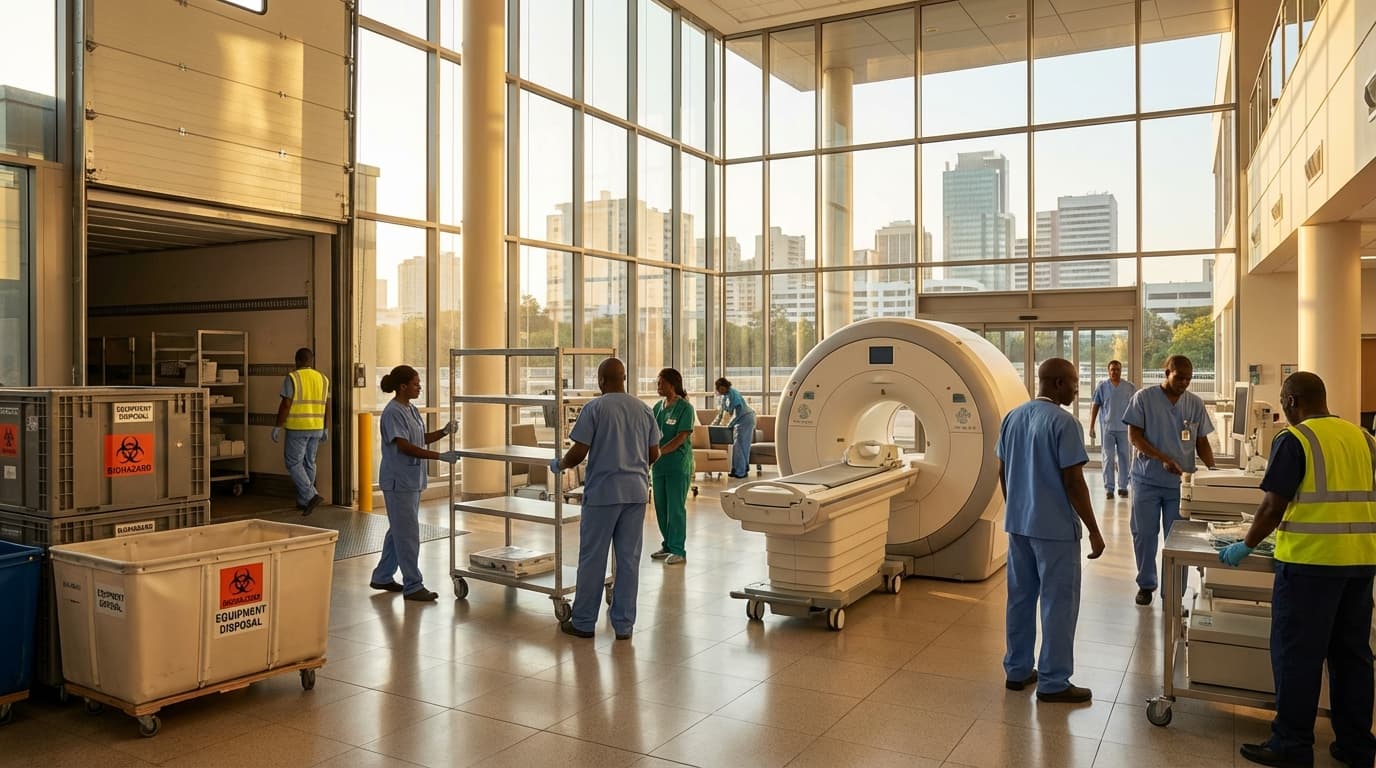
Heavy Medical Equipment De-Installation Service (MRI/CT/Cath Lab) in Liberia
Engineering Excellence & Technical Support
Heavy Medical Equipment De-Installation Service (MRI/CT/Cath Lab) High-standard technical execution following OEM protocols and local regulatory frameworks.
Precision De-Installation & Site Readiness
Expertly dismantle and meticulously prepare sites for MRI, CT, and Cath Lab equipment in Liberia, ensuring minimal downtime and optimal conditions for reinstallation or disposal. We specialize in complex de-energization, structural assessments, and waste management.
Secure Logistics & Transportation Planning
Seamlessly manage the secure transportation of valuable heavy medical equipment across Liberia's challenging terrains. Our services include detailed route planning, specialized rigging, and adherence to all safety and regulatory requirements for domestic and international transit.
Compliance & Environmental Stewardship
Adhere to stringent international and local regulations for the safe and environmentally responsible de-installation and disposal of medical imaging equipment. We prioritize hazardous material management and provide comprehensive documentation for compliance.
What Is Heavy Medical Equipment De-installation Service (Mri/ct/cath Lab) In Liberia?
Heavy medical equipment de-installation service in Liberia, specifically for modalities like Magnetic Resonance Imaging (MRI), Computed Tomography (CT), and Cardiac Catheterization (Cath) Laboratories, refers to the specialized process of safely and systematically dismantling, preparing, and packaging large-scale, high-value diagnostic and interventional imaging systems. This service is critical during various operational transitions, including facility relocation, equipment upgrades, decommissioning, or site closure. It necessitates a deep understanding of complex electromechanical systems, radiation shielding, cryogen handling (for MRI), and stringent safety protocols to prevent damage to the equipment and ensure the well-being of personnel and the environment. The process typically involves meticulous planning, proprietary disassembly techniques, secure crating, and often temporary storage or transportation logistics.
| Who Needs This Service? | Typical Use Cases | ||||
|---|---|---|---|---|---|
| Hospitals and Medical Centers in Liberia: Both public and private institutions undertaking infrastructure changes or equipment modernization. | Facility Relocation: Moving an entire hospital or a specific department to a new building or location. | Equipment Upgrades: Replacing older MRI, CT, or Cath Lab systems with newer, more advanced models. | Site Closure or Decommissioning: When a medical facility or a specific unit ceases operations. | Asset Management & Liquidation: Disassembling and preparing equipment for sale or transfer. | Healthcare Providers with Existing Modalities: Any institution operating these complex systems that anticipate a need for their removal. |
Key Components of Heavy Medical Equipment De-Installation Service:
- Systematic Disassembly: De-energizing, draining of cryogens (if applicable), disconnection of all power, data, and cooling lines. Modular components are carefully detached and labeled.
- Component Handling & Protection: Utilizing specialized lifting equipment and protective materials to prevent damage to sensitive components during removal and transit.
- Cryogen Management (MRI): Safe venting and recovery of helium and nitrogen from superconducting magnets, adhering to strict environmental and safety regulations.
- Radiation Shielding Considerations: Proper handling and containment of leaded components or shielding materials associated with CT scanners and Cath Labs.
- Documentation & Labeling: Comprehensive recording of the de-installation process, including photographic evidence and meticulous labeling of all parts for reassembly.
- Packaging & Crating: Custom-designed crates and packaging solutions to ensure the physical integrity of the equipment during transport.
- Logistics & Transportation Planning: Coordinating the movement of heavy and bulky components, often requiring specialized vehicles and permits.
- Site Remediation: Restoring the installation site to its original condition or as per contractual agreements.
Who Needs Heavy Medical Equipment De-installation Service (Mri/ct/cath Lab) In Liberia?
Specialized de-installation services for Heavy Medical Equipment such as MRI, CT scanners, and Cath Labs are critical for a range of healthcare facilities and institutions in Liberia. This service is essential when these sophisticated machines reach the end of their operational life, require relocation to a new facility, are being replaced by newer technology, or are being decommissioned for upgrades or renovations. The careful and professional de-installation of such complex and often sensitive equipment is paramount to ensure safety, prevent damage to the machinery, protect the facility infrastructure, and facilitate successful re-installation or disposal. This niche service requires highly trained technicians with expertise in medical imaging and interventional cardiology equipment, along with specialized tools and procedures to handle the size, weight, and delicate components of these systems.
| Customer Type | Key Departments Involved | Reasons for De-installation |
|---|---|---|
| Public Hospitals | Radiology/Imaging Departments, Cardiology Departments, Biomedical Engineering Departments, Facilities Management | Equipment upgrades, replacement, relocation due to facility renovation or expansion, end-of-life decommissioning |
| Private Hospitals & Specialty Clinics | Radiology/Imaging Departments, Cardiology Departments, Operations Management, Facilities Management | Technological upgrades, relocation to new facilities, replacement of outdated systems, consolidation of services |
| Diagnostic Centers | Imaging Departments, Technical Operations, Administrative Management | Equipment upgrades, relocation for expansion, decommissioning of older units |
| Government Health Ministries/Agencies | Procurement Departments, Biomedical Engineering Units, Public Health Infrastructure Management | National equipment replacement programs, relocation of government-owned assets, decommissioning of obsolete public health equipment |
| Research & Academic Medical Institutions | Radiology/Imaging Research Departments, Cardiology Research Labs, Biomedical Engineering, IT Departments | Research project completion requiring equipment change, relocation for new research facilities, upgrades for advanced research capabilities |
| International Aid Organizations/NGOs | Medical Program Management, Logistics Departments, Biomedical Engineering, Facility Operations | Project completion and handover of facilities, relocation of equipment between mission sites, upgrades to meet evolving healthcare needs |
Target Customers and Departments for Heavy Medical Equipment De-Installation in Liberia
- Hospitals (Public and Private)
- Specialty Clinics and Diagnostic Centers
- Government Health Ministries and Agencies
- Research and Academic Medical Institutions
- International Aid Organizations and NGOs operating medical facilities
Heavy Medical Equipment De-installation Service (Mri/ct/cath Lab) Process In Liberia
This document outlines the comprehensive workflow for the heavy medical equipment de-installation service, specifically for MRI, CT, and Cath Lab systems, within Liberia. The process is designed to be transparent, efficient, and compliant with all relevant safety and regulatory standards. It covers the journey from the initial client inquiry to the final successful execution of the de-installation.
| Stage | Description | Key Activities | Deliverables | Key Stakeholders |
|---|---|---|---|---|
| Inquiry & Initial Assessment | The client contacts the service provider to request de-installation services for heavy medical equipment. | Receive and review client inquiry, gather preliminary information (equipment type, location, reason for de-installation). | Confirmation of inquiry receipt, initial understanding of project scope. | Client (Hospital/Clinic Administration, Biomedical Engineering Department), Service Provider (Sales/Business Development) |
| Site Survey & Planning | A detailed assessment of the installation site is conducted to understand the complexities of the de-installation. | On-site visit, detailed inspection of equipment and surrounding infrastructure (power, cooling, access routes, structural integrity), risk assessment, development of a preliminary de-installation plan. | Detailed site survey report, preliminary de-installation plan, identification of potential challenges. | Service Provider (Technical Team, Project Manager), Client (Biomedical Engineering Department, Facilities Management) |
| Proposal & Quotation | Based on the site survey, a comprehensive proposal and detailed quotation are provided to the client. | Development of a detailed scope of work, cost estimation for labor, specialized tools, transportation, and any required permits, formulation of a comprehensive proposal document. | Formal proposal, detailed quotation with breakdown of costs, projected timeline. | Service Provider (Project Manager, Finance Department), Client (Procurement Department, Administration) |
| Contracting & Scheduling | Upon acceptance of the proposal, a formal contract is signed, and the de-installation schedule is finalized. | Contract negotiation and signing, agreement on payment terms, confirmation of de-installation dates and times, coordination with client's operational schedule. | Signed contract, confirmed de-installation schedule, payment schedule. | Service Provider (Legal Department, Project Manager), Client (Legal Department, Administration, Department Heads) |
| Pre-De-Installation Preparation | All necessary preparations are made by both the service provider and the client prior to the actual de-installation. | Procurement of specialized tools and equipment, mobilization of the de-installation team, confirmation of necessary permits and authorizations, internal team briefing, client notification of commencement. | Readiness confirmation for de-installation, communicated commencement date. | Service Provider (Logistics, Technical Team), Client (Facilities Management, IT Department if applicable) |
| Equipment De-Installation | The physical de-installation of the heavy medical equipment is executed by the trained technical team. | Power down and isolation of equipment, disconnection of all utilities (power, cooling, data), dismantling of components according to manufacturer specifications and safety protocols, careful packing and securing of dismantled parts. | Dismantled and safely packaged equipment, completed de-installation, safety checklists signed. | Service Provider (Technical Team, Safety Officer), Client (Biomedical Engineering Department) |
| Documentation & Handover | All relevant documentation is compiled and handed over to the client, and the site is prepared for the next phase. | Creation of a de-installation report, inventory of all removed parts, photographic evidence of the process, handover of all documentation to the client, site cleanup and restoration. | De-installation report, inventory list, photographic documentation, site clearance confirmation. | Service Provider (Project Manager, Technical Team), Client (Biomedical Engineering Department, Facilities Management) |
| Post-Execution Follow-up | A follow-up is conducted to ensure client satisfaction and address any outstanding issues. | Client feedback collection, addressing any post-de-installation queries, final invoice processing, archiving of project documentation. | Client satisfaction confirmation, project closure. | Service Provider (Project Manager, Customer Service), Client (Administration) |
Key Stages of the De-Installation Process
- Inquiry & Initial Assessment
- Site Survey & Planning
- Proposal & Quotation
- Contracting & Scheduling
- Pre-De-Installation Preparation
- Equipment De-Installation
- Documentation & Handover
- Post-Execution Follow-up
Heavy Medical Equipment De-installation Service (Mri/ct/cath Lab) Cost In Liberia
De-installing heavy medical equipment like MRI, CT scanners, and Cath Labs is a complex and specialized service. In Liberia, the cost for such services is not standardized and can vary significantly due to several influencing factors. These services require skilled technicians, specialized tools, and careful logistical planning to ensure the safe dismantling and preparation for transport or relocation of these high-value and sensitive machines. Estimating a precise cost without specific project details is challenging, but we can outline the key pricing factors and provide an estimated range in Liberian Dollars (LRD).
| Equipment Type | Estimated Cost Range (LRD) | Notes |
|---|---|---|
| MRI Scanner (e.g., 1.5T, 3T) | 250,000 - 700,000+ | This is a highly complex and time-consuming process. Costs can escalate significantly for larger bore or higher field strength magnets. Includes expert team and specialized handling. |
| CT Scanner (e.g., 64-slice, 128-slice) | 150,000 - 400,000+ | Involves dismantling the gantry, table, and control console. Complexity increases with the number of slices and associated hardware. |
| Cath Lab (Angiography System) | 200,000 - 500,000+ | Requires careful disconnection of imaging detectors, X-ray tubes, patient table, and multiple control consoles. Logistics for moving large components are critical. |
| Other Heavy Medical Equipment (e.g., Linear Accelerator - if applicable) | Variable (Quote-based) | For highly specialized equipment like linear accelerators, de-installation is extremely complex, often requiring international expertise and significant structural considerations. Always quote-based. |
Key Pricing Factors for Heavy Medical Equipment De-Installation in Liberia:
- {"title":"Type and Size of Equipment","description":"Larger and more intricate machines like MRI (Magnetic Resonance Imaging) scanners, which often involve powerful magnets, and CT (Computed Tomography) scanners, with their rotating gantry systems, are generally more complex and time-consuming to de-install than, for example, a portable X-ray unit. Cath Labs, with their extensive cabling, imaging components, and often large control consoles, also present unique challenges."}
- {"title":"Accessibility and Site Conditions","description":"The ease of access to the equipment's location within the healthcare facility is a major factor. De-installation in tight spaces, on upper floors without adequate elevator access, or in areas requiring significant structural modifications (e.g., door widening, reinforcement) will incur higher costs due to the added labor and time. Environmental conditions, such as extreme temperatures or humidity, can also impact the process and require specialized handling."}
- {"title":"Dismantling Complexity and Specialization Required","description":"Some equipment may require specialized tools, techniques, or even manufacturer-specific procedures for safe dismantling. This can include handling cryogenics for MRI machines, managing radiation shielding, or disconnecting intricate electronic and hydraulic systems. The level of expertise and specialized training of the de-installation team directly influences the cost."}
- {"title":"Logistics and Transportation Preparation","description":"While the de-installation itself is the primary service, the cost often includes preparing the equipment for transport. This might involve crating, padding, labeling, and securing components. The need for specialized transport vehicles or cranes for moving heavy parts out of the facility can also add to the overall expense."}
- {"title":"Labor Costs and Team Size","description":"The number of technicians required, their skill level, and the duration of the de-installation project are direct cost drivers. Skilled engineers and technicians with experience in medical equipment de-installation command higher rates."}
- {"title":"Timeframe and Urgency","description":"Rush or emergency de-installation requests will typically come with a premium. Projects that can be scheduled with ample notice allow for better planning and potentially more competitive pricing."}
- {"title":"Location within Liberia","description":"Costs can vary slightly between major urban centers like Monrovia and more remote regions due to differences in availability of skilled labor, specialized equipment, and travel expenses for the de-installation team."}
- {"title":"Ancillary Services","description":"Some service providers might offer additional services such as basic site remediation after de-installation, or preliminary assessments of the equipment's condition before dismantling. These would be itemized separately."}
Affordable Heavy Medical Equipment De-installation Service (Mri/ct/cath Lab) Options
Navigating the de-installation of heavy medical equipment like MRI, CT scanners, and Cath Labs can be a significant undertaking. Finding affordable, reliable services is crucial for hospitals, clinics, and imaging centers aiming to upgrade, relocate, or decommission these high-value assets. This guide explores cost-effective options, the value of bundled services, and strategic approaches to minimize expenses while ensuring safe and compliant de-installation.
| Service Bundle | Description | Cost-Saving Benefits |
|---|---|---|
| Basic De-installation | Includes physical disconnection, disassembly (where necessary), and safe removal of the equipment from its operational site. | Lower upfront cost. Suitable for clients managing transportation and disposal separately. |
| De-installation + Logistics | Combines basic de-installation with secure packaging, transportation arrangements, and delivery to a new site or storage facility. | Streamlined process, reduced coordination efforts, potential for bulk transport discounts. |
| Full-Service De-installation | Encompasses de-installation, packaging, transportation, site preparation at the new location, re-installation, and initial testing. | Ultimate convenience, minimized internal resource allocation, single point of accountability, potential for integrated project management savings. |
| De-installation + Decommissioning/Disposal | Includes de-installation and responsible handling of waste materials or the entire unit for recycling or disposal according to regulations. | Ensures environmental compliance, avoids separate disposal fees and complexities, can sometimes leverage equipment resale value. |
Key Considerations for Affordable De-installation
- Specialized Expertise: Ensure de-installation providers have specific experience with your equipment type. Improper handling can lead to costly damage.
- Licensing and Insurance: Verify that the company is properly licensed and carries adequate insurance for the scope of work.
- Logistics and Timeline: A well-planned schedule and efficient logistics can significantly reduce labor costs and downtime.
- Regulatory Compliance: De-installation must adhere to all relevant environmental and safety regulations.
- Equipment Condition: The existing condition of the equipment can impact de-installation complexity and cost.
Verified Providers In Liberia
Finding reliable healthcare providers is paramount for individuals and organizations operating in Liberia. Franance Health stands out as a leading organization dedicated to ensuring access to verified and high-quality medical services. This document outlines why Franance Health credentials represent the best choice for your healthcare needs in Liberia.
| Credentialing Aspect | Franance Health Approach | Benefit to You |
|---|---|---|
| Medical Licensing and Certification | Verification of current and valid medical licenses and certifications from recognized regulatory bodies. | Ensures providers are legally qualified and have met foundational educational and training requirements. |
| Professional Background Checks | Thorough review of employment history, disciplinary actions, and any malpractice claims. | Mitigates risk and ensures providers have a consistent record of good standing. |
| Clinical Competence Assessment | Evaluation of clinical skills, experience, and adherence to best practices through peer review or other validated methods. | Guarantees that providers possess the necessary expertise to deliver effective care. |
| Ethical Standards and Professionalism | Assessment of a provider's commitment to ethical conduct, patient rights, and professional integrity. | Promotes a patient-centered and trustworthy healthcare experience. |
| Continuous Quality Improvement | Ongoing monitoring and re-credentialing to ensure sustained quality of care. | Provides assurance that providers remain up-to-date with medical advancements and maintain high standards. |
Why Franance Health Credentials Matter
- Rigorous Vetting Process: Franance Health employs a stringent and multi-faceted verification process for all healthcare providers within its network.
- Commitment to Quality: Our credentialing ensures that providers meet established standards of medical competence, ethical practice, and patient safety.
- Access to Diverse Specialties: We connect you with a wide range of medical professionals across various specialties, ensuring your specific healthcare requirements are met.
- Enhanced Trust and Reliability: By choosing Franance Health, you gain confidence in the expertise and integrity of the healthcare professionals you engage with.
- Streamlined Healthcare Navigation: Our credentials simplify the process of finding and accessing suitable medical care, saving you time and reducing uncertainty.
Scope Of Work For Heavy Medical Equipment De-installation Service (Mri/ct/cath Lab)
This Scope of Work (SOW) outlines the requirements for the professional de-installation of heavy medical imaging equipment, specifically MRI, CT scanners, and Cath Labs. This service is critical for relocation, decommissioning, or upgrade projects and requires highly specialized technical expertise to ensure safety, preserve equipment integrity, and comply with all relevant regulations. The contractor will be responsible for all aspects of the de-installation process, from initial site assessment to final equipment readiness for transport. This includes planning, dismantling, disconnection of utilities, packaging, and documentation.
| Technical Deliverable | Description | Standard Specifications / Requirements |
|---|---|---|
| Pre-Deinstallation Report | Detailed report outlining the plan, safety protocols, necessary tools and equipment, estimated timeline, and potential challenges for each specific equipment de-installation. | Must include schematics, room dimensions, access routes, lifting requirements, and power/utility information. Risk assessment and mitigation strategies. Confirmation of site readiness. |
| Equipment De-Energization Certificate | Formal confirmation that the equipment has been safely shut down and all power sources have been disconnected and locked out/tagged out (LOTO) according to industry standards. | Compliance with OSHA (or equivalent) Lockout/Tagout procedures. Verification by qualified personnel. Signed and dated certificate. |
| Component Disassembly Logs | Detailed records of each major component removed, including its identification number, removal sequence, and handling procedures. | Photography and/or video documentation of critical disassembly steps. Use of manufacturer-recommended or equivalent tools and techniques. Maintaining component integrity. |
| Utility Disconnection Forms | Documentation confirming the safe and complete disconnection of all electrical, cooling, water, or other utility lines connected to the equipment. | Verification by a qualified technician for each utility type. Proper capping or sealing of disconnected lines. Compliance with local building codes and safety regulations. |
| Packaging and Securing Records | Evidence of proper packaging, labeling, and securing of all de-installed components to prevent damage during transit. | Use of appropriate protective materials (e.g., anti-static wrapping, custom cradles, shock-absorbent padding). Clear labeling with component identification, handling instructions, and destination. Load securement in accordance with transport regulations. |
| Site Restoration Verification | Confirmation that the de-installation area has been returned to its original or agreed-upon condition, with all debris removed. | Removal of all tools, materials, and waste generated during the de-installation. Repair of any minor damages to flooring, walls, or ceilings if applicable and agreed upon. |
| Final De-installation Report | A comprehensive report summarizing the entire de-installation process, including any deviations from the plan, final condition of the equipment, and confirmation of all deliverables. | Includes all preceding reports and documentation. Photographic evidence of the final state of the de-installed equipment. Sign-off by authorized representatives of both parties. |
| Manufacturer Compliance Documentation | Evidence that the de-installation was performed in accordance with manufacturer guidelines and recommendations, where applicable. | Reference to specific manufacturer service manuals or bulletins. Use of manufacturer-certified technicians or equivalent expertise. |
Key Phases and Activities
- Pre-Deinstallation Survey and Planning
- Equipment Shutdown and De-energization
- Disassembly and Component Removal
- Utility Disconnection and Isolation
- Securing and Packaging for Transport
- Site Restoration and Cleanup
- Documentation and Handover
Service Level Agreement For Heavy Medical Equipment De-installation Service (Mri/ct/cath Lab)
This Service Level Agreement (SLA) outlines the response times and uptime guarantees for the De-Installation Services of Heavy Medical Equipment, specifically focusing on MRI, CT, and Cath Lab systems. This agreement is between [Client Name] (hereinafter referred to as 'Client') and [Service Provider Name] (hereinafter referred to as 'Provider').
1. Service Description:
The Provider will perform the safe and efficient de-installation of the Client's specified MRI, CT, or Cath Lab equipment at the designated Client facility. This includes:
- Disconnection of all utilities and ancillary equipment.
- Professional dismantling of the core equipment.
- Preparation of equipment for transport (as specified in the separate Scope of Work).
- Removal of debris and site cleanup to a pre-defined standard.
2. Response Times:
Response times are critical for minimizing downtime and disruption. The Provider commits to the following response times for critical service issues arising during the de-installation process:
- Level 1 (Critical System Failure/Safety Hazard): Immediate remote acknowledgment (within 15 minutes) followed by on-site technician dispatch within 4 hours (business hours). This applies to situations posing an immediate risk to personnel or the equipment's structural integrity.
- Level 2 (Significant Process Interruption): Remote acknowledgment (within 30 minutes) followed by on-site technician dispatch within 8 business hours. This applies to issues significantly hindering the de-installation progress but not posing immediate safety risks.
- Level 3 (Minor Issue/Inquiry): Remote acknowledgment (within 2 business hours) with resolution or scheduled on-site visit within 24 business hours.
Business Hours: Monday to Friday, 8:00 AM to 5:00 PM [Client's Time Zone], excluding national holidays.
| Service Type | Priority Level | Acknowledgment Time (Business Hours) | On-Site Dispatch Target (Business Hours) | Uptime Guarantee (Process Continuity) |
|---|---|---|---|---|
| Heavy Medical Equipment De-Installation (MRI/CT/Cath Lab) | Level 1 (Critical System Failure/Safety Hazard) | 15 minutes | 4 hours | N/A (Focus on response for critical issues) |
| Heavy Medical Equipment De-Installation (MRI/CT/Cath Lab) | Level 2 (Significant Process Interruption) | 30 minutes | 8 business hours | N/A (Focus on response for critical issues) |
| Heavy Medical Equipment De-Installation (MRI/CT/Cath Lab) | Level 3 (Minor Issue/Inquiry) | 2 business hours | 24 business hours | N/A (Focus on response for critical issues) |
| Overall Process Continuity (Provider-initiated delays) | N/A | N/A | N/A | No single delay initiated by the Provider exceeding 24 business hours, unless specified exceptions apply. |
Key Service Definitions
- De-Installation: The process of safely dismantling and preparing heavy medical equipment for transport, as per industry best practices and manufacturer guidelines.
- Response Time: The maximum time allowed for the Provider to acknowledge a reported issue and/or dispatch resources.
- Uptime Guarantee: While this SLA focuses on de-installation services, a proxy for operational readiness during the de-installation process is maintained. The Provider guarantees that the de-installation process will not be unilaterally paused or delayed by the Provider for more than 24 business hours, unless due to Client-imposed restrictions, unforeseen site conditions beyond the Provider's control, or force majeure events.
- Critical Service Issue: An event that prevents the continuation of the de-installation process, poses a significant safety risk, or could lead to irreparable damage to the equipment or facility.
- Force Majeure: Events beyond the reasonable control of either party, including but not limited to, acts of God, war, terrorism, natural disasters, or government actions.
Frequently Asked Questions

Ready when you are
Let's scope your Heavy Medical Equipment De-Installation Service (MRI/CT/Cath Lab) in Liberia project in Liberia.

Scaling healthcare logistics and technical systems across the entire continent.