
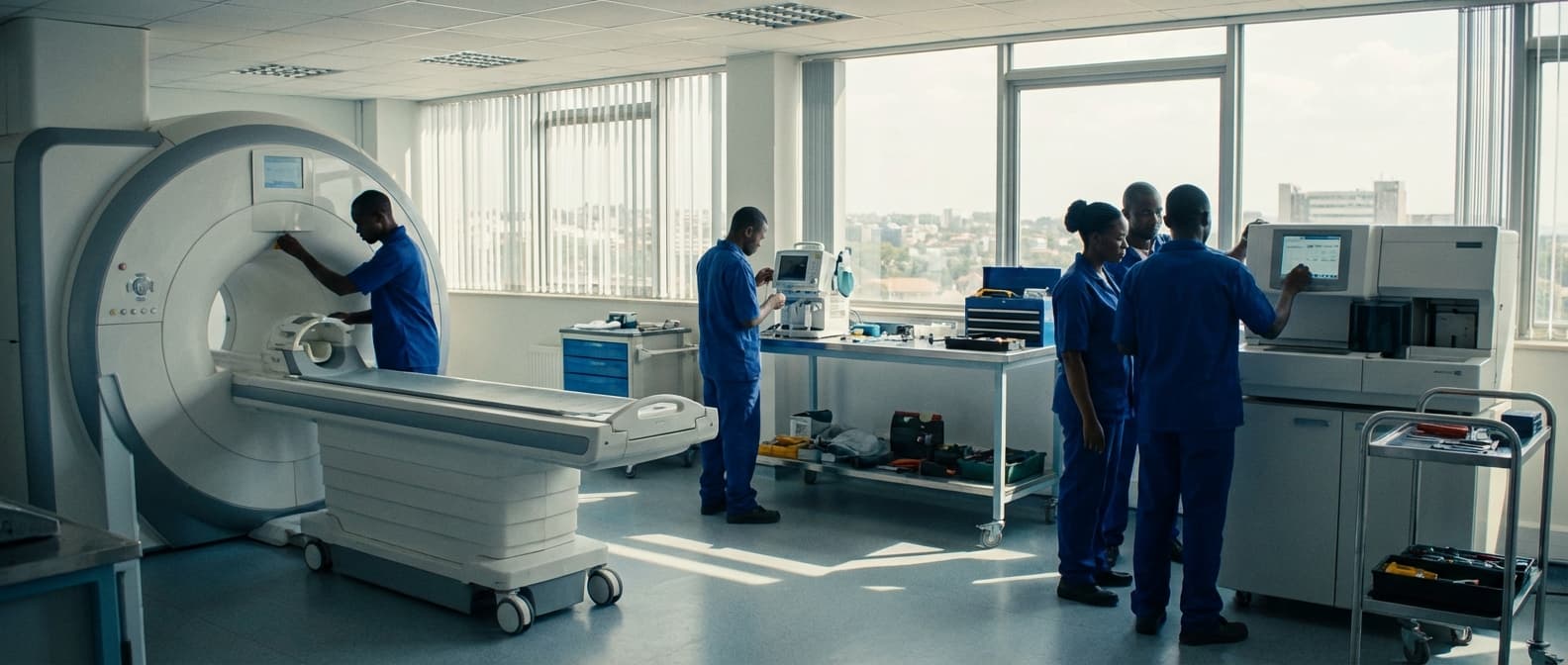
Uptime, Downtime & Root-Cause Analysis Reporting Service in Liberia
Engineering Excellence & Technical Support
Uptime, Downtime & Root-Cause Analysis Reporting Service High-standard technical execution following OEM protocols and local regulatory frameworks.
Proactive Uptime Assurance
Leveraging advanced monitoring tools, our service proactively identifies and mitigates potential issues before they impact your operations. We ensure maximum availability for critical services across Liberia.
Rapid Downtime Response
In the event of unexpected outages, our expert team is equipped to diagnose and resolve issues swiftly. We minimize downtime through efficient incident management and real-time status updates tailored for the Liberian market.
In-depth Root-Cause Analysis
Beyond immediate fixes, we conduct thorough root-cause analyses to understand underlying problems. Our detailed reports provide actionable insights to prevent future occurrences and optimize system stability for businesses in Liberia.
What Is Uptime, Downtime & Root-cause Analysis Reporting Service In Liberia?
Uptime, Downtime & Root-Cause Analysis (RCA) Reporting Service in Liberia refers to the provision of comprehensive monitoring, incident identification, and diagnostic services for digital infrastructure and operational systems within Liberian organizations. This service aims to maximize system availability (uptime), minimize service interruptions (downtime), and systematically determine the underlying causes of failures to prevent recurrence.
Uptime: This metric quantifies the percentage of time a system or service is operational and accessible to users. High uptime is critical for business continuity and user satisfaction.
Downtime: Conversely, downtime represents the period during which a system or service is unavailable, impacting operations, revenue, and reputation.
Root-Cause Analysis (RCA): RCA is a structured methodology employed to identify the fundamental reasons for a problem or incident, rather than just addressing its immediate symptoms. This involves investigation, data collection, and analysis to pinpoint the originating factor(s) of system failures.
The service involves:
- Proactive Monitoring: Continuous surveillance of critical IT infrastructure, applications, and services using specialized tools and platforms. This includes network devices, servers, databases, cloud resources, and business-critical applications.
- Real-time Alerting: Immediate notification to relevant stakeholders upon detection of performance degradation, anomalies, or service outages. Alerts are typically categorized by severity.
- Incident Triage and Diagnosis: Initial assessment of reported incidents to understand their scope, impact, and potential causes. This often involves correlation of monitoring data and user-reported issues.
- Downtime Quantification: Precise measurement and documentation of downtime events, including start time, end time, duration, and affected services.
- Root-Cause Investigation: In-depth analysis to identify the primary factors leading to an incident. This may involve log analysis, configuration review, performance profiling, and testing.
- Reporting: Generation of detailed reports on uptime statistics, downtime incidents, RCA findings, and recommended corrective actions. These reports provide actionable insights for improvement.
- Trend Analysis: Identification of recurring patterns in incidents to preemptively address systemic weaknesses.
Who Needs It:
This service is essential for any organization in Liberia that relies on digital infrastructure and services for its operations. This includes, but is not limited to:
- Financial Institutions: Banks, microfinance institutions, and insurance companies, where continuous service availability is paramount for transactions and customer trust.
- Telecommunications Providers: Ensuring uninterrupted voice, data, and internet services for subscribers.
- Government Agencies: Maintaining public service delivery and critical infrastructure operations.
- E-commerce and Online Services: Businesses operating online require high uptime to facilitate sales and customer interactions.
- Healthcare Providers: Critical for patient record access, scheduling, and communication systems.
- Large Enterprises: Across various sectors (e.g., manufacturing, logistics, hospitality) that depend on integrated IT systems.
- Managed Service Providers (MSPs): To offer reliable IT support and infrastructure management to their clients.
Typical Use Cases:
- Website/Application Unavailability: A Liberian e-commerce platform experiences intermittent periods where customers cannot access their shopping cart. The service would monitor for this, alert administrators, and investigate the cause (e.g., server overload, database issues, network latency).
- Network Performance Degradation: A financial institution's inter-branch communication network becomes slow, impacting transaction processing. The service would detect the slowdown, identify the bottleneck (e.g., a faulty router, saturated link), and report on the impact and resolution.
- Server Failure: A critical server hosting an enterprise resource planning (ERP) system in Liberia crashes. The service would immediately detect the server's unavailability, trigger alerts, and initiate an RCA to determine if it was due to hardware failure, software bug, or power surge.
- Database Transaction Errors: A telecommunications company's billing system experiences a high rate of failed transactions. The RCA would investigate whether this is due to database corruption, incorrect queries, or resource contention.
- Cloud Service Outage: A Liberian business utilizing cloud-based CRM software experiences an outage. The service would monitor the cloud provider's status and, if the issue is external, report on the provider's incident and its impact on the client's operations.
- Disaster Recovery Testing Validation: Ensuring that failover systems for critical applications perform as expected during simulated disaster scenarios, and identifying any deviations for corrective action.
| Stakeholder/Organization Type | Primary Need | Key Uptime/Downtime Concerns | RCA Focus Areas |
|---|---|---|---|
| Financial Institutions | Uninterrupted Transaction Processing & Customer Access | ATM availability, online banking downtime, ATM network connectivity | Transaction failures, network latency, system reconciliation issues |
| Telecommunications Providers | Continuous Network Service Availability | Mobile network downtime, internet service interruptions, call drop rates | Network equipment failure, software glitches in billing systems, capacity limitations |
| Government Agencies | Reliable Public Service Delivery | Citizen portal downtime, essential service system outages, data integrity | Infrastructure failures, security breaches, application performance issues |
| E-commerce & Online Businesses | Maximized Sales & Customer Engagement | Website inaccessibility, shopping cart errors, payment gateway failures | Server performance bottlenecks, database load, third-party integration failures |
| Healthcare Providers | Critical Patient Data Access & System Reliability | Electronic Health Record (EHR) system downtime, PACS availability, communication system failures | Medical device integration issues, data backup/restore failures, network segmentation problems |
| Managed Service Providers (MSPs) | Demonstrable Service Level Agreement (SLA) Compliance | Client system uptime, incident response times, service degradation | Client-specific infrastructure issues, common vulnerability patching failures, proactive threat mitigation |
Key Components of Uptime, Downtime & RCA Reporting Service
- Proactive System Monitoring
- Real-time Event Alerting
- Incident Triage & Diagnosis
- Downtime Measurement & Documentation
- Root-Cause Investigation Framework
- Comprehensive Reporting & Analytics
- Trend Analysis for Predictive Maintenance
Who Needs Uptime, Downtime & Root-cause Analysis Reporting Service In Liberia?
In Liberia's rapidly developing economic landscape, ensuring the reliability and efficiency of critical IT infrastructure is paramount. Downtime can lead to significant financial losses, reputational damage, and disruption to essential services. Therefore, a comprehensive Uptime, Downtime & Root-Cause Analysis Reporting Service is indispensable for businesses and organizations across various sectors. This service provides the crucial insights needed to proactively prevent outages, quickly resolve issues, and continuously improve system performance. By understanding the 'why' behind every downtime event, organizations can implement targeted solutions, optimize resource allocation, and build more resilient IT environments, ultimately driving operational excellence and sustained growth.
| Sector/Industry | Key Departments Benefiting |
|---|---|
| Financial Services | IT Operations, Compliance, Risk Management, Customer Service |
| Telecommunications | Network Operations Center (NOC), IT Infrastructure, Customer Support |
| Government & Public Services | IT Departments, Service Delivery Units, Administrative Offices |
| E-commerce & Retail | E-commerce Operations, IT Support, Marketing |
| Mining & Extractive Industries | IT Infrastructure Management, Operations Control, Asset Management |
| Logistics & Transportation | Logistics Operations, IT Support, Fleet Management |
| Healthcare Providers | IT Departments, Clinical Support, Administrative Management |
| Media & Broadcasting | Broadcast Operations, IT Infrastructure, Content Management |
Target Customers & Departments in Liberia
- {"title":"Financial Services Sector","description":"Banks, microfinance institutions, insurance companies, and fintech startups rely heavily on continuous system availability. Downtime can result in lost transactions, customer dissatisfaction, regulatory penalties, and significant financial losses. Their IT departments are the primary beneficiaries, along with operations and compliance teams."}
- {"title":"Telecommunications Providers","description":"Mobile network operators, internet service providers, and telecommunications infrastructure companies require constant uptime to deliver essential communication services. Outages impact millions of users and can cripple businesses. Their Network Operations Centers (NOCs), IT infrastructure teams, and customer support departments will benefit greatly."}
- {"title":"Government Agencies & Public Services","description":"Critical government functions, including healthcare, education, utilities, and administrative services, depend on reliable IT systems. Downtime in these sectors can have widespread societal impact. IT departments, service delivery units, and administrative offices are key stakeholders."}
- {"title":"E-commerce & Retail Businesses","description":"Online retailers and businesses with significant digital sales channels face direct revenue loss with every minute of downtime. Maintaining a seamless online shopping experience is crucial for customer retention and growth. E-commerce operations, IT support, and marketing departments are primary users."}
- {"title":"Mining & Extractive Industries","description":"These industries often operate in remote locations with complex IT systems supporting operations, logistics, and safety. Downtime can lead to significant production halts and safety risks. Their IT infrastructure management, operations control, and asset management departments are crucial."}
- {"title":"Logistics & Transportation Companies","description":"Companies managing supply chains, shipping, and transportation rely on real-time data and system availability to ensure efficient operations. Delays due to IT failures can have cascading effects. Logistics operations, IT support, and fleet management departments will be key beneficiaries."}
- {"title":"Healthcare Providers","description":"Hospitals, clinics, and health information systems require uninterrupted access to patient data and operational systems. Downtime can compromise patient care and safety. Their IT departments, clinical support teams, and administrative management will find this service invaluable."}
- {"title":"Media & Broadcasting Companies","description":"Ensuring continuous broadcasting and content delivery is vital. Outages can lead to missed deadlines, lost advertising revenue, and damage to reputation. Broadcast operations, IT infrastructure, and content management teams are key users."}
Uptime, Downtime & Root-cause Analysis Reporting Service Process In Liberia
This document outlines the standard workflow for the Uptime, Downtime & Root-Cause Analysis Reporting Service in Liberia, from initial inquiry to the final execution and reporting. The service aims to provide comprehensive insights into system availability, identify the causes of disruptions, and recommend corrective actions.
| Stage | Description | Key Activities | Responsible Party | Deliverables/Outcomes |
|---|---|---|---|---|
| The client (organization experiencing or anticipating uptime/downtime issues) initiates contact to request the reporting service. | Client contacts service provider via email, phone, or inquiry form. Discusses initial concerns and needs. | Client, Service Provider (Sales/Consultation Team) | Initial understanding of client's requirements. Service proposal/quote generated. |
| Detailed understanding of the client's systems, infrastructure, and past incidents is obtained. | On-site or remote meetings with client IT teams. Review of existing documentation (network diagrams, incident logs, system architecture). Definition of service scope, SLAs, and reporting frequency. | Service Provider (Project Manager, Technical Analysts), Client IT Team | Project scope document. Agreed-upon service level agreements (SLAs). Defined reporting framework. |
| Tools and methodologies are deployed to monitor system performance and collect relevant data. | Installation/configuration of monitoring agents. Setup of data collection platforms. Configuration of alerts and notifications. Establishing secure data access. | Service Provider (Technical Team) | Operational monitoring infrastructure. Access to real-time system data. |
| Continuous or scheduled collection of uptime and downtime data, alongside performance metrics. | Monitoring system logs, event logs, network traffic, application performance. Identifying periods of service interruption or degradation. Analyzing trends and patterns. | Service Provider (Technical Analysts, Data Analysts) | Raw uptime/downtime data. Performance metrics. Preliminary incident logs. |
| Investigating the underlying reasons for any identified downtime or performance issues. | Correlation of events. Analysis of error messages. Interviewing relevant personnel. Testing hypotheses. Utilizing diagnostic tools. | Service Provider (Senior Technical Analysts, Subject Matter Experts) | Identified root causes for specific incidents. Evidence supporting the identified causes. |
| Compiling findings into a comprehensive report and developing actionable recommendations. | Drafting uptime/downtime reports. Documenting root causes and contributing factors. Formulating strategic and tactical recommendations for improvement. Proposing preventative measures. | Service Provider (Technical Writers, Analysts) | Draft report. List of actionable recommendations. |
| Delivering the finalized report to the client and presenting key findings. | Submission of the final report (digital and/or physical). Scheduling and conducting a presentation of findings and recommendations. Q&A session with client stakeholders. | Service Provider (Project Manager, Lead Analyst), Client Stakeholders | Approved final report. Client understanding of findings and recommendations. |
| Ensuring client comprehension, assisting with implementation, and verifying the effectiveness of recommendations. | Answering post-presentation queries. Providing support for recommendation implementation. Scheduling follow-up monitoring to verify improvements in uptime and reduction in downtime. Iterating the process as needed. | Service Provider (Project Manager, Technical Team), Client IT Team | Confirmation of successful implementation. Verified improvements in system uptime and reliability. Ongoing service relationship. |
Workflow Stages
- Inquiry & Service Request
- Information Gathering & Scoping
- Diagnostic & Monitoring Setup
- Data Collection & Analysis
- Root-Cause Identification
- Reporting & Recommendation Development
- Report Submission & Presentation
- Follow-up & Verification
Uptime, Downtime & Root-cause Analysis Reporting Service Cost In Liberia
Providing Uptime, Downtime & Root-Cause Analysis (RCA) reporting services in Liberia involves a nuanced cost structure influenced by several key factors. The pricing is typically determined by the complexity of the systems being monitored, the frequency and depth of reporting required, the expertise of the analysts, and the chosen technology solutions. Liberian businesses, like those globally, are increasingly recognizing the critical importance of ensuring operational continuity and quickly identifying the origins of service disruptions. This drives demand for specialized reporting services.
| Service Component/Tier | Estimated Range (Liberian Dollar - LRD) | Typical Inclusions |
|---|---|---|
| Basic Uptime Monitoring & Reporting | 1,500 - 4,000 LRD per month | System availability checks, basic uptime percentage reporting, simple incident logging. |
| Standard Downtime & Incident Reporting | 3,000 - 7,500 LRD per month | Downtime duration tracking, incident timelines, basic cause identification, monthly summary reports. |
| Comprehensive RCA & Performance Reporting | 6,000 - 15,000+ LRD per month | In-depth root cause analysis, performance metrics, trend analysis, proactive recommendations, detailed incident post-mortems, customizable dashboards. |
| Ad-hoc RCA Projects (Per Incident) | Negotiable (e.g., 10,000 - 30,000+ LRD per major incident) | Dedicated analysis for significant outages, detailed investigation, presentation of findings, recommended corrective actions. |
| Consulting & Implementation (Setup Fee) | 5,000 - 20,000+ LRD (one-time) | System assessment, monitoring tool setup, integration, initial configuration of reporting. |
Key Pricing Factors for Uptime, Downtime & RCA Reporting Services in Liberia
- System Complexity and Scope: The number and type of systems (servers, applications, networks, databases) to be monitored directly impact cost. More complex and interconnected systems require more sophisticated monitoring tools and deeper analysis.
- Reporting Frequency and Depth: Daily, weekly, monthly, or ad-hoc reports will have different pricing. The level of detail in the reports, including executive summaries, technical deep-dives, and trend analysis, also influences the cost.
- Real-time vs. Historical Analysis: Services offering real-time monitoring and immediate incident response will be priced higher than those focusing on historical data analysis and periodic RCA.
- Analyst Expertise and Experience: Highly skilled and experienced RCA specialists command higher fees. Their ability to quickly and accurately diagnose root causes is a valuable asset.
- Technology and Tools: The cost of implementing and maintaining monitoring software, dashboards, and RCA platforms is factored into the service price. Proprietary or advanced tools may increase expenses.
- Service Level Agreements (SLAs): The commitment to specific uptime guarantees and response times for reporting and analysis will impact pricing. Stricter SLAs usually come with higher costs.
- On-site vs. Remote Services: While remote services are generally more cost-effective, the need for on-site support or presence for critical incidents could increase the overall cost.
- Customization and Integration: The need for custom reporting formats, integration with existing IT infrastructure, or bespoke RCA methodologies will add to the service cost.
- Provider Reputation and Support: Established providers with a proven track record and strong customer support may charge a premium for their reliability and expertise.
Affordable Uptime, Downtime & Root-cause Analysis Reporting Service Options
Providing a robust and affordable service for Uptime, Downtime, and Root-Cause Analysis (RCA) reporting is crucial for businesses to maintain operational efficiency, minimize financial losses, and ensure customer satisfaction. This service focuses on proactive monitoring, detailed incident documentation, and insightful analysis to prevent future occurrences. We offer flexible value bundles and cost-saving strategies designed to meet the diverse needs of organizations, from startups to large enterprises.
| Value Bundle | Target Audience | Included Services | Key Benefits | Pricing Model |
|---|---|---|---|---|
| Starter Uptime Essentials | Small Businesses, Startups | Basic Uptime Monitoring, Automated Downtime Alerts, Standard Downtime Reports | Foundation for service availability, immediate issue detection | Monthly Subscription (Low Cost) |
| Growth & Analysis Pro | Growing Businesses, Mid-Sized Companies | Real-time Uptime Monitoring, Automated Downtime Alerts, Advanced Downtime Logging, Automated RCA (Basic), Customizable Reports | Deeper insights, proactive issue resolution, performance optimization | Tiered Monthly Subscription (Moderate Cost) |
| Enterprise Resilience Suite | Large Enterprises, Mission-Critical Operations | All features of Growth & Analysis Pro + Manual RCA Support, Historical Trend Analysis, API Integration, Dedicated Account Manager | Comprehensive incident management, strategic resilience planning, minimized business impact | Custom Enterprise Pricing (Volume Discounts Available) |
| On-Demand RCA Pack | Any Business requiring ad-hoc in-depth analysis | Dedicated manual RCA for specific incidents, detailed post-mortem reports | Expert analysis for critical outages, knowledge transfer for prevention | Per-Incident or Retainer Basis |
Key Features of Our Uptime, Downtime & RCA Reporting Service
- Real-time Uptime Monitoring: Continuous tracking of service availability across all critical systems.
- Automated Downtime Alerts: Immediate notification upon detection of any service interruption.
- Comprehensive Downtime Logging: Detailed records of incident start/end times, affected services, and duration.
- Automated Root-Cause Analysis (RCA) Tools: Leveraging AI and historical data to identify contributing factors.
- Manual RCA Support: Expert analysis for complex incidents.
- Actionable Recommendations: Clear steps to prevent recurrence and improve system resilience.
- Customizable Reporting Dashboards: Visualizations tailored to specific business needs and KPIs.
- Historical Trend Analysis: Identifying patterns and potential weaknesses over time.
- Integration with Existing Tools: Seamless connection with your IT infrastructure and ticketing systems.
- Scalable Solutions: Adapting to your growing business requirements.
Verified Providers In Liberia
In Liberia, ensuring access to quality healthcare is paramount. Choosing a provider with verified credentials is not just a preference, but a necessity for safety and effective treatment. Franance Health stands out as a leading organization, meticulously vetting its network to guarantee that all healthcare professionals and facilities meet the highest standards of expertise, ethical practice, and patient care. This commitment to verification offers a significant advantage, providing peace of mind and confidence to individuals seeking medical assistance.
| Credential Type | Verification Process | Benefit to Patients |
|---|---|---|
| Medical Licenses & Certifications | Franance Health cross-references all professional licenses and certifications with relevant Liberian medical boards to confirm their validity and current status. | Ensures practitioners are legally qualified and have met educational and training requirements. |
| Professional Background Checks | A thorough review of a provider's employment history, disciplinary actions, and peer references is conducted to assess their professional conduct and experience. | Mitigates risks associated with unprofessionalism and provides insight into a provider's established reputation. |
| Facility Accreditation & Standards | For healthcare facilities, Franance Health verifies adherence to national and international safety, hygiene, and operational standards. This includes equipment checks and infection control protocols. | Guarantees a safe and well-equipped environment for medical procedures and treatment. |
| Continuing Medical Education (CME) | Franance Health confirms that providers are actively engaged in ongoing professional development to stay abreast of the latest medical advancements and techniques. | Ensures patients receive care informed by current best practices and innovative treatments. |
Why Franance Health Credentials Matter:
- Unwavering Commitment to Quality: Franance Health rigorously screens all providers, ensuring they possess current licenses, certifications, and a proven track record of successful patient outcomes.
- Patient Safety First: Verification protocols are designed to identify and eliminate any risks associated with unqualified or substandard medical practices, prioritizing your well-being above all else.
- Ethical Standards: Franance Health partners with professionals who adhere to the strictest ethical guidelines, guaranteeing respectful and transparent patient interactions.
- Access to Expertise: Our network comprises specialists and general practitioners equipped with the latest medical knowledge and technology, offering comprehensive care for a wide range of health needs.
- Reliability and Trust: By choosing a Franance Health verified provider, you are selecting a healthcare partner you can trust implicitly, knowing they have been thoroughly vetted and meet exceptional standards.
Scope Of Work For Uptime, Downtime & Root-cause Analysis Reporting Service
This document outlines the Scope of Work (SOW) for providing Uptime, Downtime, and Root-Cause Analysis (RCA) Reporting Services. The objective is to establish clear expectations regarding the services to be delivered, technical specifications, and reporting standards. This service aims to provide comprehensive insights into system availability, identify and document outages, and systematically determine the underlying causes to prevent recurrence.
| Category | Deliverable/Specification | Description | Standard Specification/Metric |
|---|---|---|---|
| Uptime Monitoring | Real-time Uptime Status | Continuous monitoring of critical system components and services. | 99.9% Uptime for all monitored critical services (unless otherwise specified for individual services). |
| Uptime Monitoring | Historical Uptime Reports | Monthly and quarterly reports detailing uptime percentages for each monitored service. | Uptime percentage, duration of uptime, and periods of availability. |
| Downtime Incident Management | Incident Detection | Automated detection of service interruptions or performance degradation. | Detection within 5 minutes of an anomaly or outage trigger. |
| Downtime Incident Management | Incident Alerting | Timely notification of identified downtime incidents to designated stakeholders. | Alerts delivered within 10 minutes of incident detection via email and/or SMS. |
| Downtime Incident Management | Downtime Incident Logs | Detailed logs for each downtime incident, including start time, end time, duration, and affected services. | Incident ID, Timestamp (Start/End), Duration (HH:MM:SS), Affected Services, Impact Assessment. |
| Root-Cause Analysis (RCA) | RCA Report Generation | Comprehensive analysis to identify the root cause of significant downtime incidents. | Within 24-48 hours of incident resolution for critical incidents. |
| Root-Cause Analysis (RCA) | RCA Report Content | Detailed documentation of the incident, investigative steps, identified root cause, and corrective/preventative actions. | Executive Summary, Timeline of Events, Impact Analysis, Technical Investigation Findings, Identified Root Cause(s), Corrective Actions Taken, Preventative Measures Recommended, Lessons Learned. |
| Reporting and Dashboards | Availability Dashboard | Interactive dashboard providing a real-time and historical view of system uptime and key performance indicators. | Accessible 24/7 via web portal. Key metrics: Overall Uptime %, Service-Specific Uptime %, Incident Count, Mean Time Between Failures (MTBF), Mean Time To Recover (MTTR). |
| Reporting and Dashboards | Monthly/Quarterly Summary Reports | Consolidated reports summarizing uptime performance, downtime incidents, and RCA findings. | Delivered by the 5th business day of the following month/quarter. |
| Technical Specifications | Monitoring Tools | Utilization of industry-standard and robust monitoring tools to ensure comprehensive coverage. | Tools will be agreed upon by both parties and should support agent-based and agentless monitoring. |
| Technical Specifications | Data Retention | Secure storage and retention of all monitoring and incident data. | Minimum 12 months of historical data for reporting and analysis. |
| Technical Specifications | Security | Adherence to strict security protocols for data access and transmission. | All data transmission encrypted (TLS 1.2+). Access controlled by role-based permissions. |
Key Service Components
- Continuous Uptime Monitoring and Reporting
- Downtime Incident Detection and Alerting
- Root-Cause Analysis (RCA) for Incidents
- Proactive Performance and Availability Recommendations
- Regular Reporting and Dashboarding
Service Level Agreement For Uptime, Downtime & Root-cause Analysis Reporting Service
This Service Level Agreement (SLA) outlines the commitments and guarantees provided for the Uptime, Downtime & Root-Cause Analysis Reporting Service. It defines the expected levels of service, response times for incidents, and reporting requirements.
| Metric | Target/Guarantee | Description |
|---|---|---|
| Monthly Uptime Guarantee | 99.9% | The Service will be available 99.9% of the time in any given calendar month, excluding Scheduled Downtime. |
| Maximum Annual Unscheduled Downtime | Approximately 8.76 hours | Based on the 99.9% Monthly Uptime Guarantee, this is the maximum allowed unscheduled downtime per year. |
| Incident Response Time (Critical Incidents) | < 15 minutes | For incidents classified as Critical (major impact, widespread service disruption), a Service Provider representative will begin active investigation within 15 minutes of notification. |
| Incident Response Time (High Incidents) | < 30 minutes | For incidents classified as High (significant impact, localized service disruption), a Service Provider representative will begin active investigation within 30 minutes of notification. |
| Incident Response Time (Medium Incidents) | < 1 hour | For incidents classified as Medium (minor impact, degraded performance), a Service Provider representative will begin active investigation within 1 hour of notification. |
| Root-Cause Analysis (RCA) Report Submission | Within 2 business days of Incident Resolution | A comprehensive RCA report detailing the cause, impact, and preventative measures will be provided within 2 business days of the resolution of a Critical or High incident. |
| Uptime/Downtime Reporting Frequency | Monthly | A detailed report of Uptime and Downtime percentages for the preceding month will be provided on a monthly basis. |
| Scheduled Downtime Notification | At least 48 hours in advance | All Scheduled Downtime will be communicated to the customer at least 48 hours prior to its commencement. |
Definitions
- Service: Refers to the Uptime, Downtime & Root-Cause Analysis Reporting Service.
- Uptime: The percentage of time the Service is available and functional according to its specifications.
- Downtime: The percentage of time the Service is unavailable or non-functional.
- Scheduled Downtime: Planned downtime for maintenance, upgrades, or system improvements, communicated in advance.
- Unscheduled Downtime: Unplanned downtime caused by unexpected failures or incidents.
- Incident: Any event that causes a disruption or degradation of the Service.
- Root-Cause Analysis (RCA): A systematic process for identifying the underlying causes of an incident.
- Response Time: The time taken from when an incident is reported to when a Service Provider representative begins actively working on the incident.
- Resolution Time: The time taken from when an incident is reported to when the Service is restored to normal operation.
- Reporting Interval: The frequency at which Uptime, Downtime, and RCA reports are generated and delivered.
Frequently Asked Questions

Ready when you are
Let's scope your Uptime, Downtime & Root-Cause Analysis Reporting Service in Liberia project in Liberia.

Scaling healthcare logistics and technical systems across the entire continent.