
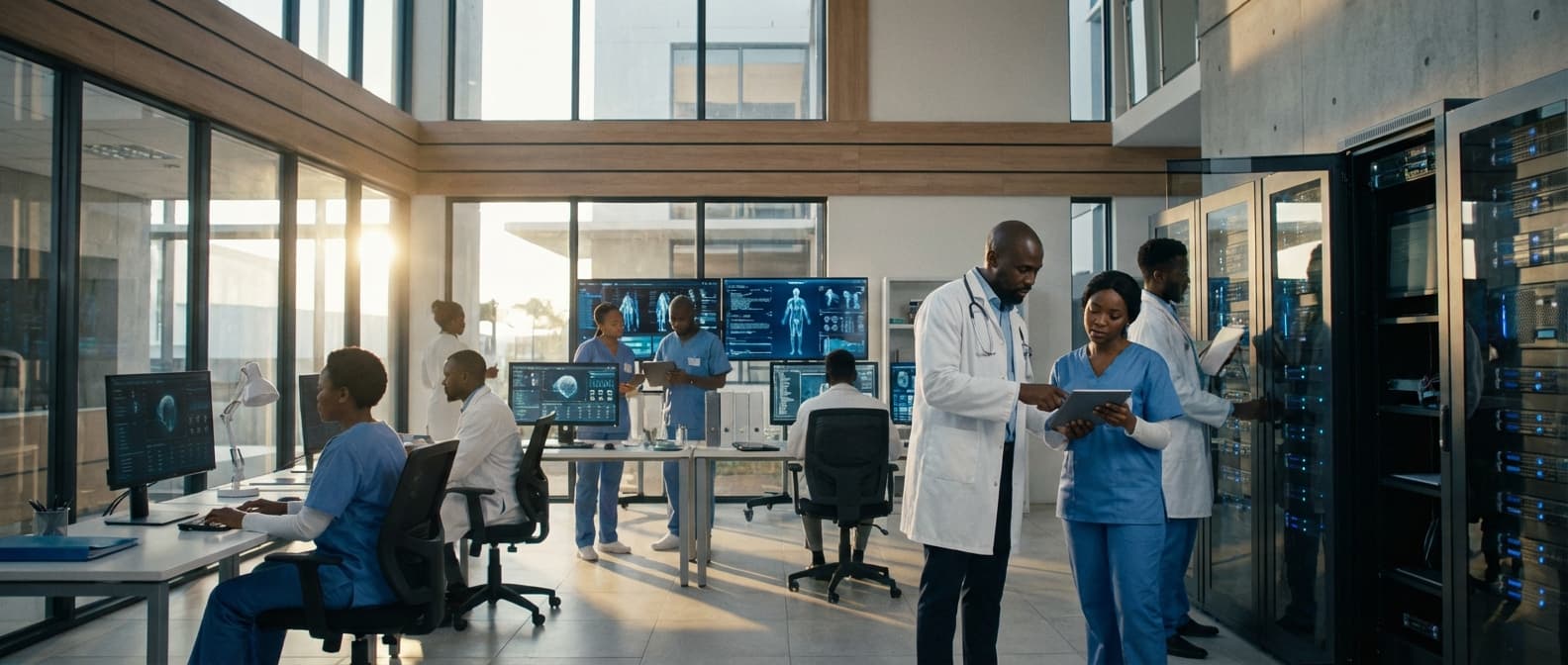
Tele-Radiology in Liberia
Engineering Excellence & Technical Support
24/7 access to certified radiologists providing rapid, accurate remote interpretation of diagnostic imaging studies. High-standard technical execution following OEM protocols and local regulatory frameworks.
Bridging Geographical Gaps
Leveraging satellite and internet infrastructure, our tele-radiology service connects remote Liberian healthcare facilities with expert radiologists, ensuring critical diagnostic imaging interpretation is accessible regardless of location, overcoming infrastructure limitations.
Advanced Diagnostic Capabilities
Utilizing high-resolution DICOM viewers and secure cloud-based PACS, we provideLiberian clinicians with access to sophisticated image analysis tools, enabling faster and more accurate diagnoses for a wide range of medical conditions.
Empowering Local Expertise
Our tele-radiology platform facilitates seamless collaboration and knowledge transfer, empowering Liberian medical professionals through remote training, case consultations, and ongoing mentorship, fostering a sustainable and locally driven radiology ecosystem.
What Is Tele-radiology In Liberia?
Tele-radiology in Liberia refers to the practice of transmitting radiological images (such as X-rays, CT scans, and MRIs) from one geographical location to another for interpretation by a radiologist. This is typically facilitated through secure digital networks. The service aims to bridge the gap in access to expert radiological interpretation, particularly in remote or underserved areas of Liberia where qualified radiologists are scarce. It involves the acquisition of imaging data at a primary healthcare facility, its secure transmission to a remote teleradiology hub, and the subsequent interpretation and reporting of these images by a radiologist located elsewhere. The final report is then sent back to the originating facility for patient management.
| Who Needs Tele-radiology in Liberia? | Typical Use Cases | |||||
|---|---|---|---|---|---|---|
| Primary Healthcare Facilities in Rural/Remote Areas: Lacking in-house radiology services or qualified radiologists. | Emergency Department Consultations: Rapid interpretation of critical imaging studies (e.g., trauma, stroke) when local expertise is unavailable. | District and County Hospitals: Augmenting limited radiology departments or providing coverage during off-hours. | Specialized Imaging Interpretation: Accessing expertise for complex cases in areas like neuroradiology, orthopedic radiology, or pediatric radiology. | Public Health Initiatives: Facilitating the diagnosis of infectious diseases (e.g., tuberculosis via chest X-rays) in widespread screening programs. | Training and Education: Providing opportunities for junior radiologists to gain experience under senior supervision. | Referral Centers: Supporting facilities that receive complex cases from primary and secondary care settings. |
Key Components of Tele-radiology in Liberia
- Digital Imaging Acquisition: Utilization of modern digital imaging modalities (CR, DR, CT, MRI) capable of producing DICOM-compliant images.
- Picture Archiving and Communication System (PACS): A system for storing, retrieving, and distributing medical images and associated data.
- Telecommunication Network: Secure and reliable internet connectivity (e.g., satellite, fiber optics, or robust mobile data) for image transmission.
- Teleradiology Platform/Software: Specialized software for viewing images, communicating with referring physicians, and generating reports.
- Remote Radiologist Interpretation: Board-certified or licensed radiologists performing image analysis and report generation remotely.
- Reporting and Communication: Delivery of interpreted reports back to the referring physician, often via the same platform or integrated with the hospital's Electronic Health Record (EHR) system.
- Quality Assurance: Mechanisms for ensuring the accuracy and timeliness of interpretations.
Who Needs Tele-radiology In Liberia?
Tele-radiology, the practice of interpreting medical images remotely, offers significant potential to address critical gaps in diagnostic imaging services in Liberia. While Liberia has made strides in healthcare infrastructure, access to trained radiologists remains a major challenge. This is particularly acute in rural areas and in overburdened urban centers. Tele-radiology can bridge this gap by connecting Liberian healthcare facilities with a global network of expert radiologists, enabling faster and more accurate diagnoses, ultimately improving patient care and outcomes. The need is not just for emergency situations, but for routine diagnostics, specialized interpretations, and continuous professional development for local medical personnel.
| Department/Service | Specific Needs Addressed by Tele-Radiology | Potential Benefits | Example Imaging Modalities |
|---|---|---|---|
| Radiology Department | Workload management, access to subspecialty expertise (e.g., neuroradiology, musculoskeletal radiology), peer review, quality assurance. | Reduced turnaround times, improved diagnostic accuracy, enhanced learning opportunities for local radiologists. | X-ray, CT, MRI, Ultrasound, Mammography |
| Emergency Medicine | Urgent interpretation of trauma imaging, stroke assessments, acute conditions requiring rapid diagnosis. | Faster decision-making, timely intervention, improved patient survival rates. | CT (head, body), X-ray (skeletal, chest) |
| Surgery | Pre-operative and post-operative imaging interpretation, guidance for minimally invasive procedures. | Improved surgical planning, reduced complications, better patient outcomes. | CT, MRI, X-ray |
| Internal Medicine/General Practice | Diagnosis of common conditions (e.g., pneumonia, fractures), monitoring of chronic diseases. | Broader diagnostic capabilities, improved patient management, reduced need for patient travel. | X-ray, Ultrasound |
| Pediatrics | Interpretation of pediatric-specific imaging, diagnosis of congenital abnormalities and childhood diseases. | Specialized pediatric diagnostic expertise, improved care for children. | X-ray, Ultrasound, CT |
| Oncology | Staging and follow-up imaging for cancer patients, assessment of treatment response. | Accurate cancer staging, effective treatment monitoring, improved prognosis. | CT, MRI, PET-CT (potentially) |
Target Customers and Departments for Tele-Radiology in Liberia
- {"title":"Hospitals (Public and Private)","description":"Central hospitals and larger regional hospitals often face a shortage of in-house radiologists or have overwhelming workloads. They will be primary users for routine and complex case interpretations."}
- {"title":"District and Rural Health Centers","description":"These facilities often lack any in-house radiology services. Tele-radiology can provide them with essential diagnostic imaging capabilities that are currently unavailable, democratizing access to care."}
- {"title":"Specialized Clinics (e.g., Oncology, Cardiology, Neurology)","description":"Facilities focusing on specific medical disciplines require expert interpretation of specialized imaging modalities (e.g., MRI, CT scans for neurological conditions, mammography for breast cancer screening). Tele-radiology can provide these niche expertise."}
- {"title":"Trauma and Emergency Centers","description":"Rapid diagnosis is crucial in emergency settings. Tele-radiology can facilitate quick turnaround times for critical imaging studies (e.g., head CTs for trauma, chest X-rays for suspected pneumothorax)."}
- {"title":"Medical Training Institutions","description":"Medical schools and teaching hospitals can leverage tele-radiology for educational purposes, allowing trainees to learn from a wider pool of cases and expert interpretations, fostering local capacity development."}
Tele-radiology Process In Liberia
The Tele-Radiology process in Liberia, while nascent, aims to bridge the gap in access to expert radiological interpretation, particularly in remote areas. The workflow typically begins with a referring physician initiating an inquiry when a patient requires a radiological examination and lacks immediate access to a qualified radiologist. This involves a series of steps from patient registration and image acquisition to the secure transmission of these images to a remote radiologist for interpretation and reporting. The final report is then returned to the referring physician for diagnosis and patient management. Key stakeholders include the referring physician, radiographers/technicians, IT personnel, the tele-radiology service provider (which may be an in-country or international entity), and ultimately, the patient.
| Step | Description | Key Stakeholders | Technology/Tools Involved | Challenges/Considerations |
|---|---|---|---|---|
| A referring physician identifies a need for radiological imaging and a subsequent interpretation, often due to limited local expertise or equipment. | Referring Physician, Patient, Clinic/Hospital Staff | Referral forms, Communication channels (phone, basic messaging) | Awareness of tele-radiology services, clarity of referral criteria. |
| A radiographer or technician performs the required radiological examination (X-ray, CT, Ultrasound) using available equipment. | Radiographer/Technician, Patient, Imaging Equipment | X-ray machines, CT scanners, Ultrasound devices | Equipment maintenance, availability of trained personnel, image quality control. |
| Acquired images are processed, anonymized (if necessary for privacy), and prepared for digital transmission. This often involves converting them into a compatible format (e.g., DICOM). | Radiographer/Technician, IT Personnel | PACS (Picture Archiving and Communication System) if available, DICOM converters, local storage | Image file sizes, lack of robust PACS, digital literacy of staff. |
| Images are securely uploaded and transmitted over a network to the tele-radiology service provider's platform. | IT Personnel, Tele-radiology Service Provider | Internet connectivity, secure VPNs, cloud-based platforms, specific tele-radiology software | Reliable and affordable internet access, data security protocols, bandwidth limitations. |
| A qualified radiologist, located remotely, accesses and reviews the transmitted images. | Remote Radiologist, Tele-radiology Service Provider | Tele-radiology software, high-resolution monitors, diagnostic workstations | Radiologist availability and workload, language barriers (if applicable), clear communication channels for queries. |
| The radiologist provides a detailed diagnostic report based on their interpretation of the images. | Remote Radiologist | Reporting software, standardized reporting templates | Consistency in reporting quality, adherence to international standards. |
| The final report is securely transmitted back to the referring physician's location. | Tele-radiology Service Provider, Referring Physician | Secure email, tele-radiology platform, secure file transfer protocols | Timeliness of report delivery, accessibility of the report for the referring physician. |
| The referring physician uses the radiologist's report to make a diagnosis, plan treatment, and manage the patient's care. | Referring Physician, Patient | Patient records, clinical decision-making tools | Integration of reports into patient management systems, further training for referring physicians on interpreting reports. |
Tele-Radiology Workflow in Liberia
- Inquiry & Patient Referral
- Image Acquisition
- Image Preparation & Upload
- Secure Transmission
- Remote Interpretation
- Report Generation
- Report Transmission & Review
- Patient Management
Tele-radiology Cost In Liberia
Tele-radiology, the practice of interpreting medical images remotely, offers a promising solution to address the shortage of radiologists in Liberia. While the precise cost of tele-radiology services in Liberia is not extensively documented in public data, it's crucial to understand the factors that influence pricing and the potential cost ranges. These factors include the type of imaging modality, the complexity of the examination, the turnaround time required, the volume of studies, the technology infrastructure of the provider and recipient, and the specific service package offered. Emerging tele-radiology providers in Liberia, whether local startups or international firms partnering with Liberian healthcare facilities, will likely establish pricing based on a combination of these elements, aiming to be competitive while ensuring sustainability. The cost is typically presented in Liberian Dollars (LRD).
| Service Type | Estimated Range (LRD per study) | Notes |
|---|---|---|
| X-ray Interpretation (Standard) | 2,000 - 5,000 LRD | Basic interpretation of common X-rays (e.g., chest, limb). |
| CT Scan Interpretation (Standard) | 6,000 - 15,000 LRD | Interpretation of non-contrast or contrast-enhanced CT scans. |
| MRI Scan Interpretation (Standard) | 10,000 - 25,000 LRD | Interpretation of various MRI sequences for different body parts. |
| Ultrasound Interpretation (Standard) | 3,000 - 8,000 LRD | Interpretation of general or specialized ultrasound examinations. |
| Urgent Interpretation Surcharge | Additional 20% - 50% of base cost | For expedited reporting (e.g., within 1-2 hours). |
| Subspecialty Interpretation | Varies significantly (potentially 50% - 100% higher than standard) | For highly specialized interpretations (e.g., neuroimaging, cardiac imaging). |
| Monthly Subscription/Volume Discount | Negotiable, based on volume | Likely offered to larger hospitals or clinics with consistent study flow. |
Key Pricing Factors for Tele-Radiology in Liberia
- Imaging Modality: The type of imaging (e.g., X-ray, CT scan, MRI, Ultrasound) significantly impacts cost due to varying complexity and the expertise required for interpretation.
- Examination Complexity: Simple X-rays might be priced lower than complex CT or MRI scans requiring detailed analysis of multiple anatomical structures.
- Turnaround Time (TAT): Urgent interpretations (e.g., emergency cases) usually command a premium over standard reporting times.
- Volume of Studies: Healthcare facilities that commit to a higher volume of tele-radiology studies may be eligible for discounted per-study rates.
- Technology Infrastructure: The cost of implementing and maintaining the necessary IT infrastructure (secure networks, PACS systems, high-speed internet) for both the provider and the receiving facility can influence the overall service cost.
- Radiologist Expertise & Subspecialization: Access to subspecialist radiologists (e.g., neuroradiologists, pediatric radiologists) may incur higher costs due to their specialized training and limited availability.
- Service Package: Providers might offer tiered service packages, including basic interpretation, preliminary reports, comprehensive reports with follow-up recommendations, and consultations with local clinicians.
- Provider Type: Pricing may differ between local Liberian tele-radiology startups and established international providers operating in the Liberian market.
Affordable Tele-radiology Options
Tele-radiology offers a cost-effective solution for healthcare providers by enabling remote interpretation of medical images. This significantly reduces the need for in-house radiologists, especially for smaller clinics or facilities facing staffing shortages. The value of tele-radiology lies in its ability to improve turnaround times, enhance diagnostic accuracy through access to subspecialty expertise, and ultimately lead to better patient outcomes. Key to realizing these benefits affordably are understanding value bundles and implementing smart cost-saving strategies.
| Cost-Saving Strategy | Description | Impact on Affordability |
|---|---|---|
| Negotiate Long-Term Contracts | Committing to longer service agreements can often secure discounted rates from tele-radiology providers. | Lower per-study costs and predictable expenses. |
| Optimize Workflow Integration | Ensure seamless integration of tele-radiology services with your existing PACS and EMR systems to minimize manual data entry and potential errors. | Reduces administrative overhead and potential for re-work or duplicate charges. |
| Leverage Technology for Efficiency | Utilize advanced reporting tools and communication platforms provided by the tele-radiology vendor to streamline communication and reporting. | Faster turnaround times can lead to quicker treatment decisions, reducing length of stay and associated costs. |
| Consider Off-Peak Hours (if applicable) | For non-urgent studies, inquire about potential discounts for interpretation during off-peak hours. | Reduced per-study cost for less time-sensitive interpretations. |
| Evaluate Provider Credentials and Accreditation | While not a direct cost-saving strategy, ensuring high-quality, accredited providers minimizes the risk of misdiagnosis, which can lead to significant downstream costs and patient harm. | Prevents costly litigation, repeat procedures, and adverse patient events. |
| Seek Providers with Flexible Service Offerings | Look for tele-radiology partners who can adapt their services to your evolving needs, rather than locking into rigid, expensive packages. | Allows for scaling services up or down, preventing overspending. |
Understanding Tele-Radiology Value Bundles
- {"title":"Per-Study Pricing","description":"A straightforward model where providers pay a set fee for each imaging study interpreted. This is ideal for facilities with variable or unpredictable imaging volumes."}
- {"title":"Volume-Based Tiers","description":"Pricing becomes progressively lower as the number of studies interpreted increases. This rewards higher-volume providers with greater cost savings."}
- {"title":"Subscription Models","description":"A fixed monthly or annual fee provides unlimited or a set number of interpretations within a defined period. This offers predictable budgeting and can be highly cost-effective for consistent, high-volume practices."}
- {"title":"Subspecialty Bundles","description":"Specific packages tailored for interpretation of particular modalities or subspecialties (e.g., neuro-radiology, cardiac imaging). This ensures access to specialized expertise at a predictable cost."}
- {"title":"24/7 Coverage Packages","description":"Bundles designed to provide round-the-clock access to radiologist interpretations, crucial for emergency departments and critical care settings. These often come at a premium but offer indispensable value."}
Verified Providers In Liberia
Finding reliable and credentialed healthcare providers is crucial for individuals seeking quality medical care in Liberia. Franance Health stands out as a premier organization dedicated to connecting patients with verified healthcare professionals, ensuring a higher standard of service and patient safety. Their rigorous credentialing process is designed to thoroughly vet each provider, guaranteeing they possess the necessary qualifications, licenses, and experience.
| Credential Type | Franance Health Verification | Patient Benefit |
|---|---|---|
| Medical Licenses | Verified current and valid Liberian medical licenses. | Ensures providers are legally authorized to practice. |
| Educational Qualifications | Confirmation of degrees and certifications from recognized institutions. | Guarantees foundational medical knowledge and training. |
| Professional Experience | Assessment of past practice and areas of specialization. | Connects patients with specialists best suited for their needs. |
| Continuing Medical Education (CME) | Proof of ongoing professional development. | Ensures providers stay updated with the latest medical advancements. |
| Background Checks | Thorough review of professional conduct and history. | Promotes a safe and trustworthy healthcare experience. |
Why Franance Health Providers Are the Best Choice:
- Rigorous Verification Process: Franance Health employs a comprehensive vetting system that goes beyond basic licensing. They assess educational backgrounds, professional licenses, certifications, and work history to ensure all providers meet stringent criteria.
- Commitment to Patient Safety: By prioritizing credentialing, Franance Health significantly reduces the risk of encountering unqualified practitioners, thereby enhancing patient safety and confidence.
- Access to Skilled Professionals: Their network comprises highly skilled and experienced doctors, nurses, specialists, and other healthcare professionals across a wide range of medical disciplines.
- Transparency and Trust: Franance Health promotes transparency by providing clear information about provider credentials, allowing patients to make informed decisions about their healthcare.
- Improved Health Outcomes: Access to verified, competent providers directly contributes to better diagnosis, treatment, and ultimately, improved health outcomes for individuals in Liberia.
- Ethical Practice Standards: Franance Health ensures their network adheres to the highest ethical standards of medical practice, fostering a trustworthy and professional healthcare environment.
Scope Of Work For Tele-radiology
This Scope of Work (SOW) outlines the technical deliverables and standard specifications for the implementation and operation of a Tele-Radiology service. This document serves as a foundational agreement for the provision of remote radiological interpretation services, ensuring quality, security, and interoperability.
| Technical Deliverable | Description | Standard Specification / Requirement | Acceptance Criteria |
|---|---|---|---|
| Tele-Radiology Platform Software | The core software application enabling the transmission, viewing, interpretation, and reporting of radiological images. | Secure, web-based or client-server application supporting DICOM 3.0 standards. Must be HIPAA/GDPR compliant. Features include image viewer, reporting tools, dictation/transcription integration, audit trails, and user management. | Successful installation and configuration. Platform demonstrates all specified features and complies with relevant data privacy regulations. Successful user testing by designated personnel. |
| Image Transmission System | The infrastructure and protocols for securely transmitting radiological images from originating sites to the Tele-Radiology platform. | Utilizes secure protocols such as SFTP, HTTPS, or VPN. Compliant with DICOM standards for image transfer. Encryption of data in transit and at rest is mandatory. | Demonstrated successful and secure transmission of various image modalities (X-ray, CT, MRI, Ultrasound) from multiple sites to the platform without data corruption or loss. |
| Radiologist Workstation Configuration | The hardware and software requirements for radiologists to effectively access and interpret images. | High-resolution (e.g., 3MP or higher) medical-grade monitors. Powerful workstations capable of rendering large image datasets smoothly. Ergonomic setup. Licensed viewing software compatible with the Tele-Radiology platform. | Workstations meet or exceed specified resolution and performance benchmarks. Radiologists can perform complex image manipulations and viewing tasks without lag or performance issues. |
| Reporting and Dictation System | Tools for radiologists to generate and finalize reports, including integrated dictation/speech recognition capabilities. | Supports structured reporting templates. Seamless integration with dictation software (e.g., Dragon Medical One) or voice-to-text services. Reports can be finalized, signed electronically, and transmitted to the EHR. | Radiologists can accurately and efficiently generate reports. Dictation and transcription achieve >95% accuracy. Finalized reports are correctly linked to patient records. |
| PACS Integration | The process of connecting the Tele-Radiology platform with the originating site's PACS. | Bi-directional HL7 messaging for patient demographics, study orders, and report results. DICOM connectivity for image retrieval and sending of reports back to PACS. Compliance with DICOM Conformance Statements. | Successful exchange of HL7 messages. Images are accessible via the Tele-Radiology platform. Reports are pushed back to the originating PACS and/or EHR as specified. |
| EHR Integration | The interface between the Tele-Radiology platform and the Electronic Health Record system. | Integration via HL7 for patient data, orders, and report delivery. API integration for real-time data exchange if required. Single Sign-On (SSO) capabilities where feasible. | Patient demographic data populates correctly. Study orders are received. Finalized reports are automatically imported into the EHR. |
| Network and Connectivity Requirements | The network infrastructure and bandwidth necessary for reliable and timely image transmission and platform access. | Sufficient bandwidth to support concurrent image transfers and remote access. Reliable internet connectivity (e.g., dedicated fiber, MPLS). Secure VPN tunnels for remote access. | Demonstrated stable network performance with minimal latency and packet loss. Successful remote access from multiple geographical locations. |
| Security and Compliance | Measures to ensure the confidentiality, integrity, and availability of patient data and system access. | Robust access controls, multi-factor authentication, data encryption (in transit and at rest), regular security audits, compliance with HIPAA, GDPR, and other relevant data privacy regulations. | Successful completion of security penetration testing. All audit logs are maintained and accessible. Adherence to all specified regulatory requirements. |
| User Training and Support | Comprehensive training for all users and ongoing technical support. | On-site or remote training sessions for radiologists, technologists, and IT staff. Development of user manuals and FAQs. Defined Service Level Agreements (SLAs) for technical support response and resolution times. | Users demonstrate proficiency with the platform after training. Support requests are addressed within agreed-upon SLA timelines. |
Key Objectives of the Tele-Radiology Service
- Enhance access to specialized radiological expertise in underserved areas.
- Improve turnaround times for diagnostic reports.
- Optimize radiologist workflow and resource allocation.
- Ensure the highest standards of diagnostic accuracy and patient care.
- Facilitate seamless integration with existing Picture Archiving and Communication Systems (PACS) and Electronic Health Records (EHR).
Service Level Agreement For Tele-radiology
This Service Level Agreement (SLA) outlines the performance expectations and guarantees for the Tele-Radiology services provided by [Your Company Name] (hereinafter referred to as "Provider") to [Client Name] (hereinafter referred to as "Client"). This SLA applies to all tele-radiology interpretations and related services as defined in the Master Service Agreement (MSA).
| Service Component | Uptime Guarantee | Response Time (Criticality Level 1 - Emergency) | Response Time (Criticality Level 2 - Urgent) | Response Time (Criticality Level 3 - Routine) |
|---|---|---|---|---|
| Tele-Radiology Platform Availability | 99.9% (excluding scheduled maintenance) | |||
| Report Availability for Emergency Studies | Within [Number] minutes of study completion and verification by Provider. | |||
| Report Availability for Urgent Studies | Within [Number] hours of study completion and verification by Provider. | |||
| Report Availability for Routine Studies | Within [Number] business hours of study completion and verification by Provider. | |||
| Data Transmission and Storage | 99.9% (excluding scheduled maintenance) |
Key Definitions
- Response Time: The time elapsed from the successful submission of a diagnostic imaging study to the Tele-Radiology platform by the Client until the preliminary or final report is made available to the Client through the agreed-upon communication channel.
- Uptime: The percentage of time the Tele-Radiology platform and its associated services are available and operational for use by the Client. Uptime excludes scheduled maintenance windows.
- Scheduled Maintenance: Pre-announced periods of time during which the Tele-Radiology platform may be temporarily unavailable for system updates, upgrades, or maintenance. Notice of scheduled maintenance will be provided at least [Number] days in advance.
- Criticality Level: A classification system for imaging studies based on their urgency and potential impact on patient care. This will be defined in an appendix to this SLA.
- Report Availability: The state in which a completed report is accessible to the Client via the designated platform or system.
- Emergency Study: A study designated as Criticality Level 1, requiring immediate attention and reporting.
- Urgent Study: A study designated as Criticality Level 2, requiring prompt attention and reporting.
- Routine Study: A study designated as Criticality Level 3, requiring reporting within standard operational timelines.
Frequently Asked Questions

Ready when you are
Let's scope your Tele-Radiology in Liberia project in Liberia.

Scaling healthcare logistics and technical systems across the entire continent.