
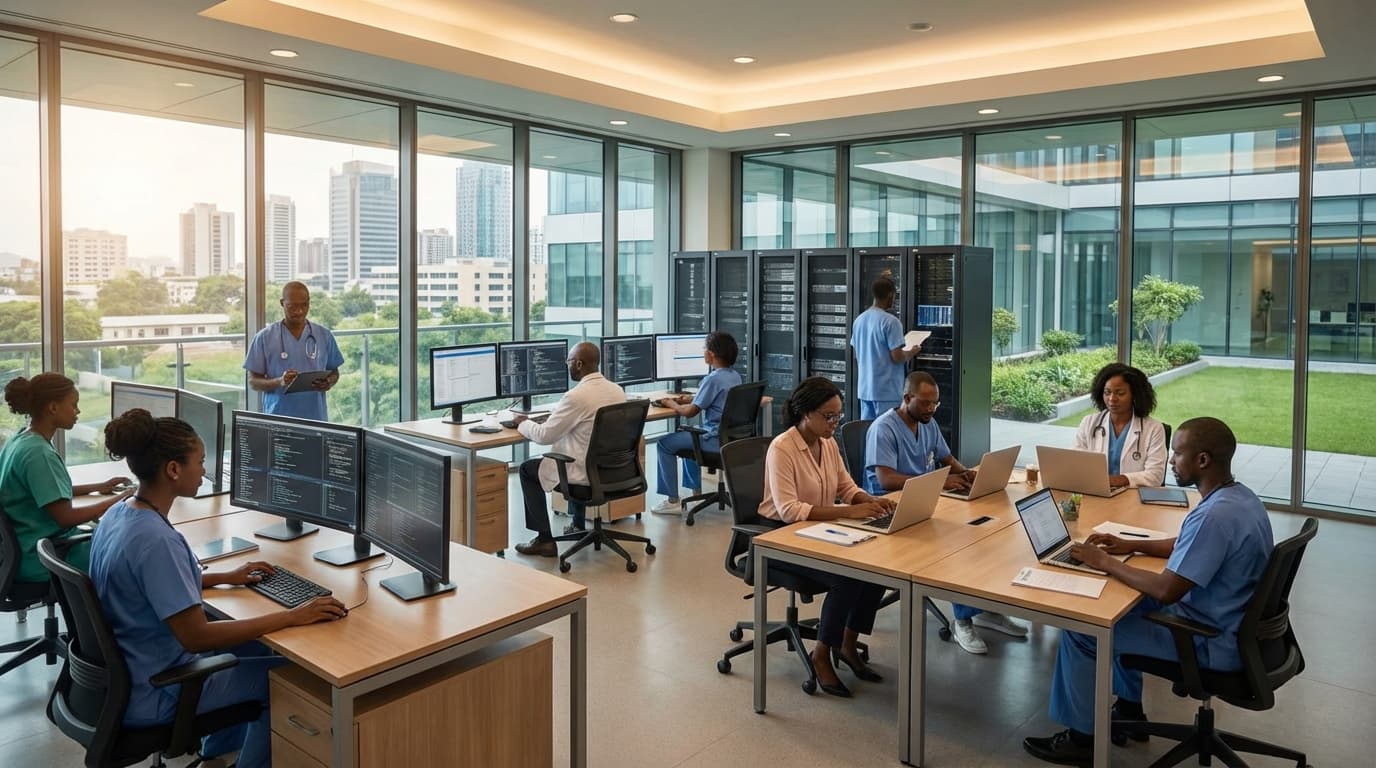
Radiology Reader & Reporting Support in Liberia
Engineering Excellence & Technical Support
Remote radiology reading and reporting services High-standard technical execution following OEM protocols and local regulatory frameworks.
AI-Powered Image Analysis for Faster Diagnosis
Leveraging cutting-edge AI algorithms to automatically detect and flag abnormalities in X-rays, CT scans, and MRIs, significantly reducing radiologist workload and accelerating diagnostic turnaround times for improved patient care in Liberia.
Cloud-Based Reporting Platform with Secure Data Archiving
Implementing a secure, HIPAA-compliant cloud platform for seamless report generation, transcription, and storage. This ensures accessibility, data integrity, and efficient retrieval of patient imaging records for radiologists across Liberia, regardless of location.
Tele-Radiology Network for Enhanced Expert Consultation
Establishing a robust tele-radiology network connecting Liberian healthcare facilities with a global pool of expert radiologists. This facilitates remote reading of complex cases, specialized opinions, and continuous medical education, bridging the expertise gap and improving diagnostic accuracy nationwide.
What Is Radiology Reader & Reporting Support In Liberia?
Radiology Reader & Reporting Support (RRRS) in Liberia refers to a specialized service providing expert interpretation of medical imaging studies (e.g., X-rays, CT scans, MRI, ultrasounds) and the generation of comprehensive diagnostic reports. This service is crucial for healthcare facilities in Liberia that may lack sufficient in-house radiologist expertise or have limited access to advanced diagnostic imaging technologies. RRRS leverages remote access to imaging data and a network of qualified radiologists to deliver timely and accurate interpretations, thereby enhancing diagnostic capabilities and patient care.
| Service | Description | Beneficiary | Typical Use Cases |
|---|---|---|---|
| Remote Teleradiology Reading | Off-site interpretation of medical images by qualified radiologists. | Hospitals, clinics, and diagnostic centers in Liberia with limited or no in-house radiologist coverage. | Emergency room consultations, routine diagnostic imaging, interpretation of complex cases, backlog reduction, after-hours coverage. |
| Subspecialty Consultations | Access to radiologists with specific expertise (e.g., neuroradiology, pediatric radiology, musculoskeletal radiology). | Healthcare providers encountering specialized imaging findings requiring advanced interpretation. | Diagnosis of neurological conditions, pediatric congenital anomalies, complex orthopedic injuries, oncological imaging interpretation. |
| Reporting Template Standardization | Development and utilization of standardized reporting formats to ensure clarity and completeness. | Facilities seeking to improve consistency and quality of radiology reports. | Ensuring all critical findings are documented, facilitating better communication with referring clinicians and improving data collection for research and quality improvement. |
| PACS/RIS Integration Support | Assistance with the implementation and integration of Picture Archiving and Communication Systems (PACS) and Radiology Information Systems (RIS) for seamless image management and workflow. | Healthcare institutions aiming to modernize their radiology departments. | Digitalization of imaging workflows, efficient storage and retrieval of images, improved report turnaround times. |
Key Components of Radiology Reader & Reporting Support
- Image Acquisition and Transmission: Secure and efficient methods for transmitting digital medical images from Liberian healthcare facilities to remote reading centers.
- Expert Interpretation: Board-certified radiologists with specialized expertise analyze transmitted images to identify abnormalities and diagnose conditions.
- Report Generation: Creation of detailed, structured diagnostic reports that are communicated back to the referring physician.
- Quality Assurance: Implementation of protocols to ensure the accuracy, consistency, and timeliness of interpretations.
- Technical Infrastructure: Provision and maintenance of necessary hardware, software, and network connectivity for image transfer and remote access.
- Training and Education (Optional): Capacity building initiatives for local healthcare professionals on basic image interpretation or system utilization.
Who Needs Radiology Reader & Reporting Support In Liberia?
Radiology reader and reporting support are crucial for enhancing diagnostic capabilities, improving patient care, and optimizing workflow in healthcare settings. In Liberia, where access to specialized medical expertise can be limited, these services are particularly valuable for a range of institutions and departments facing diagnostic challenges.
| Customer Type | Key Departments Benefiting | Specific Needs/Challenges |
|---|---|---|
| Public Hospitals | Emergency, Surgery, Internal Medicine, Pediatrics | High patient volume, limited number of radiologists, potential for diagnostic delays, need for consistent quality. |
| Private Hospitals and Clinics | Radiology, Surgery, Oncology, Internal Medicine | Desire to offer comprehensive services, need for quick turnaround times, quality assurance, access to subspecialty interpretations. |
| Referral Centers | All departments, especially complex case management | Confirmation of rare diagnoses, expert second opinions, support for complex interventions. |
| NGO and Mission Hospitals | General Medicine, Surgery, Pediatrics | Resource constraints, potential reliance on expatriate staff, need for sustainable diagnostic support. |
| Regional and Rural Health Posts | General Medicine, Emergency | Extreme lack of on-site radiology expertise, reliance on remote diagnostics for basic imaging interpretation. |
| Training and Teaching Hospitals | Radiology, all clinical departments | Educational support for trainees, ensuring high standards of patient care during training, access to diverse case studies. |
Target Customers and Departments in Liberia Needing Radiology Reader & Reporting Support:
- Public Hospitals: These are the primary healthcare providers for the majority of the Liberian population and often face the greatest strain on resources and specialized personnel.
- Private Hospitals and Clinics: As the private healthcare sector grows, these facilities also seek to offer advanced diagnostic services and require reliable interpretation of imaging studies.
- Referral Centers: Institutions that serve as hubs for more complex cases and specialized treatments will benefit from expert radiology support to confirm diagnoses and guide treatment plans.
- NGO and Mission Hospitals: Many healthcare facilities in Liberia are operated by non-governmental organizations and religious missions, which may have varying levels of in-house radiology expertise.
- Regional and Rural Health Posts: Facilities in underserved areas with limited access to on-site radiologists can leverage remote reading and reporting services.
- Training and Teaching Hospitals: Institutions involved in training future healthcare professionals can use these services for educational purposes and to ensure high-quality patient care during training.
- Emergency Departments: Timely and accurate interpretation of imaging for trauma and acute conditions is vital for immediate patient management.
- Surgical Departments: Surgeons rely heavily on radiological interpretations for pre-operative planning, intra-operative guidance, and post-operative assessment.
- Internal Medicine and Oncology Departments: These departments require expert analysis of imaging for diagnosis, staging, and monitoring of various diseases, including cancers and chronic conditions.
- Pediatric Departments: Specialized interpretation of imaging for children is essential, considering the unique anatomical and pathological considerations.
- Infectious Disease Departments: Radiology plays a critical role in diagnosing and monitoring infectious diseases, particularly in contexts where certain infections are prevalent.
- Radiology Departments with Limited Staff or Subspecialty Expertise: Even departments with existing radiologists can benefit from support during staff shortages, vacation periods, or for interpretation of rare or complex cases requiring subspecialty knowledge (e.g., neuroradiology, musculoskeletal radiology).
Radiology Reader & Reporting Support Process In Liberia
The Radiology Reader & Reporting Support Process in Liberia outlines the systematic workflow for a radiologist to receive, interpret, and report on imaging studies. This process is crucial for accurate diagnosis and patient care, especially in resource-limited settings where access to specialized expertise can be challenging. The workflow begins with an inquiry, typically initiated by a referring physician or clinician, and concludes with the delivery of a comprehensive radiology report.
| Stage | Description | Key Actors | Tools/Systems | Potential Challenges in Liberia |
|---|---|---|---|---|
| Inquiry & Request Initiation | A clinician identifies the need for a radiological examination for a patient and formally requests it. | Referring Clinician (Doctor, Nurse Practitioner) | Paper-based requisition form, Electronic Health Record (EHR) if available | Lack of standardized requisition forms, limited communication channels, delays in clinician availability. |
| Image Acquisition & Transmission | The imaging study (X-ray, CT, Ultrasound, etc.) is performed, and the digital images are generated and transmitted to a central storage or PACS system. | Radiology Technologist, Sonographer | Imaging Modality (X-ray machine, CT scanner, Ultrasound), PACS (Picture Archiving and Communication System) or DICOM server, USB drives for manual transfer | Outdated or non-functional imaging equipment, unreliable electricity, lack of PACS/network infrastructure, manual image transfer leading to delays and data loss. |
| Triage & Assignment | Incoming studies are reviewed for urgency and assigned to an appropriate radiologist based on subspecialty and workload. Urgent cases are prioritized. | Radiology Department Coordinator, Senior Radiologist | PACS worklist, manual tracking sheets, communication logs | Limited number of radiologists, heavy workload, lack of clear prioritization guidelines, absence of a dedicated PACS administrator. |
| Image Review & Interpretation | The assigned radiologist meticulously examines the acquired images to identify abnormalities and formulate a diagnosis. | Radiologist | PACS workstation, high-resolution monitors, DICOM viewers | Poor image quality due to equipment issues, insufficient viewing stations, lack of specialized interpretation tools, inadequate training for complex modalities. |
| Report Dictation & Creation | The radiologist dictates their findings, impression, and recommendations. This is then transcribed into a formal report. | Radiologist, Medical Transcriptionist (if available) | Digital dictation software, voice recorders, transcription software, word processing software | Lack of dictation equipment, limited availability of trained transcriptionists, reliance on manual typing which is time-consuming, poor audio quality of recordings. |
| Report Review & Finalization | A senior radiologist or supervisor may review the report for accuracy, completeness, and consistency before it is finalized. | Senior Radiologist, Lead Radiologist | Report editing software, quality assurance checklists | Absence of a dedicated quality assurance process, time constraints for review due to workload, lack of consensus on reporting standards. |
| Report Distribution & Communication | The finalized report is sent to the referring clinician. Urgent findings may be communicated verbally. | Radiology Department Staff, Referring Clinician | Fax machine, email, EHR system, phone calls, courier services | Unreliable fax or email, delayed mail delivery, limited access to EHR, difficulty reaching clinicians due to poor communication infrastructure. |
| Archiving & Follow-up | Images and reports are securely stored for future reference and legal purposes. Follow-up recommendations are tracked. | Radiology Department Staff, IT Support | PACS archive, physical filing systems, patient records | Limited storage capacity, risk of data loss, inadequate backup systems, difficulties in tracking follow-up recommendations due to fragmented record-keeping. |
Workflow Stages
- Inquiry & Request Initiation
- Image Acquisition & Transmission
- Triage & Assignment
- Image Review & Interpretation
- Report Dictation & Creation
- Report Review & Finalization
- Report Distribution & Communication
- Archiving & Follow-up
Radiology Reader & Reporting Support Cost In Liberia
The cost of radiology reader and reporting support in Liberia is influenced by several key factors, primarily the complexity and volume of imaging studies, the required turnaround time for reports, the expertise of the radiologist or reporting physician, and the technology/platform used for remote access and reporting. Due to the nascent state of specialized radiology services in many regions of Liberia, pricing often reflects the scarcity of readily available, highly qualified personnel and the logistical challenges of service delivery. Local currency pricing is typically presented in Liberian Dollars (LRD).
| Service Component | Estimated Price Range (LRD) | Notes |
|---|---|---|
| Per-Study Reporting (General Radiologist) | 1,500 - 5,000 LRD | Covers standard X-ray and Ultrasound reports. Volume discounts may apply. |
| Per-Study Reporting (Specialized Modalities - CT/MRI) | 3,000 - 10,000 LRD | Reflects higher complexity and often requires more specialized expertise. |
| Rush Reporting Surcharge | +50% to +150% of base per-study cost | For urgent requests with tight deadlines. |
| Monthly/Annual Support Retainer (Clinic/Hospital) | 20,000 - 100,000+ LRD | For ongoing access to a pool of reporting radiologists and basic IT support. Highly variable based on volume and service level. |
| Initial Setup & IT Integration Fee | 50,000 - 250,000 LRD | One-time cost for setting up reporting software, secure network connections, and initial training. |
| Sub-Specialty Reporting Fee (e.g., Neuroradiology, Musculoskeletal) | 5,000 - 20,000 LRD per study | For highly specialized interpretations. |
Key Pricing Factors for Radiology Reader & Reporting Support in Liberia
- Type and Volume of Imaging Modalities: Studies from X-ray, Ultrasound, CT, and MRI will have varying costs. Higher volumes generally lead to better per-study rates, but initial setup and management costs can be significant.
- Turnaround Time (TAT) Requirements: Rush reporting (e.g., within a few hours for critical findings) incurs higher fees than standard TAT (e.g., 24-48 hours).
- Radiologist Expertise and Specialization: Reporting by sub-specialist radiologists (e.g., neuroradiology, interventional radiology) commands higher prices than general radiology reporting.
- Technology Infrastructure: The cost may include software licensing, secure data transfer, and IT support for remote reading platforms, which can be a significant component in areas with limited existing infrastructure.
- Service Level Agreements (SLAs): Comprehensive SLAs covering uptime, reporting accuracy, and communication protocols will influence pricing.
- Geographic Location and Accessibility: While remote reading mitigates some travel costs, initial site assessments and ongoing support may be factored in, especially in remote areas.
- Contract Duration and Commitment: Longer-term contracts often provide more favorable pricing structures.
Affordable Radiology Reader & Reporting Support Options
Radiology practices and healthcare facilities are increasingly seeking cost-effective solutions for radiology reading and reporting. This demand is driven by the need to manage expenses while maintaining high-quality patient care and efficient workflows. Affordable options not only reduce overhead but can also free up capital for investment in other critical areas of the practice, such as advanced imaging technology or staff training. Value bundles and strategic cost-saving measures are key to achieving these financial goals. By understanding and implementing these strategies, organizations can ensure sustainable and efficient radiology operations.
| Strategy/Bundle | Cost-Saving Mechanism | Potential Benefits | Considerations |
|---|---|---|---|
| Teleradiology Services | Per-dictation/study fees, reduced overhead of in-house staff | 24/7 coverage, access to subspecialists, scalable staffing | Quality control, turnaround time management, integration with existing workflows |
| AI-Powered Reading Assistance | Increased radiologist efficiency, reduced miss rates, faster turnaround | Improved diagnostic accuracy, workflow optimization, prioritization of urgent cases | Integration complexity, AI vendor reliability, regulatory compliance, radiologist adoption |
| Managed Services Agreements (MSAs) | Predictable costs, bundled expertise, reduced capital expenditure | Streamlined operations, guaranteed service levels, simplified vendor management | Contract length and terms, vendor lock-in, flexibility to change providers |
| Outsourced Reporting Platforms | Pay-per-report model, access to a wider pool of radiologists | Cost-effectiveness for variable workloads, specialized expertise on demand | Report quality consistency, communication channels, data security |
| Hybrid Models | Optimizing fixed costs by supplementing with variable external costs | Balanced cost and coverage, flexibility for peak demand or specific needs | Coordination complexity, seamless handoffs between internal and external teams |
Key Value Bundles and Cost-Saving Strategies
- {"title":"Teleradiology Services","description":"Outsourcing radiology reads to remote specialists. Often offers flexible staffing models (24/7 coverage, subspecialty reads) at a competitive per-dictation or per-study cost."}
- {"title":"AI-Powered Reading Assistance","description":"Utilizing Artificial Intelligence tools to flag potential abnormalities, prioritize urgent cases, and pre-populate report sections. This can increase radiologist efficiency and reduce turnaround times."}
- {"title":"Managed Services Agreements (MSAs)","description":"Comprehensive agreements that include equipment maintenance, IT support, and sometimes staffing or reading services. Can provide predictable costs and bundled expertise."}
- {"title":"Outsourced Reporting Platforms","description":"Platforms that connect practices with reporting radiologists, often specialized, who can deliver reports on demand. Pricing is typically per report or a fixed monthly fee."}
- {"title":"Hybrid Models","description":"Combining in-house reading capabilities with outsourced services for specific times (e.g., nights, weekends) or subspecialties. This balances cost control with immediate availability."}
- {"title":"Cloud-Based PACS/RIS Solutions","description":"Migrating to cloud infrastructure for Picture Archiving and Communication Systems (PACS) and Radiology Information Systems (RIS) can reduce on-premise hardware costs and IT maintenance burdens."}
- {"title":"Negotiating Vendor Contracts","description":"Thoroughly reviewing and negotiating contracts with teleradiology providers, AI vendors, and other service providers to secure the best pricing and service level agreements (SLAs)."}
- {"title":"Process Optimization & Workflow Automation","description":"Implementing lean principles and automating repetitive tasks within the reporting workflow to improve radiologist productivity and reduce errors."}
- {"title":"Subspecialty Coverage Pools","description":"Collaborating with other practices or teleradiology groups to create a shared pool of subspecialists, reducing the need for individual practices to maintain full-time coverage for rare modalities."}
- {"title":"Volume-Based Pricing & Tiered Services","description":"Exploring service providers that offer tiered pricing based on reading volume or offering different service levels to match specific needs and budgets."}
Verified Providers In Liberia
In Liberia's evolving healthcare landscape, identifying reliable and credentialed healthcare providers is paramount. Franance Health stands out as a beacon of trust, meticulously vetting its network of healthcare professionals to ensure the highest standards of care. This commitment to verification not only safeguards patient well-being but also fosters a more accessible and dependable healthcare system for all Liberians. Choosing Franance Health means opting for a healthcare partner that prioritizes quality, integrity, and your health above all else. Their rigorous credentialing process is a testament to their dedication to providing safe, effective, and patient-centered medical services.
| Credential Category | Franance Health Verification Standard | Importance for Patient Care |
|---|---|---|
| Medical Licensure | Active and valid license verified with the Liberian Medical and Dental Council | Ensures providers are legally authorized to practice medicine. |
| Educational Qualifications | Verification of degrees and certifications from accredited institutions | Confirms a strong foundation in medical knowledge and training. |
| Specialized Training & Certifications | Validation of any postgraduate studies, residencies, or specialized certifications | Guarantees expertise in specific medical fields. |
| Professional Experience | Thorough review of past work history and references | Assesses practical application of skills and patient interaction history. |
| Criminal Background Checks | Comprehensive background checks conducted by reputable agencies | Prioritizes patient safety and trust by ensuring provider integrity. |
| Ethical Conduct & Disciplinary Records | Inquiries into any past disciplinary actions or malpractice claims | Upholds the highest ethical standards in healthcare delivery. |
Why Franance Health is the Premier Choice for Verified Providers in Liberia:
- Rigorous Vetting Process: Franance Health employs a comprehensive screening protocol that goes beyond basic licensing, examining educational qualifications, specialized training, and professional experience.
- Commitment to Quality Assurance: Regular audits and performance evaluations ensure that all affiliated providers maintain exceptional standards of care and adhere to ethical medical practices.
- Patient Safety First: Every provider on the Franance Health network has undergone thorough background checks and verification of their credentials to guarantee patient safety and trust.
- Enhanced Accessibility: By curating a network of verified professionals, Franance Health simplifies the process of finding competent healthcare, reducing the burden on individuals seeking quality medical attention.
- Trust and Transparency: Franance Health operates with a high degree of transparency, allowing patients to be confident in the qualifications and reliability of the healthcare providers they access through their platform.
- Focus on Continuous Improvement: The organization actively engages with its providers to encourage ongoing professional development and the adoption of the latest medical advancements.
Scope Of Work For Radiology Reader & Reporting Support
This Scope of Work (SOW) outlines the requirements for Radiology Reader & Reporting Support services. The objective is to provide expert radiological interpretation and timely, accurate reporting to support diagnostic and clinical decision-making. This document details the technical deliverables and standard specifications expected from the service provider.
| Deliverable | Standard Specification | Format/Method | Quality Assurance |
|---|---|---|---|
| Radiological Interpretation | Performed by board-certified or equivalent radiologists with subspecialty expertise where applicable. Interpretation must be based on established diagnostic criteria and clinical context provided. | Digital images viewed on calibrated medical-grade PACS workstations. Findings documented in structured or free-text reports. | Peer review, adherence to reporting templates, internal quality metrics. |
| Radiology Reports | Reports shall include sections for Clinical History, Technique, Findings, Impression, and Recommendations (if applicable). Language must be precise, unambiguous, and clinically relevant. Standardized reporting templates will be utilized where available. | Electronic reports generated within the client's Picture Archiving and Communication System (PACS) or a designated reporting platform. Secure electronic transmission to the client's Electronic Health Record (EHR) system. | Grammar and spelling checks, adherence to reporting guidelines (e.g., ACR, RSNA), regular audit of reports for accuracy and completeness. |
| Turnaround Time (TAT) | Routine interpretations: [Specify TAT, e.g., 24-48 hours from study completion]. STAT interpretations: [Specify TAT, e.g., within 1-4 hours from notification]. | Measured from the time the study is available for interpretation to the time the final report is signed and transmitted. | Performance monitoring against defined TAT benchmarks, escalation procedures for delays. |
| Critical Findings Communication | Identification and immediate verbal or secure electronic notification of potentially life-threatening or urgent findings to the referring physician or designated contact person. Documentation of communication. | Phone calls, secure messaging platforms, or direct integration with EHR alerts. Detailed record of who was notified, when, and the nature of the finding. | Audits of critical findings communication logs, verification of notification receipt. |
| Data Security and Privacy | Full compliance with HIPAA, HITECH, and any other relevant data protection regulations. All data transmission and storage must be encrypted and secured. | Secure, encrypted VPN connections for remote access. Auditable logs of system access and data handling. Signed Business Associate Agreement (BAA). | Regular security audits, penetration testing, staff training on privacy and security protocols. |
| System Integration | Seamless integration with the client's PACS and EHR systems for image access, order reconciliation, and report distribution. | Utilize standard interoperability protocols (e.g., HL7, DICOM). Technical support for integration issues. | Uptime monitoring of integration points, timely resolution of connectivity issues. |
Key Responsibilities and Deliverables
- Provide professional radiological interpretation of medical imaging studies (e.g., X-ray, CT, MRI, Ultrasound, Nuclear Medicine).
- Generate comprehensive, clear, and concise radiology reports in accordance with established medical and regulatory standards.
- Ensure timely turnaround times (TAT) for report delivery, as defined in Service Level Agreements (SLAs).
- Maintain adherence to all relevant clinical guidelines, best practices, and legal requirements.
- Participate in peer review processes and quality assurance activities as required.
- Communicate critical findings to referring physicians promptly and effectively.
- Maintain a high level of expertise and continuous professional development in radiology.
- Securely handle and protect patient health information (PHI) in compliance with HIPAA and other applicable privacy regulations.
Service Level Agreement For Radiology Reader & Reporting Support
This Service Level Agreement (SLA) outlines the terms and conditions for the provision of Radiology Reader & Reporting Support services. It defines the expected response times for critical issues, standard inquiries, and guarantees the availability (uptime) of the reporting platform and associated tools.
| Service Component | Priority Level | Response Time Guarantee | Uptime Guarantee | Description |
|---|---|---|---|---|
| Radiology Reporting Platform Availability | Critical (System Outage) | 15 Minutes | 99.9% | Ensures the core reporting software is accessible and functional for all users. |
| Radiology Reporting Platform Availability | High (Major Functionality Impaired) | 30 Minutes | 99.9% | Addresses issues preventing core reporting functions, but some limited access might be possible. |
| Radiology Reporting Platform Availability | Medium (Minor Functionality Impaired) | 2 Hours | 99.5% | Resolves issues affecting non-critical features or user experience. |
| Reader Support (Workflow Assistance) | Critical (Unable to Dictate/Sign Reports) | 10 Minutes | N/A | Immediate assistance for readers unable to complete essential reporting tasks. |
| Reader Support (Workflow Assistance) | High (Significant Workflow Disruption) | 30 Minutes | N/A | Prompt support for issues causing substantial delays in the reporting workflow. |
| Reporting Support (Data/Template Issues) | Medium (Template Inconsistency, Data Retrieval Errors) | 4 Business Hours | N/A | Resolution for issues related to reporting templates, data population, or minor reporting errors. |
| General Inquiries & Requests | Low | 8 Business Hours | N/A | Addresses non-urgent questions, feature requests, or minor configuration adjustments. |
Key Performance Indicators (KPIs) and Guarantees
- Response Times: Guaranteed maximum time from initial notification to the commencement of support activities.
- Uptime Guarantee: Percentage of time the reporting platform and core functionalities are available and operational.
- Support Channels: Methods through which support can be requested and initiated.
- Issue Prioritization: Categorization of issues based on their severity and impact on clinical operations.
Frequently Asked Questions

Ready when you are
Let's scope your Radiology Reader & Reporting Support in Liberia project in Liberia.

Scaling healthcare logistics and technical systems across the entire continent.