
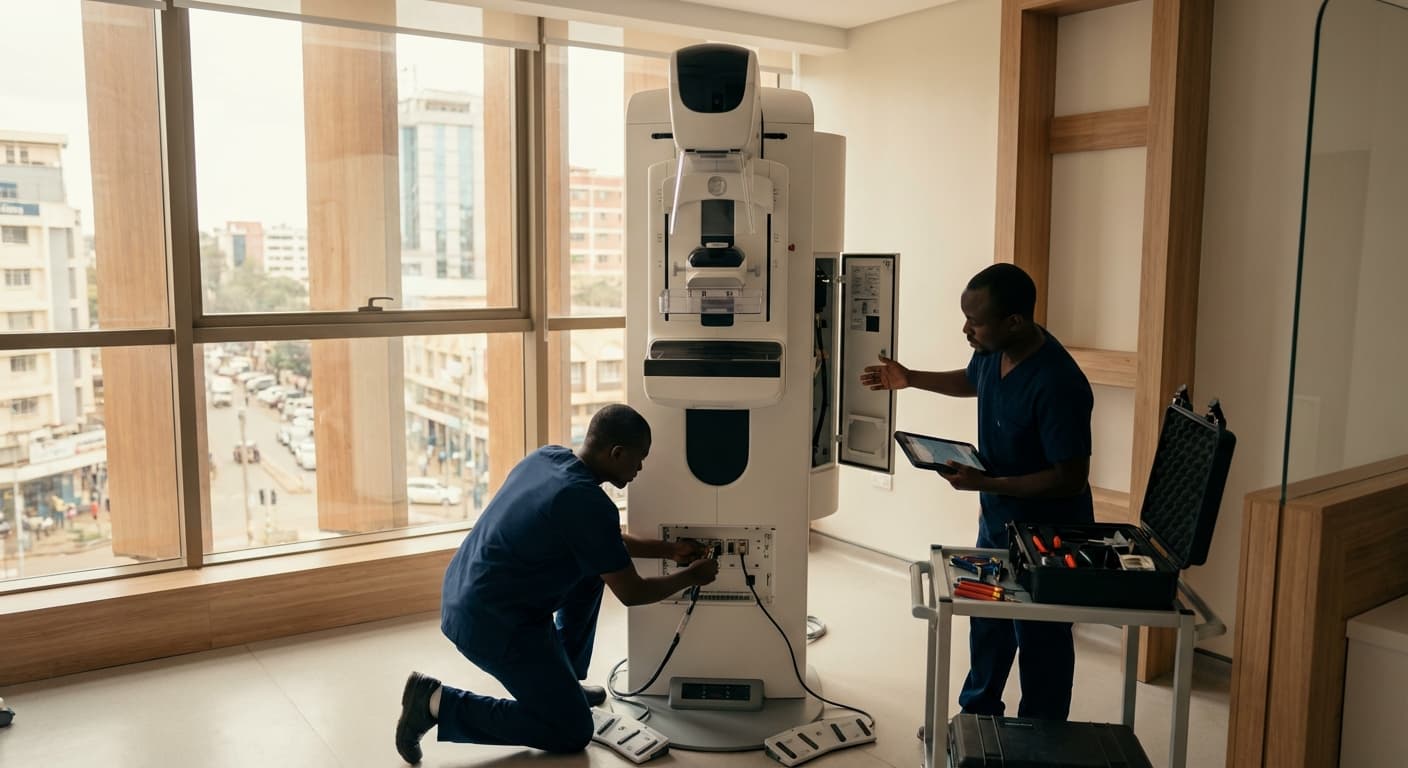
Mammography Installation Service in Liberia
Engineering Excellence & Technical Support
Mammography Installation Service High-standard technical execution following OEM protocols and local regulatory frameworks.
Advanced Imaging Technology Integration
We specialize in installing state-of-the-art mammography systems, ensuring seamless integration with existing hospital IT infrastructure. Our expert technicians calibrate and configure equipment to meet the highest diagnostic imaging standards, enhancing early detection capabilities for breast cancer in Liberia.
Certified Biomedical Engineering & Calibration
Our certified biomedical engineers provide meticulous installation and calibration services for all mammography units. We adhere to strict quality control protocols and international safety standards, guaranteeing optimal image quality and patient safety. Regular maintenance plans are also offered to ensure long-term equipment reliability.
Comprehensive Training & Support for Healthcare Professionals
Beyond installation, we offer comprehensive, hands-on training for radiologists, technologists, and biomedical staff in Liberia. Our support extends to troubleshooting, preventative maintenance, and ensuring your team is fully proficient in operating and maintaining the advanced mammography equipment for effective patient care.
What Is Mammography Installation Service In Liberia?
Mammography Installation Service in Liberia refers to the specialized process of setting up, configuring, and validating mammography equipment within healthcare facilities in Liberia. This service ensures that medical imaging systems designed for breast cancer screening and diagnosis are operational, calibrated, and compliant with relevant safety and quality standards. It encompasses the physical placement of the unit, integration with existing or new Picture Archiving and Communication Systems (PACS) and Electronic Health Records (EHR), and comprehensive testing to guarantee optimal image quality and radiation safety.
| Stakeholder | Need for Service | Typical Use Cases |
|---|---|---|
| Hospitals and Clinics in Liberia | Establishing or upgrading breast imaging capabilities for screening and diagnostic purposes. | Installation of new mammography units in public and private healthcare facilities; upgrading existing systems to incorporate advanced features or improved resolution; replacing outdated or non-functional equipment. |
| Government Health Ministries and Agencies | Ensuring access to essential diagnostic tools for public health initiatives, particularly breast cancer screening programs. | Facilitating the deployment of mammography equipment to underserved regions; establishing national standards for mammography quality and safety; supporting the implementation of national cancer control strategies. |
| Non-Governmental Organizations (NGOs) and Philanthropic Organizations | Providing critical medical equipment to support healthcare access and improve health outcomes, especially for women's health. | Donated equipment requiring professional installation; setting up mammography services in mobile clinics or outreach programs; supporting specialized breast health centers. |
| Equipment Manufacturers and Vendors | Fulfilling contractual obligations for product deployment and ensuring customer satisfaction. | Authorized technicians performing installations as part of the sales agreement; ensuring proper setup for optimal system performance and warranty validation. |
Key Components of Mammography Installation Service
- Site Assessment and Preparation: Evaluating the physical space, power requirements, and environmental conditions to ensure suitability for mammography equipment.
- Equipment Delivery and Unpacking: Safely transporting and unpacking the mammography unit and associated components.
- Physical Installation: Assembling and positioning the mammography system, including detectors, X-ray tube, compression paddles, and control console.
- Electrical and Network Integration: Connecting the unit to power sources, grounding systems, and local area networks (LANs) for PACS/EHR connectivity.
- Software Configuration and Integration: Installing and configuring mammography software, including image acquisition, processing, and storage protocols, with seamless integration into PACS/EHR.
- Calibration and Quality Assurance (QA): Performing rigorous calibration procedures to ensure accurate radiation output, image resolution, contrast, and artifact detection. This includes adherence to established QA protocols and regulatory requirements.
- Radiation Safety Survey: Conducting comprehensive radiation safety assessments to verify shielding, dose levels, and compliance with national and international safety standards.
- User Training: Providing comprehensive training to radiographers, technologists, and maintenance personnel on the operation, basic troubleshooting, and routine QA of the mammography system.
- System Testing and Validation: Performing end-to-end testing to confirm functionality, image quality, and data integrity from acquisition to archiving.
- Documentation and Handover: Providing detailed installation reports, user manuals, QA records, and warranty information, along with formal handover of the operational system.
Who Needs Mammography Installation Service In Liberia?
The installation of mammography equipment is a critical step in establishing or upgrading diagnostic imaging capabilities. This specialized service ensures that state-of-the-art technology is correctly set up, calibrated, and integrated into a healthcare facility's workflow, making it fully operational for patient care. In Liberia, the demand for such services is driven by the increasing recognition of the importance of early breast cancer detection and the ongoing efforts to improve healthcare infrastructure.
| Target Customer Type | Relevant Departments |
|---|---|
| Public Hospitals | Radiology Department, Oncology Department, Women's Health Unit, Diagnostic Imaging Services |
| Private Hospitals and Clinics | Radiology Department, Diagnostic Imaging Unit, Breast Health Services, Women's Health Department |
| Specialized Diagnostic Imaging Centers | Radiology Department, Mammography Unit, Imaging Services |
| NGOs and Charities | Health Programs Department, Medical Services Unit, Screening Programs |
| Maternity and Women's Health Clinics | Women's Health Department, Diagnostic Services, Obstetrics and Gynecology |
| Tertiary Care Centers/Referral Hospitals | Radiology Department, Diagnostic Imaging Center, Oncology Unit, Breast Health Center |
| Research Institutions and Medical Schools | Radiology Department, Medical Education Division, Research Wing |
Target Customers for Mammography Installation Service in Liberia
- Public Hospitals: Government-funded hospitals are often at the forefront of providing essential healthcare services, including diagnostic imaging, to the general population. Upgrading or establishing mammography services in these facilities is crucial for widespread access.
- Private Hospitals and Clinics: For-profit healthcare providers looking to offer comprehensive diagnostic services and attract patients often invest in advanced equipment like mammography machines. Their focus is on delivering high-quality care and competitive services.
- Specialized Diagnostic Imaging Centers: Dedicated centers focused on radiology and diagnostic imaging are prime candidates for mammography installation as it forms a core part of their service offering. They often cater to both referring physicians and direct patient access.
- Non-Governmental Organizations (NGOs) and Charities: Organizations focused on improving health outcomes, particularly in areas like maternal and child health or cancer screening, may fund and implement mammography services in underserved regions.
- Maternity and Women's Health Clinics: Clinics specializing in women's health are increasingly incorporating mammography as part of their preventative and diagnostic services, offering a more holistic approach to female well-being.
- Tertiary Care Centers/Referral Hospitals: These larger institutions that handle complex medical cases and serve as referral points for smaller facilities would require advanced mammography systems for specialized diagnosis and treatment planning.
- Research Institutions and Medical Schools: Facilities involved in medical research or training future healthcare professionals may also require mammography installation for educational purposes and for studies related to breast health.
Mammography Installation Service Process In Liberia
This document outlines the typical workflow for a mammography installation service process in Liberia. It covers the stages from initial inquiry to the final execution of the service, ensuring a comprehensive understanding of the steps involved.
| Stage | Description | Key Activities | Responsible Parties |
|---|---|---|---|
| Initial Inquiry & Consultation | The process begins when a healthcare facility in Liberia expresses interest in acquiring or installing a mammography unit. | Contacting the service provider, discussing needs and requirements, initial product information sharing, and scheduling a preliminary consultation. | Client (Healthcare Facility), Service Provider/Vendor |
| Site Assessment & Planning | A thorough evaluation of the intended installation location is conducted to ensure it meets the technical and environmental requirements for the mammography equipment. | Site visit by technical team, assessment of space, power supply, ventilation, radiation shielding needs, network connectivity, and creation of a detailed installation plan. | Service Provider's Technical Team, Client's Facilities Manager |
| Procurement & Logistics | Once the assessment is complete and the plan approved, the necessary equipment and materials are procured and transported to Liberia. | Ordering of mammography unit and accessories, shipping and customs clearance, warehousing and inventory management. | Service Provider/Vendor, Logistics Partners, Customs Authorities |
| Installation & Configuration | This is the core stage where the mammography unit is physically installed and configured according to the manufacturer's specifications and the site plan. | Unpacking and assembly of the unit, electrical and network connections, installation of any required infrastructure (e.g., shielding), software installation and initial configuration. | Service Provider's Installation Technicians, Manufacturer's Certified Engineers (if applicable) |
| Testing & Calibration | Rigorous testing is performed to ensure the mammography unit functions correctly, safely, and produces accurate diagnostic images. | Functional testing of all components, image quality assessment, radiation output measurements, calibration against established standards. | Service Provider's Calibration Specialists, Client's Radiologists/Technicians |
| Training & Handover | Training is provided to the healthcare facility's staff on the operation, maintenance, and basic troubleshooting of the mammography equipment. | Comprehensive training sessions for radiologists, radiographers, and biomedical engineers; provision of user manuals and documentation; formal handover of the installed system. | Service Provider's Trainers, Client's Medical and Technical Staff |
| Post-Installation Support | Ongoing support is offered to ensure the continued optimal performance and longevity of the mammography installation. | Warranty services, preventative maintenance, on-call technical support, remote diagnostics, spare parts management. | Service Provider's Support Team, Client's Biomedical Department |
Key Stages of Mammography Installation Service in Liberia
- Initial Inquiry & Consultation
- Site Assessment & Planning
- Procurement & Logistics
- Installation & Configuration
- Testing & Calibration
- Training & Handover
- Post-Installation Support
Mammography Installation Service Cost In Liberia
The cost of mammography installation services in Liberia can vary significantly based on several factors. These include the type and brand of mammography equipment being installed, the complexity of the installation process, the location of the healthcare facility within Liberia, and the service provider's experience and reputation. New, advanced digital mammography systems will generally incur higher installation costs than older analog models. Similarly, installations in remote areas might require additional logistical considerations and thus higher fees. It's essential to obtain detailed quotes from multiple reputable service providers to understand the specific pricing for your needs.
| Service Component | Estimated Cost Range (Liberian Dollar - LRD) | Notes |
|---|---|---|
| Basic Installation (Analog/Entry-Level Digital) | 50,000 - 150,000 | Includes equipment setup and initial connection. |
| Advanced Digital Mammography Installation | 150,000 - 400,000+ | May include calibration, network integration, and software setup. |
| Site Preparation & Electrical Work | 20,000 - 80,000 | Varies based on existing infrastructure. |
| Calibration & Testing | 30,000 - 70,000 | Ensuring accurate imaging performance. |
| Technician Travel & Logistics (Remote Areas) | 15,000 - 50,000+ | Depends on distance and transportation costs. |
| Post-Installation Training | 25,000 - 60,000 | For radiographers and technicians. |
| Optional: Extended Warranty/Maintenance Package | 100,000 - 300,000 (Annual) | Cost dependent on coverage and equipment type. |
Key Pricing Factors for Mammography Installation in Liberia:
- Equipment Type & Brand: Digital vs. Analog, specific manufacturer models.
- Installation Complexity: Site preparation, electrical work, network integration.
- Geographic Location: Accessibility of the healthcare facility (urban vs. rural).
- Service Provider's Expertise: Experience, reputation, and warranty offered.
- Additional Services: Calibration, training, and maintenance contracts.
Affordable Mammography Installation Service Options
Securing affordable mammography installation services is crucial for healthcare facilities aiming to provide essential diagnostic imaging without overburdening their budgets. This involves understanding the various service models available, from standalone installations to comprehensive value bundles. Cost-saving strategies often revolve around smart planning, negotiation, and leveraging technology.
Value bundles in mammography installation typically offer a package of services and equipment designed to provide a complete solution at a potentially lower overall cost compared to purchasing individual components and services separately. These bundles can streamline the procurement and implementation process, reduce administrative overhead, and often include extended support or training. The specific inclusions of a value bundle can vary significantly between providers, but commonly encompass:
- Mammography Equipment: The purchase or lease of the mammography unit itself (e.g., digital mammography, 3D mammography/tomosynthesis).
- Installation & Calibration: Professional setup of the equipment, including electrical, network, and radiation shielding considerations, followed by meticulous calibration to ensure diagnostic accuracy.
- PACS/RIS Integration: Setting up or integrating the mammography system with existing Picture Archiving and Communication Systems (PACS) for image storage and retrieval, and Radiology Information Systems (RIS) for workflow management.
- Training: Comprehensive training for radiographers and radiologists on operating the new equipment and interpreting the images.
- Warranty & Maintenance: Extended warranty periods and proactive maintenance plans to minimize downtime and unexpected repair costs.
- Site Preparation: Consultation and potential assistance with necessary site modifications, such as lead shielding, power upgrades, or network infrastructure.
Cost-saving strategies for mammography installation extend beyond simply choosing a value bundle. Facilities can employ a multi-pronged approach:
- Phased Implementation: For larger facilities or those with budget constraints, consider installing units in phases rather than all at once.
- Leasing vs. Purchasing: Evaluate the long-term financial implications of leasing equipment versus outright purchase. Leasing can offer lower upfront costs and predictable monthly expenses, while purchasing can lead to asset ownership and potential depreciation benefits.
- Negotiation: Don't hesitate to negotiate pricing, contract terms, and the scope of services with multiple vendors. Obtain detailed quotes and compare them meticulously.
- Refurbished Equipment: For facilities with more limited budgets, consider high-quality, certified refurbished mammography equipment. This can offer significant cost savings while still meeting diagnostic standards.
- Remote Installation Options: Explore if any aspects of the installation or initial training can be conducted remotely to reduce on-site service costs.
- Standardization: If multiple imaging modalities are being installed, explore if a single vendor can provide a bundled solution across different equipment types to leverage volume discounts.
- Long-Term Service Agreements: Negotiate favorable terms for long-term service and maintenance contracts, potentially securing lower rates for future support.
- Energy-Efficient Models: While the initial cost might be slightly higher, investing in energy-efficient mammography units can lead to long-term operational cost savings.
| Cost-Saving Strategy | Description | Potential Benefits |
|---|---|---|
| Phased Implementation | Install mammography units in stages over time. | Spreads out capital expenditure, allows for budget flexibility, and can be less disruptive to operations. |
| Leasing vs. Purchasing | Analyze the financial models of leasing versus buying the equipment. | Leasing offers lower upfront costs and predictable expenses; purchasing offers ownership and potential tax benefits. |
| Vendor Negotiation | Obtain multiple quotes and negotiate pricing, service terms, and inclusions. | Can lead to direct cost reductions on equipment and services, and better contract terms. |
| Certified Refurbished Equipment | Consider purchasing professionally refurbished mammography units. | Significant upfront cost savings compared to new equipment, while maintaining high diagnostic performance. |
| Remote Support & Training | Explore options for remote installation assistance and initial training modules. | Reduces on-site service fees and travel costs for vendors. |
| Long-Term Service Agreements | Secure bundled or discounted rates for extended maintenance and support. | Ensures predictable operating costs and minimizes unexpected repair expenses. |
| Energy-Efficient Models | Invest in mammography units designed for lower energy consumption. | Reduces ongoing electricity costs, contributing to long-term operational savings. |
Key Components of Mammography Installation Value Bundles
- Mammography Equipment Acquisition (Purchase/Lease)
- Professional Installation and Site Assessment
- System Calibration and Quality Assurance
- PACS/RIS Integration and Networking
- Staff Training (Operators & Interpreters)
- Extended Warranty and Preventive Maintenance
- Radiation Safety Compliance and Shielding Consultation
Verified Providers In Liberia
In Liberia's evolving healthcare landscape, identifying trustworthy and skilled medical practitioners is paramount for individuals seeking quality care. Verified providers stand out as a beacon of reliability, ensuring patients receive the best possible treatment. This document highlights the importance of such verification and delves into how Franance Health distinguishes itself as a leader in this space.
| Credential | Franance Health's Commitment | Why It Matters for Patients |
|---|---|---|
| Medical Licensing & Registration | Franance Health rigorously verifies all practitioners' valid Liberian medical licenses and registrations with the Ministry of Health. | Guarantees that providers have met the minimum legal and educational requirements to practice medicine in Liberia, ensuring basic competency. |
| Specialization & Board Certification | We identify and highlight providers who hold recognized board certifications in their respective medical specialties. | Ensures patients are connected with doctors who have advanced training and expertise in their specific area of need, leading to more effective treatment. |
| Continuing Medical Education (CME) | Franance Health encourages and often requires proof of ongoing professional development and CME participation. | Confirms that providers are staying current with the latest medical advancements, technologies, and treatment protocols, offering patients up-to-date care. |
| Reputation & Peer Review | We incorporate systems for gathering patient feedback and, where possible, peer review of clinical performance. | Provides insights into a provider's patient care quality and professional standing, helping patients make informed choices based on real-world experiences. |
| Ethical Conduct & Disciplinary History | Franance Health conducts background checks to identify any history of disciplinary actions or ethical violations. | Protects patients from practitioners who may have demonstrated a pattern of unethical behavior or professional misconduct. |
Why Verified Providers Matter in Liberia
- Ensures adherence to professional standards and ethical practices.
- Reduces the risk of medical errors and malpractice.
- Builds patient confidence and trust in the healthcare system.
- Facilitates access to specialists with proven expertise.
- Promotes a healthier and safer society through competent medical services.
Scope Of Work For Mammography Installation Service
This Scope of Work (SOW) outlines the requirements for the professional installation of a new mammography system at [Healthcare Facility Name], located at [Facility Address]. The objective is to ensure a seamless, compliant, and fully operational mammography unit ready for patient use. This document details the technical deliverables, standard specifications, and responsibilities of both the service provider and the healthcare facility.
| Deliverable | Description | Standard Specification/Requirement | Responsibility (Provider/Facility) |
|---|---|---|---|
| Site Readiness Report | Assessment of the installation site, including environmental factors, structural integrity, and power/network availability. | Compliance with manufacturer's site preparation guidelines; detailed report including any identified issues and proposed solutions. | Provider |
| Equipment Delivery Confirmation | Verification of all delivered components against the packing list and order. | Undamaged packaging; accurate component count; immediate reporting of any discrepancies or damages. | Provider/Facility |
| Installed Mammography Unit | The mammography system physically installed and secured in its designated location. | Alignment with manufacturer's installation manual; proper mounting and securing of all components; adherence to ergonomic principles. | Provider |
| Completed Electrical Connections | All necessary power connections made to the mammography unit and associated peripherals. | Compliance with local electrical codes and manufacturer's specifications; proper grounding and surge protection; certified electrician involvement. | Provider/Facility |
| Functional Network Integration | Successful connection of the mammography system to the hospital's Picture Archiving and Communication System (PACS) and other relevant networks. | Verification of data transmission to PACS; adherence to HL7 and DICOM standards; secure network configuration. | Provider/Facility |
| Calibration and Acceptance Testing Report | Documentation of all calibration procedures and results from comprehensive system testing. | Performance metrics meeting or exceeding manufacturer's specifications; all tests passed; signed acceptance form. | Provider |
| User Training Sessions | Training provided to designated medical staff (radiologists, technologists) on the operation and basic troubleshooting of the new system. | Comprehensive training covering all system functionalities; provision of training materials; competency assessment. | Provider |
| Installation & Maintenance Manuals | Provision of all relevant technical documentation for the installed system. | Original manufacturer manuals; installation guide; maintenance procedures; warranty information. | Provider |
| Compliance Certificate | Documentation confirming the installation meets all relevant regulatory and safety standards. | Evidence of compliance with FDA, ACR (if applicable), and local health department regulations; all required safety checks completed. | Provider |
| Final Handover Documentation | All necessary paperwork signed off to signify completion of the installation. | Signed SOW completion form; acceptance testing report; training completion sign-off; final invoice. | Provider/Facility |
Key Phases of Mammography Installation
- Site Preparation and Readiness Assessment
- Equipment Delivery and Unpacking
- System Installation and Cabling
- Power and Electrical Connections
- Network Integration and PACS Connectivity
- System Calibration and Testing
- User Training and Handover
- Documentation and Compliance Verification
Service Level Agreement For Mammography Installation Service
This Service Level Agreement (SLA) outlines the terms and conditions governing the installation and ongoing support services for Mammography equipment provided by [Your Company Name] (hereinafter referred to as "Provider") to [Client Company Name] (hereinafter referred to as "Client"). This SLA specifically addresses response times for service requests and guarantees for system uptime.
| Issue Severity | Response Time Target (within Business Hours) | Resolution Target (Initial Diagnosis/Workaround) | Escalation Procedure |
|---|---|---|---|
| Critical Issue | 1 Hour | Within 4 Business Hours | Immediate escalation to senior technical support and management. Provider will explore all options including remote diagnosis, on-site dispatch, or temporary loaner equipment if available. |
| Major Issue | 2 Business Hours | Within 8 Business Hours | Escalation to dedicated support team. Provider will aim for remote diagnosis and potential workaround. On-site visit will be scheduled if remote resolution is not feasible. |
| Minor Issue | 4 Business Hours | Within 24 Business Hours | Handled by standard support queue. Resolution may involve remote guidance, software patch, or scheduled on-site visit at Provider's discretion. |
Key Definitions
- Service Request: Any communication from the Client to the Provider, requesting assistance with the Mammography equipment, including installation, maintenance, or repair.
- Critical Issue: An event that renders the Mammography equipment completely inoperable or significantly impairs its core functionality, preventing its use for patient diagnosis. Examples include complete system failure, inability to acquire images, or critical software errors impacting diagnostic capabilities.
- Major Issue: An event that impairs the full functionality of the Mammography equipment but does not render it completely inoperable. This may include reduced image quality, intermittent operational failures, or issues affecting specific features but allowing for some level of diagnostic use.
- Minor Issue: A non-critical issue that affects minor functionalities or user interface aspects of the Mammography equipment, without impacting its core diagnostic capabilities.
- Uptime: The percentage of time the Mammography equipment is available and operational for its intended use, excluding scheduled maintenance windows.
- Scheduled Maintenance: Planned periods for preventative maintenance, software updates, or hardware upgrades, communicated in advance to the Client.
- Business Hours: [Specify Business Hours, e.g., Monday to Friday, 8:00 AM to 5:00 PM Local Time, excluding public holidays].
Frequently Asked Questions

Ready when you are
Let's scope your Mammography Installation Service in Liberia project in Liberia.

Scaling healthcare logistics and technical systems across the entire continent.