
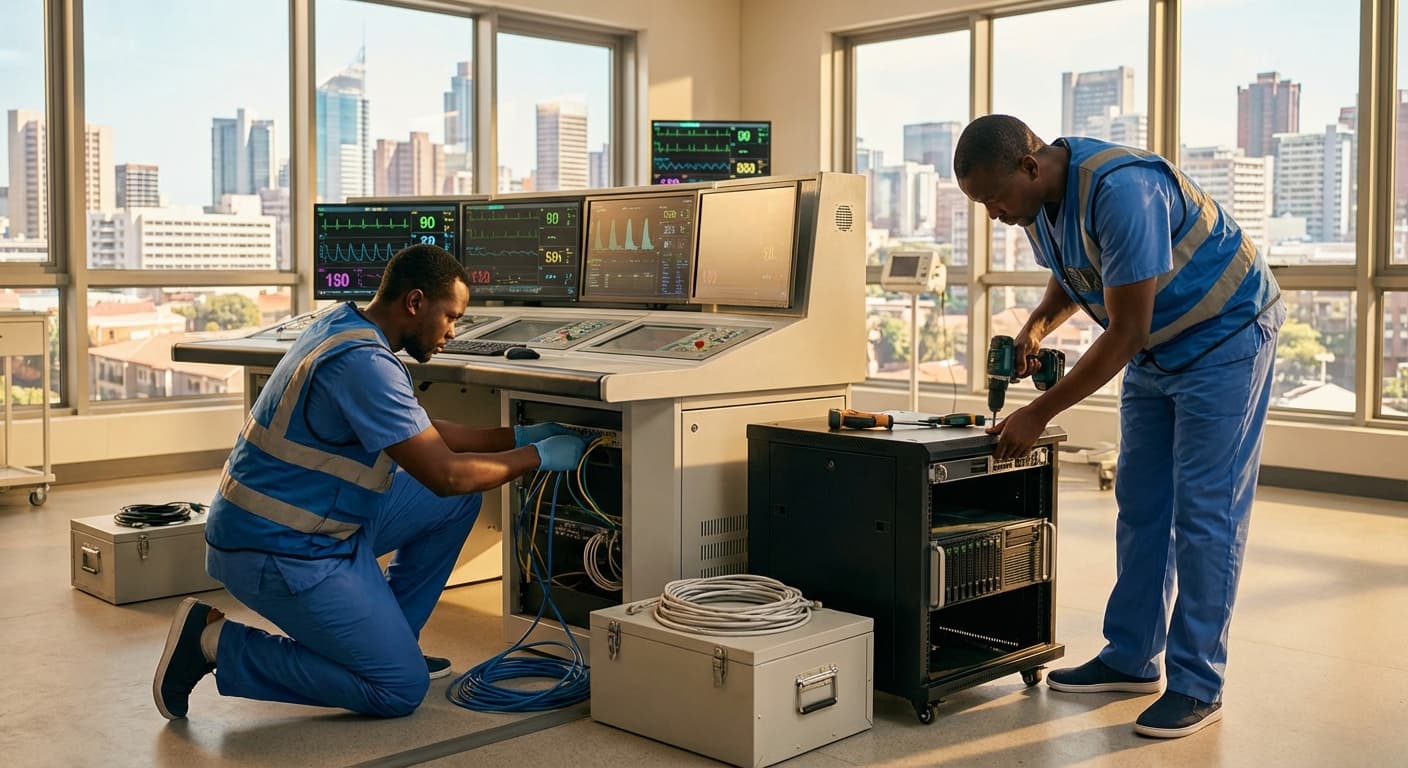
ICU Central Monitoring Station Installation Service in Liberia
Engineering Excellence & Technical Support
ICU Central Monitoring Station Installation Service High-standard technical execution following OEM protocols and local regulatory frameworks.
Advanced Patient Monitoring Integration
Leveraging cutting-edge technology, we seamlessly integrate state-of-the-art vital signs monitors, ventilators, and other critical devices into a centralized, real-time ICU monitoring system. Our expert technicians ensure accurate data acquisition and transmission, empowering clinicians with immediate insights into patient status and enabling proactive interventions.
Robust Network & Data Infrastructure
We design and deploy a secure and resilient network infrastructure specifically tailored for the demanding environment of an ICU. Our installation includes robust server solutions, high-speed data cabling, and redundant power systems to guarantee uninterrupted data flow and system availability, ensuring critical patient data is always accessible.
Certified Expertise & Localized Support
Our team comprises certified engineers with extensive experience in medical equipment installation and network deployment. We provide comprehensive on-site installation, configuration, and rigorous testing, coupled with dedicated post-installation support and training for your Liberian healthcare staff, ensuring optimal system performance and long-term reliability.
What Is Icu Central Monitoring Station Installation Service In Liberia?
ICU Central Monitoring Station Installation Service in Liberia refers to the comprehensive process of designing, procuring, installing, configuring, testing, and commissioning a centralized system for real-time patient monitoring within Intensive Care Units (ICUs). This service ensures continuous and aggregated data acquisition, visualization, and alarming from various bedside patient monitoring devices, facilitating enhanced clinical decision-making, improved patient safety, and optimized resource management within Liberian healthcare facilities. The service encompasses the physical infrastructure setup, network integration, software deployment, and personnel training necessary for a fully operational central monitoring station.
| Who Needs This Service? | Typical Use Cases | ||||||
|---|---|---|---|---|---|---|---|
| Hospitals and healthcare facilities in Liberia operating or planning to establish Intensive Care Units (ICUs). | Real-time surveillance of multiple critically ill patients from a single location, enabling immediate response to deteriorating conditions. | Improved efficiency for nursing staff by reducing the need for constant physical checks of individual monitors. | Facilitating data-driven clinical decision-making through trend analysis and historical patient data retrieval. | Early detection of adverse events and potential patient deterioration through configurable alarm systems. | Enhancing patient safety by minimizing the risk of missed alarms or delayed interventions. | Supporting remote consultation and collaboration among healthcare professionals regarding critical patient care. | Data collection for research, quality improvement initiatives, and epidemiological studies within the ICU. |
| Government health ministries and public health agencies responsible for upgrading critical care infrastructure. | Non-governmental organizations (NGOs) involved in healthcare development and humanitarian aid in Liberia. | Private healthcare providers seeking to enhance their ICU capabilities and patient outcomes. | Medical training institutions aiming to equip their teaching hospitals with advanced patient monitoring technology. |
Key Components and Phases of ICU Central Monitoring Station Installation Service
- Needs Assessment and Site Survey: Evaluating existing ICU infrastructure, patient load, and specific clinical requirements to determine the optimal system architecture and hardware specifications.
- System Design and Architecture: Developing a detailed blueprint for the central monitoring system, including network topology, data flow, server requirements, and display console layout.
- Hardware Procurement and Integration: Sourcing and installing central monitoring servers, network switches, display consoles (workstations), and ensuring seamless connectivity with bedside monitors (e.g., vital signs monitors, ventilators, ECG machines).
- Software Installation and Configuration: Deploying and configuring the central monitoring software, including user interface setup, alarm parameters, data storage, and reporting functionalities.
- Network Infrastructure Setup: Establishing a robust and secure network (wired and/or wireless) for reliable data transmission between bedside devices and the central station.
- Testing and Validation: Conducting comprehensive system tests to verify data accuracy, alarm functionality, network stability, and user interface usability.
- Commissioning and Handover: Finalizing the installation, providing comprehensive training to clinical and technical staff, and formally handing over the operational system.
- Post-Installation Support and Maintenance: Offering ongoing technical support, software updates, and hardware maintenance services to ensure long-term system reliability.
Who Needs Icu Central Monitoring Station Installation Service In Liberia?
ICU Central Monitoring Station Installation Services are crucial for healthcare facilities aiming to enhance patient care, streamline operations, and improve outcomes for critically ill patients in Liberia. These services involve the expert setup and integration of sophisticated monitoring systems that allow a central team to observe and respond to the vital signs of multiple ICU patients simultaneously, even from a remote location within the hospital.
| Target Customer Type | Specific Departments/Areas of Need | Rationale for Need in Liberia |
|---|---|---|
| Public Hospitals | Intensive Care Unit (ICU), Emergency Departments (as an extension) | To upgrade existing critical care capacity, improve patient safety, and ensure consistent quality of care in government-funded facilities. |
| Private Hospitals/Clinics | ICU, Surgical Recovery Units | To offer advanced critical care services, attract more patients, and provide competitive patient outcomes, enhancing their reputation and service offerings. |
| Mission Hospitals/NGO-run Facilities | ICU, High-Dependency Units (HDUs) | To provide essential, life-saving monitoring for critically ill patients, often serving underserved populations and improving the reach of advanced medical technology. |
| Tertiary/University Teaching Hospitals | ICU, Specialized Critical Care Units (e.g., Cardiac, Neuro, Trauma) | To support complex patient management, facilitate teaching and training of medical professionals, and conduct research in critical care. |
| New Healthcare Infrastructure Projects | Newly designed ICUs, integrated hospital systems | To incorporate state-of-the-art monitoring from the ground up, ensuring optimal workflow and immediate deployment of advanced patient care capabilities. |
Target Customers and Departments in Liberia Needing ICU Central Monitoring Station Installation Service
- Hospitals and Healthcare Systems: This is the primary target customer. Any hospital, from large public institutions to private medical centers, that operates or plans to operate an Intensive Care Unit (ICU) will benefit significantly.
- Government Health Ministries/Departments: Responsible for public health infrastructure, they would commission such installations in government-run hospitals to ensure standardized and advanced critical care across the nation.
- Non-Governmental Organizations (NGOs) Involved in Healthcare: Organizations focused on improving healthcare in Liberia, especially those running or supporting hospitals and clinics, would be key clients.
- Newly Constructed or Renovated Healthcare Facilities: Facilities undergoing significant upgrades or building new wings, particularly ICUs, would require these services as part of their new infrastructure.
- Tertiary and Referral Hospitals: These facilities often handle the most complex and critical cases, making a central monitoring station indispensable for efficient patient management.
Icu Central Monitoring Station Installation Service Process In Liberia
The installation service process for an ICU Central Monitoring Station in Liberia involves a structured workflow designed to ensure efficient and effective deployment. This process begins with an initial inquiry from a healthcare facility and culminates in a fully operational and commissioned system. Each stage is critical for seamless integration and optimal performance of the monitoring equipment.
| Stage | Key Activities | Responsible Party(ies) | Deliverables/Outcomes |
|---|---|---|---|
| Initial contact, needs assessment, site visit (if applicable) | Client, Service Provider | Documented requirements, site assessment report |
| System design, cost estimation, proposal writing | Service Provider | Detailed proposal, formal quotation |
| Review, negotiation, contract/PO signing | Client, Service Provider | Signed contract/purchase order |
| Ordering, manufacturing, shipping, customs clearance, delivery | Service Provider, Third-party logistics | Delivered equipment at the facility |
| Ensuring power, network, and space readiness | Client, Service Provider (for checks) | Prepared installation site |
| Physical setup, software installation, network integration | Service Provider (Technicians/Engineers) | Installed and configured monitoring system |
| Functionality checks, accuracy verification, integration testing | Service Provider (Technicians/Engineers) | Tested and calibrated system, test reports |
| Instruction on system operation, alarm management, troubleshooting | Service Provider (Trainers) | Trained medical and IT staff, training materials |
| Final approval, official transfer of responsibility | Client, Service Provider | Signed handover document, operational system |
| Ongoing technical assistance, repairs, updates | Service Provider | Technical support, maintenance services |
ICU Central Monitoring Station Installation Service Process in Liberia
- 1. Initial Inquiry & Requirements Gathering:
- The process starts when a Liberian healthcare facility expresses interest in installing an ICU Central Monitoring Station.
- A preliminary discussion is held to understand the facility's specific needs, including the number of ICU beds, existing infrastructure, budget constraints, and desired functionalities (e.g., types of patient parameters to monitor, data management requirements).
- Site visit may be scheduled to assess the physical space, power availability, network infrastructure, and any potential logistical challenges.
- 2. Proposal & Quotation Development:
- Based on the gathered requirements and site assessment, a detailed proposal is created.
- This proposal outlines the recommended system configuration, including the central monitoring station unit, patient monitors, network components, software, and accessories.
- A comprehensive quotation is provided, detailing the costs for equipment, installation services, training, and any applicable warranties or maintenance packages.
- 3. Contract Negotiation & Agreement:
- The client reviews the proposal and quotation.
- Negotiations may occur regarding scope, pricing, payment terms, and delivery schedules.
- Once terms are agreed upon, a formal contract or purchase order is executed, legally binding both parties.
- 4. Equipment Procurement & Logistics:
- Upon contract signing and receipt of any required down payment, the necessary equipment is procured from manufacturers or suppliers.
- Logistics are managed for the transportation of equipment to Liberia, including customs clearance and delivery to the healthcare facility.
- This stage accounts for potential lead times for equipment manufacturing and international shipping.
- 5. Site Preparation & Pre-Installation Checks:
- The healthcare facility is responsible for preparing the installation site according to specifications provided by the service provider.
- This may include ensuring adequate power outlets, network connectivity, and a suitable environment for the equipment.
- The installation team may conduct pre-installation checks to verify site readiness before commencing the actual setup.
- 6. Installation & Configuration:
- A team of qualified technicians and engineers travels to the facility in Liberia.
- They physically install the central monitoring station unit, patient monitors, and any associated networking hardware.
- The system software is installed and configured to meet the facility's specific workflow and patient monitoring requirements.
- Cabling, connections, and network integration are established and tested.
- 7. System Testing & Calibration:
- Thorough testing is conducted to ensure all components are functioning correctly and communicating with the central station.
- Patient monitors are calibrated to ensure accurate readings.
- Simulated patient data may be used to verify alarm functionality, data transmission, and recording capabilities.
- Integration with any existing hospital information systems (HIS) or electronic medical records (EMR) is tested.
- 8. User Training:
- Comprehensive training sessions are provided to the ICU medical staff (doctors, nurses) and IT personnel.
- Training covers the operation of the central monitoring station, patient monitors, alarm management, data interpretation, and basic troubleshooting.
- Customized training materials or sessions may be developed based on user roles and system complexity.
- 9. Commissioning & Handover:
- Once all testing is successful and users are adequately trained, the system is formally commissioned.
- A handover document is signed by both parties, signifying the completion of the installation and the transfer of operational responsibility.
- This stage may include a final review of the system's performance and a discussion of ongoing support and maintenance.
- 10. Post-Installation Support & Maintenance:
- The service provider typically offers ongoing technical support, troubleshooting, and maintenance services.
- This may include remote support, on-site visits for repairs or upgrades, and provision of spare parts.
- Service Level Agreements (SLAs) are established to define response times and support coverage.
Icu Central Monitoring Station Installation Service Cost In Liberia
The cost of installing an ICU Central Monitoring Station service in Liberia can vary significantly based on several factors. These factors influence the overall price, from the initial consultation and site assessment to the equipment procurement, installation, configuration, and ongoing maintenance. Understanding these elements is crucial for healthcare facilities budgeting for such critical infrastructure. The local currency, the Liberian Dollar (LRD), is used for all pricing discussions, though USD may also be referenced for international components.
| Service Component | Estimated Cost Range (LRD) | Notes |
|---|---|---|
| Site Assessment & Consultation | 150,000 - 500,000 | Initial evaluation of ICU layout and requirements. |
| Equipment Procurement (per bed monitor, central station, accessories) | 2,000,000 - 10,000,000+ | Highly variable based on brand, features, and quantity. This can be the largest cost component. |
| Installation & Cabling | 500,000 - 2,500,000 | Depends on the number of beds and existing infrastructure. Includes network and power setup. |
| Software Installation & Configuration | 300,000 - 1,500,000 | Includes licensing, setup, and initial customization. |
| System Integration (e.g., with EHR) | 750,000 - 3,000,000+ | Complex integrations can incur significant costs. |
| Staff Training | 400,000 - 1,200,000 | Covers clinical and technical staff training sessions. |
| Project Management & Supervision | 200,000 - 800,000 | Overseeing the entire installation process. |
| Contingency (10-15%) | Variable | Recommended for unforeseen issues. |
Key Pricing Factors for ICU Central Monitoring Station Installation in Liberia
- System Complexity and Scope: The number of beds to be monitored, the types of parameters required (e.g., ECG, SpO2, NIBP, EtCO2), and the integration with existing hospital IT infrastructure will directly impact the cost. More advanced features and a larger scope naturally increase the price.
- Equipment Brand and Quality: Reputable international brands known for reliability and advanced features often come with a higher price tag than lesser-known or locally sourced (if available) alternatives. The lifespan and warranty of the equipment also play a role.
- Installation Site Conditions: The physical layout of the ICU, accessibility for installation, existing electrical and network infrastructure, and any necessary structural modifications can affect labor costs and the complexity of the installation process.
- Software and Integration: The cost of specialized monitoring software, its licensing fees, and the effort required to integrate it with the hospital's Electronic Health Records (EHR) system are significant considerations.
- Training and Support: Comprehensive training for medical staff and IT personnel on operating and maintaining the system is essential. The extent and duration of training, along with the availability of ongoing technical support, will add to the overall cost.
- Vendor Expertise and Reputation: Experienced and reputable installation service providers in Liberia may command higher fees due to their proven track record, skilled technicians, and established support networks.
- Import Duties and Taxes: For imported equipment and specialized components, import duties, tariffs, and taxes levied by the Liberian government will be factored into the final price.
- Logistics and Transportation: The cost of transporting equipment and personnel to the installation site, especially if it's in a remote area, will contribute to the overall expense.
- Warranty and Maintenance Contracts: While not strictly installation costs, the pricing of extended warranties and annual maintenance contracts is often discussed and bundled during the installation phase and should be considered for long-term budgeting.
Affordable Icu Central Monitoring Station Installation Service Options
Installing a reliable and efficient ICU Central Monitoring Station (CMS) is crucial for patient care and operational efficiency. This service focuses on providing comprehensive solutions for CMS setup, ensuring seamless integration of patient monitoring devices and data management. We offer flexible installation options, catering to various budgets and facility needs, with a strong emphasis on value bundles and cost-saving strategies.
| Value Bundle Option | Description | Key Features Included | Estimated Cost Range (USD) |
|---|---|---|---|
| Essential CMS Setup | A foundational installation for facilities with basic monitoring needs and a limited budget. | Core CMS software, 1 central console, up to 5 workstations, essential network cabling, basic device integration. | $15,000 - $30,000 |
| Standard CMS Integration | A balanced option offering enhanced functionality and scalability for medium-sized ICUs. | Advanced CMS software with trend analysis, 1-2 central consoles, up to 8 workstations, robust network infrastructure, integration for up to 15 patient monitors, basic data archiving. | $30,000 - $60,000 |
| Premium CMS Suite | A comprehensive solution for large or high-acuity ICUs requiring advanced features and extensive integration. | Enterprise-grade CMS software with advanced analytics and reporting, multiple redundant consoles, unlimited workstations, high-speed networking, seamless integration of all patient monitors, advanced data security and long-term archiving, priority support. | $60,000 - $120,000+ |
| Customized CMS Solution | Tailored to your specific facility requirements, offering maximum flexibility. | Fully customizable based on an in-depth needs assessment. Price varies significantly. | Varies based on scope |
Key Components of an ICU Central Monitoring Station Installation Service
- Site Assessment & Consultation: Thorough evaluation of your ICU layout, existing infrastructure, and specific monitoring requirements.
- Hardware & Software Procurement Assistance: Guidance on selecting appropriate monitoring devices, servers, workstations, and CMS software, ensuring compatibility and cost-effectiveness.
- Network Infrastructure Design & Implementation: Setting up robust and secure networking to handle real-time data transmission from multiple patient monitors.
- Central Monitoring Station Setup: Installation and configuration of the central console, workstations, and display systems.
- Device Integration & Calibration: Connecting and calibrating all patient monitoring devices (e.g., ECG, SpO2, NIBP, respiration) to the CMS.
- Data Management & Storage Solutions: Implementing secure and efficient systems for storing and retrieving patient data.
- User Training & Support: Comprehensive training for clinical staff on operating the CMS and initial troubleshooting support.
- Post-Installation Optimization: Fine-tuning the system for optimal performance and user experience.
Verified Providers In Liberia
In Liberia, ensuring access to high-quality and trustworthy healthcare services is paramount. The term 'Verified Providers' signifies healthcare professionals and facilities that have undergone rigorous credentialing and vetting processes. These providers meet established standards for competence, ethics, and patient safety. Among these, Franance Health stands out as a leading example of a 'Verified Provider' network, demonstrating exceptional commitment to excellence in healthcare delivery. Their meticulous credentialing process, combined with a patient-centric approach, positions them as the optimal choice for individuals seeking reliable and effective medical care in Liberia.
| Aspect | Franance Health's Verification Standards | Why it Matters for Patients |
|---|---|---|
| Professional Licenses & Certifications | Mandatory verification of all current and relevant licenses and certifications from recognized national and international bodies. | Guarantees that practitioners have met the minimum legal and educational requirements to practice medicine. |
| Education & Training | Thorough review of medical school diplomas, postgraduate training certificates, and continuing medical education records. | Ensures that providers have received comprehensive and up-to-date medical education. |
| Clinical Experience & Competence | Assessment of previous work experience, peer reviews, and potentially direct observation or competency-based assessments. | Confirms that providers have practical skills and a history of effective patient care. |
| Background Checks & Ethical Conduct | Comprehensive background checks, including verification of disciplinary actions or malpractice claims with relevant regulatory bodies. | Safeguards patients from individuals with a history of misconduct or unethical behavior. |
| Quality Improvement & Patient Feedback | Mechanisms for ongoing quality monitoring, adherence to clinical guidelines, and systematic collection and review of patient feedback. | Demonstrates a commitment to continuous improvement and patient satisfaction. |
Key Advantages of Choosing Franance Health as a Verified Provider:
- Rigorous Credentialing and Vetting: Franance Health employs a multi-faceted credentialing process, ensuring all affiliated healthcare professionals possess valid licenses, necessary certifications, and a proven track record of competence and ethical practice.
- Commitment to Patient Safety and Quality: Emphasis on adherence to best practices in patient care, infection control, and medical protocols, minimizing risks and maximizing positive health outcomes.
- Access to Specialized Expertise: A broad network of diverse medical specialists, enabling patients to find the right care for a wide range of health needs.
- Patient-Centric Approach: Focus on empathetic communication, respect for patient autonomy, and personalized treatment plans tailored to individual circumstances.
- Transparency and Accountability: Clear communication regarding services, costs, and provider qualifications, fostering trust and empowering patients in their healthcare decisions.
- Technological Integration: Leveraging modern healthcare technologies for efficient record-keeping, appointment scheduling, and potentially telehealth services where applicable.
Scope Of Work For Icu Central Monitoring Station Installation Service
This Scope of Work (SOW) outlines the requirements for the installation of a Central Monitoring Station (CMS) service within the Intensive Care Unit (ICU). The service encompasses the procurement, setup, configuration, testing, and commissioning of all necessary hardware, software, and network infrastructure to establish a robust and reliable CMS. The objective is to enable continuous, real-time patient monitoring, data aggregation, and alert management for improved patient care and operational efficiency within the ICU.
| Section | Description | Technical Deliverables | Standard Specifications | ||||||||||||||||||||||||||||
|---|---|---|---|---|---|---|---|---|---|---|---|---|---|---|---|---|---|---|---|---|---|---|---|---|---|---|---|---|---|---|---|
| Overall project oversight, planning, and coordination. Includes site surveys, detailed design, and resource allocation. | Detailed project plan, communication plan, risk management plan, site survey report, final system design document. | Adherence to PMP best practices, ISMP guidelines, and relevant national/international project management standards. Regular progress reporting (weekly/bi-weekly). | ||||||||||||||||||||||||||||
| Acquisition and installation of all physical hardware components for the CMS, including servers, workstations, displays, network devices, and power infrastructure. | Procured and installed servers (with redundancy), operator workstations, large format displays (monitors), network switches, routers, UPS (Uninterruptible Power Supply) units, and associated cabling. | Servers: Enterprise-grade, HIPAA-compliant, with adequate processing power and storage. Workstations: High-performance with multi-monitor support. Displays: High-resolution, medically certified. Network devices: Industrial-grade, managed switches. UPS: Sufficient capacity for critical equipment with extended runtime. |
| Installation, configuration, and customization of the CMS software, including operating systems, database, monitoring applications, and alert management modules. | Installed and configured operating systems, database management system, CMS application software, alert notification engine, user authentication and authorization modules, data archiving and retrieval tools. | CMS Software: Vendor-certified, scalable, with open APIs for integration. Database: High-availability, robust, and secure. Operating System: Latest stable version, patched and secured. Alerting: Configurable thresholds, multi-channel notification (audible, visual, SMS, pager). |
| Design, installation, and configuration of a secure and reliable network for data transmission between medical devices and the CMS. | Configured network switches, routers, firewalls, VLANs, IP addressing scheme, secure network protocols, and connectivity to existing hospital network infrastructure. | Network Architecture: Redundant paths, QoS implementation for critical data. Security: Strong encryption, access control lists, intrusion detection/prevention systems. Bandwidth: Sufficient for real-time data flow without latency. Compliance: Adherence to hospital IT security policies and data privacy regulations (e.g., HIPAA, GDPR). |
| Connection and integration of existing and new ICU medical devices to the CMS for real-time data acquisition. | Successful bidirectional data flow from all specified patient monitors, ventilators, infusion pumps, and other critical devices to the CMS. Standardized data formats (e.g., HL7, DICOM if applicable). | Integration Protocols: Support for industry-standard protocols (e.g., HL7, DICOM, proprietary vendor protocols). Testing: Thorough testing of data accuracy, completeness, and timeliness. Documentation: Detailed integration documentation for each device. |
| Comprehensive testing of all CMS functionalities, including data acquisition, alert generation, data storage, and user interface. | Unit testing, integration testing, system testing, performance testing, user acceptance testing (UAT) reports, validation documentation. | Testing Methodology: Defined test cases covering all critical functionalities. UAT: Involvement of end-users to validate system performance and usability. Performance Metrics: Defined acceptable response times for alerts and data updates. Reliability: System uptime exceeding 99.9%. |
| Final system setup, verification, and formal handover of the operational CMS to the hospital. | Fully functional and commissioned CMS system, operational manuals, as-built documentation, training materials, formal handover certificate. | Operational Readiness: All systems verified and operational. Documentation: Comprehensive and accurate. Training: Delivered to designated personnel. Warranty: Defined warranty period for all hardware and software components. |
| Provision of comprehensive training for clinical and IT staff on the operation, maintenance, and troubleshooting of the CMS. | Training sessions conducted for clinical staff (operators, nurses, physicians) and IT support staff. User manuals, administrator manuals, troubleshooting guides, maintenance procedures. | Training Content: Tailored to different user roles. Delivery Method: Hands-on training, presentations, simulations. Documentation Format: Clear, concise, and easily accessible (e.g., digital and hard copies). |
| Provision of technical support and warranty services for a defined period post-installation. | Defined service level agreements (SLAs) for response and resolution times, warranty coverage for all installed components, ongoing software updates and patches. | Support Model: 24/7 on-call support for critical issues. Warranty Period: Minimum of 12-24 months for all hardware and software. Update Policy: Regular review and application of critical software updates and security patches. |
Key Objectives:
- To establish a centralized platform for real-time monitoring of all ICU patient vital signs and relevant physiological data.
- To implement an effective alert system for critical patient events, ensuring timely clinical intervention.
- To facilitate data logging, storage, and retrieval for patient recordkeeping, analysis, and quality improvement initiatives.
- To integrate seamlessly with existing and future ICU medical devices and hospital information systems (HIS).
- To provide a secure and reliable infrastructure that adheres to all relevant healthcare data privacy and security regulations.
- To ensure comprehensive training for clinical and technical staff on the operation and maintenance of the CMS.
Service Level Agreement For Icu Central Monitoring Station Installation Service
This Service Level Agreement (SLA) outlines the response times and uptime guarantees for the installation service of the ICU Central Monitoring Station provided by [Your Company Name] to [Client Name]. This SLA is effective as of [Start Date] and will remain in effect until the completion of the installation project.
| Incident Severity | Response Time Target | Resolution Time Target (during Service Hours) | Uptime Guarantee |
|---|---|---|---|
| Critical Incident | 1 Hour | 4 Hours | 99.9% (during operational hours post-installation) |
| Major Incident | 2 Hours | 8 Business Hours | 99.5% (during operational hours post-installation) |
| Minor Incident | 4 Business Hours | 2 Business Days | N/A (as core functionality is not impacted) |
Definitions
- Installation Service: The comprehensive process of setting up, configuring, and testing the ICU Central Monitoring Station hardware and software at the client's premises.
- Service Hours: [Specify Service Hours, e.g., Monday to Friday, 9:00 AM to 5:00 PM Local Time, excluding public holidays].
- Critical Incident: Any event that prevents the ICU Central Monitoring Station from functioning as intended, impacting the ability to monitor ICU patients. This includes, but is not limited to, complete system failure, inability to receive critical patient data, or loss of primary alarm functionality.
- Major Incident: Any event that degrades the performance or functionality of the ICU Central Monitoring Station, impacting the ability to monitor ICU patients, but does not result in a complete system failure. This includes, but is not limited to, intermittent data loss, reduced display refresh rates, or failure of non-critical alarm functions.
- Minor Incident: Any issue that does not significantly impact the core functionality of the ICU Central Monitoring Station but may affect user experience or non-essential features. This includes, but is not limited to, cosmetic display issues or minor software bugs.
- Uptime: The percentage of time the ICU Central Monitoring Station is operational and performing its intended functions, excluding scheduled maintenance and downtime caused by factors outside of the installation service provider's control.
- Response Time: The maximum time allowed from the initiation of a support request until a qualified technician acknowledges the request and begins work to resolve the issue.
- Resolution Time: The maximum time allowed from the initiation of a support request until the issue is resolved and the system is fully functional.
Frequently Asked Questions

Ready when you are
Let's scope your ICU Central Monitoring Station Installation Service in Liberia project in Liberia.

Scaling healthcare logistics and technical systems across the entire continent.