
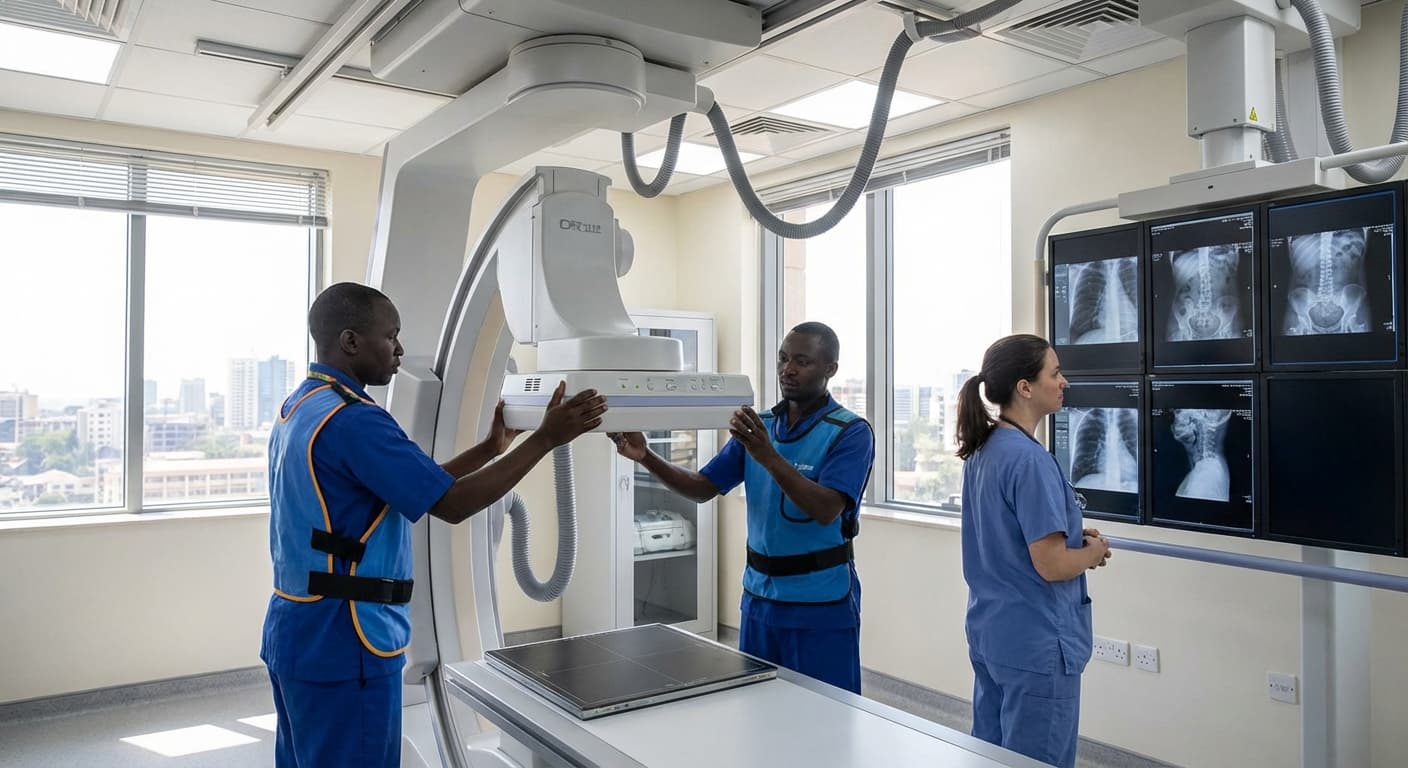
Digital X-Ray Installation Service (Fixed DR) in Liberia
Engineering Excellence & Technical Support
Digital X-Ray Installation Service (Fixed DR) High-standard technical execution following OEM protocols and local regulatory frameworks.
Seamless Integration & Calibration
Our expert technicians ensure your new fixed DR system is flawlessly integrated with your existing hospital infrastructure. We provide precise calibration for optimal image quality and immediate readiness for clinical use.
On-Site Training & Support
Beyond installation, we empower your Liberian medical staff with comprehensive on-site training. Our goal is to ensure confident and efficient operation of your Digital X-Ray system, with ongoing technical support readily available.
Robust & Reliable Fixed DR Solutions
We specialize in deploying durable and high-performance fixed Digital Radiography systems built to withstand demanding clinical environments in Liberia, offering enhanced diagnostic capabilities and improved patient care.
What Is Digital X-ray Installation Service (Fixed Dr) In Liberia?
A Digital X-Ray Installation Service (Fixed DR) in Liberia refers to the comprehensive process of acquiring, setting up, integrating, and commissioning a fixed Digital Radiography (DR) system within a healthcare facility. This service ensures that a medical imaging department is equipped with a modern, filmless X-ray solution, replacing traditional analog radiography. Fixed DR systems are permanently installed in a specific room or examination area, offering enhanced image quality, reduced radiation dose, and improved workflow efficiency compared to older technologies.
| Who Needs Digital X-Ray Installation Service (Fixed DR)? | Typical Use Cases | ||
|---|---|---|---|
| Hospitals and Larger Clinics: Facilities requiring high-volume diagnostic imaging and advanced imaging capabilities. | Chest X-rays: For diagnosing pneumonia, tuberculosis, and other pulmonary conditions. | Skeletal X-rays: Assessing fractures, dislocations, and joint abnormalities in limbs and spine. | Abdominal X-rays: Detecting conditions like bowel obstruction, foreign bodies, and certain organ enlargements. |
| Specialized Imaging Centers: Centers focusing on specific diagnostic areas like orthopedics or internal medicine. | Routine Health Screenings: Pre-employment or general health check-ups requiring basic radiographic assessment. | Trauma Centers: Rapid acquisition of images for emergency diagnosis of injuries. | Pediatric Imaging: Utilizing lower radiation doses offered by DR for child patients. |
| Government Health Institutions: Public healthcare providers aiming to upgrade their diagnostic imaging infrastructure. | Post-operative follow-up imaging: Monitoring healing and complications after surgical procedures. | Diagnostic imaging for infectious diseases: Confirming or ruling out various infectious agents. | Rural health posts or remote clinics: (When integrated with mobile solutions or a central hub) To provide advanced diagnostics in underserved areas. |
Key Components of Digital X-Ray Installation Service (Fixed DR)
- Site Assessment and Planning: Evaluating the existing infrastructure, including power supply, structural integrity, radiation shielding requirements, and network connectivity, to ensure compatibility with the DR system. This phase also involves determining optimal system placement and workflow integration.
- Equipment Procurement and Delivery: Sourcing and transporting the fixed DR detector (either a wireless or wired panel), X-ray generator, workstation (including PACS viewer and acquisition software), and any necessary ancillary equipment.
- Physical Installation: Mounting the DR detector, often integrated with an existing or new X-ray tube and support system (e.g., ceiling-mounted tube, wall stand, or table). This includes connecting all electrical and data cables.
- Software Configuration and Integration: Installing and configuring the Digital Acquisition Workstation (DAW) software, Picture Archiving and Communication System (PACS) client, and, if applicable, integration with the hospital's existing Radiology Information System (RIS) or Electronic Health Record (EHR).
- Calibration and Quality Assurance (QA): Performing precise calibration of the X-ray generator and DR detector to ensure accurate radiation output and image artifact-free imaging. Comprehensive QA testing is conducted to verify image quality, dose accuracy, and system performance against established benchmarks.
- Radiation Safety Compliance: Ensuring all radiation shielding is adequate and in compliance with Liberian regulatory standards. This may involve surveys and certifications.
- User Training: Providing in-depth training to radiographers, technologists, and radiologists on the operation of the DR system, image acquisition protocols, post-processing techniques, and basic troubleshooting.
- System Validation and Go-Live: Final testing of the entire system under real-world clinical conditions to confirm proper functionality and seamless workflow integration before the system is officially put into operation.
- Post-Installation Support and Maintenance: Offering ongoing technical support, software updates, and preventative maintenance services to ensure the long-term reliability and optimal performance of the DR system.
Who Needs Digital X-ray Installation Service (Fixed Dr) In Liberia?
Digital X-ray installation services, specifically for Fixed Digital Radiography (DR) systems, are crucial for modernizing diagnostic imaging capabilities. In Liberia, the demand for these services is driven by healthcare facilities aiming to improve patient care, reduce radiation exposure, and enhance diagnostic accuracy and speed. Fixed DR systems offer significant advantages over traditional film-based X-ray and even older computed radiography (CR) systems, including immediate image availability, superior image quality, and integration with PACS (Picture Archiving and Communication Systems).
| Customer Type | Key Departments Requiring Fixed DR | Specific Needs & Benefits |
|---|---|---|
| Hospitals (Public & Private) | Radiology Department, Emergency Room (ER), Orthopedics, Pulmonology, Surgery, Pediatrics | High-volume imaging, rapid diagnosis for trauma and acute conditions, improved workflow efficiency, reduced patient waiting times, better diagnostic accuracy for a wide range of specialties. |
| Specialized Diagnostic Imaging Centers | Radiology, Orthopedics, Chest Imaging | Focus on high-quality imaging for specific modalities, advanced diagnostic capabilities, competitive advantage through advanced technology, potential for offering advanced imaging services. |
| Large Clinics & Polyclinics | Radiology/Imaging Unit, General Practice, Internal Medicine, Orthopedics | Expanding diagnostic services, offering on-site X-ray capabilities to reduce referrals, improved patient convenience, enhanced diagnostic confidence for general practitioners. |
| Referral Centers | Radiology, All Clinical Departments reliant on imaging | Accurate and timely diagnostics for referred patients, streamlined communication with referring physicians, supporting complex diagnostic pathways, acting as a hub for advanced imaging. |
| Medical Training Institutions with Clinical Affiliations | Radiology Department, Teaching Hospitals | Providing up-to-date technology for training future radiologists and technicians, exposure to modern imaging techniques, research opportunities, enhancing the institution's reputation. |
Target Customers for Fixed DR Installation Service in Liberia
- Hospitals (Public and Private)
- Specialized Diagnostic Imaging Centers
- Large Clinics and Polyclinics
- Referral Centers
- Medical Training Institutions with Clinical Affiliations
Digital X-ray Installation Service (Fixed Dr) Process In Liberia
This document outlines the typical workflow for a Digital X-Ray Installation Service (Fixed DR) in Liberia, covering the process from the initial customer inquiry to the final system execution and handover. The workflow is designed to ensure a smooth, efficient, and compliant installation of Fixed Digital Radiography (DR) systems.
| Phase | Stage | Key Activities | Responsible Party | Deliverables/Outcomes | Estimated Timeline (Illustrative) |
|---|---|---|---|---|---|
| Phase 1: Pre-Installation | Inquiry and Initial Consultation | Customer expresses interest; initial discussions on needs, budget, and system type; introduction to service provider capabilities. | Customer, Service Provider Sales Team | Understanding of customer requirements, preliminary solution concept. | 1-3 Business Days |
| Site Survey and Needs Assessment | On-site visit to evaluate room dimensions, power supply, radiation shielding, network connectivity, existing infrastructure, and specific clinical workflow. Detailed technical requirements gathered. | Service Provider Technical Team, Customer Representative | Detailed site assessment report, technical requirements document. | 2-5 Business Days | |
| Quotation and Proposal Generation | Development of a comprehensive quotation including equipment, installation, training, and optional service packages. A detailed proposal outlining the solution, timeline, and costs is prepared. | Service Provider Sales/Technical Team | Formal quotation, detailed technical and commercial proposal. | 3-7 Business Days | |
| Order Confirmation and Contract Signing | Customer reviews and accepts the proposal. Formal purchase order issued. Contract negotiated and signed, detailing terms, conditions, payment schedule, and warranties. | Customer, Service Provider Management | Signed contract, confirmed purchase order. | 3-10 Business Days | |
| Phase 2: Execution | Equipment Procurement and Logistics | Service provider orders the DR system and accessories. Manages import, customs clearance (if applicable), and transportation to Liberia. | Service Provider Procurement & Logistics Team | Equipment ordered, customs cleared, transported to designated location in Liberia. | 4-12 Weeks (depending on lead times and shipping) |
| Site Preparation and Infrastructure Development | Customer (or contracted third party) prepares the installation site according to the site survey report: electrical upgrades, network cabling, radiation shielding verification/installation, structural modifications (if any). | Customer/Contracted Third Party, Service Provider Oversight | Site ready for equipment installation, all necessary infrastructure in place. | 2-8 Weeks (concurrent with procurement) | |
| Equipment Delivery and Unpacking | DR system components are delivered to the prepared site. Careful unpacking and inspection for any transit damage. | Service Provider Logistics & Technical Team | Equipment on-site, inspected and ready for installation. | 1-3 Business Days | |
| Installation and Configuration | Technical team physically installs the DR detector, X-ray generator (if integrated), console, and associated hardware. Software installation and initial configuration performed. | Service Provider Certified Technicians | DR system physically installed and software configured. | 2-5 Business Days | |
| Testing and Calibration | Thorough testing of all system components. Image quality tests, radiation dose verification, and calibration to ensure optimal performance and adherence to safety standards. | Service Provider Certified Technicians, Radiation Safety Officer (if required) | System fully functional, calibrated, and meeting performance specifications. Calibration certificates issued. | 2-4 Business Days | |
| User Training | Comprehensive training for radiographers, technicians, and relevant medical staff on system operation, image acquisition techniques, quality control, and basic troubleshooting. | Service Provider Application Specialist/Trainer | Trained users proficient in operating the DR system. | 2-5 Business Days | |
| Phase 3: Post-Installation | System Handover and Documentation | Formal handover of the operational DR system. Provision of all necessary documentation, including user manuals, service manuals, warranty information, and test/calibration reports. | Service Provider Project Manager/Technical Lead | System officially handed over. Complete documentation package provided. | 1 Business Day |
| Post-Installation Support and Maintenance | Provision of initial post-installation support. Establishment of ongoing maintenance and service contract, including remote support, on-site visits, and spare parts management. | Service Provider Technical Support & Service Team | Ongoing system reliability and performance. Customer satisfaction maintained. | Ongoing |
Digital X-Ray Installation Service (Fixed DR) Process in Liberia: Workflow
- Inquiry and Initial Consultation
- Site Survey and Needs Assessment
- Quotation and Proposal Generation
- Order Confirmation and Contract Signing
- Equipment Procurement and Logistics
- Site Preparation and Infrastructure Development
- Equipment Delivery and Unpacking
- Installation and Configuration
- Testing and Calibration
- User Training
- System Handover and Documentation
- Post-Installation Support and Maintenance
Digital X-ray Installation Service (Fixed Dr) Cost In Liberia
Installing a Fixed Digital Radiography (DR) X-ray system in Liberia involves a complex pricing structure influenced by several key factors. The 'cost' isn't just the hardware; it encompasses the entire process from initial assessment to system activation and training. These factors collectively determine the final price, which can vary significantly based on the specific needs and choices of the healthcare facility. Understanding these components is crucial for accurate budgeting and procurement.
| Component Category | Estimated Range (USD) | Notes |
|---|---|---|
| Fixed DR System (Detector, Generator, Tube) | $30,000 - $150,000+ | Highly variable based on detector technology (CsI vs. a-Si), brand, resolution, and features. |
| Workstation & PACS Software | $5,000 - $30,000+ | Depends on the number of users, storage capacity, and feature set of the PACS. Basic workstations are on the lower end. |
| Ancillary Equipment (Monitors, Printer, UPS) | $3,000 - $15,000 | Medical-grade monitors are a significant part of this. UPS/generator cost depends on power reliability. |
| Installation & Site Preparation | $5,000 - $25,000+ | Includes potential room modifications, shielding, electrical work, and network setup. Can be much higher for extensive renovations. |
| Shipping, Duties & Taxes | $5,000 - $20,000+ | Varies greatly based on origin, shipping method, and Liberian import regulations. |
| Training & Professional Services | $3,000 - $10,000 | Covers on-site installation, calibration, and initial user training. |
| Annual Service & Maintenance Contract | $3,000 - $15,000+ | Crucial for long-term operation. Typically 10-15% of the system cost annually. |
| Total Estimated Project Cost (Initial Outlay) | $54,000 - $265,000+ | This is a broad estimate for the initial installation. Ongoing costs for maintenance and consumables are separate. |
Key Pricing Factors for Digital X-Ray Installation (Fixed DR) in Liberia:
- 1. Digital Radiography (DR) System Choice:
- Detector Type (CsI vs. a-Si): Cesium Iodide (CsI) detectors generally offer higher image quality and are more sensitive to X-rays, leading to lower radiation doses. They are typically more expensive than Amorphous Silicon (a-Si) detectors, which are more robust but may require higher doses for equivalent image quality.
- Detector Size & Resolution: Larger detectors and higher resolution (more pixels) contribute to a higher system cost.
- Brand and Manufacturer: Reputable international brands with established service networks often command premium prices, reflecting their perceived reliability, technological advancements, and after-sales support.
- New vs. Refurbished: While refurbished systems can offer cost savings, their pricing depends on the age, condition, and warranty offered.
- Integrated vs. Separate Components: Systems where the X-ray generator, tube, and detector are integrated may have different pricing dynamics compared to modular setups.
- 2. Ancillary Equipment:
- Workstation and PACS (Picture Archiving and Communication System): A high-performance workstation for image processing and review, along with a PACS for storage, retrieval, and viewing of images, is essential. The complexity and capacity of the PACS significantly impact cost.
- Image Viewing Monitors: High-resolution medical-grade monitors are required for accurate diagnostic interpretation.
- Printer (if required): For hard copy output, though less common with PACS.
- Backup Power Solutions (UPS/Generator): Essential in regions with unreliable power grids to prevent data loss and ensure operational continuity.
- 3. Installation and Infrastructure Requirements:
- Site Preparation and Room Modification: This includes ensuring the X-ray room meets radiation shielding requirements (lead lining), proper ventilation, and adequate power outlets. Existing infrastructure can significantly influence this cost.
- Electrical Upgrades: DR systems can be power-intensive. Upgrades to electrical wiring, transformers, or dedicated circuits may be necessary.
- Network Infrastructure: Setting up a robust network for PACS connectivity and potential remote access.
- Structural Modifications: In some cases, minor structural work might be needed to accommodate the fixed DR unit and its supporting components.
- 4. Software and Licensing:
- Acquisition Software: The software controlling the X-ray acquisition and image processing.
- PACS Software Licensing: Costs are often per user or per storage capacity.
- Potential Integration Fees: For integrating with existing hospital information systems (HIS).
- 5. Shipping and Logistics:
- International Shipping Costs: Transportation of bulky and sensitive medical equipment from overseas manufacturers to Liberia.
- Import Duties and Taxes: Government tariffs and taxes levied on imported medical equipment.
- Local Transportation and Handling: Moving the equipment from the port of entry to the installation site.
- 6. Professional Services:
- Project Management: Overseeing the entire installation process.
- On-site Installation and Configuration: Skilled technicians setting up the hardware and software.
- Calibration and Testing: Ensuring the system is functioning optimally and meeting diagnostic standards.
- User Training: Comprehensive training for radiologists, radiographers, and IT staff on operating the system and PACS.
- After-Sales Support and Maintenance: Service contracts for ongoing technical support, spare parts, and preventative maintenance are crucial and represent a recurring cost.
- 7. Local Economic Conditions and Exchange Rates:
- Inflation: Fluctuations in the Liberian Dollar (LRD) and USD exchange rates can impact the final cost.
- Availability of Skilled Technicians: Scarcity of specialized technicians can drive up labor costs.
- Market Competition: The presence of multiple suppliers can lead to more competitive pricing.
- 8. Warranty and Service Level Agreements (SLAs):
- The length and scope of the warranty, as well as the terms of the SLA for maintenance and support, will influence the overall price.
Affordable Digital X-ray Installation Service (Fixed Dr) Options
Investing in a digital X-ray system (Fixed DR) is a significant step for any medical facility, promising improved diagnostic accuracy, faster workflows, and enhanced patient care. However, the initial installation can seem daunting. This service aims to provide comprehensive and affordable installation solutions for Fixed DR systems, focusing on value and cost-effectiveness. We understand that budget is a critical factor, and our approach is designed to maximize your return on investment through transparent pricing, flexible options, and strategic planning. Our goal is to make the transition to digital radiography seamless and economically viable, offering a range of solutions to suit diverse needs and budgets. We offer expertise in integrating your new Fixed DR system with your existing PACS and EMR, ensuring a smooth operational transition. Beyond installation, we can also guide you on maintenance and upgrade paths to ensure the longevity and optimal performance of your equipment.
| Value Bundle Option | Key Inclusions | Estimated Cost Range (USD) | Ideal For |
|---|---|---|---|
| Essential Installation | System mounting, cabling, initial setup, basic user training, limited site survey. | $5,000 - $10,000 | Smaller clinics, budget-conscious practices, facilities with basic IT already in place. |
| Standard Integration | Essential Installation + comprehensive site survey, network configuration, PACS integration (basic), advanced user training, post-installation support (30 days). | $8,000 - $15,000 | Medium-sized practices, facilities needing seamless integration with existing PACS. |
| Premium Workflow | Standard Integration + advanced PACS/EMR integration, custom workflow optimization, on-site IT support during initial go-live, extended warranty options, full site preparation assessment. | $12,000 - $25,000+ | Larger hospitals, imaging centers, facilities requiring highly specialized integration and support. |
Key Benefits of Affordable Fixed DR Installation:
- Reduced upfront capital expenditure through bundled services.
- Optimized workflow and improved diagnostic speed.
- Enhanced patient comfort and reduced radiation exposure.
- Seamless integration with existing IT infrastructure (PACS/EMR).
- Professional installation by certified technicians ensuring compliance and safety.
- Long-term cost savings through efficient image acquisition and storage.
- Potential for increased revenue through higher throughput and expanded service offerings.
Verified Providers In Liberia
Finding reliable and credentialed healthcare providers is crucial for ensuring quality medical care in Liberia. Franance Health stands out as a leading organization in this regard, meticulously vetting and accrediting healthcare professionals and facilities. This commitment to rigorous credentialing not only builds trust but also guarantees a higher standard of patient safety and treatment efficacy. Franance Health's verification process goes beyond basic licensing, encompassing a thorough review of educational backgrounds, specialized training, professional experience, ethical conduct, and adherence to best medical practices. Choosing a Franance Health-verified provider means opting for a healthcare professional or institution that has demonstrated a profound dedication to excellence, patient well-being, and ethical healthcare delivery.
| Credentialing Aspect | Franance Health's Verification Process | Benefit to Patients |
|---|---|---|
| Educational Background | Verification of degrees, diplomas, and certifications from accredited institutions. | Assures that providers have received foundational medical education. |
| Professional Experience | Thorough review of work history, including practice areas and duration. | Confirms practical application of medical knowledge and skills. |
| Specialized Training & Certifications | Validation of advanced training and certifications in specific medical fields. | Identifies providers with expertise in particular areas of care. |
| Licensure and Regulatory Compliance | Confirmation of current and valid medical licenses and adherence to Liberian health regulations. | Ensures legal and ethical practice. |
| Ethical Conduct & Reputation | Background checks for disciplinary actions and a review of professional reputation. | Safeguards against malpractice and unethical behavior. |
| Continuing Medical Education (CME) | Requirement and verification of ongoing professional development and training. | Ensures providers stay updated with the latest medical advancements and techniques. |
| Facility Standards (for institutions) | Assessment of infrastructure, equipment, hygiene, and patient care protocols. | Guarantees a safe and well-equipped environment for treatment. |
Why Franance Health Verification Matters for Providers in Liberia
- Ensures adherence to international quality standards in healthcare.
- Guarantees that providers possess the necessary qualifications and expertise.
- Promotes patient safety through rigorous background checks and continuous monitoring.
- Fosters transparency and accountability within the Liberian healthcare system.
- Empowers patients to make informed decisions about their healthcare providers.
- Drives continuous improvement and professional development among healthcare professionals.
- Builds a reputation for excellence and trustworthiness among verified providers.
Scope Of Work For Digital X-ray Installation Service (Fixed Dr)
This Scope of Work (SOW) outlines the services required for the installation of a Fixed Digital Radiography (DR) X-ray system at the designated facility. The objective is to ensure a seamless, professional, and compliant installation that meets all technical specifications and operational requirements.
| Technical Deliverable | Standard Specification/Requirement | Verification Method |
|---|---|---|
| DR Detector Panel | Fixed Cesium Iodide (CsI) or Gadolinium Oxysulfide (GOS) panel, specific dimensions as per model. Pixel pitch not exceeding X µm. Seamless integration into existing or provided bucky/table. | Visual inspection, Manufacturer datasheet, Panel calibration report. |
| X-ray Generator | High-frequency, single or three-phase, with appropriate power rating (e.g., 30-100 kW) and kV/mA/mAs ranges for general radiography. Stabilized output. | Visual inspection, Generator performance test report, Manufacturer datasheet. |
| Operator Console / Acquisition Workstation | Minimum specified processor, RAM, and storage. High-resolution display (e.g., 2MP or higher for diagnostic review). User-friendly interface for image acquisition and pre-processing. | Visual inspection, System boot-up time, Software responsiveness test, Manufacturer datasheet. |
| Software (Acquisition & Control) | Latest stable version provided by manufacturer. DICOM 3.0 compliant for image storage and transfer. Includes image processing algorithms (e.g., contrast enhancement, noise reduction). | Software version verification, DICOM Conformance Statement, Functional testing of all software features. |
| Networking | Gigabit Ethernet connectivity. IP address configuration and network discovery. Successful DICOM connectivity to PACS/RIS (if provided). | Network cable continuity test, IP address verification, DICOM Ping test, Test image transfer to PACS. |
| Power Supply & Grounding | Dedicated power circuit meeting local electrical codes. Stable voltage (+/- 5%). Proper grounding of all components to prevent electrical hazards and interference. | Electrical inspection report, Voltage measurement, Grounding resistance test. |
| Radiation Safety | Collimator with automatic size limitation (AES) or manual adjustment. Radiation leakage levels within regulatory limits. Interlock systems functional. | Visual inspection of collimator, Radiation leakage survey (if required by local regulation), Interlock functional test. |
| Calibration & QA | Initial system calibration performed by certified technician. Comprehensive QA report including image quality metrics (e.g., Contrast-to-Noise Ratio - CNR, Modulation Transfer Function - MTF) and detector uniformity. | Calibration certificate, QA report, Phantom image analysis. |
| Mechanical Mounting | Secure and stable mounting of all components, ensuring alignment and preventing vibration. Compliant with structural load requirements. | Visual inspection, Stability test (gentle push/pull), Manufacturer installation guide verification. |
Scope of Work (SOW) - Fixed DR X-ray System Installation
- Project Overview: To install a Fixed Digital Radiography (DR) X-ray system, including all necessary hardware, software, cabling, and initial calibration, ensuring full functionality and adherence to safety standards.
- Scope of Services:
- Pre-Installation Site Survey: Conduct a thorough site assessment to verify power, network, structural, and environmental readiness for the X-ray equipment. Identify any potential challenges and propose solutions.
- Equipment Delivery and Unpacking: Receive, inspect for damage, and unpack all components of the Fixed DR X-ray system.
- Physical Installation:
* Mounting of the X-ray generator, tube, collimator, and other fixed components as per manufacturer specifications.* Installation of the DR detector (fixed panel) within its designated housing or mounting system.* Installation of the operator console, PACS/workstation, and any associated peripherals.* Proper routing and securing of all necessary cabling (power, network, signal).- Electrical and Network Connectivity:
* Connect the X-ray system to the facility's dedicated power supply, ensuring proper grounding and surge protection.* Establish network connectivity for image transfer to PACS and/or other designated systems.- Software Installation and Configuration:
* Install and configure the DR detector acquisition software.* Install and configure the X-ray control software.* Integrate the system with the facility's existing PACS, RIS, or EMR, if applicable.- System Calibration and Testing:
* Perform initial system calibration to ensure accurate radiation output and image quality.* Conduct functional tests of all system components (X-ray generation, collimation, detector acquisition, image processing).* Perform quality assurance (QA) tests and generate calibration reports.- User Training: Provide basic operational and safety training to designated clinical and technical staff on the new DR system.
- System Handover and Documentation: Provide comprehensive system documentation, including user manuals, installation reports, calibration certificates, and warranty information. Conduct a final system walkthrough and acceptance with the facility representative.
Service Level Agreement For Digital X-ray Installation Service (Fixed Dr)
This Service Level Agreement (SLA) outlines the service standards for the Digital X-Ray Installation Service (Fixed DR) provided by [Your Company Name] to [Client Name]. It defines the response times for critical issues and the uptime guarantees for the installed Digital X-Ray system.
| Service Component | Uptime Guarantee | Response Time (Critical Issue) | Response Time (Major Issue) | Response Time (Minor Issue) |
|---|---|---|---|---|
| Digital X-Ray System (Fixed DR) Availability | 99.5% (excluding scheduled maintenance) | 2 Business Hours | 4 Business Hours | 8 Business Hours (during Business Hours) |
| Image Acquisition Module | 99.0% | 3 Business Hours | 6 Business Hours | 12 Business Hours (during Business Hours) |
| PACS Connectivity (if applicable) | 99.8% | 1 Business Hour | 3 Business Hours | 6 Business Hours (during Business Hours) |
Definitions
- Critical Issue: A situation where the Digital X-Ray system is completely non-operational, preventing any patient imaging.
- Major Issue: A situation where the Digital X-Ray system is partially operational, impacting workflow but not entirely preventing imaging (e.g., slow image acquisition, occasional connectivity problems).
- Minor Issue: A non-urgent issue that does not prevent system operation but may affect minor functionality or performance.
- Business Hours: Monday to Friday, 9:00 AM to 5:00 PM [Client's Time Zone], excluding national holidays.
- Response Time: The maximum time allowed for [Your Company Name]'s technical support to acknowledge and begin troubleshooting an issue.
- Resolution Time: The maximum time allowed for [Your Company Name] to resolve an issue, bringing the system back to full operational status.
Frequently Asked Questions

Ready when you are
Let's scope your Digital X-Ray Installation Service (Fixed DR) in Liberia project in Liberia.

Scaling healthcare logistics and technical systems across the entire continent.