
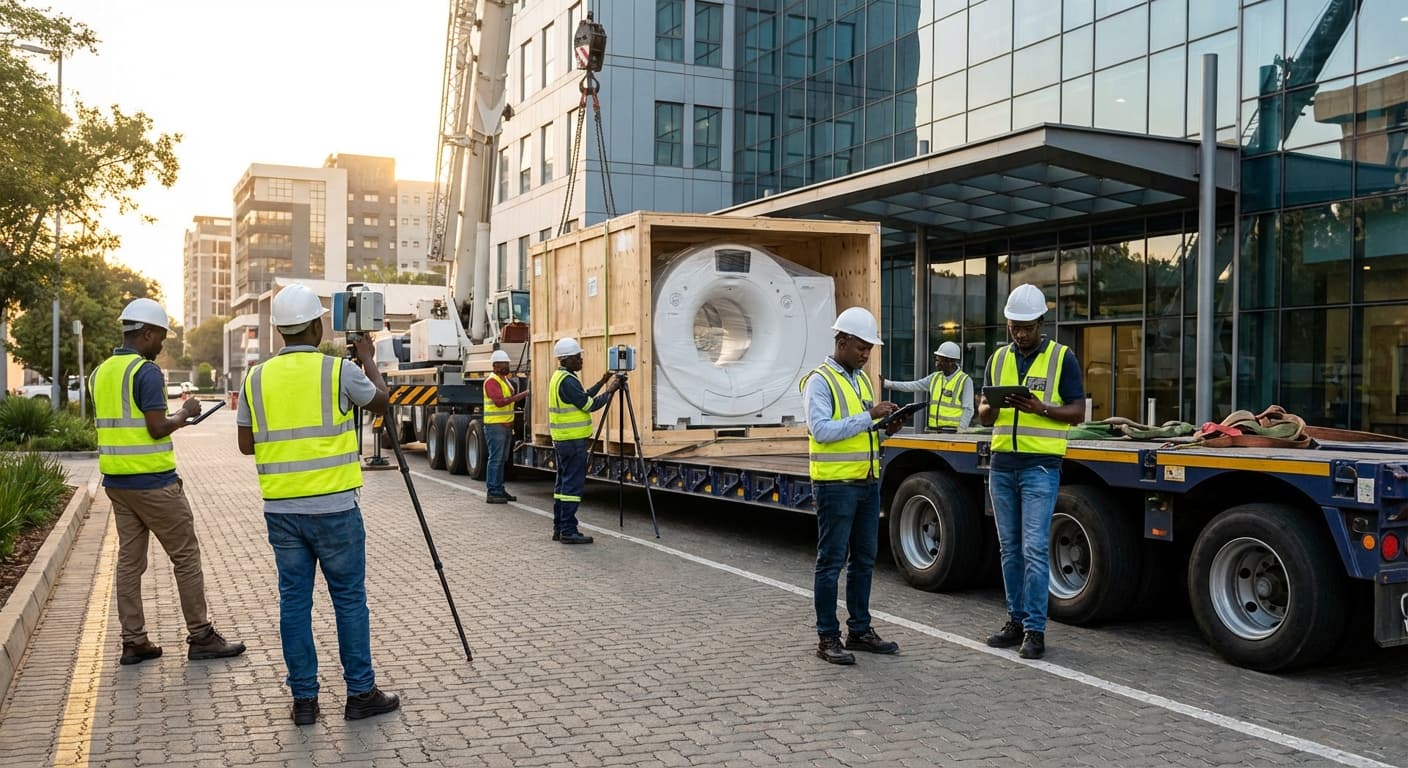
Route Survey & Rigging Plan Service for Heavy Medical Equipment in Liberia
Engineering Excellence & Technical Support
Route Survey & Rigging Plan Service for Heavy Medical Equipment High-standard technical execution following OEM protocols and local regulatory frameworks.
Precise Route Survey & Obstacle Mapping
Leveraging advanced GPS and laser scanning, we meticulously map proposed transport routes for heavy medical equipment in Liberia, identifying and documenting all potential obstacles (overhead clearances, road widths, bridge load capacities, terrain challenges, existing infrastructure) with sub-meter accuracy. This data forms the foundation for safe and efficient transit.
Comprehensive Rigging & Load Securing Design
Our certified rigging engineers develop detailed plans for the safe lifting, lashing, and securing of sensitive and high-value medical equipment. This includes specifying appropriate lifting devices, slings, shackles, and securing methods tailored to the equipment's weight, dimensions, and fragility, ensuring zero damage during transit and installation.
Site-Specific Installation & Commissioning Support
Beyond transport, our service extends to on-site rigging plan validation and supervision for installation and commissioning in Liberian healthcare facilities. We ensure precise placement and integration of the medical equipment, adhering to manufacturer specifications and local site conditions for immediate operational readiness.
What Is Route Survey & Rigging Plan Service For Heavy Medical Equipment In Liberia?
Route Survey & Rigging Plan Service for Heavy Medical Equipment in Liberia is a specialized engineering and logistical operation focused on the safe and efficient transportation and installation of large-scale, high-value medical apparatus within Liberia. This service encompasses a comprehensive assessment of the entire logistical chain, from the point of arrival (typically a port) to the final operational site, and the precise methodology for maneuvering and positioning the equipment. It requires a deep understanding of structural integrity, weight distribution, load capacities, environmental factors, and the specific constraints of the Liberian infrastructure.
| Stakeholder/Entity | Need for Service | Typical Use Cases | |
|---|---|---|---|
| Hospitals & Healthcare Facilities (Public & Private) | Installation of new, large-scale medical imaging equipment (MRI, CT scanners), radiotherapy units, surgical suites, and other complex diagnostic or therapeutic systems. | Procurement and installation of a new MRI machine at a national referral hospital. | Upgrading radiotherapy facilities with a linear accelerator. |
| Government Health Ministries & Agencies | Facilitating the deployment of critical medical infrastructure funded by national budgets or international aid. | Establishing new diagnostic centers in remote regions. | Replacing aging or obsolete heavy medical equipment in public hospitals across the country. |
| International Aid Organizations & NGOs | Ensuring the successful delivery and operationalization of donated or funded medical equipment to underserved populations. | Deploying mobile diagnostic units or specialized surgical equipment to disaster-affected areas. | Setting up new clinics or hospitals as part of development projects. |
| Medical Equipment Manufacturers & Suppliers | Ensuring their high-value, sensitive equipment is transported and installed correctly to maintain warranty and operational integrity. | Managing the final mile delivery and installation of their products in Liberia. | Providing documented assurance of safe installation for their clients. |
| Engineering & Construction Firms (involved in healthcare infrastructure projects) | Integrating the installation of heavy medical equipment into the overall construction or renovation schedule. | Coordinating the structural and access requirements for medical equipment within new hospital wings. | Ensuring compliance with building codes related to equipment installation. |
Key Components of Route Survey & Rigging Plan Service
- Route Assessment: Detailed evaluation of all potential transportation paths, including roads, bridges, tunnels, and urban infrastructure. This involves identifying obstacles (e.g., overhead clearances, weight restrictions on bridges, tight turns, road surface quality, traffic patterns, culvert capacity), and assessing their impact on the movement of oversized and overweight equipment.
- Site Survey: Comprehensive inspection of the destination site, including access points, interior pathways, floor loading capacities, ceiling heights, door dimensions, elevator availability and load ratings, and the final installation location. This ensures the equipment can physically reach and be placed in its intended operational space.
- Rigging Plan Development: Creation of a detailed technical plan outlining the lifting, maneuvering, and positioning techniques. This includes specifying the required lifting equipment (cranes, gantries, jacks), rigging hardware (slings, shackles, spreader bars), bracing, temporary supports, and fall protection systems. It also addresses the sequencing of operations and contingency measures.
- Risk Assessment & Mitigation: Identification of potential hazards associated with the transportation and rigging process (e.g., equipment damage, structural failure, personnel injury, environmental impact) and the development of strategies to mitigate these risks.
- Permitting & Regulatory Compliance: Navigating and securing all necessary permits and approvals from Liberian authorities for oversized/overweight transport, road closures, and specialized lifting operations.
- Logistical Coordination: Planning and managing all aspects of the move, including scheduling, traffic management, security, and communication with all involved parties.
- On-site Supervision: Providing qualified personnel to oversee and execute the rigging and installation process, ensuring adherence to the approved plan and safety protocols.
Who Needs Route Survey & Rigging Plan Service For Heavy Medical Equipment In Liberia?
Specialized route survey and rigging plan services are crucial for the successful and safe installation of heavy medical equipment in Liberia. These services ensure that transportation routes can accommodate the size and weight of the equipment, and that proper rigging and lifting techniques are employed to prevent damage and ensure worker safety. This is particularly important in Liberia due to potential infrastructure limitations and the need for meticulous planning in healthcare settings.
| Target Customer Type | Relevant Departments/Roles | Reason for Need | Examples of Equipment |
|---|---|---|---|
| Hospitals (Public & Private) | Facilities Management, Engineering Department, Biomedical Engineering, Procurement Department | Ensuring safe access and installation within existing or new hospital structures. Minimizing disruption to ongoing medical services. Preventing damage to costly equipment and hospital property. | MRI scanners, CT scanners, Linear Accelerators, X-ray machines, Cath Labs, large-scale laboratory analyzers, surgical robots. |
| Government Health Ministries | Procurement Unit, Planning Department, Infrastructure Division | Overseeing national health projects, ensuring compliance with safety standards, managing large-scale equipment deployments for public healthcare systems across the country. | Equipment for national health initiatives, public hospital upgrades, emergency response medical units. |
| International Aid Organizations/NGOs | Program Management, Logistics Department, Technical Advisors | Managing the complex logistics of transporting and installing donated or funded medical equipment in often challenging environments. Ensuring project success and accountability of funds. | Mobile diagnostic units, hospital equipment for remote clinics, specialized diagnostic tools for disease control programs. |
| Medical Equipment Suppliers/Manufacturers | Logistics and Installation Teams, Project Management | Meeting contractual obligations for delivery and installation, managing risks associated with transportation and on-site rigging, maintaining product integrity. | All types of heavy medical equipment they sell and install. |
| Construction/Engineering Firms | Project Management, Site Operations, Specialized Installation Teams | Integrating the precise requirements for medical equipment installation into building design and construction timelines. Ensuring structural readiness and safe access points. | Construction of new hospital wings, renovation of existing imaging suites, creation of specialized operating theaters. |
Target Customers and Departments for Route Survey & Rigging Plan Services for Heavy Medical Equipment in Liberia
- {"title":"Hospitals and Healthcare Facilities","description":"Both public and private hospitals are primary beneficiaries. This includes major national referral hospitals, regional hospitals, and specialized medical centers that are acquiring advanced imaging equipment (e.g., MRI, CT scanners), large surgical suites, or robust laboratory machinery."}
- {"title":"Government Health Ministries and Agencies","description":"The Ministry of Health and other government bodies responsible for public healthcare infrastructure, procurement, and national health programs will require these services when overseeing large-scale equipment acquisitions for public hospitals and clinics across Liberia."}
- {"title":"International Aid Organizations and NGOs","description":"Organizations involved in healthcare development, disaster relief, and capacity building in Liberia often fund and manage the installation of sophisticated medical equipment. They need these services to ensure their investments are protected and effectively deployed."}
- {"title":"Medical Equipment Suppliers and Manufacturers","description":"Companies that sell and install heavy medical equipment in Liberia will often subcontract or require these specialized services to ensure their products reach their final destination and are installed correctly and safely."}
- {"title":"Construction and Engineering Firms","description":"Firms involved in building or renovating healthcare facilities in Liberia may partner with or utilize route survey and rigging specialists to integrate the installation of heavy medical equipment into their construction projects."}
Route Survey & Rigging Plan Service For Heavy Medical Equipment Process In Liberia
This document outlines the comprehensive workflow for our Route Survey & Rigging Plan Service, specifically tailored for the intricate process of transporting and installing heavy medical equipment in Liberia. Our service ensures a safe, efficient, and compliant handling of your valuable assets from initial inquiry to final execution.
| Stage | Description | Key Activities | Deliverables | Timeline (Indicative) |
|---|---|---|---|---|
| Inquiry & Initial Consultation | The starting point of our engagement, where we understand your specific needs and project scope. | Receive client inquiry, understand equipment type, weight, dimensions, and destination. Discuss project objectives, timelines, and budget. Initial project scope definition. | Project brief document, preliminary understanding of requirements. | 1-2 business days |
| Site Assessment & Data Collection | Thorough evaluation of the proposed route and installation site to identify all potential challenges. | Site visits to destination and interim points. Detailed measurement of corridors, doorways, lifts, and final installation location. Assessment of ground conditions, road surfaces, and potential obstructions (overhead lines, bridges, etc.). Photographic and video documentation. | Detailed site survey report, including measurements, photographic evidence, and identified constraints. | 3-7 business days (depending on complexity and number of sites) |
| Route Planning & Risk Analysis | Developing the safest and most efficient transportation route, mitigating identified risks. | Mapping optimal transportation route, considering road conditions, traffic patterns, and potential hazards. Identifying necessary permits and escorts. Developing contingency plans for unforeseen circumstances. Comprehensive risk assessment and mitigation strategies. | Detailed route plan with marked critical points, risk assessment report, preliminary permits identification. | 2-5 business days |
| Rigging & Installation Plan Development | Creating a detailed, step-by-step plan for the safe lifting, maneuvering, and placement of the medical equipment. | Designing rigging configurations (slings, shackles, cranes, etc.) based on equipment weight and lifting points. Developing detailed lift plans and sequences. Planning for specialized handling equipment. Defining installation procedures and checks. | Comprehensive rigging and installation plan, including technical drawings, equipment specifications, and safety protocols. | 5-10 business days (highly dependent on equipment complexity) |
| Client Approval & Permitting | Ensuring full client understanding and obtaining all necessary approvals and permits. | Presenting the route survey and rigging/installation plans to the client for review and feedback. Incorporating client revisions. Initiating and managing the acquisition of all required permits from local authorities (road closure, heavy transport, etc.). | Client-approved route and rigging plans, all acquired permits and documentation. | Variable (dependent on permit acquisition timelines) |
| Pre-Mobilization & Resource Allocation | Preparing all resources and personnel for the execution phase. | Procuring specialized rigging and transport equipment. Mobilizing qualified rigging crews, transport drivers, and supervisors. Conducting pre-mobilization briefings and safety inductions. Finalizing logistics and scheduling. | Mobilized equipment and personnel, confirmed logistical arrangements. | 2-5 business days |
| On-Site Execution & Supervision | The physical execution of the transportation, rigging, and installation under expert supervision. | Executing the approved route plan. Performing safe and precise rigging operations. Transporting equipment to the installation site. Maneuvering and installing the equipment according to the detailed plan. Continuous on-site supervision and quality control by experienced professionals. | Successful transportation, rigging, and installation of the medical equipment. | Variable (dependent on project scope and execution duration) |
| Post-Execution & Reporting | Concluding the project with comprehensive documentation and a final review. | Conducting a post-installation inspection. Documenting the final placement and condition of the equipment. Preparing a comprehensive project report, including all executed plans, challenges encountered, and solutions implemented. Client sign-off and project closure. | Final project report, photographic evidence of completed installation, client sign-off. | 2-3 business days |
Workflow Stages
- Inquiry & Initial Consultation
- Site Assessment & Data Collection
- Route Planning & Risk Analysis
- Rigging & Installation Plan Development
- Client Approval & Permitting
- Pre-Mobilization & Resource Allocation
- On-Site Execution & Supervision
- Post-Execution & Reporting
Route Survey & Rigging Plan Service For Heavy Medical Equipment Cost In Liberia
Estimating the cost for Route Survey & Rigging Plan Services for Heavy Medical Equipment in Liberia requires careful consideration of several crucial factors. These services are vital for ensuring the safe and efficient transportation and installation of specialized, often oversized and sensitive medical machinery. The pricing will vary significantly based on the complexity of the equipment, the chosen route, the required rigging techniques, and the overall duration and scope of the project. It's important to engage with experienced local logistics providers in Liberia who have a proven track record in handling such specialized operations.
| Service Component | Estimated Price Range (USD) | Estimated Price Range (Liberian Dollar - LRD)* |
|---|---|---|
| Route Survey & Planning (Per KM / Per Project) | $500 - $2,500 | 8,750 - 43,750 LRD |
| Basic Rigging Plan Development (Standard Equipment) | $1,000 - $3,000 | 17,500 - 52,500 LRD |
| Complex Rigging Plan Development (Very Heavy/Sensitive Equipment) | $3,000 - $7,000+ | 52,500 - 122,500 LRD+ |
| Specialized Rigging Equipment & Personnel (Per Day/Per Operation) | $1,500 - $10,000+ | 26,250 - 175,000 LRD+ |
| Permits and Approvals (Variable) | $200 - $1,000+ | 3,500 - 17,500 LRD+ |
| Comprehensive Project Management (Overall) | 10% - 20% of total rigging & transport cost | 10% - 20% of total rigging & transport cost |
| Total Estimated Cost (Small Scale Project) | $5,000 - $15,000 | 87,500 - 262,500 LRD |
| Total Estimated Cost (Large Scale/Complex Project) | $15,000 - $50,000+ | 262,500 - 875,000 LRD+ |
Key Pricing Factors for Route Survey & Rigging Plan Services in Liberia:
- Equipment Characteristics: Size, weight, fragility, and specific handling requirements of the medical equipment (e.g., MRI machines, CT scanners, linear accelerators).
- Route Complexity: Distance to be covered, road conditions (paved, unpaved, mountainous, urban, rural), potential obstacles (bridges, tunnels, power lines, narrow streets), and traffic density.
- Rigging Requirements: The complexity of the lifting, moving, and positioning plan. This includes the type and quantity of specialized rigging equipment needed (cranes, hydraulic jacks, dollies, forklifts), the number of rigging personnel, and the technical expertise required.
- Survey Scope: The extent of the route survey, including detailed mapping, obstacle identification, GPS coordinate mapping, and the creation of detailed route plans and obstacle mitigation strategies.
- Time and Duration: The overall time required for the survey, planning, and the actual rigging operation. This includes survey days, planning days, mobilization/demobilization of equipment, and the execution of the rigging itself.
- Permits and Permissions: Costs associated with obtaining necessary permits from local authorities, traffic management approvals, and any other regulatory requirements.
- Risk Assessment and Contingency Planning: The level of risk involved and the development of comprehensive contingency plans for unforeseen issues.
- Insurance: The cost of specialized insurance to cover potential damage to equipment or property during the transportation and rigging process.
- Mobilization and Demobilization: Costs associated with bringing specialized rigging equipment and personnel to the site and then removing them.
- Local Partner Expertise: The experience, reputation, and overhead of the Liberian logistics and rigging service provider.
- Site Conditions: The accessibility and conditions of the delivery and installation sites, including building access points, internal layout, and space for maneuvering.
Affordable Route Survey & Rigging Plan Service For Heavy Medical Equipment Options
Navigating the logistics of transporting and installing heavy medical equipment requires specialized route surveys and rigging plans. Our service provides expert planning to ensure safe, efficient, and cost-effective relocation. We understand the unique challenges associated with medical equipment, from its delicate nature to its significant weight. Our goal is to minimize risks, prevent damage, and optimize the entire process. We offer flexible value bundles and implement strategic cost-saving measures to make this essential service accessible and economical for your healthcare facility.
| Value Bundle Name | Description | Included Services | Cost-Saving Strategies | Ideal For |
|---|---|---|---|---|
| Essential Planning Bundle | Our foundational package for straightforward installations. | Standard Route Survey, Basic Rigging Plan, Risk Assessment, Final Report. | Standardized planning templates, efficient data collection methods. | Single-piece equipment relocation, predictable routes. |
| Comprehensive Logistics Bundle | A more robust solution for complex projects. | In-depth Route Survey (including multiple route options), Detailed Rigging Plan, Full Risk Mitigation Strategy, On-Site Survey Visit, Preliminary Documentation. | Bundled pricing for multiple service elements, early identification of potential cost escalations. | Multi-equipment moves, challenging environments, sites with limited access. |
| Premium Project Management Bundle | Our all-inclusive service for the most demanding projects. | Advanced Route Survey (real-time traffic analysis, advanced clearance checks), Custom Rigging Plan, Comprehensive Risk Management & Contingency Planning, On-Site Supervision (during rigging/transport), Full Project Documentation & Post-Move Review. | Proactive problem-solving reducing delays, integrated planning to avoid rework, optimized equipment utilization. | High-value, extremely heavy, or sensitive medical equipment; multiple interconnected installations; tight deadlines. |
| Custom Solution | Tailored to your specific project needs. | As per client requirements. | Flexible pricing based on scope; focus on specific needs to avoid unnecessary costs. | Unique or highly specialized equipment requirements. |
Key Service Components
- Comprehensive Route Survey: Detailed assessment of all potential transportation paths, including accessibility, clearances (height, width, weight limits), road conditions, and any necessary permits or escorts.
- Detailed Rigging Plan: Professional blueprints and procedures for lifting, securing, and moving the equipment, specifying lifting points, equipment required (cranes, forklifts, specialized dollies), and safety protocols.
- Risk Assessment & Mitigation: Identification of potential hazards and development of strategies to prevent damage to equipment, infrastructure, and personnel.
- On-Site Supervision: Expert oversight during the rigging and transportation phases to ensure adherence to the plan and immediate problem-solving.
- Documentation & Reporting: Thorough reports detailing the survey, plan, execution, and any relevant findings for your records and compliance.
Verified Providers In Liberia
In Liberia's evolving healthcare landscape, identifying trusted and accredited medical professionals is paramount for patient well-being. Franance Health stands out as a premier entity, rigorously credentialing its healthcare providers to ensure the highest standards of care. This commitment to verification not only safeguards patients but also elevates the overall quality of healthcare services available.
| Provider Type | Key Verification Criteria | Benefits for Patients |
|---|---|---|
| Doctors (General Practitioners & Specialists) | Medical Degree, Internship Completion, Residency Certification (for specialists), Medical License, Board Certification (where applicable), Clean Disciplinary Record | Accurate diagnosis, effective treatment plans, specialized care, reduced risk of misdiagnosis. |
| Nurses (RNs, LPNs) | Nursing Diploma/Degree, National Nursing License, Relevant Certifications (e.g., BLS, ACLS), Work Experience | Competent patient care, safe administration of medications, effective patient education, compassionate support. |
| Paramedics/EMTs | Paramedic/EMT Certification, Advanced Life Support Training, First Aid Certification, Valid Driver's License | Timely and life-saving emergency medical interventions, safe patient transport. |
| Pharmacists | Pharmacy Degree, Pharmacy License, Continuing Education Requirements | Accurate prescription dispensing, medication safety counseling, drug interaction checks, safe medication management. |
| Laboratory Technicians | Relevant Technical Diploma/Degree, Laboratory Certification, Proficiency Testing Records | Accurate and reliable diagnostic test results, contributing to effective medical decision-making. |
Why Franance Health Credentials Matter:
- Rigorous Verification Process: Franance Health employs a comprehensive vetting system that scrutinizes educational backgrounds, professional licenses, certifications, and work experience of all its affiliated providers. This multi-faceted approach ensures that only qualified and competent individuals join their network.
- Commitment to Patient Safety: The primary focus of Franance Health's credentialing is to guarantee patient safety. By verifying the competence and ethical standing of providers, they minimize the risk of medical errors and substandard care.
- Access to Quality Healthcare: Patients who choose Franance Health-credentialed providers can have confidence in receiving effective and up-to-date medical treatment. This trust is built on the foundation of verified expertise and adherence to best practices.
- Upholding Professional Standards: Franance Health's credentialing process actively promotes a culture of continuous learning and adherence to ethical guidelines within the Liberian healthcare sector. This drives improvements in medical practice and patient outcomes.
- Transparency and Accountability: The clear and verifiable nature of Franance Health credentials provides transparency for patients, allowing them to make informed decisions about their healthcare providers. It also fosters a sense of accountability among the medical professionals within their network.
Scope Of Work For Route Survey & Rigging Plan Service For Heavy Medical Equipment
This Scope of Work (SOW) outlines the services required for a comprehensive route survey and rigging plan for the transportation and installation of heavy medical equipment. The objective is to ensure the safe, efficient, and timely delivery and placement of the equipment at the designated site, minimizing risks and adhering to all relevant safety and technical standards.
| Section | Description | Technical Deliverables | Standard Specifications/References |
|---|---|---|---|
| Understanding the specific equipment, site layout, and logistical constraints. |
|
|
| Comprehensive assessment of the entire transport path from receiving to final placement. |
|
|
| Detailed plan for the safe lifting, moving, and positioning of the heavy medical equipment. |
|
|
| Outline for the safe and secure movement of the equipment from origin to site. |
|
|
| Procedures for final positioning and connection of the equipment. |
|
|
| Identification and mitigation of all potential safety hazards throughout the process. |
|
|
| Compilation of all findings, plans, and procedures into comprehensive reports. |
|
|
Key Objectives
- To identify and mitigate potential route hazards.
- To develop a detailed rigging and lifting plan.
- To ensure compliance with all applicable regulations and safety standards.
- To minimize disruption to site operations during the move.
- To provide clear and actionable documentation for all stakeholders.
Service Level Agreement For Route Survey & Rigging Plan Service For Heavy Medical Equipment
This Service Level Agreement (SLA) outlines the response times and uptime guarantees for the Route Survey & Rigging Plan Service specifically for the installation and deployment of heavy medical equipment. This SLA is intended to ensure minimal disruption and timely support throughout the project lifecycle.
| Issue Severity | Response Time Target | Resolution Time Target (Estimate) | Uptime Guarantee Exclusion |
|---|---|---|---|
| Critical Issue | 1 hour (during Business Hours); 4 hours (outside Business Hours) | 4-8 business hours (subject to complexity and dependencies) | Not excluded |
| Major Issue | 4 business hours | 1-2 business days (subject to complexity) | Not excluded |
| Minor Issue | 8 business hours | 2-3 business days (subject to resource availability) | Not excluded |
| Request for New Plan/Survey | 2 business days (acknowledgement and initial assessment) | 5-10 business days (delivery of plan, dependent on survey complexity and site access) | Not excluded |
| Scheduled Maintenance | N/A (communicated in advance) | As per scheduled downtime | Included in uptime calculation exclusion |
Service Level Objectives
- Definition of Terms:
- Response Time: The maximum time allowed for the Service Provider to acknowledge and begin actively working on a reported issue or request. This is measured from the time of official notification by the Client.
- Resolution Time: The maximum time allowed to fully resolve a reported issue or complete a requested task. This is measured from the time of official notification.
- Critical Issue: An issue that prevents the primary functionality of the medical equipment installation or creates a significant safety hazard, impacting the ability to proceed with critical project milestones.
- Major Issue: An issue that significantly hinders the progress of the installation or impacts non-critical functionalities. Workarounds may exist.
- Minor Issue: An issue that has minimal impact on installation progress or functionality. Cosmetic or informational issues fall into this category.
- Scheduled Maintenance: Planned downtime for system updates, upgrades, or preventative maintenance, communicated in advance.
- Unscheduled Downtime: Any period where the Service Provider's services are unavailable due to unforeseen events or failures.
- Uptime Guarantee: The percentage of time the Service Provider's services are expected to be available and operational.
- Service Availability:
- The Service Provider commits to a minimum of 99.5% uptime for the Route Survey & Rigging Plan Service, excluding scheduled maintenance.
- Scheduled maintenance will be communicated at least 48 hours in advance and will be performed during off-peak hours whenever possible.
- Incident Management & Response Times:
- All reported incidents must be logged through the designated support portal or via email to support@example.com. Phone support is available for Critical Issues during business hours.
- The Service Provider will classify incidents based on their severity and adhere to the response times outlined below.
- Business Hours: Monday to Friday, 9:00 AM to 5:00 PM (Client's Time Zone), excluding public holidays.
Frequently Asked Questions

Ready when you are
Let's scope your Route Survey & Rigging Plan Service for Heavy Medical Equipment in Liberia project in Liberia.

Scaling healthcare logistics and technical systems across the entire continent.