
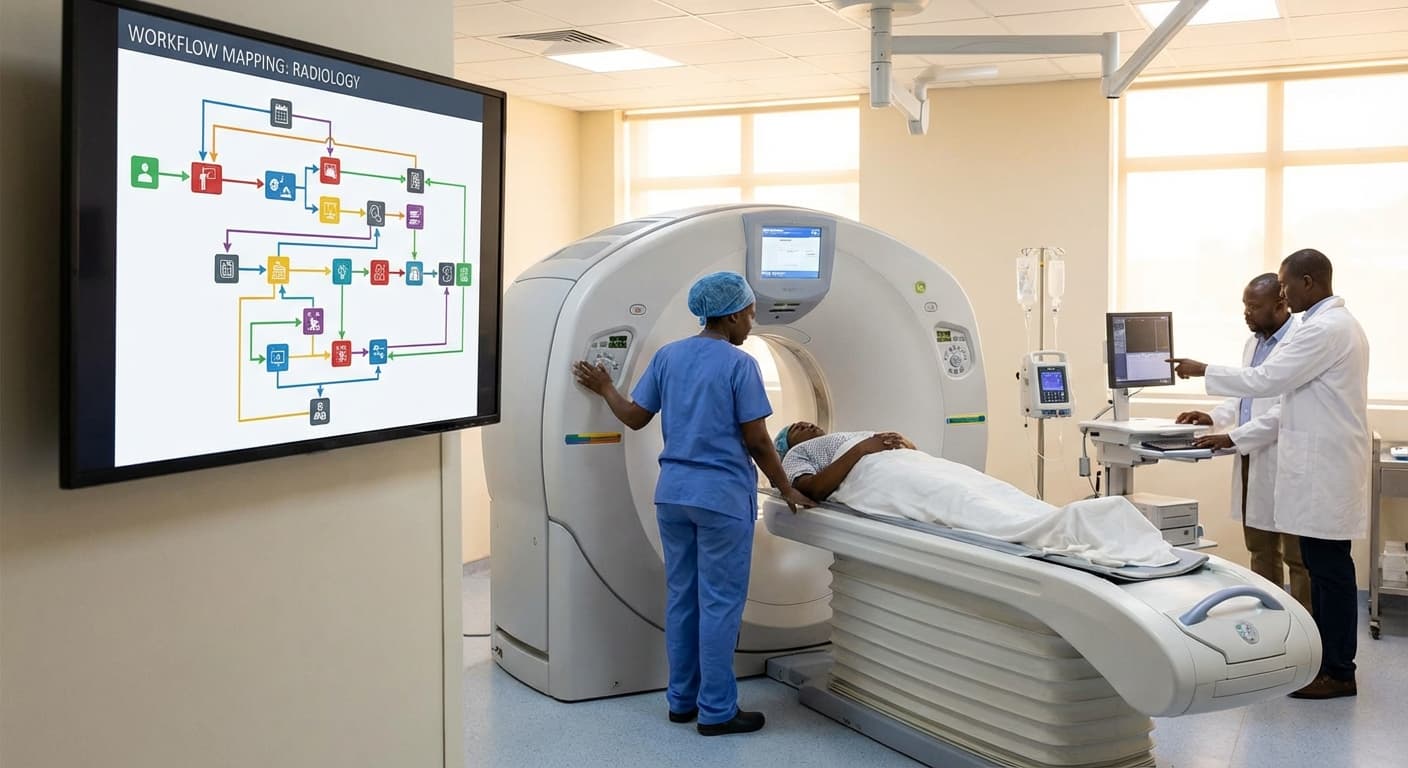
Department Workflow Mapping Service (Radiology/ICU/OT/Lab/Dialysis) in Liberia
Engineering Excellence & Technical Support
Department Workflow Mapping Service (Radiology/ICU/OT/Lab/Dialysis) High-standard technical execution following OEM protocols and local regulatory frameworks.
Streamlined Patient Flow Across Critical Departments
We meticulously map and analyze patient journeys through Radiology, ICU, OT, Lab, and Dialysis in Liberian healthcare facilities, identifying bottlenecks and implementing optimized workflows to reduce wait times, improve resource allocation, and enhance patient throughput.
Enhanced Interdepartmental Communication and Data Exchange
Our service bridges communication gaps between specialized departments by mapping information exchange points. This ensures seamless data sharing between Radiology, ICU, OT, Lab, and Dialysis, leading to more informed clinical decisions and reduced medical errors in Liberia.
Optimized Resource Utilization for High-Demand Services
By visualizing the operational flow within Radiology, ICU, OT, Lab, and Dialysis, we identify opportunities for efficient utilization of scarce medical equipment, skilled personnel, and consumables. This translates to cost savings and improved service delivery for critical patient care in Liberia.
What Is Department Workflow Mapping Service (Radiology/icu/ot/lab/dialysis) In Liberia?
Department Workflow Mapping Service, when applied to critical healthcare departments in Liberia such as Radiology, Intensive Care Units (ICU), Operating Theatres (OT), Laboratories, and Dialysis Units, refers to a systematic process of documenting, analyzing, and optimizing the sequence of activities, decisions, and resources involved in delivering patient care within these specialized areas. This service aims to identify bottlenecks, inefficiencies, and potential risks, ultimately leading to improved patient outcomes, enhanced operational efficiency, and better resource utilization. The methodology typically involves detailed observation, stakeholder interviews, process flow charting, and data analysis to create a comprehensive understanding of the current state workflows. Subsequent phases focus on designing an optimized future state, implementing changes, and establishing mechanisms for continuous monitoring and improvement.
| Department | Typical Use Cases for Workflow Mapping |
|---|---|
| Radiology | Optimizing patient scheduling and throughput for imaging studies (X-ray, CT, MRI, Ultrasound). Streamlining image acquisition, processing, and reporting workflows. Improving communication and retrieval of imaging data for clinical decision-making. Reducing patient wait times and turnaround times for diagnostic reports. |
| Intensive Care Unit (ICU) | Mapping patient admission, transfer, and discharge processes. Analyzing critical care pathways for specific conditions (e.g., sepsis, trauma). Optimizing staff communication and handoff protocols. Improving the management of medical equipment and supplies. Enhancing response times to critical events. |
| Operating Theatre (OT) | Documenting surgical case scheduling, preparation, and execution. Analyzing instrument sterilization and turnaround times. Optimizing anesthesia workflows. Improving post-operative recovery processes. Enhancing coordination between surgical teams, nursing staff, and support services. |
| Laboratory | Streamlining sample collection, accessioning, and processing. Optimizing analytical workflows for various tests (hematology, chemistry, microbiology, etc.). Improving quality control procedures and turnaround times. Enhancing communication of results to clinicians. Managing reagent inventory and equipment maintenance. |
| Dialysis Unit | Mapping patient scheduling and treatment sessions. Optimizing patient preparation and monitoring during dialysis. Streamlining equipment setup, cleaning, and maintenance. Improving infection control protocols. Ensuring efficient management of medication administration and fluid balance. |
Who Needs Department Workflow Mapping Service in Liberian Healthcare?
- Healthcare Administrators and Hospital Management: To understand departmental performance, identify areas for cost reduction and efficiency gains, and support strategic planning.
- Department Heads and Clinical Leads (Radiology, ICU, OT, Lab, Dialysis): To optimize clinical pathways, improve patient flow, ensure timely and accurate diagnostic or therapeutic interventions, and enhance staff productivity.
- Quality Improvement and Patient Safety Teams: To identify and mitigate risks, reduce medical errors, and ensure adherence to best practices and regulatory standards.
- IT and Health Informatics Professionals: To inform the design and implementation of health information systems, ensuring they align with and support optimized workflows.
- Healthcare Consultants and Project Managers: To provide expertise in process improvement and system redesign for healthcare facilities.
- Government Health Ministries and Regulatory Bodies: To assess the operational capacity and efficiency of key healthcare departments across the nation and to guide policy development.
- International Aid Organizations and NGOs: To support capacity building initiatives and ensure effective resource allocation in healthcare delivery.
Who Needs Department Workflow Mapping Service (Radiology/icu/ot/lab/dialysis) In Liberia?
In Liberia, efficient patient care and resource management within critical hospital departments are paramount. Department workflow mapping services are essential for identifying bottlenecks, improving efficiency, and ensuring high-quality service delivery across various specialized units. These services analyze the existing processes, from patient intake to discharge, within departments like Radiology, Intensive Care Units (ICU), Operating Theaters (OT), Laboratories, and Dialysis Centers. By visualizing and optimizing these workflows, healthcare facilities can reduce wait times, minimize errors, enhance staff productivity, and ultimately improve patient outcomes. This is particularly crucial in a developing healthcare landscape like Liberia, where resources may be stretched and the need for streamlined operations is significant.
| Department | Target Customers | Key Benefits of Workflow Mapping |
|---|---|---|
| Radiology | Public Hospitals (e.g., JFK Medical Center), Private Clinics, Diagnostic Centers | Reduced patient wait times for imaging, improved radiologist efficiency, optimized equipment utilization, faster report turnaround. |
| ICU | Tertiary Care Hospitals, General Hospitals with critical care units | Enhanced patient monitoring, optimized staff allocation, improved interdisciplinary communication, reduced risk of medical errors, streamlined emergency response. |
| OT | Surgical Centers, Hospitals with surgical suites | Optimized scheduling of procedures, efficient use of operating rooms and equipment, reduced patient prep and recovery times, improved surgical team coordination. |
| Lab | Hospital Laboratories, Standalone Diagnostic Labs | Faster test result turnaround, improved sample handling and tracking, reduced errors in testing and reporting, optimized reagent and supply management. |
| Dialysis | Renal Care Centers, Hospitals with nephrology departments | Efficient patient scheduling for dialysis sessions, optimized resource allocation (machines, staff), improved patient safety protocols, streamlined medication administration. |
Target Customers and Departments for Workflow Mapping in Liberia:
- Hospitals and Healthcare Facilities in Liberia
- Radiology Departments
- Intensive Care Units (ICU)
- Operating Theaters (OT) / Surgical Departments
- Clinical Laboratories
- Dialysis Centers
- Ministry of Health (for national standardization and oversight)
- International NGOs and Aid Organizations supporting healthcare infrastructure
Department Workflow Mapping Service (Radiology/icu/ot/lab/dialysis) Process In Liberia
This document outlines the comprehensive workflow for the Department Workflow Mapping Service, specifically tailored for critical departments like Radiology, Intensive Care Unit (ICU), Operating Theater (OT), Laboratory, and Dialysis within healthcare facilities in Liberia. The service aims to analyze, document, and optimize existing processes to enhance efficiency, reduce errors, and improve patient care. The workflow begins with an initial inquiry and progresses through a structured series of phases, culminating in the execution and handover of the mapped workflows.
| Phase | Key Activities | Responsible Parties | Deliverables | Timeline (Indicative) |
|---|---|---|---|---|
| Phase 1: Inquiry & Initial Consultation |
| Healthcare Facility Management/Department Heads, Service Provider (Workflow Mapping Team) | Initial meeting minutes, Service proposal | 1-3 business days |
| Phase 2: Scoping & Needs Assessment |
| Service Provider (Workflow Mapping Team), HHealthcare Facility Management/Department Heads | Scope of work document, Project plan, Stakeholder list | 3-5 business days |
| Phase 3: Data Collection & Analysis |
| Service Provider (Workflow Mapping Team), Departmental Staff | Interview notes, Observation records, Collected data | 1-3 weeks (depending on department complexity) |
| Phase 4: Workflow Mapping & Documentation |
| Service Provider (Workflow Mapping Team) | Draft workflow diagrams, Detailed process descriptions | 1-2 weeks |
| Phase 5: Review & Validation |
| Service Provider (Workflow Mapping Team), Key Stakeholders from Healthcare Facility | Validated workflow diagrams, Revised process documentation | 5-7 business days |
| Phase 6: Recommendations & Optimization Planning |
| Service Provider (Workflow Mapping Team) | Recommendations report, Proposed future-state workflows | 1 week |
| Phase 7: Implementation Support (Optional) |
| Service Provider (Workflow Mapping Team), HHealthcare Facility Staff | Training materials, Implementation progress reports | Varies based on scope |
| Phase 8: Final Reporting & Handover |
| Service Provider (Workflow Mapping Team), HHealthcare Facility Management | Final project report, Complete set of deliverables | 3-5 business days |
Department Workflow Mapping Service Process in Liberia
- Phase 1: Inquiry & Initial Consultation
- Phase 2: Scoping & Needs Assessment
- Phase 3: Data Collection & Analysis
- Phase 4: Workflow Mapping & Documentation
- Phase 5: Review & Validation
- Phase 6: Recommendations & Optimization Planning
- Phase 7: Implementation Support (Optional)
- Phase 8: Final Reporting & Handover
Department Workflow Mapping Service (Radiology/icu/ot/lab/dialysis) Cost In Liberia
Understanding the cost of Department Workflow Mapping services in Liberia requires an examination of several key pricing factors. These services are crucial for optimizing operational efficiency in vital hospital departments such as Radiology, Intensive Care Units (ICU), Operating Theatres (OT), Laboratories, and Dialysis Centers. The cost will vary based on the complexity of the department, the scope of the mapping, the experience of the service provider, and the duration of the engagement.
| Service Component | Estimated Cost Range (Liberian Dollar - LRD) |
|---|---|
| Initial Consultation & Needs Assessment | 15,000 - 40,000 LRD |
| On-site Data Collection & Observation (per day/department) | 30,000 - 75,000 LRD |
| Process Analysis & Bottleneck Identification | 50,000 - 150,000 LRD |
| Workflow Optimization Recommendations | 40,000 - 120,000 LRD |
| Report Generation & Presentation | 30,000 - 90,000 LRD |
| Full Department Workflow Mapping (e.g., Radiology, ICU, OT, Lab, Dialysis - Comprehensive Project) | 250,000 - 1,000,000+ LRD |
Key Pricing Factors for Department Workflow Mapping in Liberia
- {"title":"Department Complexity and Size","description":"Larger departments with more intricate processes and a higher volume of patient throughput will naturally require more extensive mapping, leading to higher costs. For example, mapping an entire ICU with multiple patient care pathways will be more complex than mapping a single specialized lab section."}
- {"title":"Scope of Services","description":"The depth of the mapping exercise is a significant cost driver. This can range from basic process documentation to in-depth analysis, identification of bottlenecks, recommendation of technological solutions, and implementation support."}
- {"title":"Service Provider Expertise and Reputation","description":"Consulting firms or individual consultants with a proven track record and specialized expertise in healthcare workflow optimization will command higher fees. This includes their understanding of Liberian healthcare context and regulations."}
- {"title":"Duration of Engagement","description":"The time required to complete the mapping project directly impacts the cost. This includes initial consultations, on-site observation, data collection, analysis, report generation, and stakeholder presentations."}
- {"title":"Technology and Tools Used","description":"While some providers might use standard documentation methods, others might employ sophisticated process modeling software or data analytics tools, which could influence the overall project cost."}
- {"title":"Geographic Location within Liberia","description":"Travel and accommodation costs for the consultants, especially if the facility is located in a remote area, will be factored into the overall price."}
- {"title":"Customization and Specific Requirements","description":"Unique departmental needs, integration with existing hospital information systems, or specific regulatory compliance requirements can add to the complexity and cost of the mapping service."}
Affordable Department Workflow Mapping Service (Radiology/icu/ot/lab/dialysis) Options
Our Affordable Department Workflow Mapping Service provides crucial process analysis and optimization for high-volume departments like Radiology, ICU, Operating Theatre (OT), Laboratory, and Dialysis. We help you identify bottlenecks, inefficiencies, and areas for improvement, leading to enhanced patient care, reduced errors, and significant cost savings. We offer flexible value bundles tailored to your department's specific needs and budget, alongside transparent cost-saving strategies.
Value Bundles Explained:
We understand that each department has unique challenges. Our value bundles are designed to offer a tiered approach to workflow mapping, allowing you to select the level of service that best suits your objectives and resources:
- 'Insight' Bundle (Basic): This entry-level package focuses on documenting the 'as-is' state of a core workflow within your department. It's ideal for gaining a foundational understanding of current processes and identifying obvious pain points.
- 'Optimize' Bundle (Standard): Building on the 'Insight' bundle, this package includes detailed analysis of the documented workflow, identification of key inefficiencies, and the development of actionable recommendations for improvement. This is our most popular option for departments seeking tangible process enhancements.
- 'Transform' Bundle (Premium): This comprehensive bundle encompasses the full scope of workflow mapping, from initial documentation to the design and initial implementation planning of optimized workflows. It often includes training and change management support to ensure successful adoption of new processes.
Cost-Saving Strategies:
Our services are inherently designed to drive cost savings through improved efficiency and reduced waste. Here are some of the key strategies we implement:
- Elimination of Redundant Steps: Identifying and removing unnecessary tasks that consume time and resources.
- Reduction of Rework and Errors: Streamlining processes to minimize mistakes that lead to costly rework and patient safety concerns.
- Optimized Resource Allocation: Ensuring staff, equipment, and supplies are utilized effectively, preventing over- or under-utilization.
- Improved Patient Throughput: Accelerating patient movement through the department, increasing capacity and revenue potential.
- Reduced Turnaround Times: Especially critical in labs and diagnostic imaging, faster results improve patient care and resource utilization.
- Standardization of Processes: Creating consistent workflows reduces variability and the likelihood of errors.
- Data-Driven Decision Making: Providing clear data on process performance to support informed decisions about resource allocation and future investments.
How it Works:
Our process typically involves:
- Discovery & Scoping: Understanding your department's specific goals and identifying the target workflow.
- Data Collection: On-site observation, interviews with staff, and review of existing documentation.
- Workflow Mapping: Visually representing the current process using standardized notation.
- Analysis & Identification of Bottlenecks: Pinpointing inefficiencies, delays, and sources of waste.
- Recommendation Development: Proposing practical and cost-effective solutions.
- Reporting & Presentation: Delivering a clear, actionable report and presenting findings to your team.
| Value Bundle | Focus | Key Deliverables | Ideal For |
|---|---|---|---|
| Insight | Documentation & Basic Analysis | As-Is Workflow Maps, Initial Bottleneck Identification | Departments needing a foundational understanding of their current processes. |
| Optimize | In-depth Analysis & Recommendations | As-Is & To-Be Workflow Maps, Detailed Efficiency Analysis, Actionable Improvement Recommendations | Departments seeking tangible process enhancements and cost savings. |
| Transform | Comprehensive Optimization & Planning | All 'Optimize' deliverables + Implementation Planning, Change Management Strategy, Initial Training Outline | Departments aiming for significant process overhaul and sustainable change. |
Key Benefits of Department Workflow Mapping
- Enhanced Patient Care Quality
- Reduced Operational Costs
- Improved Staff Efficiency & Morale
- Minimized Risk of Errors & Rework
- Increased Throughput & Capacity
- Data-Driven Performance Insights
- Foundation for Digital Transformation
Verified Providers In Liberia
In Liberia's evolving healthcare landscape, identifying reliable and credentialed health providers is paramount for ensuring quality care and patient safety. Franance Health stands out as a leading organization that not only vets its network of healthcare professionals but also champions transparency and excellence. This document outlines the rigorous credentialing process employed by Franance Health and explains why their verified providers represent the optimal choice for individuals seeking medical services in Liberia.
| Benefit for Patients | Why Franance Health Providers Excel |
|---|---|
| Access to Qualified Professionals: Patients can be assured they are receiving care from individuals who have met stringent professional standards. | Franance Health's verification process guarantees that all listed providers are fully licensed, educated, and experienced. |
| Enhanced Patient Safety: Reduced risk of substandard care or malpractice. | The thorough background checks and ongoing monitoring implemented by Franance Health significantly mitigate risks. |
| Trust and Reliability: Confidence in the competence and integrity of the healthcare provider. | Franance Health's commitment to transparency and a robust credentialing system builds undeniable trust. |
| Efficient Healthcare Navigation: Easier to find and access appropriate medical expertise. | Franance Health provides a curated list of verified providers, simplifying the search for specialized care. |
| Commitment to Continuous Improvement: Providers are incentivized to maintain high standards. | The ongoing nature of Franance Health's credentialing encourages providers to stay abreast of medical advancements and ethical guidelines. |
Franance Health's Rigorous Credentialing Process:
- Verification of Professional Licenses: Franance Health meticulously verifies the validity and current standing of all professional licenses held by their healthcare providers with the relevant Liberian medical regulatory bodies.
- Education and Training Confirmation: Academic and professional training credentials, including degrees, certifications, and specialized fellowships, are thoroughly reviewed and authenticated.
- Work History and Experience Validation: Previous employment history and professional experience are corroborated through references and direct communication with former institutions or practices.
- Background Checks: Comprehensive background checks are conducted to ensure a history of ethical conduct and absence of disciplinary actions or malpractice claims.
- Peer Review and Competency Assessment: In specific cases or for specialized roles, Franance Health may engage in peer review processes or competency assessments to further evaluate a provider's skills and knowledge.
- Ongoing Monitoring: The credentialing process is not a one-time event. Franance Health maintains a system for ongoing monitoring of their providers to ensure continued adherence to standards and best practices.
Scope Of Work For Department Workflow Mapping Service (Radiology/icu/ot/lab/dialysis)
This Scope of Work (SOW) outlines the services to be provided for a comprehensive workflow mapping initiative across key hospital departments: Radiology, Intensive Care Unit (ICU), Operating Theatre (OT), Laboratory (Lab), and Dialysis. The primary objective is to analyze, document, and visualize existing departmental processes to identify inefficiencies, bottlenecks, and areas for improvement. This service will deliver standardized, detailed workflow maps and a comprehensive report facilitating strategic decision-making and process optimization.
| Service Component | Description | Key Activities | Deliverables (Technical) | Standard Specifications |
|---|---|---|---|---|
| Phase 1: Discovery & Analysis | Understanding the current state of operations in each department. | Conducting stakeholder interviews (doctors, nurses, technicians, administrators).<br>Observing daily operations.<br>Reviewing existing documentation (SOPs, guidelines).<br>Gathering data on process steps, roles, systems, and timings. | Current State Workflow Maps (Visio/Lucidchart format).<br>Detailed process descriptions.<br>Identified pain points and bottlenecks report. | All maps to adhere to BPMN 2.0 standard or equivalent.<br>Documented assumptions and limitations.<br>Anonymized data where applicable. |
| Phase 2: Process Modeling & Design | Developing optimized workflows based on analysis. | Brainstorming potential improvements with stakeholders.<br>Designing future state workflows.<br>Validating optimized designs with key personnel.<br>Simulating potential process changes (if required). | Future State Workflow Maps (Visio/Lucidchart format).<br>Recommended process changes documentation.<br>Impact analysis report (potential benefits, risks). | Clarity and consistency in notation.<br>Traceability between current and future state.<br>Focus on user experience and efficiency. |
| Phase 3: Documentation & Reporting | Consolidating all findings and deliverables. | Creating a comprehensive final report.<br>Organizing and archiving all workflow maps and supporting documentation. | Final Comprehensive Workflow Mapping Report.<br>Archived digital copies of all workflow maps and documentation. | Report to be professionally formatted, including executive summary, detailed findings, recommendations, and appendices.<br>All digital deliverables to be clearly named and organized in a structured folder system. |
| Department Specific Considerations | Tailoring the mapping to the unique needs of each department. | Radiology: Patient imaging pathways, reporting workflows, equipment scheduling.<br>ICU: Patient admission, monitoring, care protocols, discharge.<br>OT: Patient scheduling, pre-operative preparation, intra-operative procedures, post-operative care.<br>Lab: Sample collection, processing, testing, reporting, quality control.<br>Dialysis: Patient scheduling, treatment procedures, monitoring, documentation. | Department-specific workflow variations documented.<br>Integration points between departments highlighted. | Consideration of regulatory requirements specific to each department (e.g., JCI, CAP for Lab, etc.). |
Objectives of the Workflow Mapping Service
- To thoroughly document current operational workflows within each specified department.
- To identify and analyze existing bottlenecks, redundancies, and areas of inefficiency.
- To propose optimized workflow designs based on best practices and identified opportunities.
- To provide a visual representation of all documented and optimized workflows.
- To facilitate inter-departmental understanding and collaboration.
- To establish a baseline for future process improvement initiatives and performance measurement.
Service Level Agreement For Department Workflow Mapping Service (Radiology/icu/ot/lab/dialysis)
This Service Level Agreement (SLA) outlines the terms and conditions for the provision of the Department Workflow Mapping Service, specifically designed for Radiology, Intensive Care Unit (ICU), Operating Theatre (OT), Laboratory, and Dialysis departments. It defines the expected response times and uptime guarantees for the service.
| Service Component | Response Time Target (Business Hours) | Uptime Guarantee |
|---|---|---|
| Initial Consultation & Scope Definition | 2 Business Days | N/A (Project-based) |
| Data Collection & Analysis Request Response | 4 Business Hours | 99.5% |
| Draft Workflow Map Delivery | 5 Business Days (post data collection completion) | N/A (Project-based) |
| Review & Revision of Workflow Maps | 3 Business Days (per revision cycle) | N/A (Project-based) |
| Access to Workflow Documentation Platform (if applicable) | N/A | 99.8% |
| Technical Support for Platform Issues | 4 Business Hours | 99.8% |
| Post-Project Support (bug fixes, minor clarification requests) | 2 Business Days | N/A (Defined support period) |
Scope of Service
- Departmental Workflow Mapping: This service involves the analysis, documentation, and visualization of existing workflows within the specified departments.
- Service Delivery: The service will be delivered through a combination of on-site consultations, remote analysis, and digital platform access for documentation and reporting.
- Support: Technical and operational support will be provided for the duration of the mapping project and for a defined post-project support period.
Frequently Asked Questions

Ready when you are
Let's scope your Department Workflow Mapping Service (Radiology/ICU/OT/Lab/Dialysis) in Liberia project in Liberia.

Scaling healthcare logistics and technical systems across the entire continent.