
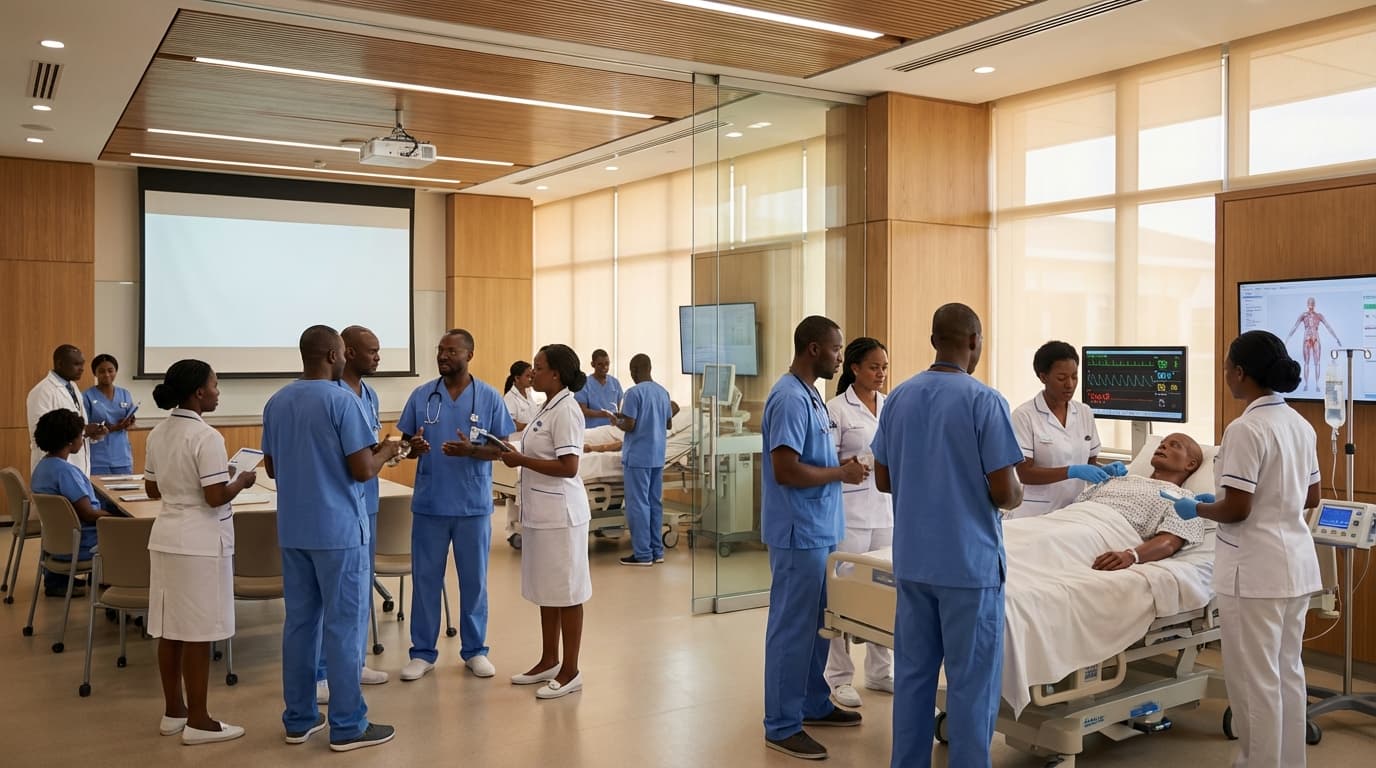
Equipment Training & Education in Lesotho
Engineering Excellence & Technical Support
Comprehensive equipment training and certification programs High-standard technical execution following OEM protocols and local regulatory frameworks.
Hands-On Heavy Equipment Operation Training
Delivering practical, in-person training sessions for critical heavy machinery such as excavators, bulldozers, and loaders. Focus on safe operation, maintenance best practices, and site-specific application relevant to Lesotho's infrastructure and mining sectors.
Mobile Mechanic & Maintenance Workshops
Providing specialized training for local technicians on the maintenance and repair of agricultural, construction, and mining equipment. Workshops emphasize diagnostic techniques, troubleshooting common faults, and preventative maintenance strategies to extend equipment lifespan and reduce downtime in remote areas.
Digital Learning Platform for Technical Skills
Launching an accessible online platform offering modular courses on equipment safety, operation, and basic maintenance. Content is designed for offline access where internet connectivity is limited, utilizing low-bandwidth solutions and localized language options to empower a wider range of Lesotho's workforce.
What Is Equipment Training & Education In Lesotho?
Equipment training and education in Lesotho refers to the systematic process of imparting knowledge, skills, and practical understanding necessary for the safe, efficient, and effective operation, maintenance, and repair of various types of equipment. This encompasses theoretical instruction, hands-on practical sessions, and ongoing competency assessment. The primary objective is to enhance human capital by ensuring individuals possess the requisite expertise to interact with and manage equipment throughout its lifecycle, thereby optimizing performance, minimizing risks, and prolonging asset lifespan.
| Who Needs Equipment Training & Education? | Typical Use Cases & Sectors | ||||||||||||
|---|---|---|---|---|---|---|---|---|---|---|---|---|---|
| Operational Personnel: Machine operators, drivers, technicians, process workers who directly interact with equipment on a daily basis. | Maintenance & Repair Staff: Mechanical, electrical, and hydraulic technicians responsible for keeping equipment in optimal working condition. | Supervisory & Management Staff: Individuals overseeing operations and maintenance, requiring an understanding of equipment capabilities, limitations, and safety implications. | Health & Safety Officers: Professionals responsible for ensuring safe working environments and compliance with regulations related to equipment usage. | New Entrants to the Workforce: Individuals entering industries that heavily rely on machinery and specialized equipment. | Existing Workforce undergoing Upskilling/Reskilling: Employees needing to adapt to new equipment or technologies introduced in their workplaces. | Agricultural Sector: Farmers and farmhands operating and maintaining tractors, irrigation systems, harvesters, and other agricultural machinery. | Construction Sector: Operators of excavators, bulldozers, cranes, concrete mixers, and other heavy construction equipment; also, site supervisors and safety officers. | Mining Sector: Personnel involved in operating and maintaining mining machinery such as drills, haul trucks, crushers, and processing equipment. | Manufacturing & Industrial Sector: Factory workers, machine operators, and maintenance technicians handling production lines, assembly machines, and specialized manufacturing equipment. | Transportation & Logistics Sector: Drivers of commercial vehicles, forklift operators, and warehouse staff managing material handling equipment. | Healthcare Sector: Technicians and medical staff operating and maintaining diagnostic equipment (e.g., X-ray machines, MRI scanners), laboratory equipment, and patient care devices. | Energy Sector: Technicians and engineers involved in the operation and maintenance of power generation equipment, distribution systems, and renewable energy installations. | Public Works & Municipal Services: Operators and maintenance staff for road construction and maintenance equipment, water treatment plants, and waste management machinery. |
Key Components of Equipment Training & Education in Lesotho
- Theoretical Instruction: Covers principles of operation, technical specifications, safety protocols, regulatory compliance, and diagnostic procedures.
- Practical Skill Development: Involves hands-on manipulation of equipment, troubleshooting exercises, calibration, and routine maintenance tasks under supervised conditions.
- Safety & Risk Management: Emphasizes hazard identification, risk assessment, the use of Personal Protective Equipment (PPE), emergency response procedures, and adherence to national safety standards.
- Maintenance & Repair: Focuses on preventative maintenance schedules, fault diagnosis, component replacement, and basic repair techniques.
- Operational Proficiency: Aims to develop the ability to operate equipment within its designed parameters, achieving optimal output and quality.
- Regulatory Compliance: Ensures trainees are aware of and adhere to relevant industry regulations, environmental standards, and health and safety legislation applicable in Lesotho.
- Competency Assessment: Involves formal evaluations, practical demonstrations, and written examinations to verify acquired skills and knowledge.
- Continuous Professional Development: Often includes advanced training modules, updates on new technologies, and refresher courses to maintain skill relevance.
Who Needs Equipment Training & Education In Lesotho?
Equipment training and education are crucial across various sectors in Lesotho to ensure safety, efficiency, and productivity. Without proper training, the risks of accidents, equipment damage, and suboptimal performance increase significantly. This impacts not only individual workers but also the overall economic development of the nation.
| Sector/Industry | Target Customers (Job Roles/Personnel) | Key Departments/Units | Types of Equipment/Training Needs |
|---|---|---|---|
| Mining Sector | Mine operators, mechanics, geologists, safety officers, supervisors | Operations, Maintenance, Safety, Geology | Drilling rigs, excavators, haul trucks, crushers, loaders, safety equipment (PPE, emergency response), underground mining machinery |
| Construction Industry | Site managers, engineers, foremen, heavy equipment operators, general laborers, safety officers | Site Management, Engineering, Operations, Health & Safety | Cranes, bulldozers, excavators, concrete mixers, scaffolding, power tools, welding equipment, safety harnesses, site surveying equipment |
| Agricultural Sector | Farmers (smallholder & commercial), farm managers, agricultural extension officers, machinery operators | Farm Operations, Livestock Management, Crop Production | Tractors, harvesters, irrigation systems, plows, sprayers, fertilizer spreaders, animal handling equipment |
| Healthcare Facilities | Nurses, doctors, technicians, biomedical engineers, administrative staff | Medical Imaging, Laboratory Services, Intensive Care Units, Operating Rooms, Maintenance | MRI machines, CT scanners, X-ray machines, ventilators, defibrillators, autoclaves, laboratory analysis equipment, patient monitoring systems |
| Manufacturing & Industrial Operations | Machine operators, technicians, production supervisors, quality control personnel, maintenance staff | Production, Quality Control, Maintenance, Engineering, Warehousing | Assembly line machinery, CNC machines, forklifts, packaging equipment, welding machines, safety guards, industrial robots |
| Transportation & Logistics | Drivers (trucks, buses, specialized vehicles), warehouse staff, logistics managers, mechanics | Fleet Management, Warehousing & Distribution, Maintenance | Heavy-duty trucks, buses, forklifts, loading docks, material handling equipment, diagnostic tools |
| Public Works & Government Agencies | Road maintenance crews, water & sanitation technicians, municipal workers, emergency responders | Roads & Infrastructure, Water & Sewerage, Disaster Management, Parks & Recreation | Graders, compactors, water pumps, sewer cleaning equipment, generators, first aid equipment |
| Education & Vocational Training Institutions | Instructors, trainers, students, workshop technicians | Mechanical Engineering, Electrical Engineering, Automotive Technology, Welding, Trades | Classroom equipment, workshop machinery, laboratory apparatus, specialized training simulators |
Target Customers & Departments for Equipment Training & Education in Lesotho
- Mining Sector
- Construction Industry
- Agricultural Sector
- Healthcare Facilities
- Manufacturing & Industrial Operations
- Transportation & Logistics
- Public Works & Government Agencies
- Education & Vocational Training Institutions
Equipment Training & Education Process In Lesotho
This document outlines the typical workflow for equipment training and education processes in Lesotho, from initial inquiry to the successful execution of training programs. The process aims to ensure that individuals and organizations in Lesotho receive the necessary knowledge and skills to operate and maintain various types of equipment effectively and safely.
| Phase | Key Activities | Responsible Parties |
|---|---|---|
| Inquiry & Needs Assessment | Receiving inquiries, understanding equipment and skill requirements, defining training scope. | Client, Training Provider |
| Proposal & Agreement | Developing and presenting training proposals, negotiating terms, finalizing contracts. | Training Provider, Client |
| Training Preparation | Developing curriculum and materials, assigning trainers, arranging logistics. | Training Provider |
| Training Execution | Delivering theoretical and practical training, conducting demonstrations, facilitating hands-on practice. | Training Provider (Trainers) |
| Assessment & Evaluation | Conducting formative and summative assessments, collecting participant feedback. | Training Provider (Assessors, Trainers) |
| Post-Training & Certification | Issuing certificates, generating reports, providing follow-up support. | Training Provider |
Equipment Training & Education Workflow in Lesotho
- {"steps":["Initial Inquiry: Potential clients (individuals, companies, government agencies) contact training providers with their equipment training needs.","Needs Identification: The training provider engages with the client to understand the specific equipment (make, model, type), the target audience (skill level, prior experience), the desired learning outcomes, and any logistical constraints (location, timeline, budget).","Scope Definition: Based on the needs assessment, the training provider defines the scope of the training, including the curriculum, duration, methodology (classroom, on-site, practical), and assessment methods."],"title":"Phase 1: Inquiry & Needs Assessment"}
- {"steps":["Proposal Development: The training provider prepares a detailed proposal outlining the training program, including objectives, modules, schedule, trainers' qualifications, materials, assessment strategy, and cost.","Proposal Review & Negotiation: The client reviews the proposal, and negotiations may occur regarding scope, cost, and terms.","Contract/Agreement Finalization: Once terms are agreed upon, a formal contract or training agreement is signed by both parties, specifying deliverables, responsibilities, payment terms, and cancellation policies."],"title":"Phase 2: Proposal & Agreement"}
- {"steps":["Curriculum Development/Customization: The training curriculum is finalized or customized to meet the specific needs identified.","Material Preparation: Training materials (manuals, presentations, videos, handouts, practical exercises) are developed or sourced.","Trainer Assignment: Qualified and experienced trainers are assigned to the specific training program.","Logistics Arrangement: Venue booking (if applicable), equipment procurement or arrangement for demonstration, scheduling of participants, and communication of training details to attendees.","Pre-Training Assessment (Optional): A pre-assessment may be conducted to gauge participants' existing knowledge and tailor the training accordingly."],"title":"Phase 3: Training Preparation"}
- {"steps":["Introduction & Objectives: The training begins with an introduction to the program, its objectives, and an overview of the agenda.","Theoretical Instruction: Delivery of theoretical knowledge related to the equipment's operation, safety procedures, maintenance principles, and relevant regulations.","Practical Demonstration & Hands-on Practice: Demonstrations of equipment operation, followed by supervised hands-on practice for participants.","Problem-Solving & Troubleshooting: Scenarios and exercises to develop participants' ability to identify and resolve common equipment issues.","Safety Briefings: Continuous emphasis on safety protocols throughout the training.","Q&A and Discussion: Opportunities for participants to ask questions and engage in discussions.","Mid-Training Review (Optional): A brief review session to gauge understanding and address any emerging concerns."],"title":"Phase 4: Training Execution"}
- {"steps":["Formative Assessment: Ongoing assessment during the training (e.g., quizzes, practical task observation) to monitor progress.","Summative Assessment: Final assessment to evaluate the achievement of learning outcomes. This can include written tests, practical skill demonstrations, or simulations.","Participant Feedback: Collection of feedback from participants on the training content, delivery, trainers, and facilities.","Trainer Evaluation: Evaluation of trainer performance based on participant feedback and assessment results."],"title":"Phase 5: Assessment & Evaluation"}
- {"steps":["Reporting: The training provider generates a comprehensive report detailing the training conducted, participant attendance, assessment results, and recommendations.","Certification: Upon successful completion of the assessment, participants receive a certificate recognizing their competency in operating or maintaining the specific equipment.","Follow-up Support (Optional): Offering ongoing support, refresher courses, or advanced training as needed by the client.","Record Keeping: Maintaining records of training conducted, participant achievements, and feedback for future reference and auditing purposes."],"title":"Phase 6: Post-Training & Certification"}
Equipment Training & Education Cost In Lesotho
Equipment training and education costs in Lesotho can vary significantly depending on the type of equipment, the level of expertise required, the duration of the training, and the provider. Factors influencing these costs include the complexity of the machinery (e.g., heavy industrial equipment vs. basic office machinery), the qualifications and experience of the trainers, the location of the training (on-site at a company's facility or at a dedicated training center), and the inclusion of materials, assessments, and certifications. The local currency is the Lesotho Loti (LSL).
| Equipment Category | Estimated Cost Range (LSL) | Typical Duration |
|---|---|---|
| Basic Office Equipment (Printers, Scanners, Basic Software) | 500 - 1,500 | 1-2 days |
| Intermediate IT Hardware/Software (Servers, Network Configuration) | 2,000 - 5,000 | 3-5 days |
| Light Industrial Machinery (Welding, Basic Fabrication) | 3,000 - 7,000 | 5-10 days |
| Heavy Machinery (Construction Equipment, Agricultural Machinery) | 5,000 - 15,000+ | 1-4 weeks |
| Specialized Medical Equipment | 10,000 - 25,000+ | 1-3 weeks (often includes international trainers) |
| Advanced Manufacturing Equipment (CNC Machines, Robotics) | 8,000 - 20,000+ | 1-2 weeks |
| Safety and Compliance Training (e.g., Forklift Operation, Working at Heights) | 1,500 - 4,000 | 2-5 days |
Factors Influencing Equipment Training & Education Costs in Lesotho:
- Type and Complexity of Equipment: Highly specialized or technical machinery commands higher training fees due to the specialized knowledge required.
- Duration and Intensity: Longer and more intensive training programs will naturally cost more.
- Trainer Expertise and Qualifications: Certified and experienced trainers, especially those with international accreditations, often charge higher rates.
- Training Location: On-site training at the client's premises might incur travel and accommodation costs for the trainer, while off-site training at a provider's facility will include venue and facility usage fees.
- Training Materials and Resources: The cost of manuals, simulators, practical exercises, and other learning resources can be factored into the overall price.
- Certification and Assessment: If the training leads to a recognized certification or involves formal assessments, these will add to the cost.
- Provider Reputation and Accreditation: Reputable and accredited training institutions may have higher pricing due to perceived quality and credibility.
- Group Size: Training larger groups can sometimes offer a lower per-person cost due to economies of scale, but this is not always the case.
- Customization of Training: Tailoring training programs to specific organizational needs will likely increase the cost.
Affordable Equipment Training & Education Options
Investing in proper equipment training is crucial for safety, efficiency, and maximizing the lifespan of your assets. Fortunately, there are numerous affordable options available, and understanding value bundles and cost-saving strategies can significantly reduce your investment. Value bundles often combine multiple training modules, hands-on practice, and even certification at a discounted rate compared to purchasing each component separately. Cost-saving strategies include leveraging online learning, group discounts, and prioritizing essential training over less critical areas. Explore manufacturer-provided resources, community college programs, and specialized training providers to find the best fit for your budget and needs.
| Training Type | Typical Cost Range (USD) | Value Bundle Potential | Cost-Saving Tips |
|---|---|---|---|
| Basic Operation & Safety | $200 - $800 | Often bundled with initial purchase or advanced modules | Online self-paced modules, manufacturer webinars |
| Maintenance & Troubleshooting | $400 - $1,500 | Bundled with repair services or advanced certification | Group discounts, train-the-trainer options |
| Advanced Features & Programming | $600 - $2,000+ | Integrated with software updates or specialized applications | Online advanced modules, community forums for peer support |
| Certification Courses | $500 - $2,500+ | Can be a standalone offering or part of a comprehensive program | Look for accredited institutions, compare certification bodies |
Cost-Saving Strategies for Equipment Training
- Leverage Online Learning Platforms: Many providers offer flexible and cost-effective online courses, reducing travel and facility costs.
- Seek Group Discounts: Train multiple employees simultaneously to benefit from reduced per-person pricing.
- Prioritize Essential Training: Focus on training for the equipment most frequently used or posing the highest risk first.
- Explore Manufacturer Resources: Some manufacturers offer free or low-cost training materials and introductory courses.
- Consider Community College Programs: Local colleges often have affordable vocational training and certification programs.
- Look for Value Bundles: Combine related training modules for a bundled discount.
- Utilize Train-the-Trainer Programs: Empower internal staff to train new employees, reducing external training costs over time.
- Negotiate Pricing: Especially for larger groups or ongoing training needs, don't hesitate to negotiate with providers.
- Focus on Practical Application: Prioritize hands-on training that directly relates to your operational needs to maximize ROI.
Verified Providers In Lesotho
In Lesotho, ensuring access to quality healthcare is paramount. Franance Health stands out as a leading organization dedicated to providing verifiable and exceptional healthcare services. Their rigorous credentialing process and commitment to excellence make them the premier choice for individuals seeking reliable medical care. This document outlines Franance Health's credentials and the compelling reasons why they represent the best option for your healthcare needs in Lesotho.
| Credential Area | Franance Health Assurance | Benefit to Patients |
|---|---|---|
| Medical Licensure & Certification | Verified and current licenses/certifications for all providers. | Guarantees that practitioners meet minimum legal and professional standards. |
| Educational Background | Thorough verification of academic qualifications and institutional accreditation. | Ensures providers have received a recognized and comprehensive medical education. |
| Professional Experience | Review of past work history and references. | Provides confidence in the provider's practical skills and experience. |
| Continuing Medical Education (CME) | Active encouragement and tracking of CME participation. | Ensures providers are current with the latest medical knowledge and techniques. |
| Patient Feedback & Grievances | Established channels for patient feedback and a process for addressing grievances. | Promotes accountability and continuous improvement in service delivery. |
Franance Health Credentials and Why They Are the Best Choice:
- Rigorous Provider Vetting: Franance Health employs a stringent vetting process for all its healthcare providers. This includes verifying medical licenses, professional certifications, educational backgrounds, and a clean disciplinary record. This ensures that only qualified and ethical practitioners are part of their network.
- Commitment to Continuous Professional Development: They actively encourage and support ongoing training and education for their network of providers. This commitment ensures that healthcare professionals remain up-to-date with the latest medical advancements, treatments, and best practices, leading to superior patient care.
- Patient-Centric Approach: Franance Health prioritizes patient well-being and satisfaction. Their network providers are selected not only for their clinical expertise but also for their compassionate bedside manner and dedication to open communication with patients.
- Comprehensive Network: They have established a wide-ranging network of healthcare professionals across various specialties, from general practitioners to specialists. This comprehensive coverage ensures that patients can access the specific care they need, when they need it, within a trusted network.
- Quality Assurance Measures: Franance Health implements robust quality assurance mechanisms to monitor the performance and outcomes of their providers. This continuous evaluation helps maintain high standards of care and identify areas for improvement.
- Transparency and Accessibility: They strive for transparency in their operations, making it easy for patients to understand the credentials of their chosen providers and to access services. This accessibility builds trust and empowers patients in their healthcare decisions.
- Partnerships with Reputable Institutions: Franance Health collaborates with well-respected healthcare institutions and organizations, further solidifying their credibility and ensuring access to a broader range of advanced medical resources.
- Focus on Evidence-Based Medicine: Providers within the Franance Health network are committed to practicing evidence-based medicine, utilizing the most scientifically sound and effective treatment approaches available.
Scope Of Work For Equipment Training & Education
This Scope of Work (SOW) outlines the requirements for providing comprehensive training and educational services for the specified equipment. The objective is to ensure that designated personnel acquire the necessary knowledge and skills for the safe, efficient, and effective operation, maintenance, and troubleshooting of the equipment.
| Technical Deliverable | Description | Standard Specification / Requirement |
|---|---|---|
| Training Curriculum Development | Creation of detailed training modules covering theoretical concepts and practical applications. | Curriculum must be modular, scalable, and aligned with equipment manufacturer specifications. Includes learning objectives, content outlines, assessment methods, and duration estimates for each module. |
| Training Materials | Development of all necessary training aids and documentation. | Includes operator manuals (digital and/or hard copy), maintenance guides, troubleshooting flowcharts, presentation slides, video demonstrations, and participant workbooks. Materials must be clear, concise, and visually engaging. |
| Instructor-Led Training Sessions | Delivery of classroom-based and/or hands-on training by qualified instructors. | Sessions to be conducted at [Specify Location(s)]. Instructor-to-trainee ratio not to exceed [Specify Ratio]. Training duration per session [Specify Duration]. |
| On-the-Job Training (OJT) | Supervised practical experience on the actual equipment in its operational environment. | OJT will be conducted under the guidance of experienced personnel. Trainees will perform assigned tasks under supervision, with regular feedback and evaluation. Focus on real-world scenarios and problem-solving. |
| Assessment and Evaluation | Methods to measure trainee comprehension and skill acquisition. | Includes written examinations, practical skill demonstrations, case studies, and performance evaluations. Minimum passing score for each assessment: [Specify Percentage]. |
| Certification of Completion | Issuance of certificates to trainees who successfully complete the training program. | Certificates will acknowledge successful completion and indicate the specific training received. Must be signed by a designated authority. |
| Post-Training Support | Provision of ongoing support and resources after the formal training period. | Includes access to a dedicated support hotline or email for technical queries, provision of updated training materials, and potentially refresher training sessions (to be defined separately). |
| Training Environment | Requirements for the physical and logistical setup of training. | Training venue must be adequately equipped with necessary tools, testing equipment, and a safe working space. Availability of the actual equipment or a functional replica is essential. |
| Reporting and Documentation | Submission of reports on training activities and outcomes. | Includes attendance records, assessment results, trainee feedback summaries, and a final training report detailing overall program effectiveness and recommendations. |
Key Objectives of Training Program
- To impart fundamental understanding of the equipment's design, functionality, and operational principles.
- To train operators on standard operating procedures (SOPs) and best practices for safe and efficient use.
- To equip maintenance personnel with the skills for routine inspections, preventative maintenance, and basic troubleshooting.
- To provide advanced training on complex operations, diagnostics, and repair procedures (as applicable).
- To foster an environment of continuous learning and skill development for all relevant personnel.
Service Level Agreement For Equipment Training & Education
This Service Level Agreement (SLA) outlines the guaranteed response times and uptime for Equipment Training & Education services provided by [Your Company Name] to [Client Company Name]. This SLA is an addendum to the Master Service Agreement (MSA) dated [MSA Date].
| Service Component | Service Level Objective (SLO) | Measurement Method | Remedy/Credit |
|---|---|---|---|
| Response Time - Technical Support (Virtual/Online Portal) | Within 2 business hours for standard queries. Within 4 business hours for complex issues requiring deeper investigation. | Ticket submission timestamp to acknowledgement of receipt by support team. | For each instance of exceeding the response time by more than 1 business hour, a credit of 1% of the monthly training fee shall be applied. |
| Response Time - Scheduling New On-Site Training | Acknowledgement of request within 1 business day. Proposal of training dates within 3 business days. | Date of request to acknowledgement date. Date of acknowledgement to date of proposed training dates. | If training dates are not proposed within 3 business days, a credit of 2% of the scheduled on-site training fee shall be applied. |
| Uptime - Online Learning Portal | 99.5% Uptime (excluding scheduled maintenance) | (Total minutes in month - Downtime minutes) / Total minutes in month * 100 | For every 0.1% decrease below 99.5% uptime, a credit of 0.5% of the monthly subscription fee for the online portal shall be applied, capped at 5%. |
| Availability of Scheduled Virtual Training Sessions | 98% Availability (sessions delivered as scheduled) | (Total scheduled sessions - Cancelled/Rescheduled sessions) / Total scheduled sessions * 100 | If a scheduled virtual training session is cancelled or rescheduled with less than 24 hours' notice, a credit of 5% of the session fee shall be applied. |
Scope of Services
- On-demand virtual training sessions for specific equipment models.
- Scheduled on-site training sessions for groups of users.
- Access to an online learning portal with training materials and documentation.
- Technical support for training-related queries.
- Regular updates and refreshers on equipment operation and best practices.
Frequently Asked Questions

Ready when you are
Let's scope your Equipment Training & Education in Lesotho project in Lesotho.

Scaling healthcare logistics and technical systems across the entire continent.