
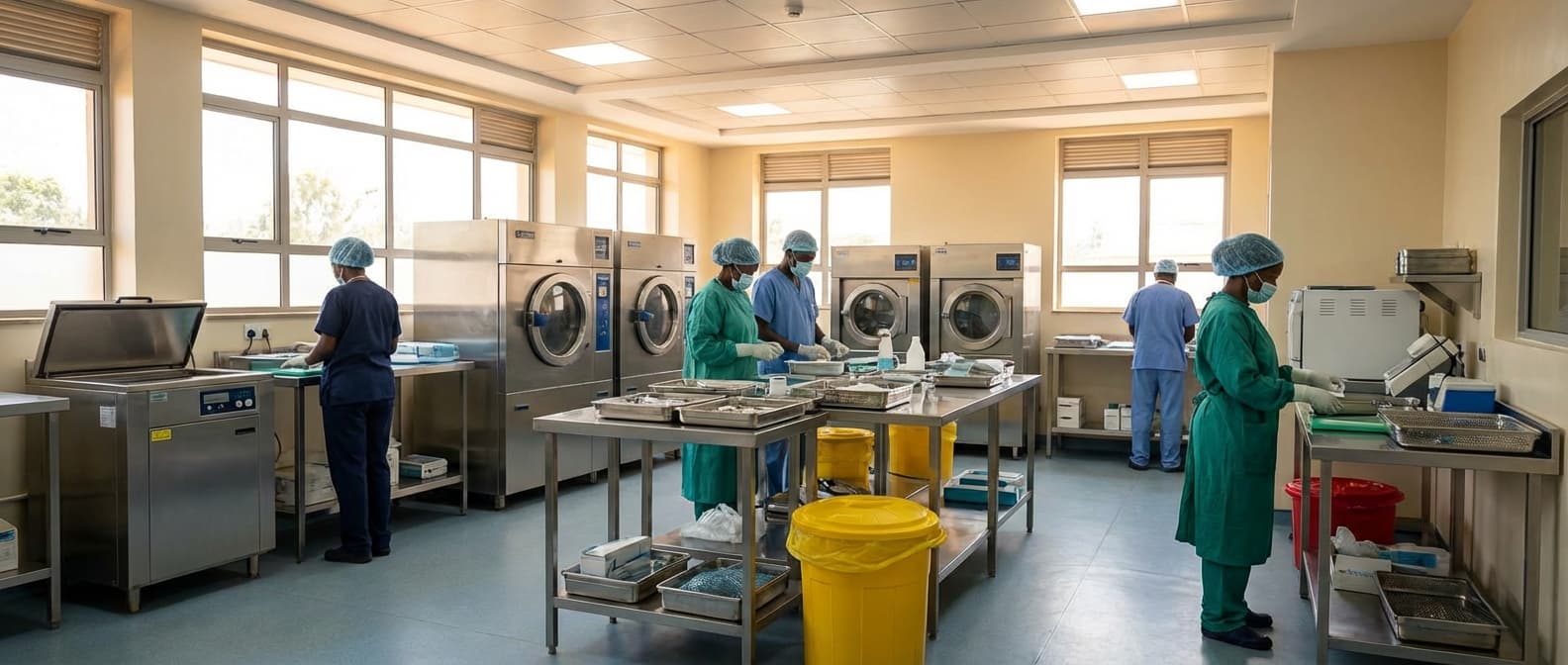
Infection-Control Readiness Support Service for Reusable Equipment in Lesotho
Engineering Excellence & Technical Support
Infection-Control Readiness Support Service for Reusable Equipment High-standard technical execution following OEM protocols and local regulatory frameworks.
Sterilization Assurance
Leveraging advanced steam and chemical sterilization monitoring systems to guarantee the efficacy of reprocessing reusable medical equipment, minimizing the risk of healthcare-associated infections in Lesotho's facilities.
Training & Competency Frameworks
Implementing a robust, context-specific training program and competency assessment framework for healthcare workers on proper cleaning, disinfection, and sterilization protocols, ensuring adherence to international best practices for reusable equipment.
Supply Chain Resilience for Consumables
Establishing a resilient and sustainable supply chain for critical cleaning and sterilization consumables (e.g., detergents, disinfectants, sterilization wraps), ensuring uninterrupted availability and supporting infection-control readiness across all levels of care in Lesotho.
What Is Infection-control Readiness Support Service For Reusable Equipment In Lesotho?
Infection-Control Readiness Support Service for Reusable Equipment (ICRS-RE) in Lesotho refers to a specialized, multifaceted service designed to bolster the capacity of healthcare facilities and associated entities to safely and effectively manage reusable medical equipment (RME) throughout its lifecycle. This service is critical for preventing healthcare-associated infections (HAIs) by ensuring that all reusable items are thoroughly cleaned, disinfected, and sterilized according to established national and international standards, and that the infrastructure, policies, and human resources are in place to support these processes.
| Service Component | Description of Activity | Key Output/Outcome |
|---|---|---|
| Needs Assessment | On-site evaluation of current RME practices, equipment, and training. | Identified gaps in readiness, prioritized areas for intervention. |
| Policy Development | Drafting or updating SOPs for cleaning, disinfection, and sterilization. | Approved and disseminated RME management policies. |
| Training | Delivering targeted workshops and practical sessions on RME reprocessing. | Competent and confident healthcare staff in RME handling. |
| Quality Monitoring | Establishing systems for tracking sterilization cycles and using indicators. | Reduced risk of reprocessing failures and improved patient safety. |
| Infrastructure Review | Assessing suitability of existing decontamination suites and sterilization equipment. | Recommendations for necessary upgrades or procurements. |
Typical Use Cases
- Establishment of New Decontamination and Sterilization Units: Providing expert guidance during the planning, design, and commissioning phases of new RME processing facilities.
- Response to Outbreaks of HAIs: Investigating RME-related infection transmission pathways and implementing corrective actions to prevent recurrence.
- Introduction of New Reusable Medical Devices: Ensuring appropriate reprocessing protocols and equipment are available and staff are trained before introducing new types of RME.
- Accreditation and Licensing Compliance: Assisting healthcare facilities in meeting the stringent infection control requirements mandated by regulatory bodies.
- Routine Quality Improvement Initiatives: Conducting periodic assessments to identify areas for enhancement in RME management processes and workflow efficiency.
- Post-Disaster or Emergency Preparedness: Ensuring that RME reprocessing capabilities can be scaled up or maintained under challenging conditions following natural disasters or public health emergencies.
- Capacity Building for Rural and Remote Facilities: Providing tailored support to facilities with limited resources and infrastructure to improve their RME handling practices.
Who Needs Infection-control Readiness Support Service For Reusable Equipment In Lesotho?
This document outlines the critical need for infection-control readiness support services for reusable medical equipment in Lesotho. Ensuring the proper cleaning, disinfection, and sterilization of reusable items is paramount to preventing healthcare-associated infections (HAIs) and safeguarding patient well-being. This service aims to bolster the capacity of healthcare facilities to consistently adhere to best practices in reusable equipment reprocessing.
| Facility Type | Key Departments Benefiting | Specific Needs Addressed |
|---|---|---|
| Public Hospitals (Central, District, Referral) | CSSD, Operating Theatres, Wards (Maternity, ICU, General), OPDs | Training on new sterilization technologies, capacity building for CSSD staff, developing standardized protocols, equipment maintenance guidance for disinfection units. |
| Private Hospitals and Clinics | CSSD (if applicable), Surgical Suites, Treatment Rooms | Assistance with implementing international best practices, quality assurance of reprocessing, staff training on infection control standards for reusable items. |
| NGO Healthcare Facilities | All patient care areas utilizing reusable equipment | Cost-effective solutions for disinfection and sterilization, basic training on safe reprocessing, supply chain management for reprocessing consumables. |
| Community Health Centers | Treatment Areas, Minor Procedure Rooms | Basic disinfection techniques, appropriate use of disinfectants, safe handling of reusable items with limited resources, training for community health nurses. |
| Specialized Medical Centers (e.g., Dental, Eye) | Treatment/Procedure Rooms, Sterilization Areas | Specific protocols for specialized instruments, training on high-level disinfection and sterilization for unique equipment, quality control of reprocessing. |
Target Customers and Departments:
- {"items":["Public Hospitals (Central, District, and Referral)","Private Hospitals and Clinics","Non-Governmental Organization (NGO) Healthcare Facilities","Community Health Centers","Specialized Medical Centers (e.g., dental clinics, eye clinics)"],"title":"Primary Target Customers:"}
- {"items":["Central Sterile Supply Department (CSSD) / Sterilization Units: This is the core department responsible for the reprocessing of reusable medical devices. Support will directly enhance their operational efficiency and adherence to standards.","Operating Theatres / Surgical Wards: High volume of reusable surgical instruments necessitates robust infection control. Staff in these areas will benefit from training and guidance on immediate handling and preparation of soiled instruments.","Maternity Wards / Obstetric Units: Essential for the safe delivery of babies, these units rely heavily on disinfected and sterilized equipment. Infection prevention is critical for both mother and child.","Outpatient Departments (OPDs): While often dealing with less complex procedures, OPDs still utilize reusable items (e.g., speculums, examination tools) that require proper reprocessing.","Emergency Departments / Casualty: Rapid patient turnover and the need for immediate availability of equipment make efficient and safe reprocessing crucial.","Intensive Care Units (ICUs) / High Dependency Units (HDUs): Patients in these units are highly vulnerable to infections, making strict adherence to infection control protocols for all equipment, especially reusable items, non-negotiable.","Laboratory Services: While not directly reprocessing medical devices in the same way as CSSD, laboratories use and may rely on reusable equipment (e.g., glassware, certain instruments) that require meticulous cleaning and disinfection.","Nursing Services Management: Overall responsibility for patient care and infection prevention falls under nursing leadership. Support will empower them to enforce and monitor compliance.","Biomedical Engineering Department: While focused on equipment maintenance, they play a role in ensuring the proper functioning of sterilization and disinfection equipment. Collaboration will be key.","Infection Prevention and Control (IPC) Committees/Officers: These individuals are central to developing, implementing, and monitoring IPC policies. The support service will directly augment their efforts and provide specialized expertise."],"title":"Key Departments within Healthcare Facilities:"}
Infection-control Readiness Support Service For Reusable Equipment Process In Lesotho
This document outlines the workflow for the Infection-Control Readiness Support Service for Reusable Equipment Process in Lesotho. It details the steps involved from the initial inquiry from a healthcare facility to the successful execution of the support service.
| Phase | Key Activities | Responsible Parties | Deliverables/Outcomes | Timeline (Indicative) |
|---|---|---|---|---|
| Healthcare facility expresses interest in the service. Initial contact and information gathering. Preliminary needs assessment via phone/email/brief visit. | Healthcare Facility, Ministry of Health (MoH) - Infection Prevention and Control (IPC) Unit, Support Service Provider (SSP) | Confirmation of interest, Understanding of facility's basic needs, Initial eligibility check. | 1-2 Weeks |
| Formal proposal development by SSP. Scope of work (SOW) finalization. Memorandum of Understanding (MoU) or Service Level Agreement (SLA) signing. | SSP, MoH - IPC Unit, Healthcare Facility Management | Signed MoU/SLA, Agreed-upon SOW and objectives. | 2-3 Weeks |
| On-site comprehensive assessment of current reusable equipment processes. Evaluation of infrastructure, equipment, consumables, staff knowledge, and adherence to protocols. Identification of gaps and specific challenges. | SSP (Assessment Team), Healthcare Facility Staff (IPC Focal Point, relevant departments) | Detailed Readiness Assessment Report, Gap Analysis Report with prioritized areas for improvement. | 1-2 Weeks |
| Development of tailored training materials based on gap analysis. Delivery of theoretical and practical training sessions on infection control for reusable equipment (e.g., cleaning, disinfection, sterilization). Training of trainers (if applicable). | SSP (Trainers), Healthcare Facility Staff (Participants) | Trained healthcare personnel, Updated knowledge and skills in reusable equipment IPC. | 2-4 Weeks (depending on facility size and scope) |
| On-site support during the initial implementation of improved practices. Mentorship and coaching for staff. Troubleshooting of any emerging challenges. Procurement advice for necessary supplies/equipment (if included in SOW). | SSP (Mentors/Technical Advisors), Healthcare Facility Staff | Successfully implemented improved IPC practices, Increased confidence and competence among staff. | 4-8 Weeks (ongoing, with defined visit schedules) |
| Post-implementation monitoring of adherence to new protocols. Periodic follow-up visits. Data collection on key IPC indicators. Final evaluation report and recommendations for sustained improvement. | SSP, MoH - IPC Unit, Healthcare Facility Management | Performance monitoring data, Sustainability plan, Final Report, Recommendations for ongoing support. | Ongoing (post-implementation, scheduled visits) |
Infection-Control Readiness Support Service Workflow
- Phase 1: Inquiry and Initial Assessment
- Phase 2: Service Planning and Agreement
- Phase 3: Readiness Assessment and Gap Analysis
- Phase 4: Training and Capacity Building
- Phase 5: Implementation Support and Mentorship
- Phase 6: Monitoring, Evaluation, and Follow-up
Infection-control Readiness Support Service For Reusable Equipment Cost In Lesotho
Assessing the cost of Infection-Control Readiness Support Services for Reusable Equipment in Lesotho requires a multifaceted approach, considering various factors that influence pricing. These services are critical for ensuring that medical devices and equipment that are reused are properly cleaned, disinfected, and sterilized to prevent healthcare-associated infections (HAIs). The cost will vary significantly based on the scope of services, the complexity of the equipment, the frequency of support, and the qualifications of the service providers. In Lesotho, like many developing nations, resource constraints and the availability of specialized expertise play a significant role in determining cost ranges. Local currency, the Maloti (LSL), will be used for all pricing. It's important to note that these are indicative ranges and actual costs may differ based on specific contracts and negotiations.
| Service Component / Level | Estimated Price Range (LSL) | Notes |
|---|---|---|
| Basic Consultation & Awareness Training (Per Day) | 2,000 - 5,000 | Focus on general principles of infection control for reusable equipment, awareness of hazards. |
| Specific Equipment Reprocessing Training (Per Module/Equipment Type) | 3,000 - 7,000 | Hands-on training for staff on specific cleaning, disinfection, and sterilization methods for particular equipment types (e.g., endoscopes, surgical instruments). |
| Equipment Auditing & Gap Analysis (Per Facility/Department) | 5,000 - 15,000 | Comprehensive assessment of current reprocessing practices, infrastructure, and staff competency. Includes a detailed report with recommendations. |
| Process Validation & Verification Support (Per Process/Equipment Type) | 4,000 - 10,000 | Assistance with establishing and validating cleaning, disinfection, and sterilization cycles. May include provision of consumables like indicators. |
| Routine Monitoring & Quality Assurance Support (Monthly Retainer) | 6,000 - 20,000+ | Ongoing support, periodic checks, competency reassessments, troubleshooting, and reporting. Cost is highly dependent on frequency and scope. |
| Development of Standard Operating Procedures (SOPs) for Reprocessing (Per Set of SOPs) | 4,000 - 12,000 | Customized SOPs tailored to the facility's specific equipment and resources. |
| Consultancy for Equipment Acquisition & Infrastructure Assessment (Per Project) | 5,000 - 15,000 | Advising on the selection of appropriate reprocessing equipment and the design/modification of reprocessing areas. |
| Full Spectrum Readiness Support Package (Annual Contract) | 50,000 - 150,000+ | A comprehensive package including regular audits, training, validation, SOP development, and ongoing advisory services. Highly customizable. |
Key Pricing Factors for Infection-Control Readiness Support Services (Reusable Equipment) in Lesotho
- Scope of Services: This is the most significant determinant of cost. It can range from basic training and consultation to comprehensive equipment auditing, process development, validation, and ongoing monitoring. Higher-level services naturally command higher prices.
- Type and Complexity of Reusable Equipment: Different equipment requires varying levels of cleaning, disinfection, and sterilization. Simple instruments may require less intensive support than complex surgical tools, endoscopes, or anesthesia equipment. The associated risks of inadequate reprocessing also influence the level of service and, consequently, the cost.
- Frequency and Duration of Support: One-off training sessions will be less expensive than ongoing monthly or quarterly support contracts. The total number of hours or days dedicated by the service provider will directly impact the overall cost.
- Personnel Expertise and Qualifications: Services provided by highly experienced infection control practitioners, engineers with specialized knowledge of sterilization equipment, or certified technicians will be priced higher than those offered by less experienced personnel.
- Geographical Location and Accessibility: While Lesotho is relatively small, travel and logistical costs for service providers to reach remote healthcare facilities can add to the overall price. This includes transportation, accommodation, and per diem expenses.
- Training and Capacity Building: The cost of developing and delivering training programs for healthcare staff on proper reprocessing techniques, including hands-on practice and competency assessments, will be factored in.
- Validation and Verification Services: Costs associated with validating cleaning and sterilization processes (e.g., biological indicators, chemical indicators, process monitoring) will be included, especially for high-risk equipment.
- Equipment Auditing and Gap Analysis: Assessing current practices, identifying deficiencies, and recommending improvements contribute to the service cost.
- Technology and Equipment Used by the Service Provider: If the service provider uses advanced diagnostic tools or specialized cleaning/testing equipment for assessments, this may be reflected in the pricing.
- Regulatory Compliance and Reporting: Ensuring that the facility's reprocessing practices meet national and international guidelines and providing detailed reports will also be part of the service and its cost.
Affordable Infection-control Readiness Support Service For Reusable Equipment Options
Our Affordable Infection-Control Readiness Support Service offers crucial assistance for organizations utilizing reusable equipment, ensuring stringent infection control practices are maintained without exorbitant costs. We focus on optimizing processes, implementing efficient protocols, and providing accessible expertise. This service is designed to enhance patient safety, comply with regulatory standards, and minimize the risk of healthcare-associated infections (HAIs) associated with reusable medical devices and instruments. The value lies in proactive risk mitigation, improved operational efficiency, and cost savings through reduced re-processing errors, fewer equipment failures, and optimized staff time.
| Cost-Saving Strategy | Description | Impact on Service Cost |
|---|---|---|
| Standardized Workflows & SOPs | Developing and implementing clear, consistent procedures for cleaning, disinfection, and sterilization reduces errors, rework, and material waste. | Lowers training time, reduces consumable usage, minimizes equipment damage from improper handling. |
| Optimized Staff Training | Targeted and effective training ensures staff competency, reducing the likelihood of compliance breaches and reprocessing errors. | Decreases the need for repeated training, reduces incidents requiring costly investigations and remediation. |
| Preventative Maintenance | Proactive maintenance of reprocessing equipment prevents unexpected breakdowns, minimizing downtime and costly emergency repairs. | Reduces repair costs, avoids lost revenue due to equipment unavailability, extends equipment lifespan. |
| Data-Driven Process Improvement | Analyzing reprocessing data to identify bottlenecks, inefficiencies, and trends allows for targeted improvements, leading to better resource allocation. | Optimizes staff time and resource utilization, identifies opportunities to reduce consumable costs. |
| Remote Support & Tele-Consulting | Utilizing virtual tools for consultations, troubleshooting, and training reduces the need for on-site visits, saving travel and time costs. | Lower travel expenses for the provider, increased accessibility and responsiveness for the client. |
| Group Purchasing & Resource Sharing | Facilitating access to group purchasing for cleaning agents, disinfectants, and testing supplies, and sharing best practices across a network of supported organizations. | Potentially lower costs for consumables and supplies for clients through aggregated purchasing power. |
Value Bundles for Infection-Control Readiness Support
- Core Readiness Bundle: Includes essential training modules, standardized operating procedure (SOP) template development for cleaning, disinfection, and sterilization processes, and initial risk assessment of reusable equipment workflows.
- Enhanced Compliance Bundle: Builds upon the Core Bundle with regular compliance audits, mock regulatory inspections, and customized training programs for specific equipment types and staff roles.
- Proactive Maintenance Bundle: Integrates the Enhanced Bundle with preventative maintenance scheduling for reprocessing equipment, troubleshooting support for reprocessing failures, and data analytics to identify trends and areas for improvement.
- Custom Solutions Bundle: Tailored packages designed to address unique organizational needs, specific equipment challenges, or advanced infection control initiatives, often incorporating specialized consulting and project management.
Verified Providers In Lesotho
Ensuring access to quality healthcare is paramount, and in Lesotho, partnering with 'Verified Providers' is crucial for making informed decisions. Franance Health stands out as a premier entity in this regard, offering a robust system for credentialing and a commitment to excellence that positions them as the best choice for patients seeking reliable medical services. Their verification process delves deep into the qualifications, experience, and ethical standing of healthcare professionals, providing a much-needed layer of assurance in a sometimes opaque system. By choosing Franance Health verified providers, individuals can be confident they are receiving care from competent and trustworthy practitioners, safeguarding their health and well-being.
| Verification Aspect | Franance Health Standard | Patient Benefit |
|---|---|---|
| Medical Licensure | Up-to-date and valid licenses verified with relevant authorities. | Ensures provider is legally qualified to practice medicine. |
| Educational Qualifications | Verification of degrees and certifications from accredited institutions. | Confirms foundational knowledge and expertise. |
| Professional Experience | Review of work history and practice experience. | Indicates practical application of skills and knowledge. |
| Continuing Professional Development | Evidence of ongoing training and skill enhancement. | Guarantees providers stay current with medical advancements. |
| Ethical Conduct & Disciplinary History | Checks for any past malpractice claims or disciplinary actions. | Protects patients from practitioners with a history of misconduct. |
Why Franance Health Verified Providers are the Best Choice:
- Rigorous Credentialing Process: Franance Health employs a comprehensive vetting system that scrutinizes medical licenses, educational backgrounds, professional experience, and any disciplinary actions.
- Commitment to Quality Care: Verification signifies adherence to high standards of medical practice and ethical conduct.
- Enhanced Patient Trust and Safety: Knowing a provider has been verified by a reputable organization like Franance Health reduces anxiety and promotes confidence in the care received.
- Access to Competent Professionals: Franance Health identifies and promotes skilled and qualified healthcare professionals, ensuring patients have access to the best possible medical expertise.
- Transparency in Healthcare: The verification process brings a much-needed level of transparency to the healthcare landscape in Lesotho.
Scope Of Work For Infection-control Readiness Support Service For Reusable Equipment
This Scope of Work (SOW) outlines the requirements for providing Infection-Control Readiness Support Services for Reusable Equipment. The service aims to ensure healthcare facilities have robust processes and trained personnel to safely and effectively manage the cleaning, disinfection, and sterilization of reusable medical equipment, thereby minimizing the risk of healthcare-associated infections (HAIs). This SOW details the technical deliverables and associated standard specifications.
| Technical Deliverable | Description | Standard Specifications/Criteria |
|---|---|---|
| Current State Assessment Report | A detailed analysis of existing workflows, policies, equipment, and staff competency related to reusable equipment reprocessing. | Includes identification of gaps, risks, and areas for improvement based on current guidelines (e.g., CDC, AAMI, WHO) and best practices. |
| Revised/New SOPs | Development or refinement of comprehensive SOPs for all stages of reusable equipment reprocessing (cleaning, disinfection, sterilization, storage, handling). | SOPs must be clear, concise, evidence-based, aligned with manufacturer IFUs, and incorporate relevant regulatory requirements. Must include specific details on chemical concentrations, contact times, temperature parameters, and quality control measures. |
| Training Materials & Sessions | Creation of educational materials and delivery of training sessions for relevant staff (e.g., sterile processing technicians, nurses, biomedical engineers). | Materials to cover infection prevention principles, aseptic techniques, equipment-specific reprocessing, documentation, and troubleshooting. Training effectiveness to be assessed through quizzes and practical demonstrations. |
| Equipment Verification Checklist | Development of checklists to ensure all reprocessing equipment (e.g., washers, sterilizers, ultrasonic cleaners) are functioning correctly and maintained according to manufacturer specifications. | Checklists to include parameters such as cycle logs, temperature/pressure readings, water quality, and routine maintenance schedules. Verification of calibration certificates for critical equipment. |
| Monitoring & Auditing Program Framework | Design of a system for ongoing monitoring and auditing of reprocessing practices and outcomes. | Framework to include sampling strategies, data collection methods (e.g., checklists, direct observation, spore testing), frequency of audits, and reporting mechanisms for non-compliance and corrective actions. |
| Infrastructure & Equipment Recommendations | Identification of necessary upgrades or additions to physical spaces (e.g., decontamination areas, sterile storage) and equipment. | Recommendations based on workflow optimization, patient safety, regulatory compliance, and efficiency gains. Should include cost-benefit analysis where appropriate. |
| Readiness Report | A comprehensive final report summarizing the project's findings, implemented solutions, training outcomes, and recommendations for sustained compliance. | Report to include an executive summary, detailed findings from the assessment, a plan for ongoing improvement, and a roadmap for maintaining infection control readiness. |
Key Activities and Deliverables
- Assessment of current infection control practices for reusable equipment.
- Development or enhancement of Standard Operating Procedures (SOPs) for cleaning, disinfection, and sterilization.
- Provision of staff training on infection control principles and equipment reprocessing.
- Verification of equipment functionality and adherence to manufacturer's instructions for use (IFU).
- Development of a monitoring and auditing program for reprocessing practices.
- Recommendations for infrastructure and equipment upgrades.
- Creation of a comprehensive readiness report.
Service Level Agreement For Infection-control Readiness Support Service For Reusable Equipment
This Service Level Agreement (SLA) outlines the response times and uptime guarantees for the Infection-Control Readiness Support Service for Reusable Equipment. This service is designed to ensure that critical reusable equipment is maintained in a state of readiness to prevent the spread of infections, and to provide timely support in the event of any disruption or need for intervention.
| Service Component | Response Time Target (Normal Business Hours) | Response Time Target (Outside Normal Business Hours) | Uptime Guarantee |
|---|---|---|---|
| Monitoring and Alerting: Proactive system checks and alerts for critical reusable equipment status and infection control compliance. | 1 hour | 2 hours | 99.9% within the Service Window |
| Non-Emergency Support Ticket Resolution: Addressing non-critical issues, questions, or requests related to equipment readiness and infection control protocols. | 4 business hours (for acknowledgement and initial assessment) | 8 business hours (for acknowledgement and initial assessment) | N/A (Resolution times vary based on complexity) |
| Emergency Support Response: Immediate action and dispatch of qualified personnel for critical equipment failures or infection control breaches. | 30 minutes (for acknowledgement and dispatch) | 1 hour (for acknowledgement and dispatch) | N/A (Focus on immediate resolution) |
| System Availability: The underlying platform and associated services required for the Infection-Control Readiness Support Service to function. | N/A | N/A | 99.9% within the Service Window |
Definitions
- Downtime: Any period during which the Infection-Control Readiness Support Service is unavailable or not functioning as intended, preventing the provision of agreed-upon support or monitoring.
- Emergency: A situation that poses an immediate and significant risk of infection transmission due to critical reusable equipment failure, malfunction, or procedural breakdown.
- Critical Reusable Equipment: Equipment identified as essential for patient care and infection prevention that, if non-operational or compromised, would significantly impact patient safety and operational continuity. (A comprehensive list of such equipment is maintained in Appendix A, which is incorporated by reference.)
- Normal Business Hours: 08:00 to 18:00, Monday to Friday, excluding public holidays.
- Service Window: 24 hours a day, 7 days a week, 365 days a year.
- Support Ticket: A formal request for assistance logged through the designated ticketing system or by direct contact for emergencies.
Frequently Asked Questions

Ready when you are
Let's scope your Infection-Control Readiness Support Service for Reusable Equipment in Lesotho project in Lesotho.

Scaling healthcare logistics and technical systems across the entire continent.