
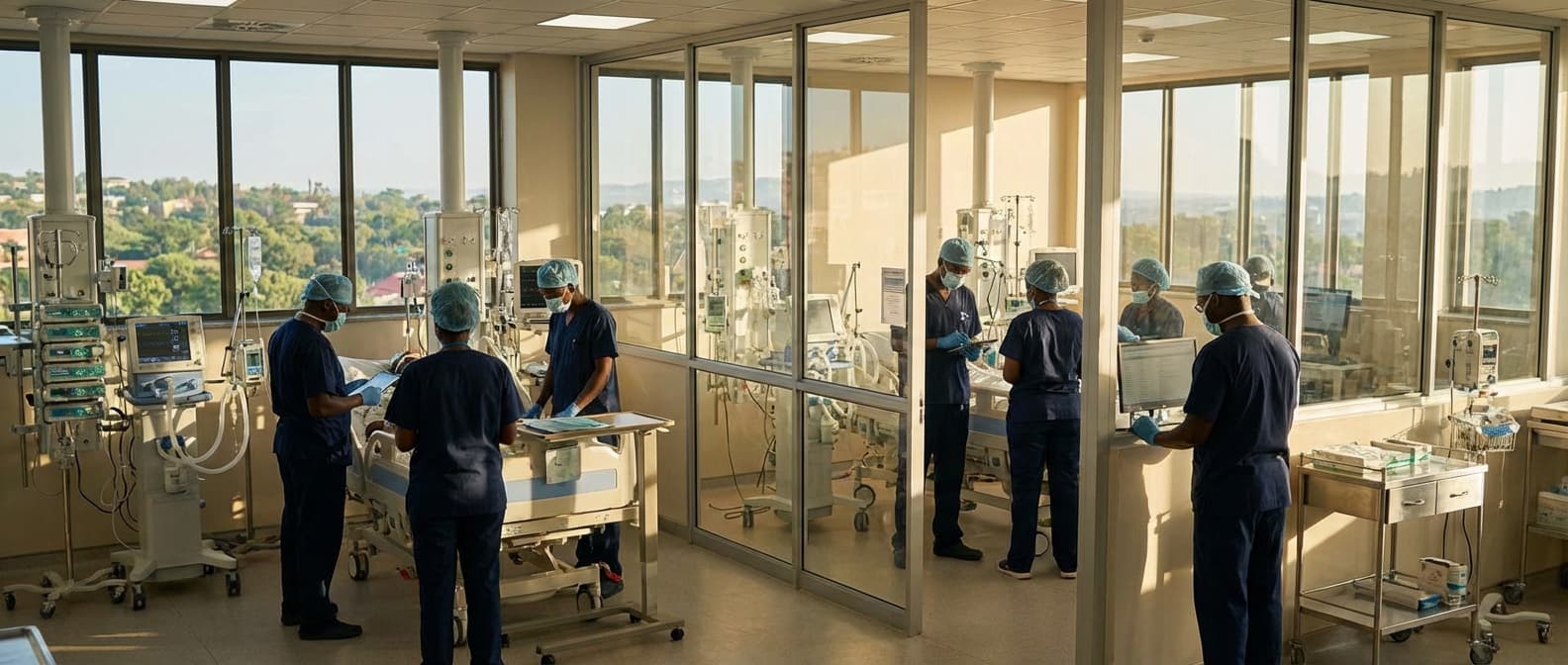
Ventilator Fleet Management & PM in Lesotho
Engineering Excellence & Technical Support
Preventive maintenance and fleet management for ICU ventilators High-standard technical execution following OEM protocols and local regulatory frameworks.
Proactive PM Schedules
Implementing predictive maintenance schedules for the national ventilator fleet, ensuring optimal performance and minimizing unexpected failures through advanced sensor data analysis and historical usage patterns.
Real-time Fleet Visibility
Establishing a centralized, real-time inventory management system for all ventilators across Lesotho's healthcare facilities, enabling accurate tracking of location, status, and maintenance history.
Remote Diagnostics & Support
Deploying remote monitoring capabilities for critical ventilator parameters, allowing for immediate fault detection and enabling remote technical support to address issues efficiently, reducing downtime and travel costs.
What Is Ventilator Fleet Management & Pm In Lesotho?
Ventilator fleet management and Preventive Maintenance (PM) in Lesotho refers to the systematic organization, maintenance, and operational oversight of mechanical ventilators within healthcare facilities. This service is critical for ensuring the consistent availability, optimal functionality, and safe use of these life-sustaining devices, particularly in resource-constrained environments like Lesotho where access to advanced medical equipment and specialized maintenance expertise can be limited. The objective is to maximize device uptime, minimize unexpected failures, and adhere to regulatory and clinical standards.
| Who Needs Ventilator Fleet Management & PM in Lesotho? | Typical Use Cases | ||||||||
|---|---|---|---|---|---|---|---|---|---|
| Public Hospitals and Health Centers: Facilities, especially those in district or rural areas, that rely heavily on mechanical ventilation for respiratory support in critical care, emergency departments, and intensive care units (ICUs). | Management of Ventilators in ICUs: Ensuring constant availability for patients with severe respiratory failure, sepsis, or post-operative complications. | Emergency Preparedness: Maintaining a readily deployable and functional fleet for mass casualty incidents or public health emergencies (e.g., pandemics). | Rural and Remote Clinics: Providing essential respiratory support where access to specialized care is limited. | Non-Governmental Organizations (NGOs) and Donor-Funded Projects: Managing fleets of donated or procured ventilators to ensure their long-term efficacy and sustainability. | Trauma Centers: Supporting patients with acute respiratory distress due to injuries. | Pediatric and Neonatal ICUs: Maintaining specialized ventilators for the unique needs of young patients. | Surgical Recovery Units: Providing short-term ventilation support post-anesthesia or surgery. | Research and Training Institutions: Ensuring reliable equipment for clinical research and medical education. | Long-term Ventilation Support: Managing devices for patients requiring prolonged respiratory assistance. |
| Ministry of Health (MoH): Overall responsibility for healthcare infrastructure, including medical equipment oversight and policy development. | Hospital Administrators and Biomedical Engineering Departments: Direct management and operational control of the ventilator fleet within individual facilities. | Clinical Staff (Physicians, Nurses): Daily users who rely on functional ventilators for patient care and contribute to initial reporting of issues. | Medical Equipment Suppliers and Service Providers: External entities that may provide maintenance, repair, or training services under contract. | International Aid Organizations and Donors: Ensuring the proper utilization and maintenance of donated equipment to achieve program objectives. |
Key Components of Ventilator Fleet Management & PM in Lesotho:
- Inventory Management: Establishing and maintaining a comprehensive and accurate inventory of all ventilators, including make, model, serial number, acquisition date, location, and current operational status. This often involves a centralized digital database.
- Preventive Maintenance (PM) Scheduling & Execution: Developing and adhering to a rigorous PM schedule based on manufacturer recommendations, usage patterns, and local environmental conditions. This includes routine inspections, calibration, cleaning, and replacement of parts prone to wear.
- Corrective Maintenance & Repair: Promptly addressing any malfunctions or breakdowns. This involves troubleshooting, diagnosis, and repair by qualified biomedical engineers or technicians, utilizing approved parts and procedures.
- Performance Monitoring & Data Analysis: Continuously tracking ventilator performance metrics, such as alarms, error codes, and usage hours. Analyzing this data helps identify trends, predict potential failures, and optimize maintenance strategies.
- Training & Competency Assurance: Ensuring that clinical staff (nurses, physicians) are adequately trained on the proper operation, basic troubleshooting, and safety features of the ventilators. Biomedical staff require specialized training on maintenance and repair.
- Logistics & Spare Parts Management: Establishing a reliable system for procuring, storing, and managing a sufficient stock of critical spare parts to minimize downtime during repairs.
- Regulatory Compliance: Adhering to national and international standards for medical device maintenance and safety.
- Asset Lifecycle Management: Planning for the eventual decommissioning, replacement, and disposal of ventilators, considering their economic and technological lifespan.
Who Needs Ventilator Fleet Management & Pm In Lesotho?
Effective Ventilator Fleet Management & Preventative Maintenance (PM) is crucial in Lesotho to ensure the optimal performance, longevity, and readiness of vital respiratory support equipment. This proactive approach safeguards patient care, reduces costly emergency repairs, and extends the lifespan of expensive medical assets, ultimately improving healthcare outcomes for the population.
| Customer/Department | Specific Needs & Responsibilities | Key Benefits of Fleet Management & PM |
|---|---|---|
| Public Hospitals (e.g., Queen 'Mants'ase, Mafeteng, Paray) | Managing a diverse fleet of ventilators acquired through various funding streams. Ensuring consistent availability for emergency and routine patient care. Training clinical staff on proper usage and basic troubleshooting. Coordinating with central procurement for spare parts. | Reduced breakdowns during critical patient care, extended equipment lifespan, cost savings on repairs, improved patient safety, compliance with national health standards. |
| Tertiary/Referral Hospitals (e.g., Queen Elizabeth II Hospital) | Handling a higher volume and complexity of ventilators, often supporting specialized ICUs. Implementing robust PM schedules to minimize downtime. Managing advanced features and calibration requirements. Ensuring interoperability with other critical care equipment. | High equipment uptime for critical patients, optimized resource allocation, enhanced diagnostic and therapeutic capabilities, reduced risk of equipment-related adverse events. |
| Ministry of Health | Overseeing the national health infrastructure, including medical equipment. Developing national policies and guidelines for equipment maintenance. Allocating budgets for procurement and maintenance. Monitoring the condition and performance of the national ventilator fleet. | Strategic overview of national health assets, informed decision-making for procurement and resource allocation, standardization of maintenance practices, improved national health security. |
| Biomedical Engineering Departments/Maintenance Units | Primary responsibility for the hands-on implementation of PM schedules, repairs, and calibration. Maintaining detailed equipment logs and inventory. Troubleshooting complex technical issues. Recommending upgrades or replacements. | Proactive identification and resolution of potential issues, accurate equipment status reporting, efficient spare parts management, extended operational life of ventilators. |
| NGOs (e.g., Doctors Without Borders, local health charities) | Operating in resource-constrained areas, often supplementing public healthcare. Managing donated or acquired ventilators. Ensuring functionality in challenging environments. Training local healthcare workers on basic maintenance. | Maximizing the impact of donated equipment, ensuring reliable support in remote areas, capacity building for local staff, sustained provision of critical care services. |
Target Customers & Departments in Lesotho Requiring Ventilator Fleet Management & PM
- Hospitals (Public and Private)
- District Hospitals
- Tertiary/Referral Hospitals
- Specialized Clinics (e.g., Intensive Care Units, Surgical Centers)
- Ministry of Health
- District Health Management Teams (DHMTs)
- Procurement and Logistics Departments
- Biomedical Engineering Departments
- Maintenance and Repair Units
- Non-Governmental Organizations (NGOs) involved in healthcare delivery
- Medical Equipment Suppliers and Distributors (for servicing contracts)
- Training Institutions (for understanding equipment needs and maintenance)
Ventilator Fleet Management & Pm Process In Lesotho
This document outlines the workflow for managing the ventilator fleet and its associated preventative maintenance (PM) processes within Lesotho. The process is designed to ensure optimal functionality, timely repairs, and efficient resource allocation for all ventilators across the country.
| Stage | Description | Key Activities | Responsible Parties | Output/Deliverable |
|---|---|---|---|---|
| Inquiry & Needs Assessment | Initial identification of a need for ventilator PM or repair. | Healthcare facility staff observe equipment malfunction or schedule routine PM. Contacting the central management unit. | Healthcare Facility Staff, Biomedical Engineering Technicians (BMETs) | Identified need for service. |
| Request Submission & Prioritization | Formal submission of the service request and assessment of urgency. | Submitting a formal request form (digital or paper). Assessing urgency based on patient impact, severity of malfunction, and availability of alternative equipment. Prioritizing requests in a queue. | BMETs, Ministry of Health (MoH) Logistics/Procurement Officer | Prioritized service request queue. |
| Resource Allocation & Scheduling | Assigning personnel, parts, and scheduling the service. | Identifying available BMETs with the necessary skills. Checking stock of required spare parts. Scheduling the visit to the facility, considering geographical location and travel time. Coordinating with the requesting facility. | BMETs, MoH Logistics/Procurement Officer | Scheduled service appointment, confirmed availability of resources. |
| Execution of PM or Repair | Performing the scheduled preventative maintenance or corrective repair. | Traveling to the healthcare facility. Conducting thorough PM checks or diagnosing and repairing the malfunction. Performing tests to ensure full functionality after service. | BMETs | Serviced ventilator, functional equipment. |
| Completion & Documentation | Finalizing the service record and updating inventory. | Completing the service report form, detailing all work performed, parts used, and time taken. Updating the central ventilator asset registry with service history. Obtaining sign-off from the requesting facility. | BMETs, Healthcare Facility Representative | Completed service report, updated asset registry. |
| Fleet Monitoring & Reporting | Ongoing tracking of ventilator status and performance. | Regularly reviewing the asset registry for PM due dates, repair history, and overall fleet utilization. Generating reports on fleet status, maintenance costs, and common issues for strategic decision-making. | MoH Logistics/Procurement Officer, Central Health Management Information System (HMIS) Team | Fleet performance reports, data for strategic planning and procurement. |
Workflow Stages
- Inquiry & Needs Assessment
- Request Submission & Prioritization
- Resource Allocation & Scheduling
- Execution of PM or Repair
- Completion & Documentation
- Fleet Monitoring & Reporting
Ventilator Fleet Management & Pm Cost In Lesotho
Managing a ventilator fleet in Lesotho involves several cost considerations, primarily related to the acquisition, maintenance, and operational upkeep of these critical medical devices. Pricing factors are influenced by the type of ventilator (e.g., ICU, transport, portable), brand reputation, new vs. refurbished status, warranty periods, and the supplier's service offerings. Beyond the initial purchase, preventative maintenance (PM) costs are a significant ongoing expense, covering routine checks, calibration, parts replacement, and trained technician labor. The availability of local technical expertise and spare parts also plays a crucial role in determining PM costs and turnaround times. Government tenders, bulk purchasing, and partnerships with NGOs can often lead to more favorable pricing. The economic climate in Lesotho, including import duties, taxes, and currency fluctuations (primarily against the South African Rand, which is legal tender), will directly impact the final cost of ventilators and their associated PM services.
| Cost Category | Typical Pricing Factor | Estimated Range (LSL) |
|---|---|---|
| New ICU Ventilator (Purchase) | High-end, advanced features, extended warranty | LSL 400,000 - LSL 1,500,000+ |
| Refurbished ICU Ventilator (Purchase) | Older models, limited warranty | LSL 150,000 - LSL 500,000 |
| Portable/Transport Ventilator (Purchase) | Basic functionality, ruggedized | LSL 80,000 - LSL 300,000 |
| Annual Preventative Maintenance (PM) - Per Ventilator | Includes labor, calibration, basic parts | LSL 15,000 - LSL 50,000 |
| Major PM/Repair (Per Incident) | Includes significant part replacement, specialized labor | LSL 30,000 - LSL 150,000+ |
| Service Engineer Call-out Fee | Travel, diagnosis, minor fixes | LSL 5,000 - LSL 15,000 |
| Spare Parts (e.g., Sensors, Batteries) | Cost varies significantly by part and model | LSL 500 - LSL 20,000+ per item |
| Training for Biomedical Technicians | Per technician, per course | LSL 10,000 - LSL 30,000 |
Key Ventilator Fleet Management & PM Cost Factors in Lesotho
- Ventilator Type & Technology
- Brand & Manufacturer Reputation
- New vs. Refurbished Units
- Warranty & Service Contracts
- Preventative Maintenance (PM) Schedule & Scope
- Availability of Local Technical Expertise
- Spare Parts Availability & Cost
- Import Duties & Taxes
- Currency Exchange Rates (vs. ZAR)
- Supplier Markups & Distribution Costs
- Volume Discounts & Tender Pricing
Affordable Ventilator Fleet Management & Pm Options
Managing a ventilator fleet efficiently is crucial for healthcare organizations to ensure patient safety, operational readiness, and cost control. This document outlines affordable fleet management and preventative maintenance (PM) options, emphasizing value bundles and cost-saving strategies. By adopting a proactive and strategic approach to ventilator upkeep, facilities can significantly reduce downtime, extend equipment lifespan, and optimize budgetary resources. We will explore how comprehensive service packages and smart maintenance scheduling can deliver exceptional value.
| Value Bundle Component | Description | Cost-Saving Strategy |
|---|---|---|
| Comprehensive PM Program | Includes scheduled preventative maintenance, calibration, safety checks, and software updates for all ventilators in the fleet. | Reduces unexpected breakdowns and costly emergency repairs. Extends equipment lifespan, delaying capital expenditure. |
| Extended Warranty & Service Contracts | Covers parts and labor for repairs beyond the standard manufacturer warranty. Can be bundled with PM services. | Provides predictable maintenance costs. Protects against unforeseen repair expenses. May include loaner equipment during extended repairs. |
| Managed Parts Inventory | A vendor-managed inventory of critical spare parts, ensuring availability when needed. | Minimizes downtime by having parts readily accessible. Reduces the need for large in-house inventory and associated carrying costs. |
| Bundled Training & Certification | Training for in-house biomedical staff on specific ventilator models and PM procedures. | Empowers internal teams to handle routine tasks, reducing reliance on external service. Improves response times for minor issues. |
| Discounted Consumables | Access to discounted pricing on essential consumables and disposables when purchased through the service provider. | Lower operational costs for day-to-day ventilator use. Simplifies procurement through a single vendor relationship. |
| Equipment Audit & Optimization | Regular review of fleet utilization, performance data, and repair history to identify underutilized or problematic units. | Identifies opportunities to consolidate, reallocate, or replace equipment, optimizing capital investment and reducing maintenance overhead. |
Key Components of Affordable Ventilator Fleet Management & PM Options
- Tiered Service Agreements: Offering different levels of service to match budget and needs (e.g., basic maintenance, comprehensive coverage, parts included).
- On-Demand Service: Access to technicians for unscheduled repairs, often with faster response times.
- Remote Monitoring & Diagnostics: Utilizing technology to identify potential issues before they cause failure, enabling proactive intervention.
- In-House Training & Support: Empowering biomedical teams with the knowledge and tools to perform routine PM and minor repairs.
- Refurbished Equipment Programs: Utilizing certified pre-owned ventilators for less critical applications or to supplement existing fleets.
- Consumables & Parts Management: Bulk purchasing, preferred vendor agreements, and inventory optimization for essential parts.
- Equipment Lifecycle Management: Strategic planning for replacement and upgrades based on usage, repair history, and technological advancements.
Verified Providers In Lesotho
In Lesotho's healthcare landscape, ensuring you connect with verified providers is paramount for quality care. Franance Health stands out as a trusted platform, meticulously credentialing its network of healthcare professionals. This rigorous vetting process guarantees that all providers listed on Franance Health meet stringent standards for education, licensing, experience, and ethical practice. Choosing Franance Health means opting for reliability, expertise, and peace of mind, knowing you are receiving care from individuals who have been thoroughly evaluated and confirmed to be competent and trustworthy. Their commitment to transparency and patient safety makes them the definitive choice for accessing the best healthcare services in Lesotho.
| Verification Aspect | Franance Health Standard | Patient Benefit |
|---|---|---|
| Licensing and Registration | Mandatory verification of current and valid professional licenses with relevant Lesotho regulatory bodies. | Ensures providers are legally authorized to practice and meet national standards. |
| Educational Qualifications | Thorough review of degrees, certifications, and postgraduate training from accredited institutions. | Guarantees providers possess the necessary academic foundation for competent care. |
| Professional Experience | Verification of past employment and clinical experience, often with reference checks. | Confirms practical application of knowledge and skills in real-world healthcare settings. |
| Ethical Conduct and Background Checks | Review of professional conduct records and, where applicable, background checks. | Upholds the highest ethical standards and protects patients from potential harm. |
| Specialization and Competency | Confirmation of specific areas of expertise and certifications in specialized fields. | Allows patients to find providers with the exact skills needed for their condition. |
Why Franance Health is the Best Choice for Verified Providers in Lesotho:
- Rigorous Credentialing Process: Franance Health employs a multi-faceted verification system for all listed providers.
- Focus on Quality and Safety: We prioritize patient well-being by ensuring all providers are qualified and ethical.
- Access to Trusted Professionals: Connect with experienced and licensed doctors, nurses, specialists, and other healthcare professionals.
- Transparency in Provider Information: Detailed profiles allow you to make informed decisions about your care.
- Streamlined Healthcare Access: Easily find and book appointments with verified providers across Lesotho.
Scope Of Work For Ventilator Fleet Management & Pm
This Scope of Work (SOW) outlines the requirements for a comprehensive Ventilator Fleet Management and Preventative Maintenance (PM) program. The objective is to ensure the optimal performance, reliability, and safety of the institution's ventilator fleet, thereby maximizing patient care outcomes and minimizing operational disruptions and costs. This SOW details the technical deliverables and standard specifications required from the service provider.
| Category | Technical Deliverables | Standard Specifications / Requirements |
|---|---|---|
| Fleet Inventory Management | Comprehensive digital inventory of all ventilators. | Includes model, serial number, acquisition date, current location, PM status, warranty information, and repair history. System must be accessible to authorized personnel and allow for real-time updates. |
| Preventative Maintenance (PM) | Scheduled PM services according to manufacturer guidelines and regulatory requirements. | PM frequency and scope to be defined per ventilator model. All PMs must be documented with checklists signed by certified technicians. Use of manufacturer-approved parts and consumables is mandatory. |
| Corrective Maintenance (CM) | On-demand repair services for malfunctioning ventilators. | Response times for critical equipment failures (e.g., within 2-4 hours). Technicians must be qualified and equipped to diagnose and repair complex issues. All repairs must be documented and tested prior to return to service. |
| Calibration & Performance Verification | Regular calibration and performance verification of all ventilators. | Tests must adhere to manufacturer specifications and industry best practices. Calibration certificates must be provided for all units. |
| Technical Support & Troubleshooting | 24/7 availability of technical support for urgent issues. | On-site support for critical failures. Remote diagnostic capabilities are highly desirable. |
| Reporting & Documentation | Detailed reports on PM, CM, calibration, and fleet status. | Reports to include: PM completion rates, mean time between failures (MTBF), mean time to repair (MTTR), cost per ventilator, parts usage, and compliance with service level agreements (SLAs). Reports to be submitted monthly and quarterly. |
| Parts & Consumables Management | Management and stocking of necessary spare parts and consumables. | Maintain adequate stock levels of critical parts to minimize CM delays. Proactive identification and procurement of obsolescent parts. Clear process for tracking and billing parts used. |
| Technician Qualifications | Qualified and certified biomedical technicians. | Technicians must possess relevant certifications (e.g., Certified Biomedical Equipment Technician - CBET) and demonstrable experience with a wide range of ventilator models. Ongoing training to keep skills current. |
| Equipment Decommissioning & Disposal | Procedures for safe and compliant decommissioning and disposal of end-of-life ventilators. | Adherence to environmental regulations and data security protocols for any stored data on devices. |
| Software Updates & Firmware Management | Management of software updates and firmware for ventilators. | Ensuring all devices are running the latest approved versions, tested for compatibility and stability before deployment. |
| User Training Support | Providing basic user training or refresher courses on ventilator operation. | Focus on correct setup, alarm management, and basic troubleshooting for clinical staff. |
Key Objectives of Ventilator Fleet Management & PM Program
- Ensure continuous availability and operational readiness of all ventilators.
- Minimize equipment downtime and associated patient care impacts.
- Extend the lifespan of the ventilator fleet through proactive maintenance.
- Maintain compliance with all relevant regulatory standards and manufacturer recommendations.
- Optimize inventory management for parts and consumables.
- Provide accurate and timely reporting on fleet status, maintenance activities, and costs.
- Enhance the safety and reliability of patient ventilation therapy.
Service Level Agreement For Ventilator Fleet Management & Pm
This Service Level Agreement (SLA) outlines the terms and conditions for Ventilator Fleet Management and Preventative Maintenance (PM) services provided by [Provider Name] to [Client Name]. This SLA defines response times for critical incidents and uptime guarantees for the managed ventilator fleet. The objective is to ensure the optimal performance and availability of the ventilator fleet for patient care.
| Service Category | Severity Level | Response Time Target | Resolution Time Target (On-site/Remote) | Uptime Guarantee |
|---|---|---|---|---|
| Ventilator Fleet Management & PM | Critical (Total Ventilator Failure, Major System Malfunction impacting multiple units) | 15 Minutes (for initial acknowledgement) | 2-4 Hours (on-site for critical failures), 1 Hour (remote diagnosis) | 98% Uptime |
| Ventilator Fleet Management & PM | High (Single Ventilator Malfunction, Performance Degradation) | 30 Minutes (for initial acknowledgement) | 4-8 Business Hours (on-site or remote) | 99% Uptime |
| Ventilator Fleet Management & PM | Medium (Preventative Maintenance Scheduling Conflict, Minor Software Issue) | 2 Business Hours (for initial acknowledgement) | Next Business Day (remote or on-site) | N/A (Preventative maintenance is scheduled) |
| Ventilator Fleet Management & PM | Low (Reporting Inquiry, Non-critical Feature Request) | 4 Business Hours (for initial acknowledgement) | 2-3 Business Days (remote) | N/A |
Scope of Services
- Proactive preventative maintenance scheduling and execution as per manufacturer recommendations and regulatory guidelines.
- Remote monitoring of ventilator status and performance metrics.
- On-site and remote technical support for hardware and software issues.
- Triage and diagnosis of reported issues.
- Coordination of repair and replacement parts.
- Asset tracking and inventory management.
- Performance reporting and analysis.
Frequently Asked Questions

Ready when you are
Let's scope your Ventilator Fleet Management & PM in Lesotho project in Lesotho.

Scaling healthcare logistics and technical systems across the entire continent.