
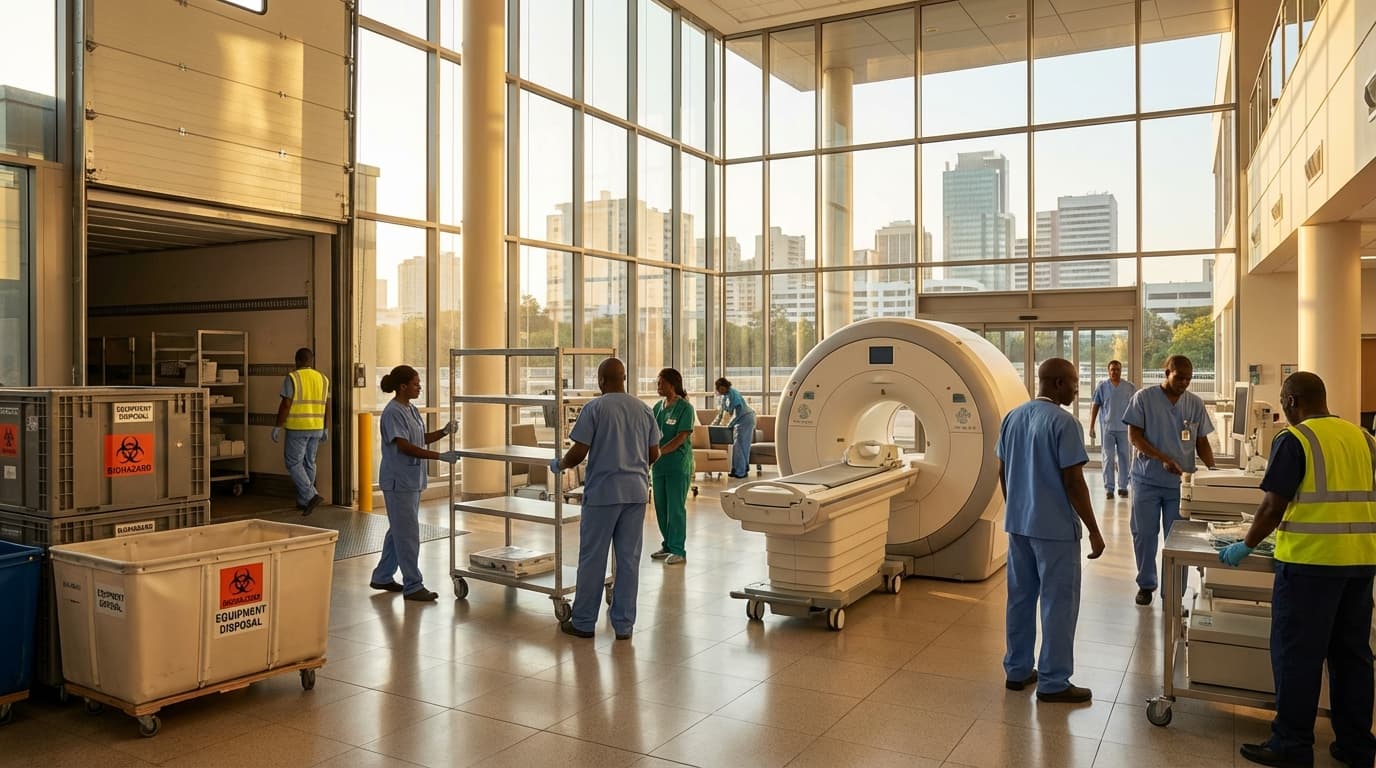
Medical Equipment Relocation Service (Move & Re-Install) in Lesotho
Engineering Excellence & Technical Support
Medical Equipment Relocation Service (Move & Re-Install) High-standard technical execution following OEM protocols and local regulatory frameworks.
Expert Medical Equipment Handling
Our specialized team in Lesotho is trained in the safe and meticulous handling of all types of medical equipment, from sensitive diagnostic machines to large surgical units. We ensure a secure move to prevent damage and preserve operational integrity.
Precision Re-Installation & Calibration
Beyond just moving, we provide certified re-installation and calibration services. Our technicians in Lesotho ensure your medical equipment is set up to manufacturer specifications, guaranteeing accuracy and readiness for immediate use.
Compliance & Certification Assurance
We navigate Lesotho's regulatory landscape for medical equipment relocation. Our service includes adherence to all local health and safety standards, providing the necessary documentation and certifications for your peace of mind and operational legality.
What Is Medical Equipment Relocation Service (Move & Re-install) In Lesotho?
Medical Equipment Relocation Service (Move & Re-Install) in Lesotho refers to a specialized logistical and technical process involving the safe, secure, and compliant transportation of medical devices from one location to another within Lesotho, followed by their professional reassembly, calibration, and functional verification at the new site. This service is critical for healthcare facilities undergoing renovations, expansions, mergers, or relocations, as well as for individual practitioners moving their practices. It necessitates adherence to stringent safety protocols, regulatory requirements (e.g., health and safety standards, potentially specific medical device regulations), and manufacturer specifications to ensure the continued integrity and operational readiness of sensitive and often expensive equipment.
| Who Needs This Service? | Typical Use Cases | |||
|---|---|---|---|---|
| Hospitals & Healthcare Institutions | Renovations or upgrades requiring temporary or permanent equipment movement. | Facility mergers or acquisitions necessitating consolidated equipment inventories. | Opening of new wings, clinics, or satellite facilities. | Strategic asset reallocation within a healthcare network. |
| Specialized Clinics & Diagnostic Centers | Relocation of imaging equipment (e.g., X-ray, CT scanners, MRI machines). | Moving laboratory analyzers and sensitive diagnostic instrumentation. | Transferring surgical equipment and operating room infrastructure. | Setting up new practice locations. |
| Medical Research Facilities | Relocating advanced research instrumentation and laboratory equipment. | Transferring high-precision scientific apparatus. | ||
| Individual Medical Practitioners | Doctors, dentists, physiotherapists, etc., moving their practices to new premises. | |||
| Government Health Agencies | Redeploying or upgrading equipment across public health facilities. |
Key Components of Medical Equipment Relocation (Move & Re-Install)
- Pre-move Assessment & Planning: Detailed inventory, site surveys, risk assessment, and development of a comprehensive relocation strategy.
- Dismantling & Preparation: Expert disassembly of equipment, protective packaging, and securing of components for transit.
- Specialized Transportation: Utilization of appropriate vehicles and handling techniques to prevent damage during transport, considering environmental factors (e.g., temperature, humidity).
- On-site Reassembly: Professional reinstallation of equipment at the destination according to manufacturer guidelines and engineering best practices.
- Calibration & Testing: Verification of equipment accuracy and performance through rigorous calibration and functional testing by certified technicians.
- Documentation & Handover: Provision of detailed records of the relocation process, including testing results and certification of re-installation.
- Decontamination & Sterilization (if applicable): Adherence to protocols for maintaining sterility or ensuring a clean state for sensitive medical devices.
- Compliance & Regulatory Adherence: Ensuring all stages of the process meet relevant Lesotho health, safety, and potentially medical device regulations.
Who Needs Medical Equipment Relocation Service (Move & Re-install) In Lesotho?
Moving and re-installing specialized medical equipment is a complex and critical task, requiring a dedicated service provider who understands the unique needs of the healthcare sector. In Lesotho, various entities and departments regularly face the necessity of relocating such sensitive equipment, whether for facility upgrades, expansions, new installations, or internal department transfers. This is not a DIY job; it demands expert handling to ensure the integrity and functionality of expensive and vital medical devices, minimizing downtime and ensuring patient care is not compromised.
| Target Customer/Entity | Specific Departments/Areas Requiring Service | Typical Relocation Scenarios |
|---|---|---|
| Public Hospitals (e.g., Queen 'Mants'ase Children's Hospital, Queen Elizabeth II Hospital) | Radiology (X-ray, CT, MRI), Pathology Labs, Surgical Theatres, Intensive Care Units (ICU), Operating Rooms (OR), Sterilization Units, Emergency Departments | Facility renovations, equipment upgrades, ward relocations, installation of new diagnostic machinery, departmental restructuring. |
| Private Hospitals and Clinics (e.g., Lesotho Medical Services, private surgical centers) | Diagnostic Imaging Suites, Laboratory Services, Maternity Wards, Outpatient Departments, Pharmacy | Expansion of services, installation of advanced imaging technology, inter-clinic transfers, office consolidation, setup of new branches. |
| Diagnostic Laboratories (e.g., National Health Laboratory Service) | Microbiology, Biochemistry, Hematology, Molecular Diagnostics, Blood Banks | Acquisition of new automated analyzers, lab upgrades, relocation to larger or better-equipped facilities, departmental reorganization for workflow efficiency. |
| Specialized Medical Centers (e.g., Physiotherapy clinics, Dental clinics, Ophthalmology centers) | Treatment rooms, imaging equipment areas, consultation rooms | Relocation to more accessible locations, acquisition of new therapy equipment, expansion of service offerings, practice mergers. |
| Research Institutions and Universities (Medical faculties) | Research laboratories, teaching labs, specialized equipment storage | Setting up new research projects, upgrading lab infrastructure, moving between campus buildings, acquisition of advanced research equipment. |
| Government Health Departments and Ministries | Centralized laboratories, administrative offices requiring specialized equipment, national health programs | Consolidation of resources, relocation of essential public health equipment, establishment of new regional health facilities. |
| Non-Governmental Organizations (NGOs) involved in healthcare | Mobile clinics, community health centers, training facilities | Deployment of equipment to new project sites, upgrades of existing facilities, provision of equipment to underserved areas, setting up temporary medical installations. |
Who Needs Medical Equipment Relocation Service (Move & Re-Install) in Lesotho?
- Hospitals (Public and Private)
- Clinics and Health Centers
- Diagnostic Laboratories
- Specialized Medical Centers (e.g., imaging, physiotherapy)
- Research Institutions
- Medical Training Facilities
- Government Health Departments
- Non-Governmental Organizations (NGOs) involved in healthcare
- Private Medical Practitioners with multiple locations or needing upgrades
Medical Equipment Relocation Service (Move & Re-install) Process In Lesotho
This document outlines the comprehensive workflow for the Medical Equipment Relocation Service (Move & Re-Install) in Lesotho, from initial client inquiry to the successful re-installation and handover of medical equipment. The process is designed to ensure minimal disruption, safety, and compliance with relevant regulations.
| Phase | Key Activities | Responsible Party | Key Deliverables/Outcomes | Notes/Considerations |
|---|---|---|---|---|
| Client contacts service provider for relocation needs. | Client | Service request received. | Initial contact can be via phone, email, or website form. |
| Provider visits site(s), inspects equipment, discusses client needs and timelines. | Service Provider (Technical Assessor/Sales Representative) | Detailed understanding of scope, identification of risks, preliminary plan. | Consideration of access, power requirements, environmental factors. |
| Provider prepares and submits a detailed quotation and proposal. | Service Provider (Sales/Management) | Formal quotation and service proposal outlining costs, timeline, and services. | Includes breakdown of costs for packing, transport, insurance, re-installation. |
| Client reviews and accepts the quotation; contract is signed. | Client & Service Provider | Signed service agreement/contract. | Clearly defines terms, conditions, liabilities, and payment schedule. |
| Detailed relocation plan developed, including dates, times, resources, and communication protocols. | Service Provider (Project Manager/Logistics Team) | Comprehensive relocation plan, confirmed schedule, and assigned team. | Coordination with client's operations and facility management. |
| Equipment preparation: disassembly, cleaning, specialized packing, labeling, inventory creation. | Service Provider (Technical Team) | Professionally packed and labeled equipment, detailed inventory list. | Adherence to manufacturer's guidelines and regulatory requirements for specific equipment. |
| Secure and safe transit of equipment from origin to destination. | Service Provider (Logistics Team/Drivers) | Equipment safely transported to the new location. | Use of appropriate vehicles, securing methods, and trained personnel. Insurance coverage is crucial. |
| Equipment moved into place, assembled, connected, and configured according to specifications. | Service Provider (Technical Team) | Equipment physically installed at the new site. | Ensuring correct placement, power, and network connectivity. |
| Thorough functional testing, performance validation, and calibration of the equipment. | Service Provider (Biomedical Engineers/Technicians) | Verified functional and calibrated equipment. | Compliance with industry standards and manufacturer's performance specifications. |
| Demonstration of equipment functionality, user training, and provision of documentation. | Service Provider (Technical Team/Trainer) | Trained client staff, completed handover documentation, and sign-off. | Emphasis on safe operation and basic troubleshooting. |
| Addressing client queries, minor adjustments, and follow-up verification. | Service Provider (Customer Support/Technical Team) | Client satisfaction, resolution of any immediate issues. | Maintenance of good client relationships. |
Medical Equipment Relocation Service Workflow in Lesotho
- Inquiry & Initial Consultation: The process begins with a client (hospital, clinic, research facility, etc.) initiating contact to inquire about medical equipment relocation services.
- Site Assessment & Quotation: A thorough assessment of the equipment and sites is conducted to understand the scope of work, identify potential challenges, and prepare a detailed quotation.
- Planning & Logistics Coordination: Upon acceptance of the quotation, a comprehensive relocation plan is developed, including scheduling, transportation, staffing, and necessary permits.
- Equipment Preparation & Disassembly: Medical equipment is carefully prepared for transport, which may involve specialized disassembly, packing, and labeling according to manufacturer guidelines and safety protocols.
- Secure Transportation: The equipment is transported using specialized vehicles and techniques to ensure its safety and integrity throughout the journey within Lesotho.
- Re-installation & Configuration: At the destination, the equipment is expertly re-installed, configured, and calibrated to meet manufacturer specifications and operational requirements.
- Testing & Validation: Rigorous testing and validation procedures are performed to confirm the equipment's functionality, accuracy, and safety.
- Client Handover & Training: A final handover is conducted with the client, including comprehensive training for their staff on the re-installed equipment, and all necessary documentation is provided.
- Post-Relocation Support & Follow-up: Ongoing support is offered, including addressing any immediate post-installation queries and scheduling follow-up checks if required.
Medical Equipment Relocation Service (Move & Re-install) Cost In Lesotho
Relocating medical equipment in Lesotho can be a complex and specialized undertaking, often requiring expert handling to ensure the integrity and functionality of sensitive instruments. The cost of such services is influenced by a variety of factors, making it essential to obtain detailed quotes from providers. This discussion outlines the key pricing determinants and provides estimated cost ranges in Maloti (LSL).
| Service Component | Estimated Cost Range (LSL) | Notes |
|---|---|---|
| Basic Relocation (Small to Medium Equipment, Short Distance) | 2,000 - 7,500 | Includes labor, standard vehicle, and basic packing for less sensitive items. |
| Standard Relocation (Medium to Large Equipment, Moderate Distance) | 7,500 - 25,000 | Covers more complex packing, specialized handling, larger vehicle, and moderate distances. |
| Specialized Relocation (Large/High-Tech Equipment, Long Distance, Dismantling/Re-assembly) | 25,000 - 100,000+ | Includes expert technicians, specialized equipment (cranes, climate control), extensive packing, and long-haul transport. Costs can escalate significantly for extremely large or sensitive items. |
| Consultation and Site Survey | 500 - 2,000 | Often a one-time fee for initial assessment and planning. |
| Insurance Premium (per LSL 10,000 of value) | 50 - 200 | Varies based on the insurer and the value of the equipment. |
| Dismantling & Re-assembly (per hour, by technician) | 400 - 1,500 | Dependent on the complexity of the equipment and the technician's specialization. |
| Specialized Packaging/Crating | 1,000 - 15,000+ | Costs depend on the size, materials, and custom nature of the packaging. |
Key Pricing Factors for Medical Equipment Relocation in Lesotho:
- {"title":"Type and Size of Equipment:","description":"Larger, heavier, or more intricate equipment (e.g., MRI machines, CT scanners, large laboratory centrifuges) will naturally incur higher relocation costs due to the need for specialized lifting gear, larger vehicles, and more personnel. Smaller items like diagnostic kits or basic lab glassware will be significantly less expensive."}
- {"title":"Distance of Relocation:","description":"The geographical distance between the origin and destination is a primary cost driver. Longer hauls will involve increased fuel consumption, driver time, and potential overnight accommodation for the relocation team. Inter-city moves within Lesotho will differ in price from moves to remote or rural areas."}
- {"title":"Complexity of Dismantling and Re-assembly:","description":"Some medical equipment requires specialized dismantling and re-assembly procedures by certified technicians. This adds significant labor costs and may involve specific tools and expertise, particularly for high-tech or sensitive machinery."}
- {"title":"Special Handling and Precautions:","description":"Many medical devices are fragile and require careful handling, shock absorption, and climate control during transit. This can necessitate specialized packaging, temperature-controlled vehicles, and a higher level of care, all of which contribute to the overall cost."}
- {"title":"Insurance Coverage:","description":"Adequate insurance for the valuable medical equipment during transit is crucial. The cost of comprehensive insurance will be factored into the service fee. Higher value equipment will naturally have higher insurance premiums."}
- {"title":"Accessibility of Locations:","description":"Difficult access to either the pick-up or delivery point (e.g., narrow doorways, upper floors without elevators, unpaved roads) can increase labor time and require specialized equipment, thereby raising costs."}
- {"title":"Time Sensitivity and Urgency:","description":"Rush jobs or tight deadlines often come with premium pricing. If the relocation needs to be completed outside of standard business hours or on weekends, expect additional charges."}
- {"title":"Need for Specialized Technicians/Engineers:","description":"If the equipment requires calibration or testing by a certified manufacturer's technician or engineer before and after relocation, these specialized services will be an additional cost."}
- {"title":"Packaging and Crating Materials:","description":"The cost of custom crating, padding, and specialized packaging materials for sensitive equipment is a direct expense that will be passed on to the client."}
- {"title":"Permits and Approvals:","description":"In some cases, permits or special approvals might be required for transporting large or sensitive medical equipment, especially across borders or through certain regions. This can incur administrative fees."}
Affordable Medical Equipment Relocation Service (Move & Re-install) Options
Moving specialized medical equipment requires a high level of care, expertise, and precision. Our Affordable Medical Equipment Relocation Service (Move & Re-Install) is designed to provide a seamless and cost-effective solution for healthcare facilities, clinics, and individual practitioners. We understand the critical nature of your equipment and prioritize its safe transit and accurate re-installation to minimize downtime and ensure operational readiness. We offer flexible service packages, valuable bundles, and strategic cost-saving measures to meet your specific needs and budget constraints.
| Value Bundle Name | Included Services | Key Benefits | Estimated Price Range (Illustrative) |
|---|---|---|---|
| Basic Move & Re-Install | Equipment pickup, secure transport, uncrating, placement, basic connection (power/network). | Cost-effective for standard equipment with minimal setup requirements. Focus on safe transit. | $500 - $2,500 per item |
| Advanced Move & Re-Install | All Basic services plus specialized packing, environmental controls during transit, re-installation of complex systems, initial functional testing. | Ideal for sensitive or complex equipment requiring a higher level of care and verification. | $1,500 - $7,000 per item |
| Full-Service Relocation Package | Comprehensive site survey, complete de-installation, custom crating, secure transportation, full re-installation, calibration, calibration verification, staff training on new placement, redundant system testing. | Turnkey solution for large-scale moves or critical equipment. Minimizes facility downtime and ensures immediate operational readiness. | Custom Quote Required (based on scope and equipment) |
| Multi-Unit Discount Bundle | Discounted pricing when relocating multiple pieces of equipment in a single move. | Significant cost savings for larger facilities or practice consolidations. | 10-25% off standard rates per item |
Our Comprehensive Medical Equipment Relocation Services Include:
- On-site assessment and consultation
- Specialized packing and crating materials
- Secure transportation with climate-controlled options
- Professional uncrating and placement
- Expert re-installation and calibration
- Testing and validation post-installation
- Decommissioning and disposal of old equipment (optional)
- Comprehensive insurance coverage
- Experienced and trained technical staff
Verified Providers In Lesotho
In Lesotho, ensuring access to reliable and high-quality healthcare is paramount. Franance Health stands out as a leading provider, offering a comprehensive suite of services backed by stringent credentialing processes. This commitment to verification not only guarantees patient safety but also signifies a dedication to excellence in healthcare delivery. Understanding why Franance Health's credentials represent the best choice involves examining their rigorous selection criteria, their adherence to international standards, and the tangible benefits this brings to patients in Lesotho.
| Franance Health Credential | Meaning for Patients in Lesotho | Why it Represents the Best Choice |
|---|---|---|
| Board Certification in Specialities | Ensures doctors have met the highest standards of knowledge and expertise in their chosen medical field. | Guarantees access to specialists with proven competence, leading to accurate diagnoses and effective treatment plans. |
| Active Medical Licenses and Registration | Confirms that healthcare professionals are legally permitted to practice in Lesotho and adhere to regulatory requirements. | Provides a layer of assurance that providers are accountable and meet the basic professional standards set by the governing bodies. |
| Verification of Educational Background and Training | Confirms the authenticity and completeness of a provider's medical education and specialized training from recognized institutions. | Reduces the risk of unqualified individuals providing care, ensuring patients receive treatment from genuinely trained medical professionals. |
| Background Checks and Criminal Record Verification | Ensures that healthcare providers have no history of misconduct or criminal activity that could compromise patient safety. | Promotes a secure and trustworthy healthcare environment, protecting vulnerable patients from harm. |
| Peer Review and Performance Monitoring | Involves ongoing evaluation of a provider's clinical performance and adherence to best practices by their peers. | Drives continuous improvement in care quality, identifying and addressing any potential areas for enhancement. |
| Malpractice Insurance | Confirms that providers are insured against medical malpractice claims, protecting both the provider and the patient. | Offers financial recourse and protection for patients in the unlikely event of substandard care or negligence. |
Key Aspects of Franance Health's Verified Provider Status:
- Rigorous credentialing and privileging processes for all healthcare professionals.
- Adherence to national and international healthcare quality standards and regulations.
- Commitment to continuous professional development and ongoing training for staff.
- Emphasis on patient safety, ethical practices, and evidence-based medicine.
- Transparency in provider qualifications and service offerings.
Scope Of Work For Medical Equipment Relocation Service (Move & Re-install)
This Scope of Work (SOW) outlines the requirements for the relocation and re-installation of medical equipment at [Client Facility Name] from [Origin Location] to [Destination Location]. The service provider shall be responsible for the safe, efficient, and compliant execution of all tasks related to the transportation and re-commissioning of designated medical equipment. Technical deliverables and standard specifications are detailed below.
| Phase | Activity | Description | Technical Deliverables | Standard Specifications/Requirements | ||||||||||||||||||||
|---|---|---|---|---|---|---|---|---|---|---|---|---|---|---|---|---|---|---|---|---|---|---|---|---|
| Planning & Preparation | Site Survey & Assessment | Conduct a thorough survey of both origin and destination sites, identifying access routes, power/utility requirements, potential hazards, and staging areas. Assess environmental conditions (temperature, humidity). | Site Survey Report (including floor plans, access constraints, utility maps, risk assessment). | Site survey conducted by qualified personnel. Report submitted at least [X] days prior to move date. Identification of all equipment to be moved. | Decontamination Protocol | Develop and implement a pre-move decontamination plan for all equipment, following established infection control guidelines. | Decontamination Certificates/Logs for each equipment item. | Compliance with [Client Facility's] approved decontamination procedures. Use of EPA-approved disinfectants. Trained personnel. | Equipment Tagging & Inventory | Tag and inventory all equipment to be moved, including serial numbers, asset tags, and current condition. | Master Equipment Inventory List (with photos of condition, if applicable). Tagging system that is durable and easily visible. | Crating & Protection | Design and construct custom crating or utilize approved protective materials for sensitive equipment. | Custom crates or protective packaging for each piece of equipment. Evidence of vibration and shock protection measures. | Manufacturer's recommendations for packaging and transportation of sensitive equipment shall be followed. | Logistics & Scheduling | Develop a detailed move schedule, coordinating with [Client Facility] stakeholders and minimizing disruption to operations. | Move Schedule/Timeline. Communication Plan. | Scheduled downtime coordinated with [Client Facility] departments. Approval of the schedule by [Client Facility Representative]. | Utility Disconnection Plan | Develop a plan for safe and compliant disconnection of all utilities (power, water, gas, data) from the equipment. | Utility Disconnection Matrix (identifying equipment, utility, disconnection procedure, and responsible party). | Disconnection performed by qualified technicians. Adherence to safety lockout/tagout procedures. | Coordination with facility engineers. |
| Execution (Move Phase) | Equipment Disassembly (if required) | Safely disassemble any equipment requiring it for transport, following manufacturer's guidelines. Document disassembly process. | Disassembly Report (with photos/videos). Labeled parts and components. | Performed by trained technicians. Use of manufacturer-recommended tools. Proper storage of disassembled parts. | Transportation | Transport equipment from origin to destination using appropriate vehicles and handling techniques. | Bill of Lading. Proof of Insurance. GPS Tracking Log (if applicable). | Vehicles equipped with climate control (if required for sensitive equipment). Securement of equipment during transit. Insurance coverage of at least $[Amount] per occurrence. | Environmental Monitoring during Transit | Monitor and record environmental conditions (temperature, humidity) during transit, if specified for sensitive equipment. | Environmental Monitoring Logs. | Use of calibrated data loggers. Report to be submitted post-transit. | Equipment Loading & Unloading | Carefully load and unload all equipment, utilizing appropriate lifting equipment and ensuring safe handling. | Loading/Unloading Sign-off Sheet. | Use of certified operators for all lifting equipment. Adherence to weight limits and structural integrity of ramps and lifts. | Site Preparation at Destination | Ensure destination sites are prepared according to the site survey, including power, utility hookups, and access. | Confirmation of site readiness by [Client Facility Representative]. | Coordination with facility engineers and IT departments. | ||||
| Execution (Re-Installation Phase) | Equipment Reassembly (if required) | Reassemble any equipment disassembled for transport, ensuring all connections are secure and correct. | Reassembly Report (with photos/videos). | Performed by trained technicians. Verification of all connections. | Utility Reconnection | Safely and correctly reconnect all utilities to the equipment, following manufacturer specifications and facility guidelines. | Utility Reconnection Sign-off Sheet. Verification of correct utility connections. | Performed by qualified technicians. Adherence to safety lockout/tagout procedures. Coordination with facility engineers. | Equipment Calibration & Testing | Calibrate and test all re-installed equipment to ensure full functionality and accuracy according to manufacturer specifications. | Calibration Certificates. Functional Test Reports. Performance Verification Documentation. | Performed by manufacturer-certified technicians or appropriately trained personnel. Use of traceable calibration standards. Documentation of all test results. | Initial Performance Verification | Conduct an initial performance verification to confirm the equipment is operating as intended in its new location. | Initial Performance Verification Report. | Sign-off by [Client Facility Representative] and Service Provider Representative. | Infection Control Compliance | Ensure all re-installation activities comply with relevant infection control protocols and standards. | Confirmation of Infection Control Protocol Adherence. | Use of personal protective equipment (PPE). Proper waste disposal. Maintaining sterile fields where applicable. | ||||
| Closeout | Documentation & Reporting | Provide comprehensive documentation of the entire relocation and re-installation process. | Final Project Report (including all previous deliverables, summary of activities, any deviations, and lessons learned). | Report submitted within [X] days of completion. All documentation to be provided in [Format - e.g., PDF, electronic archive]. | Training (if required) | Provide basic operational training to [Client Facility] staff on the re-installed equipment if significant changes or new models are involved. | Training Records. Training Materials. | Training provided by qualified personnel. Tailored to [Client Facility] staff needs. | Waste Removal | Remove all debris, packaging materials, and waste generated during the relocation process. | Waste Removal Manifest. | Environmentally responsible disposal of waste. Compliance with local regulations. | Final Walkthrough & Sign-off | Conduct a final walkthrough with [Client Facility Representative] to ensure all requirements have been met and obtain final sign-off. | Final Project Sign-off Document. | Joint inspection and agreement on project completion. |
Project Objectives
- To successfully move all specified medical equipment from the origin to the destination location with minimal downtime and risk of damage.
- To ensure all re-installed equipment is fully functional and calibrated to manufacturer specifications.
- To adhere to all relevant safety regulations, infection control protocols, and environmental standards throughout the relocation process.
- To provide comprehensive documentation of the entire relocation and re-installation process.
Service Level Agreement For Medical Equipment Relocation Service (Move & Re-install)
This Service Level Agreement (SLA) outlines the response times and uptime guarantees for the Medical Equipment Relocation Service (Move & Re-Install), hereinafter referred to as 'the Service'. This SLA is an addendum to the Master Service Agreement between [Client Name/Hospital Name] and [Service Provider Name].
| Service Level Objective | Target | Measurement Method | SLA Metric |
|---|---|---|---|
| Initial Response Time (Critical) | Within 30 minutes of ticket creation | System-generated timestamp upon receipt of a Level 1 Critical Service Request. | Response Time |
| On-site Arrival Time (Critical - Post-Response) | Within 4 hours of initial response | Actual arrival time confirmed by client acknowledgement or site log. | Availability of technicians for critical issues |
| Initial Response Time (Non-Critical) | Within 4 business hours of ticket creation | System-generated timestamp upon receipt of a Level 2 or Level 3 Service Request. | Response Time |
| On-site Arrival Time (Non-Critical - Post-Response) | Within 24 business hours of initial response | Actual arrival time confirmed by client acknowledgement or site log. | Availability of technicians for non-critical issues |
| Equipment Operational Uptime (Post-Re-Install) | 99.9% during scheduled operational hours | Percentage of time the relocated equipment is fully functional and available for its intended use, as verified by client confirmation and system logs, excluding scheduled maintenance and pre-defined downtime windows. | Uptime |
| Scheduled Downtime Communication | Minimum 7 days advance notice for planned downtime exceeding 2 hours | Formal written notification to designated client contacts. | Communication timeliness |
Service Level Objectives (SLOs)
- 1. Response Times for Critical Issues:
- 2. Response Times for Non-Critical Issues:
- 3. Uptime Guarantees:
- 4. Definitions:
- 5. Exclusions:
- 6. Service Credits:
- 7. Reporting:
- 8. Review and Amendments:
Frequently Asked Questions

Ready when you are
Let's scope your Medical Equipment Relocation Service (Move & Re-Install) in Lesotho project in Lesotho.

Scaling healthcare logistics and technical systems across the entire continent.