
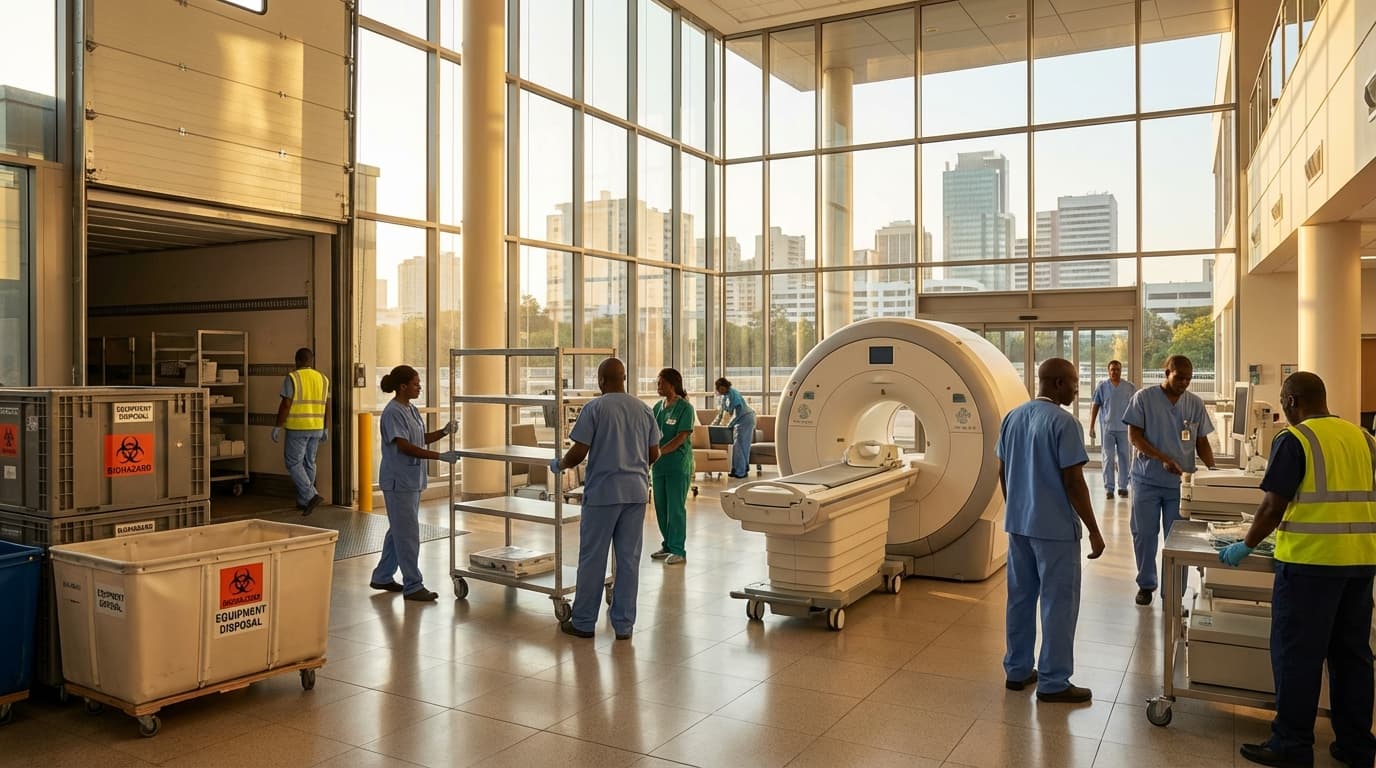
Medical E-Waste Handling & Recycling Coordination Service in Lesotho
Engineering Excellence & Technical Support
Medical E-Waste Handling & Recycling Coordination Service High-standard technical execution following OEM protocols and local regulatory frameworks.
Comprehensive Asset Tracking & Chain of Custody
Our advanced platform provides end-to-end tracking of medical e-waste from point of generation to final destruction, ensuring full compliance with hazardous waste regulations and complete audit trails for healthcare facilities in Lesotho.
Specialized Hazardous Material Segregation & Safe Disposal Protocols
We implement rigorous, medically-informed protocols for the identification, segregation, and safe handling of various medical e-waste streams, including those containing hazardous materials, minimizing environmental contamination and health risks specific to Lesotho's context.
Optimized Recycling & Resource Recovery for Healthcare Infrastructure
Leveraging our network of certified recycling partners, we maximize the recovery of valuable resources from medical e-waste, generating cost savings for Lesotho's healthcare sector while promoting a circular economy and reducing the reliance on virgin materials.
What Is Medical E-waste Handling & Recycling Coordination Service In Lesotho?
Medical e-waste handling and recycling coordination services in Lesotho refer to the organized management of electronic and electrical equipment (EEE) generated by healthcare facilities that have reached their end-of-life. This encompasses the entire lifecycle of medical e-waste, from its generation and segregation at source to its safe collection, transportation, dismantling, material recovery, and final disposal. The service aims to ensure that this specialized waste stream is managed in an environmentally sound, compliant, and economically viable manner, mitigating the significant health and environmental risks associated with improper disposal of hazardous materials present in medical e-waste, such as heavy metals and persistent organic pollutants.
| Target Audience | Needs Addressed | Typical Use Cases |
|---|---|---|
| Hospitals (Public & Private) | Safe disposal of outdated diagnostic imaging equipment (e.g., X-ray machines, CT scanners), laboratory instruments, patient monitoring devices, and surgical tools incorporating electronic components. Compliance with environmental regulations. | Scheduled replacement of imaging technology, decommissioning of old laboratories, upgrade of medical equipment fleets. |
| Clinics and Health Centers | Management of smaller electronic medical devices such as blood pressure monitors, glucose meters, and basic diagnostic equipment. Cost-effective and compliant disposal solutions. | Routine equipment obsolescence, transitioning to digital health records requiring new devices. |
| Medical Research Institutions | Disposal of specialized laboratory equipment, analytical instruments, and data processing hardware. Secure data destruction for sensitive research information. | Project completion requiring specialized equipment, upgrade of research infrastructure. |
| Government Health Ministries & Environmental Agencies | Establishing and overseeing a national framework for medical e-waste management. Monitoring and enforcement of waste disposal policies. Development of national e-waste recycling strategies. | Implementing national waste management policies, responding to environmental incidents related to improper e-waste disposal, capacity building for healthcare sector. |
| Medical Equipment Manufacturers & Suppliers | End-of-life product stewardship. Facilitating take-back programs. Ensuring responsible disposal of their products within Lesotho. | Launch of new product lines requiring disposal of older models, fulfilling extended producer responsibility (EPR) obligations. |
Key Components of Medical E-Waste Handling & Recycling Coordination Service in Lesotho
- Waste Stream Identification and Characterization: Defining and categorizing medical e-waste based on its origin and hazardous content.
- Regulatory Compliance Advisory: Ensuring adherence to national and international regulations governing hazardous waste management.
- Logistics and Transportation Management: Establishing secure and compliant pathways for the collection and transit of medical e-waste.
- Specialized Collection and Storage Infrastructure: Developing or facilitating access to appropriate facilities for temporary storage and consolidation.
- Processing and Recycling Partnerships: Identifying and engaging licensed and reputable e-waste recyclers with the capability to handle hazardous medical equipment.
- Data Management and Reporting: Tracking waste volumes, material flows, and disposal records for accountability and auditing.
- Stakeholder Engagement and Training: Educating healthcare personnel on proper e-waste segregation, handling protocols, and the importance of the service.
- Environmental and Health Risk Assessment: Continuously evaluating and mitigating potential environmental contamination and occupational health hazards.
Who Needs Medical E-waste Handling & Recycling Coordination Service In Lesotho?
Effective management and recycling of medical e-waste in Lesotho is a critical concern requiring specialized coordination services. This service aims to streamline the collection, transportation, treatment, and environmentally sound disposal of electronic waste generated by the healthcare sector. Identifying the key beneficiaries and departments involved is crucial for successful implementation and widespread adoption of best practices.
| Target Customer/Department | Key Needs & Responsibilities | How Coordination Service Benefits Them |
|---|---|---|
| Public and Private Hospitals | Large volumes of e-waste (imaging equipment, monitors, old IT infrastructure). Need for compliant and safe disposal methods. Potential for cost savings through recycling. | Streamlined collection and disposal logistics. Compliance assurance. Access to certified recycling partners. Reduced environmental liability. Potential revenue from valuable material recovery. |
| Community Clinics and Health Centers | Smaller but consistent generation of e-waste (diagnostic tools, basic medical electronics). Limited resources for dedicated e-waste management. | Cost-effective collection solutions. Simplified compliance. Access to specialized handling expertise. Reduced burden on existing staff. |
| Medical Equipment Suppliers & Manufacturers | Responsibility for end-of-life management of their products (Extended Producer Responsibility - EPR). Need for reliable and environmentally sound take-back programs. | Facilitated EPR compliance. Brand protection through responsible disposal. Access to data on product lifecycle and waste streams. Partnership opportunities for sustainable product design. |
| Ministry of Health | Oversight of the healthcare sector. Setting national e-waste policies and regulations. Ensuring public health and environmental protection. | Data collection and reporting for policy development. Facilitation of national e-waste management strategies. Enforcement of regulations. Improved public health outcomes and environmental quality. |
| Ministry of Energy and Meteorology (Environmental Division) | Responsibility for environmental protection, waste management policies, and licensing of waste handlers. | Easier monitoring and regulation of medical e-waste. Access to accurate data for environmental impact assessments. Support for developing and enforcing appropriate waste management standards. |
| Ministry of Trade and Industry | Promotion of economic development, including the potential for a local e-waste recycling industry. | Identification of opportunities for local job creation in e-waste processing. Support for developing a circular economy for medical electronics. Facilitation of investment in recycling infrastructure. |
| NGOs working in the Health Sector | Often operate clinics or provide health services in remote areas. Need for efficient and affordable waste management solutions. | Cost-effective and accessible e-waste disposal. Compliance support for their operations. Contribution to sustainable healthcare delivery. |
| Universities and Research Institutions (Medical Faculties) | Generation of e-waste from specialized medical equipment and IT used in research and education. | Safe and compliant disposal of sensitive or specialized e-waste. Support for research into medical e-waste challenges and solutions. Educational opportunities related to environmental sustainability in healthcare. |
Who Needs Medical E-Waste Handling & Recycling Coordination Service in Lesotho?
- Healthcare Facilities (Hospitals, Clinics, Health Centers)
- Medical Equipment Suppliers and Manufacturers
- Government Ministries and Agencies
- Non-Governmental Organizations (NGOs) in the Health Sector
- Research and Educational Institutions with Medical Programs
Medical E-waste Handling & Recycling Coordination Service Process In Lesotho
This document outlines the workflow for the Medical E-Waste Handling & Recycling Coordination Service Process in Lesotho, from initial inquiry to successful execution. The service aims to ensure safe, compliant, and environmentally responsible management of medical electronic waste generated within the country.
| Stage | Description | Key Activities | Responsible Parties | Outcome/Deliverable |
|---|---|---|---|---|
| The process begins when a healthcare facility or organization expresses interest in the medical e-waste handling and recycling service. An initial assessment is conducted to understand their specific needs and the types/quantities of medical e-waste generated. | Receive and acknowledge inquiry, Schedule initial consultation, Discuss waste profile (types, quantities, frequency), Assess current handling practices, Provide preliminary service overview and pricing. | Client (Healthcare Facility), Service Provider (Coordination Team) | Understanding of client's waste management needs, Preliminary cost estimate, Agreement to proceed to the next stage. |
| Formal agreement is established, outlining the scope of services, terms, conditions, pricing, and responsibilities. Detailed planning for collection and processing commences. | Develop and present detailed service proposal, Negotiate and finalize service agreement/contract, Develop customized collection schedule, Identify specific recycling partners, Plan logistics for collection and transportation. | Client, Service Provider (Coordination Team), Legal Counsel (if required) | Signed Service Agreement, Detailed Collection & Logistics Plan, Identified Recycling Partners. |
| The medical e-waste is collected from the client's premises. Proper segregation at the source or upon collection is crucial for efficient and compliant recycling. | Provide appropriate collection containers/bags, Schedule and execute waste collection as per plan, Supervise and ensure proper segregation of medical e-waste (e.g., sharps, hazardous, non-hazardous e-waste), Initial inventory and labeling of collected waste. | Client (Source Segregation), Service Provider (Collection Team), Specialized Waste Handlers | Collected Medical E-Waste, Segregated Waste Streams, Initial Waste Inventory Log. |
| Collected medical e-waste is transported to designated processing facilities. Robust tracking mechanisms are employed to ensure chain of custody and accountability. | Secure and compliant transportation of waste, Utilize licensed and trained transport providers, Implement tracking system (e.g., manifest system, GPS), Ensure adherence to transportation regulations. | Service Provider (Logistics Team), Licensed Transport Providers | Transferred Medical E-Waste to Processing Facility, Chain of Custody Documentation (Manifests). |
| The medical e-waste is processed and recycled by pre-approved and certified partners. This stage focuses on resource recovery and safe disposal of non-recyclable components. | Transfer waste to certified recycling facility, Oversee and monitor the dismantling and sorting of e-waste, Ensure appropriate recycling processes (e.g., material recovery, hazardous component treatment), Secure and environmentally sound disposal of residual waste. | Service Provider (Coordination), Certified Recycling Partner | Recycled Materials, Certified Disposal Certificates, Data Destruction Certificates (if applicable). |
| Comprehensive reports are generated detailing the entire process, including quantities of waste handled, recycling rates, and environmental impact. Certificates of destruction/recycling are provided to the client. | Compile detailed reports on waste volumes, recycling outputs, and disposal methods, Obtain certificates of destruction/recycling from partners, Provide final report and certificates to the client, Document compliance with national and international regulations. | Service Provider (Reporting Team), Certified Recycling Partner | Final Service Report, Certificates of Destruction/Recycling, Documentation of Compliance. |
| Final invoices are issued based on the agreed service terms, and a follow-up is conducted to ensure client satisfaction and identify any areas for improvement. | Issue final invoice to the client, Process payments, Conduct client satisfaction survey, Discuss potential for ongoing partnership, Gather feedback for service enhancement. | Service Provider (Finance & Account Management), Client | Payment Completion, Client Satisfaction Achieved, Feedback for Service Improvement. |
Key Stages of the Medical E-Waste Handling & Recycling Coordination Service Process
- Inquiry & Initial Assessment
- Service Agreement & Planning
- Collection & Segregation
- Transportation & Tracking
- Processing & Recycling
- Reporting & Certification
- Payment & Follow-up
Medical E-waste Handling & Recycling Coordination Service Cost In Lesotho
The cost of Medical E-Waste Handling & Recycling Coordination Services in Lesotho is influenced by a variety of factors, making a definitive single price impossible. These services are crucial for ensuring that hazardous electronic medical equipment is disposed of safely and responsibly, preventing environmental contamination and health risks. Key pricing determinants include the volume and type of medical e-waste, the required transportation distance and logistics, the specific treatment and recycling processes involved, and the regulatory compliance requirements. Specialized handling for items containing hazardous materials like mercury or lead will incur higher costs. Furthermore, the availability of local recycling facilities and their processing capacities play a significant role. Coordination services often involve assessment, collection, secure transportation, data destruction (if applicable), and certification of disposal, all of which contribute to the overall expense. The Lesotho Maloti (LSL) is the local currency, and pricing will be presented in this denomination.
| Service Component | Typical Cost Range (LSL) | Notes |
|---|---|---|
| Initial Assessment & Waste Auditing | 500 - 2,500 | Dependent on the scale and complexity of the audit. |
| Collection & Secure Packaging (per kg or item) | 10 - 50 | Varies significantly based on waste type (e.g., general electronics vs. hazardous medical devices). |
| Transportation (per km or vehicle load) | 20 - 100 | Includes fuel, driver, and vehicle maintenance. Longer distances or specialized vehicles increase cost. |
| Specialized Handling (hazardous materials) | 200 - 1,000+ | Per item or batch, depending on the nature and quantity of hazardous components. |
| Data Destruction (if applicable) | 100 - 500 | Per device, for secure wiping or physical destruction. |
| Recycling Fees (per kg or item) | 15 - 75 | Cost for processing and material recovery at the recycling facility. Highly variable by material. |
| Certification & Documentation | 200 - 1,000 | For proof of proper disposal and compliance. |
| Full Coordination Service (small scale, basic waste) | 2,000 - 10,000 | Estimated for a small clinic with regular, non-hazardous e-waste. |
| Full Coordination Service (medium scale, mixed waste) | 10,000 - 50,000 | Estimated for a hospital with a moderate volume of diverse medical e-waste, including some hazardous items. |
| Full Coordination Service (large scale, complex waste) | 50,000+ | For large institutions with significant volumes of hazardous and complex medical e-waste requiring extensive logistical and specialized processing. |
Key Pricing Factors for Medical E-Waste Handling & Recycling Coordination Services in Lesotho
- Volume of Medical E-Waste: Larger quantities generally lead to a lower per-unit cost.
- Type of Medical E-Waste: Equipment containing hazardous materials (e.g., CRT monitors, fluorescent lamps, batteries) incurs higher disposal fees due to specialized treatment requirements.
- Complexity of Waste: Items requiring dismantling, data sanitization, or specific chemical treatments will be more expensive.
- Transportation Logistics: Distance from collection point to recycling facility, accessibility of the location, and the number of trips required.
- Recycling and Treatment Processes: Different materials require different recycling methods. Services that offer advanced, environmentally sound recycling will have higher costs.
- Regulatory Compliance & Certification: Costs associated with ensuring adherence to national and international regulations and obtaining disposal certificates.
- Data Destruction Requirements: For devices storing sensitive patient data, secure data destruction services add to the cost.
- Service Provider Expertise & Reputation: Highly specialized and reputable providers may command higher fees.
- Frequency of Service: Regular, scheduled pickups might offer a slight discount compared to ad-hoc services.
- Market Demand and Supply: The availability of local recycling infrastructure and the number of service providers can influence pricing.
Affordable Medical E-waste Handling & Recycling Coordination Service Options
This document outlines affordable medical e-waste handling and recycling coordination service options, focusing on value bundles and cost-saving strategies. Efficient and compliant disposal of medical electronic waste is crucial for environmental protection and regulatory adherence. Our services aim to simplify this complex process, offering a cost-effective and responsible solution for healthcare facilities.
| Service Package | Description | Included Services | Value Proposition | Target Facility Size |
|---|---|---|---|---|
| Essential Compliance Bundle | Basic handling and recycling for smaller volumes of standard medical electronics. | Scheduled pickups, certified recycling, basic documentation, data sanitization (standard). | Ensures regulatory compliance for routine e-waste disposal at a minimal cost. | Small Clinics, Private Practices, Labs |
| Comprehensive Care Bundle | Integrated solution for larger facilities with diverse e-waste streams, including specialized equipment. | On-demand pickups, advanced data destruction (shredding/wiping), detailed chain-of-custody reporting, waste audits, environmental impact reports. | Maximizes cost savings through optimized waste management and minimizes compliance risks. | Medium to Large Hospitals, Imaging Centers, Research Facilities |
| Proactive Partnership Bundle | A holistic approach focused on long-term waste reduction and strategic planning, ideal for multi-site organizations. | All services from Comprehensive Care, plus on-site waste assessments, customized reduction strategies, sustainability consulting, preferential scheduling, and volume discounts. | Drives significant long-term cost savings, enhances sustainability initiatives, and positions facilities as leaders in responsible e-waste management. | Large Healthcare Systems, Universities, Government Health Agencies |
Key Features and Benefits of Our Service
- Compliance Assurance: Expert guidance and documentation to meet all local, state, and federal regulations for medical e-waste disposal.
- Environmental Responsibility: Partnership with certified R2 or e-Stewards recycling facilities to ensure safe and sustainable processing.
- Data Security: Secure data destruction methods for any devices containing sensitive patient information, preventing breaches.
- Logistical Management: Streamlined pickup, transportation, and tracking of medical e-waste.
- Waste Stream Optimization: Assessment and advice on reducing e-waste generation at its source.
- Cost Transparency: Clear and upfront pricing with no hidden fees.
- Scalable Solutions: Services tailored to the needs of facilities of all sizes, from small clinics to large hospitals.
Verified Providers In Lesotho
In Lesotho's evolving healthcare landscape, identifying reliable and qualified medical practitioners is paramount. Franance Health stands out as a leading platform for verifying healthcare providers, ensuring that patients have access to trusted professionals. Their rigorous credentialing process scrutinizes qualifications, experience, and adherence to ethical standards, making them a definitive source for identifying the best healthcare options available. Choosing a Franance Health-verified provider means opting for expertise, patient safety, and peace of mind.
| Provider Type | Franance Health Verified Benefits | Why They Are the Best Choice |
|---|---|---|
| General Practitioners | Access to highly qualified and experienced GPs for routine care. | Their verified practitioners offer comprehensive health assessments and early detection of illnesses, ensuring long-term well-being. |
| Specialist Doctors | Credibility and expertise in specific medical fields. | Franance Health ensures specialists have proven track records and advanced training, leading to accurate diagnoses and effective treatment plans. |
| Dentists | Assurance of safe and effective dental procedures. | Verified dentists adhere to strict hygiene protocols and utilize modern techniques for optimal oral health outcomes. |
| Pharmacies | Reliable sources for quality and authentic medications. | Franance Health verifies that pharmacies stock genuine pharmaceuticals and are managed by qualified pharmacists, guaranteeing medication safety. |
| Clinics & Hospitals | Confirmation of high standards of care and facilities. | Their vetted institutions meet stringent quality benchmarks, providing a secure and effective healthcare environment for all patients. |
Why Franance Health Credentials Matter
- Rigorous verification of medical licenses and certifications.
- Thorough background checks on professional history and patient feedback.
- Commitment to upholding the highest ethical and professional standards.
- Ensures providers are up-to-date with the latest medical advancements.
- Empowers patients with confidence in their healthcare choices.
Scope Of Work For Medical E-waste Handling & Recycling Coordination Service
This Scope of Work (SOW) outlines the requirements for a Medical E-Waste Handling & Recycling Coordination Service. The service provider will be responsible for the end-to-end management of medical electronic waste, from collection and transportation to certified recycling and disposal. The objective is to ensure compliance with all relevant environmental regulations, promote sustainable practices, and maintain the highest standards of data security and confidentiality for sensitive medical devices.
| Section | Description | Technical Deliverables | Standard Specifications |
|---|---|---|---|
| 1.0 Waste Stream Assessment & Planning | Initial assessment of the client's medical e-waste generation, types, volumes, and current handling practices. Development of a tailored e-waste management plan. | Detailed e-waste inventory report, Waste Management Plan document, Risk Assessment report. | ISO 14001 environmental management system principles, EPA guidelines for medical waste management, Client-specific waste characterization protocols. |
| 2.0 Collection & Transportation | Safe and secure collection of medical e-waste from designated client locations. Transportation to certified recycling facilities. | Collection Schedule & Log, Manifests for each shipment, Chain of Custody documentation. | DOT regulations for hazardous materials (if applicable), HIPAA compliance for any residual data, Secure and GPS-tracked transport vehicles, Trained personnel for handling medical devices. |
| 3.0 Data Destruction & Sanitization | Secure and verifiable destruction or sanitization of all data-bearing medical devices according to industry best practices and regulatory requirements. | Data Destruction Certificates for each device/batch, Sanitization reports. | NIST SP 800-88 guidelines for media sanitization, HIPAA compliant data wiping methods (software/hardware), Physical destruction methods (shredding, crushing) for irrecoverable data. |
| 4.0 Recycling & Processing | Processing of medical e-waste at certified facilities to recover valuable materials and ensure environmentally sound disposal of residual components. | Certificates of Recycling, Material Recovery Reports, Certificates of Destruction for non-recyclable components. | R2 (Responsible Recycling) or e-Stewards certification for recycling facilities, EPA and state-specific regulations for e-waste recycling, Audited downstream vendor management. |
| 5.0 Reporting & Auditing | Provision of regular reports detailing waste volumes, recycling rates, material recovery, and compliance. Facilitation of client audits. | Monthly/Quarterly Performance Reports, Annual Compliance Summary, Audit Support documentation. | Transparent data tracking and reporting mechanisms, Standardized reporting templates, Adherence to client's audit protocols and timeline. |
| 6.0 Regulatory Compliance & Training | Ensuring all activities comply with local, state, and federal regulations. Providing training to client personnel involved in e-waste handling. | Compliance Verification Reports, Training materials and attendance records. | OSHA safety standards, EPA RCRA regulations, State-specific medical waste disposal laws, HIPAA privacy and security rules, Best practices for infection control. |
Key Objectives
- Ensure compliant and secure handling of medical e-waste.
- Maximize recycling and material recovery rates.
- Minimize environmental impact and associated risks.
- Provide transparent reporting and auditing capabilities.
- Maintain data security and privacy for all handled devices.
Service Level Agreement For Medical E-waste Handling & Recycling Coordination Service
This Service Level Agreement (SLA) outlines the performance standards for the Medical E-Waste Handling & Recycling Coordination Service. It defines the responsibilities of both the service provider and the client, with a focus on critical metrics such as response times for service requests and guaranteed uptime for the coordination platform.
| Service Area | Metric | Target | Measurement Period | Remedy for Non-Compliance |
|---|---|---|---|---|
| Urgent Service Requests | Response Time | [X] minutes | 24/7/365 | Service credit of [A]% of monthly fee for each incident exceeding target response time, up to a maximum of [B]% of monthly fee. |
| Routine Service Requests | Response Time | [Y] business hours | Business Hours ([Specify Days/Times]) | Service credit of [C]% of monthly fee for every [D] incidents exceeding target response time within a billing cycle. |
| Coordination Platform | Uptime | [Z]% | Monthly | Service credit of [E]% of monthly fee for each hour of downtime exceeding the guaranteed uptime, up to a maximum of [F]% of monthly fee. |
| Reporting & Documentation | Timeliness of Reports | Within [G] business days of request/completion | Per Agreement Schedule | No direct monetary penalty, but repeated failures may result in a formal performance review and corrective action plan. |
| Compliance & Audits | Audit Readiness | Prompt provision of requested documentation | As required | Failure to comply with audit requests may incur additional fees to cover third-party audit assistance. |
Key Performance Indicators (KPIs)
- Response Time for Urgent Service Requests: For critical incidents requiring immediate attention (e.g., immediate spill, security breach, urgent pickup), the service provider guarantees a response time of [X] minutes.
- Response Time for Routine Service Requests: For non-urgent requests (e.g., scheduling standard pickups, information requests, reporting), the service provider guarantees a response time of [Y] business hours.
- Platform Uptime Guarantee: The medical e-waste coordination platform will be available and operational [Z]% of the time, measured on a monthly basis.
- Data Security & Privacy: Adherence to all relevant data protection regulations (e.g., HIPAA, GDPR) and implementation of robust security measures to protect sensitive client information.
Frequently Asked Questions

Ready when you are
Let's scope your Medical E-Waste Handling & Recycling Coordination Service in Lesotho project in Lesotho.

Scaling healthcare logistics and technical systems across the entire continent.