
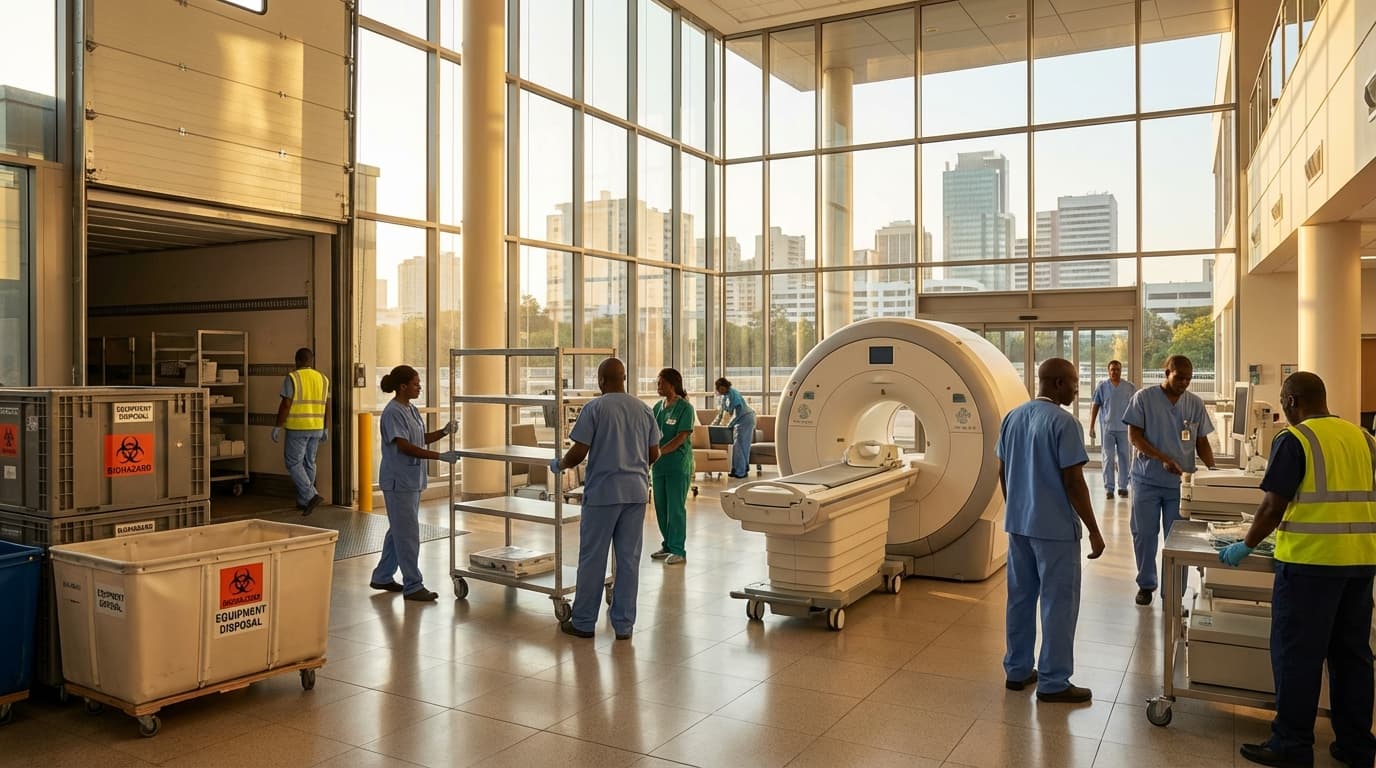
Heavy Medical Equipment De-Installation Service (MRI/CT/Cath Lab) in Lesotho
Engineering Excellence & Technical Support
Heavy Medical Equipment De-Installation Service (MRI/CT/Cath Lab) High-standard technical execution following OEM protocols and local regulatory frameworks.
Specialized De-Installation Expertise
Our highly trained technicians possess in-depth knowledge of the intricate de-installation procedures for high-value medical imaging equipment such as MRI, CT, and Cath Labs, ensuring adherence to manufacturer specifications and regulatory compliance in Lesotho.
Safety and Risk Mitigation
We implement rigorous safety protocols and employ specialized lifting and rigging equipment to guarantee the secure and risk-free de-installation of heavy medical machinery, protecting both personnel and the equipment's integrity throughout the process in Lesotho.
Logistics and Relocation Management
Our comprehensive service extends to meticulous planning and execution of the logistics for transporting heavy medical equipment, offering a seamless transition and minimizing downtime for healthcare facilities in Lesotho.
What Is Heavy Medical Equipment De-installation Service (Mri/ct/cath Lab) In Lesotho?
Heavy Medical Equipment De-Installation Service (MRI/CT/Cath Lab) in Lesotho refers to the specialized process of safely and systematically dismantling, disconnecting, and preparing large-scale, high-value medical imaging and interventional diagnostic equipment for relocation, disposal, or storage. This service is critical for healthcare facilities undergoing upgrades, renovations, or closures, as well as for manufacturers, dealers, and asset management companies involved in the secondary market.
| Who Needs This Service? | Typical Use Cases | |||
|---|---|---|---|---|
| Hospitals and Diagnostic Centers: Undergoing facility upgrades, equipment replacement cycles, or permanent closure. | Medical Equipment Manufacturers/Dealers: Managing trade-ins, returns, or relocating equipment between facilities. | Asset Management Companies: Facilitating the remarketing or disposal of used medical imaging equipment. | Research Institutions: Relocating specialized imaging or interventional suites. | Government Health Agencies: Managing the decommissioning of public healthcare infrastructure. |
| Replacement of Aging Equipment: Removing an older MRI, CT, or Cath Lab to install a newer generation model. | Facility Renovations/Relocations: De-installing equipment to allow for structural changes or moving the entire unit to a different wing or building. | Technology Upgrades: Migrating from one imaging modality or manufacturer to another. | End-of-Lease Returns: Preparing equipment for return to the lessor at the conclusion of a lease agreement. | Consolidation of Services: Merging imaging departments or closing underutilized facilities. |
Key Aspects of Heavy Medical Equipment De-Installation
- Technical Dismantling: Involves the precise disassembly of complex systems, including superconducting magnets (MRI), gantry components (CT), and patient access systems (Cath Lab), adhering to manufacturer specifications and safety protocols.
- Electrical and Data Disconnection: Safely isolates and disconnects high-voltage power supplies, control systems, network interfaces, and any auxiliary equipment.
- Cooling System Management: For MRI scanners, this includes the controlled venting and removal of cryogens (e.g., liquid helium) by certified personnel to prevent hazards and preserve the magnet's integrity.
- Structural Component Separation: Detaching and preparing large, often modular, components for transport, which may involve specialized lifting and bracing techniques.
- Ancillary System Removal: Disconnecting associated infrastructure such as patient tables, X-ray tubes, detectors, power conditioning units, and cooling chillers.
- Preservation and Packaging: Implementing measures to protect sensitive components from environmental damage and physical stress during handling and transit, often involving custom crating and protective wrapping.
- Documentation and Certification: Providing comprehensive records of the de-installation process, including adherence to safety standards, component inventories, and certifications for specialized procedures (e.g., cryogen handling).
- Regulatory Compliance: Ensuring all de-installation activities comply with local and international health, safety, and environmental regulations applicable in Lesotho.
- Logistics Coordination: Integrating with transportation and rigging services to facilitate the secure movement of disassembled equipment.
Who Needs Heavy Medical Equipment De-installation Service (Mri/ct/cath Lab) In Lesotho?
In Lesotho, the demand for specialized de-installation services for heavy medical equipment such as MRI, CT scanners, and Cath Labs is driven by several key scenarios. These services are essential for healthcare facilities undergoing upgrades, relocations, or experiencing equipment obsolescence. The primary need arises when existing imaging or interventional suites are being decommissioned to make way for newer, more advanced technology. Furthermore, hospitals undergoing significant renovations or facility expansions often require the careful removal and temporary storage of these large, sensitive machines. International medical aid organizations or private healthcare providers considering the donation or sale of functional but older equipment to other regions also necessitate professional de-installation to ensure safe transport and preservation of the machinery's integrity.
| Department | Specific Need for De-Installation |
|---|---|
| Radiology/Medical Imaging | De-installation of MRI, CT scanners for upgrades, replacement, or relocation of imaging suites. |
| Cardiology/Interventional Radiology | De-installation of Cath Labs for modernization, expansion, or relocation of cardiac suites. |
| Hospital Administration/Facilities Management | Coordinating equipment removal during major renovations, infrastructure upgrades, or when entire departments are being reconfigured. |
| Procurement/Biomedical Engineering | Managing the decommissioning of obsolete or end-of-life equipment, or preparing functional equipment for resale or donation. |
| IT/Information Technology | Ensuring safe disconnection and removal of associated IT infrastructure and cabling connected to the medical equipment. |
Target Customers and Departments for Heavy Medical Equipment De-Installation in Lesotho
- Hospitals (Public and Private)
- Specialized Diagnostic Imaging Centers
- University Teaching Hospitals
- Large Medical Clinics with Advanced Diagnostic Capabilities
- Government Health Ministries
- International Health Organizations (e.g., WHO, NGOs involved in healthcare infrastructure)
Heavy Medical Equipment De-installation Service (Mri/ct/cath Lab) Process In Lesotho
This document outlines the comprehensive workflow for the heavy medical equipment de-installation service (MRI/CT/Cath Lab) in Lesotho, from initial inquiry to the successful completion of the project. The process is designed to ensure safety, efficiency, and minimal disruption to healthcare facilities. It involves meticulous planning, specialized expertise, and strict adherence to protocols. The service caters to the complex task of dismantling, preparing for transport, and securing large-scale medical imaging and diagnostic equipment within the Lesotho healthcare landscape.
| Stage | Description | Key Activities | Responsible Parties | Deliverables |
|---|---|---|---|---|
| The process begins with a client (e.g., hospital, clinic) contacting the de-installation service provider with a request for de-installation of specific heavy medical equipment. | Receive inquiry, understand equipment type and location, gather preliminary information (model, age, site access). | Client, De-Installation Service Provider | Initial understanding of project scope and feasibility. |
| A thorough on-site evaluation is conducted to assess the equipment's condition, the physical environment, and logistical challenges. | Detailed inspection of equipment, power and cooling infrastructure assessment, evaluation of access routes (doors, corridors, elevators), measurement of equipment dimensions, identification of potential hazards, development of a detailed de-installation plan. | De-Installation Service Provider (Technical Team, Project Manager) | Comprehensive site survey report, detailed de-installation plan, risk assessment, preliminary timeline. |
| Based on the site survey and project plan, a detailed quotation is prepared, outlining costs, timeline, and terms. | Cost estimation for labor, specialized tools, transport, and any required permits or certifications. Negotiation and finalization of the service agreement. | De-Installation Service Provider, Client | Formal quotation, signed service agreement. |
| This stage involves all necessary preparatory work before the actual de-installation begins. | Dismantling of peripheral equipment, disconnecting utilities (power, cooling, data), securing loose components, coordinating with facility management for power outages and access, mobilizing specialized tools and equipment. | De-Installation Service Provider (Technical Team, Site Supervisor) | Equipment prepared for de-installation, site ready for the main operation. |
| The core phase where the heavy medical equipment is systematically dismantled by trained professionals. | Careful disassembly of magnet (for MRI), gantry, patient table, control consoles, and associated components. Adherence to manufacturer specifications and safety protocols. Management of hazardous materials (if any). | De-Installation Service Provider (Certified Technicians, Engineers) | Dismantled equipment components. |
| Each component is meticulously packaged and secured for safe transportation. | Use of specialized packing materials (e.g., anti-static wraps, custom crates), securing components to prevent movement and damage during transit, labeling for identification and tracking. | De-Installation Service Provider (Logistics Team, Technicians) | Securely packaged and labeled equipment ready for transport. |
| Comprehensive documentation is created to record the entire de-installation process and facilitate future re-installation. | Detailed photographic and video records of the de-installation process, inventory of all dismantled parts, certificates of de-installation, final report outlining work completed and any observations. | De-Installation Service Provider (Project Manager, Technical Team) | Complete de-installation report, photographic evidence, inventory list, certificates. |
| This stage ensures a smooth transition and addresses any immediate post-de-installation queries. | Confirmation of equipment handover to the client or designated transport provider, addressing any client questions or concerns, providing contact information for future support. | De-Installation Service Provider (Client Relations Manager, Project Manager) | Client satisfaction, seamless project closure. |
De-Installation Workflow Stages
- Inquiry & Initial Assessment
- Site Survey & Planning
- Quotation & Agreement
- Pre-De-Installation Preparations
- De-Installation Execution
- Equipment Packaging & Securing
- Documentation & Handover
- Post-De-Installation Support
Heavy Medical Equipment De-installation Service (Mri/ct/cath Lab) Cost In Lesotho
The cost of de-installing heavy medical equipment such as MRI, CT scanners, and Cath Labs in Lesotho can vary significantly due to a range of technical, logistical, and service-specific factors. These specialized de-installations require expert knowledge, precision, and adherence to strict safety protocols. Factors influencing the price include the complexity of the equipment, the accessibility of the installation site, the need for specialized tools and rigging, and the level of disassembly required. Labor costs, travel expenses for technicians (especially if they are not locally based), and any necessary disposal or packaging services also contribute to the overall expenditure. It's crucial to obtain detailed quotes from qualified service providers in Lesotho to get an accurate assessment for your specific needs.
| Service Type | Estimated Cost Range (LSL) | Notes |
|---|---|---|
| MRI De-installation | LSL 30,000 - LSL 150,000+ | Highly dependent on magnet size, shielding, and component separation. May involve specialized cryogenic handling for older MRI models. |
| CT Scanner De-installation | LSL 25,000 - LSL 100,000+ | Cost influenced by gantry size, detector array complexity, and X-ray tube handling. Integration with surrounding infrastructure plays a role. |
| Cath Lab De-installation | LSL 40,000 - LSL 200,000+ | Often the most complex due to multiple integrated systems (imaging, patient monitoring, interventional tools). Requires extensive planning and coordination. |
| Consultation and Site Assessment | LSL 2,000 - LSL 10,000 | Essential for accurate quoting and planning, often a prerequisite for a formal service agreement. |
| Specialized Tooling/Rigging Rental | Variable (quoted separately) | Costs are additional and depend on the specific equipment and site requirements. |
Key Pricing Factors for Heavy Medical Equipment De-Installation in Lesotho
- Equipment Type and Complexity (MRI, CT Scanner, Cath Lab)
- Size and Weight of Components
- Accessibility of Installation Site (e.g., floor access, ceiling height, door width)
- Required De-installation Scope (e.g., partial vs. full disassembly)
- Need for Specialized Tools and Rigging Equipment
- Labor Costs (technician rates, team size, hours required)
- Travel and Accommodation Expenses for Technicians (if not local)
- Logistical Challenges (e.g., on-site maneuvering, temporary power disconnects)
- Safety and Environmental Compliance Measures
- Disposal or Packaging Services for Removed Components
- Time Constraints and Urgency of the De-installation
Affordable Heavy Medical Equipment De-installation Service (Mri/ct/cath Lab) Options
De-installing complex medical equipment like MRI, CT scanners, and Cath Labs is a significant undertaking. Finding affordable options without compromising safety and efficiency requires careful planning and understanding of service provider offerings. This service involves the expert dismantling, disconnection, and preparation for transport of large, sensitive, and potentially hazardous medical imaging and interventional devices. It's crucial to partner with experienced professionals who understand the intricate nature of these machines and adhere to strict safety protocols and regulatory compliance. Options range from specialized de-installation companies to broader medical equipment service providers who offer this as part of a larger project.
| Value Bundle Component | Description | Cost-Saving Strategy |
|---|---|---|
| De-installation & Crating/Packaging | Expert dismantling and preparing equipment for transport, including specialized crates for sensitive components. | Bundling de-installation with professional packaging can prevent damage during transit, avoiding costly repairs or replacements later. Negotiate package deals. |
| De-installation & Site Preparation | Includes disconnecting power, cooling, and data lines, as well as clearing pathways for removal. | Proper site preparation by the de-installation team minimizes delays and unexpected issues on the day of removal, reducing hourly labor costs and potential overtime. |
| De-installation & Transportation Coordination | Coordinating the de-installation with a chosen transport company. | Working with a de-installation provider who has established relationships with reputable logistics partners can lead to more competitive shipping rates. Simultaneous booking can sometimes offer discounts. |
| De-installation & Decommissioning Documentation | Providing all necessary paperwork for regulatory compliance and record-keeping. | Ensuring proper decommissioning documentation from the outset avoids potential fines or delays in future installations, saving time and administrative costs. |
| Full Project Management (De-installation, Relocation, Installation) | A comprehensive service covering the entire lifecycle of equipment movement. | Engaging a single provider for all stages can lead to significant cost savings through streamlined operations, fewer points of contact, and bulk service discounts. Often the most cost-effective for complex projects. |
Affordable De-installation Service Options for MRI/CT/Cath Labs
- {"title":"Specialized Medical Equipment De-installation Companies","description":"These firms focus exclusively on the de-installation, relocation, and installation of heavy medical equipment. They often have the most expertise and specialized tools for MRI, CT, and Cath Labs, potentially leading to smoother, faster, and therefore more cost-effective de-installations due to their efficiency."}
- {"title":"Medical Equipment Service & Maintenance Providers","description":"Many companies that offer ongoing maintenance and repair for medical equipment also provide de-installation services. Bundling de-installation with other services can sometimes result in discounted rates."}
- {"title":"Equipment Manufacturers","description":"While often more expensive, direct manufacturer services guarantee that de-installation is performed by individuals with intimate knowledge of the specific equipment. Negotiating as part of a new purchase or upgrade can sometimes yield better pricing."}
- {"title":"Rigging and Logistics Companies with Medical Expertise","description":"Some larger rigging and logistics companies have divisions or partnerships that specialize in handling sensitive medical equipment. Their experience with heavy lifting can be beneficial."}
Verified Providers In Lesotho
Navigating the healthcare landscape in Lesotho can be challenging. Patients seek reliable and qualified medical professionals to ensure their well-being. Franance Health has emerged as a trusted source for identifying verified providers, offering a beacon of assurance in a complex system. This document outlines Franance Health's credentials and explains why they represent the best choice for finding dependable healthcare in Lesotho.
| Provider Category | Key Verification Criteria | Benefits for Patients |
|---|---|---|
| Doctors (General Practitioners & Specialists) | Medical Council Registration, Postgraduate Qualifications, Hospital Affiliations, Peer Endorsements | Access to accurate diagnoses, appropriate treatment plans, and specialized care from qualified professionals. |
| Nurses | Nursing Council Registration, Specialized Training (e.g., midwifery, critical care), Employment History | Quality bedside care, effective patient support, and accurate administration of treatments. |
| Pharmacies | Pharmacy Board Registration, Good Pharmacy Practice Certification, Supply Chain Integrity Checks | Access to genuine medications, safe dispensing practices, and reliable pharmaceutical advice. |
| Laboratories & Diagnostic Centers | Health Professions Council Accreditation, Equipment Calibration Records, Quality Assurance Programs | Accurate and timely diagnostic results crucial for effective medical management. |
| Hospitals & Clinics | Ministry of Health Licensing, Accreditation Status, Infection Control Protocols, Patient Safety Records | Safe and well-equipped healthcare facilities offering comprehensive medical services. |
Franance Health's Credentials and Commitment to Quality
- Rigorous Vetting Process: Franance Health employs a multi-stage verification process that goes beyond basic licensing. This includes checking educational qualifications, professional certifications, and peer reviews.
- Adherence to International Standards: Franance Health aligns its verification protocols with internationally recognized healthcare accreditation standards, ensuring a high level of competence among listed providers.
- Continuous Monitoring and Feedback: The platform actively monitors provider performance through patient feedback mechanisms and regular audits, ensuring ongoing adherence to quality benchmarks.
- Transparency and Accessibility: Franance Health prioritizes transparency by clearly outlining the qualifications and areas of expertise of each verified provider, making it easier for patients to make informed decisions.
- Commitment to Ethical Practice: Beyond clinical skills, Franance Health also assesses providers for their commitment to ethical medical practices and patient confidentiality.
Scope Of Work For Heavy Medical Equipment De-installation Service (Mri/ct/cath Lab)
This Scope of Work (SOW) outlines the requirements for the de-installation of heavy medical equipment, specifically Magnetic Resonance Imaging (MRI) scanners, Computed Tomography (CT) scanners, and Cardiac Catheterization (Cath Lab) systems. The service provider will be responsible for safely and efficiently dismantling, preparing for transport, and securing these complex medical devices according to manufacturer specifications and industry best practices. This includes all necessary technical de-installation procedures, documentation, and adherence to safety protocols.
| Equipment Type | Key De-installation Tasks | Standard Specifications/Considerations | ||||
|---|---|---|---|---|---|---|
| MRI Scanner | Ramp-down and quench of superconducting magnet (if applicable). | Adherence to manufacturer's specific quench procedure. Strict adherence to cryogenic safety protocols. Shielding integrity assessment. | Disconnect and secure RF coils, gradient coils, patient table, and magnet housing. | Proper handling of high-field magnet components. Verification of system's internal components security. | Disconnect all power, data, and cooling lines. | Follow manufacturer's labeling and disconnection guidelines. Ensure proper containment of cooling fluids. |
| CT Scanner | Power down and disable X-ray tube and high-voltage system. | Verification of safe discharge of capacitors. Isolation of high-voltage components. | Dismantle gantry components (e.g., detector array, slip rings). | Careful handling of detector elements. Securement of rotating components. | Disconnect all power, data, and cooling lines. | Manufacturer-specific disconnection and labeling protocols. Protection of sensitive electronics. |
| Cath Lab System | Power down and disconnect C-arm, patient table, and detector assembly. | Securement of heavy articulating C-arm. Protection of image intensifier or flat-panel detector. | Disconnect all power, data, and cooling lines. | Manufacturer-specific disconnection and labeling protocols. Prevention of fluid leaks. | Disconnect and secure associated equipment (e.g., injectors, monitors, workstations). | Organization and labeling of all associated cabling and components. |
| General | Site preparation and safety checks. | Establishment of exclusion zones, use of PPE, confirmation of electrical isolation and grounding. | Documentation of connections and component locations. | Photographic and written records for re-installation. Tagging of all removed parts. | Packaging and crating of components. | Use of appropriate protective materials (anti-static, shock-absorbent), secure bracing and labeling for transport. |
Technical Deliverables
- Detailed de-installation plan, including sequence of operations and estimated timelines.
- Confirmation of all required tools, equipment, and consumables for safe de-installation.
- Pre-de-installation site assessment report, including environmental conditions and access routes.
- Comprehensive de-installation checklist, signed by both parties upon completion.
- Properly disconnected and labeled all electrical, data, and fluid connections.
- Component segregation and packaging suitable for transportation, including specialized materials for sensitive parts (e.g., cryogen systems for MRI).
- Temporary securing of all moving parts and delicate components.
- Disposal of any hazardous materials (e.g., refrigerants) in accordance with environmental regulations.
- Post-de-installation site clean-up and restoration to a safe and orderly condition.
- Final de-installation report summarizing work performed, any deviations, and recommendations.
- Photos/videos documenting the de-installation process (optional, upon request).
Service Level Agreement For Heavy Medical Equipment De-installation Service (Mri/ct/cath Lab)
This Service Level Agreement (SLA) outlines the terms and conditions for the de-installation of heavy medical equipment, specifically MRI, CT, and Cath Lab systems. It defines response times for service requests and establishes uptime guarantees for critical support services related to the de-installation process.
| Service Component | Response Time Guarantee (Business Hours) | Uptime Guarantee (24/7 Support) | Notes |
|---|---|---|---|
| Initial Contact & Service Request Acknowledgment | Within 2 Business Hours | N/A | For urgent service requests during business hours. |
| On-site Technician Arrival (Critical Issue - e.g., safety hazard during de-installation) | Within 4 Business Hours | N/A | Applies to issues preventing safe continuation of de-installation. |
| Remote Technical Support (for de-installation planning or troubleshooting) | Within 2 Business Hours | N/A | For non-critical issues requiring expert consultation. |
| 24/7 Emergency Support Line Availability | N/A | 99.5% | Availability of the dedicated emergency support line for critical issues outside business hours. This does not guarantee immediate on-site response, but rather the availability of a qualified technician for consultation. |
| Scheduled De-installation Service Window Adherence | Within 30 minutes of scheduled start time | N/A | Ensuring technicians arrive within the agreed-upon window for scheduled de-installation. |
Scope of Service
- De-installation of Magnetic Resonance Imaging (MRI) scanners.
- De-installation of Computed Tomography (CT) scanners.
- De-installation of Cardiac Catheterization Laboratory (Cath Lab) systems.
- Safe and compliant disconnection of all associated power, cooling, and data infrastructure.
- Disassembly of equipment according to manufacturer specifications and industry best practices.
- Secure packaging and preparation for transportation (packaging materials not included unless specified in a separate addendum).
- Coordination with site facility management for utility shutdowns and re-connections (where applicable).
- Post-de-installation site assessment and basic cleanup of the immediate work area.
Frequently Asked Questions

Ready when you are
Let's scope your Heavy Medical Equipment De-Installation Service (MRI/CT/Cath Lab) in Lesotho project in Lesotho.

Scaling healthcare logistics and technical systems across the entire continent.