
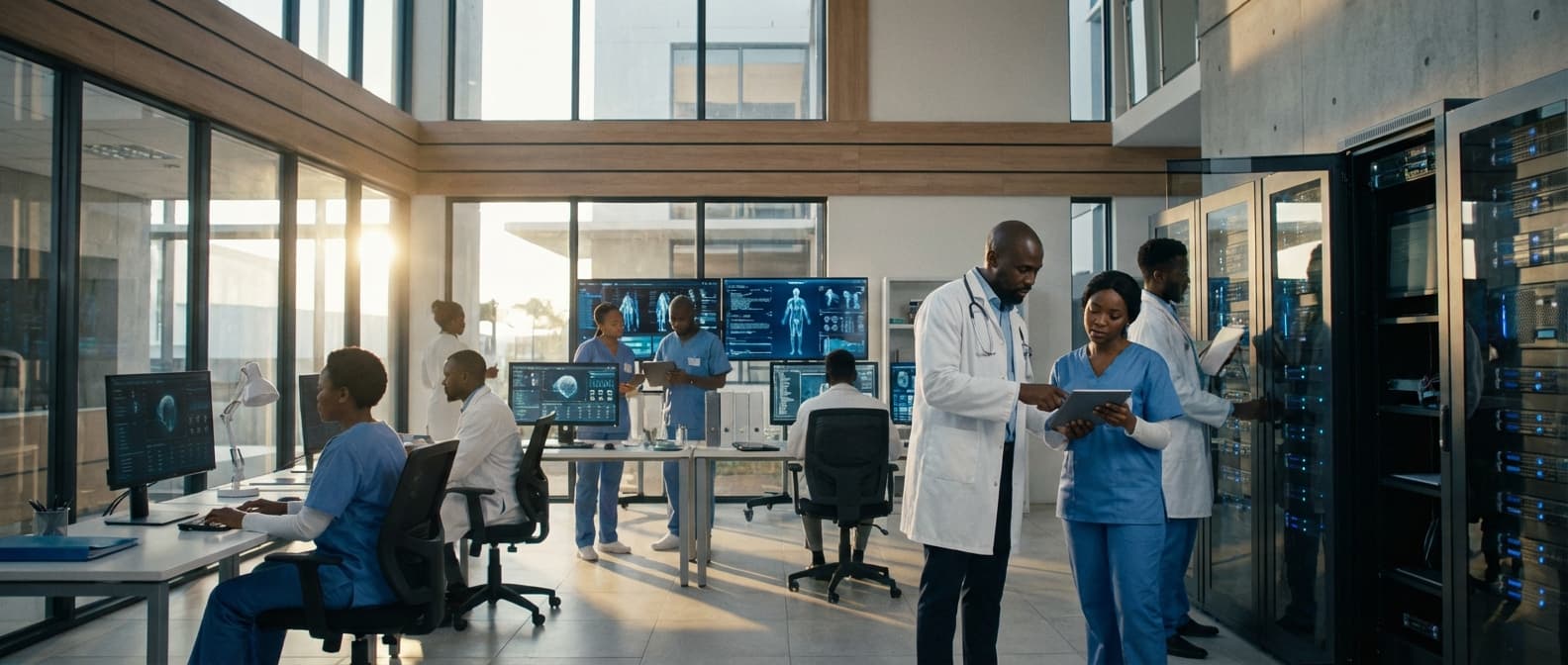
Medical IT Consultation in Lesotho
Engineering Excellence & Technical Support
Strategic technology consulting to optimize healthcare operations, streamline workflows, and integrate cutting-edge medical information systems. High-standard technical execution following OEM protocols and local regulatory frameworks.
Cloud-Based EHR Implementation
Successfully deployed a scalable, cloud-based Electronic Health Records (EHR) system across multiple rural clinics in Lesotho. This enhanced data accessibility, improved patient record accuracy, and facilitated remote diagnostics and consultations, overcoming infrastructure limitations.
Secure Telemedicine Network
Architected and implemented a robust and secure telemedicine network utilizing low-bandwidth solutions. This enabled healthcare professionals in remote areas to connect with specialists in urban centers and internationally, significantly reducing travel time and cost for critical patient care.
Data Analytics & Reporting Platform
Developed and integrated a centralized data analytics and reporting platform from disparate health information systems. This provided actionable insights into disease prevalence, resource allocation, and treatment effectiveness, empowering data-driven decision-making for public health initiatives in Lesotho.
What Is Medical It Consultation In Lesotho?
Medical IT Consultation in Lesotho refers to the provision of expert advice and services related to the strategic planning, implementation, optimization, and management of information technology (IT) systems and infrastructure within healthcare organizations in Lesotho. This encompasses a broad spectrum of IT-related needs, from basic network setup to complex electronic health record (EHR) system deployment and cybersecurity strategies. The objective is to leverage technology to improve healthcare delivery, operational efficiency, data management, and patient outcomes within the specific context and resource landscape of Lesotho.
| Target Audience | Typical Use Cases |
|---|---|
| Public Healthcare Facilities (Hospitals, Clinics, Health Centers) | Implementing or upgrading EHR/EMR systems for patient record management. Establishing reliable network infrastructure for data access and communication. Developing cybersecurity strategies to protect patient data. Integrating diagnostic equipment with IT systems. Implementing telemedicine solutions for remote areas. |
| Private Healthcare Providers (Clinics, Private Hospitals, Pharmacies) | Migrating from paper-based to digital record-keeping. Enhancing patient appointment scheduling and management systems. Improving billing and financial management through integrated IT solutions. Ensuring compliance with data protection regulations. Leveraging technology for improved patient engagement. |
| Non-Governmental Organizations (NGOs) in the Health Sector | Developing IT strategies for health program management and data collection. Implementing mobile health (mHealth) solutions for community outreach and data gathering. Establishing secure data storage and reporting mechanisms for donor reporting. Facilitating communication and data sharing among field staff. |
| Ministry of Health and other Government Health Agencies | Developing national health IT strategies and policies. Overseeing the implementation of national health information systems. Ensuring interoperability between different health facilities. Managing national health data repositories and analytics. Coordinating cybersecurity initiatives across the health sector. |
| Medical Training and Research Institutions | Establishing IT infrastructure for educational purposes and research. Implementing digital libraries and access to medical research databases. Supporting data analysis for research projects. Developing platforms for online learning and collaboration. |
Key Components of Medical IT Consultation:
- Needs Assessment and Gap Analysis: Evaluating existing IT infrastructure, identifying technological deficiencies, and aligning IT capabilities with organizational goals and healthcare mandates.
- System Design and Architecture: Planning and designing robust, scalable, and secure IT architectures, including hardware, software, networking, and data storage solutions.
- Electronic Health Record (EHR) / Electronic Medical Record (EMR) Implementation and Optimization: Guiding the selection, deployment, customization, and ongoing maintenance of EHR/EMR systems to facilitate digital patient records, clinical workflows, and data interoperability.
- Health Information Exchange (HIE) Strategies: Developing and implementing frameworks for secure and efficient sharing of patient health information among different healthcare providers and stakeholders.
- IT Infrastructure Management: Advising on the procurement, installation, configuration, and maintenance of servers, workstations, network devices, and telecommunications systems.
- Data Management and Analytics: Establishing policies and technologies for data integrity, storage, backup, recovery, and leveraging data analytics for clinical decision support and operational improvement.
- Cybersecurity and Data Privacy: Developing and implementing comprehensive security protocols, access controls, threat detection mechanisms, and compliance strategies to protect sensitive patient data (PHI) in accordance with national and international regulations.
- Telemedicine and Remote Care Solutions: Designing and deploying platforms and infrastructure to support remote patient monitoring, virtual consultations, and e-health initiatives.
- IT Policy and Governance Development: Establishing clear IT policies, procedures, and governance frameworks to ensure effective and compliant IT operations.
- Training and Capacity Building: Providing technical training to healthcare IT staff and end-users to enhance their proficiency and adoption of new technologies.
- Vendor Selection and Management: Assisting in the evaluation and selection of IT vendors and service providers, and managing vendor relationships.
Who Needs Medical It Consultation In Lesotho?
In Lesotho, the demand for specialized medical IT consultation is growing as healthcare facilities strive to modernize their operations, enhance patient care, and improve efficiency. This consultation is crucial for navigating the complexities of health information technology, from implementing electronic health records to ensuring robust cybersecurity measures. A key focus is on leveraging technology to overcome geographical challenges and extend healthcare access to remote populations.
| Customer Type | Key Departments/Needs |
|---|---|
| Public Hospitals and Health Centers | Information Technology (IT) Department, Medical Records Department, Pharmacy, Laboratory, Administration, Clinical Departments (e.g., Pediatrics, Obstetrics & Gynecology, Internal Medicine) |
| Private Clinics and Hospitals | Clinic Management, Patient Registration, Billing, Clinical Staff, IT Support |
| Non-Governmental Organizations (NGOs) in Healthcare | Program Management, Data Management, Field Operations, Monitoring & Evaluation (M&E), Health Information Systems |
| Tertiary Healthcare Institutions | Specialized IT Infrastructure, Research & Development, Advanced Diagnostics, Electronic Medical Records (EMR) Integration, PACS (Picture Archiving and Communication System) |
| Pharmaceutical and Medical Equipment Suppliers | Sales & Technical Support, Inventory Management, Data Integration with Hospital Systems |
| Government Ministry of Health | Health Information Systems (HIS), Public Health Surveillance, National Health Data Management, Policy Development, E-health Initiatives |
| Rural Health Posts and Mobile Clinics | Basic EMR implementation, Data Collection Tools, Telemedicine Solutions, Connectivity Solutions, Training for local staff |
Target Customers for Medical IT Consultation in Lesotho
- Public Hospitals and Health Centers
- Private Clinics and Hospitals
- Non-Governmental Organizations (NGOs) in Healthcare
- Tertiary Healthcare Institutions
- Pharmaceutical and Medical Equipment Suppliers (for integrated IT solutions)
- Government Ministry of Health
- Rural Health Posts and Mobile Clinics
Medical It Consultation Process In Lesotho
The Medical IT Consultation Process in Lesotho outlines the structured workflow adopted by IT service providers to address the technology needs of healthcare facilities within the country. This process ensures efficient problem-solving, implementation of new systems, and ongoing support, from the initial client inquiry to the successful execution of the IT solution.
| Stage | Description | Key Activities | Deliverables |
|---|---|---|---|
| Inquiry & Initial Assessment | The process begins when a healthcare facility in Lesotho expresses interest in IT services or faces a specific technology challenge. | Receive inquiry (phone, email, referral), initial understanding of the problem/need, gather basic information about the facility. | Acknowledgement of inquiry, preliminary understanding of the client's situation. |
| Needs Analysis & Scoping | A detailed understanding of the client's current IT infrastructure, specific requirements, and desired outcomes is established. | On-site or remote assessment of existing systems, interviews with stakeholders (doctors, administrators, IT staff), identification of pain points and objectives. | Detailed needs assessment report, defined project scope, identification of key stakeholders. |
| Proposal Development & Approval | Based on the needs analysis, a tailored IT solution proposal is created and presented to the client. | Develop a comprehensive proposal outlining recommended solutions, technical specifications, project timeline, budget, and service level agreements (SLAs). Present proposal to the client. | Formal project proposal, cost breakdown, projected ROI, approved project plan. |
| Planning & Design | Once the proposal is approved, a detailed plan for the implementation is meticulously crafted. | Develop a project management plan, design the technical architecture of the solution, define deployment strategy, identify necessary resources and dependencies. | Detailed implementation plan, system architecture diagrams, resource allocation plan. |
| Implementation & Deployment | The designed IT solution is installed, configured, and integrated into the healthcare facility's environment. | Procurement of hardware/software, installation and configuration of systems, data migration (if applicable), integration with existing systems. | Deployed IT infrastructure/software, functional system components. |
| Testing & Quality Assurance | Rigorous testing is conducted to ensure the solution functions as intended and meets quality standards. | Unit testing, integration testing, user acceptance testing (UAT) with client staff, performance testing, security vulnerability assessment. | Test results documentation, bug reports and resolutions, UAT sign-off. |
| Training & Knowledge Transfer | End-users and relevant staff are trained on how to effectively use and manage the new IT systems. | Develop training materials, conduct on-site or remote training sessions, provide documentation and user manuals. | Trained staff, user manuals and guides, support contact information. |
| Go-Live & Support | The new IT solution is officially launched, and ongoing support is provided to address any immediate issues. | Deployment of the live system, hypercare support (intensive initial support), troubleshooting of immediate issues, establishment of ongoing support channels. | Live and functional IT system, documented support procedures, resolved initial issues. |
| Evaluation & Optimization | The implemented solution is reviewed for effectiveness, and opportunities for improvement are identified and acted upon. | Post-implementation review, performance monitoring, user feedback collection, identification of optimization opportunities, implementation of enhancements. | Performance reports, optimization recommendations, ongoing service improvement plan. |
Workflow Stages of Medical IT Consultation in Lesotho
- Inquiry & Initial Assessment
- Needs Analysis & Scoping
- Proposal Development & Approval
- Planning & Design
- Implementation & Deployment
- Testing & Quality Assurance
- Training & Knowledge Transfer
- Go-Live & Support
- Evaluation & Optimization
Medical It Consultation Cost In Lesotho
The cost of medical IT consultation in Lesotho can vary significantly based on several key factors. These include the complexity of the IT challenges faced by the healthcare facility, the specific services required (e.g., EMR implementation, network security, telemedicine setup, data analytics), the experience and specialization of the IT consultant, and the duration of the engagement. Local market conditions and the size and budget of the healthcare organization also play a crucial role in determining pricing. While a precise universal range is difficult to establish without specific project details, estimations can be provided for different service levels.
| Service Level | Estimated Hourly Rate (M), LSL | Estimated Daily Rate (M), LSL | Notes |
|---|---|---|---|
| Basic IT Assessment & Recommendations | 200 - 400 | 1,500 - 3,000 | Covers initial site visits, basic system review, and preliminary advice. |
| Standard IT Project Support (e.g., EMR setup, network upgrades) | 400 - 700 | 3,000 - 5,500 | Involves active participation in implementation, configuration, and troubleshooting. |
| Specialized Consultancy (e.g., Cybersecurity audit, data analytics strategy) | 600 - 1,000+ | 4,500 - 8,000+ | Requires in-depth knowledge and often involves complex analysis and strategic planning. Rates can be higher for niche expertise. |
| Long-term IT Strategy & Management | Negotiable (often retainer-based) | Negotiable | Typically involves ongoing advisory services and strategic guidance, often on a monthly retainer. |
Factors Influencing Medical IT Consultation Costs in Lesotho
- Complexity of IT needs: Simple troubleshooting vs. comprehensive system design.
- Scope of services: EMR/EHR implementation, cybersecurity, network infrastructure, cloud migration, data analytics, telemedicine solutions, IT policy development, etc.
- Consultant's expertise and experience: Junior consultants will likely charge less than highly specialized and experienced professionals.
- Project duration and intensity: Short-term assessments versus long-term project management.
- Size and budget of the healthcare facility: Larger hospitals with bigger budgets may attract higher consultancy fees.
- Urgency of the project: Rush jobs often incur premium charges.
- Geographical location within Lesotho: While less of a factor for remote consultations, on-site visits might incur travel costs.
Affordable Medical It Consultation Options
Navigating the complexities of Medical IT can be daunting for practices of all sizes. Fortunately, affordable consultation options exist that can significantly improve your technology infrastructure, enhance patient care, and streamline operations without breaking the bank. This guide explores value bundles and cost-saving strategies to help you make informed decisions.
| Cost-Saving Strategy | Description | Potential Benefits |
|---|---|---|
| Leverage Value Bundles | Opt for pre-defined service packages that often come at a lower per-service cost compared to individual engagements. These bundles are designed to address common needs holistically. | Predictable budgeting, reduced administrative overhead for procurement, comprehensive problem-solving. |
| Phased Implementation | Instead of tackling all IT upgrades at once, break down projects into smaller, manageable phases. This allows for budget allocation over time and reduces the immediate financial impact. | Improved cash flow, ability to assess and adapt after each phase, easier integration of new technologies. |
| Remote Consultation | Many IT consultation tasks, such as strategic planning, system reviews, and training, can be effectively conducted remotely via video conferencing and screen sharing. | Significant reduction in travel and accommodation costs for consultants, increased flexibility and availability. |
| Focus on ROI-Driven Projects | Prioritize IT initiatives that offer a clear return on investment, such as those improving operational efficiency, reducing administrative burden, or enhancing patient engagement. Consultants can help identify these opportunities. | Maximizes the impact of IT spending, justifies investment, and frees up resources for other critical areas. |
| Negotiate Long-Term Contracts | For ongoing IT support or managed services, negotiate longer-term contracts. This can often lead to discounted hourly rates or fixed monthly fees, providing cost stability. | Cost predictability, potential for volume discounts, builds a deeper partnership with the IT provider. |
| Seek Consultants with Healthcare Specialization | While general IT consultants can be helpful, those with specific experience in the healthcare industry understand regulatory requirements (like HIPAA), clinical workflows, and common EMR/EHR challenges. This expertise leads to more efficient and effective solutions. | Faster problem resolution, reduced risk of compliance issues, solutions tailored to healthcare needs, potentially requiring less re-work. |
| Utilize Free Initial Consultations | Many IT consulting firms offer a free initial consultation to assess your needs. This is an excellent opportunity to gather information, ask questions, and get a preliminary understanding of potential solutions without upfront cost. | Opportunity for needs assessment and initial advice, helps in comparing different providers, no financial commitment required initially. |
Understanding Value Bundles
- {"title":"What are Value Bundles?","description":"Value bundles are pre-packaged service offerings that combine multiple IT consultation services into a single, often discounted, package. They are designed to provide comprehensive solutions for common practice needs."}
- {"title":"Common Bundle Components","description":"These bundles typically include a mix of strategic planning, assessment, implementation support, and ongoing advisory services. Specific components might include EHR optimization, cybersecurity assessments, cloud migration planning, HIPAA compliance reviews, and network infrastructure upgrades."}
- {"title":"Benefits of Bundles","description":"Bundles offer predictable costs, streamlined procurement, and a holistic approach to IT challenges. They can also foster a stronger, ongoing relationship with a consulting partner, leading to better understanding and tailored solutions over time."}
Verified Providers In Lesotho
In Lesotho, access to reliable and trustworthy healthcare services is paramount. When seeking medical assistance, it's crucial to rely on Verified Providers who have undergone rigorous credentialing and adhere to the highest standards of care. Franance Health stands out as a leading example of such a provider, offering a comprehensive and dependable healthcare experience. Their commitment to patient well-being, combined with their stringent verification processes, makes them an exceptional choice for individuals and families in Lesotho.
| Key Verification Aspect | Franance Health's Commitment | Patient Benefit |
|---|---|---|
| Licensing and Accreditation | Thorough verification of all medical licenses and accreditations. | Ensures providers are legally and ethically qualified to practice. |
| Educational Background | Scrutiny of academic qualifications and training from recognized institutions. | Guarantees a strong foundation in medical knowledge and expertise. |
| Professional Experience | Verification of past practice and specialization. | Ensures practitioners have relevant experience for your specific health needs. |
| Continuing Education | Mandatory participation in ongoing professional development programs. | Ensures access to the latest medical knowledge and treatment techniques. |
| Ethical Conduct | Adherence to strict professional and ethical guidelines. | Promotes a safe, respectful, and trustworthy healthcare environment. |
Why Franance Health is Your Best Choice for Verified Healthcare in Lesotho:
- Rigorous Credentialing: Franance Health meticulously vets all their healthcare professionals. This involves verifying medical licenses, academic qualifications, professional experience, and adherence to ethical codes of conduct. This ensures that every practitioner you encounter is fully qualified and authorized to provide the care you need.
- Commitment to Quality: Beyond basic credentials, Franance Health emphasizes continuous professional development and ongoing training for their staff. This ensures they are up-to-date with the latest medical advancements, treatment protocols, and best practices, guaranteeing you receive high-quality care.
- Patient-Centric Approach: Franance Health prioritizes the patient experience. This translates into accessible appointments, clear communication from healthcare providers, a supportive environment, and a focus on personalized treatment plans tailored to individual needs.
- Comprehensive Services: Whether you require general medical consultations, specialized treatments, diagnostic services, or preventative care, Franance Health offers a wide spectrum of medical services under one roof. This convenience eliminates the need to seek care from multiple unverified sources.
- Trust and Transparency: The verification process inherently builds trust. Franance Health operates with transparency, clearly outlining their credentials and standards. This allows patients to make informed decisions about their healthcare with confidence.
- Adherence to International Standards: Franance Health often aligns its practices with internationally recognized healthcare standards. This commitment to global benchmarks further solidifies their position as a reliable and high-quality provider in Lesotho.
Scope Of Work For Medical It Consultation
This Scope of Work (SOW) outlines the services to be provided by [Consulting Firm Name] (hereinafter referred to as the "Consultant") to [Client Organization Name] (hereinafter referred to as the "Client") for Medical IT Consultation. The primary objective is to assess, strategize, and recommend improvements to the Client's existing medical IT infrastructure, systems, and workflows to enhance efficiency, security, compliance, and patient care.
| Deliverable | Description | Standard Specification/Scope |
|---|---|---|
| Current State Assessment Report | In-depth analysis of existing IT environment. | Includes infrastructure, software, networks, security, and workflows. SWOT analysis. Detailed inventory and diagrams. |
| Gap Analysis and Benchmarking Report | Identifies discrepancies between current state and ideal/regulatory state. | Benchmarking against industry best practices and compliance standards (e.g., HIPAA). |
| Strategic IT Roadmap and Recommendations | Phased plan for IT improvement. | Prioritized recommendations, timelines, budget estimates, and ROI analysis. |
| Cybersecurity Assessment and Enhancement Plan | Evaluation of security posture and risk mitigation. | Vulnerability assessment, NIST framework adherence, incident response planning. |
| Cloud Strategy and Migration Plan | Assessment and plan for cloud adoption (if applicable). | Cost-benefit analysis, vendor evaluation, migration strategy. |
| Interoperability and Data Integration Strategy | Recommendations for seamless data exchange. | FHIR and HL7 standards, API strategy. |
| DR/BCP Review and Update | Evaluation and improvement of disaster recovery and business continuity. | RTO/RPO analysis, testing protocols. |
| Training and Change Management Recommendations | Strategies for end-user adoption. | Training material outlines, communication plans. |
| Vendor Selection and Evaluation Criteria | Objective criteria for vendor selection (if applicable). | RFP templates, scoring matrices. |
| Project Management Support (Optional) | Oversight and guidance during implementation. | Agile/Waterfall methodology, progress reporting. |
Key Deliverables and Standard Specifications
- 1. Current State Assessment Report: Comprehensive analysis of existing IT infrastructure, hardware, software, networks, data storage, security measures, and user workflows. Includes identification of strengths, weaknesses, opportunities, and threats (SWOT analysis). Standard specifications: Includes detailed inventory, network diagrams, system architecture reviews, and user interviews.
- 2. Gap Analysis and Benchmarking Report: Compares current IT capabilities against industry best practices, regulatory requirements (e.g., HIPAA, HITECH), and client-specific strategic goals. Identifies critical gaps and areas for improvement. Standard specifications: Benchmarking against similar healthcare organizations, identification of specific compliance deficiencies.
- 3. Strategic IT Roadmap and Recommendations: A phased plan for IT modernization and optimization. Includes prioritized recommendations for hardware upgrades, software implementation, network enhancements, cybersecurity improvements, and workflow automation. Standard specifications: Clearly defined phases, timelines, budget estimates, and ROI projections for each recommendation.
- 4. Cybersecurity Assessment and Enhancement Plan: Detailed evaluation of current security posture, including vulnerability assessments, penetration testing (if applicable), and review of access controls and data encryption. Provides a plan to mitigate identified risks and strengthen defenses. Standard specifications: Adherence to NIST Cybersecurity Framework or equivalent, recommendations for intrusion detection, incident response, and data loss prevention.
- 5. Cloud Strategy and Migration Plan (if applicable): Assessment of suitability for cloud adoption, evaluation of cloud service providers, and a detailed plan for migrating relevant systems and data to the cloud. Standard specifications: Cost-benefit analysis of cloud vs. on-premise, vendor selection criteria, data migration strategy, and contingency planning.
- 6. Interoperability and Data Integration Strategy: Recommendations for improving data exchange between different IT systems (e.g., EHR, PACS, LIS) and external entities. Focuses on achieving seamless patient data flow. Standard specifications: FHIR standards adherence, HL7 implementation guidance, API strategy.
- 7. Disaster Recovery and Business Continuity Plan (DR/BCP) Review and Update: Evaluation of existing DR/BCP, identification of gaps, and recommendations for updates to ensure rapid recovery of critical IT systems and data in the event of disruptions. Standard specifications: RTO (Recovery Time Objective) and RPO (Recovery Point Objective) analysis, testing protocols.
- 8. Training and Change Management Recommendations: Strategies to ensure successful adoption of new technologies and workflows by end-users. Includes recommendations for training programs and communication plans. Standard specifications: Development of training materials outline, change management communication strategy.
- 9. Vendor Selection and Evaluation Criteria (if applicable): Development of objective criteria for evaluating and selecting IT vendors for hardware, software, or services. Standard specifications: Detailed RFP (Request for Proposal) templates, scoring matrices, and negotiation guidance.
- 10. Project Management Support and Oversight (Optional Add-on): Active participation in the implementation of recommended solutions, including project planning, resource allocation, risk management, and status reporting. Standard specifications: Agile or Waterfall methodology adherence, regular progress reports, stakeholder management.
Service Level Agreement For Medical It Consultation
This Service Level Agreement (SLA) outlines the commitment for Medical IT Consultation services, focusing on response times for support requests and guaranteed uptime for critical IT systems. This SLA is effective as of [Date] and applies to all clients utilizing the Medical IT Consultation services provided by [Your Company Name].
| Service Component | Priority Level | Response Time Target (Business Hours) | Response Time Target (24/7) |
|---|---|---|---|
| Medical IT Consultation Support | Emergency | 15 minutes | 30 minutes |
| Medical IT Consultation Support | High Priority Incident | 1 hour | 2 hours |
| Medical IT Consultation Support | Normal Priority Incident | 4 business hours | N/A |
Key Definitions
- Business Hours: Monday to Friday, 8:00 AM to 6:00 PM, excluding public holidays.
- Critical System: Any IT system deemed essential for the core operations of the client's medical practice, including but not limited to Electronic Health Records (EHR) systems, practice management software, patient portals, and critical network infrastructure.
- Emergency: A situation that renders a Critical System completely unusable or severely degraded, preventing access to patient data or the ability to provide patient care.
- High Priority Incident: A situation that significantly impacts the functionality of a Critical System but does not render it completely unusable.
- Normal Priority Incident: Any IT issue or request that does not meet the criteria for Emergency or High Priority Incident.
- Response Time: The maximum time allowed from the initial reporting of an issue to the initiation of active investigation and troubleshooting by the IT consultation team.
- Resolution Time: The time it takes to fix a reported issue and restore full functionality to the affected system. Resolution times are targets and may vary based on the complexity of the issue and third-party dependencies.
- Uptime Guarantee: The percentage of time a Critical System is expected to be operational and accessible.
Frequently Asked Questions

Ready when you are
Let's scope your Medical IT Consultation in Lesotho project in Lesotho.

Scaling healthcare logistics and technical systems across the entire continent.