
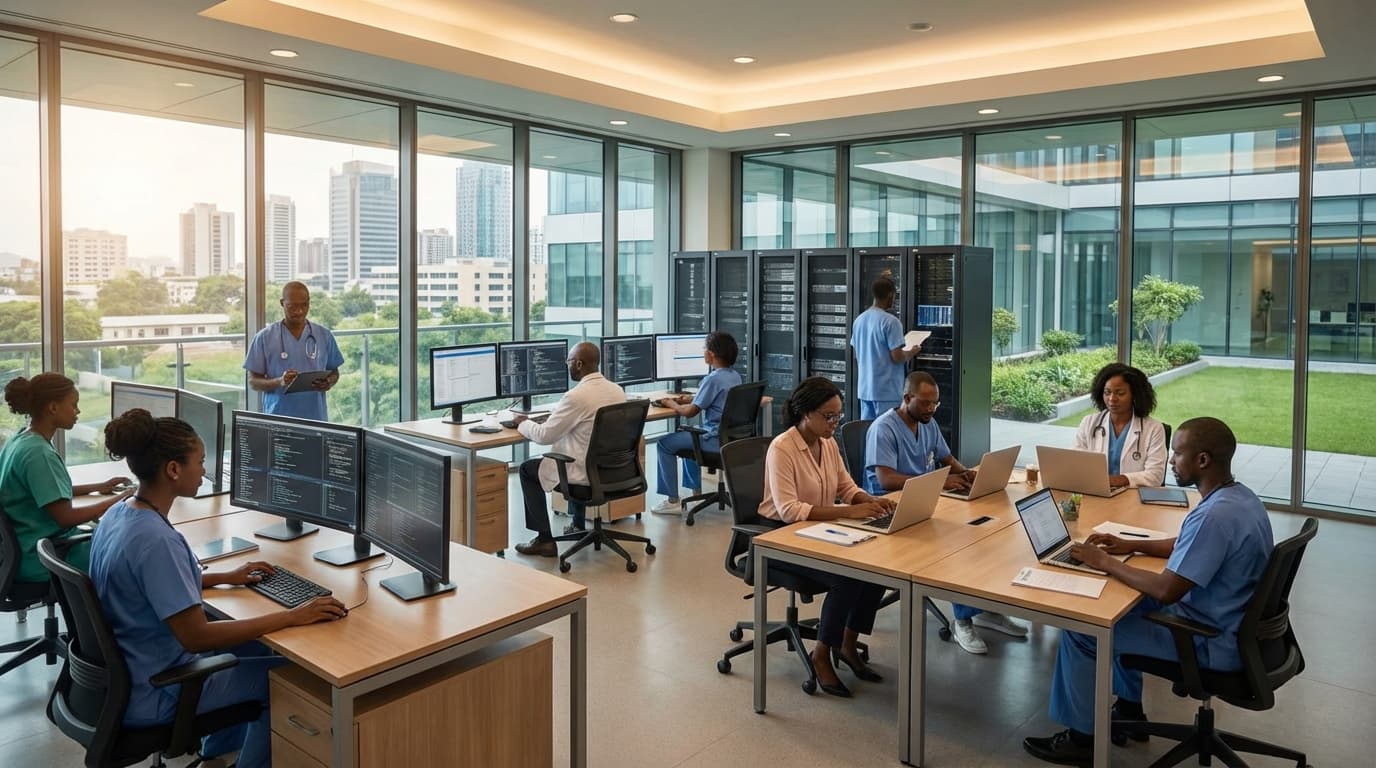
Radiology Reader & Reporting Support in Lesotho
Engineering Excellence & Technical Support
Remote radiology reading and reporting services High-standard technical execution following OEM protocols and local regulatory frameworks.
Seamless Remote Access
Empowering radiologists in Lesotho with secure, high-speed remote access to PACS and reporting systems, enabling timely and efficient image interpretation and report generation from any location.
AI-Powered Diagnostic Assistance
Integrating cutting-edge AI algorithms for enhanced detection of critical findings and automated preliminary report generation, reducing diagnostic turnaround time and improving accuracy for complex cases.
Streamlined Reporting Workflow
Providing intuitive tools and customizable templates for a standardized and efficient reporting process, minimizing transcription errors and facilitating seamless integration with existing hospital information systems.
What Is Radiology Reader & Reporting Support In Lesotho?
Radiology Reader & Reporting Support in Lesotho refers to the provision of specialized expertise and technological solutions to assist healthcare facilities in the interpretation of medical imaging studies and the generation of comprehensive diagnostic reports. This service aims to address potential deficiencies in local radiological capacity, such as a shortage of trained radiologists, remote geographical locations, or high patient volumes, thereby enhancing diagnostic accuracy and timeliness. It can be delivered through various modalities, including tele-radiology platforms, on-site consultation, or structured reporting templates and software.
| Who Needs This Service? | Typical Use Cases |
|---|---|
| District hospitals and clinics in Lesotho lacking on-site radiologists. | Urgent interpretation of emergency imaging studies (e.g., trauma, stroke) to facilitate timely management decisions. |
| Larger referral hospitals experiencing high imaging workloads that exceed local radiologist capacity. | Routine interpretation of a high volume of general radiology examinations, ensuring consistent turnaround times. |
| Specialized medical centers requiring expert sub-specialty interpretations (e.g., neuroradiology, musculoskeletal radiology). | Second opinion consultations for complex or ambiguous cases to confirm diagnoses and treatment plans. |
| Healthcare providers seeking to improve the quality and standardization of radiological reports. | Implementation of structured reporting templates to ensure all critical findings are addressed systematically and consistently. |
| Facilities aiming to reduce diagnostic turnaround times and improve patient flow. | Support for screening programs (e.g., tuberculosis screening via chest X-rays) by providing rapid interpretation services. |
| Medical training institutions looking to enhance the radiology education of their students and residents. | Access to a wider range of imaging pathologies and expert interpretations for educational purposes. |
Key Components of Radiology Reader & Reporting Support
- Remote interpretation of radiological images (X-rays, CT scans, MRI, Ultrasound, etc.) by qualified radiologists.
- Generation of structured and standardized diagnostic reports for referring physicians.
- Quality assurance and peer review of radiological interpretations.
- Integration with Picture Archiving and Communication Systems (PACS) and Electronic Health Records (EHRs).
- Training and capacity building for local healthcare professionals in radiology interpretation and reporting best practices.
- Provision of advanced reporting software and tools to improve efficiency and standardization.
Who Needs Radiology Reader & Reporting Support In Lesotho?
In Lesotho, the demand for radiology reader and reporting support is driven by a critical need to improve diagnostic accuracy, reduce radiologist workload, and enhance patient care across various healthcare settings. This support is particularly vital for facilities that may experience a shortage of specialized radiologists or struggle with high patient volumes. The target customers are primarily public and private healthcare institutions, with specific departments playing a crucial role in leveraging these services.
| Target Customer/Department | Specific Needs & Benefits | Key Contributions to Healthcare |
|---|---|---|
| Public Hospitals (e.g., Queen Elizabeth II Hospital,}`) and Regional Hospitals | Overcome radiologist shortages, expedite report turnaround times, improve diagnostic accuracy for complex cases, manage high patient loads, reduce burnout among existing radiologists. | Ensure equitable access to advanced diagnostic interpretation, support primary healthcare referrals, facilitate timely treatment decisions. |
| Private Hospitals and Clinics | Enhance service offerings, maintain competitive advantage, provide specialized reporting (e.g., interventional radiology, neuro-radiology) not readily available locally, ensure consistent and high-quality reporting. | Improve patient outcomes through faster and more accurate diagnoses, attract patients seeking specialized care, contribute to the overall improvement of private healthcare standards. |
| Rural Health Centers | Bridge the gap in specialized expertise, provide remote interpretation of X-rays, ultrasounds, and CT scans, enable early detection of diseases in underserved areas. | Extend diagnostic capabilities to remote populations, reduce the need for patient travel to urban centers, empower local healthcare providers with crucial diagnostic information. |
| Maternal and Child Health Departments | Facilitate prenatal ultrasound interpretation for high-risk pregnancies, assist in the diagnosis of pediatric conditions requiring imaging (e.g., congenital anomalies, trauma). | Improve maternal and infant mortality rates through early identification and management of complications. |
| Oncology Departments | Provide timely and accurate staging and response assessment of cancers through CT, MRI, and PET scans, support treatment planning and monitoring. | Optimize cancer treatment strategies, improve patient prognosis and survival rates. |
| Orthopedic Departments | Assist in the diagnosis and management of fractures, degenerative joint diseases, sports injuries, and musculoskeletal tumors through X-ray, CT, and MRI interpretation. | Enhance the precision of surgical planning, improve patient recovery times, and reduce complications. |
| Emergency Departments | Enable rapid interpretation of trauma imaging (e.g., CT head, chest, abdomen), expedite diagnosis of acute conditions (e.g., stroke, pulmonary embolism) to facilitate immediate intervention. | Save lives and minimize long-term disability by ensuring swift and accurate diagnosis in critical care scenarios. |
| Diagnostic Imaging Centers | Supplement in-house radiology capacity, provide specialized reporting for modalities not fully covered by local staff, ensure compliance with quality standards. | Optimize workflow, increase throughput, and maintain a high standard of diagnostic services. |
Target Customers & Departments in Lesotho for Radiology Reader & Reporting Support
- Public Hospitals & Healthcare Centers
- Private Hospitals & Clinics
- Rural Health Centers
- Specialized Medical Centers
- Diagnostic Imaging Centers
Radiology Reader & Reporting Support Process In Lesotho
The Radiology Reader & Reporting Support Process in Lesotho outlines the structured workflow for managing radiology image interpretation and reporting requests. This process ensures efficient handling of inquiries, accurate image analysis, and timely delivery of reports by qualified radiologists or support staff. The workflow begins with a request initiation, followed by image acquisition, review, report generation, and finally, report distribution and archiving.
| Step | Description | Key Actors | Tools/Systems | Output/Outcome |
|---|---|---|---|---|
| A referring clinician or healthcare provider submits a request for a radiology examination and subsequent interpretation. This typically involves filling out a requisition form detailing patient information, clinical history, and the specific examination required. | Referring Clinician/Healthcare Provider | Paper Requisition Form, Electronic Health Record (EHR) System | Completed Requisition Form with patient details and examination request |
| The patient undergoes the requested radiology examination (e.g., X-ray, CT scan, Ultrasound). The acquired images are then processed and made available for viewing. | Radiographer/Technologist | Imaging Modalities (X-ray machine, CT scanner, Ultrasound machine), Picture Archiving and Communication System (PACS) | Digital or physical radiology images stored on PACS or other media |
| The request and associated images are assigned to a qualified radiologist or a designated reader (which may include trained senior technologists or registrars in a support capacity) based on availability, expertise, and workload. | Radiology Department Administrator, PACS System | PACS System, Worklist Management Software | Assigned case on the reader's worklist |
| The assigned radiologist/reader meticulously reviews the acquired images, correlating them with the clinical history provided. They identify any abnormalities, make measurements, and form a diagnostic opinion. | Radiologist, Reader (Senior Technologist/Registrar) | PACS Workstation with advanced viewing software, Medical knowledge | Diagnostic findings and interpretation of the images |
| Based on the interpretation, the radiologist/reader dictates or types a comprehensive radiology report. This report includes patient demographics, clinical indication, examination details, findings, impression, and recommendations. | Radiologist, Reader | Speech Recognition Software, Reporting Software, Word Processor | Draft radiology report |
| In some cases, particularly for complex cases or trainee reports, a senior radiologist may review and approve the generated report before finalization. This ensures quality control and accuracy. | Senior Radiologist (if applicable) | Reporting Software, PACS | Approved and finalized radiology report |
| The finalized radiology report is then disseminated to the referring clinician or healthcare provider. This can be done electronically via the EHR system, fax, or as a printed copy. | Radiology Department Staff, EHR System, PACS | EHR System, Fax Machine, Printer | Report delivered to the referring clinician |
| Both the radiology images and the final reports are securely archived for a specified period, adhering to local regulations and institutional policies. This allows for future reference, audits, and retrieval if needed. | IT Department, Radiology Department Staff | PACS, Archiving System, Database | Securely stored and retrievable radiology data |
Radiology Reader & Reporting Support Process Workflow in Lesotho
- Inquiry/Request Initiation
- Image Acquisition & Preparation
- Radiologist/Reader Assignment
- Image Review & Interpretation
- Report Generation
- Report Review & Approval (if applicable)
- Report Distribution
- Archiving & Retrieval
Radiology Reader & Reporting Support Cost In Lesotho
The cost of radiology reader and reporting support in Lesotho is influenced by several factors, leading to a range of pricing structures. These factors can include the complexity and volume of imaging studies, the specialization of the radiologists (e.g., general radiology vs. subspecialties like neuroradiology or musculoskeletal radiology), the turnaround time required for reports, and the technological infrastructure employed by the service provider. Given Lesotho's unique healthcare landscape, pricing might also be affected by the availability of local expertise, the need for remote services, and administrative overhead. Local currency (Maloti - LSL) is used, and while specific publicly listed prices are scarce, estimates can be derived based on general market principles and regional comparisons.
| Service Component | Estimated Pricing Range (LSL) | Notes |
|---|---|---|
| Per Study Reading (Basic X-ray) | 150 - 300 LSL | This is a conservative estimate for simple plain film interpretations. May vary based on provider. |
| Per Study Reading (Complex Modalities - CT/MRI) | 400 - 1,200 LSL | Prices increase significantly for advanced imaging due to complexity and radiologist expertise required. |
| Dedicated Radiologist Time (Hourly/Daily) | 1,500 - 4,000 LSL per hour | Applicable for on-demand support, bulk contract negotiations, or dedicated remote services. Prices can be higher for highly specialized subspecialists. |
| Reporting Software License/Subscription | Varies significantly (e.g., 500 - 2,000 LSL per month per user) | If the service provider charges separately for their reporting platform. Bulk licenses may reduce per-user cost. |
| Remote PACS Integration & Support | One-time setup fee + monthly service charge (e.g., 2,000 - 5,000 LSL setup, 500 - 1,500 LSL monthly) | Costs associated with establishing and maintaining secure connections to Picture Archiving and Communication Systems (PACS). |
| Subspecialty Interpretation Surcharge | Add 20% - 50% to base study cost | For highly specialized interpretations (e.g., pediatric radiology, interventional radiology). |
| STAT Report Fee | Add 50% - 100% to standard report fee | For urgent reports required within a very short timeframe. |
Factors Influencing Radiology Reader & Reporting Support Costs in Lesotho
- Complexity of imaging studies (e.g., plain X-rays vs. CT scans, MRIs)
- Volume of imaging studies processed
- Radiologist specialization and subspecialty expertise
- Required turnaround time for reports (e.g., STAT vs. routine)
- Technological infrastructure and software used
- Availability of local vs. remote radiology services
- Level of detail and annotation required in reports
- Administrative and logistical costs
- Contractual agreements and service level agreements (SLAs)
Affordable Radiology Reader & Reporting Support Options
Accessing quality radiology reading and reporting support is crucial for efficient healthcare operations, but can strain budgets. This document outlines affordable options, focusing on value bundles and cost-saving strategies to help your organization optimize its radiology services.
| Service Offering | Description | Cost-Saving Mechanism | Potential Benefits |
|---|---|---|---|
| Teleradiology Reading (General) | Remote interpretation of imaging studies by licensed radiologists. | Reduced overhead (no physical space, fewer employee benefits), flexible staffing, 24/7 coverage. | Improved turnaround times, access to subspecialists, cost predictability. |
| AI-Assisted Triage & Prioritization | Using AI to flag critical findings or prioritize urgent studies. | Faster identification of critical cases, allowing radiologists to focus efforts, potentially reducing overall read time. | Quicker diagnosis for critical patients, efficient resource allocation. |
| Reporting Template Optimization | Standardizing and optimizing radiology report templates. | Increased radiologist efficiency, reduced dictation time, consistent report structure. | Faster report generation, improved clarity for referring physicians. |
| Partnerships with Academic Centers | Collaborating with academic institutions for reading services or resident training. | Potentially lower rates, access to cutting-edge research and technology, training opportunities. | Cost-effective access to expertise, enhanced educational value. |
| Volume-Based Discounting | Tiered pricing structures that offer lower per-study rates for higher volumes. | Direct cost reduction as study volume increases. | Significant savings for high-volume imaging centers. |
| Dedicated Remote Radiologist Teams | Engaging a specific team of remote radiologists for consistent quality and familiarity. | Predictable costs, strong working relationships, tailored service. | Improved workflow integration, consistent quality and turnaround. |
| Subspecialty On-Demand | Accessing subspecialists only when needed for complex cases. | Avoids the high cost of maintaining multiple in-house subspecialists. | Cost-effective access to niche expertise, improved diagnostic accuracy for complex cases. |
Key Value Bundles and Cost-Saving Strategies
- {"title":"Value-Based Pricing Models","description":"Instead of per-study fees, explore pricing based on volume tiers, service level agreements (SLAs), or outcomes. This can lead to predictable costs and incentivize efficient workflows."}
- {"title":"Hybrid Reading Models","description":"Combine in-house radiologists with teleradiology support. Use teleradiology for overflow, after-hours, or subspecialty reads to manage peaks and ensure 24/7 coverage without full-time hiring."}
- {"title":"Subspecialty Pooling","description":"Leverage teleradiology providers that offer access to a broad network of subspecialists. This avoids the cost of maintaining an in-house team for every rare or specific subspecialty."}
- {"title":"Technology Integration","description":"Invest in or partner with providers who utilize advanced PACS, AI-powered triage tools, and streamlined reporting platforms. This increases radiologist efficiency and reduces turnaround times, indirectly lowering costs."}
- {"title":"Long-Term Contracts & Commitments","description":"Negotiate longer-term contracts with teleradiology partners. This often unlocks discounted rates and demonstrates commitment, leading to better service and pricing."}
- {"title":"Flexible Staffing Models","description":"Consider on-demand or part-time teleradiology support for fluctuating workloads. This is more cost-effective than maintaining a larger permanent staff that may be underutilized."}
- {"title":"Managed Services & Outsourcing","description":"Explore full outsourcing of radiology reading and reporting. This can include infrastructure, staffing, and technology, offering a comprehensive and often more cost-effective solution."}
- {"title":"Focus on Report Quality & Turnaround Time (TAT)","description":"While cost is key, ensure quality and TAT are not compromised. Poor quality leads to repeat studies or clinical errors, increasing overall costs. Negotiate TAT guarantees as part of your service agreement."}
Verified Providers In Lesotho
In Lesotho, ensuring you receive quality healthcare from trusted sources is paramount. Franance Health stands out as a leading entity, meticulously vetting and credentialing healthcare providers to guarantee a high standard of care. This commitment to verification offers patients peace of mind and confidence in their medical treatment.
| Category | Franance Health Verification Focus | Benefit to Patients |
|---|---|---|
| Medical Qualifications | Verification of degrees, diplomas, and specialized training from accredited institutions. | Ensures providers have the foundational knowledge and expertise for effective treatment. |
| Professional Licensing | Confirmation of valid and current medical licenses issued by the relevant regulatory bodies in Lesotho and abroad. | Guarantees providers are legally authorized to practice and adhere to professional standards. |
| Clinical Experience | Assessment of past work experience, areas of specialization, and proven track record in patient care. | Provides confidence in the provider's practical skills and ability to handle various medical conditions. |
| Continuing Education & Professional Development | Confirmation that providers are actively engaged in ongoing learning to stay updated with the latest medical advancements and practices. | Indicates a commitment to offering cutting-edge and evidence-based treatments. |
| Ethical Conduct & Disciplinary History | Thorough background checks for any ethical breaches or disciplinary actions from previous employers or regulatory bodies. | Safeguards against malpractice and ensures a patient-centered approach focused on well-being. |
Why Franance Health Credentials Matter
- Rigorous Vetting Process: Franance Health employs a comprehensive evaluation process for all providers seeking to be listed. This includes scrutinizing educational backgrounds, professional licenses, certifications, and a history of ethical practice.
- Quality Assurance: The credentialing process is designed to ensure that only competent and qualified healthcare professionals are endorsed, thereby upholding the quality of healthcare services available in Lesotho.
- Patient Safety: By verifying credentials, Franance Health significantly contributes to patient safety, minimizing the risks associated with unqualified or inadequately trained practitioners.
- Accessibility to Trustworthy Care: Franance Health acts as a reliable navigator, making it easier for individuals to find and access healthcare providers they can trust.
- Promoting Excellence in Healthcare: The emphasis on credentials encourages providers to maintain the highest professional standards and to continuously engage in professional development.
Scope Of Work For Radiology Reader & Reporting Support
This Scope of Work (SOW) outlines the services for Radiology Reader & Reporting Support, including technical deliverables and standard specifications. The objective is to provide expert radiological interpretation and reporting services to support patient care and clinical decision-making. Services will be performed remotely by qualified radiologists who will access imaging studies via secure Picture Archiving and Communication Systems (PACS) and produce comprehensive, clinically relevant reports using a designated Reporting System.
| Service Component | Description | Standard Specifications |
|---|---|---|
| Image Interpretation | Review of medical imaging studies (e.g., X-ray, CT, MRI, Ultrasound) by qualified radiologists. | Adherence to established radiological interpretation protocols and best practices. Identification of abnormalities and correlation with clinical history. Turnaround time (TAT) for preliminary and final reports as defined in service level agreements (SLAs). |
| Report Generation | Creation of comprehensive, accurate, and clinically relevant radiology reports. | Reports will include patient demographics, examination details, findings, impression, and recommendations. Standardized report templates will be utilized. Reports will be signed by a board-certified radiologist. |
| Reporting System | Utilization of a secure, web-based reporting platform for report creation, editing, and storage. | HIPAA/GDPR compliant. User-friendly interface for efficient reporting. Integration capabilities with PACS and EMR/EHR systems where feasible. Audit trails for all report modifications. |
| PACS Access | Secure, read-only access to the client's PACS for viewing imaging studies. | VPN or secure gateway for remote access. Compliance with all client IT security policies and data privacy regulations. Minimal disruption to client's PACS performance. |
| Quality Assurance | Regular review of reports for accuracy, completeness, and adherence to standards. | Internal quality control processes. Periodic audits of a sample of reports. Feedback mechanisms for continuous improvement. Performance metrics tracking (e.g., TAT, error rates). |
| Communication | Establishment of clear communication channels for critical findings and urgent requests. | Defined escalation procedures for critical findings. Secure communication tools (e.g., encrypted email, secure messaging). Regular status updates and performance reports. |
Technical Deliverables
- Radiology Interpretation Reports
- Final Reports in DICOM or PDF format
- Access to Reporting System for Report Review and Retrieval
- Secure Remote Access to PACS
- Regular Performance Monitoring and Quality Assurance Reports
Service Level Agreement For Radiology Reader & Reporting Support
This Service Level Agreement (SLA) outlines the guaranteed response times and uptime for the Radiology Reader & Reporting Support service. This SLA applies to all services provided by [Your Company Name] to [Client Company Name] for the duration specified in the overarching contract.
| Service Component | Uptime Guarantee (Monthly) | Critical Issue Response Time (from ticket creation) | High Issue Response Time (from ticket creation) | Medium Issue Response Time (from ticket creation) | Low Issue Response Time (from ticket creation) |
|---|---|---|---|---|---|
| Radiology Reader Software Access & Functionality | 99.9% | 2 Business Hours | 4 Business Hours | 8 Business Hours | 24 Business Hours |
| Reporting Tool Access & Functionality | 99.9% | 2 Business Hours | 4 Business Hours | 8 Business Hours | 24 Business Hours |
| Reporting Template Availability | 99.9% | 4 Business Hours | 8 Business Hours | 16 Business Hours | 48 Business Hours |
| Integration with PACS/RIS (if applicable) | 99.5% | 4 Business Hours | 8 Business Hours | 16 Business Hours | 48 Business Hours |
Key Service Commitments
- This SLA defines the minimum performance standards for the Radiology Reader & Reporting Support.
- Downtime is defined as the period during which the Radiology Reader & Reporting Support is unavailable to the client.
- Response Time is defined as the time from when a support request is logged by the client to when [Your Company Name] begins actively working on the issue.
- Uptime is calculated on a monthly basis.
- Response times and uptime guarantees are subject to the exclusions outlined in this agreement.
Frequently Asked Questions

Ready when you are
Let's scope your Radiology Reader & Reporting Support in Lesotho project in Lesotho.

Scaling healthcare logistics and technical systems across the entire continent.