
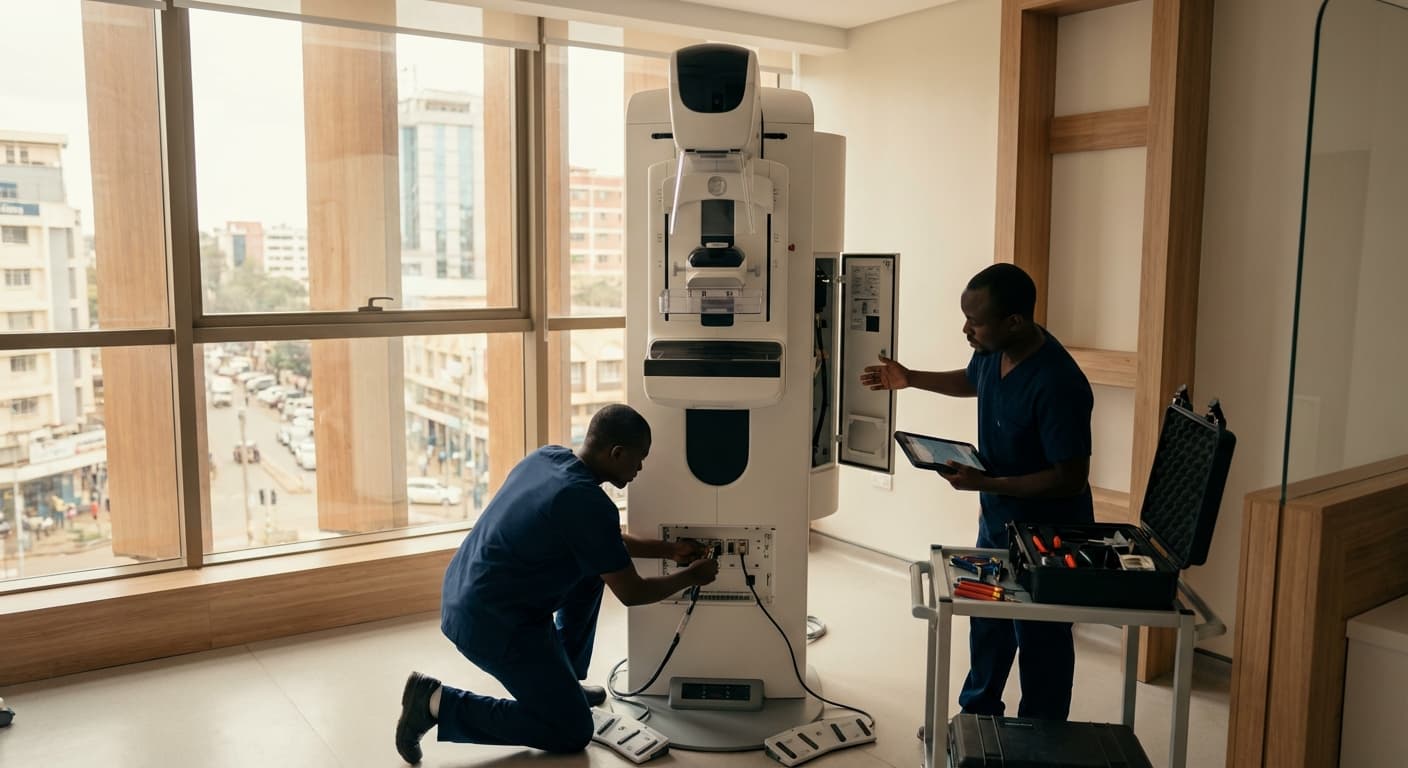
Mammography Installation Service in Lesotho
Engineering Excellence & Technical Support
Mammography Installation Service High-standard technical execution following OEM protocols and local regulatory frameworks.
Nationwide Diagnostic Imaging Accessibility
We are committed to deploying state-of-the-art mammography units across all ten districts of Lesotho, ensuring that vital breast cancer screening is accessible to women in both urban centers and remote communities, reducing geographical barriers to healthcare.
Expert Installation & Integration
Our highly skilled technical teams specialize in the precise installation, calibration, and seamless integration of advanced mammography systems, adhering to international medical equipment standards and local regulations for optimal performance and patient safety.
Comprehensive Clinical & Technical Training
Beyond installation, we provide thorough training for radiographers, technologists, and biomedical engineers on the operation, maintenance, and troubleshooting of the new mammography equipment, empowering local healthcare professionals to maximize system utilization and ensure ongoing diagnostic accuracy.
What Is Mammography Installation Service In Lesotho?
Mammography installation service in Lesotho refers to the specialized process of setting up, configuring, and calibrating mammography equipment within healthcare facilities. This encompasses the physical installation of the unit, integration with existing imaging and information systems, and comprehensive testing to ensure optimal performance and diagnostic accuracy. The service is crucial for establishing or upgrading breast imaging capabilities, adhering to regulatory standards, and ensuring the safe and effective operation of the mammography system. It involves a multidisciplinary approach, often including medical physicists, biomedical engineers, IT specialists, and vendor representatives.
| Who Needs Mammography Installation Service? | Typical Use Cases | ||
|---|---|---|---|
| New Breast Imaging Centers: Facilities establishing dedicated mammography services for the first time. | Establishment of new screening programs for breast cancer detection. | Setting up diagnostic imaging departments within hospitals and clinics. | Rural and remote healthcare facilities aiming to provide essential breast imaging services. |
| Existing Healthcare Facilities Upgrading Equipment: Hospitals and clinics replacing older mammography units with newer, more advanced technology. | Enhancing diagnostic capabilities with digital mammography (FFDM) or 3D mammography (tomosynthesis). | Expanding capacity to meet growing patient demand. | Replacing obsolete or malfunctioning equipment to maintain service continuity. |
| Government and Public Health Initiatives: Organizations implementing national or regional breast cancer screening programs. | Deployment of mobile mammography units for outreach services. | Public health campaigns aimed at early detection of breast cancer. | |
| Private Healthcare Providers: Private hospitals, diagnostic centers, and specialized imaging clinics. | Offering advanced diagnostic and screening mammography services to a broader patient base. | Improving turnaround times and diagnostic accuracy through technology upgrades. | |
| Research Institutions: Academic medical centers and research facilities acquiring mammography equipment for clinical studies. | Conducting research related to breast cancer detection, imaging technologies, and treatment outcomes. |
Key Components of Mammography Installation Service:
- Site Preparation and Infrastructure Assessment: Evaluating the suitability of the installation site, including power requirements, radiation shielding, environmental controls (temperature, humidity), and network connectivity.
- Equipment Delivery and Unpacking: Safe and secure transportation of the mammography unit and associated components to the facility.
- Physical Installation and Assembly: Mounting and connecting all parts of the mammography system, including the X-ray generator, detector, image acquisition console, and workstation.
- Electrical and Network Integration: Connecting the equipment to the facility's power supply and local area network (LAN) for data transfer and PACS integration.
- Software Installation and Configuration: Installing the operating system, image processing software, and any necessary DICOM (Digital Imaging and Communications in Medicine) drivers.
- System Calibration and Quality Assurance Testing: Performing rigorous tests to verify image quality, radiation output, mechanical alignment, and overall system performance according to established protocols (e.g., ACR, IAEA guidelines).
- Integration with Picture Archiving and Communication Systems (PACS) and Electronic Health Records (EHR): Ensuring seamless data flow and interoperability with other hospital IT systems.
- User Training: Providing comprehensive training to radiographers, technologists, and radiologists on the operation, maintenance, and troubleshooting of the installed equipment.
- Documentation and Handover: Providing detailed installation reports, user manuals, and warranty information.
Who Needs Mammography Installation Service In Lesotho?
Mammography installation is a critical service for healthcare facilities aiming to provide advanced diagnostic imaging for breast health. In Lesotho, this service is essential for hospitals and specialized diagnostic centers that are expanding or upgrading their radiology departments to offer comprehensive cancer screening and detection. The installation process requires specialized technicians and adherence to strict medical equipment standards, ensuring the mammography unit operates optimally and safely.
| Target Customer Type | Key Departments Involved | Needs and Benefits |
|---|---|---|
| Public Hospitals | Radiology Department, Oncology Department, General Surgery, Administration | To provide essential breast cancer screening and diagnostic services to the general population, improving early detection rates and patient outcomes. Supports national health strategies. |
| Private Hospitals/Clinics | Radiology Department, Breast Surgery Unit, Oncology Unit, Outpatient Services | To offer high-quality, state-of-the-art mammography services to a paying clientele, enhancing their reputation and service portfolio. Competitiveness in the healthcare market. |
| Specialized Diagnostic & Imaging Centers | Radiology Department, Imaging Technicians, Medical Physicists, Management | To expand their diagnostic capabilities and attract more patients seeking specialized breast imaging. Focus on advanced imaging techniques and interpretation. |
| Cancer Treatment & Research Centers | Radiology Department, Oncology, Pathology, Research Department, Clinical Trials Unit | To facilitate accurate diagnosis for cancer patients, monitor treatment effectiveness, and support research into breast cancer. Crucial for comprehensive cancer care and research initiatives. |
| Government Health Ministries/Departments | Public Health Division, Medical Equipment Procurement, Health Infrastructure Unit | To establish or upgrade mammography services in public health facilities across the country, aiming to reduce breast cancer mortality through widespread screening programs and equitable access to diagnostic tools. |
Target Customers and Departments for Mammography Installation Service in Lesotho
- Hospitals (Public and Private)
- Specialized Diagnostic and Imaging Centers
- Cancer Treatment and Research Centers
- Rural Health Clinics (with advanced diagnostic capabilities)
- Government Health Ministries/Departments (for public health initiatives)
Mammography Installation Service Process In Lesotho
This document outlines the standard workflow for a mammography installation service in Lesotho, covering the process from initial client inquiry to the successful execution and handover of the installed equipment. The aim is to ensure a seamless and efficient installation, meeting all regulatory and technical requirements.
| Stage | Description | Key Activities | Responsible Party/Parties | Expected Outcome |
|---|---|---|---|---|
| Inquiry & Initial Consultation | The client expresses interest in a mammography installation service. | Receive inquiry, understand client needs, discuss initial requirements, provide preliminary information about services offered. | Client, Service Provider Sales/Technical Team | Clear understanding of client's basic needs, initial project scope definition. |
| Site Assessment & Planning | A detailed assessment of the installation site is conducted. | On-site visit, survey of space (dimensions, power, ventilation, radiation shielding), review of existing infrastructure, identify potential challenges. | Service Provider Technical Team, Client Facility Management | Detailed site report, confirmed installation feasibility, identification of specific technical requirements (e.g., power upgrades, structural modifications). |
| Quotation & Contract Agreement | Based on the assessment, a formal proposal and contract are prepared. | Prepare detailed quotation (equipment, installation, training, consumables), present proposal to client, negotiate terms, finalize contract, secure necessary approvals. | Service Provider Sales/Project Management Team, Client Procurement/Administration | Signed contract, agreed scope of work, pricing, and timeline. |
| Logistics & Equipment Procurement | Sourcing and procurement of the mammography equipment and necessary accessories. | Place orders for equipment, manage lead times, arrange for shipping and customs clearance (if applicable in Lesotho). | Service Provider Procurement Team, Equipment Manufacturer/Supplier | Equipment and accessories are ready for transport to Lesotho. |
| Pre-Installation Preparation | Preparation of the installation site according to technical specifications. | Carry out any required civil works, electrical upgrades, radiation shielding installation/verification, ensure accessibility for delivery. | Client Facility Management, Approved Contractors (if needed), Service Provider Technical Team (supervision) | Installation site is fully prepared and meets all prerequisites for equipment installation. |
| Equipment Delivery & Unpacking | Safe and secure delivery of the mammography equipment to the installation site. | Transport equipment to site, careful unpacking, visual inspection for any transit damage. | Logistics Provider, Service Provider Installation Team | Equipment safely delivered and unpacked at the installation site. |
| Installation & Configuration | Physical installation of the mammography system and its components. | Assemble and connect all parts of the mammography unit, install software, connect to PACS/RIS (if applicable), configure system settings. | Service Provider Installation & Technical Team | Mammography equipment is physically installed and powered on. |
| Testing & Calibration | Ensuring the equipment functions optimally and meets all performance standards. | Perform comprehensive diagnostic tests, calibrate image acquisition parameters, conduct quality control (QC) tests, verify radiation output. | Service Provider Technical & Medical Physics Team | Equipment performance verified and calibrated according to manufacturer and regulatory standards. |
| Training & Demonstration | Training for the end-users on the operation of the mammography system. | Provide hands-on training for radiographers and technicians, demonstrate standard procedures, troubleshooting basic issues. | Service Provider Training Specialist, Client End-Users | Client staff are proficient in the basic operation of the mammography system. |
| Final Inspection & Sign-off | Formal inspection and acceptance of the installed system by the client. | Client representatives conduct a final review of the installation, confirm all requirements are met, and provide formal sign-off. | Client Project Manager/Lead Radiographer, Service Provider Project Manager | Client formally accepts the installed and commissioned mammography system. |
| Documentation & Handover | Provision of all relevant documentation to the client. | Handover of user manuals, service manuals, warranty information, calibration certificates, training materials, site reports. | Service Provider Project Management Team | Client receives a complete set of documentation for the installed system. |
| Post-Installation Support | Ongoing support and maintenance services. | Provide warranty support, schedule preventive maintenance, offer ongoing technical assistance and troubleshooting. | Service Provider Technical Support & Service Team | Client benefits from continued reliable operation of the mammography system. |
Mammography Installation Service Workflow in Lesotho
- Inquiry & Initial Consultation
- Site Assessment & Planning
- Quotation & Contract Agreement
- Logistics & Equipment Procurement
- Pre-Installation Preparation
- Equipment Delivery & Unpacking
- Installation & Configuration
- Testing & Calibration
- Training & Demonstration
- Final Inspection & Sign-off
- Documentation & Handover
- Post-Installation Support
Mammography Installation Service Cost In Lesotho
The cost of mammography installation services in Lesotho can vary significantly depending on a range of factors. These include the complexity of the installation, the specific type and model of the mammography equipment, the accessibility of the installation site, and the reputation and experience of the service provider. Additional costs may arise from necessary infrastructure upgrades, calibration services, and potential training for medical personnel. Due to the specialized nature of this service, there isn't a single fixed price, and quotations are typically provided on a project-by-project basis after a thorough site assessment.
| Service Component | Estimated Cost Range (LSL) | Notes |
|---|---|---|
| Initial Consultation & Site Assessment | 2,000 - 7,500 | May be credited towards installation if contract is awarded. |
| Equipment Transportation & Handling | 5,000 - 25,000+ | Depends on distance, equipment size, and specialized handling needs. |
| Basic Installation Labor | 15,000 - 40,000 | Covers setup, connection, and basic integration. |
| Electrical & Power Upgrades | 3,000 - 15,000 | If existing infrastructure is insufficient. |
| Radiation Shielding (if required) | 5,000 - 20,000+ | Dependent on room size and shielding materials. |
| Calibration & Quality Assurance Testing | 7,000 - 18,000 | Essential for accurate and safe operation. |
| Software Installation & Integration | 2,000 - 8,000 | Including PACS/RIS integration. |
| User Training (Initial) | 10,000 - 25,000 | For radiographers and technicians. |
| Project Management | 5,000 - 15,000 | Can be a separate fee or bundled. |
| Total Estimated Installation Cost (Excluding Equipment) | 54,000 - 178,500+ | This is a broad estimate; complex installations can exceed this range significantly. |
Key Factors Influencing Mammography Installation Costs in Lesotho
- Type and Model of Mammography Equipment: Advanced digital mammography systems are generally more expensive to install than older analog models.
- Installation Site Complexity: Difficult terrain, limited access, or the need for extensive structural modifications can increase labor and material costs.
- Infrastructure Requirements: This includes the need for specialized electrical wiring, cooling systems, radiation shielding, and network connectivity.
- Service Provider Expertise and Reputation: Established and highly-skilled technicians or companies may command higher fees.
- Calibration and Testing: Ensuring the equipment is functioning accurately and safely requires specialized calibration services, which are an additional cost.
- Training for Medical Staff: Comprehensive training on operating the new mammography unit and associated software is often included or offered as an add-on service.
- Geographical Location within Lesotho: Travel and accommodation expenses for technicians can impact the overall cost, especially for remote areas.
- Warranty and Support Packages: Extended warranties or ongoing maintenance contracts can influence the initial installation price.
Affordable Mammography Installation Service Options
Securing affordable mammography installation services is crucial for healthcare providers seeking to expand or upgrade their diagnostic imaging capabilities. Beyond just the physical setup, installation encompasses a range of services from site preparation and equipment delivery to calibration, testing, and staff training. Understanding value bundles and implementing cost-saving strategies can significantly reduce the overall expenditure without compromising quality or safety.
| Cost-Saving Strategy | Description | Potential Impact on Cost |
|---|---|---|
| Negotiate Package Deals: | Leverage your purchasing power by negotiating a bundled price for equipment and installation, or for multiple installation projects. | Significant reduction through volume discounts and bundled pricing. |
| Obtain Multiple Quotes: | Request detailed proposals from at least three different reputable installation service providers. Compare not just the price, but also the scope of services included. | Helps identify competitive pricing and prevents overpayment. |
| Consider Off-Peak Installation: | If possible, schedule installation during less busy periods for the provider, which might allow for more flexible scheduling and potentially better rates. | Minor to moderate reduction through improved provider scheduling. |
| Involve Internal IT and Facilities Teams Early: | Leverage your internal resources for tasks like network infrastructure assessment, basic site preparation, and coordination with building management. This can reduce the billable hours for external technicians. | Moderate to significant reduction by outsourcing fewer tasks. |
| Understand Equipment Specifications: | Ensure the installation plan aligns precisely with the manufacturer's specifications to avoid costly rework or unnecessary customizations. | Prevents budget overruns due to non-compliance. |
| Explore Refurbished or Certified Pre-Owned Equipment: | While focusing on installation, consider if purchasing certified pre-owned mammography equipment can free up budget for a more robust installation package. | Indirect cost saving by reducing the capital expenditure, allowing for better installation budget allocation. |
| Long-Term Service Agreements: | While an upfront cost, negotiating a favorable long-term service agreement at the time of installation can often provide better rates than securing services later. | Stabilizes long-term operational costs, potentially offering discounts compared to ad-hoc service calls. |
| Prioritize Essential Services: | Clearly define your essential installation needs and be open to deferring non-critical services or training to a later date if budget is a primary concern. | Allows for upfront focus on core installation, deferring non-essential spending. |
Understanding Value Bundles in Mammography Installation
- Comprehensive Installation Package: This is the most common bundle, including everything from initial site assessment to final system handover. It often encompasses hardware setup, software configuration, network integration, radiation safety compliance, and basic user training. The value lies in its all-in-one nature, simplifying project management and ensuring all aspects are covered by a single provider.
- Equipment & Installation Synergy: Some vendors offer bundles where the purchase of the mammography equipment is directly tied to their installation service at a discounted rate. This can be highly cost-effective if you are already committed to a specific equipment manufacturer.
- Managed Services Integration: Increasingly, installation bundles include an initial period of managed services, such as remote monitoring, preventative maintenance, and software updates. This adds long-term value by ensuring optimal system performance and minimizing potential downtime.
- Turnkey Solutions: For providers with limited in-house technical expertise, turnkey solutions provide end-to-end management of the entire installation process, including facility modifications, permitting, and coordination with all third-party contractors. While often more expensive upfront, they offer the greatest peace of mind and reduce the administrative burden.
- Phased Installation & Training: Some bundles allow for a phased approach, where the core installation is completed, followed by subsequent training sessions or supplementary services at a later date. This can help manage cash flow and allow staff to adapt to new technology gradually.
Verified Providers In Lesotho
In Lesotho's healthcare landscape, discerning the most reliable and trustworthy providers is paramount. Franance Health has emerged as a leading entity, distinguished by its rigorous credentialing processes and unwavering commitment to quality patient care. Understanding what makes Franance Health stand out is crucial for anyone seeking dependable healthcare services.
| Credential Aspect | Franance Health's Approach | Patient Benefit |
|---|---|---|
| Licensing & Certification Verification | Mandatory verification of all official licenses and board certifications with relevant regulatory bodies. | Ensures providers are legally authorized and possess the foundational qualifications to practice. |
| Educational Background Review | Thorough examination of medical school transcripts, postgraduate training completion, and specialty certifications. | Confirms a strong academic and theoretical foundation in their respective fields. |
| Professional Experience Assessment | Verification of previous practice history, including duration, roles, and any reported disciplinary actions. | Provides insight into a provider's practical application of knowledge and experience. |
| Clinical Competency Evaluation | May involve peer reviews, outcome data analysis, and assessment of adherence to evidence-based guidelines. | Guarantees that providers are skilled in delivering effective and up-to-date medical care. |
| Commitment to Patient Care Standards | Screening for patient feedback, ethical conduct, and commitment to patient safety protocols. | Fosters trust and confidence in the provider's dedication to patient well-being and a positive experience. |
Why Franance Health is the Best Choice:
- Rigorous Credentialing and Verification: Franance Health employs a multi-faceted credentialing process for all its affiliated healthcare providers. This includes thorough background checks, verification of medical licenses and certifications, and a comprehensive review of their educational qualifications and professional experience.
- Commitment to Quality and Safety: Beyond basic verification, Franance Health assesses providers based on their adherence to established medical best practices, patient safety protocols, and a track record of positive patient outcomes. This ensures that all associated healthcare professionals are not only qualified but also dedicated to delivering high-quality care.
- Continuous Monitoring and Re-evaluation: The credentialing process is not a one-time event. Franance Health engages in ongoing monitoring of its providers, including regular performance reviews and peer assessments. This commitment to continuous improvement guarantees that providers consistently meet and exceed standards.
- Patient-Centric Approach: Franance Health actively seeks providers who demonstrate a strong patient-centric philosophy, prioritizing empathy, clear communication, and individualized treatment plans. This focus on the patient experience ensures a more positive and effective healthcare journey.
- Access to a Network of Excellence: By partnering with Franance Health, patients gain access to a curated network of highly qualified and trusted healthcare professionals across various specialties in Lesotho. This network represents the pinnacle of medical expertise and dedication within the country.
Scope Of Work For Mammography Installation Service
This document outlines the Scope of Work (SOW) for the installation of a new mammography system. It details the technical deliverables, standard specifications, and project phases required to ensure a successful and compliant implementation. The objective is to provide a comprehensive framework for the installation process, covering all essential aspects from site preparation to system testing and handover.
| Category | Technical Deliverable | Standard Specification | Verification Method |
|---|---|---|---|
| Site Preparation | Electrical Power Supply Compliance | Dedicated, properly grounded, and surge-protected power outlet meeting manufacturer's voltage and amperage requirements (e.g., 200-240V AC, 50/60 Hz, 30A). Power conditioner and UPS recommended. | Visual inspection, electrical testing (voltage, amperage, grounding), and documentation review. |
| Site Preparation | Environmental Controls | Temperature: 15-30°C (59-86°F). Humidity: 30-60% RH non-condensing. Adequate ventilation to prevent overheating. | Environmental monitoring sensors, visual inspection of HVAC system, and humidity readings. |
| Site Preparation | Radiation Shielding | Lead-lined walls, doors, and viewing windows meeting local and national radiation safety regulations (e.g., adherence to NCRP or equivalent standards). | Radiation survey by a qualified physicist, structural inspection, and review of architectural plans. |
| Site Preparation | Network Connectivity | Reliable, high-speed wired Ethernet connection (Gigabit recommended) for RIS/PACS integration. IP address, subnet mask, gateway, and DNS details provided. | Network cable testing, ping tests, and successful data transfer test. |
| Site Preparation | Physical Space Requirements | Adequate floor space, door clearances, and ceiling height as per manufacturer's specifications for system placement and access. | On-site measurement, comparison with manufacturer's drawings, and visual confirmation. |
| Equipment Delivery | Secure Transportation | System transported in original, undamaged packaging. Handling according to manufacturer's guidelines for sensitive medical equipment. | Visual inspection of packaging for damage, review of shipping manifests and condition reports. |
| Installation | System Assembly and Cabling | Correct assembly of all system components (gantry, console, workstation). Secure and organized cabling adhering to safety standards. | Visual inspection, continuity testing of critical cables. |
| Installation | Software Installation and Configuration | Installation of operating system, mammography application software, and any required drivers. Network and DICOM configurations completed. | Successful software boot-up, application launch, and validation of network/DICOM settings. |
| Installation | Integration with RIS/PACS | Successful connection and data exchange with the Hospital Information System (HIS) / Radiology Information System (RIS) and Picture Archiving and Communication System (PACS). | Order entry testing, image sending/receiving tests, and verification of patient data integrity. |
| Testing | System Performance Testing | All system functions tested according to manufacturer's protocols, including image acquisition, processing, and display. | Execution of manufacturer's diagnostic tests, image quality assessment, and functional checks. |
| Testing | Quality Assurance (QA) Procedures | Execution of essential QA tests (e.g., ACR accreditation phantom testing, geometric accuracy, dose consistency) by a certified medical physicist. | Review of QA test results and reports signed by a qualified medical physicist. |
| Testing | Radiation Safety Checks | Verification of radiation output, beam alignment, and interlocks by a qualified medical physicist. | Radiation survey report and functional testing of safety mechanisms. |
| Training | Operator Training | Comprehensive training for radiographers and technologists on system operation, image acquisition techniques, and basic troubleshooting. | Attendance records, participant feedback, and practical demonstration of proficiency. |
| Training | Physician/Radiologist Training | Training on image interpretation, system advanced features, and QC protocols. | Attendance records and demonstrated understanding of system functionalities relevant to interpretation. |
| Handover | Final System Acceptance | Formal sign-off by authorized personnel confirming successful installation, testing, and training, meeting all SOW requirements. | Signed acceptance certificate and documentation review. |
| Handover | Documentation Package | Complete set of manufacturer manuals, installation reports, QA/QC reports, warranty information, and service contact details. | Review and confirmation of all required documents. |
| Post-Installation | Warranty and Service Agreement | Activation of manufacturer's warranty and defined service level agreement (SLA) for ongoing maintenance and support. | Confirmation of warranty start date and SLA details. |
Key Project Phases
- Site Assessment and Preparation
- Equipment Delivery and Unpacking
- Installation and Configuration
- Testing and Calibration
- Training and Handover
- Post-Installation Support
Service Level Agreement For Mammography Installation Service
This Service Level Agreement (SLA) outlines the terms and conditions governing the installation of mammography equipment and the associated response times and uptime guarantees provided by [Your Company Name] (hereinafter referred to as 'Provider') to [Client Name] (hereinafter referred to as 'Client'). This SLA is an integral part of the Master Service Agreement (MSA) between the Provider and the Client.
| Service Component | Description | Response Time Target | Uptime Guarantee | Notes |
|---|---|---|---|---|
| Mammography Installation | Initial setup, configuration, and testing of new mammography equipment. | Within 2 business days of project initiation. | N/A (Installation is a one-time event, uptime guarantee applies post-installation) | Client must provide clear site access and necessary utilities as per the installation plan. |
| Critical System Failure (Post-Installation) | Complete unavailability of the mammography system preventing all imaging and diagnostic procedures. | 2 hours | 99.5% monthly uptime (excluding scheduled maintenance) | Applies to hardware failures and critical software issues directly related to the installed system. |
| Major System Malfunction (Post-Installation) | Significant degradation of system performance impacting primary imaging functions, but not complete unavailability. | 4 business hours | N/A (Covered under Critical System Failure Uptime Guarantee) | Examples include image quality issues, scan time delays, or partial functionality loss. |
| Minor System Issues (Post-Installation) | Non-critical issues impacting workflow but not preventing essential imaging (e.g., user interface glitches, minor reporting errors). | 8 business hours | N/A (Covered under Critical System Failure Uptime Guarantee) | Focus on remote troubleshooting and workarounds where possible. |
| Scheduled Maintenance | Planned downtime for preventative maintenance, software updates, or system upgrades. | Advance notification of at least 7 business days. | N/A (Downtime is planned and agreed upon) | Maintenance windows to be mutually agreed upon, typically during off-peak hours. |
Key Definitions
- Installation: The process of physically installing, configuring, and testing the specified mammography equipment at the Client's designated facility.
- Downtime: A period during which the mammography equipment is unavailable for use due to a failure of the equipment itself or the installation services provided by the Provider, and for which the Client has submitted a valid support request.
- Response Time: The maximum time elapsed between the Client reporting a critical issue and the Provider initiating troubleshooting efforts (e.g., phone call, remote access, or dispatching a technician).
- Resolution Time: The maximum time elapsed between the Provider initiating troubleshooting and the issue being resolved to the Client's satisfaction, or a mutually agreed-upon workaround being implemented.
- Uptime Guarantee: The percentage of time the mammography equipment is expected to be operational and available for use.
- Scheduled Maintenance: Planned downtime for preventative maintenance, software updates, or system upgrades, communicated to the Client in advance.
- Force Majeure: Events beyond the reasonable control of the Provider, including but not limited to natural disasters, acts of war, terrorism, or widespread communication failures.
Frequently Asked Questions

Ready when you are
Let's scope your Mammography Installation Service in Lesotho project in Lesotho.

Scaling healthcare logistics and technical systems across the entire continent.