
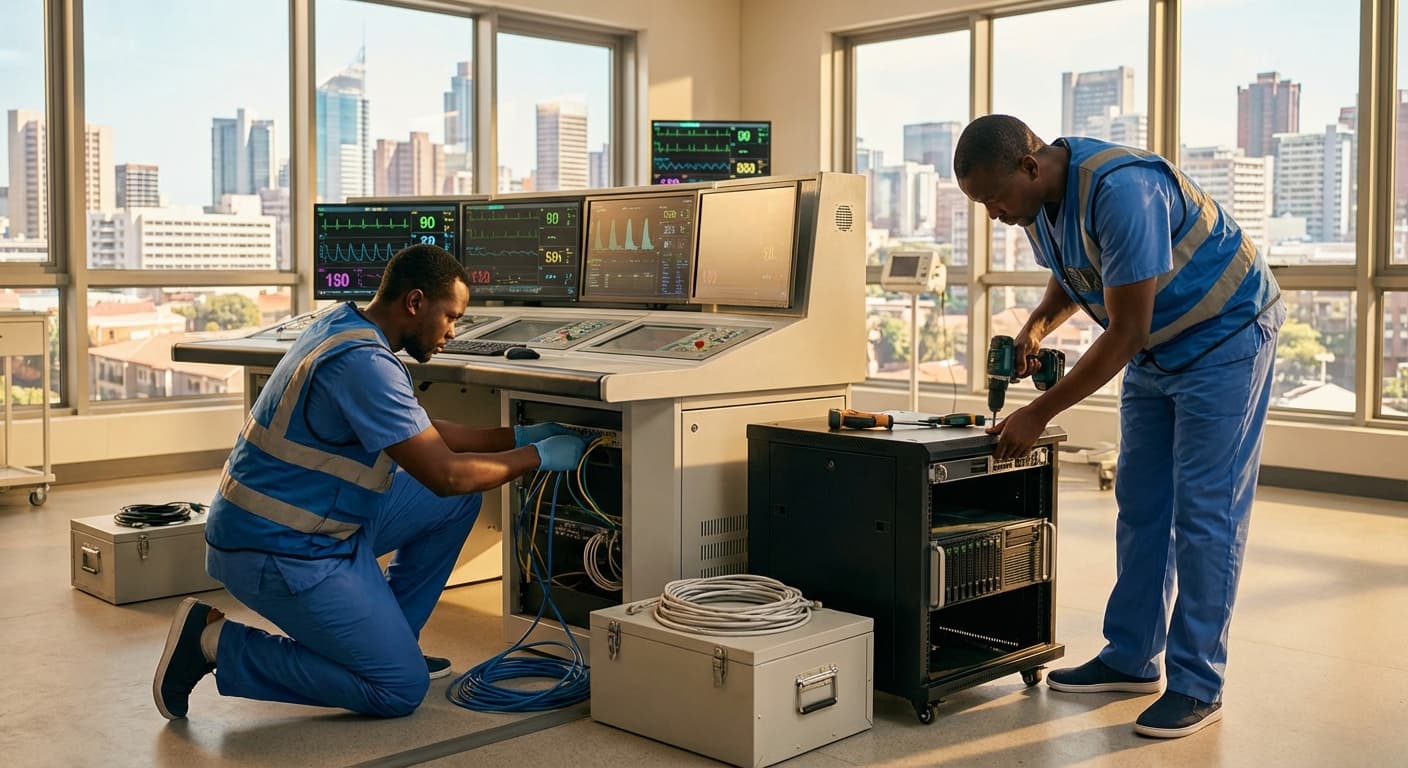
ICU Central Monitoring Station Installation Service in Lesotho
Engineering Excellence & Technical Support
ICU Central Monitoring Station Installation Service High-standard technical execution following OEM protocols and local regulatory frameworks.
Robust Centralized Monitoring Infrastructure
We design and implement highly reliable and scalable central monitoring infrastructure, ensuring continuous, real-time patient data aggregation from diverse ICU devices. Our solutions leverage secure network protocols and redundant systems to guarantee uninterrupted data flow and system uptime, even in challenging environments.
Seamless Device Integration & Data Harmonization
Our expertise lies in integrating a wide range of ICU medical devices (ventilators, monitors, infusion pumps) with our central monitoring platform. We provide sophisticated data parsing and harmonization to present unified, actionable patient information, reducing alarm fatigue and enabling faster clinical decision-making for healthcare professionals in Lesotho.
Secure & Compliant Data Management
We prioritize the security and privacy of sensitive patient data. Our installation services adhere to strict data protection standards and implement robust cybersecurity measures, including encryption, access controls, and audit trails, to ensure compliance with relevant health regulations and safeguard patient confidentiality within Lesotho's healthcare system.
What Is Icu Central Monitoring Station Installation Service In Lesotho?
ICU Central Monitoring Station Installation Service in Lesotho refers to the comprehensive process of designing, deploying, configuring, and commissioning a centralized system for real-time physiological monitoring of patients in Intensive Care Units (ICUs) within healthcare facilities in Lesotho. This service ensures seamless data acquisition, aggregation, visualization, and alert generation from multiple bedside patient monitoring devices to a central station, enabling critical care teams to efficiently oversee and manage patient status.
| Who Needs It | Typical Use Cases | ||||
|---|---|---|---|---|---|
| Hospitals and Tertiary Care Centers in Lesotho: Facilities with dedicated Intensive Care Units (ICUs) or High Dependency Units (HDUs) requiring continuous patient oversight. | Management of Critically Ill Patients: Real-time surveillance of vital signs in patients recovering from surgery, severe trauma, sepsis, cardiac events, respiratory failure, or neurological emergencies. | Monitoring Multiple Patients Simultaneously: Enabling a single clinician or a team to efficiently monitor the condition of several patients within the ICU, optimizing resource allocation. | Early Detection of Patient Deterioration: Prompt identification of subtle changes in physiological parameters that may indicate a worsening clinical condition, facilitating timely interventions. | Facilitating Clinical Decision-Making: Providing a consolidated view of patient data to support informed diagnostic and therapeutic decisions by the critical care team. | Research and Data Analysis: Collection of continuous physiological data for retrospective analysis, clinical research, and quality improvement initiatives within the ICU. |
| Specialized Units within Hospitals: Cardiac Intensive Care Units (CICUs), Surgical ICUs (SICUs), Medical ICUs (MICUs), and Neonatal ICUs (NICUs) that rely heavily on continuous monitoring. | High-Risk Patient Populations: Continuous observation of patients with unstable hemodynamics, severe respiratory compromise, or neurological impairment requiring constant vigilance. | Telemedicine and Remote Monitoring (Future/Advanced Implementations): Potentially enabling remote consultation and oversight of ICU patients by specialists located elsewhere, assuming adequate bandwidth and security. | Training and Education: Utilizing the central monitoring station as a teaching tool for medical and nursing students to understand critical care physiology and monitoring principles. |
Service Inclusions and Scope:
- System Design and Planning: Needs assessment, network architecture design, equipment selection, and layout planning for the central monitoring station and associated bedside monitors.
- Hardware Installation: Physical installation and mounting of central monitoring workstations, servers, network infrastructure (cables, switches), and power management systems.
- Software Deployment and Configuration: Installation and configuration of the central monitoring software platform, including patient data integration, alarm parameter setup, and user access controls.
- Network Integration: Establishing secure and reliable network connectivity between bedside monitors and the central station, ensuring data integrity and low latency.
- Device Integration and Calibration: Connecting and configuring various patient monitoring devices (e.g., ECG, SpO2, NIBP, invasive pressure, ventilators) to the central system and performing necessary calibrations.
- Alarm Management System Setup: Configuring customizable alarm thresholds, priorities, and notification mechanisms to alert staff to critical patient events.
- User Training: Providing comprehensive training to clinical staff (physicians, nurses, technicians) on operating the central monitoring system, interpreting data, and responding to alarms.
- System Testing and Validation: Performing rigorous testing to ensure all components are functioning correctly, data is accurate, and alarm systems are operational.
- Documentation and Handover: Providing detailed system documentation, user manuals, and conducting a formal handover to the healthcare facility's IT and clinical teams.
- Post-Installation Support and Maintenance (Optional): Offering ongoing technical support, software updates, and preventative maintenance services.
Who Needs Icu Central Monitoring Station Installation Service In Lesotho?
ICU Central Monitoring Station Installation Services are crucial for healthcare facilities in Lesotho seeking to enhance patient care, streamline operations, and improve clinical outcomes. These services involve the professional setup and integration of advanced monitoring systems that allow a centralized team to observe and respond to the critical conditions of multiple ICU patients simultaneously. This proactive approach is vital for early detection of deterioration, timely intervention, and optimized resource allocation within the Intensive Care Unit.
| Target Customers | Relevant Departments |
|---|---|
| Public Hospitals (e.g., Queen Mamohato Memorial Hospital, National Referral Hospital) | Intensive Care Unit (ICU), Critical Care Department, Nursing Administration, Biomedical Engineering Department |
| Private Hospitals and Clinics | ICU, Critical Care Services, Hospital Management, IT Department, Biomedical Services |
| Mission Hospitals and Faith-Based Healthcare Facilities | ICU, Nursing Services, Hospital Administration, Technical Services |
| Tertiary and Referral Centers | ICU, Cardiology ICU, Neurosurgical ICU, Trauma ICU, Anesthesiology Department, Critical Care Medicine Department |
| Government Health Initiatives and Projects | Ministry of Health, Public Health Departments, Health Infrastructure Development Units |
| Healthcare Training and Research Institutions (with clinical components) | ICU Training Units, Medical Simulation Centers, Clinical Research Departments |
Who Needs ICU Central Monitoring Station Installation Service in Lesotho?
- Hospitals and healthcare providers in Lesotho aiming to upgrade their Intensive Care Unit (ICU) capabilities.
- Facilities looking to implement modern, integrated patient monitoring solutions.
- Organizations prioritizing enhanced patient safety and improved clinical response times for critically ill individuals.
- Healthcare institutions seeking to optimize the workflow and efficiency of their ICU nursing and medical staff.
- Government health ministries and regional health authorities focused on improving the quality of critical care services across the nation.
Icu Central Monitoring Station Installation Service Process In Lesotho
This document outlines the typical workflow for an ICU Central Monitoring Station Installation Service in Lesotho, from initial inquiry to final execution and handover. The process is designed to ensure a smooth, efficient, and compliant installation that meets the critical needs of a healthcare facility.
| Phase | Key Activities | Responsible Parties | Key Deliverables | Estimated Timeline (Lesotho Context) |
|---|---|---|---|---|
| Phase 1: Inquiry and Initial Consultation | Client expresses interest in ICU Central Monitoring Station installation. Initial discussion of needs, scope, and expectations. Introduction to the service provider and their capabilities. | Healthcare Facility (Client), Service Provider | Confirmed interest, understanding of initial requirements | 1-3 Business Days |
| Phase 2: Site Assessment and Requirements Gathering | Detailed on-site visit to the ICU and relevant areas. Assessment of existing infrastructure (power, networking, space). Understanding specific clinical workflow and monitoring needs. Identification of required equipment and integration points. | Service Provider (Technical Team), Healthcare Facility (ICU Staff, IT, Biomedical Engineering) | Detailed site survey report, comprehensive list of technical and functional requirements, equipment specifications | 3-7 Business Days |
| Phase 3: Proposal Development and Quotation | Development of a tailored proposal based on site assessment and requirements. Detailed breakdown of equipment, software, installation services, and timelines. Pricing and cost estimation, including any potential contingencies. | Service Provider | Formal proposal document, detailed quotation, project timeline outline | 5-10 Business Days |
| Phase 4: Contract Negotiation and Agreement | Review of the proposal and quotation by the client. Discussion and negotiation of terms, conditions, payment schedules, and SLAs. Finalization and signing of the installation contract. | Client, Service Provider | Signed installation contract, agreed-upon terms and conditions | 5-15 Business Days (can vary based on internal approval processes) |
| Phase 5: Project Planning and Design | Detailed project plan creation, including resource allocation, risk management, and communication protocols. Finalizing system architecture, network topology, and data flow diagrams. Obtaining necessary permits or approvals (if applicable). | Service Provider (Project Manager), Client (Liaison) | Detailed project plan, system design documents, risk assessment report | 7-14 Business Days |
| Phase 6: Procurement and Logistics | Ordering of all necessary equipment, software licenses, and materials. Arranging for shipping, customs clearance (if imported), and delivery to the site in Lesotho. Ensuring all items are accounted for and in good condition. | Service Provider (Procurement & Logistics), Client (Import/Customs Support if needed) | Procurement orders, shipping manifests, delivery confirmation | 2-6 Weeks (highly dependent on lead times and international shipping) |
| Phase 7: Pre-Installation Preparation | Preparation of the installation site (e.g., ensuring clean environment, clear access). Installation of necessary cabling (network, power) if not already present or requiring upgrades. Pre-configuration of devices in a controlled environment. | Service Provider (Technical Team), Client (Facilities Management, IT) | Prepared installation site, completed cabling infrastructure, pre-configured equipment | 3-7 Business Days (can overlap with Phase 6 deliveries) |
| Phase 8: On-site Installation and Configuration | Physical installation of the central monitoring station hardware and servers. Connecting patient monitors, ventilators, and other bedside devices to the network. Software installation, configuration, and integration of all components. | Service Provider (Installation Engineers, Network Specialists) | Installed hardware and software, connected devices, basic system functionality established | 5-15 Business Days (depending on ICU size and complexity) |
| Phase 9: Testing, Calibration, and Commissioning | Thorough functional testing of all system components and features. Calibration of sensors and devices to ensure accuracy. Verification of data transmission, alarm functions, and integration with EMR (if applicable). User Acceptance Testing (UAT) with client staff. | Service Provider (Commissioning Engineers), Client (Biomedical Engineering, ICU Staff) | Test reports, calibration certificates, UAT sign-off, commissioned system | 3-7 Business Days |
| Phase 10: Training and Handover | Comprehensive training for ICU staff, IT personnel, and biomedical engineers on system operation, maintenance, and troubleshooting. Provision of user manuals and technical documentation. Formal handover of the installed system to the client. | Service Provider (Trainers, Project Manager), Client (All relevant staff) | Trained personnel, complete documentation, formal handover certificate | 2-5 Business Days |
| Phase 11: Post-Installation Support and Maintenance | Provision of warranty and ongoing technical support as per contract. Remote monitoring, software updates, and planned preventative maintenance. On-call support for critical issues. | Service Provider (Support Team), Client (IT, Biomedical Engineering) | Ongoing system performance, resolved issues, maintained warranty | Ongoing (as per service agreement) |
ICU Central Monitoring Station Installation Service Workflow in Lesotho
- Phase 1: Inquiry and Initial Consultation
- Phase 2: Site Assessment and Requirements Gathering
- Phase 3: Proposal Development and Quotation
- Phase 4: Contract Negotiation and Agreement
- Phase 5: Project Planning and Design
- Phase 6: Procurement and Logistics
- Phase 7: Pre-Installation Preparation
- Phase 8: On-site Installation and Configuration
- Phase 9: Testing, Calibration, and Commissioning
- Phase 10: Training and Handover
- Phase 11: Post-Installation Support and Maintenance
Icu Central Monitoring Station Installation Service Cost In Lesotho
Installing an ICU Central Monitoring Station (CMS) in Lesotho involves a range of costs influenced by several key factors. These systems are critical for patient safety and require specialized equipment, skilled labor, and often integration with existing hospital infrastructure. The pricing in Lesotho will be denominated in the local currency, the Lesotho Loti (LSL). Understanding these pricing dynamics is crucial for healthcare providers and facility managers planning such an investment.
| Service Component | Estimated Cost Range (LSL) |
|---|---|
| Basic ICU Central Monitoring Station (for 4-6 beds) | 50,000 - 150,000 |
| Mid-Range ICU Central Monitoring Station (for 8-12 beds, with more parameters) | 150,000 - 350,000 |
| Advanced/Comprehensive ICU Central Monitoring Station (for 12+ beds, with advanced features & integration) | 350,000 - 1,000,000+ |
| Installation & Setup Labor (per system) | 20,000 - 80,000 |
| Training (per session/group) | 10,000 - 30,000 |
| Site Preparation/Minor Infrastructure Upgrades | 5,000 - 50,000 |
| Integration with Existing HIS/EHR | 15,000 - 70,000 |
Key Factors Influencing ICU Central Monitoring Station Installation Costs in Lesotho:
- System Complexity and Features: The number of patient monitoring beds, the sophistication of the parameters monitored (e.g., ECG, SpO2, NIBP, invasive pressures, respiratory rate, temperature, ETCO2), and advanced features like waveform trending, data archiving, and remote access capabilities significantly impact the overall cost.
- Equipment Brand and Quality: Reputable international brands known for reliability and advanced technology generally command higher prices than less established or locally sourced options. The quality of sensors, displays, and software also plays a role.
- Infrastructure Requirements: Existing electrical wiring, network cabling, and power backup systems (UPS, generators) within the hospital can affect installation costs. If upgrades or new installations are needed, the price will increase.
- Installation Labor and Expertise: The cost of skilled technicians and engineers for setup, configuration, calibration, and testing is a significant component. The availability of locally trained personnel may influence pricing, and international expertise can be more expensive.
- Training and Support: Comprehensive training for medical staff on operating the CMS and ongoing technical support agreements are often bundled into installation packages or offered as separate services, adding to the total cost.
- Integration with Existing Systems: If the CMS needs to be integrated with existing hospital information systems (HIS), electronic health records (EHR), or other medical equipment, this can involve additional software development, configuration, and testing, increasing the overall expense.
- Site Preparation and Structural Modifications: Minor modifications to the hospital environment, such as mounting points for monitors, cable management, and potential room enhancements for optimal viewing and accessibility, can contribute to the cost.
- Consumables and Accessories: Initial provision of necessary consumables (e.g., cables, electrodes, sensors) and accessories will be factored into the installation price.
- Warranty and Maintenance: The duration and scope of the warranty, as well as any included initial maintenance packages, will influence the upfront cost.
- Import Duties and Taxes: For imported equipment, customs duties, taxes, and shipping costs will be added to the base price of the equipment and installation services.
Affordable Icu Central Monitoring Station Installation Service Options
This guide outlines affordable options for installing ICU Central Monitoring Station (CMS) systems, focusing on value bundles and cost-saving strategies to ensure critical care facilities can access essential technology without breaking the budget. We explore different service tiers, integration considerations, and long-term maintenance plans to provide a comprehensive overview.
| Service Bundle Tier | Description | Typical Included Services | Estimated Cost Range (USD, excluding major hardware procurement) | Value Proposition for Budget-Conscious Facilities |
|---|---|---|---|---|
| Basic Installation & Configuration | Focuses on core setup and essential functionalities. | Site survey, basic hardware installation (workstations, network cabling), software installation, initial configuration, basic user training. | $5,000 - $15,000 | Ideal for smaller ICUs or facilities with limited existing infrastructure. Offers essential CMS functionality at the lowest entry point. Saves on extensive customization. |
| Standard Value Bundle | A balanced approach offering comprehensive setup with some customization. | Includes Basic Installation, plus: advanced software configuration, integration with basic bedside monitors, initial data validation, comprehensive user training, and basic post-installation support (e.g., 30-90 days). | $15,000 - $30,000 | Provides a robust CMS solution with essential integrations. Offers good value for money by combining setup, training, and initial support, reducing the need for separate service contracts. |
| Premium Integration Bundle | Designed for facilities requiring seamless integration with a wide range of existing systems. | Includes Standard Value Bundle, plus: complex integration with EMR/EHR systems, integration with advanced bedside devices (ventilators, infusion pumps), custom reporting setup, data migration assistance, extended post-installation support (e.g., 6-12 months). | $30,000 - $60,000+ | Maximizes ROI by ensuring full interoperability and data utilization. While a higher initial investment, it minimizes future integration costs and enhances clinical workflow efficiency, leading to long-term savings. |
| Phased Implementation Support | Modular approach to installation, allowing for budget flexibility. | Customizable based on facility priorities. Can include installation of core CMS, followed by modular additions of integration capabilities or advanced features over time. | Variable (dependent on chosen modules) | Spreads costs over a longer period, making advanced CMS technology accessible even with tight budgets. Allows for gradual upgrades as funding becomes available. |
Key Considerations for Affordable ICU CMS Installation
- Understanding different CMS architectures (server-based, cloud-based, hybrid) and their cost implications.
- The importance of needs assessment to avoid over-speccing or under-speccing the system.
- Evaluating the total cost of ownership (TCO), including hardware, software, installation, training, and ongoing support.
- The benefits of phased implementation for managing upfront costs.
- Investigating potential government grants, subsidies, or non-profit funding opportunities.
- Negotiating with vendors for bulk purchasing discounts on hardware and software licenses.
- Leveraging existing IT infrastructure where possible to reduce hardware requirements.
- Prioritizing essential functionalities and considering optional add-ons for future upgrades.
- The role of third-party integration specialists versus direct vendor installation.
- The long-term cost savings associated with reliable and scalable CMS solutions.
Verified Providers In Lesotho
Finding reliable and qualified healthcare providers is paramount for individuals seeking quality medical care in Lesotho. Franance Health stands out as a trusted name, committed to ensuring that its network comprises only verified and highly competent professionals. This commitment translates into a superior healthcare experience for patients, offering peace of mind and access to the best possible treatment.
| Category | Franance Health Verification Criteria | Benefit to Patients |
|---|---|---|
| Licensure and Certification | Mandatory verification of current, valid medical licenses and relevant certifications from recognized authorities. | Ensures providers are legally qualified and have met industry-standard requirements. |
| Education and Training | Verification of academic credentials and specialized training from accredited institutions. | Confirms providers possess the necessary foundational knowledge and specialized skills. |
| Professional Experience | Review of past employment history, references, and practice history. | Assesses practical experience and professional conduct. |
| Background Checks | Comprehensive checks for any disciplinary actions, malpractice claims, or criminal records. | Mitigates risk and ensures patient safety. |
| Commitment to Continuing Education | Preference for providers actively engaged in ongoing medical education and professional development. | Guarantees patients receive care informed by the latest medical advancements and best practices. |
Why Franance Health Providers are the Best Choice:
- Rigorous Vetting Process: Franance Health employs a stringent credentialing process to onboard its providers. This involves thorough background checks, verification of licenses, education, and professional experience.
- Commitment to Excellence: We partner with healthcare professionals who demonstrate a dedication to ethical practices, continuous professional development, and patient-centered care.
- Specialized Expertise: Our network includes a diverse range of specialists, ensuring that patients can find the exact expertise needed for their specific health concerns.
- Improved Patient Outcomes: By focusing on quality and competence, Franance Health aims to contribute to better health outcomes for all its members.
- Enhanced Trust and Reliability: Patients can feel confident that when they choose a Franance Health-affiliated provider, they are selecting a professional who meets the highest standards of care.
Scope Of Work For Icu Central Monitoring Station Installation Service
This Scope of Work (SOW) outlines the requirements for the installation services of a new ICU Central Monitoring Station (CMS). The project involves the procurement, installation, configuration, testing, and commissioning of a comprehensive ICU CMS solution, including all necessary hardware, software, and network infrastructure within the designated Intensive Care Unit (ICU) areas. The objective is to establish a reliable and efficient central monitoring system that enhances patient care by providing real-time physiological data to a centralized location, enabling prompt clinical intervention and improved patient outcomes. The service provider will be responsible for all aspects of the installation from site preparation to final handover, adhering to all relevant industry standards, hospital policies, and safety regulations.
| Task ID | Description | Technical Deliverables | Standard Specifications / Requirements | Acceptance Criteria |
|---|---|---|---|---|
| 1.0 | Project Planning and Site Assessment | Detailed project plan, site survey report, risk assessment report, network topology diagrams. | Adherence to hospital project management methodologies, compliance with all local building codes and electrical safety standards, identification of all required cabling pathways, power outlets, and network drops. | Approved project plan, signed-off site survey report, documented risk mitigation strategies. |
| 2.0 | Hardware Installation | Installed central monitoring workstations, server(s), network switches, uninterruptible power supply (UPS) units, cabling (network, power, audio/visual). | Mounting and securing of all hardware in designated locations, proper cable management and labeling, adherence to manufacturer installation guidelines, compliance with electromagnetic compatibility (EMC) standards. | All hardware physically installed and secured, all cabling routed and terminated correctly, visual inspection and functional power-up tests completed. |
| 3.0 | Software Installation and Configuration | Installed and configured CMS software on workstations and servers, database setup and configuration, user account creation and role assignment. | Installation of the latest stable version of the CMS software, configuration of all parameters as per hospital requirements, implementation of robust security protocols for data access and integrity, integration with existing HL7/DICOM interfaces (if applicable). | Successful installation of all software modules, verified configuration settings, functional user logins with appropriate permissions. |
| 4.0 | Network Integration and Configuration | Integrated CMS with existing hospital network infrastructure, configured network protocols (TCP/IP, etc.), firewall rules implemented. | Secure and reliable network connectivity between CMS components and existing hospital network, adherence to hospital IT security policies, bandwidth utilization monitoring. | Successful network connectivity tests, confirmed data flow between CMS devices and workstations, verified firewall configurations. |
| 5.0 | System Testing and Validation | Comprehensive system testing reports (functional, performance, stress, security), integration testing results, user acceptance testing (UAT) documentation. | All system functionalities tested against the SOW requirements, performance benchmarks met, system stability under stress conditions verified, security vulnerabilities identified and remediated. | Signed-off test reports from both the service provider and hospital representatives, successful completion of all critical test cases, UAT sign-off from end-users. |
| 6.0 | Training and Documentation | Training materials (manuals, presentations), delivered training sessions (clinical staff, IT support), system administration guide, user manuals. | Training delivered by qualified personnel, materials tailored to different user groups, comprehensive documentation covering installation, configuration, operation, troubleshooting, and maintenance. | Attendance records for training sessions, positive feedback from trainees, signed-off acceptance of all documentation. |
| 7.0 | Commissioning and Handover | Commissioning report, final as-built drawings, warranty documentation, project closure report. | Successful demonstration of full system functionality under live operational conditions, confirmation of all contractual obligations met, formal handover of the system to hospital IT and clinical departments. | Formal sign-off of the commissioning report, acceptance of all deliverables by the hospital, completion of all contractual documentation. |
Key Objectives
- Seamless integration of new CMS hardware and software with existing hospital IT infrastructure.
- Ensuring uninterrupted patient care during the installation and transition phases.
- Providing comprehensive training to clinical and IT staff on system operation and maintenance.
- Delivering a fully functional, tested, and commissioned CMS solution.
- Minimizing disruption to ICU operations throughout the project lifecycle.
Service Level Agreement For Icu Central Monitoring Station Installation Service
This Service Level Agreement (SLA) outlines the response times and uptime guarantees for the installation and ongoing support of the ICU Central Monitoring Station. It is designed to ensure the continuous and reliable operation of critical patient monitoring systems.
| Service Component | Response Time (Critical) | Response Time (High) | Response Time (Medium) | Uptime Guarantee |
|---|---|---|---|---|
| Installation & Initial Setup | Within 2 business hours | Within 4 business hours | Within 8 business hours | N/A (installation phase) |
| System Malfunction (critical patient data affected) | Within 1 business hour | N/A | N/A | 99.95% |
| System Malfunction (non-critical patient data affected) | N/A | Within 2 business hours | Within 4 business hours | 99.90% |
| Software Glitch/Performance Degradation | N/A | Within 4 business hours | Within 8 business hours | 99.80% |
| Connectivity Issues (internal network) | Within 2 business hours | Within 4 business hours | Within 8 business hours | 99.90% |
| Routine Inquiries & Minor Configuration Changes | N/A | N/A | Within 1 business day | N/A |
Key Service Metrics
- This SLA applies to the installation phase of the ICU Central Monitoring Station, including hardware setup, software configuration, network integration, and initial testing.
- It also covers the post-installation support and maintenance services provided by the vendor.
- All response times are measured from the moment a support ticket is officially logged with the vendor's designated support channel.
- Uptime guarantees are calculated on a monthly basis for the operational status of the central monitoring station's core functionalities.
- Exclusions to uptime guarantees include scheduled maintenance, force majeure events, and issues caused by third-party network providers outside the vendor's control.
Frequently Asked Questions

Ready when you are
Let's scope your ICU Central Monitoring Station Installation Service in Lesotho project in Lesotho.

Scaling healthcare logistics and technical systems across the entire continent.