
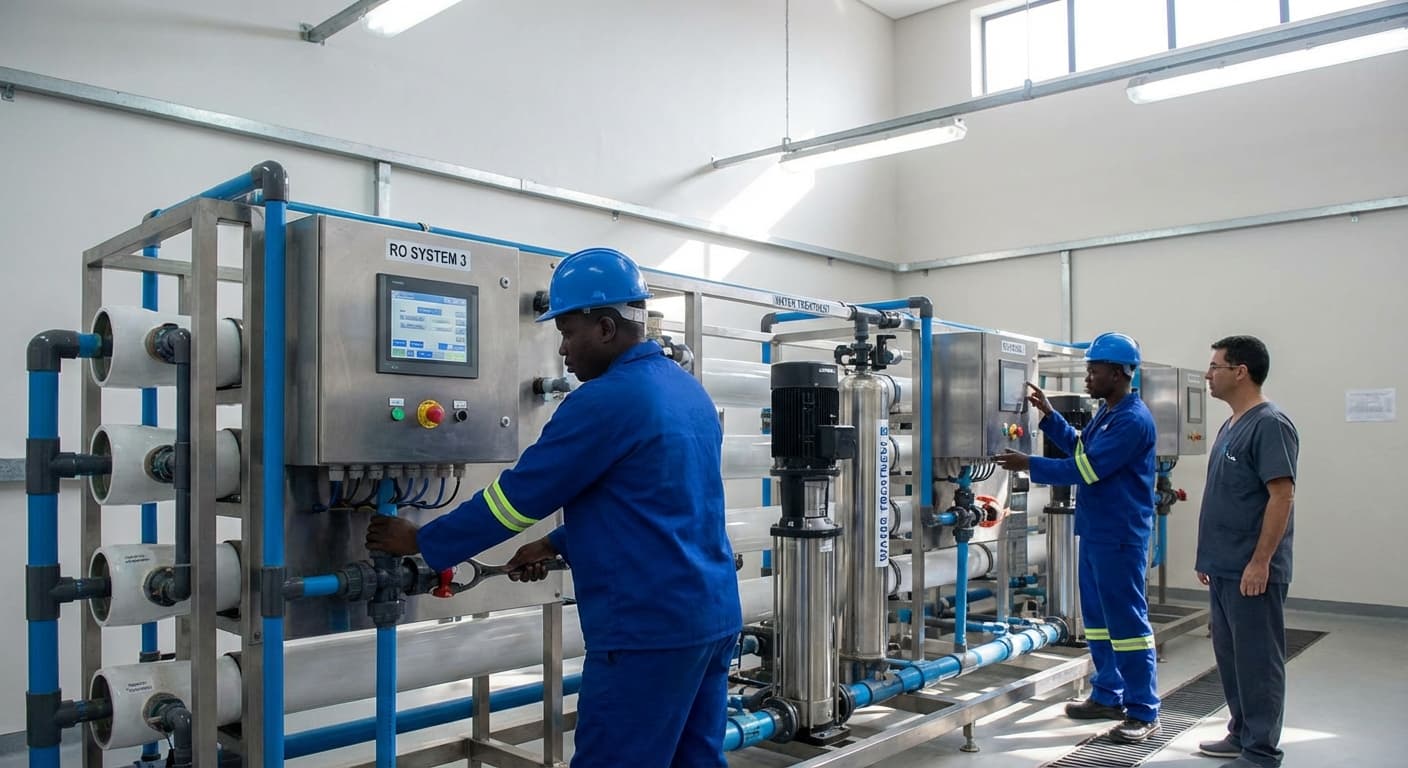
Dialysis RO/Water Treatment Plant Installation Service in Lesotho
Engineering Excellence & Technical Support
Dialysis RO/Water Treatment Plant Installation Service High-standard technical execution following OEM protocols and local regulatory frameworks.
Expert RO System Design & Installation
We provide bespoke Reverse Osmosis (RO) water treatment plant design and installation services specifically tailored for the unique water quality challenges and operational demands of healthcare facilities and industrial clients in Lesotho. Our engineers ensure optimal system performance, efficiency, and long-term reliability.
Seamless Project Management & Commissioning
Our comprehensive service covers the entire installation lifecycle, from site assessment and material procurement to meticulous installation, rigorous testing, and full system commissioning. We minimize downtime and ensure your dialysis water treatment plant is operational to the highest standards, compliant with all relevant regulations.
Robust Local Support & Maintenance
Beyond installation, we offer dedicated local support and preventative maintenance packages for your water treatment plant across Lesotho. Our trained technicians ensure continuous, high-quality water supply for critical dialysis operations, guaranteeing peace of mind and operational continuity.
What Is Dialysis Ro/water Treatment Plant Installation Service In Lesotho?
Dialysis RO/Water Treatment Plant Installation Service in Lesotho refers to the specialized process of designing, supplying, and commissioning Reverse Osmosis (RO) and associated water treatment systems specifically for healthcare facilities, primarily dialysis centers, within the geographical confines of Lesotho. This service ensures the provision of purified, medical-grade water essential for hemodialysis procedures, safeguarding patient health by removing impurities, dissolved solids, microorganisms, and pyrogens that could cause serious complications. The installation encompasses not only the RO units but also pre-treatment filtration, post-treatment storage, distribution piping, and quality monitoring equipment, all configured to meet stringent international and local healthcare standards.
| Who Needs It | Typical Use Cases | |||
|---|---|---|---|---|
| Dialysis Centers (Public and Private): The primary recipients, requiring a constant supply of ultra-pure water for hemodialysis. | Hospitals with Renal Units: Facilities offering hemodialysis services as part of their comprehensive medical care. | New Healthcare Infrastructure Projects: Any new construction or renovation of healthcare facilities in Lesotho that will include dialysis capabilities. | Existing Facilities with Aging or Inadequate Systems: Centers requiring upgrades or replacements of outdated or non-compliant water treatment systems. | Remote Clinics or Mobile Dialysis Units: Locations where reliable access to medical-grade water from municipal sources is unavailable or inconsistent. |
| Hemodialysis Procedures: The core application, where purified water is mixed with dialysis concentrate to create dialysate. Impurities in water can lead to patient toxicity and adverse reactions. | Peritoneal Dialysis Solution Preparation: While often pre-packaged, some facilities may use purified water for compounding solutions. | Sterilization and Disinfection of Dialysis Equipment: Using purified water for rinsing and cleaning dialysis machines and accessories to prevent contamination. | Laboratory and Diagnostic Testing: Certain sensitive tests within a healthcare setting may require high-purity water. | General Medical Applications: In certain critical care areas, the availability of purified water can be beneficial. |
Key Components and Processes of Dialysis RO/Water Treatment Plant Installation:
- Site Assessment and System Design: Evaluating water source quality (municipal, borehole), flow rate requirements, and spatial constraints to design a bespoke treatment system.
- Component Selection and Procurement: Sourcing and acquiring high-quality RO membranes, pumps, filters (sediment, carbon), UV sterilizers, storage tanks, piping, and control systems.
- Pre-treatment Module Installation: Setting up sediment filters, activated carbon filters, and water softeners to remove particulate matter, chlorine, and hardness that can damage RO membranes.
- Reverse Osmosis Unit Installation: Integrating the primary RO system, including high-pressure pumps and specialized membranes, to desalinate and purify the water.
- Post-treatment Module Installation: Implementing UV sterilization or microfiltration to eliminate any remaining viable microorganisms and ensure a sterile water supply.
- Storage and Distribution System Setup: Installing purified water storage tanks (typically stainless steel or food-grade plastic) and a dedicated, sanitizable distribution loop with appropriate materials (e.g., PEX, stainless steel).
- Control and Monitoring System Integration: Installing automated control systems for system operation, pressure regulation, flow control, and crucial water quality monitoring (TOC, conductivity, microbial counts).
- Testing, Commissioning, and Validation: Rigorous testing of the entire system to verify performance, water quality according to dialysis standards (e.g., AAMI, ISO), and operational reliability. This includes flushing, disinfection, and multiple water quality tests.
- Operator Training and Documentation: Providing comprehensive training to facility personnel on system operation, routine maintenance, troubleshooting, and record-keeping.
- Ongoing Support and Maintenance Planning: Establishing service contracts for preventive maintenance, spare parts, and emergency support.
Who Needs Dialysis Ro/water Treatment Plant Installation Service In Lesotho?
This document outlines the target customers and key departments within organizations that would benefit from Dialysis RO/Water Treatment Plant Installation Services in Lesotho. Reliable and purified water is paramount for the safe and effective operation of dialysis facilities. Ensuring the highest water quality minimizes the risk of complications for patients and extends the lifespan of dialysis equipment.
| Target Customer/Organization | Key Departments/Stakeholders Involved | Specific Needs & Responsibilities |
|---|---|---|
| Public Hospitals (e.g., Queen 'Mantoetse Royal Hospital, Botšabelo Hospital) | Nephrology Department, Biomedical Engineering Department, Facility Management, Procurement Department, Hospital Administration | Establishing or upgrading dialysis units, ensuring compliance with water quality standards, maintenance of existing systems, patient safety, cost-effective solutions. |
| Private Hospitals and Clinics with Nephrology Services | Clinical Operations Management, Biomedical Engineering, Procurement, Facility Management, Financial Department | High-quality water for patient treatment, reliability of dialysis machines, competitive service offerings, patient satisfaction. |
| Government Ministry of Health | Directorate of Health Services, Public Health Directorate, Infrastructure and Facilities Management Unit, Procurement Unit | National dialysis program development, standardization of water treatment across public facilities, public health outcomes, efficient resource allocation. |
| NGOs Operating Healthcare Facilities (e.g., with mobile clinics or supporting local health centers) | Program Managers, Medical Coordinators, Logistics Department, Finance Department | Providing essential dialysis services in underserved areas, ensuring sustainable water solutions for remote facilities, capacity building. |
| Medical Equipment Suppliers and Distributors | Sales and Technical Support Teams, Service Department, Procurement | Bundling installation services with dialysis machine sales, offering comprehensive maintenance packages, ensuring seamless integration of water treatment systems. |
Target Customers & Departments for Dialysis RO/Water Treatment Plant Installation Services in Lesotho
- Healthcare Institutions (Public and Private)
- Government Health Ministries and Departments
- Non-Governmental Organizations (NGOs) focused on healthcare
- Large Industrial Facilities with critical water needs (though primary focus is healthcare)
- Medical Equipment Suppliers and Distributors
Dialysis Ro/water Treatment Plant Installation Service Process In Lesotho
This document outlines the comprehensive workflow for the installation of Dialysis Reverse Osmosis (RO) / Water Treatment Plants in Lesotho. The process is designed to ensure efficient, compliant, and high-quality service delivery, from initial client inquiry to the final handover and ongoing support.
| Stage | Description | Key Activities | Deliverables | Responsible Party |
|---|---|---|---|---|
| The client expresses interest in a Dialysis RO/Water Treatment Plant. This stage involves understanding their specific needs, requirements, and location. | Receive inquiry, understand client needs, initial discussion of plant type and capacity, information gathering. | Initial understanding of project scope, preliminary client requirements documented. | Client, Service Provider Sales Team |
| A thorough assessment of the installation site in Lesotho is conducted to evaluate existing infrastructure, water sources, power availability, and environmental conditions. | Site visit, water quality analysis (raw water), assessment of space and access, review of existing plumbing and electrical systems, identification of potential challenges. | Detailed site survey report, raw water quality analysis report, site suitability assessment. | Service Provider Technical Team, Client Representative |
| Based on the site assessment and client requirements, a detailed proposal and quotation are prepared. | System design, equipment selection, Bill of Materials (BOM), detailed cost breakdown, project timeline, technical specifications, compliance information. | Comprehensive project proposal, detailed quotation, proposed system design schematics. | Service Provider Engineering & Sales Teams |
| The client reviews the proposal, and negotiations take place to finalize terms and conditions. A formal contract is established. | Proposal review, pricing negotiation, contract terms discussion, legal review, contract signing. | Signed installation contract, payment schedule agreement. | Client, Service Provider Management |
| All necessary equipment, components, and materials are procured and arranged for transportation to the site in Lesotho. | Ordering of equipment and parts, supplier management, quality control of procured items, customs clearance (if applicable), shipping and transportation arrangements to Lesotho. | Procured equipment and materials, logistics plan, import/export documentation. | Service Provider Procurement & Logistics Teams |
| The installation site is prepared according to the project plan, ensuring all necessary utilities and access are ready. | Site preparation (e.g., concrete pads, utility connections), storage of materials, pre-assembly of certain components (if feasible), confirmation of access for delivery and installation. | Prepared installation site, availability of utilities, confirmed site access. | Client (site readiness), Service Provider Installation Team |
| The Dialysis RO/Water Treatment Plant is physically installed and assembled on-site by skilled technicians. | Unloading and positioning of equipment, mechanical and electrical connections, piping and tubing installation, framework assembly, adherence to installation manuals and safety protocols. | Assembled RO/Water Treatment Plant structure, completed mechanical and electrical connections. | Service Provider Installation Team |
| The installed plant undergoes rigorous testing and commissioning to ensure optimal performance and compliance with water quality standards. | System flushing and sanitization, performance testing (flow rates, pressure), water quality testing (TDS, conductivity, microbial count, specific contaminants), calibration of sensors, adjustment of operational parameters. | Commissioning report, validated water quality test results, operational parameters set. | Service Provider Commissioning Engineers, Client Representative |
| The client's technical staff are trained on the operation, maintenance, and troubleshooting of the installed plant. | Theoretical and practical training sessions, operation manuals explanation, routine maintenance procedures, troubleshooting guidance, safety protocols. | Trained client operators, comprehensive operation and maintenance manuals. | Service Provider Training Specialists, Client Technical Staff |
| The completed and tested plant is formally handed over to the client, along with all relevant documentation. | Final inspection by client, provision of all project documentation (as-built drawings, test reports, manuals), warranty information, training completion confirmation. | Signed handover certificate, complete project documentation package, warranty certificates. | Service Provider Project Manager, Client Representative |
| Ongoing support and maintenance services are provided to ensure the long-term reliability and performance of the plant. | Scheduled preventive maintenance, emergency breakdown support, spare parts supply, remote monitoring (if applicable), ongoing technical consultation. | Service level agreements (SLAs) for maintenance, ongoing operational support, maintenance records. | Service Provider Technical Support & Maintenance Team |
Dialysis RO/Water Treatment Plant Installation Service Process in Lesotho
- Inquiry & Initial Consultation
- Site Assessment & Technical Survey
- Proposal Development & Quotation
- Contract Negotiation & Agreement
- Procurement & Logistics
- Pre-Installation Preparation
- Plant Installation & Assembly
- System Commissioning & Testing
- Operator Training
- Handover & Documentation
- Post-Installation Support & Maintenance
Dialysis Ro/water Treatment Plant Installation Service Cost In Lesotho
Installing a Reverse Osmosis (RO) and water treatment plant for dialysis facilities in Lesotho is a critical investment for ensuring the safety and efficacy of patient treatments. The cost of such an installation is influenced by several key factors, leading to a broad price range. Understanding these determinants is crucial for budgeting and selecting the appropriate service provider. These factors typically include the scale and capacity of the plant, the complexity of the existing water source and its contamination levels, the specific technologies employed, the required level of automation and monitoring, the geographical location of the dialysis unit within Lesotho, and the chosen service provider's expertise and reputation.
| Service Component | Estimated Cost Range (LSL - Maloti) | Notes |
|---|---|---|
| Small-Scale Dialysis RO/Water Treatment Plant (e.g., 1-2 Dialysis Stations) | 50,000 - 150,000 | Basic pre-treatment, single-pass RO, limited automation. Depends heavily on water source. |
| Medium-Scale Dialysis RO/Water Treatment Plant (e.g., 3-5 Dialysis Stations) | 150,000 - 350,000 | More robust pre-treatment, potentially dual-pass RO, advanced monitoring, greater redundancy. |
| Large-Scale Dialysis RO/Water Treatment Plant (e.g., 6+ Dialysis Stations) | 350,000 - 700,000+ | Comprehensive pre-treatment, high-efficiency RO, sophisticated automation, extensive safety features, and redundancy. May include specialized disinfection. |
| Pre-treatment Systems (Filters, Softeners, UV) | 10,000 - 50,000+ | Varies significantly based on water quality and required stages. |
| RO Membranes and Housings | 5,000 - 30,000+ | Depends on capacity, number of stages, and quality of membranes. |
| Pumps and Storage Tanks | 8,000 - 40,000+ | Capacity and material of tanks are key cost drivers. |
| Installation Labor and Project Management | 20,000 - 100,000+ | Influenced by project complexity, duration, and provider rates. |
| Water Quality Testing and Commissioning | 5,000 - 15,000 | Essential for validation and sign-off. |
Key Pricing Factors for Dialysis RO/Water Treatment Plant Installation in Lesotho
- {"title":"Plant Capacity and Flow Rate","description":"The volume of purified water the plant needs to produce per hour or per day directly impacts the size and cost of the RO membranes, pumps, tanks, and other components. Larger capacities necessitate more robust and expensive equipment."}
- {"title":"Water Source Quality and Pre-treatment Requirements","description":"The initial quality of the raw water (e.g., from boreholes, municipal supply) significantly affects the complexity of the treatment process. Water with high levels of suspended solids, dissolved minerals, bacteria, or specific contaminants will require more extensive pre-treatment stages (e.g., sediment filters, carbon filters, UV sterilization), increasing the overall cost."}
- {"title":"Technology and System Design","description":"Different RO and water treatment technologies have varying costs. Factors include the number of RO stages, the type of membranes used, the incorporation of advanced disinfection methods (e.g., ozone, double UV), and the overall system design for efficiency and redundancy."}
- {"title":"Automation and Monitoring Systems","description":"The level of automation in controlling and monitoring the plant's performance impacts cost. Basic manual systems are cheaper than sophisticated systems with real-time data logging, remote monitoring capabilities, and automated alarms for quality deviations."}
- {"title":"Installation Location and Site Preparation","description":"The accessibility of the dialysis unit's location within Lesotho, the need for extensive site preparation (e.g., leveling, foundation work, plumbing connections), and any logistical challenges will influence installation labor and material costs."}
- {"title":"Service Provider Expertise and Reputation","description":"Experienced and reputable installation service providers, particularly those with specialized knowledge in medical water treatment, may command higher fees due to their proven track record, quality assurance, and ongoing support. This often includes training for facility staff."}
- {"title":"Ancillary Equipment and Accessories","description":"This includes costs for storage tanks, distribution piping, water quality testing equipment, spare parts, and any necessary electrical infrastructure upgrades."}
Affordable Dialysis Ro/water Treatment Plant Installation Service Options
Finding affordable dialysis RO (Reverse Osmosis) and water treatment plant installation services is crucial for dialysis centers to ensure patient safety and maintain operational efficiency without breaking the bank. This involves understanding the value offered by different service packages and implementing smart cost-saving strategies throughout the process.
| Cost-Saving Strategy | Description | Potential Savings |
|---|---|---|
| Thorough Site Assessment & Planning: | Investing time upfront to accurately assess your site's water quality, available space, and power requirements helps prevent costly rework and ensures the correct system is chosen. | 5-15% on installation and potential future upgrades |
| Compare Multiple Quotes: | Obtain detailed proposals from at least 3-5 reputable installation service providers. Compare not only the price but also the scope of work, included components, warranty, and service response times. | 10-20% on the overall installation cost |
| Negotiate Contract Terms: | Don't be afraid to negotiate on pricing, payment schedules, and warranty periods. Look for opportunities to bundle installation with maintenance contracts for potential discounts. | 5-10% on the base installation cost and long-term service fees |
| Consider Refurbished or Certified Pre-Owned Equipment: | For less critical components or for centers with tighter budgets, exploring high-quality refurbished or certified pre-owned RO systems can offer significant savings without compromising quality, provided they come with a solid warranty. | 20-40% on equipment cost |
| Phased Installation (where feasible): | If budget constraints are severe, explore if a phased installation is possible, allowing you to implement essential components now and add others later as funds become available. This requires careful planning to ensure future compatibility. | Spreads out capital expenditure, allowing for better cash flow management |
| Inquire About Manufacturer/Supplier Discounts: | Ask installers if they have preferred supplier relationships or if there are any manufacturer-specific discounts or promotions available for the chosen RO system. | 2-5% on equipment costs |
| Leverage Existing Infrastructure: | If your facility already has some plumbing or electrical infrastructure in place that can be safely and effectively utilized, it can reduce the scope and cost of new installations. | Variable, depending on existing infrastructure and installation requirements |
| Focus on Energy-Efficient Models: | While initial costs might be slightly higher, investing in energy-efficient RO systems can lead to substantial savings on electricity bills over the system's lifespan. | 10-25% on annual electricity costs |
Understanding Value Bundles in Dialysis RO/Water Treatment Plant Installation
- Basic Installation Package: Typically includes the physical installation of the RO system and essential plumbing. This is the most budget-friendly option, often suitable for smaller centers or those with existing basic infrastructure.
- Standard Installation Package: Builds upon the basic package by including pre-installation site assessment, water quality testing, and initial system calibration. This offers more comprehensive setup and ensures the system is optimized from the start.
- Comprehensive Installation Package: Encompasses all aspects of the standard package plus extended warranties, initial operator training, and a post-installation performance review. This provides peace of mind and ensures your staff is fully equipped to manage the system.
- Customizable Bundles: Many providers offer the flexibility to tailor packages based on your specific needs, such as the required water volume, existing infrastructure, and desired service levels. This allows you to pay only for what you truly need.
- Integrated Service Bundles: Some providers combine installation with ongoing maintenance and water quality monitoring contracts. While the upfront cost might be higher, this can lead to significant long-term savings through proactive issue resolution and reduced downtime.
Verified Providers In Lesotho
Ensuring access to quality healthcare is paramount, and in Lesotho, the presence of verified providers is crucial for patient safety and trust. Franance Health stands out as a leading organization dedicated to this mission, meticulously credentialing healthcare providers to guarantee they meet the highest standards of competence, ethics, and patient care. Their rigorous vetting process offers a significant advantage to individuals seeking medical services, providing peace of mind and confidence in the quality of care received.
| Aspect of Verification | Franance Health's Approach | Benefit to Patients |
|---|---|---|
| Educational Background | Thoroughly checks degrees, diplomas, and accredited institutions. | Ensures foundational knowledge and appropriate training. |
| Licensure and Certification | Verifies current and valid professional licenses and certifications with relevant regulatory bodies. | Confirms legal authorization to practice and specialized expertise. |
| Professional References | Contacts previous employers and colleagues to assess performance and character. | Provides insights into practical skills and professional conduct. |
| Work History | Reviews past employment and practice history for any red flags or gaps. | Indicates consistent and reliable professional experience. |
| Ethical Conduct | Investigates any disciplinary actions or malpractice claims. | Guarantees providers adhere to high ethical standards and patient welfare. |
Why Franance Health Credentials Represent the Best Choice:
- Rigorous Verification Process: Franance Health employs a comprehensive and multi-faceted approach to credentialing, examining educational backgrounds, licenses, certifications, professional references, and work history.
- Commitment to Patient Safety: The core of Franance Health's mission is to protect patients by ensuring that all credentialed providers are qualified and ethically sound, reducing the risk of medical errors and substandard care.
- Upholding Professional Standards: By adhering to strict national and international healthcare standards, Franance Health ensures that its credentialed providers are up-to-date with the latest medical practices and ethical guidelines.
- Enhanced Trust and Transparency: Franance Health's transparent credentialing process builds trust between patients and healthcare providers, making it easier for individuals to make informed decisions about their healthcare.
- Access to Competent Professionals: Patients can be assured that providers listed as Franance Health credentialed possess the necessary skills, knowledge, and experience to deliver effective and compassionate care.
Scope Of Work For Dialysis Ro/water Treatment Plant Installation Service
This Scope of Work (SOW) outlines the requirements for the installation services of a Dialysis Reverse Osmosis (RO)/Water Treatment Plant. It details the technical deliverables and standard specifications to ensure the successful and compliant deployment of the system, meeting all relevant healthcare and water quality standards. The project encompasses site preparation, equipment installation, system testing, commissioning, and handover.
| Category | Technical Deliverables | Standard Specifications / Requirements |
|---|---|---|
| Site Assessment | Detailed site survey report, including assessment of space, power, water inlet, drainage, and environmental conditions. | Compliance with local building codes, accessibility requirements, and infection control guidelines. Identification of potential hazards. |
| Equipment Installation | Proper installation of all RO membrane modules, pre-filters, post-filters, storage tanks, pumps, UV sterilizers, and control panels. | Adherence to manufacturer's installation manuals. Secure mounting and proper alignment of all components. Use of approved materials for all connections. |
| Piping and Plumbing | Installation of all necessary piping for raw water inlet, treated water outlet, drain lines, and chemical dosing lines. | Use of food-grade, medical-grade, or appropriate corrosion-resistant materials (e.g., SS316L, PVC, CPVC). All connections to be leak-free and properly insulated where necessary. Compliance with plumbing codes. |
| Electrical and Instrumentation | Wiring of all electrical components, including pumps, control panels, sensors, and indicators. Installation of instrumentation for monitoring flow, pressure, conductivity, and other parameters. | Compliance with relevant electrical codes (e.g., NEC, IEC). Use of appropriate wiring gauges and conduits. Proper grounding and earthing. Calibration of all sensors and instruments. |
| System Testing | Pre-commissioning tests, including pressure testing, leak testing, electrical continuity tests, and functional checks of individual components. | Documentation of all test results. Identification and rectification of any defects or anomalies. |
| Commissioning and Validation | Full system startup, including flushing, sanitization, and initial water quality testing. | Achieving specified water quality parameters (e.g., conductivity, TOC, microbial counts) as per relevant standards (e.g., AAMI, ISO 13485). Validation of system performance over an agreed period. |
| Training | Comprehensive training for facility maintenance and operations staff on system operation, routine maintenance, troubleshooting, and emergency procedures. | Training materials to be provided in an understandable format. Hands-on training sessions to be conducted. |
| Documentation | Provision of a comprehensive O&M manual, as-built drawings, test reports, validation certificates, and warranty information. | All documentation to be accurate, complete, and delivered in hard and soft copies. |
Key Stages of Installation
- Site Assessment and Preparation
- Equipment Delivery and Offloading
- Mechanical Installation
- Electrical and Instrumentation Installation
- Piping and Plumbing
- System Testing and Calibration
- Commissioning and Validation
- Training and Handover
- Documentation
Service Level Agreement For Dialysis Ro/water Treatment Plant Installation Service
This Service Level Agreement (SLA) outlines the guaranteed response times and uptime for the installation services of Dialysis Reverse Osmosis (RO) and Water Treatment Plants. It is designed to ensure minimal disruption and efficient deployment of critical healthcare infrastructure.
| Service Component | Response Time Guarantee (Business Hours) | Uptime Guarantee (Post-Installation) |
|---|---|---|
| Initial Site Survey & Planning | Within 48 hours of request | N/A (Pre-installation) |
| On-site Installation Commencement | Within 5 business days of agreement signing (subject to site readiness) | N/A (Pre-installation) |
| Critical System Component Failure (during installation) | Within 4 hours | N/A (During Installation) |
| Non-Critical System Component Failure (during installation) | Within 8 business hours | N/A (During Installation) |
| Post-Installation System Readiness Verification | Within 24 hours of installation completion | N/A (Post-Installation) |
| Emergency Technical Support (after commissioning) | Within 2 hours (remote) | 99.9% (for the installed RO/Water Treatment Plant functionality) |
| Standard Technical Support (after commissioning) | Within 8 business hours (remote) | 99.9% (for the installed RO/Water Treatment Plant functionality) |
| On-site Technician Dispatch (if remote resolution fails) | Within 24 business hours | 99.9% (for the installed RO/Water Treatment Plant functionality) |
Scope of Service
- Installation of new Dialysis RO/Water Treatment Plant systems.
- Configuration and commissioning of installed systems.
- Initial training for facility staff on system operation and basic maintenance.
- Troubleshooting and resolution of installation-related issues.
Frequently Asked Questions

Ready when you are
Let's scope your Dialysis RO/Water Treatment Plant Installation Service in Lesotho project in Lesotho.

Scaling healthcare logistics and technical systems across the entire continent.