
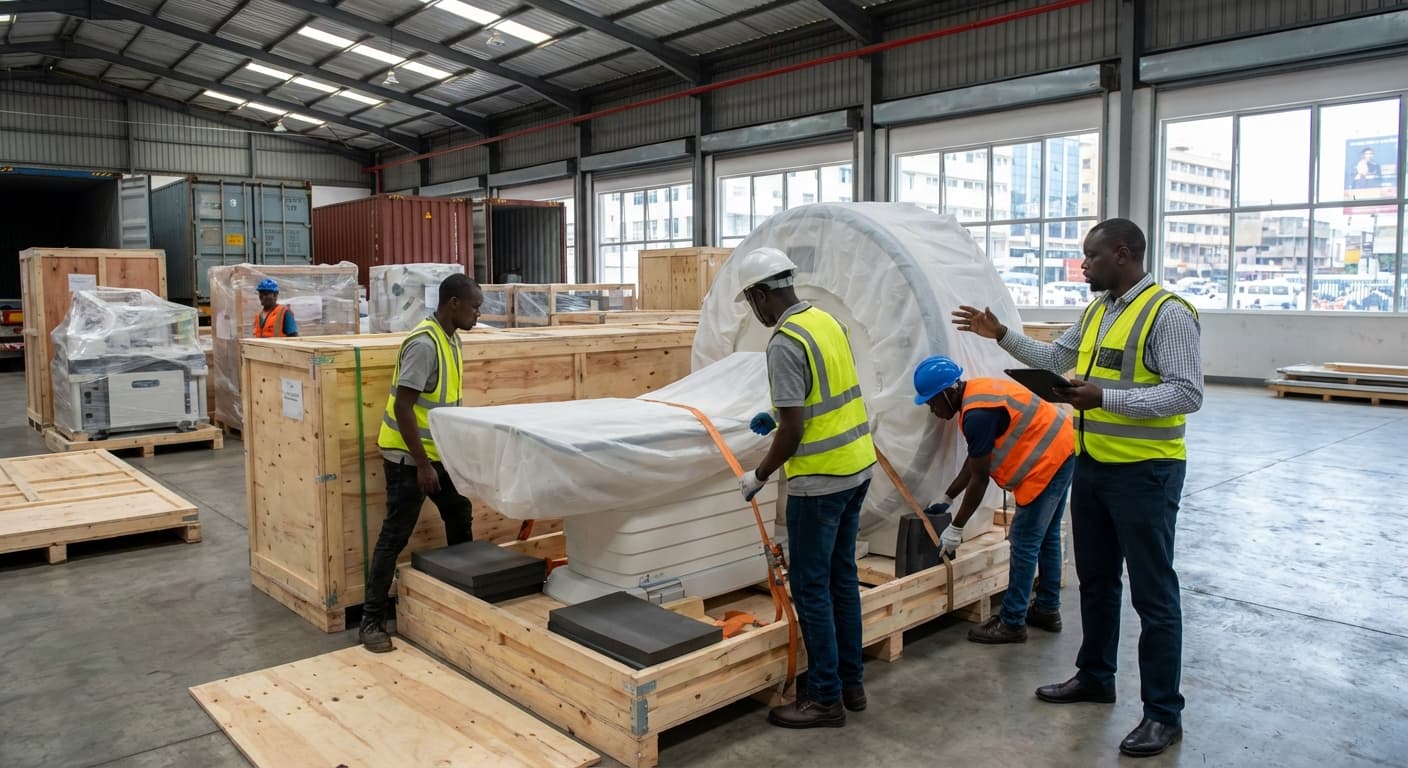
Packaging & Crating Supervision Service for Medical Equipment in Lesotho
Engineering Excellence & Technical Support
Packaging & Crating Supervision Service for Medical Equipment High-standard technical execution following OEM protocols and local regulatory frameworks.
Optimized Logistics & Secure Transit
Our expert supervision ensures packaging and crating protocols are rigorously followed, minimizing transit damage and optimizing load efficiency for medical equipment shipments within Lesotho. We leverage knowledge of local infrastructure to mitigate risks and ensure timely, secure delivery.
Customized Crate Design & Material Selection
We provide specialized supervision for the design and construction of custom crates, selecting appropriate, high-quality materials (e.g., ISPM-15 compliant wood, anti-static padding, shock-absorbing inserts) to protect sensitive medical equipment from environmental factors and physical stresses encountered during transport in Lesotho's diverse terrain.
Traceability & Regulatory Compliance
Our service includes meticulous oversight of labeling, inventory, and documentation, ensuring full traceability of medical equipment from origin to destination within Lesotho. We meticulously adhere to all relevant national and international packaging standards and regulatory requirements for healthcare shipments.
What Is Packaging & Crating Supervision Service For Medical Equipment In Lesotho?
Packaging & Crating Supervision Service for Medical Equipment in Lesotho refers to the specialized oversight provided during the processes of preparing, protecting, and enclosing medical devices and apparatus for transit. This service ensures that the unique requirements of medical equipment, such as sensitivity to environmental factors (temperature, humidity, shock), sterility maintenance, and regulatory compliance for handling and transport, are meticulously addressed. The objective is to mitigate risks of damage, contamination, or compromise to the equipment's integrity throughout the supply chain, from point of origin to final destination within Lesotho. This encompasses the selection of appropriate packaging materials, the application of specialized crating techniques, accurate labeling, and adherence to international shipping standards relevant to medical goods.
| Stakeholder | Need for Service | Typical Use Cases |
|---|---|---|
| Medical Device Manufacturers | To ensure product integrity, protect brand reputation, and meet contractual obligations for safe delivery of sophisticated medical equipment to healthcare facilities in Lesotho. | Export of new diagnostic imaging systems, laboratory analyzers, surgical robots, and patient monitoring systems to hospitals and clinics in Maseru, Leribe, and other regions. |
| Healthcare Providers (Hospitals, Clinics, Diagnostic Centers) | To receive vital medical equipment without damage or compromise, ensuring uninterrupted patient care and maximizing the return on investment for capital expenditures. | Importation of refurbished medical equipment, replacement parts, or large-scale infrastructure components (e.g., CT scanners, MRI machines) for installation in healthcare facilities across Lesotho. |
| Logistics and Freight Forwarders | To fulfill client requirements for specialized handling of high-value, sensitive medical cargo, thereby minimizing liability and ensuring successful delivery. | Managing the end-to-end transportation of medical equipment imports and exports, requiring expert oversight of packaging and crating procedures to comply with international transit regulations. |
| Governmental Health Agencies and NGOs | To ensure the safe and effective deployment of donated or procured medical equipment for public health initiatives and disaster relief efforts within Lesotho. | Receiving and distributing critical medical supplies and equipment for vaccination campaigns, emergency response, or development projects in remote areas of Lesotho. |
| Research and Development Institutions | To safeguard sensitive and often prototype medical research equipment during transit for collaborative studies or testing in Lesotho. | Transporting specialized laboratory equipment, bio-sample containers, or experimental medical devices to research facilities or partner organizations in Lesotho. |
Key Components of Packaging & Crating Supervision for Medical Equipment:
- Pre-shipment assessment of equipment requirements and environmental risks.
- Selection and validation of appropriate cushioning, shock-absorption, and static-control materials.
- Supervision of the assembly and sealing of primary, secondary, and tertiary packaging layers.
- Design and construction oversight for custom-built crates, ensuring structural integrity and load-bearing capacity.
- Application of specialized bracing and support mechanisms to prevent movement during transit.
- Verification of temperature and humidity control measures, including the use of data loggers and climate-controlled packaging.
- Ensuring compliance with hazard communication standards (e.g., UN, IATA, IMDG) for any hazardous components or materials.
- Accurate and compliant labeling, including handling instructions, destination details, and regulatory markings.
- Documentation of the packaging and crating process for audit and insurance purposes.
- Inspection and approval of the final packaged and crated units prior to handover for shipment.
Who Needs Packaging & Crating Supervision Service For Medical Equipment In Lesotho?
Ensuring the safe and secure transport of medical equipment is paramount, especially in a country like Lesotho where logistical challenges can be significant. Packaging and crating supervision services are crucial to mitigate risks of damage, contamination, and loss during transit. These specialized services are essential for a variety of stakeholders and departments involved in the procurement, deployment, and maintenance of medical devices. Understanding who requires these services highlights the importance of professional handling and meticulous attention to detail throughout the supply chain.
| Target Customer Group | Key Departments/Roles Involved | Specific Needs & Concerns | |
|---|---|---|---|
| Hospitals and Clinics (Public & Private) | Procurement Department, Biomedical Engineering, Facilities Management, IT Department (for specialized equipment) | Receiving new equipment, relocating existing sensitive machinery, ensuring sterile packaging for surgical instruments, protecting sensitive diagnostic equipment from environmental factors. | Local clinics in remote areas requiring secure transport from central distribution points. |
| Diagnostic Laboratories | Laboratory Management, Procurement, Technical Staff | Handling of sensitive analytical instruments, ensuring sterility and integrity of equipment for accurate testing, secure transport of specialized reagents alongside equipment. | Labs relying on imported diagnostic kits and analyzers. |
| Pharmaceutical Distributors | Logistics and Supply Chain Management, Warehouse Operations, Quality Assurance | Ensuring temperature-sensitive medical equipment (e.g., cold chain storage units) remains operational and intact during transit, protecting high-value pharmaceutical equipment. | Distributors responsible for the national supply of essential medical devices. |
| Medical Device Manufacturers (Local & International) | Export/Logistics Department, Quality Control, Product Managers | Ensuring their products arrive at their destination in Lesotho in pristine condition, adhering to international shipping standards, protecting against potential damage during long-haul and local transport. | Manufacturers with no local presence who need reliable partners for export. |
| Government Health Ministries and Agencies | Procurement Unit, Health Infrastructure Department, Logistics Division | Managing large-scale procurements of medical equipment for national health programs, ensuring bulk shipments are handled correctly, safeguarding public health investments. | Central procurement of essential medical equipment for national health initiatives. |
| Non-Governmental Organizations (NGOs) | Program Managers, Logistics Coordinators, Procurement Officers | Transporting donated medical equipment to underserved areas, ensuring equipment is protected in challenging terrains and environments, often with limited resources. | NGOs delivering medical supplies and equipment to remote communities. |
| Research Institutions | Research Leads, Lab Managers, Procurement Specialists | Handling of specialized research equipment, ensuring delicate scientific instruments are not compromised, maintaining sterile conditions for sample-related equipment. | Institutions conducting medical research requiring sophisticated equipment. |
| International Aid Organizations | Logistics Officers, Operations Managers, Project Coordinators | Coordinating the delivery of vital medical equipment for humanitarian projects, managing complex supply chains, ensuring equipment is ready for immediate deployment upon arrival. | Organizations providing emergency medical relief or long-term development aid. |
Who Needs Packaging & Crating Supervision Service for Medical Equipment in Lesotho?
- Hospitals and Clinics
- Diagnostic Laboratories
- Pharmaceutical Distributors
- Medical Device Manufacturers
- Government Health Ministries and Agencies
- Non-Governmental Organizations (NGOs) involved in healthcare
- Research Institutions
- International Aid Organizations
Packaging & Crating Supervision Service For Medical Equipment Process In Lesotho
This document outlines the comprehensive workflow for our Packaging & Crating Supervision Service for Medical Equipment in Lesotho, ensuring secure and compliant handling from initial inquiry to successful execution. Our service provides expert oversight to guarantee that medical equipment is packaged and crated according to international standards, protecting its integrity during transit and storage within Lesotho.
| Stage | Description | Key Activities | Deliverables |
|---|---|---|---|
| Inquiry & Needs Assessment | The client initiates contact to discuss their medical equipment packaging and crating requirements. | Initial consultation, understanding equipment type, dimensions, weight, fragility, destination, and specific handling needs. Information gathering regarding local regulations and environmental conditions in Lesotho. | Understanding of client's specific requirements, initial assessment of project scope. |
| Proposal & Agreement | Based on the needs assessment, a detailed proposal is developed and presented to the client. | Preparation of a comprehensive proposal outlining scope of work, methodologies, timelines, resource allocation, risk assessment, and pricing. Contract negotiation and signing. | Formal proposal document, signed service agreement/contract. |
| Pre-Operational Planning | Detailed planning and preparation for on-site supervision. | Development of a detailed project plan, including specific packing protocols, material selection criteria, crating design specifications (if applicable), safety procedures, and communication channels. Identification and scheduling of supervisory personnel with relevant expertise. Pre-site visit (if necessary) to assess the environment and access. Procurement of necessary tools and equipment for supervision. | Detailed project plan, supervisor schedules, communication plan, risk mitigation strategies. |
| On-Site Supervision & Execution | Direct oversight and guidance during the packaging and crating process. | Supervising the selection and application of appropriate packaging materials (e.g., anti-static bags, foam padding, VCI paper). Ensuring correct packing techniques are employed to prevent movement and damage. Overseeing the construction and reinforcement of crates, ensuring adherence to specified dimensions and structural integrity. Verification of proper labeling (handling instructions, destination, origin, fragile warnings). Monitoring compliance with safety protocols and international standards (e.g., ISTA, ISO). On-the-spot problem-solving and decision-making. | Real-time supervision, adherence to protocols, documented observations, photographic evidence of the process. |
| Documentation & Handover | Formalizing the completed service and providing necessary records to the client. | Compiling a comprehensive post-service report detailing the entire process, including materials used, methods employed, any deviations from the plan and their resolutions, and confirmation of compliance. Providing photographic evidence of the packaged and crated equipment. Issuing a certificate of supervision. Formal handover of documentation to the client. | Post-service report, certificate of supervision, photographic documentation, final invoice. |
| Post-Service Follow-up | Ensuring client satisfaction and addressing any residual concerns. | Follow-up communication with the client to confirm satisfaction with the service. Addressing any queries or feedback. Maintaining service records for future reference. | Client feedback, confirmation of satisfaction, updated client records. |
Workflow Stages
- Inquiry & Needs Assessment
- Proposal & Agreement
- Pre-Operational Planning
- On-Site Supervision & Execution
- Documentation & Handover
- Post-Service Follow-up
Packaging & Crating Supervision Service For Medical Equipment Cost In Lesotho
The cost of Packaging & Crating Supervision Services for Medical Equipment in Lesotho is influenced by several key factors. These include the size, weight, and fragility of the equipment, the complexity of the packaging required (e.g., specialized cushioning, climate control), the distance and mode of transportation, the level of insurance needed, and the duration of the supervision service. Demand for specialized services also plays a role. Due to the specialized nature of medical equipment, which often requires stringent handling and protective measures, the pricing will generally be higher than for general cargo. It's crucial to obtain detailed quotes from multiple service providers to ensure competitive pricing and a thorough understanding of what is included.
| Service Component | Estimated Cost Range (LSL) | Notes |
|---|---|---|
| Basic Packaging & Crating Supervision (Standard equipment) | 5,000 - 15,000 | Covers general supervision for moderately sized, non-highly sensitive equipment. Includes basic material assessment and oversight. |
| Advanced Packaging & Crating Supervision (Complex/Sensitive equipment) | 15,000 - 40,000 | For highly sensitive, large, or complex medical devices requiring specialized materials, shock absorption, and meticulous handling. May include documentation and quality checks. |
| Premium Packaging & Crating Supervision (High-value/Ultra-sensitive equipment) | 40,000+ | For extremely high-value, fragile, or critical medical equipment (e.g., MRI machines, advanced lab equipment). Often includes detailed risk assessment, bespoke packaging solutions, and extended supervision. |
| On-site Supervision (Per Hour/Day) | 500 - 2,500 (per hour) | Charged for the time spent on-site supervising the packaging and crating process. Varies based on the expertise of the supervisor. |
| Material Sourcing & Handling (Variable) | Varies significantly | The cost of specialized packaging materials (e.g., custom crates, foam inserts, moisture barriers) will be added to the service fee. |
| Transportation Logistics Coordination (Variable) | Varies significantly | While supervision is the focus, some providers may offer ancillary services for coordinating the movement of packaged goods. |
Key Pricing Factors for Medical Equipment Packaging & Crating Supervision in Lesotho
- Equipment Dimensions and Weight
- Fragility and Sensitivity of Equipment
- Packaging Complexity (e.g., anti-static, shock-absorbing materials)
- Specialized Requirements (e.g., temperature-controlled packaging)
- Transit Distance and Mode of Transport (air, sea, road)
- Insurance Coverage Requirements
- Duration of Supervision Services
- Regulatory Compliance (e.g., customs, export/import permits)
- Urgency of the Service
Affordable Packaging & Crating Supervision Service For Medical Equipment Options
Ensuring the safe and compliant packaging and crating of medical equipment is paramount, not only for preserving the integrity of sensitive devices but also for meeting regulatory requirements and preventing costly damage during transit. Our Affordable Packaging & Crating Supervision Service offers comprehensive oversight to guarantee your medical equipment is handled with the utmost care. We understand that budget is a key concern for healthcare providers, which is why we've developed flexible value bundles and employ strategic cost-saving measures to make expert supervision accessible.
| Value Bundle | Description | Included Services | Ideal For | Cost-Saving Focus |
|---|---|---|---|---|
| Basic Oversight | Essential supervision for standard shipments. | On-site presence during critical packing/crating stages, visual inspection of materials and methods. | Low-risk, non-sensitive equipment, smaller shipments. | Minimizes direct supervision time, focuses on core critical points. |
| Standard Compliance | Comprehensive supervision ensuring regulatory adherence. | Includes Basic Oversight plus material verification against specifications, preliminary documentation review, and basic environmental condition checks. | Moderate-risk equipment, routine shipments, compliance-focused needs. | Streamlined processes, proactive issue identification to avoid rework. |
| Premium Assurance | Full-spectrum supervision for high-value and sensitive equipment. | Includes Standard Compliance plus in-depth material selection guidance, advanced environmental testing oversight, detailed pre-shipment documentation audit, and final sign-off. | High-value, highly sensitive medical devices, complex international shipments, critical healthcare infrastructure. | Maximizes damage prevention, reduces potential for catastrophic losses, ensures smooth transit and delivery. |
Key Features of Our Affordable Packaging & Crating Supervision Service
- Expert supervision by experienced professionals familiar with medical equipment handling protocols.
- Compliance checks with relevant industry standards and regulations (e.g., ISTA, DOT, IATA).
- On-site oversight during packing, crating, and labeling processes.
- Damage prevention strategies and quality assurance checks.
- Documentation and reporting for audit and record-keeping purposes.
- Customizable service levels to fit specific project needs and budgets.
- Reduced risk of costly equipment damage, delays, and insurance claims.
Verified Providers In Lesotho
In Lesotho's evolving healthcare landscape, access to reliable and trustworthy medical services is paramount. 'Verified Providers' signifies a commitment to quality, patient safety, and adherence to stringent standards. Franance Health stands as a leading example of such a provider, meticulously cultivating a network of healthcare professionals and facilities that not only meet but exceed these benchmarks. Their unwavering dedication to credential verification, ongoing professional development, and patient-centric care makes them the discerning choice for individuals and families seeking optimal health outcomes in Lesotho.
| Credentialing Aspect | Franance Health's Approach | Benefit to Patients |
|---|---|---|
| License Verification | Thorough checking of current and valid medical licenses from recognized authorities. | Ensures providers are legally authorized to practice medicine, guaranteeing a fundamental level of competency. |
| Educational Background & Training | Verification of degrees, diplomas, and specialized training from accredited institutions. | Confirms that providers possess the necessary foundational knowledge and specialized skills for their respective fields. |
| Professional Experience & References | Review of past employment history and validation of professional references. | Provides insight into a provider's practical experience and reputation within the medical community. |
| Continuing Medical Education (CME) | Ensures providers actively participate in ongoing learning and professional development programs. | Guarantees that patients receive care based on the latest medical knowledge and techniques. |
| Ethical Conduct & Disciplinary History | Background checks for any disciplinary actions or malpractice claims. | Protects patients from encountering providers with a history of unethical behavior or patient harm. |
| Specialty Certifications | Verification of board certifications in specific medical specialties. | Confirms that providers have met rigorous standards and demonstrated expertise in their chosen area of specialization. |
Why Franance Health is the Best Choice for Verified Providers in Lesotho:
- Rigorous Credentialing Process: Franance Health employs a comprehensive and multi-faceted credentialing process for all its associated providers. This involves verifying medical licenses, educational qualifications, certifications, and a thorough background check to ensure legitimacy and competence.
- Commitment to Continuous Professional Development: Beyond initial verification, Franance Health actively encourages and supports its providers in ongoing training and education. This ensures they remain at the forefront of medical advancements, best practices, and emerging treatments.
- Patient-Centric Approach: Franance Health prioritizes patient well-being and satisfaction. This translates into providers who are not only medically skilled but also empathetic, communicative, and dedicated to personalized care plans.
- Network of Excellence: Franance Health has curated a network of healthcare professionals and facilities renowned for their expertise, ethical conduct, and commitment to high-quality service delivery across various medical disciplines.
- Transparency and Accountability: Franance Health maintains a transparent system of provider evaluation and accountability, ensuring that patients have access to reliable information and that providers are held to the highest standards of professional conduct.
- Accessibility to Specialized Care: Through its verified network, Franance Health facilitates access to a wide range of specialized medical services, ensuring that patients can find the appropriate expertise for their specific health needs.
- Enhanced Patient Safety: The stringent verification and ongoing monitoring processes implemented by Franance Health significantly contribute to enhanced patient safety by minimizing risks associated with unqualified or unethical practitioners.
Scope Of Work For Packaging & Crating Supervision Service For Medical Equipment
This Scope of Work (SOW) outlines the requirements for Packaging & Crating Supervision Services for Medical Equipment. The service provider will be responsible for overseeing and ensuring that all packaging and crating activities for designated medical equipment meet the highest industry standards for protection, safety, and compliance during transit and storage. This includes ensuring proper material selection, handling procedures, bracing, securing, and final inspection of all crated items.
| Deliverable | Description | Standard Specification Reference |
|---|---|---|
| Packaging Material Verification Report | Documentation of all packaging materials used, verifying their suitability and adherence to specifications for each piece of equipment. | Client's Bill of Materials (BOM), relevant ASTM standards for packaging materials (e.g., ASTM D4169, ASTM D6653). |
| Handling & Securing Procedure Checklist | Confirmation that proper lifting, handling, and internal securing procedures were followed for each equipment item. | Manufacturer's handling instructions, industry best practices for heavy/sensitive equipment handling. |
| Crate Construction Inspection Log | Record of inspections on crate dimensions, wood type, thickness, joint strength, and fasteners used to ensure structural integrity. | ISO 9001 (Quality Management Systems), specific project drawings, or industry standards for wooden crates (e.g., ISPM 15 for international shipping). |
| Moisture Control Implementation Record | Verification of the correct placement and quantity of desiccants and proper sealing of vapor barrier materials. | Manufacturer's recommendations for desiccant usage, MIL-STD-2073 (Military Standard for Preservation, Packaging, and Packing – Material Handling). |
| Labeling & Marking Compliance Audit | Confirmation that all crates are correctly labeled with shipping information, handling instructions (e.g., 'Fragile', 'This Side Up'), and any required regulatory markings. | International Air Transport Association (IATA) Dangerous Goods Regulations (if applicable), client's shipping guidelines, ISO 780 (Pictorial marking for handling of goods). |
| Pre-Shipment Inspection Report | A comprehensive report detailing the final inspection of each crated item before shipment, noting any deficiencies and confirming corrective actions. | Client's quality assurance procedures, internal checklists. |
| Daily/Weekly Supervision Summary | Regular updates on progress, identified issues, and resolutions to the client's project manager. | Client's reporting requirements. |
| Final Packaging & Crating Sign-off Report | A concluding document summarizing all supervision activities, confirming adherence to SOW and standards, and providing formal approval for shipment. | Client's acceptance criteria. |
Key Responsibilities of the Service Provider:
- Provide on-site supervision of all packaging and crating operations.
- Verify and approve selected packaging materials (e.g., crates, cushioning, desiccants, vapor barrier materials) against project specifications.
- Ensure proper handling and lifting techniques are employed for all medical equipment during the packaging process.
- Oversee the correct application of internal cushioning and shock-absorbing materials to prevent damage.
- Monitor the secure bracing and blocking of equipment within crates to prevent movement.
- Verify the correct application of moisture control measures (e.g., desiccants, vapor barrier bags) as per equipment requirements and transit conditions.
- Inspect the integrity of crate construction (wood type, thickness, fasteners) according to standard specifications.
- Ensure proper labeling of crates, including handling instructions, shipping marks, and destination information.
- Conduct pre-shipment visual inspections of all packaged and crated items.
- Document all supervision activities, including inspections, any deviations, and corrective actions taken.
- Liaise with the client's logistics and technical teams, as well as the packaging/crating crew, to ensure seamless execution.
- Adhere to all relevant safety regulations and site-specific procedures.
- Provide a final sign-off report for all completed packaging and crating activities.
Service Level Agreement For Packaging & Crating Supervision Service For Medical Equipment
This Service Level Agreement (SLA) outlines the response times and uptime guarantees for the Packaging & Crating Supervision Service provided for medical equipment. This SLA is a supplement to the Master Service Agreement (MSA) and details specific performance metrics for the supervision service.
The service involves on-site or remote supervision of packaging and crating processes to ensure the safe and compliant handling of medical equipment during transit. The goal is to minimize transit damage and ensure the integrity of the equipment throughout the supply chain.
Scope of Service:
- On-site supervision during packaging and crating of specified medical equipment.
- Remote supervision via video conferencing and real-time communication.
- Verification of packing materials and methods against industry best practices and manufacturer specifications.
- Documentation of the packaging and crating process.
- Guidance to packing and crating personnel.
Service Hours:
- The standard service hours are Monday to Friday, 9:00 AM to 5:00 PM [Specify Time Zone, e.g., EST].
- Emergency support is available 24/7/365.
| Service Level | Metric | Target | Definition |
|---|---|---|---|
| Standard On-Site Supervision | Response Time | 4 Business Hours | Time from confirmed service request receipt to commencement of on-site supervision or initial assessment. |
| Standard On-Site Supervision | Uptime Guarantee | 98% of Scheduled Hours | The service will be available for scheduled on-site supervision events at least 98% of the time. Downtime excludes pre-scheduled maintenance or events outside of the provider's control. |
| Remote Supervision | Response Time | 1 Business Hour | Time from confirmed service request receipt to initiation of remote connection and communication. |
| Remote Supervision | Uptime Guarantee | 99.5% of Scheduled Hours | The remote supervision service will be available at least 99.5% of the time during scheduled remote supervision events. Downtime excludes client-side connectivity issues. |
| Emergency Support (On-site/Remote) | Response Time | 2 Business Hours | Time from confirmed emergency service request receipt to commencement of on-site supervision or initiation of remote support. |
| Emergency Support (On-site/Remote) | Uptime Guarantee | N/A | Emergency support is provided on a best-effort basis to address critical situations requiring immediate attention. Uptime is not guaranteed in the same manner as scheduled services due to the unpredictable nature of emergencies. |
Key Performance Indicators (KPIs)
- Response Time: The time taken to acknowledge and initiate action upon receiving a service request.
- Uptime Guarantee: The percentage of scheduled service hours during which the supervision service is available and operational.
Frequently Asked Questions

Ready when you are
Let's scope your Packaging & Crating Supervision Service for Medical Equipment in Lesotho project in Lesotho.

Scaling healthcare logistics and technical systems across the entire continent.