
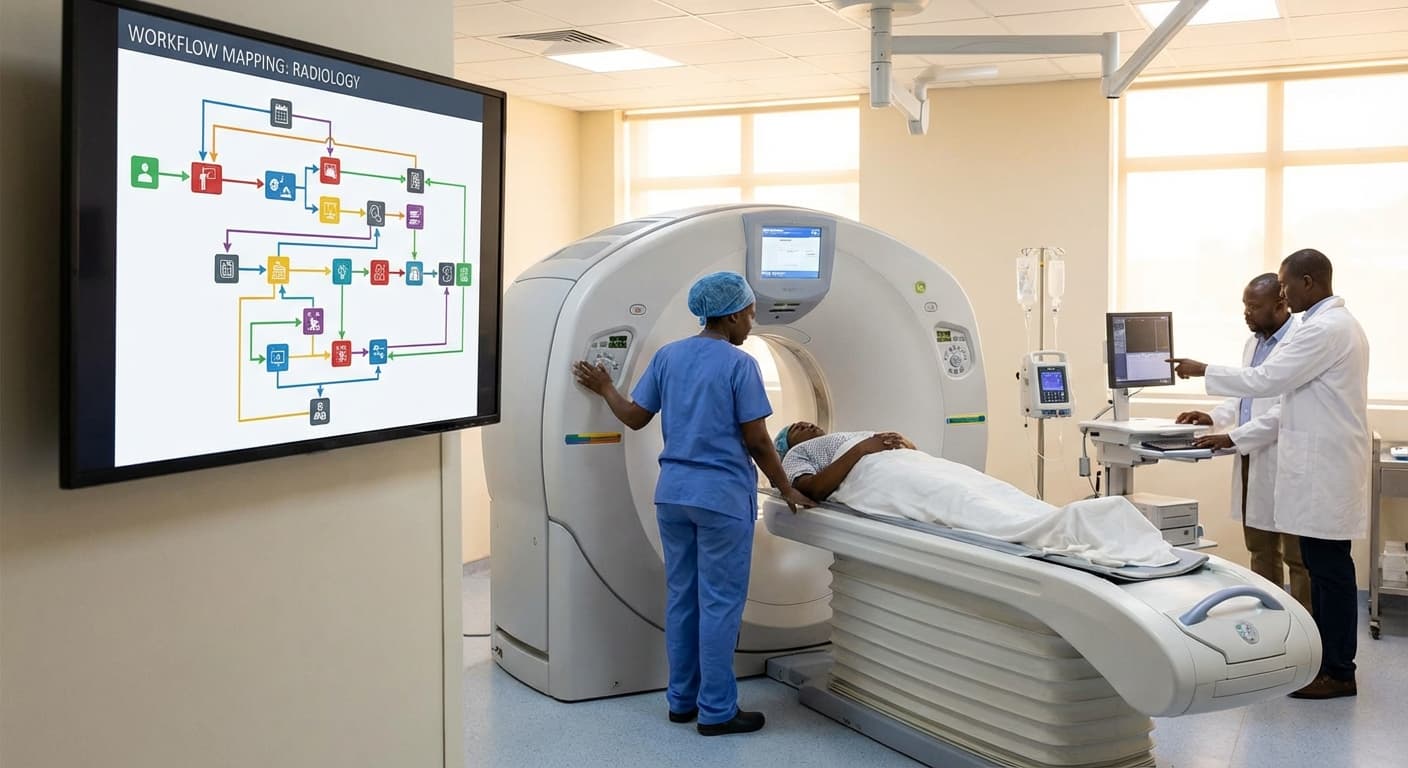
Department Workflow Mapping Service (Radiology/ICU/OT/Lab/Dialysis) in Lesotho
Engineering Excellence & Technical Support
Department Workflow Mapping Service (Radiology/ICU/OT/Lab/Dialysis) High-standard technical execution following OEM protocols and local regulatory frameworks.
Radiology Workflow Optimization in Lesotho
Streamlining the patient journey from referral to reporting in Lesotho's radiology departments. Our service maps the entire workflow, identifying bottlenecks, improving turnaround times, and enhancing diagnostic accuracy through clear process visualization and data-driven insights.
ICU Patient Flow Enhancement in Lesotho
Critical care efficiency redefined. We meticulously map ICU workflows, from admission to discharge, focusing on resource allocation, inter-departmental communication, and patient safety protocols to reduce critical care response times and improve patient outcomes across Lesotho's hospitals.
Operating Theatre Scheduling & Throughput Maximization
Elevating surgical efficiency in Lesotho. Our service visualizes the entire Operating Theatre lifecycle, from pre-operative assessment to post-operative recovery, enabling optimized scheduling, reduced idle time, and improved throughput for critical surgical procedures.
What Is Department Workflow Mapping Service (Radiology/icu/ot/lab/dialysis) In Lesotho?
Department Workflow Mapping Service in Lesotho, particularly within high-acuity and specialized departments such as Radiology, Intensive Care Units (ICU), Operating Theatres (OT), Laboratories (Lab), and Dialysis Units, refers to a systematic process of documenting, analyzing, and optimizing the sequences of activities, information flows, and resource utilization within these critical healthcare areas. The objective is to gain a granular understanding of existing operational processes, identify inefficiencies, bottlenecks, and areas for improvement, and ultimately design more effective, patient-centric, and cost-efficient workflows. This service is crucial for ensuring timely diagnosis, treatment, and patient management in complex clinical environments.
| Department/Area | Who Needs the Service | Typical Use Cases |
|---|---|---|
| Radiology | Radiology Department Heads, Hospital Administrators, Quality Improvement Teams | Optimizing patient scheduling for imaging studies (MRI, CT, X-ray), streamlining report generation and distribution, improving image acquisition protocols, managing contrast media inventory, integrating PACS with HIS/RIS for seamless data flow. |
| Intensive Care Unit (ICU) | ICU Directors, Critical Care Nurses, Physicians, Hospital Administrators | Improving patient admission and discharge processes, optimizing multidisciplinary team rounds, managing critical equipment availability (ventilators, monitors), streamlining medication administration, enhancing communication protocols between shifts and departments, reducing alarm fatigue. |
| Operating Theatre (OT) | Surgical Department Heads, Anesthesiologists, Surgical Nurses, Hospital Administrators | Streamlining surgical case scheduling, optimizing instrument and equipment preparation, improving patient flow through pre-op, OR, and post-op recovery, managing sterile supply chain, ensuring efficient turnover times between cases, enhancing interdisciplinary communication. |
| Laboratory (Lab) | Laboratory Directors, Pathologists, Lab Technicians, Hospital Administrators | Reducing turnaround times for diagnostic tests, optimizing sample collection and transportation workflows, improving reagent and consumable management, enhancing quality control processes, integrating LIS with HIS for order entry and result reporting, implementing automation strategies. |
| Dialysis Unit | Nephrology Department Heads, Dialysis Nurses, Renal Technicians, Hospital Administrators | Optimizing patient scheduling for dialysis sessions, improving patient throughput and bed utilization, streamlining medication preparation and administration, managing water treatment systems and dialyzer reprocessing, enhancing staff allocation and patient monitoring, improving documentation and reporting of treatment outcomes. |
Key Components of the Department Workflow Mapping Service:
- Process Identification & Documentation: Comprehensive mapping of all standard operating procedures (SOPs), patient pathways, and administrative tasks from admission/request to discharge/reporting.
- Activity Analysis: Detailed breakdown of each task, including responsible personnel, required resources (equipment, consumables, IT systems), time estimates, and decision points.
- Information Flow Analysis: Tracking the movement of patient data, test results, imaging reports, and orders across different systems and personnel.
- Resource Utilization Assessment: Evaluation of the efficiency and availability of personnel, equipment, and infrastructure.
- Bottleneck Identification: Pinpointing areas where delays, inefficiencies, or quality issues are most prevalent.
- Performance Metrics Definition: Establishing key performance indicators (KPIs) to measure workflow effectiveness and efficiency (e.g., turnaround times, patient waiting times, error rates).
- Optimization & Redesign: Developing proposed improvements, implementing new process flows, and reconfiguring resource allocation.
- Technology Integration Assessment: Evaluating the role and effectiveness of existing IT systems (HIS, LIS, RIS, PACS) and identifying opportunities for better integration or new technology adoption.
- Change Management & Training: Planning and executing the implementation of redesigned workflows, including staff training and communication strategies.
Who Needs Department Workflow Mapping Service (Radiology/icu/ot/lab/dialysis) In Lesotho?
Department workflow mapping is a critical process for optimizing operations, improving efficiency, and ensuring high-quality patient care within healthcare facilities. In Lesotho, like many developing nations, resource constraints and a need for enhanced service delivery make this service particularly valuable. Understanding the flow of patients, information, and resources within key departments allows for the identification of bottlenecks, redundancies, and areas for improvement. This leads to better patient outcomes, reduced waiting times, more efficient use of limited personnel and equipment, and ultimately, a more sustainable healthcare system.
| Target Customer | Key Departments Benefiting | Specific Needs Addressed |
|---|---|---|
| Public Hospitals (National, District, Referral) | Radiology, Intensive Care Unit (ICU), Operating Theatre (OT), Laboratory, Dialysis | Optimizing patient flow for diagnostic imaging and procedures, improving critical care response times, streamlining surgical processes, enhancing lab turnaround times, ensuring efficient dialysis scheduling and patient management, reducing waiting lists, improving resource allocation. |
| Private Hospitals and Clinics | Radiology, ICU, OT, Laboratory, Dialysis | Enhancing patient experience and satisfaction, increasing throughput for profit-generating services, improving operational efficiency to manage costs, competitive differentiation through superior service delivery, streamlining specialized care pathways. |
| Tertiary Healthcare Institutions | Radiology, ICU, OT, Laboratory, Dialysis | Managing complex patient cases, optimizing advanced diagnostic and treatment pathways, ensuring seamless integration of specialized services, supporting research and training initiatives through efficient data and process management, maintaining high standards of care. |
| Specialized Medical Centers (e.g., Oncology Centers, Cardiac Centers) | Radiology, ICU, OT, Laboratory, Dialysis (if applicable to specialty) | Tailoring workflow maps to specific disease management protocols, ensuring timely access to specialized diagnostics and treatments, improving interdisciplinary team collaboration, reducing treatment delays, optimizing patient journeys through the center. |
| NGOs providing Healthcare Services | Radiology, ICU, OT, Laboratory, Dialysis (depending on their service offerings) | Maximizing the impact of limited funding, ensuring efficient service delivery in underserved areas, standardizing processes across multiple facilities or mobile units, demonstrating accountability and impact to donors, improving reach and accessibility of critical services. |
| Government Health Ministries and Agencies | All departments within public healthcare facilities | Developing national health strategies, setting service delivery standards, identifying areas for infrastructure investment, monitoring and evaluating healthcare performance, informing policy decisions, facilitating equitable access to specialized services across the country. |
Who Needs Department Workflow Mapping Service in Lesotho?
- Public Hospitals (National, District, and Referral)
- Private Hospitals and Clinics
- Tertiary Healthcare Institutions
- Specialized Medical Centers
- Non-Governmental Organizations (NGOs) providing healthcare services
- Government health ministries and agencies responsible for healthcare planning and oversight.
Department Workflow Mapping Service (Radiology/icu/ot/lab/dialysis) Process In Lesotho
This document outlines the workflow for the Department Workflow Mapping Service, specifically designed for key departments within healthcare facilities in Lesotho, including Radiology, Intensive Care Unit (ICU), Operating Theatre (OT), Laboratory, and Dialysis. The service aims to visually represent and analyze existing departmental processes to identify inefficiencies, bottlenecks, and areas for improvement. The process begins with an initial inquiry from a healthcare facility and culminates in the delivery of detailed workflow maps and actionable recommendations.
| Stage | Description | Key Activities | Deliverables/Outcomes |
|---|---|---|---|
| Inquiry & Initial Consultation | The process begins when a healthcare facility (e.g., a hospital in Lesotho) expresses interest in the workflow mapping service for a specific department (Radiology, ICU, OT, Lab, or Dialysis). | Initial contact via email, phone, or referral. Introduction to the service and its benefits. Brief discussion of the facility's general challenges or goals. | Understanding of the facility's interest. Agreement to proceed to the next stage. |
| Scope Definition & Needs Assessment | A more in-depth discussion to clearly define the boundaries of the workflow mapping project and understand the specific pain points the facility wishes to address. | On-site or virtual meeting with key stakeholders (department heads, senior staff). Identification of the specific department(s) and processes to be mapped. Clarification of project objectives (e.g., reduce patient wait times, improve resource utilization, enhance communication). | Clearly defined project scope. Agreed-upon objectives. Identification of key stakeholders for each department. |
| Data Collection & Process Observation | Gathering detailed information about the current state of the workflow through direct observation and interviews. | On-site shadowing of staff performing their daily tasks. Interviews with personnel at all levels within the department. Collection of existing documentation (SOPs, forms, equipment logs). Time-motion studies (if necessary). | Comprehensive understanding of the 'as-is' workflow. Identification of all steps, decision points, handoffs, and resources involved. Collection of relevant quantitative and qualitative data. |
| Workflow Mapping & Analysis | Translating the collected data into visual workflow diagrams and identifying areas for improvement. | Creation of detailed process flowcharts (e.g., using BPMN or similar standards). Identification of bottlenecks, redundancies, delays, and potential failure points. Root cause analysis of identified issues. Benchmarking against best practices (where applicable). | Visual representation of the current ('as-is') workflow. List of identified inefficiencies and their root causes. Preliminary insights into potential optimization areas. |
| Validation & Refinement | Presenting the initial workflow maps and findings to the stakeholders for feedback and ensuring accuracy. | Presentation of draft workflow maps and analysis to departmental teams. Facilitating discussions to confirm the accuracy of the maps. Incorporating feedback and making necessary revisions. | Accurate and validated 'as-is' workflow maps. Consensus among stakeholders on the current process state. |
| Reporting & Recommendation Delivery | Providing a comprehensive report that includes the validated workflow maps and actionable recommendations for improvement. | Development of a final report detailing the project methodology, findings, and recommended solutions. Presentation of the report and recommendations to facility management and departmental teams. Discussion of proposed 'to-be' workflows and their potential impact. | Finalized workflow maps. Comprehensive report with actionable recommendations. Clear understanding of proposed improvements and expected outcomes. |
| Implementation Support (Optional) | Providing guidance and assistance to the facility in implementing the recommended changes. | Assistance with developing implementation plans. Training for staff on new processes. Monitoring the implementation progress and providing ongoing support. Evaluation of the impact of implemented changes. | Successful adoption of new workflows. Achieved improvements in efficiency, quality, or other key performance indicators. Sustainable process improvements. |
Workflow Stages
- Inquiry & Initial Consultation
- Scope Definition & Needs Assessment
- Data Collection & Process Observation
- Workflow Mapping & Analysis
- Validation & Refinement
- Reporting & Recommendation Delivery
- Implementation Support (Optional)
Department Workflow Mapping Service (Radiology/icu/ot/lab/dialysis) Cost In Lesotho
This document outlines the cost considerations for a Department Workflow Mapping Service specifically tailored for healthcare departments in Lesotho, including Radiology, Intensive Care Units (ICU), Operating Theatres (OT), Laboratories, and Dialysis Units. Workflow mapping is crucial for identifying bottlenecks, inefficiencies, and areas for improvement, ultimately leading to enhanced patient care and operational effectiveness.
The cost of such a service in Lesotho is not a fixed figure but is influenced by several key pricing factors. These factors determine the overall investment required for a comprehensive and effective workflow analysis. The ranges provided are indicative and subject to negotiation based on the specific scope and requirements of each project.
Pricing Factors:
- Department Size and Complexity: Larger departments with more intricate processes and a higher volume of patient activity will naturally require more extensive mapping and analysis, thus increasing the cost.
- Number of Workflows to Map: The service fee is directly proportional to the number of distinct workflows that need to be documented, analyzed, and optimized within each department.
- Depth of Analysis Required: A basic visual representation of current workflows will be less expensive than a detailed analysis that includes data collection, performance metrics, root cause analysis, and the development of future-state recommendations.
- Data Collection and Validation Methods: The intensity of data collection (e.g., direct observation, interviews, system data extraction, patient journey tracking) and the need for validation with stakeholders will impact the time and resources required.
- Technology and Tools Used: The specific software or tools employed for mapping, simulation, and reporting can influence the pricing. Some providers may use specialized proprietary software which might come with licensing fees.
- Consultant Expertise and Experience: The qualifications, experience, and reputation of the workflow mapping consultants are significant factors. Highly specialized expertise in healthcare operations, particularly within the Lesotho context, will command a higher rate.
- Project Timeline and Urgency: Expedited projects with shorter turnaround times may incur additional charges due to the need for increased resource allocation and potential overtime.
- Deliverables and Reporting: The scope and detail of the final deliverables, including detailed reports, visual maps, improvement recommendations, and implementation roadmaps, will affect the overall cost.
- Travel and Accommodation (if applicable): For projects requiring consultants to travel to different locations within Lesotho, associated travel and accommodation expenses will be factored into the overall cost.
| Pricing Factor | Influence on Cost | Indicative Range (M) |
|---|---|---|
| Department Size & Complexity | Higher complexity and size increase cost | Small: M 5,000 - M 15,000 Medium: M 15,000 - M 40,000 Large: M 40,000 - M 100,000+ |
| Number of Workflows | More workflows mean more effort | Per workflow: M 2,000 - M 10,000 (dependent on complexity) |
| Depth of Analysis | Detailed analysis is more resource-intensive | Basic Mapping: M 5,000 - M 20,000 Detailed Analysis & Recommendations: M 20,000 - M 80,000+ |
| Data Collection Methods | Intensive data collection drives up cost | Observation/Interviews: Included in analysis System Data Extraction/Patient Journey: Additional M 5,000 - M 25,000+ |
| Consultant Expertise | Experienced and specialized consultants cost more | Junior Consultant: M 1,500 - M 2,500 per day Senior Consultant: M 3,000 - M 6,000+ per day |
| Project Timeline | Urgency often incurs premium fees | Standard: No premium Expedited: 15-30% premium |
| Deliverables | Comprehensive reports and plans are more costly | Basic Maps: Included Detailed Reports & Roadmaps: Additional M 5,000 - M 30,000+ |
| Travel & Accommodation | Costs vary based on distance and duration | Actual costs incurred |
Indicative Cost Ranges (Maloti - M)
- {"item":"For a small to medium-sized department (e.g., a single lab section, a specific area within ICU) with a limited number of core workflows, a basic mapping and analysis might range from M 15,000 to M 35,000."}
- {"item":"For a larger or more complex department (e.g., full ICU, comprehensive Radiology department) requiring detailed analysis of multiple workflows, including significant data collection and recommendation development, costs could range from M 40,000 to M 100,000 or more."}
- {"item":"For a comprehensive project involving multiple departments (e.g., mapping of Radiology, ICU, and OT workflows within a single hospital) with advanced analytics and implementation planning, the cost can range from M 150,000 to M 300,000+."}
Affordable Department Workflow Mapping Service (Radiology/icu/ot/lab/dialysis) Options
Our Affordable Department Workflow Mapping Service offers a strategic approach to optimizing operations within critical hospital departments. We specialize in analyzing and visualizing the intricate processes of Radiology, Intensive Care Units (ICU), Operating Theaters (OT), Laboratories (Lab), and Dialysis units. Our service aims to identify bottlenecks, inefficiencies, and areas for improvement, leading to enhanced patient care, reduced costs, and increased staff satisfaction. We provide tailored solutions through flexible value bundles and implement proven cost-saving strategies.
Value Bundles: Our service is structured into tiered value bundles, designed to cater to varying departmental needs and budgets. Each bundle includes a core set of services, with optional add-ons for enhanced customization.
Cost-Saving Strategies: We integrate practical cost-saving measures directly into our workflow mapping process. This includes optimizing resource allocation, reducing waste (time, materials, and staff effort), improving communication pathways, and implementing technology where it yields the greatest return on investment.
| Value Bundle | Included Services | Ideal For | Starting Price (USD) |
|---|---|---|---|
| Essential Workflow Snapshot | Initial workflow analysis & visualization (1 core process) | Small departments, specific process optimization | $1,500 |
| Standard Operational Tune-Up | Comprehensive workflow analysis & visualization (2-3 core processes) | Medium-sized departments, identifying major inefficiencies | $3,500 |
| Advanced Process Integration | In-depth workflow analysis & visualization (4-5 core processes) | Larger departments, cross-functional process optimization, significant cost reduction goals | $6,000 |
| Enterprise-Wide Optimization | End-to-end departmental workflow mapping, strategy development | Multiple departments, hospital-wide efficiency initiatives | Custom Quote |
Key Benefits of Workflow Mapping Service
- Increased efficiency and throughput
- Reduced operational costs
- Improved patient flow and satisfaction
- Enhanced staff productivity and morale
- Better resource utilization
- Identification of potential risks and mitigation strategies
- Streamlined communication and collaboration
- Foundation for digital transformation initiatives
Verified Providers In Lesotho
In the pursuit of reliable and high-quality healthcare services in Lesotho, discerning individuals and organizations often seek assurance. Verified providers, those who have met stringent standards and undergone thorough vetting, stand out as the most dependable choice. Franance Health has established itself as a leading entity in this regard, offering a suite of credentials and demonstrating a commitment to excellence that makes them the premier selection for healthcare needs in Lesotho. Their rigorous verification process ensures that all associated medical professionals and facilities adhere to the highest ethical and professional benchmarks, providing patients with peace of mind and access to superior care.
| Franance Health Advantage | What it Means for You | Why it's the Best Choice |
|---|---|---|
| Rigorous Verification Process | Guarantees that all listed providers meet strict quality and safety standards. | Eliminates the risk of subpar or unqualified healthcare providers, ensuring you receive competent care. |
| Focus on Patient Well-being | Prioritizes patient safety, ethical practices, and positive health outcomes. | You can trust that your health and comfort are the top priorities of Franance Health's network. |
| Access to Leading Professionals | Connects you with highly qualified and experienced doctors, specialists, and facilities. | Ensures you receive expert medical attention from the best available healthcare professionals in Lesotho. |
| Transparency and Trust | Provides clear information about provider credentials and service standards. | Builds confidence and allows you to make informed healthcare decisions without doubt. |
| Streamlined Healthcare Access | Simplifies the process of finding and accessing reliable healthcare services. | Saves you time and reduces stress in seeking necessary medical treatment. |
Key Credentials and Strengths of Franance Health:
- Accreditation and Licensing: Franance Health meticulously vets all partner providers to ensure they hold valid, up-to-date accreditations and licenses from relevant Lesotho health authorities.
- Professional Qualifications: We verify the academic and professional qualifications of all medical practitioners, ensuring they have the necessary expertise and experience.
- Patient Safety Protocols: Franance Health mandates strict adherence to patient safety standards, including infection control, emergency preparedness, and ethical patient care practices.
- Quality Assurance Programs: Our partners undergo regular quality assurance reviews to monitor and improve service delivery, patient outcomes, and operational efficiency.
- Ethical Standards and Compliance: We ensure all providers operate with the highest ethical standards and comply with all local and international healthcare regulations.
- Insurance and Liability Coverage: Verified providers affiliated with Franance Health maintain appropriate insurance and liability coverage, safeguarding both patients and practitioners.
- Patient Testimonials and Feedback: While not a direct credential, Franance Health values and integrates positive patient feedback as an indicator of consistently high service quality.
Scope Of Work For Department Workflow Mapping Service (Radiology/icu/ot/lab/dialysis)
This document outlines the Scope of Work (SOW) for a Department Workflow Mapping Service. The objective is to comprehensively map, analyze, and optimize existing operational workflows within specified hospital departments, including Radiology, Intensive Care Unit (ICU), Operating Theatre (OT), Laboratory, and Dialysis. The service will deliver detailed workflow diagrams, identify bottlenecks and inefficiencies, and propose actionable recommendations for improvement. This will be achieved through a structured approach involving stakeholder interviews, process observation, data collection, and analysis, culminating in a final report and presentation.
| Deliverable | Description | Standard Specifications |
|---|---|---|
| Detailed Workflow Diagrams | Visual representation of current state processes, including steps, roles, decision points, and information flow. | Utilize standard flowcharting notation (e.g., BPMN 2.0). Each diagram will be clearly labeled with department, process name, version, and date. Diagrams should be delivered in both editable (e.g., Visio, Lucidchart) and image (e.g., PDF, PNG) formats. |
| Process Narration and Descriptions | Written explanations accompanying each workflow diagram, detailing each step, its purpose, responsible parties, and any associated documentation or systems. | Clear, concise, and standardized language. Each step description should include inputs, outputs, and potential dependencies. Documentation should be provided in a searchable format (e.g., Word, PDF). |
| Bottleneck and Inefficiency Report | Identification and analysis of areas within the workflows that cause delays, errors, increased costs, or reduced patient satisfaction. | Quantifiable data where possible (e.g., average wait times, error rates). Prioritization of identified issues based on impact. Clear rationale for each identified bottleneck. |
| Recommendations for Improvement | Actionable proposals to address identified bottlenecks and inefficiencies, including process re-engineering, technology adoption, training needs, and policy changes. | Recommendations should be specific, measurable, achievable, relevant, and time-bound (SMART). Include estimated impact of implementing each recommendation. Outline potential benefits and risks. |
| Final Project Report | Comprehensive document summarizing the entire workflow mapping process, findings, and recommendations. | Executive summary, introduction, methodology, current state analysis, findings (bottlenecks/inefficiencies), recommendations, conclusion, and appendices. Report to be delivered in PDF format. |
| Stakeholder Presentation | Presentation of findings and recommendations to key stakeholders. | Clear and engaging presentation slides (e.g., PowerPoint, Google Slides) summarizing the SOW, methodology, key findings, and prioritized recommendations. Time allocated for Q&A. |
| Data Collection Templates | Templates used for gathering information during stakeholder interviews and process observations. | Standardized questionnaires and observation checklists. Formats will be editable (e.g., Excel, Word) to allow for customization if needed, but the core structure will be maintained. |
Key Service Components
- Project Kick-off and Planning
- Information Gathering and Analysis
- Workflow Mapping and Documentation
- Bottleneck and Inefficiency Identification
- Recommendations for Optimization
- Final Report and Presentation
Service Level Agreement For Department Workflow Mapping Service (Radiology/icu/ot/lab/dialysis)
This Service Level Agreement (SLA) outlines the response times and uptime guarantees for the Department Workflow Mapping Service. This service is critical for optimizing processes within the Radiology, Intensive Care Unit (ICU), Operating Theatre (OT), Laboratory, and Dialysis departments. Adherence to these metrics ensures timely support and reliable access to workflow mapping tools and expertise.
| Service Component | Response Time (Target) | Uptime Guarantee |
|---|---|---|
| Initial Triage and Assessment of Workflow Mapping Request | 1 Business Hour | N/A (Focus on response) |
| Scheduled Workflow Mapping Session | Within 2 Business Days of agreement | N/A (Scheduled activity) |
| Access to Workflow Mapping Documentation Portal/Tools | N/A | 99.5% Uptime (24/7 availability) |
| Urgent Workflow Disruption Support (e.g., critical process breakdown) | 30 Minutes (for initial contact/acknowledgement) | N/A (Focus on rapid response) |
| Post-Mapping Support and Clarifications | 8 Business Hours | N/A (Focus on response) |
Scope of Service
- Workflow analysis and documentation for Radiology.
- Process mapping for the Intensive Care Unit (ICU).
- Optimization of workflows within the Operating Theatre (OT).
- Service mapping for Laboratory operations.
- Efficiency improvement for Dialysis department processes.
Frequently Asked Questions

Ready when you are
Let's scope your Department Workflow Mapping Service (Radiology/ICU/OT/Lab/Dialysis) in Lesotho project in Lesotho.

Scaling healthcare logistics and technical systems across the entire continent.