
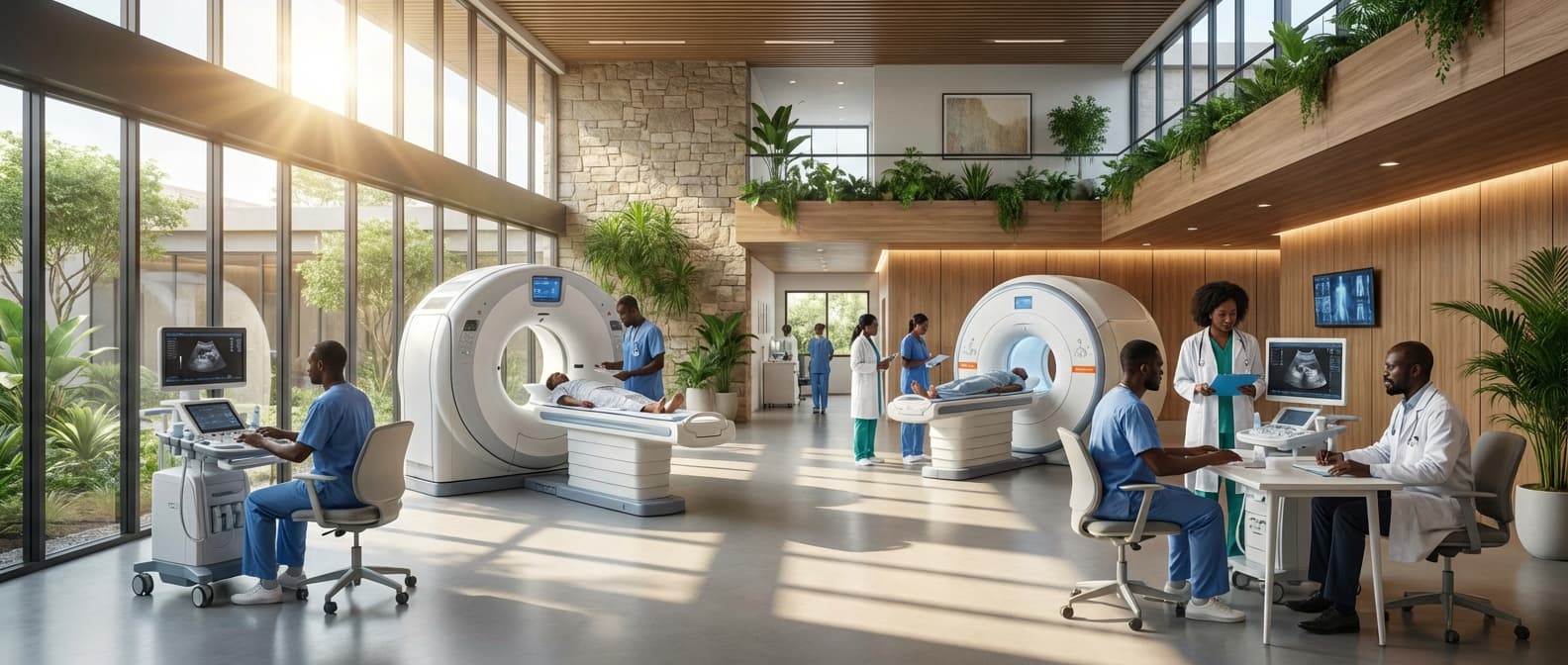
Diagnostic Imaging in Lesotho
Engineering Excellence & Technical Support
High-resolution imaging systems including CT scanners, MRI, X-ray, and ultrasound technology for accurate clinical diagnosis. High-standard technical execution following OEM protocols and local regulatory frameworks.
AI-Powered Diagnostic Assistance
Leveraging Artificial Intelligence (AI) algorithms to enhance the accuracy and speed of image interpretation. This assists radiologists by flagging potential abnormalities in X-rays, CT scans, and ultrasounds, improving early detection of diseases like tuberculosis and pneumonia.
Mobile X-ray Units for Remote Access
Deploying portable X-ray machines and trained technicians to underserved rural communities. This significantly reduces travel time and costs for patients, bringing essential diagnostic imaging services closer to those who need them most, especially for chest radiography.
PACS & Teleradiology Network
Implementing a Picture Archiving and Communication System (PACS) to digitize and store medical images, coupled with a teleradiology network. This allows images to be securely transmitted and reviewed by specialists remotely, overcoming geographical barriers and improving access to expert interpretation for complex cases.
What Is Diagnostic Imaging In Lesotho?
Diagnostic imaging in Lesotho refers to the use of medical imaging technologies to visualize the internal structures of the human body for the purpose of diagnosis, treatment planning, and monitoring of disease. This service is crucial for healthcare providers to obtain detailed anatomical and physiological information that is often not attainable through physical examination alone. The modality employed is contingent upon the specific clinical question and anatomical region of interest. Technological advancements and the availability of specialized equipment are key determinants of the scope and accessibility of diagnostic imaging services within the country.
| Imaging Modality | Primary Applications in Lesotho | Indications for Use |
|---|---|---|
| Radiography (X-ray) | Skeletal imaging (fractures, dislocations), Chest imaging (pneumonia, tuberculosis), Abdominal imaging (bowel obstruction, perforation) | Pain, swelling, suspected fractures; cough, fever, shortness of breath; abdominal pain, distension |
| Ultrasound | Obstetrics and Gynecology (fetal assessment, pelvic pathology), Abdominal organs (liver, kidneys, spleen, pancreas), Urology (bladder, prostate) | Pregnancy monitoring, menstrual irregularities, pelvic masses; abdominal pain, jaundice; urinary symptoms |
| Computed Tomography (CT) | Head trauma, Stroke assessment, Pulmonary embolism, Abdominal trauma, Cancer staging (limited availability) | Head injury with neurological deficit; sudden onset neurological deficits; severe chest pain with risk factors; blunt or penetrating abdominal trauma; known malignancy requiring staging |
| Magnetic Resonance Imaging (MRI) | Spinal cord imaging, Joint pathology (ligamentous/meniscal tears), Brain imaging (complex lesions, epilepsy), Soft tissue masses (limited availability) | Back pain with neurological signs; joint pain and instability; seizures, chronic headaches, suspected tumors; palpable or suspected deep soft tissue abnormalities |
Key Aspects of Diagnostic Imaging in Lesotho
- Definition: The application of various imaging modalities (e.g., X-ray, Ultrasound, CT, MRI) to generate internal body views for diagnostic and therapeutic purposes.
- Involves: Procedures such as radiography, ultrasonography, computed tomography, magnetic resonance imaging, and potentially nuclear medicine, depending on available infrastructure.
- Who Needs It: Patients presenting with a wide spectrum of pathologies, including but not limited to trauma, infections, tumors, cardiovascular conditions, neurological disorders, and musculoskeletal injuries. It is essential for both inpatient and outpatient settings.
- Typical Use Cases:
- Radiography: Bone fractures, pneumonia, intestinal obstruction, foreign body detection.
- Ultrasound: Gynecological and obstetric assessments, abdominal organ evaluation (liver, kidneys, gallbladder), thyroid imaging, vascular studies, superficial soft tissue masses.
- Computed Tomography (CT): Detailed imaging of the brain, chest, abdomen, and pelvis; evaluation of complex fractures, trauma, and neoplastic disease.
- Magnetic Resonance Imaging (MRI): Advanced visualization of soft tissues, including the brain, spinal cord, joints, and abdominal organs; particularly useful for neurological and musculoskeletal conditions.
- Referral Pathways: Primarily utilized following clinical suspicion of internal pathology, as indicated by physicians, surgeons, and other medical specialists.
Who Needs Diagnostic Imaging In Lesotho?
Diagnostic imaging plays a crucial role in healthcare delivery across all levels of the healthcare system. In Lesotho, identifying the specific needs and potential users of these services is vital for resource allocation, service development, and ensuring equitable access to quality healthcare. This analysis outlines the key target customers and departments that would benefit most from and require diagnostic imaging services.
| Department/Service Area | Key Diagnostic Imaging Needs | Typical Modalities | Primary Target Population |
|---|---|---|---|
| Radiology Department (General) | Comprehensive diagnostic imaging for a wide range of conditions. | X-ray, Ultrasound, CT, MRI (depending on facility level) | All patient demographics |
| Emergency Medicine | Rapid diagnosis of trauma, fractures, internal bleeding, stroke. | X-ray, CT Scan, Ultrasound | Acute care patients, trauma victims |
| Orthopedics | Diagnosis of fractures, dislocations, joint abnormalities, bone diseases. | X-ray, CT Scan, MRI | Patients with musculoskeletal injuries or conditions |
| Surgery (General & Specialized) | Pre-operative assessment, post-operative monitoring, diagnosis of surgical emergencies. | X-ray, CT Scan, Ultrasound | Surgical patients |
| Internal Medicine | Diagnosis of pulmonary, abdominal, and neurological conditions. | X-ray, Ultrasound, CT Scan, MRI | Adult patients with diverse medical issues |
| Pediatrics | Diagnosis of congenital anomalies, infections, injuries in children. | X-ray, Ultrasound, CT Scan | Infants, children, and adolescents |
| Obstetrics & Gynecology | Prenatal screening, assessment of fetal well-being, diagnosis of gynecological conditions. | Ultrasound, MRI (limited) | Pregnant women, women with gynecological concerns |
| Oncology | Staging of cancer, treatment planning, monitoring response to therapy. | CT Scan, MRI, X-ray, Ultrasound, PET Scan (if available) | Cancer patients |
| Cardiology | Assessment of cardiac structure and function, vascular imaging. | Echocardiography (Ultrasound), CT Angiography, MRI (Cardiac) | Patients with suspected or confirmed heart disease |
| Neurology/Neurosurgery | Diagnosis of stroke, tumors, trauma, degenerative neurological diseases. | CT Scan, MRI, X-ray (skull) | Patients with neurological conditions |
| Pulmonology | Diagnosis and management of lung diseases, tuberculosis. | X-ray (Chest), CT Scan (Chest) | Patients with respiratory symptoms |
Target Customers & Departments for Diagnostic Imaging in Lesotho
- {"title":"Primary Healthcare Facilities (Health Centers)","description":"While not typically equipped for on-site advanced imaging, these facilities serve as the first point of contact for most Basotho citizens. They require efficient referral pathways to secondary and tertiary centers for imaging services. They are crucial for initial diagnosis and screening."}
- {"title":"District Hospitals (Secondary Level Facilities)","description":"These hospitals are the backbone of district-level healthcare and require a range of diagnostic imaging capabilities to manage common conditions and provide essential diagnostic support to a wider patient population. This is where a significant volume of imaging will be performed."}
- {"title":"Tertiary/Referral Hospitals (National/Specialized Hospitals)","description":"These facilities handle complex cases, specialized procedures, and serve as referral centers for the entire country. They require advanced imaging modalities and a high volume of diverse imaging examinations. This is where specialized interpretation and advanced diagnostics are concentrated."}
- {"title":"Specialized Clinics and Units","description":"Dedicated units focusing on specific conditions (e.g., oncology, cardiology, orthopedics) will have specialized imaging needs, often requiring advanced techniques and expert interpretation."}
- {"title":"Emergency Departments/Trauma Centers","description":"Crucial for rapid diagnosis of acute injuries and life-threatening conditions, requiring immediate access to imaging, particularly X-ray and CT scans."}
- {"title":"Maternal and Child Health Services","description":"Essential for prenatal care (ultrasound) and diagnosis of pediatric conditions. This includes antenatal screening and assessment of neonatal health."}
- {"title":"Public Health Programs","description":"Imaging is vital for the diagnosis and monitoring of prevalent public health issues such as tuberculosis (X-ray), HIV-related opportunistic infections, and certain cancers."}
- {"title":"Medical Training and Research Institutions","description":"Academic institutions and hospitals involved in training medical professionals require imaging services for educational purposes and may contribute to research endeavors."}
Diagnostic Imaging Process In Lesotho
The diagnostic imaging process in Lesotho, like in many healthcare systems, follows a structured workflow to ensure accurate and timely patient care. This process typically begins with a physician's inquiry, stemming from a patient's symptoms or a need for further investigation. The physician then initiates a request for a specific imaging modality (e.g., X-ray, ultrasound, CT scan) based on their clinical judgment. This request is usually submitted to the radiology department or a designated imaging center. Once received, the request is reviewed, appointments are scheduled, and patient preparation instructions are provided if necessary. On the day of the examination, the patient arrives, undergoes the imaging procedure performed by a radiographer, and then awaits the interpretation of the images by a radiologist. The radiologist generates a report, which is then communicated back to the referring physician, who uses this information to inform the patient's diagnosis and treatment plan. In resource-limited settings like Lesotho, challenges related to equipment availability, trained personnel, and logistical complexities can influence the efficiency and accessibility of this workflow. However, the fundamental steps remain consistent.
| Stage | Description | Key Personnel Involved | Potential Challenges in Lesotho |
|---|---|---|---|
| Physician Inquiry | Recognition of the need for diagnostic imaging based on patient symptoms or clinical suspicion. | Physician (Doctor, Clinical Officer) | Limited access to specialist physicians for complex cases; potential for delayed referrals. |
| Imaging Request | Formal documentation of the required imaging study, including clinical information. | Physician | Lack of standardized request forms; potential for incomplete clinical information. |
| Scheduling and Preparation | Booking the patient for the imaging appointment and providing necessary pre-procedure instructions. | Radiology Department Administrator, Radiographer, Nurse | Limited appointment slots due to high demand and equipment availability; insufficient patient education materials; logistical issues for rural patients (transportation). |
| Image Acquisition | Performing the diagnostic imaging procedure according to established protocols. | Radiographer | Equipment downtime/malfunction; insufficient number of trained radiographers; inconsistent quality control. |
| Image Interpretation | Radiologist's analysis of the acquired images to identify abnormalities and formulate a diagnosis. | Radiologist | Severe shortage of radiologists; reliance on remote interpretation (tele-radiology) which may have connectivity issues; delayed reporting times. |
| Report Generation and Communication | Documenting the findings in a clear and concise report and sending it to the referring physician. | Radiologist, Radiographer (for preliminary reports) | Inefficient communication channels (e.g., manual delivery of reports); language barriers; potential for lost reports. |
| Clinical Decision Making | The referring physician uses the imaging report to make informed decisions about the patient's diagnosis and management. | Physician | Physician's understanding of imaging reports; integration of imaging findings with other clinical data. |
Key Stages in the Diagnostic Imaging Workflow in Lesotho
- Physician Inquiry and Clinical Assessment
- Imaging Request Generation
- Request Review and Scheduling
- Patient Preparation
- Image Acquisition (Radiographer)
- Image Interpretation (Radiologist)
- Report Generation
- Report Communication to Referring Physician
- Diagnosis and Treatment Planning
Diagnostic Imaging Cost In Lesotho
Diagnostic imaging plays a crucial role in healthcare, enabling accurate diagnosis and guiding treatment decisions. In Lesotho, the cost of these essential services can vary significantly due to several pricing factors. These include the type of imaging modality (e.g., X-ray, ultrasound, CT scan, MRI), the specific area of the body being scanned, the complexity of the examination, and the private versus public healthcare provider. Private facilities generally command higher prices than public hospitals due to overhead costs, technology investment, and perceived service quality. Geographical location within Lesotho can also influence costs, with urban centers potentially offering a wider range of services and higher pricing compared to rural areas. The availability of specialized equipment and trained personnel also impacts the cost. Insurance coverage, or lack thereof, is a significant factor for patients. Many individuals in Lesotho rely on out-of-pocket payments, making cost a primary consideration. While specific price lists are not always publicly available, anecdotal evidence and information from healthcare providers suggest general price ranges in local currency (Maloti, LSL).
| Imaging Type | Estimated Price Range (LSL) | Notes |
|---|---|---|
| Basic X-ray (e.g., Chest X-ray) | 150 - 400 LSL | Varies by number of views. Public facilities may be lower. |
| Ultrasound (e.g., Abdominal, Pelvic) | 300 - 800 LSL | Can be higher for specialized ultrasounds (e.g., obstetric Doppler). |
| CT Scan (e.g., Head, Abdomen) | 1,500 - 5,000 LSL | Significantly higher for specialized scans or contrast agents. Limited availability in public sector. |
| MRI Scan | 3,000 - 10,000+ LSL | Most expensive modality. Very limited availability in Lesotho, often requiring referral to South Africa. |
Key Factors Influencing Diagnostic Imaging Costs in Lesotho
- Imaging Modality (X-ray, Ultrasound, CT, MRI)
- Area of Body/Complexity of Examination
- Provider Type (Public vs. Private)
- Geographical Location (Urban vs. Rural)
- Availability of Technology and Expertise
- Patient's Insurance Coverage Status
Affordable Diagnostic Imaging Options
Diagnostic imaging plays a crucial role in healthcare, but costs can be a significant barrier for many. Fortunately, there are ways to access affordable diagnostic imaging. Understanding value bundles and employing cost-saving strategies can make these essential services more accessible and manageable.
| Cost-Saving Strategy | Explanation | Potential Savings |
|---|---|---|
| Compare Prices Across Providers | Different imaging centers and hospitals may have vastly different pricing for the same procedure. It's essential to shop around. | Can range from 10% to over 50%. |
| Utilize Out-of-Network Benefits (Carefully) | While generally more expensive, sometimes out-of-network providers can offer significantly lower self-pay prices that might still be cheaper than in-network costs. | Varies; requires careful calculation. |
| Ask About Self-Pay Discounts | Many imaging facilities offer discounts to patients paying out-of-pocket, especially if you pay before or at the time of service. | Often 20-50% off the billed amount. |
| Inquire About Value Bundles or Package Deals | As mentioned, inquire if the imaging center offers discounted packages for multiple scans or related services. | Can offer significant discounts compared to individual scan costs. |
| Negotiate Pricing | If you have a large bill or are self-paying, don't hesitate to negotiate the price with the billing department. | Can lead to reductions on a case-by-case basis. |
| Choose Imaging Centers Over Hospitals (When Appropriate) | Independent imaging centers are often less expensive than hospital-based imaging departments for the same services. | Can be 20-40% cheaper. |
| Understand Your Insurance Coverage | Know your deductible, co-pays, and co-insurance. Sometimes a higher deductible plan with lower co-pays might be cheaper overall for imaging if you expect to have many services. | Helps predict out-of-pocket costs and identify optimal plans. |
| Explore Advanced Imaging Discount Programs | Some programs or companies specialize in negotiating lower rates for advanced imaging like MRIs and CT scans, accessible to individuals. | Can provide substantial discounts, often 40-70%. |
What are Value Bundles in Diagnostic Imaging?
- {"title":"Definition","description":"Value bundles are packages of related diagnostic imaging services offered at a predetermined, often discounted, price. Instead of paying for each scan individually, patients or healthcare providers purchase a bundle that may include multiple imaging modalities (e.g., MRI and X-ray) or follow-up scans."}
- {"title":"Benefits","description":"These bundles can simplify billing, provide cost certainty, and encourage the use of appropriate imaging pathways, potentially leading to better patient outcomes and reduced overall healthcare expenditure."}
- {"title":"Provider Partnerships","description":"Often, value bundles are created by imaging centers or hospital networks, sometimes in collaboration with insurance companies or employers, to offer more competitive pricing."}
Verified Providers In Lesotho
In Lesotho's growing healthcare landscape, identifying reliable and high-quality healthcare providers is paramount for individuals and organizations seeking dependable medical services. Franance Health has emerged as a leading entity, distinguishing itself through rigorous credentialing processes and a commitment to excellence. This document outlines why Franance Health's verified providers represent the best choice for healthcare needs in Lesotho, detailing their accreditation standards, the benefits of choosing a verified provider, and showcasing examples of their esteemed network.
| Provider Type | Franance Health Verification Criteria | Benefits for Patients/Clients | Examples of Verified Professionals |
|---|---|---|---|
| General Practitioners | Valid medical license, completed medical degree from an accredited institution, minimum 3 years of clinical experience, board certification (where applicable), clean disciplinary record. | Reliable primary care, early diagnosis and treatment, accessible health advice. | Dr. 'Mabatho Mokhethi (MBBS, Lesotho), Dr. 'Ntsane Leballo (MD, South Africa) |
| Specialist Physicians (e.g., Cardiologists, Pediatricians) | All GP criteria plus relevant postgraduate specialization degree, fellowship or equivalent, proven track record in their specialty, active professional development. | Access to expert diagnosis and management of complex conditions, specialized treatments. | Dr. Palesa Sefuthi (Cardiology, FCP SA), Dr. Teboho Moloi (Pediatrics, MMED) |
| Surgeons | All relevant medical and specialist criteria, extensive surgical training and experience, competency in specific surgical procedures, adherence to surgical safety protocols. | Safe and effective surgical interventions, specialized surgical expertise. | Dr. 'Masello Rantho (General Surgery, MMED), Dr. Thabo Khumalo (Orthopedic Surgery, FRCS) |
| Diagnostic Services (e.g., Radiologists, Pathologists) | Relevant medical degree, specialization in diagnostic imaging or pathology, advanced technical proficiency, continuous training on new technologies and methodologies. | Accurate and timely diagnostic reports, critical for treatment planning. | Dr. Khotso Radebe (Radiology, DMRD), Dr. 'Mantsebo Ntsane (Pathology, MMED) |
| Dentists | Valid dental license, accredited dental degree, minimum 2 years of clinical practice, proficiency in various dental procedures. | Comprehensive oral healthcare, preventive and restorative dental services. | Dr. Rethabile Mokoena (BDS, Lesotho), Dr. Lerato Thulo (DMD, Botswana) |
Why Franance Health's Verified Providers are the Best Choice in Lesotho:
- Unwavering Commitment to Quality: Franance Health adheres to stringent international and national standards for healthcare provider credentialing, ensuring that every listed professional meets the highest benchmarks of education, experience, and ethical practice.
- Enhanced Patient Safety: Verification by Franance Health significantly reduces risks for patients. It guarantees that practitioners have undergone thorough background checks, have valid licenses, and possess the necessary skills and competencies for safe and effective care.
- Access to Specialized Expertise: Our network comprises a diverse range of specialists, from general practitioners to highly specialized surgeons and diagnosticians. Franance Health's verification process ensures that these specialists are not only qualified but also actively practicing and up-to-date in their fields.
- Trust and Transparency: Patients can be confident in the credentials and qualifications of Franance Health's verified providers. This transparency builds trust, empowering individuals to make informed decisions about their healthcare.
- Streamlined Healthcare Navigation: By partnering with Franance Health, individuals and organizations gain access to a pre-vetted list of healthcare professionals, simplifying the process of finding reliable medical assistance and reducing the burden of individual verification.
- Continuous Quality Improvement: Franance Health actively monitors the performance and ongoing professional development of its verified providers, fostering a culture of continuous improvement within the network and ensuring sustained high standards of care.
Scope Of Work For Diagnostic Imaging
This Scope of Work (SOW) outlines the technical deliverables and standard specifications required for the provision of Diagnostic Imaging services. It defines the expected quality, performance, and reporting standards for all imaging procedures performed, ensuring accurate and timely diagnosis.
| Modality | Standard Image Resolution | Report Turnaround Time (TAT) | Archival Period | Key Quality Standards |
|---|---|---|---|---|
| X-ray | Minimum 300 DPI (digital) | 24 hours | 7 years | Digital Imaging and Communications in Medicine (DICOM) compliance, ALARA principles |
| CT Scan | Axial slice thickness < 5mm (variable based on protocol) | 24 hours (routine), 1 hour (STAT) | 7 years | DICOM compliance, Contrast guidelines adherence, Radiation dose monitoring |
| MRI | Variable based on sequence and anatomy | 24 hours (routine), 2 hours (STAT) | 7 years | DICOM compliance, Gradient field uniformity, Signal-to-noise ratio (SNR) maintenance |
| Ultrasound | High-definition imaging | 24 hours (routine), 1 hour (STAT) | 7 years | DICOM compliance, Image optimization for Doppler and B-mode |
| Nuclear Medicine | Adequate spatial resolution for lesion detection | 48 hours (routine), 24 hours (STAT) | 7 years | DICOM compliance, Isotope administration guidelines, Image reconstruction parameters |
| Mammography | High contrast resolution | 48 hours | 10 years (for screening) | ACR accreditation standards, Digital breast tomosynthesis (DBT) if applicable |
Key Technical Deliverables
- High-resolution imaging studies across all modalities (X-ray, CT, MRI, Ultrasound, Nuclear Medicine, Mammography).
- Comprehensive and accurate diagnostic reports generated by board-certified radiologists.
- Secure and timely electronic transmission of imaging studies and reports.
- Adherence to all relevant regulatory and accreditation standards.
- Maintenance and calibration of all imaging equipment to manufacturer specifications.
- Provision of image archival and retrieval services for a defined period.
- Regular quality assurance and quality control (QA/QC) reports.
Service Level Agreement For Diagnostic Imaging
This Service Level Agreement (SLA) outlines the performance standards and commitments for the provision of diagnostic imaging services between [Provider Name] and [Client Name]. It covers response times for various service requests and uptime guarantees for critical imaging systems and associated infrastructure.
| Service/Request Type | Response Time Guarantee (Business Hours) | Uptime Guarantee (%) | Downtime Notification (Minutes) | Service Credit (% of Monthly Fee) |
|---|---|---|---|---|
| Critical System Failure (e.g., PACS/RIS Unavailable) | 15 minutes (initial acknowledgement) | 99.9% | 15 | 5% |
| Urgent Image Request (e.g., STAT Reads) | 30 minutes (image available for review) | N/A (focus on response) | N/A | 2% |
| Routine Image Request | 2 hours (image available for review) | N/A (focus on response) | N/A | 1% |
| PACS/RIS Scheduled Maintenance | Advance notice of 48 hours | N/A (planned) | N/A | 0% |
| General System Performance Degradation | 4 business hours (diagnosis and remediation plan) | 99.5% | 60 | 3% |
| Non-Critical System/Feature Outage | 8 business hours (diagnosis and remediation plan) | 99.0% | 120 | 1% |
Key Service Areas Covered
- Image Acquisition and Processing
- Image Storage and Retrieval
- PACS (Picture Archiving and Communication System) Availability
- RIS (Radiology Information System) Availability
- Reporting and Dictation Systems
- Network Connectivity to Imaging Systems
Frequently Asked Questions

Ready when you are
Let's scope your Diagnostic Imaging in Lesotho project in Lesotho.

Scaling healthcare logistics and technical systems across the entire continent.