
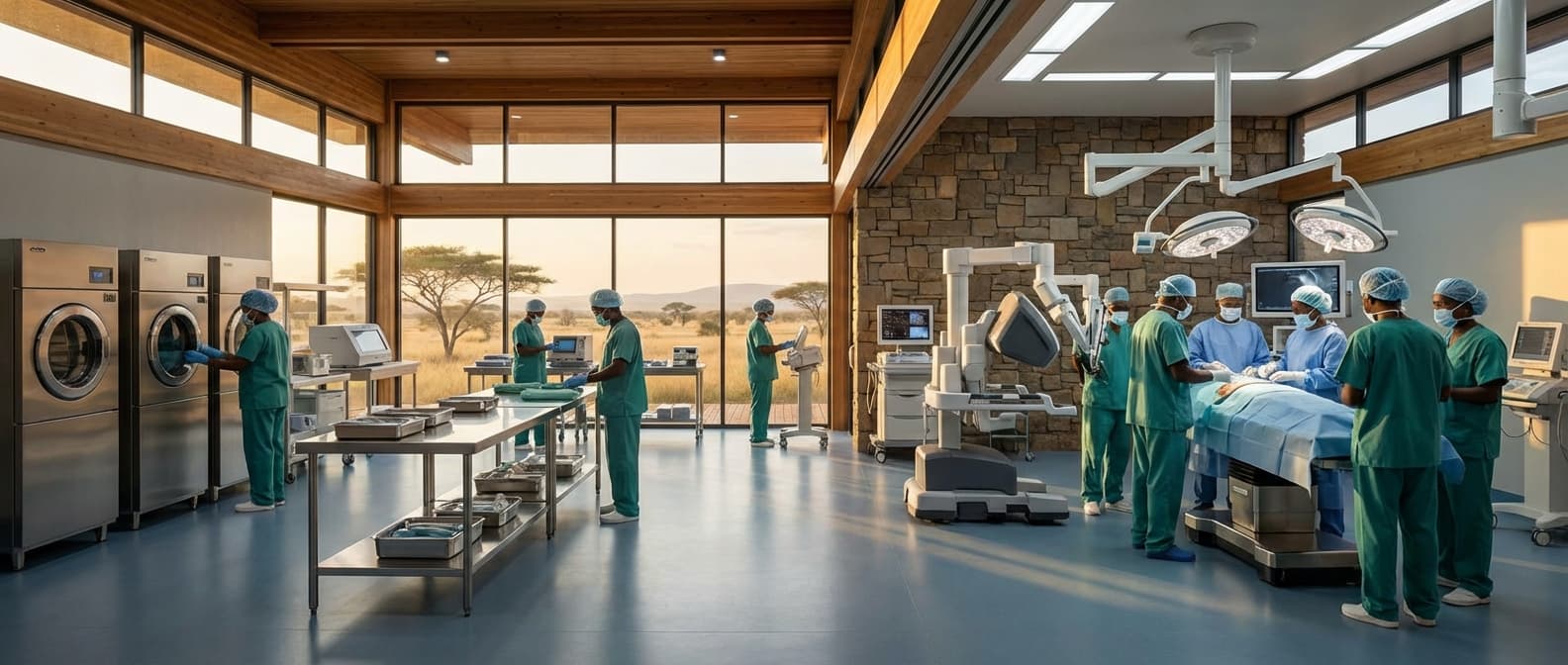
Operating Theatre Turnkey Build in Lesotho
Engineering Excellence & Technical Support
Complete OR design, equipment integration and commissioning High-standard technical execution following OEM protocols and local regulatory frameworks.
Expedited Site Mobilization & Preparation
Swift mobilization of specialized construction teams and equipment to Lesotho, ensuring rapid site assessment, decontamination, and meticulous preparation of the designated area for the operating theatre build, minimizing project timelines.
Integrated HVAC & Medical Gas Systems
Design and installation of state-of-the-art, redundant HVAC systems with HEPA filtration for sterile environments, coupled with fully compliant medical gas pipeline systems (oxygen, medical air, vacuum) to meet international healthcare standards.
Turnkey Project Management & Commissioning
Comprehensive end-to-end project management, from initial design and procurement to construction, installation of medical equipment, rigorous testing, and final commissioning, delivering a fully operational, ready-to-use operating theatre facility in Lesotho.
What Is Operating Theatre Turnkey Build In Lesotho?
An Operating Theatre Turnkey Build in Lesotho refers to a comprehensive service package that delivers a fully functional, ready-to-operate surgical suite. This encompasses the entire lifecycle from initial design and planning through construction, installation of all necessary equipment, commissioning, and final handover. The 'turnkey' aspect signifies that the client receives a complete, operational facility with minimal further involvement required on their part. This integrated approach streamlines the development process, reduces project complexity, and ensures that all components are designed and installed to meet stringent healthcare standards and regulatory requirements specific to Lesotho.
| Who Needs This Service? | Typical Use Cases in Lesotho | |||
|---|---|---|---|---|
| Hospitals and Healthcare Facilities: Both public and private hospitals seeking to upgrade existing infrastructure or establish new surgical capabilities. | Government Health Ministries: For the development of public healthcare infrastructure across the nation, aiming to expand access to surgical services. | Non-Governmental Organizations (NGOs) and Charities: Involved in healthcare provision and capacity building, requiring state-of-the-art surgical facilities for their operations. | Research Institutions: Needing specialized surgical suites for clinical research and advanced medical procedures. | Private Medical Practitioners and Groups: Establishing or expanding private surgical clinics and centers. |
| Establishing New Surgical Departments: Creating entirely new operating theatre complexes within existing or newly constructed hospitals. | Upgrading Existing Operating Theatres: Modernizing outdated facilities with advanced technology, improved infection control, and enhanced workflow efficiency. | Implementing Specialized Surgical Services: Developing dedicated theatres for specific specialties like cardiology, orthopedics, neurosurgery, or minimal access surgery. | Disaster Relief and Emergency Response Facilities: Rapid deployment of pre-fabricated or quickly constructed surgical units in response to health crises. | Rural Healthcare Expansion: Providing essential surgical capabilities to underserved remote areas through well-equipped, self-contained units. |
Key Components of an Operating Theatre Turnkey Build:
- Facility Design and Architectural Planning: Development of detailed blueprints, including layout, workflow optimization, and adherence to infection control principles.
- Civil Construction and Infrastructure: Building the physical structure, including walls, flooring, ceilings, and ensuring structural integrity and appropriate environmental controls.
- MEP (Mechanical, Electrical, and Plumbing) Systems: Installation of specialized HVAC systems for air quality control (HEPA filtration, positive/negative pressure), medical gas pipelines (oxygen, medical air, vacuum), electrical power distribution with UPS/generator backup, and appropriate plumbing for sterile water and waste management.
- Specialized Operating Room Finishes: Application of seamless, non-porous, and easily cleanable materials for walls, floors, and ceilings to maintain sterility.
- Medical Equipment Procurement and Integration: Sourcing, installation, and calibration of all essential surgical equipment, including surgical lights, tables, anesthesia machines, patient monitors, imaging modalities (e.g., C-arms), and sterilization equipment.
- Information Technology (IT) and Communication Systems: Installation of network infrastructure, data cabling, and integration of audiovisual systems for surgical procedures.
- Sterilization and Waste Management Systems: Implementation of robust systems for instrument sterilization (autoclaves) and safe disposal of medical waste.
- Regulatory Compliance and Certification: Ensuring adherence to local health regulations, building codes, and international standards (e.g., HTM, JCI where applicable) and obtaining necessary certifications.
- Training and Commissioning: Providing training for medical and technical staff on the operation of newly installed systems and equipment, followed by thorough commissioning to verify functionality.
- Project Management and Handover: Dedicated project management throughout the process, culminating in a seamless handover of the fully functional operating theatre.
Who Needs Operating Theatre Turnkey Build In Lesotho?
Operating theatre turnkey builds in Lesotho are crucial for enhancing healthcare infrastructure and providing advanced surgical services. These comprehensive solutions offer a complete, ready-to-use surgical environment, from design and construction to equipment installation and commissioning. The demand for such specialized projects stems from a need to modernize existing facilities, expand capacity, and introduce new surgical specialties.
| Department/Area | Key Requirements for Turnkey Build | Specific Surgical Needs |
|---|---|---|
| General Surgery | Sterile environment, flexible layout, robust lighting, availability of essential surgical instruments and anesthesia equipment. | Appendectomy, hernia repair, cholecystectomy, exploratory laparotomies. |
| Orthopedics | Specialized tables for fracture reduction and imaging integration, advanced power tools, radiation protection measures. | Joint replacements (hip, knee), fracture fixation, spinal surgery. |
| Obstetrics and Gynecology | Dedicated space for gynecological procedures, potential for labor ward integration, specialized instruments for gynecological surgeries. | Cesarean sections, hysterectomies, laparoscopic gynecological procedures. |
| Anesthesia | Adequate space for anesthesia machines and monitoring equipment, easy access to emergency drugs and equipment. | Pre-operative assessment, induction and maintenance of anesthesia, post-operative recovery monitoring. |
| Sterilization and CSSD (Central Sterile Services Department) | Dedicated area for instrument cleaning, disinfection, and sterilization, adherence to strict infection control protocols. | Ensuring sterility of all surgical instruments and equipment used in the operating theatre. |
| Post-Anesthesia Care Unit (PACU) / Recovery Room | Close proximity to operating theatres, monitoring equipment for vital signs, skilled nursing staff. | Monitoring patients during immediate post-operative recovery, pain management, detection of complications. |
| Imaging Services (e.g., X-ray, Fluoroscopy) | Integration with operating theatres for intraoperative imaging, radiation shielding. | Guiding surgical procedures, confirming placement of implants, assessing bone alignment. |
| Intensive Care Unit (ICU) | Close proximity to operating theatres for immediate transfer of critically ill patients. | Post-operative critical care for patients with complex surgical needs or complications. |
Target Customers and Departments for Operating Theatre Turnkey Builds in Lesotho
- Government Hospitals: Public hospitals are primary beneficiaries, seeking to upgrade their surgical capabilities to serve a larger population and improve patient outcomes. They often require multiple operating theatres to meet diverse surgical needs.
- Private Hospitals and Clinics: For-profit healthcare providers aim to offer state-of-the-art surgical services to attract patients seeking specialized or elective procedures. These entities often prioritize rapid deployment and advanced technology.
- Tertiary Referral Centers: Hospitals that serve as hubs for complex medical cases and specialized treatments will require advanced operating theatres capable of handling intricate surgeries and equipped with cutting-edge technology.
- Specialized Medical Centers: Facilities focusing on specific surgical disciplines, such as cardiology, orthopedics, or neurosurgery, will need tailored operating theatre designs and equipment.
- Disaster Relief and Emergency Response Organizations: In situations requiring rapid establishment of medical facilities, turnkey operating theatre solutions can be invaluable for setting up temporary or semi-permanent surgical units.
- Medical Training and Research Institutions: Universities and medical schools involved in surgical training and research will benefit from modern, well-equipped operating theatres that facilitate hands-on learning and advanced studies.
Operating Theatre Turnkey Build Process In Lesotho
Establishing a fully equipped operating theatre in Lesotho involves a comprehensive turnkey build process, ensuring all aspects from initial design to final handover are meticulously managed. This workflow guides clients through each stage, from their first inquiry to the complete operational readiness of the medical facility.
| Phase | Key Activities | Deliverables | Typical Timeline (Illustrative) |
|---|---|---|---|
| Phase 1: Inquiry & Initial Consultation | Client expresses interest, initial meetings, understand requirements and budget. | Project brief, preliminary scope definition. | 1-2 Weeks |
| Phase 2: Needs Assessment & Feasibility Study | Detailed analysis of clinical needs, site evaluation, regulatory review. | Needs assessment report, feasibility study. | 2-4 Weeks |
| Phase 3: Conceptual Design & Space Planning | Developing preliminary layouts, workflow diagrams, service integration. | Conceptual drawings, space allocation plans. | 3-6 Weeks |
| Phase 4: Detailed Design & Engineering | Producing full architectural and MEP drawings, technical specifications. | Complete design package (drawings, specifications, BOQ). | 6-12 Weeks |
| Phase 5: Equipment Specification & Procurement Strategy | Defining equipment needs, identifying suppliers, procurement planning. | Equipment list, vendor shortlist, procurement plan. | 4-8 Weeks (overlaps with design) |
| Phase 6: Regulatory Approvals & Permitting | Submitting applications, liaising with authorities. | Approved permits and licenses. | 4-16 Weeks (highly variable) |
| Phase 7: Construction & Civil Works | Site preparation, building shell construction, finishes. | Completed building structure and interiors. | 12-24 Months |
| Phase 8: MEP Installation & Integration | Installing HVAC, medical gases, electrical systems, plumbing. | Fully functional MEP systems. | 6-12 Months (overlaps with construction) |
| Phase 9: Medical Equipment Installation & Commissioning | Installing, testing, and calibrating all medical equipment. | Installed and commissioned equipment. | 2-4 Months |
| Phase 10: Training & Staff Familiarization | Conducting training sessions for staff. | Trained personnel, training manuals. | 2-4 Weeks (overlaps with commissioning) |
| Phase 11: Final Inspection & Handover | Joint inspections, defect rectification, official handover. | Certified handover documentation, operational facility. | 1-2 Weeks |
| Phase 12: Post-Handover Support & Maintenance | Warranty period, maintenance services, troubleshooting. | Ongoing operational support. | As per contract (ongoing) |
Operating Theatre Turnkey Build Process in Lesotho: Workflow from Inquiry to Execution
- {"title":"Phase 1: Inquiry & Initial Consultation","description":"The process begins with an interested party (e.g., hospital, government health department, private clinic) submitting an inquiry. This is followed by an in-depth consultation to understand the client's specific needs, scope of the project, budget, timeline, and any existing infrastructure or site constraints."}
- {"title":"Phase 2: Needs Assessment & Feasibility Study","description":"A detailed needs assessment is conducted to define the type and number of operating theatres required, the intended surgical specialities, patient volume, and essential equipment. A feasibility study might be undertaken to assess site suitability, regulatory compliance, and potential challenges specific to the Lesotho context."}
- {"title":"Phase 3: Conceptual Design & Space Planning","description":"Based on the needs assessment, conceptual designs are developed. This includes preliminary floor plans, layout considerations for workflow efficiency, infection control, patient and staff safety, and integration of essential services (medical gases, ventilation, power). Space planning ensures optimal utilization of the designated area."}
- {"title":"Phase 4: Detailed Design & Engineering","description":"Once the conceptual design is approved, detailed architectural, structural, mechanical, electrical, and plumbing (MEP) designs are created. This phase involves precise specifications for all building elements, including specialized finishes, lighting, HVAC systems (with HEPA filtration for theatres), medical gas pipelines, and electrical safety measures."}
- {"title":"Phase 5: Equipment Specification & Procurement Strategy","description":"A comprehensive list of surgical equipment, sterilization units, imaging devices, anesthesia machines, and other necessary medical technology is compiled. This includes defining technical specifications, sourcing reputable manufacturers, and developing a procurement strategy that considers lead times, import regulations in Lesotho, and cost-effectiveness."}
- {"title":"Phase 6: Regulatory Approvals & Permitting","description":"Navigating and obtaining all necessary building permits, health facility licenses, and environmental clearances from relevant Lesotho authorities is a critical step. This often involves submitting detailed plans and documentation to the Ministry of Health, local councils, and other regulatory bodies."}
- {"title":"Phase 7: Construction & Civil Works","description":"The physical construction begins. This includes site preparation, excavation, foundation laying, structural framing, roofing, wall construction, and installation of all interior and exterior finishes. Strict adherence to design specifications and quality control is paramount."}
- {"title":"Phase 8: MEP Installation & Integration","description":"Specialized MEP systems are installed, including medical gas lines, advanced HVAC with laminar flow, medical-grade electrical wiring with backup power (generators, UPS), and plumbing for sterile and non-sterile areas. These systems are meticulously integrated to ensure seamless operation and safety."}
- {"title":"Phase 9: Medical Equipment Installation & Commissioning","description":"Once the building is substantially complete, the procured medical equipment is installed by qualified technicians. This is followed by rigorous commissioning and testing of each piece of equipment to ensure it functions according to manufacturer specifications and meets clinical requirements."}
- {"title":"Phase 10: Training & Staff Familiarization","description":"Comprehensive training is provided to clinical and technical staff on the operation of new equipment, theatre protocols, infection control procedures, and the use of specialized systems. This ensures staff are competent and confident in utilizing the new facility."}
- {"title":"Phase 11: Final Inspection & Handover","description":"A final joint inspection is conducted by the client, the project team, and regulatory authorities. Any outstanding issues are addressed, and upon successful completion and compliance, the operating theatre facility is formally handed over to the client, ready for operational use."}
- {"title":"Phase 12: Post-Handover Support & Maintenance","description":"Often, the turnkey provider offers post-handover support, including warranty management, maintenance contracts, and ongoing technical assistance to ensure the long-term optimal performance of the operating theatre."}
Operating Theatre Turnkey Build Cost In Lesotho
Establishing an operating theatre in Lesotho involves significant investment, with costs influenced by a multitude of factors. These can be broadly categorized into the initial build, specialized medical equipment, and ongoing operational considerations. The 'turnkey' nature implies a fully functional facility delivered ready for use, encompassing design, construction, fit-out, and essential equipment. Pricing in Lesotho is subject to local economic conditions, import duties, availability of skilled labor, and the specific requirements of the healthcare facility. It's crucial to obtain detailed quotes from multiple reputable suppliers and contractors to ensure competitive pricing and quality assurance.
| Category | Estimated Range (M Lesotho Loti - M) | Notes |
|---|---|---|
| Small to Medium Operating Theatre (Basic Fit-out) | 2 - 5 | Includes essential equipment, standard finishes, and basic HVAC. Suitable for less complex procedures. |
| Medium to Large Operating Theatre (Standard Fit-out) | 5 - 15 | Higher quality finishes, more comprehensive equipment list, advanced HVAC, and reliable backup power. Suitable for a wider range of surgical specialties. |
| State-of-the-Art Operating Theatre (Advanced Fit-out) | 15 - 30+ | Includes cutting-edge equipment, highly specialized finishes (e.g., laminar flow, integrated imaging), advanced medical gas systems, sophisticated IT integration, and robust backup power. For complex surgeries and specialized units. |
| Design & Consultancy Fees | 0.5 - 2 | Varies based on the complexity and scope of services required from architects and consultants. |
| Import Duties & Taxes | Variable (can add 15-40% to equipment/material costs) | Highly dependent on specific items and current government tariffs. |
| Medical Equipment (per theatre) | 3 - 10+ | This is a broad range. A single theatre can be equipped for 3 million Loti for very basic needs, up to 10 million Loti or more for high-end, specialized equipment. |
Key Pricing Factors for Operating Theatre Turnkey Builds in Lesotho
- {"title":"Construction & Infrastructure","description":"This covers the physical building of the operating theatre suite. Factors include the size of the theatre, the complexity of the design (e.g., number of theatres, pre-op/recovery rooms), the quality of materials used, foundation work, and any necessary structural modifications to existing buildings. Site preparation, including excavation and ground leveling, also contributes to costs."}
- {"title":"Specialized Medical Equipment","description":"This is often the most significant cost component. It includes major items like surgical tables, anesthesia machines, operating lights, electrosurgical units, patient monitors, sterilizers (autoclaves), and imaging equipment (e.g., C-arm X-ray). The brand, model, and technological sophistication of each piece of equipment will greatly impact the price."}
- {"title":"Finishes & Fit-Out","description":"This includes interior elements like specialized flooring (anti-static, seamless), wall finishes (anti-microbial, easy to clean), ceiling systems, ventilation and air conditioning (HVAC) with HEPA filtration (critical for sterile environments), lighting, and plumbing for medical gases and waste. The integration of these systems requires specialized expertise."}
- {"title":"Medical Gas Systems","description":"Installation and supply of essential medical gases such as oxygen, medical air, nitrous oxide, and vacuum systems. This involves piping, outlets, and alarm systems, all requiring stringent safety standards."}
- {"title":"Electrical Systems & Power Backup","description":"Robust electrical infrastructure is paramount, including dedicated circuits for medical equipment and a reliable backup power system (e.g., generators) to prevent disruptions during surgery."}
- {"title":"Design & Consultancy Fees","description":"Costs associated with architects, engineers, and specialized healthcare consultants who will design the theatre to meet international standards and local regulations. This includes space planning, workflow optimization, and compliance with infection control protocols."}
- {"title":"Installation & Commissioning","description":"The cost of installing all equipment, testing systems, and ensuring everything functions correctly. This often involves manufacturers' representatives or certified technicians."}
- {"title":"Import Duties & Taxes","description":"Lesotho's import regulations and tax structures will affect the cost of imported materials and equipment. These can be substantial and need to be factored into the budget."}
- {"title":"Labor Costs","description":"Wages for skilled construction workers, electricians, plumbers, and specialized technicians. The availability of locally trained personnel can influence these costs."}
- {"title":"Project Management","description":"Fees for managing the entire turnkey project from inception to completion, ensuring adherence to timelines, budgets, and quality standards."}
- {"title":"Contingency","description":"An essential buffer for unforeseen issues or changes during the project. A typical contingency is 10-20% of the total project cost."}
Affordable Operating Theatre Turnkey Build Options
Investing in a new operating theatre (OT) is a significant undertaking, but it doesn't have to break the bank. Affordable operating theatre turnkey build options offer a streamlined and cost-effective approach to acquiring modern surgical facilities. These solutions focus on delivering fully functional OTs within a defined budget and timeframe, often through pre-engineered designs, standardized components, and efficient project management. The value lies in the predictability of cost, reduced lead times, and a comprehensive package that includes design, construction, equipment, and commissioning. Focusing on essential functionalities and avoiding unnecessary customizations are key to achieving affordability. Furthermore, understanding how value bundles and strategic cost-saving measures are integrated into these turnkey solutions is crucial for making informed decisions.
| Value Bundle Component | Description | Cost-Saving Strategy |
|---|---|---|
| Design & Planning | Pre-engineered, optimized OT layouts based on common surgical needs. | Minimizes bespoke architectural fees and lengthy design iterations. Focuses on essential workflows. |
| Construction & Fit-out | Use of modular wall systems, pre-fabricated ceiling panels, and standardized flooring. | Reduces on-site labor time and waste. Faster installation and higher quality control. |
| Medical Equipment | Curated packages of essential, reliable surgical equipment from reputable manufacturers. | Leverages bulk purchasing power and pre-negotiated pricing. Avoids expensive, specialized equipment not always required. |
| HVAC & Medical Gases | Integrated, compliant ventilation and medical gas systems designed for efficiency and performance. | Standardized system designs reduce engineering complexity. Energy-efficient components lower operating costs. |
| Lighting & Electrics | Efficient LED surgical lighting and streamlined electrical distribution. | Lower energy consumption and maintenance costs. Optimized electrical layouts simplify installation. |
| Project Management | A single point of contact for all aspects of the build, from concept to commissioning. | Reduces coordination overhead and potential for delays. Ensures efficient resource allocation and adherence to budget. |
| Commissioning & Training | Integrated testing and validation of all systems, with basic staff training. | Ensures the OT is fully operational upon handover. Reduces the need for separate commissioning agents and extensive external training. |
Key Features of Affordable Operating Theatre Turnkey Builds
- Pre-designed and modular OT layouts
- Standardized, high-quality medical equipment packages
- Integrated HVAC and medical gas systems
- Simplified electrical and IT infrastructure
- Project management by a single, accountable provider
- Reduced construction timelines
- Predictable budgeting and cost control
- Compliance with relevant healthcare regulations
Verified Providers In Lesotho
In Lesotho, accessing reliable and high-quality healthcare is paramount. Franance Health has emerged as a leading force, distinguished by its rigorous credentialing process that ensures only the most competent and ethical healthcare providers are part of their network. This commitment to verification not only elevates the standard of care but also provides patients with the assurance and confidence they deserve when seeking medical services. Understanding what makes Franance Health's credentials significant is key to recognizing why they represent the best choice for healthcare in Lesotho.
| Credentialing Area | Franance Health's Standard | Benefit to Patients in Lesotho |
|---|---|---|
| Academic & Professional Qualifications | Verified against accredited institutions and regulatory bodies. | Ensures providers have the fundamental knowledge and legal authorization to practice. |
| Clinical Experience | Thorough review of work history, case management, and references. | Guarantees that providers have practical, proven experience in delivering care. |
| Ethical Conduct | Comprehensive background checks and assessment of professional history. | Protects patients from unqualified or unethical practitioners, fostering trust. |
| Continuous Professional Development | Mandatory participation in accredited CPD programs. | Ensures patients receive care informed by the latest medical knowledge and techniques. |
| Specialization Validation | Formal verification of specific medical expertise. | Facilitates accurate referrals to the most suitable specialists for complex needs. |
| Patient Satisfaction Monitoring | Regular collection and analysis of patient feedback and outcomes. | Drives continuous improvement in service delivery and patient experience. |
Key Aspects of Franance Health's Verified Provider Credentials
- Rigorous Academic and Professional Qualification Verification: Franance Health meticulously checks the educational degrees, certifications, and licenses of all their healthcare professionals against recognized national and international standards. This ensures that providers possess the foundational knowledge and skills required for effective patient care.
- Extensive Clinical Experience Assessment: Beyond academic achievements, Franance Health evaluates the practical experience of its providers. This includes reviewing past performance, case management histories, and references from previous employers and colleagues, ensuring a proven track record of successful patient outcomes.
- Adherence to Ethical Standards and Professional Conduct: A core component of Franance Health's verification process is an in-depth review of a provider's professional conduct and ethical standing. This involves background checks and an assessment of any disciplinary actions or complaints lodged against them, guaranteeing patient safety and trust.
- Commitment to Continuous Professional Development (CPD): Franance Health requires its providers to engage in ongoing learning and skill enhancement through recognized CPD programs. This commitment ensures that their network stays abreast of the latest medical advancements, techniques, and best practices, offering patients the most current and effective treatments.
- Specialization and Sub-Specialization Validation: For providers offering specialized services, Franance Health verifies their specific areas of expertise. This allows patients to be confidently matched with professionals who possess the exact skills needed for their particular medical condition or need.
- Patient Feedback and Performance Monitoring: Franance Health actively incorporates patient feedback and performance metrics into its ongoing provider assessment. This continuous feedback loop helps maintain high standards and allows for prompt addressing of any concerns, further solidifying their commitment to patient satisfaction and quality care.
Scope Of Work For Operating Theatre Turnkey Build
This Scope of Work (SOW) outlines the requirements for a turnkey operating theatre (OT) build, encompassing all phases from design and construction to commissioning and handover. The project aims to deliver a fully functional, state-of-the-art operating theatre suite compliant with international healthcare standards and best practices.
| Category | Standard Specification | Key Considerations |
|---|---|---|
| Room Size and Layout | Minimum clear internal dimensions as per HTM 02-01, ISO 7742, or equivalent local regulations. Optimized workflow and access for equipment and personnel. | Patient access, instrument trolley movement, surgical team space, anaesthesia workstation positioning. |
| Wall, Floor, and Ceiling Finishes | Seamless, non-porous, antimicrobial, and easily cleanable materials. Epoxy resin or vinyl flooring, anti-microbial wall cladding (e.g., laminate or specialized paint). | Durability, chemical resistance, impact resistance, seamless joints to prevent microbial growth. |
| Air Quality and Ventilation (HVAC) | ISO Class 7 or 8 cleanroom standards (ISO 14644-1), positive pressure relative to adjacent areas, >20 air changes per hour (ACH) with HEPA filtration (H13/H14). | Laminar flow, particle control, temperature and humidity control (typically 20-24°C, 40-60% RH), prevention of cross-contamination. |
| Medical Gas Pipeline System (MGPS) | Compliance with HTM 02-01, ISO 7396-1, or equivalent standards. Color-coded outlets and pipework for oxygen, medical air, vacuum, nitrous oxide, etc. | Correct gas types, pressures, flow rates, leak testing, alarm systems, outlet safety features. |
| Electrical Systems | Adequate power supply, dedicated circuits for critical equipment, UPS for essential systems, medical isolation transformers, grounding and bonding. | Reliability, redundancy, electrical safety, compliance with IEC 60364-7-710 or equivalent. |
| Surgical Lighting | High color rendering index (CRI >90), adjustable intensity and focus, shadow reduction, ergonomic design. | Illumination levels (e.g., 100,000-160,000 lux), color temperature, heat emission. |
| Doors and Windows | Hermetically sealed sliding doors for OT and clean corridor, vision panels, lead shielding for X-ray rooms. | Airtightness, ease of operation, hygiene, safety. |
| Infection Control | Smooth surfaces, minimal ledges, integrated waste disposal points, antimicrobial coatings. | Ease of cleaning, prevention of microbial colonization, effective waste segregation. |
| Noise Levels | Maximum ambient noise levels as per healthcare guidelines (e.g., <55 dB). | Patient comfort, communication clarity, reduced stress for staff. |
| Safety Systems | Emergency power, fire detection and suppression, emergency exits, clear signage. | Risk mitigation, immediate response to emergencies. |
Key Technical Deliverables
- Architectural and Engineering Designs (including layout, structural, MEP, and medical gas systems)
- Civil Works and Construction of the OT Shell
- Interior Fit-out and Finishes (walls, floors, ceilings, doors)
- Medical Gas Pipeline System (MGPS) Installation and Certification
- Ventilation and Air Conditioning (HVAC) System including HEPA filtration and pressure control
- Electrical Systems (including standby power, UPS, and specialized lighting)
- Specialized OT Lighting (surgical lights, ambient lighting)
- Audiovisual and Communication Systems (for recording, conferencing, and patient monitoring)
- Integrated Control Panels and Building Management System (BMS) for OT environment control
- Medical Equipment Installation and Integration (if specified in separate scope)
- Waste Management Systems (including sterile and hazardous waste disposal)
- Fire Detection and Suppression Systems
- Waterproofing and Drainage Systems
- Testing, Commissioning, and Validation of all systems
- As-built Drawings and Documentation
- User Training and Handover
- Post-Occupancy Evaluation (optional)
Service Level Agreement For Operating Theatre Turnkey Build
This Service Level Agreement (SLA) outlines the response times and uptime guarantees for the Operating Theatre Turnkey Build project. It defines the expected performance standards and the remedies for any deviations from these standards. This SLA is an integral part of the overall contract for the Operating Theatre Turnkey Build.
| Service Component | Uptime Guarantee | Response Time (Critical Issues) | Response Time (Non-Critical Issues) | Resolution Target (Critical Issues) | Resolution Target (Non-Critical Issues) |
|---|---|---|---|---|---|
| Overall Project Timeline Adherence | N/A (Milestone-based) | 24 Hours for delay notification | 48 Hours for progress update | Mitigation plan within 72 hours | Progress update and revised plan |
| Critical MEP Systems (e.g., Medical Gas, HVAC for sterile zones) | 99.9% | 1 Hour | 4 Hours | 4 Hours (stabilization/temporary fix) | 24 Hours (permanent fix) |
| Specialized Medical Equipment Functionality (post-commissioning) | 99.5% | 2 Hours | 8 Hours | 8 Hours (troubleshooting) | 48 Hours (repair/replacement) |
| Cleanroom Air Quality and Pressure | 99.8% | 1 Hour | 4 Hours | 2 Hours (containment/stabilization) | 12 Hours (full restoration) |
| IT Infrastructure & Network (for theatre operations) | 99.7% | 1 Hour | 4 Hours | 4 Hours (restoration of basic connectivity) | 24 Hours (full functionality) |
| Structural Integrity & Building Envelope | N/A (Ongoing maintenance responsibility post-handover) | 24 Hours for reported defects | N/A | Assessment and repair plan within 72 hours | N/A |
| Project Documentation & Deliverables | N/A (Deadline-based) | 48 Hours for clarification requests | N/A | Clarification provided within 48 hours | N/A |
Scope of Services Covered by SLA
- Design and Engineering Phase
- Procurement and Material Sourcing
- Construction and Infrastructure Development
- MEP (Mechanical, Electrical, Plumbing) Installation
- Specialized Medical Equipment Integration
- Cleanroom and HVAC System Implementation
- Testing, Commissioning, and Validation
- Handover and Documentation
Frequently Asked Questions

Ready when you are
Let's scope your Operating Theatre Turnkey Build in Lesotho project in Lesotho.

Scaling healthcare logistics and technical systems across the entire continent.