
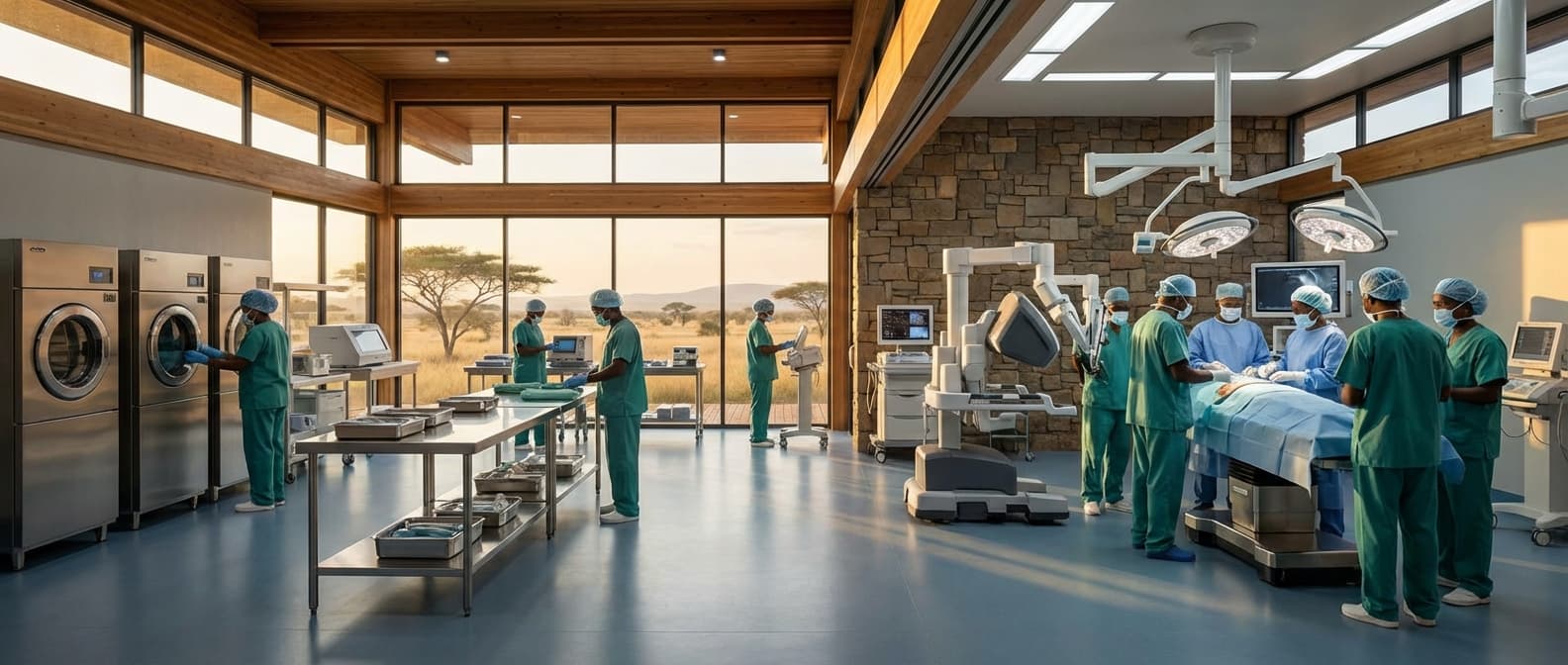
CSSD Design & Validation in Lesotho
Engineering Excellence & Technical Support
CSSD workflow design, validation and process development High-standard technical execution following OEM protocols and local regulatory frameworks.
Advanced Sterilization Workflow Modeling
Leveraging Figma and collaborative platforms to meticulously design and validate intricate CSSD workflows, ensuring optimal instrument processing pathways and minimizing bottlenecks for enhanced patient safety in Lesotho's healthcare facilities.
Data-Driven Validation Protocols
Implementing robust validation protocols, powered by Moxie or similar simulation tools, to rigorously test sterilization cycles, equipment efficacy, and staff competency, guaranteeing compliance with international standards and the highest level of sterile processing in Lesotho.
3D Equipment Layout & Spatial Analysis
Utilizing 3D modeling software like Fusion 360 to create precise layouts of CSSD equipment, conduct spatial analysis, and simulate material flow, thereby optimizing ergonomics, infection control, and operational efficiency within Lesotho's unique facility constraints.
What Is Cssd Design & Validation In Lesotho?
Central Sterile Services Department (CSSD) Design and Validation in Lesotho refers to the comprehensive process of planning, engineering, and verifying the optimal functionality and compliance of a CSSD facility. This involves ensuring the department is configured to meet international standards for sterilization, disinfection, and sterile storage of medical devices. The design phase focuses on workflow optimization, spatial planning, equipment selection, ventilation systems, and materials suitable for the demanding CSSD environment. Validation is a critical, multi-stage process that scientifically demonstrates that the CSSD facility, its equipment, and its processes consistently perform as intended, thereby guaranteeing the safety and efficacy of sterilized medical items and preventing healthcare-associated infections (HAIs). This includes prospective, concurrent, and retrospective validation of sterilization cycles, environmental monitoring, and personnel competency.
| Service Component | Description | Target Audience/Need | Typical Use Cases |
|---|---|---|---|
| Facility Design | Strategic planning and architectural detailing of the CSSD to optimize workflow from dirty to clean to sterile areas, minimizing cross-contamination risks. | Hospitals, large clinics, surgical centers, specialized medical facilities. | Construction of new healthcare facilities, renovation or expansion of existing CSSDs, establishing a new surgical unit. |
| Equipment Specification & Procurement | Defining precise technical requirements for sterilization and disinfection equipment based on anticipated workload, device types, and regulatory standards. | Healthcare institutions requiring efficient and compliant sterilization processes. | Purchasing new autoclaves, washer-disinfectors, or upgrading existing equipment to meet evolving standards. |
| HVAC System Design & Validation | Engineering and verifying ventilation systems to maintain appropriate air changes, pressure differentials (negative pressure in dirty areas, positive in sterile), and filtration levels to control microbial contamination. | Facilities handling critical sterile procedures, to prevent airborne contamination. | Ensuring the sterile storage area maintains required environmental conditions, validating HEPA filter integrity. |
| Sterilization Process Validation | Documented proof that a specific sterilization process (e.g., steam, low-temperature plasma) consistently achieves the required level of microbial inactivation for defined medical devices and cycles. | All healthcare facilities using reusable medical devices that require sterilization. | Validating new sterilization cycles, revalidating after equipment maintenance or changes, ensuring compliance with standards like ISO 17665. |
| Environmental Monitoring | Regular testing of the CSSD environment (air and surfaces) for microbial contamination levels to assess the efficacy of cleaning, disinfection, and HVAC systems. | Facilities aiming to maintain a sterile environment and prevent HAIs. | Monthly air sampling, quarterly surface swabbing, and periodic water quality testing. |
| Operational Qualification (OQ) & Performance Qualification (PQ) | OQ verifies equipment operates within specified parameters, while PQ demonstrates consistent performance of the sterilization process under normal operating conditions with actual loads. | Ensuring installed equipment and processes function reliably and effectively. | Testing a new autoclave with biological indicators and chemical indicators across multiple cycles, demonstrating consistent sterilization of specific instrument trays. |
Key Components of CSSD Design & Validation
- Facility Layout and Workflow Analysis
- Equipment Selection and Specification (Autoclaves, Washer-Disinfectors, Ultrasonic Cleaners, Packaging Systems)
- HVAC System Design and Commissioning (Airflow, Pressure Differentials, Filtration)
- Material Selection for Surfaces and Finishes
- Lighting and Ergonomics
- Water Quality Management and Testing
- Waste Management Integration
- Validation Protocol Development
- Installation Qualification (IQ)
- Operational Qualification (OQ)
- Performance Qualification (PQ)
- Sterilization Cycle Development and Validation
- Environmental Monitoring (Airborne and Surface Bioburden)
- Routine Performance Testing
- Personnel Training and Competency Assessment
- Documentation and Record Keeping
Who Needs Cssd Design & Validation In Lesotho?
CSSD (Central Sterile Services Department) design and validation are critical for ensuring the safety and efficiency of healthcare facilities. In Lesotho, as in any nation striving for quality healthcare, these services are essential for a range of institutions. Properly designed and validated CSSDs prevent the spread of infections, reduce the risk of surgical site complications, and optimize the utilization of expensive sterilization equipment. Without these foundational elements, healthcare providers in Lesotho face increased risks of patient harm and operational inefficiencies.
| Target Customer | Key Departments/Functions Requiring CSSD Expertise |
|---|---|
| Public Hospitals | |
| Private Hospitals & Clinics | |
| Specialty Clinics (e.g., Eye Clinics, Orthopedic Centers) | |
| Diagnostic Laboratories | |
| Government Health Ministries & Regulatory Bodies |
Who Needs CSSD Design & Validation in Lesotho?
- Hospitals (public and private)
- Specialty Clinics (e.g., surgical centers, dental clinics)
- Diagnostic Laboratories performing sterile procedures
- Healthcare facilities involved in outreach or mobile clinics where sterile supplies are crucial.
Cssd Design & Validation Process In Lesotho
The design and validation process for a Central Sterile Services Department (CSSD) in Lesotho, like in many healthcare settings, is a multi-stage undertaking that ensures the facility meets international standards for infection control and efficient instrument reprocessing. This process typically begins with an initial inquiry and culminates in a fully validated and operational CSSD. The workflow involves close collaboration between the healthcare facility, design consultants, equipment suppliers, and validation specialists.
| Stage | Key Activities | Responsible Parties |
|---|---|---|
| Needs Assessment & Inquiry | Define scope, site visit, regulatory review, budget. | Healthcare Facility, Consultants |
| Design & Planning | Layout, engineering, equipment selection, tender docs. | Design Consultants, Healthcare Facility |
| Procurement & Construction | Tendering, construction, equipment purchase, installation. | Contractors, Suppliers, Healthcare Facility |
| Commissioning & Qualification | SAT, IQ, OQ, PQ, workflow validation. | Suppliers, Validation Specialists, Healthcare Facility |
| Validation & Training | Process validation, microbiological testing, staff training, SOPs, QMS. | Validation Specialists, Healthcare Facility |
| Go-Live & Post-Validation Monitoring | Operational start, ongoing monitoring, audits, revalidation. | Healthcare Facility, Regulatory Bodies |
CSSD Design & Validation Workflow in Lesotho
- {"items":["Initial inquiry from healthcare facility regarding CSSD upgrade or new construction.","Needs assessment to define scope: number of beds, surgical specialties, instrument types, sterilization methods required (steam, low-temperature, etc.).","Site visit and assessment of existing infrastructure (space, utilities, ventilation).","Review of local regulations, national health guidelines, and international best practices (e.g., ISO standards, AAMI guidelines).","Budget allocation and preliminary financial planning."],"title":"Phase 1: Needs Assessment & Inquiry"}
- {"items":["Appointment of design consultants (architects, engineers, CSSD specialists).","Development of preliminary design concepts and layout options based on needs assessment and workflow analysis.","Detailed architectural design: room layouts, workflow segregation (dirty, clean, sterile), traffic flow.","Engineering design: HVAC (ventilation, air pressure differentials), plumbing, electrical, medical gas systems.","Selection of equipment: washers, disinfectors, sterilizers, drying cabinets, packaging equipment, storage solutions.","Preparation of tender documents and specifications for construction and equipment procurement."],"title":"Phase 2: Design & Planning"}
- {"items":["Tendering and selection of construction contractors and equipment suppliers.","Construction phase: adherence to design specifications, quality control, and regular site inspections.","Procurement of CSSD equipment, including pre-installation checks and factory acceptance testing (FAT) where applicable.","Installation of all CSSD equipment according to manufacturer guidelines and design plans.","Commissioning of building services (HVAC, plumbing, electrical) to ensure they meet design parameters."],"title":"Phase 3: Procurement & Construction"}
- {"items":["Manufacturer's site acceptance testing (SAT) for all installed equipment.","Development of detailed commissioning protocols and test procedures.","Installation Qualification (IQ): verifying that equipment is installed correctly as per manufacturer's specifications and design.","Operational Qualification (OQ): verifying that equipment operates within its intended parameters across its specified range.","Performance Qualification (PQ): verifying that the equipment consistently performs as intended in the actual operating environment with the specific load types.","Validation of workflows and material handling processes to ensure effective segregation and sterile processing."],"title":"Phase 4: Commissioning & Qualification"}
- {"items":["Process validation: demonstrating that the entire CSSD process (cleaning, disinfection, sterilization, packaging, storage, distribution) consistently produces sterile medical devices.","Microbiological challenge testing of sterilization cycles.","Training of CSSD staff on equipment operation, standard operating procedures (SOPs), infection control practices, and quality management systems.","Development of comprehensive SOPs for all CSSD functions.","Establishment of a quality management system (QMS) for ongoing monitoring and improvement."],"title":"Phase 5: Validation & Training"}
- {"items":["Official go-live of the validated CSSD.","Ongoing monitoring of key performance indicators (KPIs) and process parameters.","Regular internal audits and external surveillance to ensure continued compliance with standards.","Periodic revalidation of sterilization cycles and equipment as per regulatory requirements and manufacturer recommendations.","Continuous improvement initiatives based on performance data and feedback."],"title":"Phase 6: Go-Live & Post-Validation Monitoring"}
Cssd Design & Validation Cost In Lesotho
Designing and validating a Central Sterile Supply Department (CSSD) is a critical undertaking for any healthcare facility. In Lesotho, the cost of this process is influenced by a combination of factors, including the size and complexity of the facility, the specific equipment chosen, the extent of renovations or new construction required, and the involvement of local versus international consultants. Pricing is typically discussed in Maloti (LSL). Understanding these elements is crucial for accurate budgeting and successful project implementation.
| Cost Component | Estimated Range (LSL) | Notes |
|---|---|---|
| Basic Design & Consultation (Small Facility) | 30,000 - 80,000 | Primarily local architects and basic CSSD layout planning. |
| Comprehensive Design & Consultation (Medium to Large Facility) | 80,000 - 250,000+ | Involves specialized CSSD consultants, detailed engineering plans, and potentially international expertise. |
| Equipment Procurement (per major unit - e.g., autoclave) | 150,000 - 700,000+ | Highly variable based on brand, capacity, and technology (e.g., steam, plasma). Includes installation costs. |
| Infrastructure Modifications/Upgrades | 50,000 - 300,000+ | Depends on the extent of electrical, plumbing, HVAC, and steam requirements. |
| Validation & Testing Services | 40,000 - 150,000+ | Cost per validation cycle for equipment and processes. May include external testing agencies. |
| Project Management (if outsourced) | 5% - 15% of total project cost | Percentage-based fee for managing the entire project lifecycle. |
| Staff Training | 15,000 - 50,000 | Covers training on equipment operation, infection control, and quality assurance. |
| Contingency (Recommended) | 10% - 20% of estimated total project cost | Essential for managing unexpected expenses. |
Key Pricing Factors for CSSD Design & Validation in Lesotho
- Facility Size and Scope: The square footage of the CSSD, the number of sterilization units required, and the overall workflow complexity directly impact design fees and validation scope.
- Equipment Selection: High-tech autoclaves, washer-disinfectors, and specialized instruments represent a significant portion of the cost. The brand, capacity, and features of chosen equipment will vary widely in price.
- Infrastructure Requirements: This includes plumbing, electrical upgrades, ventilation systems (HVAC), steam generation, and waste disposal. Existing infrastructure limitations will increase costs.
- Design & Consultancy Fees: Charges from architects, engineers, and CSSD specialists. Local consultants may offer lower rates than international firms, but the latter might bring specialized expertise for larger or more complex projects.
- Validation & Testing: This involves performance qualification (PQ), operational qualification (OQ), and installation qualification (IQ) of equipment and processes. Specialized testing equipment and external validation services contribute to this cost.
- Project Management: Oversight of the design, procurement, installation, and commissioning phases.
- Training: Essential for staff competency in CSSD operations and equipment use.
- Regulatory Compliance: Adhering to national and international standards (e.g., SADC guidelines, WHO recommendations) may necessitate specific design features and validation protocols.
- Contingency: Unforeseen issues during construction, procurement, or validation often require a contingency fund.
Affordable Cssd Design & Validation Options
Designing and validating a Central Sterile Supply Department (CSSD) is crucial for patient safety and operational efficiency. While comprehensive, fully custom solutions can be expensive, there are affordable design and validation options available. These often involve leveraging standardized approaches, pre-designed modules, and phased validation processes. Understanding value bundles and cost-saving strategies is key to implementing a compliant and effective CSSD within budget.
| Strategy | Description | Potential Cost Savings Impact | Considerations |
|---|---|---|---|
| Modular Design | Utilizing pre-designed, adaptable CSSD modules. | Reduced design fees, faster construction, predictable costs. | Ensure modularity meets specific workflow needs and regulatory requirements. |
| Phased Validation | Breaking down validation into manageable stages over time. | Lower upfront validation costs, deferred expenses, phased budget allocation. | Requires meticulous planning to ensure interim compliance and data integrity. |
| Standardized Equipment Bundles | Purchasing integrated sets of CSSD equipment from a single vendor. | Volume discounts, simplified procurement, assured compatibility. | Verify that the bundled equipment meets all performance and capacity needs. |
| Remote Support | Utilizing virtual consultations for design and planning. | Minimized travel expenses, faster initial planning. | Requires clear communication and reliable technology for effective remote collaboration. |
| Risk-Based Validation | Prioritizing validation efforts based on the criticality of the process/equipment. | Reduced validation time and resources for lower-risk areas. | Requires a robust risk assessment framework and clear justification for validation levels. |
| Workflow Optimization | Analyzing and improving existing processes before physical changes. | Reduced need for expensive renovations, increased efficiency. | Requires thorough process mapping and staff involvement to identify true bottlenecks. |
Key Value Bundles and Cost-Saving Strategies
- {"title":"Modular CSSD Design Bundles","description":"Pre-engineered, modular CSSD layouts can significantly reduce design time and custom fabrication costs. These bundles typically include standardized workflows, optimized space utilization, and pre-selected equipment packages, offering a predictable cost structure."}
- {"title":"Phased Validation Services","description":"Instead of a single, large validation event, consider a phased approach. This involves validating critical components and processes first, allowing for operational readiness and deferring some costs. Phased validation can also be integrated with equipment upgrades or renovations."}
- {"title":"Standardized Equipment Packages","description":"Many vendors offer bundled equipment packages for CSSD, which can be more cost-effective than purchasing individual pieces. These packages often include compatible washers, sterilizers, and drying cabinets, ensuring seamless integration."}
- {"title":"Remote Consultation & Design Support","description":"Utilize remote expertise for initial design consultations and space planning. This can reduce the need for expensive on-site visits during the early stages of the project."}
- {"title":"Training & Competency Assessment Bundles","description":"Investing in standardized training programs for CSSD staff can improve efficiency and reduce errors, indirectly saving costs. Look for bundles that combine initial training with ongoing competency assessment tools."}
- {"title":"Optimized Workflow Analysis","description":"Focus on optimizing existing workflows before investing in new infrastructure. A thorough analysis can identify bottlenecks and inefficiencies that can be addressed with process improvements, which are often less expensive than physical changes."}
- {"title":"Risk-Based Validation Approach","description":"Prioritize validation efforts based on risk. Focus extensive validation on critical sterilization processes and equipment, while using less intensive methods for lower-risk areas or consumables."}
- {"title":"Leveraging Existing Infrastructure","description":"Assess the potential to adapt and upgrade existing spaces and utilities rather than building new. This can involve refurbishing areas, upgrading HVAC systems, or reconfiguring existing layouts."}
- {"title":"Long-Term Service & Maintenance Agreements","description":"Negotiate comprehensive service and maintenance agreements upfront. These can prevent costly breakdowns and unexpected repair bills, providing predictable operational expenses."}
- {"title":"Group Purchasing Organizations (GPOs)","description":"If your facility is part of a GPO, leverage their negotiated pricing for CSSD equipment and supplies. This can lead to significant cost savings."}
Verified Providers In Lesotho
In Lesotho, ensuring you receive care from Verified Providers is paramount for your health and well-being. Franance Health stands out as a leading organization dedicated to credentialing and verifying healthcare professionals. Their rigorous vetting process guarantees that the providers listed under their umbrella meet the highest standards of competence, ethical practice, and patient safety. This commitment to excellence makes Franance Health a trusted name, and their verified providers the best choice for your healthcare needs in Lesotho.
| Provider Type | Franance Health Verification Criteria | Benefits to Patients |
|---|---|---|
| Doctors (General Practitioners & Specialists) | Valid medical license, post-graduate qualifications, proof of continuing medical education, clean disciplinary record. | Accurate diagnosis, effective treatment plans, specialized medical expertise. |
| Nurses (RNs, ENs, Midwives) | Registered nurse license, relevant certifications, proof of practical experience, adherence to nursing ethics. | Compassionate care, skilled patient monitoring, safe administration of treatments. |
| Pharmacists | Registered pharmacist license, understanding of drug interactions and safe dispensing practices. | Safe and accurate prescription fulfillment, expert advice on medication usage. |
| Allied Health Professionals (e.g., Physiotherapists, Lab Technicians) | Relevant certifications and degrees, professional registration where applicable, adherence to professional guidelines. | Specialized therapeutic interventions, accurate diagnostic testing, comprehensive health support. |
Why Choose Franance Health Verified Providers?
- Unwavering commitment to patient safety and quality of care.
- Rigorous credentialing and verification processes.
- Adherence to ethical medical practices and professional standards.
- Access to competent and qualified healthcare professionals.
- Peace of mind knowing you are in safe hands.
Scope Of Work For Cssd Design & Validation
This document outlines the Scope of Work (SOW) for the Design and Validation of a Central Sterile Supply Department (CSSD). It details the technical deliverables and specifies the standard specifications to be adhered to throughout the project lifecycle, ensuring a compliant, efficient, and safe operational environment. The SOW encompasses all phases from initial concept and detailed design to equipment selection, installation, commissioning, and final validation. Key areas include workflow analysis, space planning, equipment integration, environmental controls, infection control protocols, and regulatory compliance.
| Deliverable | Description | Standard Specifications / References |
|---|---|---|
| CSSD Workflow Analysis Report | Detailed study of current and proposed workflows for decontamination, sterilization, storage, and distribution of sterile medical devices. | AAMI ST79, ISO 13485, Local Health Authority Guidelines |
| Space Planning & Layout Drawings | Architectural and MEP (Mechanical, Electrical, Plumbing) drawings for the CSSD, including zoning, traffic flow, and equipment placement. | ASHRAE Standards, NFPA 99, Building Codes, Infection Control Guidelines |
| Equipment Specification Documents | Detailed technical specifications for all CSSD equipment (e.g., washer-disinfectors, sterilizers, sterile storage cabinets, tracking systems). | Manufacturer Specifications, EN Standards, FDA Requirements, AAMI Standards |
| HVAC & Environmental Control Design | Design of heating, ventilation, and air conditioning systems to maintain specific temperature, humidity, and air changes per hour for different CSSD zones. | ASHRAE 170, Local Environmental Regulations |
| Plumbing & Drainage Design | Design of water supply (including purified water systems), drainage, and backflow prevention for all relevant areas. | ASPE Data Books, Local Plumbing Codes |
| Electrical Design | Specification of power requirements, distribution, emergency power, and lighting for the CSSD. | NFPA 70 (NEC), Local Electrical Codes |
| Instrument Tracking System Design | Design and specification of a system for tracking instruments throughout their lifecycle within the CSSD. | GS1 Standards, Industry Best Practices |
| Commissioning Plan | Detailed plan for the systematic testing and verification of installed systems and equipment. | ASHRAE Guideline 0, CIBSE Commissioning Code |
| Validation Master Plan (VMP) | Comprehensive plan outlining the overall validation strategy for the CSSD, including IQ, OQ, and PQ. | ISPE Baseline Pharmaceutical Engineering Guide, FDA Guidance |
| Installation Qualification (IQ) Protocol & Report | Documented verification that all equipment and systems are installed according to design specifications. | AAMI ST79, Manufacturer Installation Manuals |
| Operational Qualification (OQ) Protocol & Report | Documented verification that installed equipment and systems operate within defined parameters. | AAMI ST79, Manufacturer Operating Manuals, Protocol-Specific Parameters |
| Performance Qualification (PQ) Protocol & Report | Documented verification that the CSSD, with its equipment and systems, consistently performs as intended under normal operating conditions. | AAMI ST79, ISO 13485, Relevant Sterilization Standards (e.g., EN 285, ISO 17665) |
| Infection Control Policies & Procedures | Development and review of CSSD-specific infection control policies and standard operating procedures (SOPs). | CDC Guidelines, WHO Recommendations, Local Infection Control Standards |
| Training Manuals & Records | Development of training materials for CSSD staff and comprehensive records of training completion. | Industry Best Practices, Regulatory Requirements |
Key Project Phases and Activities
- Conceptual Design & Feasibility Study
- Detailed Design & Engineering
- Equipment Specification & Procurement Support
- Installation & Commissioning Oversight
- Validation & Performance Testing
- Training & Handover
Service Level Agreement For Cssd Design & Validation
This Service Level Agreement (SLA) outlines the performance and availability expectations for the Central Sterile Supply Department (CSSD) Design & Validation services. It defines response times for support requests and uptime guarantees for critical CSSD systems and processes that are directly impacted by the design and validation activities.
| Service Category | Response Time Objective | Uptime Guarantee (for impacted systems/processes) | Notes |
|---|---|---|---|
| Critical Design Flaws/Validation Failures (impacting patient safety or regulatory compliance) | Within 2 business hours (escalation to senior management within 4 hours) | N/A (Focus is on immediate resolution and risk mitigation) | Requires immediate on-site or remote intervention to rectify. |
| Urgent Support Requests (e.g., critical equipment malfunction directly related to design, validation error requiring immediate correction) | Within 4 business hours | N/A (Focus is on rapid resolution of the urgent issue) | May require on-site presence depending on the nature of the issue. |
| Routine Support Requests (e.g., clarification on design specifications, minor adjustments, questions regarding validation documentation) | Within 1 business day | N/A (Focus is on providing timely information and guidance) | Resolution may be via email, phone, or scheduled meeting. |
| Design Review & Validation Plan Review | Within 2 business days (for initial feedback) | N/A | Turnaround time for final approvals will be outlined in specific project plans. |
| General Inquiries & Consultations | Within 2 business days | N/A | For non-critical information requests. |
Scope of Services Covered
- Initial CSSD conceptual design and space planning.
- Detailed design of CSSD workflows, equipment layout, and utility requirements.
- Validation protocol development and execution (IQ, OQ, PQ) for CSSD equipment and processes.
- Post-implementation review and optimization.
- Troubleshooting and support related to implemented design and validation parameters.
Frequently Asked Questions

Ready when you are
Let's scope your CSSD Design & Validation in Lesotho project in Lesotho.

Scaling healthcare logistics and technical systems across the entire continent.