
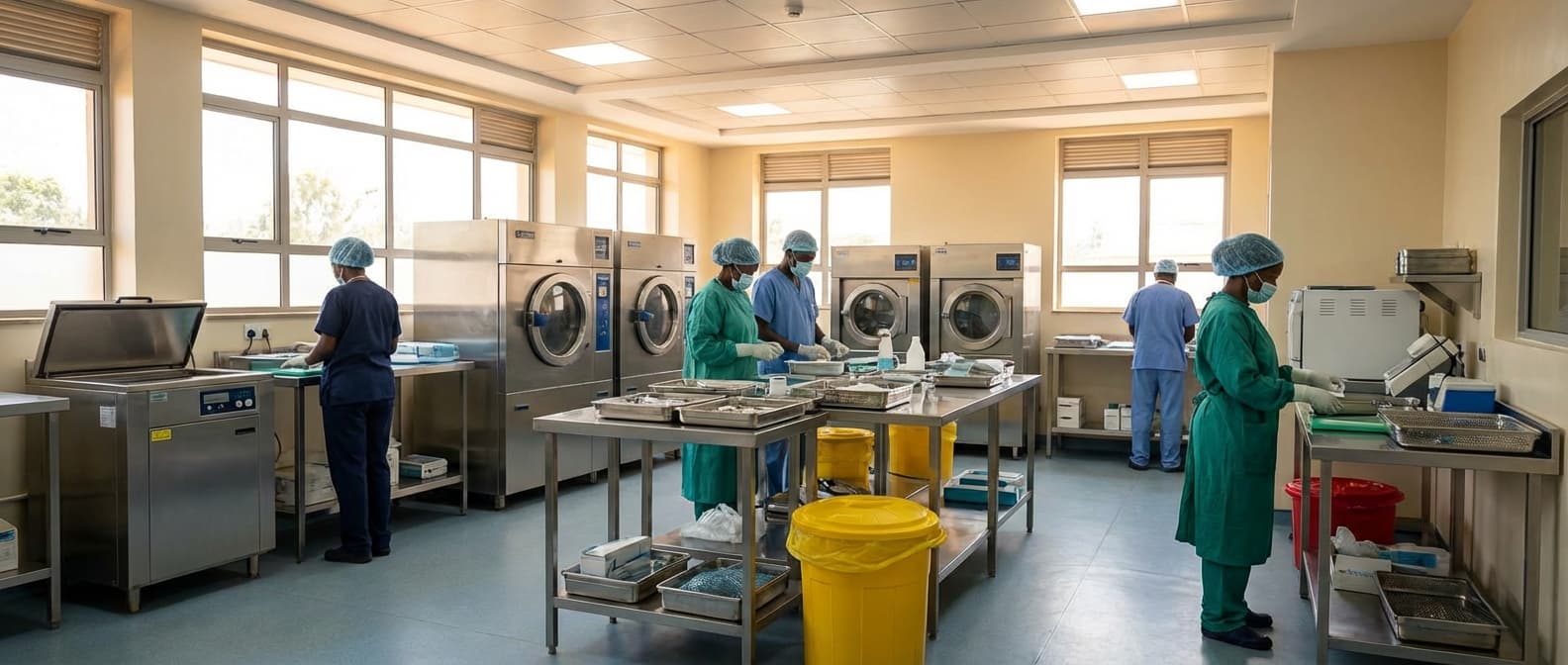
Infection-Control Readiness Support Service for Reusable Equipment in Kenya
Engineering Excellence & Technical Support
Infection-Control Readiness Support Service for Reusable Equipment High-standard technical execution following OEM protocols and local regulatory frameworks.
Optimized Sterilization Workflow
Streamlined and standardized sterilization protocols for all reusable medical equipment, ensuring adherence to international guidelines and reducing the risk of cross-contamination in healthcare facilities across Kenya.
Real-time Equipment Traceability
Implementation of a robust digital tracking system for reusable equipment, providing end-to-end visibility from usage to reprocessing and deployment, enhancing accountability and preventing mismanaged instruments.
Capacity Building & Competency Assessment
Development and delivery of comprehensive, evidence-based training modules for healthcare personnel on safe handling, cleaning, disinfection, and sterilization of reusable medical devices, with regular competency assessments to maintain high standards.
What Is Infection-control Readiness Support Service For Reusable Equipment In Kenya?
Infection-Control Readiness Support Service for Reusable Equipment in Kenya refers to a specialized consulting and operational service designed to ensure healthcare facilities maintain robust protocols and infrastructure for the safe decontamination and sterilization of reusable medical devices. This service is critical in preventing Healthcare-Associated Infections (HAIs) by guaranteeing that instruments and equipment are rendered free from viable microbial contamination before subsequent patient use. It encompasses a comprehensive assessment of existing practices, provision of technical expertise, implementation of standardized workflows, and validation of sterilization processes to meet national and international infection prevention and control (IPC) standards.
| Stakeholder/Entity | Requirement/Need | Typical Use Case |
|---|---|---|
| Hospitals (Public & Private) | Mandatory compliance with IPC regulations; reduction of HAIs; patient safety; operational efficiency; cost savings through effective equipment lifecycle management. | Ensuring surgical instruments are properly sterilized before each procedure; managing outbreaks of HAIs linked to inadequately reprocessed equipment; preparing for accreditation or regulatory audits. |
| Health Centers & Dispensaries | Basic but effective infection control for essential reusable medical devices (e.g., syringes, speculums, examination instruments); limited resources often necessitate optimization. | Implementing basic sterilization techniques for common instruments; training staff on manual disinfection and appropriate storage in resource-constrained settings. |
| Specialized Clinics (e.g., Dental, Ophthalmology, Endoscopy) | High-risk procedures requiring stringent sterilization protocols for specialized, often complex reusable devices (e.g., endoscopes, dental handpieces). | Developing and validating specific reprocessing protocols for flexible and rigid endoscopes; ensuring proper sterilization of dental instruments to prevent cross-contamination. |
| Medical Equipment Manufacturers/Suppliers | Ensuring their equipment is supported by appropriate reprocessing guidelines and that end-users are trained for optimal and safe utilization. | Providing training packages on the reprocessing of their specific devices as part of a product sale; offering post-installation validation of reprocessing efficacy. |
| Ministry of Health & Regulatory Bodies | Enforcement of national IPC standards; data collection on HAIs; ensuring public health safety. | Establishing national guidelines for reusable equipment reprocessing; conducting facility inspections; setting benchmarks for IPC readiness. |
Key Components of the Service
- Needs Assessment and Gap Analysis: Comprehensive evaluation of current reprocessing workflows, infrastructure, equipment inventory, and staff competency in handling reusable medical devices.
- Policy and Procedure Development/Review: Creation or refinement of Standard Operating Procedures (SOPs) for cleaning, disinfection, sterilization, storage, and transportation of reusable equipment, aligned with Kenyan Ministry of Health guidelines and relevant international standards (e.g., ISO 13485, AAMI ST79).
- Infrastructure and Equipment Evaluation: Assessment of the suitability and functionality of the Central Sterile Supply Department (CSSD) or reprocessing areas, including ventilation, water quality, and the condition and calibration of sterilization equipment (autoclaves, washer-disinfectors, etc.).
- Staff Training and Competency Building: Targeted training programs for healthcare professionals involved in the reprocessing cycle, covering principles of IPC, correct use of equipment and disinfectants/sterilants, documentation, and quality control procedures.
- Validation and Quality Assurance: Implementation of monitoring systems for sterilization processes, including biological and chemical indicators, process challenges devices (PCDs), and regular performance testing and maintenance of equipment.
- Supply Chain Management for Reprocessing Materials: Guidance on procurement of appropriate detergents, disinfectants, sterilants, packaging materials, and sterile storage solutions.
- Waste Management Integration: Ensuring safe and compliant disposal of biohazardous waste generated during the reprocessing of reusable equipment.
Who Needs Infection-control Readiness Support Service For Reusable Equipment In Kenya?
The Infection-Control Readiness Support Service for Reusable Equipment in Kenya is crucial for healthcare facilities aiming to minimize the risk of healthcare-associated infections (HAIs) and ensure patient safety. This specialized service focuses on enhancing the processes and infrastructure related to the sterilization, disinfection, and maintenance of medical equipment that is intended for reuse. By providing expert guidance, training, and technical assistance, the service helps facilities achieve and maintain high standards of infection prevention and control, thereby improving overall patient outcomes and reducing the burden of HAIs.
| Customer Type | Key Departments/Units Involved | Specific Needs Addressed |
|---|---|---|
| Hospitals (Public & Private) | CSSD, Operating Theatres, ICU, OPD, ER, Nursing Units, Biomedical Engineering, IPC Committee | Standardization of sterilization protocols, staff training on handling reusable devices, equipment maintenance, audit support, validation of sterilization processes, supply chain management for cleaning agents and consumables. |
| Specialty Clinics (e.g., Dental, Ophthalmology) | Clinic Management, Clinical Staff, Sterilization Technicians (if applicable) | Specific disinfection and sterilization protocols for specialized instruments, safe handling of sharps, staff competency assessment, regulatory compliance. |
| Maternity Homes/Small Clinics | Midwives/Clinical Officers, Nurses, Facility Management | Basic infection control principles for reusable delivery instruments and equipment, proper cleaning and disinfection techniques, resource-appropriate solutions. |
| Ministry of Health/County Health Departments | IPC Directorate, Public Health Units, Hospital Management Units | Development and implementation of national/county IPC guidelines, capacity building for healthcare workers, monitoring and evaluation of infection control practices, support for quality improvement initiatives. |
| Healthcare Training Institutions | Faculty (Nursing, Public Health, Biomedical Technology), Curriculum Developers | Integration of up-to-date IPC principles for reusable equipment into training programs, provision of training materials, opportunities for practical exposure for students. |
Target Customers and Departments for Infection-Control Readiness Support Service for Reusable Equipment in Kenya:
- Hospitals (Public and Private)
- Sub-county and County Referral Hospitals
- Tertiary and National Referral Hospitals
- Mission Hospitals and Faith-Based Healthcare Facilities
- Private Clinics and Day Surgeries
- Dental Clinics
- Specialty Clinics (e.g., Ophthalmology, Dermatology)
- Maternity Homes
- Outpatient Departments (OPDs) with procedure rooms
- Emergency Departments (ERs)
- Surgical Theatres/Operating Rooms
- Intensive Care Units (ICUs)
- Sterilization Units/Central Sterile Supply Departments (CSSDs)
- Endoscopy Units
- Dialysis Centers
- Maternity Wards
- Laboratory Departments (for reusable lab equipment)
- Infection Prevention and Control (IPC) Committees/Departments
- Biomedical Engineering Departments
- Nursing Departments
- Quality Assurance and Patient Safety Departments
- Healthcare Administrators and Management
- Ministry of Health (MoH) Regional and National Offices
- County Health Management Teams
- Healthcare Training Institutions (for curriculum integration and student exposure)
Infection-control Readiness Support Service For Reusable Equipment Process In Kenya
This document outlines the workflow for the Infection-Control Readiness Support Service for Reusable Equipment Process in Kenya. The service aims to assess and enhance the infection prevention and control (IPC) practices related to the sterilization and reprocessing of reusable medical equipment in healthcare facilities across Kenya. The workflow begins with an initial inquiry from a healthcare facility and culminates in the provision of tailored support and recommendations for improved readiness.
| Stage | Description | Key Activities | Responsible Parties | Deliverables | Timeline (Approximate) |
|---|---|---|---|---|---|
| Healthcare facilities express interest in the service or are identified for assessment. | Facility contacts the support service via email/phone/website. Initial information gathering on facility type, size, and concerns regarding reusable equipment. Preliminary eligibility screening. | Healthcare Facility, Ministry of Health (MoH) IPC Department, Service Provider (e.g., NGO, specialized consultancy) | Confirmation of interest, preliminary facility profile, agreement to proceed. | 1-2 weeks |
| Comprehensive assessment of the facility's current infection control practices for reusable equipment. | Site visit by trained assessors. Review of IPC policies & procedures. Observation of equipment reprocessing workflow (cleaning, disinfection, sterilization). Assessment of infrastructure, equipment availability & functionality, waste management, and staff knowledge/skills. Interviews with relevant personnel (nurses, technicians, administrators). Sample testing of sterilization processes where applicable. | Service Provider Assessors, Facility Staff (IPC Committee, nurses, technicians) | Completed assessment checklist/questionnaire, observation notes, interview summaries, any initial data collected (e.g., sterilization logs). | 2-4 weeks |
| Analysis of evaluation findings and formulation of specific, actionable recommendations. | Data analysis from the evaluation. Identification of strengths, weaknesses, gaps, and areas for improvement. Development of a detailed readiness report. Formulation of tailored recommendations addressing specific IPC deficits, including required equipment, consumables, training, and policy updates. | Service Provider Team (Assessors, IPC Specialists) | Comprehensive Readiness Assessment Report, List of specific, prioritized recommendations. | 1-3 weeks |
| Collaborative development of an implementation plan and provision of necessary training. | Presentation of the report and recommendations to facility management. Joint development of an action plan with clear timelines, responsibilities, and resource allocation. Delivery of targeted training sessions for staff on updated IPC protocols, proper equipment handling, cleaning, disinfection, and sterilization techniques. Provision of Standard Operating Procedures (SOPs) and relevant guidelines. | Service Provider Team, Facility Management & Staff | Approved Action Plan, Training materials, Evidence of staff training (attendance sheets, pre/post-tests). | 2-6 weeks (depending on training scope) |
| Verification of implemented changes and ongoing support to ensure sustainability. | Scheduled follow-up visits to assess the implementation of the action plan. Observation of practice changes and adherence to new protocols. Provision of ongoing technical support and mentorship. Data collection to monitor key IPC indicators (e.g., sterilization failure rates, adherence to protocols). | Service Provider Team, Facility Staff | Follow-up reports, updated IPC indicator data, documentation of mentorship provided. | 3-6 months (ongoing) |
| Facilitating sustained high standards and formal recognition. | Regular performance reviews based on monitoring data. Identification of further areas for improvement and development of new action plans. Potentially, a formal certification process or recognition for facilities meeting specific IPC readiness standards for reusable equipment. Sharing of best practices among facilities. | Service Provider Team, Facility Management, MoH IPC Department | Certification status (if applicable), documented continuous improvement plans, case studies of successful implementation. | Ongoing |
Workflow Stages
- Inquiry & Initial Assessment
- Readiness Evaluation
- Report Generation & Recommendation Development
- Action Planning & Training
- Follow-up & Monitoring
- Continuous Improvement & Certification
Infection-control Readiness Support Service For Reusable Equipment Cost In Kenya
The cost of infection-control readiness support services for reusable medical equipment in Kenya is influenced by a variety of factors, making it difficult to provide a single definitive price. These services are crucial for healthcare facilities to ensure that reusable items, such as surgical instruments, endoscopes, and respiratory equipment, are safely cleaned, disinfected, and sterilized to prevent the transmission of healthcare-associated infections (HAIs). The pricing structure typically reflects the scope of services, the complexity of the equipment, the frequency of support, and the specific provider. Below is a discussion of the key pricing factors and their potential impact on cost, along with estimated price ranges in Kenyan Shillings (KES).
| Service Component / Package | Estimated Price Range (KES) | Notes |
|---|---|---|
| Basic Training & Consultation (per session/day) | 5,000 - 15,000 | Focus on best practices, protocol review, single-day workshops. |
| Equipment-Specific Sterilization Protocol Development | 10,000 - 30,000 | Tailored protocols for different equipment types. |
| On-Demand Support for Specific Equipment Issues (per incident) | 7,000 - 25,000 | Troubleshooting, immediate guidance. |
| Regular Auditing & Quality Assurance (monthly visit) | 15,000 - 40,000 | Includes site visit, checklist review, minor recommendations. |
| Comprehensive Staff Training Program (e.g., 5-day course) | 50,000 - 150,000 | In-depth theoretical and practical training for a team. |
| Managed Reprocessing Service (per equipment type/month, e.g., endoscopes) | 30,000 - 100,000+ | Service provider takes over cleaning, disinfection, and potentially sterilization for specific high-volume or complex equipment. Excludes consumables unless specified. |
| Full-Cycle Infection Control Support (Annual Contract) | 200,000 - 1,000,000+ | Bundled services including regular audits, training updates, equipment checks, protocol review, and ongoing consultation for a facility. |
| Equipment Maintenance & Calibration (per device/service) | 10,000 - 50,000 | For autoclaves, washer-disinfectors, etc. Varies by equipment size and complexity. |
Key Pricing Factors for Infection-Control Readiness Support Services:
- Scope of Services: This is the most significant determinant of cost. Services can range from basic training on sterilization protocols to comprehensive management of the entire reprocessing cycle, including equipment maintenance, supply chain management for consumables, and quality assurance audits. More comprehensive services will naturally command higher fees.
- Type and Complexity of Equipment: Different types of reusable equipment require varying levels of expertise and technology for effective reprocessing. For example, reprocessing flexible endoscopes is more complex and requires specialized equipment and trained personnel than reprocessing simple surgical instruments. The cost will increase with the complexity of the equipment handled.
- Frequency of Support: The frequency of support services – whether it's daily, weekly, monthly, or on-demand – directly impacts the overall cost. Facilities requiring continuous or frequent support will incur higher expenses.
- Training and Staff Development: If the service includes training for healthcare facility staff on infection control practices, sterilization techniques, and equipment handling, this will be factored into the pricing. The duration and depth of the training will influence the cost.
- Equipment Maintenance and Calibration: Some support services may include routine maintenance, calibration, and repair of sterilization and disinfection equipment (e.g., autoclaves, washer-disinfectors). This adds to the service cost.
- Consumables and Supplies: While some contracts might exclude consumables, others may bundle them. The cost of specialized cleaning agents, disinfectants, sterilization indicators, and packaging materials will affect the overall service price if included.
- Auditing and Quality Assurance: Regular audits, performance monitoring, and quality assurance checks are essential for ensuring compliance and effectiveness. The extent and frequency of these activities will influence the cost.
- Provider Expertise and Reputation: Established and highly reputable service providers with specialized knowledge and a proven track record may charge premium rates compared to newer or less specialized companies.
- Geographic Location (within Kenya): While less of a primary driver, logistical costs for service providers might slightly vary depending on the remoteness of the healthcare facility within Kenya. However, for most urban and semi-urban areas, this difference is often negligible.
- Contract Duration and Volume: Longer-term contracts and agreements for servicing a larger volume of equipment might offer economies of scale and potentially lower per-unit costs.
Affordable Infection-control Readiness Support Service For Reusable Equipment Options
This service offers flexible, cost-effective solutions for organizations relying on reusable equipment to maintain rigorous infection-control standards. We understand the financial pressures faced by many healthcare and other facilities, and our "Affordable Infection-Control Readiness Support Service" is designed to provide comprehensive preparedness without prohibitive costs. By offering tailored value bundles and implementing smart cost-saving strategies, we empower our clients to achieve and maintain optimal infection control.
Value Bundles are curated packages designed to meet specific needs and budget levels. These bundles offer a discount compared to purchasing individual services, providing predictable costs and ensuring essential infection-control components are addressed. Our bundles can range from basic monitoring and compliance checks to comprehensive training, equipment validation, and emergency preparedness plans. The core principle is to deliver greater value through integrated solutions.
Cost-Saving Strategies are embedded within our service delivery model. These include leveraging technology for remote monitoring and data analysis, optimizing staff training through standardized modules and train-the-trainer programs, and recommending evidence-based, cost-effective disinfection and sterilization methods. We also focus on preventative maintenance to reduce equipment downtime and the associated costs of replacement or expedited services. Our aim is to reduce your operational expenditure while enhancing your infection-control posture.
| Value Bundle Tier | Included Services | Target Audience | Approximate Cost Savings (vs. A La Carte) | Ideal For |
|---|---|---|---|---|
| Bronze Readiness | Basic Compliance Checklist Review, Annual Policy Update Guidance, Access to Online Resources | Small Clinics, Independent Practices | 10-15% | Organizations needing foundational infection control oversight. |
| Silver Readiness | Bronze Services + Quarterly Audits, Staff Training Module Access, Equipment Functionality Checklists | Medium-Sized Clinics, Dental Offices | 15-20% | Facilities requiring regular verification and staff development. |
| Gold Readiness | Silver Services + Semi-Annual Site Visits, Equipment Performance Validation, Emergency Protocol Development Support, Dedicated Support Contact | Hospitals, Extended Care Facilities, High-Volume Clinics | 20-25% | Organizations needing comprehensive, proactive infection control management. |
| Platinum Readiness | Gold Services + Annual Deep Dive Analysis, Customized Training Programs, Pre-Audit Readiness Assessment, Priority On-site Support | Large Healthcare Systems, High-Risk Environments | 25-30% | Facilities prioritizing advanced preparedness and risk mitigation. |
Key Components of the Service
- Customizable Value Bundles
- On-demand Expert Consultation
- Staff Training & Competency Assessments
- Equipment Validation & Maintenance Support
- Compliance Monitoring & Gap Analysis
- Emergency Preparedness Planning
- Cost-Effective Disinfection & Sterilization Guidance
Verified Providers In Kenya
In Kenya's evolving healthcare landscape, identifying trusted and qualified healthcare providers is paramount for patients seeking quality care. Franance Health has emerged as a leading entity in this regard, rigorously vetting and credentialing healthcare professionals and facilities. Their stringent verification process ensures that all associated providers meet the highest standards of medical expertise, ethical practice, and patient safety. This commitment to quality makes Franance Health credentials a hallmark of reliability, offering Kenyan citizens peace of mind and access to superior healthcare services. Choosing a Franance Health-verified provider means opting for competence, integrity, and a patient-centered approach.
| Provider Type | Franance Health Verification Criteria | Patient Benefit |
|---|---|---|
| Doctors (Specialists & General Practitioners) | Valid medical license, board certification, proven clinical experience, adherence to ethical codes, continuing professional development. | Access to highly qualified medical professionals with proven expertise in their respective fields, ensuring accurate diagnosis and effective treatment. |
| Hospitals & Clinics | Accreditation from relevant health authorities, adherence to hygiene and safety protocols, availability of essential medical equipment, qualified medical staff, robust patient record management. | Safe and well-equipped healthcare facilities offering a comprehensive range of services with a focus on patient well-being and privacy. |
| Laboratories & Diagnostic Centers | Accreditation, qualified technicians and pathologists, use of calibrated and up-to-date equipment, adherence to quality control measures. | Accurate and reliable diagnostic test results essential for timely and appropriate medical interventions. |
| Pharmacies | Valid operating license, dispensing qualified pharmacists, proper storage of medications, adherence to drug dispensing regulations. | Access to genuine and safely stored medications, dispensed with professional advice and care. |
Key Benefits of Choosing Franance Health Verified Providers:
- Assurance of medical expertise and qualifications.
- Commitment to ethical patient care and safety standards.
- Access to a network of reputable and reliable healthcare professionals.
- Streamlined patient experience with trusted providers.
- Contribution to a higher standard of healthcare delivery in Kenya.
Scope Of Work For Infection-control Readiness Support Service For Reusable Equipment
This Scope of Work (SOW) outlines the requirements for providing Infection-Control Readiness Support Services for Reusable Equipment. The service aims to ensure healthcare facilities maintain robust infection prevention and control (IPC) protocols for reusable medical devices, thereby minimizing the risk of healthcare-associated infections (HAIs). This SOW details the technical deliverables and standard specifications that the service provider must adhere to.
| Deliverable | Description | Standard Specifications/Acceptance Criteria |
|---|---|---|
| Current State Assessment Report | Comprehensive review of existing reprocessing workflows, equipment, staff training, and documentation for reusable medical devices. Includes identification of gaps and areas for improvement. | Report shall include: detailed workflow mapping, risk assessment of current practices, staff competency matrix, review of current SOPs, identification of equipment maintenance status, and a summary of observed deviations from best practices. Assessment must align with CDC, AAMI, and local regulatory guidelines. |
| Revised Standard Operating Procedures (SOPs) for Reprocessing | Development of clear, concise, and evidence-based SOPs covering cleaning, disinfection, sterilization, storage, and handling of all critical, semi-critical, and non-critical reusable equipment. | SOPs must be specific to equipment types and manufacturers' instructions for use (IFU). Each SOP must include: purpose, scope, responsibilities, step-by-step procedures, required materials and equipment, safety precautions, validation requirements, and documentation requirements. SOPs must meet or exceed standards set by AAMI ST79, ISO 17665, and other applicable standards. |
| Staff Training Program and Materials | Development and delivery of a comprehensive training program for all personnel involved in the reprocessing of reusable equipment. Includes initial training and ongoing competency validation. | Training program shall cover: principles of infection control, specific reprocessing techniques for different equipment categories, proper use of cleaning agents and disinfectants, sterile processing principles, aseptic technique, and troubleshooting. Training materials must be in written and visual formats. Competency validation shall include written assessments, practical demonstrations, and periodic retraining. Training must align with CDC guidelines for healthcare IPC. |
| Equipment Validation and Performance Verification Plan | Development of a plan for initial validation and ongoing performance verification of all reprocessing equipment (e.g., washer-disinfectors, sterilizers). | Plan must include: protocols for installation qualification (IQ), operational qualification (OQ), and performance qualification (PQ). Specifies frequency and methodology for routine performance monitoring (e.g., chemical indicators, biological indicators, Bowie-Dick tests, process parameter logging). All validation and verification activities must comply with AAMI, ISO, and manufacturer recommendations. |
| Infection Control Compliance Audit Tool | Creation of a standardized audit tool for regular assessment of compliance with reprocessing SOPs and IPC best practices. | The audit tool shall be designed for ease of use and cover all aspects of the reprocessing cycle. It should include checklists for observable practices, documentation review, and environmental monitoring. Audit frequency and reporting mechanisms to be defined in the service plan. Audits should provide actionable feedback for continuous improvement. |
| Technology Integration Recommendations (Optional) | Recommendations for the implementation of technology to enhance reprocessing efficiency, tracking, and compliance monitoring (e.g., barcode tracking systems, automated monitoring software). | Recommendations will be based on the facility's specific needs and budget, providing a clear ROI analysis and implementation roadmap. Technology solutions recommended should be validated and compliant with relevant regulatory requirements and data security standards. |
| Final Project Report and Recommendations | A comprehensive report summarizing all activities undertaken, the achieved state of infection control readiness, and ongoing recommendations for maintaining compliance and improving practices. | Report to include: executive summary, details of services provided, findings from audits, staff competency levels achieved, a summary of implemented improvements, and a strategic roadmap for sustained infection control excellence in reusable equipment reprocessing. Recommendations should be prioritized and measurable. |
Key Objectives
- Assess current infection control practices for reusable equipment.
- Develop and implement enhanced infection control protocols.
- Provide training and competency assessment for staff involved in reprocessing.
- Recommend and integrate appropriate technologies for monitoring and compliance.
- Ensure compliance with relevant national and international standards.
Service Level Agreement For Infection-control Readiness Support Service For Reusable Equipment
This Service Level Agreement (SLA) outlines the response times and uptime guarantees for the Infection-Control Readiness Support Service (ICRSS) for reusable equipment. This service aims to ensure that reusable medical equipment is consistently maintained in a state of readiness for infection control, minimizing downtime and risk.
| Service Component | Response Time Guarantee | Uptime Guarantee | Notes |
|---|---|---|---|
| Critical Equipment Support (e.g., sterilization units, high-level disinfection machines) | Within 1 hour of reported issue (during business hours: Mon-Fri, 8 AM - 5 PM) | 99.5% | Defined as equipment available for use and fully functional for its intended infection control purpose. |
| High Priority Equipment Support (e.g., specialized surgical instruments requiring specific reprocessing) | Within 4 hours of reported issue (during business hours) | 98.0% | Focus on ensuring timely availability for scheduled procedures. |
| Standard Equipment Support (e.g., general-use reusable medical devices) | Within 8 business hours of reported issue | 95.0% | Includes routine maintenance and non-critical repairs. |
| After-Hours/Weekend Critical Equipment Support | Within 3 hours of reported issue (on-call service activated) | 99.0% (applicable to critical equipment only during off-hours) | Requires specific notification procedures for after-hours support. |
Key Service Objectives
- To provide rapid response to reported equipment issues impacting infection control.
- To maximize the availability of critical reusable equipment.
- To ensure adherence to established infection control protocols during support activities.
- To maintain clear and timely communication regarding service status.
Frequently Asked Questions

Ready when you are
Let's scope your Infection-Control Readiness Support Service for Reusable Equipment in Kenya project in Kenya.

Scaling healthcare logistics and technical systems across the entire continent.