
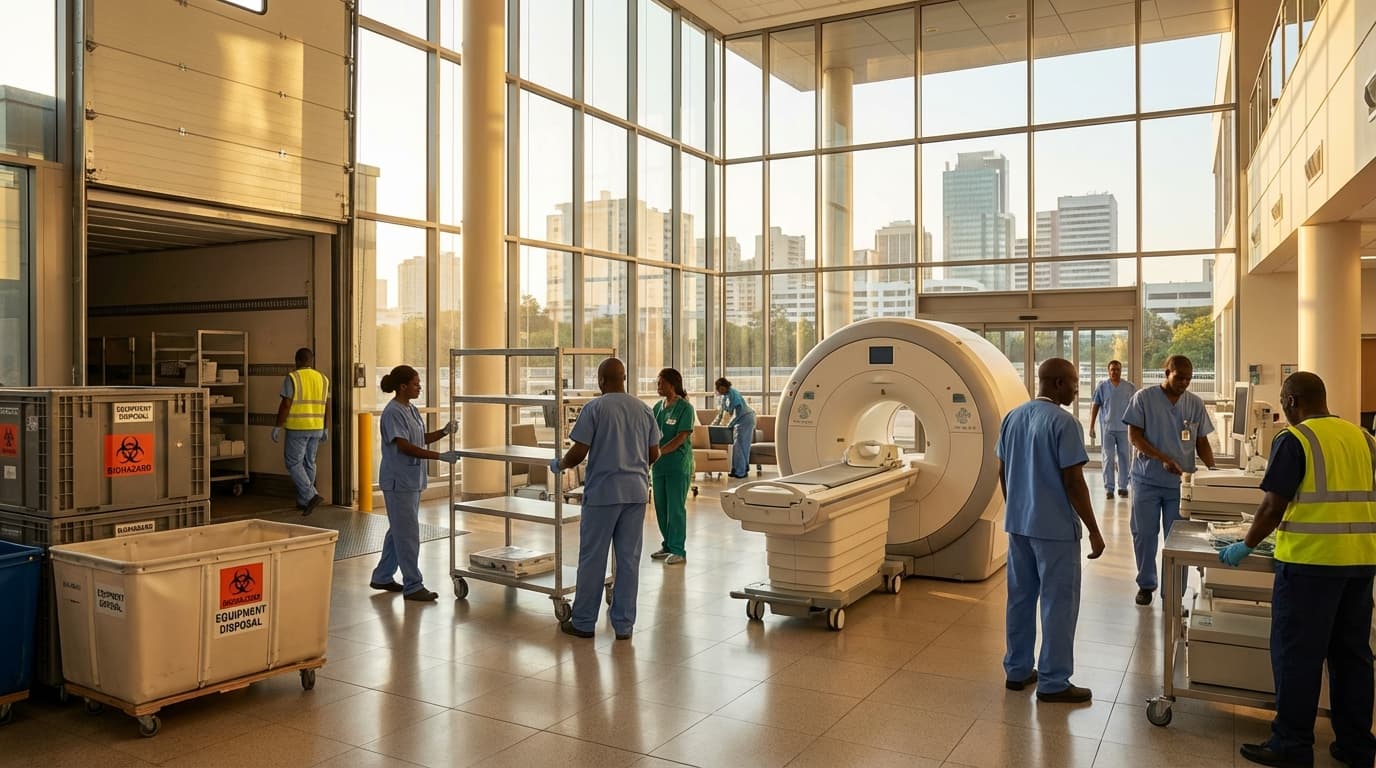
Medical Equipment Relocation Service (Move & Re-Install) in Kenya
Engineering Excellence & Technical Support
Medical Equipment Relocation Service (Move & Re-Install) High-standard technical execution following OEM protocols and local regulatory frameworks.
Specialized Medical Equipment Transport
Our fleet is equipped with climate-controlled, vibration-dampened vehicles and specialized handling equipment to ensure the safe transit of sensitive medical devices across Kenya, maintaining their integrity and operational readiness.
Certified Re-Installation & Calibration
Our certified technicians possess deep expertise in re-installing and calibrating a wide range of medical equipment, adhering to strict Kenyan regulatory standards and manufacturer specifications for optimal performance and patient safety.
Minimizing Downtime, Maximizing Uptime
We employ strategic planning and efficient logistics to minimize disruption to your healthcare services. Our goal is rapid, precise relocation and re-installation, ensuring your critical medical equipment is back online with minimal downtime.
What Is Medical Equipment Relocation Service (Move & Re-install) In Kenya?
Medical Equipment Relocation Service (Move & Re-Install) in Kenya refers to a specialized logistical and technical undertaking focused on the safe, efficient, and compliant transfer of medical devices from one location to another within Kenya. This service encompasses the entire lifecycle of the relocation process, from initial planning and disassembly to transportation, reassembly, calibration, and validation at the new site. It is a critical component for healthcare institutions undergoing infrastructure changes, expansions, or consolidations, ensuring minimal disruption to patient care and adherence to stringent regulatory standards governing medical equipment.
| Who Needs Medical Equipment Relocation Service? | Typical Use Cases |
|---|---|
| Hospitals and Healthcare Facilities (Public & Private) | Hospital renovations, expansions, or complete facility moves. Relocation of entire departments or specialized units (e.g., ICU, Radiology, Oncology). Acquisition or merger of healthcare institutions. |
| Diagnostic and Imaging Centers | Upgrading or replacing imaging equipment (e.g., MRI, CT scanners, X-ray machines). Opening new branch locations. |
| Laboratories (Clinical & Research) | Relocation of high-precision analytical instruments (e.g., mass spectrometers, PCR machines). Setting up new research facilities. |
| Medical Device Manufacturers & Distributors | Delivery and installation of new equipment at client sites. Decommissioning and relocation of demonstration or loaned equipment. |
| Government and Non-Profit Healthcare Organizations | Relocation of equipment to new clinics or health posts, particularly in remote areas. Disaster relief efforts involving temporary medical facility setup. |
| Specialized Medical Clinics (e.g., Dental, Ophthalmology, Dialysis) | Upgrading or relocating specialized treatment chairs, lasers, or dialysis units. Establishing new practice locations. |
Key Components of Medical Equipment Relocation Service:
- Pre-Relocation Assessment & Planning: Site surveys of both origin and destination, equipment inventory, risk assessment, development of detailed relocation protocols, and coordination with stakeholders.
- Decommissioning & Disassembly: Expert disconnection of power, data, and auxiliary services; safe dismantling of complex systems while preserving component integrity and functionality.
- Specialized Packing & Handling: Utilization of appropriate anti-static, shock-absorbent, and environmentally controlled packaging materials and methods tailored to the specific equipment type (e.g., imaging systems, laboratory analyzers, surgical robots).
- Secure Transportation: Employing specialized vehicles with climate control, air-ride suspension, and secure fastening systems. Adherence to transport regulations for sensitive or hazardous materials where applicable.
- Reassembly & Reconnection: Precise reassembly of disassembled components, adhering to manufacturer specifications and engineering blueprints.
- System Integration & Testing: Reconnection to power, data networks, and other essential infrastructure. Functional testing to ensure all sub-systems are operating correctly.
- Calibration & Performance Verification: Essential for diagnostic and therapeutic equipment, ensuring accuracy and reliability. This often involves specialized test equipment and adherence to established protocols.
- Validation & Commissioning: Confirmation that the equipment is installed and operating according to its intended specifications and regulatory requirements at the new site.
- Staff Training & Handover: Providing on-site training to the healthcare facility's technical and clinical staff on the re-installed equipment's operation and maintenance.
- Documentation & Compliance: Comprehensive record-keeping of all relocation activities, including disassembly/reassembly logs, calibration certificates, and validation reports, to ensure regulatory compliance.
Who Needs Medical Equipment Relocation Service (Move & Re-install) In Kenya?
Moving and re-installing sensitive medical equipment in Kenya presents unique challenges. Specialized relocation services are crucial for ensuring the safety, functionality, and compliance of these valuable assets. This service is not just about transportation; it encompasses careful de-installation, secure transit, expert re-installation, and often calibration and testing to guarantee the equipment is ready for immediate use. Failure to use specialized services can lead to damage, costly downtime, and regulatory non-compliance.
| Target Customer Type | Relevant Departments | Specific Needs/Equipment Examples |
|---|---|---|
| Hospitals (Public & Private) | Radiology/Imaging, Operating Theatres, ICU, Laboratory, Oncology, Cardiology, Central Sterilization Services Department (CSSD) | MRI machines, CT scanners, X-ray units, Linear accelerators, Surgical robots, Anesthesia machines, Ventilators, Microscopes, Spectrophotometers, Autoclaves |
| Clinics & Diagnostic Centers | Radiology, Pathology, Endoscopy, General Practice | Ultrasound machines, X-ray machines, ECG machines, Laboratory analyzers, Endoscopes |
| Research Institutions & Universities | Medical Research Labs, Biotechnology Departments, Teaching Hospitals | Advanced imaging equipment, Gene sequencers, Mass spectrometers, Cell culture incubators, Laboratory centrifuges |
| Medical Device Manufacturers & Suppliers | Service & Maintenance, Sales & Demonstrations, Warehouse & Logistics | New installations, Equipment servicing requiring off-site work, Showroom setups, Inventory relocation |
| Government Health Agencies | Public Health Laboratories, Ministry of Health Facilities, Regional Health Offices | Diagnostic equipment for public health programs, Outbreak response equipment, Upgrading public healthcare infrastructure |
| Specialized Medical Facilities | Imaging Centers, Dialysis Clinics, Cancer Treatment Centers | High-precision imaging equipment, Dialysis machines, Radiation therapy equipment |
Target Customers and Departments Requiring Medical Equipment Relocation Services in Kenya:
- Hospitals (Public & Private)
- Clinics & Diagnostic Centers
- Research Institutions & Universities
- Medical Device Manufacturers & Suppliers
- Government Health Agencies
- Specialized Medical Facilities (e.g., MRI centers, Dialysis units)
Medical Equipment Relocation Service (Move & Re-install) Process In Kenya
This document outlines the typical workflow for a Medical Equipment Relocation Service (Move & Re-Install) in Kenya, from the initial client inquiry to the successful execution of the service. This process is designed to ensure safety, efficiency, and compliance throughout the relocation of sensitive and valuable medical devices.
| Stage | Description | Key Activities | Responsible Parties | Key Deliverables/Outcomes |
|---|---|---|---|---|
| Phase 1: Inquiry & Initial Consultation | The client contacts the relocation service provider to express their need for medical equipment relocation. | Initial contact via phone, email, or website form. Discussion of project scope, equipment types, origin, and destination. Gathering preliminary information. | Client, Relocation Service Provider (Sales/Consultation Team) | Understanding of client needs, preliminary project scope, agreement to proceed to the next stage. |
| Phase 2: Site Assessment & Quotation | A thorough assessment of both the origin and destination sites to determine logistical requirements and potential challenges. | On-site visit by a qualified assessor. Detailed inventory of equipment, measurement of access routes, identification of power/utility requirements, assessment of potential risks (e.g., stairs, narrow corridors). Development of a detailed quotation. | Relocation Service Provider (Assessors, Technical Team) | Comprehensive site survey report, detailed list of equipment, personalized quotation with scope of work, timelines, and pricing. |
| Phase 3: Planning & Preparation | Developing a detailed relocation plan and preparing all necessary resources for a smooth operation. | Creation of a project plan. Scheduling of relocation date(s). Procurement of specialized packing materials. Coordination with client for access and downtime. Obtaining any necessary permits or permissions. | Relocation Service Provider (Project Manager, Logistics Team), Client | Approved project plan, confirmed schedule, readily available resources, client's awareness and cooperation. |
| Phase 4: Packing & Transportation | The careful and secure packing of medical equipment and its safe transportation to the new location. | Disconnection of equipment (if applicable and within scope). Expert packing using specialized materials (e.g., anti-static, shock-absorbent). Loading onto specially equipped vehicles. Secure transportation with trained personnel. Real-time tracking (optional). | Relocation Service Provider (Technicians, Packers, Drivers) | Safely packed equipment, documented inventory of packed items, secure transportation of goods. |
| Phase 5: Re-Installation & Testing | Unpacking and professional re-installation of medical equipment at the destination, followed by rigorous testing. | Unpacking of equipment. Professional installation and connection to utilities. Calibration and functional testing by qualified technicians. Verification of all parameters and performance against manufacturer specifications. | Relocation Service Provider (Qualified Technicians, Engineers) | Fully installed and functional equipment, successful test results, initial calibration verification. |
| Phase 6: Handover & Documentation | Formal handover of the relocated and tested equipment to the client, along with all relevant documentation. | Demonstration of equipment functionality to the client. Provision of installation reports, test results, and any warranty information. Signing of a completion certificate. Final invoice settlement. | Relocation Service Provider (Project Manager), Client | Client's acceptance of relocated equipment, complete documentation package, project closure. |
| Phase 7: Post-Relocation Support | Offering ongoing support to the client after the relocation is completed. | Addressing any immediate post-installation queries or minor adjustments. Providing contact information for further support. Gathering client feedback for service improvement. | Relocation Service Provider (Customer Support) | Client satisfaction, identification of areas for service enhancement. |
Medical Equipment Relocation Process (Kenya)
- Phase 1: Inquiry & Initial Consultation
- Phase 2: Site Assessment & Quotation
- Phase 3: Planning & Preparation
- Phase 4: Packing & Transportation
- Phase 5: Re-Installation & Testing
- Phase 6: Handover & Documentation
- Phase 7: Post-Relocation Support
Medical Equipment Relocation Service (Move & Re-install) Cost In Kenya
Relocating medical equipment in Kenya can be a complex and sensitive process, requiring specialized handling, packing, and re-installation to ensure the equipment's functionality and safety. The cost of such a service is not fixed and depends on a variety of factors. This guide will delve into these pricing determinants and provide a general understanding of the cost ranges you can expect in Kenyan Shillings (KES).
| Service Component / Equipment Type | Estimated Cost Range (KES) | Notes |
|---|---|---|
| Local Relocation (Small Equipment - e.g., patient monitors, basic lab equipment) | 15,000 - 40,000 | Includes basic packing, loading, transport, and unloading. Excludes specialized re-installation. |
| Local Relocation (Medium Equipment - e.g., trolleys, some diagnostic devices) | 30,000 - 70,000 | May involve more careful packing and handling. Re-installation may be extra. |
| Local Relocation (Large/Complex Equipment - e.g., X-ray machines, large lab analyzers) | 60,000 - 250,000+ | Includes specialized packing, dismantling (if required), careful transport, and basic positioning. Full re-installation and calibration are usually separate. |
| Inter-County Relocation (per km surcharge) | 100 - 300 per km | This is an additional charge on top of the base relocation cost, varying with distance and fuel prices. |
| Dismantling & Re-installation (per hour/per device) | 5,000 - 25,000+ | Highly dependent on the complexity of the equipment. Calibration costs are often separate. |
| Specialized Packing Materials | 5,000 - 30,000+ | For delicate or sensitive equipment, can be a significant cost. |
| Insurance (percentage of equipment value) | 0.5% - 2% of equipment value | Mandatory for high-value items. May be negotiated. |
| Decommissioning/Commissioning Services | 10,000 - 50,000+ | Can be charged separately or as part of a comprehensive package. |
Key Factors Influencing Medical Equipment Relocation Costs in Kenya:
- {"title":"Type and Size of Equipment","description":"Larger, heavier, or more intricate machines (e.g., MRI scanners, X-ray machines, CT scanners, specialized laboratory equipment) will naturally incur higher costs due to the need for more specialized handling, lifting equipment, and potentially more personnel."}
- {"title":"Distance of Relocation","description":"The distance between the origin and destination is a primary cost driver. Local moves within a city will be significantly cheaper than inter-county or cross-country relocations, which involve more logistics, fuel, and time."}
- {"title":"Dismantling and Re-installation Complexity","description":"Some equipment requires professional dismantling and re-installation by certified technicians. The complexity of these processes, including calibration and testing after re-installation, will add to the overall cost."}
- {"title":"Specialized Packing and Handling Requirements","description":"Medical equipment often requires specific packing materials (e.g., anti-static wraps, climate-controlled packaging) and meticulous handling to prevent damage. This specialized approach increases costs."}
- {"title":"Insurance","description":"Adequate insurance coverage for high-value medical equipment during transit is crucial and will be factored into the total cost. The value of the equipment will influence the insurance premium."}
- {"title":"Accessibility at Both Locations","description":"Difficult access at either the pick-up or drop-off point (e.g., narrow corridors, upper floors without elevators, lack of loading docks) can necessitate the use of specialized equipment like cranes or extra manpower, increasing costs."}
- {"title":"Timeliness and Urgency","description":"Rush jobs or moves required outside of normal working hours might incur premium charges."}
- {"title":"Number of Equipment Items","description":"Naturally, the more pieces of equipment you need to move, the higher the overall cost will be, although there might be some economies of scale for larger jobs."}
- {"title":"Decommissioning and Commissioning Services","description":"Some providers may offer separate decommissioning (safely shutting down) and commissioning (setting up and testing) services which can add to the overall expense."}
- {"title":"Provider's Experience and Reputation","description":"Established and reputable medical equipment relocation specialists may charge more due to their proven track record, expertise, and reliability."}
Affordable Medical Equipment Relocation Service (Move & Re-install) Options
Moving sensitive and often heavy medical equipment requires specialized care and expertise. Our Affordable Medical Equipment Relocation Service is designed to provide a secure and cost-effective solution for your needs. We offer comprehensive move and re-installation services, ensuring your equipment is handled by trained professionals and set up correctly in its new location. We understand that budget is a key consideration, so we've developed flexible value bundles and implemented smart cost-saving strategies to make this essential service accessible.
| Cost-Saving Strategy | Description | Benefit |
|---|---|---|
| Off-Peak Scheduling | Scheduling your move during less busy times (weekdays, mid-month, or specific seasons) can often lead to lower rates. | Reduced labor and truck rental costs. |
| Bundled Services | Combining move, de-installation, and re-installation into a single package offers better pricing than booking services separately. | Streamlined process and volume discounts. |
| Accurate Equipment Inventory | Providing a detailed list of all equipment to be moved allows for precise quoting and efficient resource allocation. | Prevents unexpected costs and ensures proper equipment is allocated. |
| Prepared Site Access | Ensuring clear pathways and accessibility at both the origin and destination sites for our team and equipment. | Reduces labor time and potential for damage. |
| Pre-Move Consultation | A thorough consultation to assess equipment needs, site conditions, and any special requirements before the move. | Optimizes planning and avoids costly last-minute changes. |
| Multi-Location Discounts | If you have multiple locations requiring relocation services, inquire about package deals for greater savings. | Economies of scale for larger projects. |
Our Value Bundles & Service Tiers
- {"title":"Essential Move Package","description":"Ideal for standard, non-specialized equipment. Includes careful de-installation, secure transport, and basic re-installation at the new site. Perfect for smaller clinics, therapy offices, or departmental moves."}
- {"title":"Comprehensive Care Package","description":"Designed for more complex or sensitive equipment. Features enhanced protective packaging, specialized handling for delicate instruments, and detailed re-installation with basic calibration checks. Suitable for diagnostic equipment or larger imaging units."}
- {"title":"Full-Service Premium Package","description":"Our most inclusive option, offering end-to-end support. Includes meticulous de-installation, advanced crating, expert transportation with climate control (if needed), full re-installation, comprehensive calibration, and functional testing. Best for high-value, highly specialized, or critical care equipment."}
Verified Providers In Kenya
In Kenya's burgeoning healthcare landscape, identifying reliable and credentialed providers is paramount for individuals seeking quality medical care. Franance Health stands out as a beacon of trust, meticulously vetting its network of healthcare professionals and institutions. This commitment to verification ensures that patients receive care from qualified and ethical practitioners, offering peace of mind and superior health outcomes. Understanding Franance Health's rigorous credentialing process illuminates why they represent the best choice for healthcare needs in Kenya.
| Provider Type | Franance Health Verification Standards | Benefits for Patients |
|---|---|---|
| Doctors (GPs & Specialists) | Valid medical license (KMPDC), recognized degree/specialization, clean disciplinary record, ongoing professional development. | Accurate diagnosis, effective treatment plans, access to specialist knowledge, patient-centered care. |
| Hospitals & Clinics | Accreditation (e.g., from Ministry of Health or relevant bodies), adherence to safety and hygiene protocols, adequate staffing and equipment, good governance. | Safe and sterile environment, access to advanced medical technology, comprehensive medical services, reliable emergency care. |
| Diagnostic Laboratories | Accreditation, certified technologists, quality control measures for testing accuracy, adherence to biosafety standards. | Reliable test results, accurate disease detection, informed medical decisions, timely diagnostic turnaround. |
| Pharmacies | Registered with the Pharmacy and Poisons Board, qualified pharmacists, proper storage of medications, authentic drug supply chain. | Access to safe and genuine medications, professional pharmaceutical advice, appropriate drug dispensing, medication safety information. |
Why Franance Health Providers are the Best Choice in Kenya:
- Rigorous Qualification Checks: Franance Health thoroughly verifies medical licenses, certifications, and educational backgrounds of all affiliated healthcare professionals.
- Experience and Expertise Validation: Beyond formal qualifications, Franance Health assesses the practical experience and specialized expertise of their providers.
- Ethical Practice and Patient Feedback: Providers are evaluated based on their adherence to ethical medical practices and positive patient feedback.
- State-of-the-Art Facilities: Franance Health partners with healthcare facilities that meet high standards for equipment, hygiene, and patient comfort.
- Comprehensive Service Network: Access a wide range of medical specialties and services, from general practitioners to specialized surgeons and diagnostic centers.
- Insurance and Payment Facilitation: Many Franance Health providers offer seamless integration with insurance plans, simplifying payment processes for patients.
Scope Of Work For Medical Equipment Relocation Service (Move & Re-install)
This Scope of Work (SOW) outlines the requirements for a Medical Equipment Relocation Service (Move & Re-Install) for [Client Name/Facility Name]. The service encompasses the safe and efficient disconnection, transportation, and re-installation of specified medical equipment within or between designated locations. The objective is to minimize downtime, ensure equipment integrity, and restore full operational functionality post-relocation.
| Item | Technical Deliverable | Standard Specification/Requirement | Acceptance Criteria |
|---|---|---|---|
| 1 | Detailed Move Plan | Includes equipment inventory, site maps, move sequence, staffing, risk assessment, and communication protocols. | Approved by client prior to commencement of services. |
| 2 | Equipment Disconnection Report | Confirms safe disconnection, identifies all connections (power, data, gas), and notes any anomalies. | Signed off by client representative and moving team lead. |
| 3 | Equipment Packing and Protection | Use of appropriate materials (e.g., anti-static wrap, padded blankets, custom crates) to prevent damage. | Visual inspection for any superficial or structural damage after unpacking. |
| 4 | Transportation Log | Records of vehicle used, driver, departure/arrival times, and any incidents during transit. | Available for client review upon request. |
| 5 | Equipment Re-Installation Report | Confirms successful re-installation, connection of all services, and adherence to manufacturer guidelines. | Signed off by client representative and moving team lead. |
| 6 | Functional Testing Results | Documented results of all performance and diagnostic tests, including calibration data. | Equipment meets or exceeds manufacturer's performance specifications; documented in a test report. |
| 7 | Calibration Certificate (if applicable) | Certificate from a qualified technician confirming equipment is calibrated to industry standards. | Provided for critical measurement equipment; within manufacturer's specified tolerance. |
| 8 | Move Completion Report | Summary of the entire relocation process, including confirmation of successful re-installation and operational readiness. | Signed by client representative, confirming satisfaction with services rendered. |
| 9 | Safety Compliance | Adherence to all local, state, and federal safety regulations, including OSHA and relevant medical equipment handling standards. | Zero safety incidents reported during the relocation process. |
| 10 | Equipment Integrity Guarantee | No functional damage or loss of performance attributable to the relocation process. | All equipment passes post-move functional testing and meets pre-move performance benchmarks (where available). |
Key Activities and Responsibilities
- Pre-Move Planning and Assessment:
- Site surveys to identify access routes, potential hazards, and specific requirements for each piece of equipment.
- Development of a detailed move plan, including timelines, personnel allocation, and equipment staging.
- Coordination with client stakeholders (IT, facilities, clinical departments) to ensure minimal disruption.
- Identification and acquisition of necessary specialized equipment (e.g., lifts, dollies, climate-controlled transport).
- Disconnection and Preparation:
- De-energizing and safe disconnection of all power, data, and medical gas lines from the equipment.
- Draining of any fluids or gases as per manufacturer specifications and safety protocols.
- Packaging and protection of sensitive components and surfaces.
- Labeling and inventory of all disconnected parts and accessories.
- Transportation:
- Loading of equipment onto specialized transport vehicles.
- Securing of equipment to prevent movement and damage during transit.
- Climate-controlled transportation where required to maintain equipment integrity.
- Transportation between the originating and destination sites.
- Re-Installation and Connection:
- Unloading and positioning of equipment at the designated installation location.
- Re-assembly and reconnection of all power, data, and medical gas lines.
- Adherence to manufacturer's installation guidelines and site-specific requirements.
- Testing and Validation:
- Pre-power-on checks to ensure proper connections and safety.
- Power-on and initial system checks.
- Performance testing to verify operational functionality and accuracy.
- Calibration and adjustment as necessary to meet performance standards.
- Basic user familiarization and handover to client representatives.
- Post-Move Documentation:
- Completion of a move confirmation report.
- Documentation of any issues encountered and resolutions.
- Handover of all relevant documentation to the client.
Service Level Agreement For Medical Equipment Relocation Service (Move & Re-install)
This Service Level Agreement (SLA) outlines the response times and uptime guarantees for the Medical Equipment Relocation Service (Move & Re-Install). It defines the commitments of the service provider (hereinafter referred to as "Provider") to the client (hereinafter referred to as "Client") regarding the timely and reliable relocation and re-installation of medical equipment.
| Service Component | Response Time Target | Uptime Guarantee | Notes |
|---|---|---|---|
| Initial Contact for Relocation Request | Within 4 business hours of receiving a confirmed service request. | N/A | Acknowledgement of request and confirmation of scheduling feasibility. |
| On-Site Arrival for De-installation/Preparation (Scheduled Date) | Within 30 minutes of the scheduled arrival time. | N/A | Ensures timely commencement of the relocation process. |
| Completion of De-installation (Origin) | As per agreed project timeline for de-installation. | N/A | Specific timeframe to be detailed in the project work order. |
| Arrival at Destination for Re-installation (Scheduled Date) | As per agreed project timeline for re-installation. | N/A | Specific timeframe to be detailed in the project work order. |
| Completion of Re-installation & Basic Testing | Within 2 business hours of equipment being safely positioned and connected. | N/A | Focus on ensuring the equipment powers on and basic operational checks are passed. |
| Post-Re-installation Technical Support (Immediate Issue) | Within 4 business hours. | N/A | For issues identified immediately after re-installation related to the relocation/re-installation process. |
| Equipment Availability Post Re-installation | N/A | 99.5% within 24 hours of confirmed successful re-installation and testing. | This guarantee pertains to the equipment being in a state ready for use, assuming no pre-existing faults or external factors beyond Provider's control. |
| Response to Critical Equipment Downtime (Post Re-installation) | Within 2 business hours. | N/A | Applicable only if downtime is directly attributable to the Provider's relocation or re-installation work. Excludes issues with power, network, or pre-existing equipment faults. |
Scope of Service
- Relocation of designated medical equipment from an origin location to a destination location.
- Safe and secure transportation of the equipment.
- De-installation of equipment at the origin (if applicable).
- Re-installation and initial setup of equipment at the destination.
- Basic functional testing post re-installation to ensure readiness for operation.
Frequently Asked Questions

Ready when you are
Let's scope your Medical Equipment Relocation Service (Move & Re-Install) in Kenya project in Kenya.

Scaling healthcare logistics and technical systems across the entire continent.