
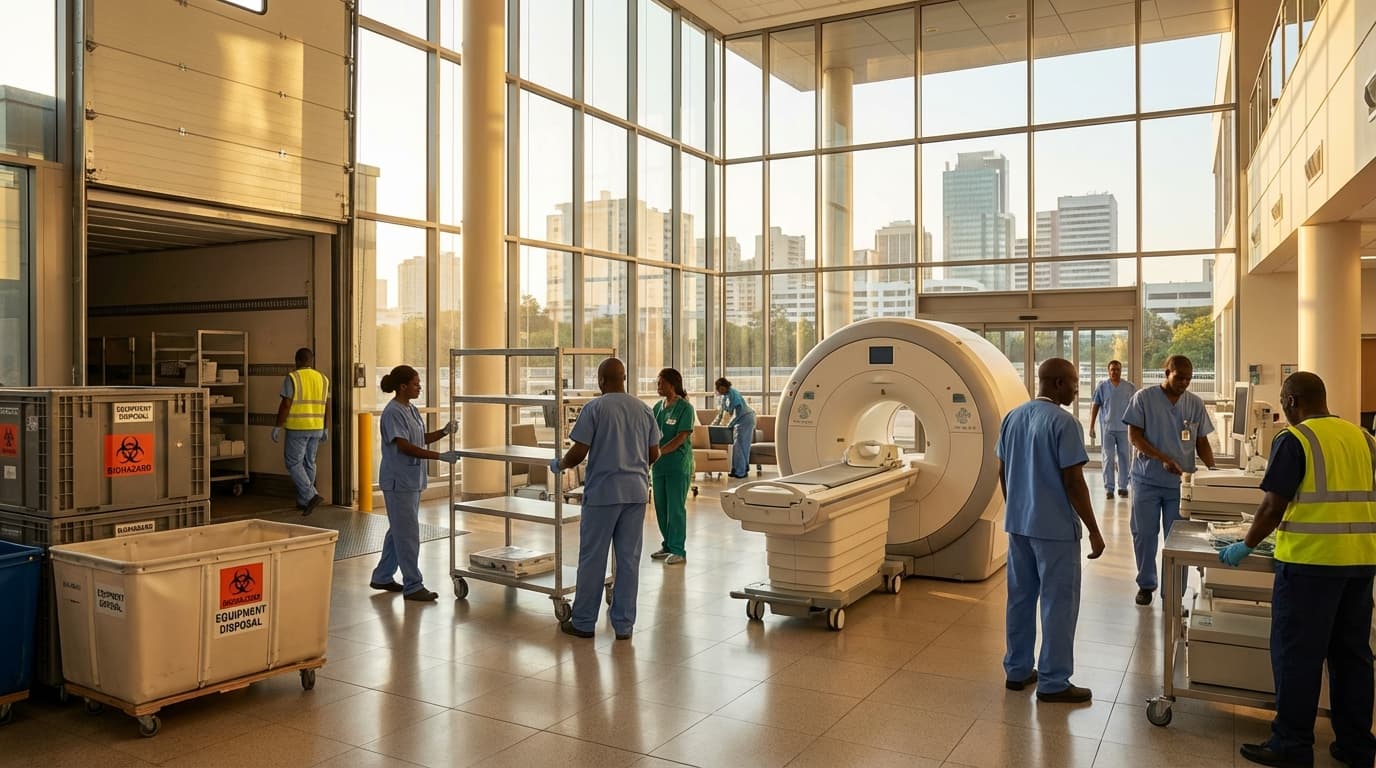
Heavy Medical Equipment De-Installation Service (MRI/CT/Cath Lab) in Kenya
Engineering Excellence & Technical Support
Heavy Medical Equipment De-Installation Service (MRI/CT/Cath Lab) High-standard technical execution following OEM protocols and local regulatory frameworks.
Unrivaled Safety & Compliance
Our specialized de-installation process strictly adheres to all Kenyan safety regulations and international best practices. We employ advanced containment and handling techniques to guarantee the utmost safety for personnel, the environment, and your valuable medical assets during the entire MRI, CT, or Cath Lab removal.
Expert Technical Dismantling
Leveraging a team of certified technicians with extensive experience in MRI, CT, and Cath Lab systems, we ensure precise and meticulous dismantling. Our expertise covers complex electrical, mechanical, and cooling systems, guaranteeing component integrity and minimizing the risk of damage for seamless relocation or disposal.
Logistical Precision & Asset Recovery
We provide end-to-end logistical management for your heavy medical equipment. From careful disconnection and packing to secure transportation within Kenya, our service is designed to optimize asset recovery and facilitate efficient project timelines, minimizing downtime and ensuring a smooth transition.
What Is Heavy Medical Equipment De-installation Service (Mri/ct/cath Lab) In Kenya?
Heavy Medical Equipment De-Installation Service in Kenya, specifically for modalities like Magnetic Resonance Imaging (MRI), Computed Tomography (CT) scanners, and Cardiac Catheterization (Cath) Laboratories, refers to the specialized process of safely and meticulously dismantling, disconnecting, and preparing large-scale, high-value medical imaging and diagnostic systems for relocation, decommissioning, or disposal. This service is critical for healthcare facilities undergoing upgrades, renovations, or complete facility closures, ensuring minimal disruption to ongoing operations and preserving the integrity of sophisticated equipment.
| Who Needs This Service? | Typical Use Cases | ||||||
|---|---|---|---|---|---|---|---|
| Hospitals and Large Healthcare Facilities (Public and Private) | Relocation of existing equipment to a new wing or a different facility. | Upgrading to newer, more advanced imaging or diagnostic technology. | Renovations or major structural changes within a medical imaging department. | Temporary decommissioning of a unit due to extensive upgrades or emergencies. | Closure or sale of a healthcare facility. | Disposal or sale of used medical equipment to a third party. | Transitioning from older analog to digital systems. |
| Specialized Imaging Centers (e.g., MRI centers, CT scan clinics) | Similar to hospitals, but often with a more focused need related to their core modality. | Consolidation of services or facilities. | Contractual equipment replacement cycles. | ||||
| Medical Equipment Vendors and Manufacturers | As part of their service offerings when a client is upgrading or relocating equipment they previously installed. | Managing the logistical and technical aspects of decommissioning older units from their product lines. | |||||
| Third-Party Service Providers and Asset Managers | Managing the lifecycle of medical equipment for multiple healthcare organizations. | Facilitating the transfer of ownership or resale of pre-owned medical equipment. |
Key Aspects of Heavy Medical Equipment De-Installation:
- System Isolation and Shutdown: Executing controlled power-down procedures, isolating all power sources (electrical, hydraulic, pneumatic), and ensuring the safe dissipation of any stored energy (e.g., superconducting magnets in MRI).
- Component Disconnection and Labeling: Precisely disconnecting all internal and external cabling (power, data, cooling, control), plumbing (water, gas), and structural supports. Meticulous labeling of all removed components for accurate re-installation.
- Structural Dismantling: Strategically disassembling the main components of the equipment, which may include gantry removal, magnet disassembly (where applicable and feasible), patient table extraction, and console detachment.
- Ancillary System Decommissioning: Disconnecting and preparing associated infrastructure, such as cooling systems (chillers, chillers), RF shielding, patient handling systems, and control rooms.
- Containment and Protection: Implementing appropriate containment measures for sensitive components and protecting them from environmental damage during the de-installation and subsequent handling.
- Logistical Planning: Developing detailed plans for the physical removal of dismantled components from the facility, considering site access, lifting requirements, and transportation logistics.
- Documentation and Certification: Providing comprehensive documentation of the de-installation process, including service reports, checklists, and, where applicable, certification of safe disconnection.
- Environmental and Safety Compliance: Adhering to all relevant Kenyan regulations regarding electrical safety, hazardous material handling, and general workplace safety during the de-installation process.
Who Needs Heavy Medical Equipment De-installation Service (Mri/ct/cath Lab) In Kenya?
When it comes to sophisticated medical imaging and interventional systems like MRI scanners, CT scanners, and Cath Labs, their installation and subsequent removal require specialized expertise. De-installation is not a simple unplug-and-go process; it involves careful dismantling, preservation of sensitive components, and compliance with safety regulations. This service is crucial for healthcare facilities undergoing upgrades, relocations, or when retiring old equipment. In Kenya, a growing healthcare sector with increasing investment in advanced medical technology creates a clear demand for professional heavy medical equipment de-installation services.
| Target Customer Type | Key Departments Involved | Reasons for De-installation |
|---|---|---|
| Large Hospitals (Public & Private) | Radiology/Medical Imaging Department, Cardiology Department, IT Department, Facilities Management, Procurement Department | Equipment upgrade to newer models, Relocation within the hospital, Renovation of imaging suites, Retirement of outdated equipment |
| Specialized Medical Centers (e.g., Diagnostic Imaging Centers, Cardiology Clinics) | Imaging Specialists, Technical Staff, Administrative Staff, Procurement | Expansion of services, Transition to a new facility, Replacement of aging equipment, Consolidation of services |
| University Teaching Hospitals | Radiology Department, Cardiology Department, Biomedical Engineering Department, Research & Development, Estates Department | Research upgrades, Integration of new teaching technologies, Relocation of research facilities, Standard equipment replacement cycles |
| Government Healthcare Facilities | Ministry of Health (represented at facility level), Radiology Department, Clinical Engineering, Procurement Officers | Government-led upgrades and modernization programs, Decentralization of services, Replacement of aging public sector equipment |
| Medical Equipment Suppliers/Resellers | Sales Department, Technical Services Department, Logistics Department | Removal of old equipment as trade-in, De-installation for re-sale of used equipment, Site preparation for new installations requiring removal of existing units |
Who Needs Heavy Medical Equipment De-Installation Service (MRI/CT/Cath Lab) in Kenya? - Target Customers & Departments
- Hospitals (Public and Private)
- Specialized Medical Centers (e.g., Cardiology Clinics, Diagnostic Imaging Centers)
- University Teaching Hospitals
- Government Healthcare Facilities
- Medical Equipment Suppliers and Installers (requiring de-installation as part of a package or for resale)
Heavy Medical Equipment De-installation Service (Mri/ct/cath Lab) Process In Kenya
This document outlines the comprehensive workflow for the heavy medical equipment de-installation service for MRI, CT, and Cath Labs in Kenya, from the initial client inquiry through to the successful completion of the de-installation. Our process is designed for efficiency, safety, and minimal disruption.
| Stage | Description | Key Activities | Deliverables/Outcomes | Responsible Party |
|---|---|---|---|---|
| Inquiry & Initial Consultation | The client expresses interest in de-installation services. | Receive client request, gather preliminary equipment details, understand client's objectives (relocation, upgrade, disposal), discuss general timelines and requirements. | Understanding of client needs, initial equipment scope, confirmation of service interest. | Client, Service Provider (Sales/Consultation Team) |
| Site Assessment & Planning | A thorough evaluation of the installation site and equipment is conducted. | On-site visit by experienced engineers, detailed inspection of the equipment, assessment of surrounding infrastructure (power, cooling, structural integrity), identification of access/egress routes, risk assessment, development of a detailed de-installation plan. | Detailed site report, comprehensive de-installation plan, risk mitigation strategies, confirmed equipment scope and complexity. | Service Provider (Engineering Team, Project Manager) |
| Quotation & Contract Agreement | A formal proposal and agreement are presented to the client. | Develop a detailed quotation based on the site assessment, including labor, materials, specialized tools, permits (if any), and estimated timeline. Present quotation and discuss terms. Finalize and sign the service contract. | Formal quotation, signed service contract, agreed-upon scope of work, timeline, and cost. | Service Provider (Sales/Project Management), Client |
| Pre-De-installation Preparations | All necessary steps are taken to ensure a smooth and safe de-installation. | Procurement of specialized tools and equipment, scheduling of qualified personnel, communication with facility management regarding site access and any necessary building modifications, confirmation of power shutdown procedures, obtaining any required permits, pre-installation safety briefings for the team. | All necessary resources and personnel mobilized, site access secured, safety protocols established, permits obtained. | Service Provider (Project Manager, Engineering Team) |
| Equipment De-installation | The core process of safely dismantling the heavy medical equipment. | Controlled shutdown of equipment, disconnection of power and ancillary systems (e.g., cooling), systematic disassembly of components (e.g., gantry, magnet, couch, X-ray tube), careful handling and protection of delicate parts, adherence to manufacturer's guidelines and safety protocols. | Equipment safely and systematically dismantled, components organized for removal or storage. | Service Provider (De-installation Engineering Team) |
| Safety Checks & Documentation | Ensuring safety and maintaining records throughout the process. | Post-disassembly safety checks on all components and the site, photographic and video documentation of the de-installation process and the state of components, creation of a de-installation report detailing steps taken, any issues encountered, and safety measures implemented. | De-installation report, photographic/video evidence, confirmation of site safety. | Service Provider (Engineering Team, Project Manager) |
| Logistics & Transportation Coordination (if applicable) | Arranging for the movement of the de-installed equipment. | Coordination with specialized logistics partners for transport, ensuring appropriate packaging and securing of equipment for transit, managing loading and unloading procedures. | Equipment safely packaged and ready for transport, logistics arrangements confirmed. | Service Provider (Logistics Coordinator, Project Manager) |
| Post-De-installation Support & Handover | Concluding the service and ensuring client satisfaction. | Final site inspection with the client, handover of all relevant documentation (de-installation report, photos, etc.), addressing any client queries, confirmation of service completion. | Client sign-off on service completion, complete documentation package, satisfactory conclusion of the de-installation project. | Service Provider (Project Manager, Client) |
Key Stages in the De-installation Process
- Inquiry & Initial Consultation
- Site Assessment & Planning
- Quotation & Contract Agreement
- Pre-De-installation Preparations
- Equipment De-installation
- Safety Checks & Documentation
- Logistics & Transportation Coordination (if applicable)
- Post-De-installation Support & Handover
Heavy Medical Equipment De-installation Service (Mri/ct/cath Lab) Cost In Kenya
De-installing heavy medical equipment like MRI, CT scanners, and Cath Labs is a specialized and complex process requiring trained technicians, specialized tools, and often, significant logistical planning. The cost in Kenya varies considerably based on several key factors. These machines are not only large and heavy but also contain sensitive components and potentially hazardous materials (like coolants in MRI machines), necessitating a professional and careful approach. The pricing reflects the expertise, time, and resources involved. It's crucial for healthcare facilities to obtain detailed quotes from multiple reputable service providers to ensure they receive competitive pricing and a service that meets the highest safety and technical standards.
| Equipment Type | Estimated Cost Range (KES) |
|---|---|
| Small to Medium CT Scanner | KES 300,000 - KES 750,000 |
| Large/High-Field MRI Scanner | KES 700,000 - KES 1,500,000+ |
| Cath Lab (System Components) | KES 500,000 - KES 1,200,000+ |
| X-Ray Machine (Heavy Duty) | KES 150,000 - KES 400,000 |
Key Pricing Factors for Heavy Medical Equipment De-Installation in Kenya
- {"title":"Type and Size of Equipment","description":"The specific modality (MRI, CT, Cath Lab) and its physical dimensions and weight are primary cost drivers. Larger, heavier machines like high-field MRI units will generally be more expensive to de-install than smaller CT scanners or Cath Lab components. The complexity of the system's internal components also plays a role."}
- {"title":"Dismantling Complexity","description":"The degree of disassembly required significantly impacts cost. Some equipment might require extensive component separation, while others can be moved with minimal dismantling. This depends on the manufacturer's design and the capabilities of the de-installation team."}
- {"title":"Accessibility and Site Conditions","description":"The ease of access to the equipment's location within the facility and the surrounding environment is critical. Narrow corridors, tight turns, multiple floors, limited doorway sizes, and the need for specialized lifting equipment (cranes, forklifts) will increase costs. Site surveys are essential to assess these challenges."}
- {"title":"Technical Expertise and Certification","description":"Hiring certified and experienced technicians who are specifically trained for de-installing these high-value and complex medical devices is paramount. The cost reflects their specialized knowledge, skill, and the potential risks involved."}
- {"title":"Logistics and Transportation","description":"This includes the cost of specialized transport vehicles, loading and unloading equipment, packaging materials to protect the sensitive components, and the distance to the new location or disposal site. The need for specialized rigging or engineering solutions can add substantial costs."}
- {"title":"Decommissioning and Disposal Requirements","description":"If the equipment is being decommissioned and disposed of, there are often environmental regulations and disposal fees to consider. This can include the safe removal and disposal of coolants (e.g., helium for MRI). If the equipment is being moved, the preparation of the receiving site is also a factor."}
- {"title":"Timeframe and Urgency","description":"Rush de-installations or those requiring work during off-hours (weekends, nights) may incur additional charges due to overtime labor and potential scheduling disruptions."}
- {"title":"Service Provider Reputation and Guarantees","description":"Established companies with a proven track record, comprehensive insurance, and warranties on their de-installation work often command higher prices, reflecting their reliability and the peace of mind they offer."}
Affordable Heavy Medical Equipment De-installation Service (Mri/ct/cath Lab) Options
When it's time to de-install complex and heavy medical equipment like MRI, CT scanners, or Cath Labs, finding an affordable and reliable service is crucial. This often involves significant planning, specialized expertise, and careful logistical management. This guide explores options for affordable de-installation, focusing on value bundles and cost-saving strategies to help healthcare facilities manage this process efficiently.
| Strategy | Description | Potential Savings |
|---|---|---|
| Value Bundling | Partnering with a single provider who offers a comprehensive de-installation package (disassembly, rigging, crating, transport, site cleanup) can often be more cost-effective than piecing services together from multiple vendors. | Reduced administrative overhead, potential for volume discounts, streamlined project management. |
| Early Planning and Phased De-installation | Initiating the de-installation planning well in advance allows for better negotiation with service providers and potentially scheduling during off-peak times. Consider if phased de-installation is feasible to spread costs over time. | Access to more competitive pricing, ability to coordinate with other facility upgrades or renovations, reduced risk of rush fees. |
| Obtain Multiple Quotes | Always solicit quotes from at least three reputable de-installation service providers. Ensure quotes are itemized and comparable. | Ability to compare pricing and identify the best value for your specific needs, leverage competitive bids. |
| Negotiate Contract Terms | Don't be afraid to negotiate on pricing, payment terms, and scope of services. Clearly define deliverables and expectations in the contract. | Potentially lower overall cost, clearer understanding of services rendered, dispute prevention. |
| Consider Regional Providers | While national companies have extensive reach, local or regional specialized de-installation companies might offer more competitive pricing due to lower travel costs. | Reduced travel and logistics expenses. |
| Evaluate Equipment Condition and Resale Value | If the equipment is being resold, coordinate de-installation with potential buyers. Sometimes, the buyer may have their own de-installation arrangements, or a buyer might offer a credit for de-installation costs. | Potential for de-installation costs to be offset by equipment sale, reduced out-of-pocket expenses. |
| Inquire About Package Deals for Multiple Equipment | If your facility is decommissioning multiple pieces of heavy medical equipment, inquire about package discounts for bundling these services. | Significant cost savings on larger projects. |
| Understand Insurance and Liability | Ensure the chosen provider has adequate insurance. Clarify who is responsible for any damage during the de-installation process. This can prevent unexpected costs down the line. | Protection against unforeseen expenses due to accidents or damages. |
Understanding De-Installation Costs
- {"title":"Key Cost Factors","description":"Several elements contribute to the overall cost of de-installing heavy medical equipment:"}
- {"title":"Equipment Type and Size","description":"Larger and more complex machines (e.g., high-field MRI vs. lower-field CT) require more specialized handling and potentially larger teams, increasing costs."}
- {"title":"Location and Accessibility","description":"The ease of access to the equipment within the facility, as well as the proximity of the facility to the de-installation team's base, impacts travel and labor time."}
- {"title":"De-installation Scope","description":"Will the service include disconnection, dismantling, crating, transportation, and site restoration? Each additional service adds to the price."}
- {"title":"Timeline and Urgency","description":"Expedited services or tight deadlines often come with premium pricing."}
- {"title":"Specialized Tools and Equipment","description":"The need for specific lifting equipment, rigging, or containment systems will influence the overall cost."}
- {"title":"Regulatory Compliance","description":"Ensuring compliance with safety regulations and environmental disposal requirements can involve additional costs."}
Verified Providers In Kenya
In Kenya's evolving healthcare landscape, identifying truly reliable and high-quality healthcare providers is paramount for patient well-being. Franance Health stands out as a beacon of trust and excellence, meticulously vetting its network of healthcare professionals. This commitment to verification ensures that patients accessing care through Franance Health can do so with confidence, knowing they are in the hands of qualified and competent practitioners. Franance Health's rigorous credentialing process goes beyond basic licensing, encompassing a holistic evaluation of a provider's experience, ethical standing, and adherence to best practices. This multi-faceted approach is what elevates Franance Health providers as the best choice for comprehensive and dependable healthcare services in Kenya.
| Provider Type | Franance Health Verification Highlights | Why This Matters to You |
|---|---|---|
| Doctors (Specialists & General Practitioners) | Verified educational background, board certifications, and clinical experience. Rigorous checks on past performance and patient feedback. | Ensures you receive expert diagnosis and treatment from qualified professionals. |
| Nurses (Registered & Enrolled) | Confirmed nursing qualifications, valid practice licenses, and specialized training where applicable. Assessment of their commitment to patient care. | Guarantees compassionate and skilled nursing support throughout your healthcare journey. |
| Pharmacists | Verification of pharmacy degrees, registration with the Pharmacy and Board, and adherence to dispensing regulations. Checks on inventory management and drug safety protocols. | Ensures you receive accurate prescriptions and safe medication practices. |
| Hospitals & Clinics | Accreditation status, quality of facilities, adherence to hygiene standards, and availability of essential medical equipment. Review of management and patient safety protocols. | Provides access to well-equipped facilities with a focus on patient safety and quality care. |
| Diagnostic Laboratories | Certification of laboratory technicians, validation of testing methodologies, and adherence to quality control standards. Checks on equipment calibration and sample integrity. | Ensures accurate and reliable diagnostic results crucial for proper treatment planning. |
Key Credentials Franance Health Verifies:
- Active and Unrestricted Medical Licenses
- Specialty Board Certifications
- Proof of Advanced Training and Fellowships
- Clean Disciplinary Records
- Peer Reviews and Recommendations
- Evidence of Continuous Professional Development (CPD)
Scope Of Work For Heavy Medical Equipment De-installation Service (Mri/ct/cath Lab)
This Scope of Work outlines the requirements for the safe and efficient de-installation of heavy medical equipment, specifically Magnetic Resonance Imaging (MRI) scanners, Computed Tomography (CT) scanners, and Cardiac Catheterization (Cath Lab) systems. The service includes all necessary labor, equipment, and materials for complete disassembly, preparation for transport, and handover of the de-installed system.
| Service Component | Description | Technical Deliverables | Standard Specifications / Considerations |
|---|---|---|---|
| Site Assessment & Planning | Initial survey of the installation site to identify access routes, power requirements, structural considerations, and any potential hazards. | Detailed de-installation plan including timeline, personnel allocation, equipment staging, and risk assessment. | Confirmation of site readiness (clearance, access, power isolation). Adherence to manufacturer's site preparation guides. |
| Equipment Shutdown & Isolation | Safe and controlled shutdown of all equipment components. | Verification of power isolation and disconnection. | Follow manufacturer's recommended shutdown procedures. Utilize lockout/tagout procedures as per safety standards (e.g., OSHA). |
| Disassembly & Component Removal | Careful disassembly of the main system components (e.g., gantry, magnet, console, patient table, X-ray tube, detector arrays). | Segregation and labeling of all removed components, cables, and hardware. | Use of specialized tools and lifting equipment. Maintain component integrity. Protect sensitive parts from damage. |
| De-commissioning of Ancillary Systems | Disconnection and safe removal of associated systems such as RF shielding, cooling systems (chillers), power distribution units, and any integrated workstations. | Proper disposal or preparation for transport of ancillary equipment. | Compliance with environmental regulations for refrigerant handling (if applicable). Ensure all connections are safely terminated. |
| Shielding Removal (MRI) | Careful dismantling and removal of RF shielding from the MRI room. | Proper handling and storage of shielding materials. | Avoid damage to walls and surrounding structures. Follow manufacturer guidelines for shield removal. |
| Coil Handling & Packing | Safe handling and packaging of all MRI/CT coils to prevent damage. | Use of protective cases and cushioning materials. | Manufacturer-recommended packaging methods to maintain coil integrity and performance. |
| Preparation for Transport | Securing all components for safe transportation, including crating or shrink-wrapping as needed. | Creation of a detailed inventory of all packaged components and their locations. | Use of industry-standard packing materials and techniques. Ensure components are labeled with destination and handling instructions. |
| Site Restoration (Basic) | Basic cleanup of the de-installation area, removing debris and temporary materials. | Leave the site in a tidy condition. | Does not include major structural repairs unless specified as a separate item. |
| Documentation & Handover | Provision of a comprehensive de-installation report, including photographs, inventory lists, and confirmation of successful completion. | Formal handover of the de-installed equipment and documentation to the client's authorized representative. | Report to be submitted within [X] business days of completion. Handover to be signed off by client. |
| Safety & Compliance | Adherence to all relevant safety regulations, manufacturer's service manuals, and industry best practices. | All personnel involved must be trained and certified for the specific tasks. | Compliance with local, state, and federal safety and environmental regulations. Risk mitigation strategies to be in place. |
Key Objectives
- Ensure the safety of personnel and the equipment throughout the de-installation process.
- Comply with all relevant industry standards, manufacturer guidelines, and regulatory requirements.
- Minimize downtime for adjacent or related medical services.
- Document all stages of the de-installation process.
- Prepare the equipment for secure transportation to a new location or storage.
- Provide a complete handover of the de-installed system to the client's designated representative.
Service Level Agreement For Heavy Medical Equipment De-installation Service (Mri/ct/cath Lab)
This Service Level Agreement (SLA) outlines the response times and uptime guarantees for the de-installation of heavy medical equipment, specifically MRI, CT, and Cath Lab systems. This agreement is between [Your Company Name/Provider] and [Client Name/Facility].
| Service Type | Response Time (Business Hours) | Response Time (Outside Business Hours/Emergency) | Resolution Time (Maximum Target) | Uptime Guarantee |
|---|---|---|---|---|
| MRI De-installation (Scheduled) | 2 Business Hours | 4 Business Hours (upon notification/scheduling) | As per agreed project timeline (typically 1-3 days per unit) | 98% availability of qualified technicians during scheduled service windows. |
| CT De-installation (Scheduled) | 2 Business Hours | 4 Business Hours (upon notification/scheduling) | As per agreed project timeline (typically 1-2 days per unit) | 98% availability of qualified technicians during scheduled service windows. |
| Cath Lab De-installation (Scheduled) | 2 Business Hours | 4 Business Hours (upon notification/scheduling) | As per agreed project timeline (typically 2-5 days per system) | 98% availability of qualified technicians during scheduled service windows. |
| Emergency MRI/CT/Cath Lab De-installation | N/A (Service is initiated upon immediate request and deployment) | 2 Business Hours (Acknowledgement and dispatch) | As per agreed scope and complexity, with constant communication on progress. | 99% availability of emergency response teams within the agreed response time. |
Key Definitions
- Service: Professional de-installation of MRI, CT, or Cath Lab equipment.
- Downtime: A period where the equipment is unavailable for de-installation due to reasons attributable to the Service Provider's negligence or failure to meet agreed-upon response times.
- Response Time: The maximum allowed time from when a service request is logged until a qualified technician acknowledges the request and begins working on a resolution.
- Resolution Time: The maximum allowed time from when a service request is logged until the de-installation service is completed and the equipment is safely removed as per agreed scope.
- Scheduled De-installation: De-installation services planned and agreed upon in advance with a specific date and time.
- Emergency De-installation: De-installation required outside of normal business hours or with immediate urgency due to unforeseen circumstances (e.g., facility closure, urgent upgrade).
- Business Hours: Monday to Friday, 8:00 AM to 5:00 PM [Specify Time Zone].
- Uptime Guarantee: Refers to the availability of the service provider's resources to perform the de-installation within the agreed-upon timeframes, not the operational status of the medical equipment itself.
Frequently Asked Questions

Ready when you are
Let's scope your Heavy Medical Equipment De-Installation Service (MRI/CT/Cath Lab) in Kenya project in Kenya.

Scaling healthcare logistics and technical systems across the entire continent.