
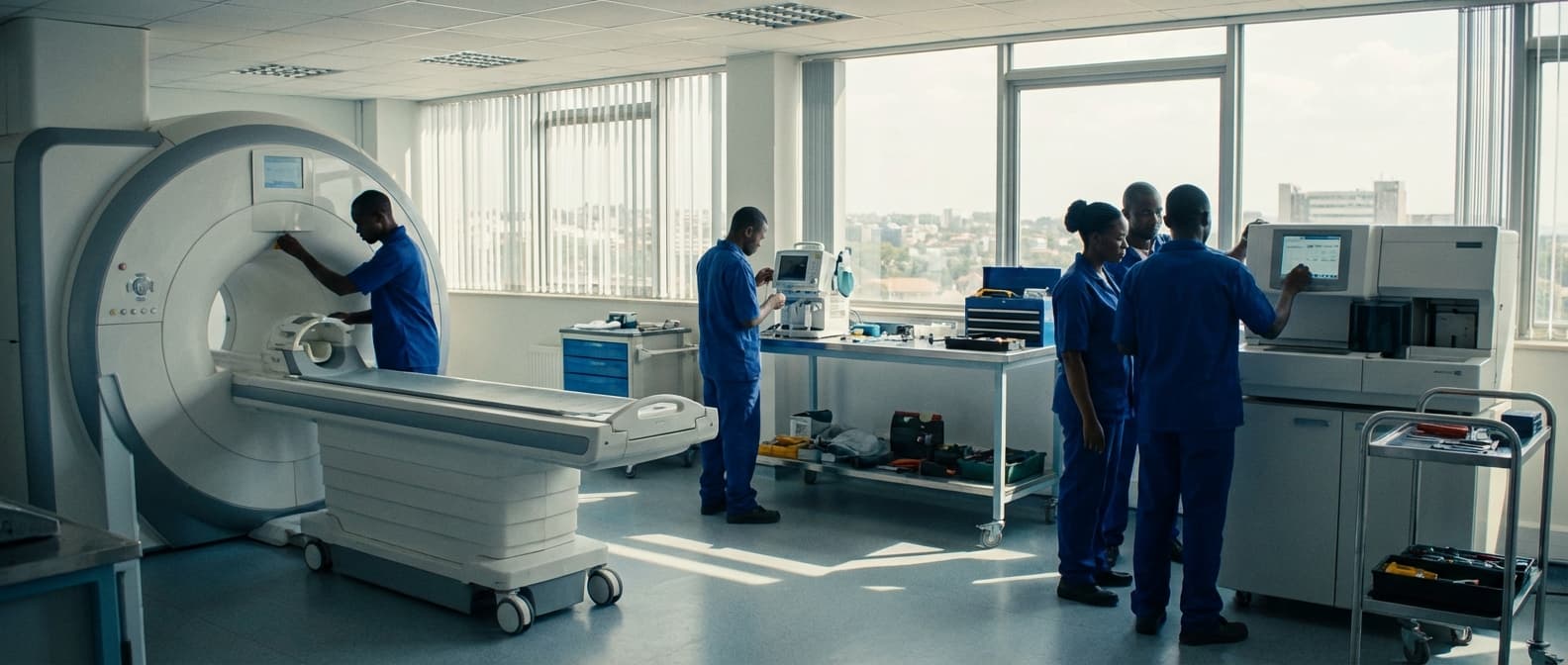
Comprehensive Maintenance Contract (CMC) Management Service (Parts & Labor) in Kenya
Engineering Excellence & Technical Support
Comprehensive Maintenance Contract (CMC) Management Service (Parts & Labor) High-standard technical execution following OEM protocols and local regulatory frameworks.
Guaranteed Parts Availability & Expert Labor
Ensure seamless operations with our CMC, guaranteeing prompt access to genuine spare parts and certified technicians across Kenya. We minimize downtime by preemptively stocking critical components and maintaining a skilled workforce ready to respond, ensuring your equipment runs at peak performance.
Predictable Budgeting & Cost Control
Gain financial clarity with our comprehensive CMC. Our fixed-price contracts eliminate unexpected repair costs, allowing for precise budgeting and efficient financial planning. Focus on your core business while we manage all parts and labor expenses, preventing cost overruns.
Proactive Maintenance & Extended Asset Lifespan
Maximize the return on your investment with our proactive maintenance strategy. Our CMC includes scheduled inspections and preventative servicing, identifying and addressing potential issues before they escalate. This significantly reduces the likelihood of major breakdowns and extends the operational lifespan of your assets.
What Is Comprehensive Maintenance Contract (Cmc) Management Service (Parts & Labor) In Kenya?
Comprehensive Maintenance Contract (CMC) Management Service (Parts & Labor) in Kenya refers to a specialized service that oversees and administers contracts for the complete maintenance of equipment and assets, encompassing both the provision of necessary spare parts and the labor required for repairs and preventive upkeep. This service is designed to offer clients a proactive and integrated approach to asset management, ensuring optimal operational performance, minimizing downtime, and controlling maintenance expenditure.
| Who Needs CMC Management Service (Parts & Labor)? | Typical Use Cases | ||||||
|---|---|---|---|---|---|---|---|
| Organizations in Kenya with significant investments in critical machinery, equipment, or IT infrastructure that require continuous operational uptime. | Manufacturing plants relying on complex production lines and machinery. | Healthcare facilities dependent on specialized medical equipment (e.g., MRI scanners, ventilators). | Telecommunications companies with extensive network infrastructure and base stations. | Financial institutions with critical IT systems, servers, and data centers. | Large-scale agricultural operations utilizing heavy machinery and processing equipment. | Government agencies responsible for maintaining public infrastructure (e.g., transportation, utilities). | Commercial real estate and facilities management companies overseeing building systems (HVAC, elevators, electrical systems). |
| Industrial Manufacturing: Ensuring uninterrupted operation of production lines, machinery, and automated systems. | Healthcare Sector: Maintaining the reliability and accuracy of diagnostic, therapeutic, and life-support medical devices. | Telecommunications: Guaranteeing network availability and performance of transmission equipment, switches, and power systems. | Information Technology: Upholding the uptime and performance of servers, storage devices, networking hardware, and data center infrastructure. | Energy and Utilities: Ensuring the continuous operation of power generation equipment, transmission lines, and water treatment facilities. | Transportation and Logistics: Maintaining the operational readiness of fleet vehicles, specialized transport equipment, and warehousing automation. | Heavy Construction and Mining: Ensuring the availability and efficiency of earthmoving equipment, cranes, and processing machinery. |
Key Components of CMC Management Service (Parts & Labor)
- Contract Administration: This involves the negotiation, establishment, and ongoing management of CMC agreements with original equipment manufacturers (OEMs) or third-party service providers. It includes scope definition, service level agreement (SLA) adherence, and performance monitoring.
- Preventive Maintenance Scheduling and Execution: Proactive planning and execution of scheduled maintenance activities to identify and rectify potential issues before they lead to failures. This minimizes unexpected downtime and extends asset lifespan.
- Corrective Maintenance and Repair Management: Efficiently managing unplanned breakdowns. This includes prompt dispatch of qualified technicians, diagnosis of faults, procurement of required spare parts, and execution of repairs to restore functionality.
- Spare Parts Inventory Management: Strategic sourcing, stocking, and management of a readily available inventory of critical spare parts to ensure timely availability for both preventive and corrective maintenance activities. This often involves supplier negotiation and cost optimization.
- Labor Resource Management: Coordinating and deploying skilled technicians and engineers for maintenance tasks. This includes ensuring adequate staffing, skill matching, and efficient scheduling to meet operational demands.
- Performance Monitoring and Reporting: Continuously tracking maintenance activities, asset performance, and contract compliance. This involves generating regular reports on key performance indicators (KPIs) such as Mean Time Between Failures (MTBF), Mean Time To Repair (MTTR), availability, and cost-effectiveness.
- Budget Management and Cost Control: Overseeing the maintenance budget, tracking expenditure against planned costs, and identifying opportunities for cost savings through optimized parts procurement, efficient labor utilization, and preventive strategies.
- Risk Management: Identifying and mitigating potential risks associated with equipment failure, including production losses, safety hazards, and regulatory non-compliance.
- Technical Support and Consultation: Providing expert advice and technical guidance on asset health, maintenance strategies, and technology upgrades.
Who Needs Comprehensive Maintenance Contract (Cmc) Management Service (Parts & Labor) In Kenya?
A Comprehensive Maintenance Contract (CMC) Management Service, encompassing both parts and labor, is crucial for organizations in Kenya aiming to ensure the optimal performance, longevity, and cost-effectiveness of their critical assets. This service goes beyond basic repairs, providing proactive maintenance, scheduled servicing, and the guaranteed availability of necessary spare parts, all while managing the labor involved. The primary goal is to minimize downtime, prevent unexpected breakdowns, and maintain operational efficiency. In Kenya's dynamic economic landscape, where operational continuity is paramount for success and competitiveness, robust CMC management is no longer a luxury but a strategic necessity.
| Target Customer Type | Key Departments Benefiting from CMC Management |
|---|---|
| Manufacturing Companies | Production Department, Engineering & Maintenance Department, Operations Department, Quality Control Department |
| Hospitals & Healthcare Providers | Biomedical Engineering Department, IT Department, Facilities Management Department, Clinical Operations Department |
| Telecommunication Providers | Network Operations Center (NOC), Field Operations Department, Technical Support Department, Infrastructure Management |
| Energy & Utilities Companies | Operations & Maintenance Department, Engineering Department, Grid Management Department, Asset Management |
| Financial Institutions | IT Operations Department, Branch Operations Department, Facilities Management, Security Department |
| Aviation & Logistics | Fleet Maintenance Department, Ground Operations, Logistics Management, Safety & Compliance Department |
| Government Agencies (e.g., Ministry of Transport, Health, Infrastructure) | Public Works Department, IT Department, Service Delivery Units, Procurement Department |
| Educational Institutions (Universities, Colleges) | IT Services Department, Estates & Facilities Management, Laboratory Management, Technical Support |
| Large Retail Chains | Operations Department, IT Department, Store Maintenance, Supply Chain Management |
| Oil & Gas Companies | Maintenance & Reliability Department, Operations Department, Process Engineering, Safety Department |
Target Customers for CMC Management Service (Parts & Labor) in Kenya
- Large-scale manufacturing plants requiring continuous production uptime.
- Hospitals and healthcare facilities dependent on sophisticated medical equipment.
- Telecommunication companies relying on uninterrupted network infrastructure.
- Power generation and distribution companies needing consistent energy supply.
- Financial institutions with critical IT infrastructure and ATM networks.
- Aviation and logistics companies with complex machinery and transport fleets.
- Government agencies managing public infrastructure and essential services.
- Educational institutions with specialized laboratory and IT equipment.
- Large retail chains with extensive operational technology like POS systems and refrigeration units.
- Companies in the oil and gas sector with high-value, specialized equipment.
Comprehensive Maintenance Contract (Cmc) Management Service (Parts & Labor) Process In Kenya
This document outlines the comprehensive workflow for managing a Comprehensive Maintenance Contract (CMC) service, encompassing both parts and labor, within the Kenyan market. The process is designed to be efficient, transparent, and customer-centric, ensuring optimal uptime and longevity of assets. It covers the entire lifecycle from initial customer inquiry to the successful execution and closure of the maintenance service.
| Stage | Description | Key Activities | Responsible Party | Key Deliverables/Outcomes |
|---|---|---|---|---|
| The initial stage where a potential client expresses interest in CMC services. | Receive customer inquiry (phone, email, website form). Understand client's asset(s), scope of service required (preventive, corrective, parts coverage). Gather technical specifications and site information. | Sales/Business Development Team, Client | Understanding of client's needs, preliminary asset list, site details. |
| Developing a tailored offer based on the gathered requirements. | Technical team assesses asset condition and maintenance needs. Generate a detailed proposal outlining services, inclusions, exclusions, and pricing. Prepare a formal quotation. | Technical Team, Sales Team | Comprehensive proposal, detailed quotation, preliminary cost breakdown. |
| Finalizing the terms and conditions of the CMC. | Client reviews proposal and quotation. Negotiate pricing, service levels, payment terms, and contract duration. Draft and finalize the CMC document. Sign the contract. | Sales Team, Legal Department, Client | Signed Comprehensive Maintenance Contract (CMC). |
| Formally initiating the service based on the agreed-upon SLA. | Onboarding the client into the service management system. Assigning a dedicated account manager or service coordinator. Communicate key contact points and escalation procedures. | Service Delivery Manager, Account Manager | Active SLA, client onboarding complete, assigned service team. |
| Proactive maintenance to minimize breakdowns. | Develop a preventive maintenance schedule based on manufacturer recommendations and asset usage. Notify client in advance of scheduled maintenance. Deploy technicians for scheduled inspections and servicing. | Service Planning Team, Field Technicians | Scheduled maintenance visits, completed preventive maintenance tasks, maintenance reports. |
| Addressing unexpected equipment failures. | Client reports a breakdown. Receive and log the service request. Prioritize the issue based on SLA. Dispatch qualified technicians to the site. | Customer Support Center, Service Dispatch, Field Technicians | Acknowledged service request, rapid response, initial diagnosis. |
| Ensuring availability of necessary spare parts. | Identify required parts for both preventive and corrective maintenance. Check stock levels and order from approved suppliers. Manage inventory of critical spare parts. Track parts delivery and usage. | Procurement Team, Stores/Warehouse Staff, Field Technicians | Availability of required parts, efficient inventory management, reduced downtime due to parts shortage. |
| Dispatching skilled personnel for maintenance activities. | Assign skilled and certified technicians based on the nature of the work. Provide technicians with necessary tools, equipment, and safety gear. Ensure technicians adhere to safety protocols and best practices. | Service Planning Team, Field Technicians | Qualified technicians on-site, proper execution of maintenance tasks, adherence to safety standards. |
| Documenting and communicating the outcome of maintenance. | Technicians complete the service task. Record all work performed, parts used, and time spent. Generate a detailed service report. Client reviews and approves the service report. | Field Technicians, Service Coordinator, Client | Completed service reports, client sign-off on work done. |
| Billing for services rendered. | Generate invoices based on the CMC agreement and completed services. Submit invoices to the client. Track payments and follow up on outstanding amounts. | Finance Department, Accounts Receivable Team | Accurate invoices, timely payments, reconciled accounts. |
| Evaluating contract performance and planning for renewal. | Review contract performance against SLA metrics. Discuss client satisfaction and identify areas for improvement. Propose renewal terms and conditions. | Account Manager, Service Delivery Manager, Client | Performance review report, contract renewal proposal, client feedback. |
| Concluding the service cycle and storing relevant documentation. | Finalize all pending tasks and payments. Archive all contract-related documentation, service reports, and financial records. Maintain historical data for future reference. | Administration Team, Records Management | Closed contract file, comprehensive historical records. |
Key Stages in CMC Management Service Process
- Inquiry & Requirement Gathering
- Proposal & Quotation Generation
- Contract Negotiation & Agreement
- Service Level Agreement (SLA) Activation
- Preventive Maintenance Scheduling
- Corrective Maintenance (Breakdown) Response
- Parts Procurement & Management
- Labor Deployment & Execution
- Service Completion & Reporting
- Invoicing & Payment
- Contract Renewal & Performance Review
- Closure & Archiving
Comprehensive Maintenance Contract (Cmc) Management Service (Parts & Labor) Cost In Kenya
Managing Comprehensive Maintenance Contracts (CMCs) for parts and labor in Kenya involves a multifaceted approach to pricing. The cost isn't a one-size-fits-all figure but rather a dynamic sum influenced by several critical factors. These factors determine the overall risk, effort, and resources required by the service provider to ensure optimal performance and longevity of the equipment or asset under contract. Understanding these elements is crucial for both clients seeking reliable maintenance and service providers offering their expertise.
| Equipment Category | Typical Annual CMC Cost Range (KES) | Notes/Assumptions |
|---|---|---|
| Standard Office Equipment (Printers, PCs, Laptops) | 10,000 - 30,000 | Covers basic preventive maintenance, on-site repairs, and common part replacements (e.g., toner cartridges might be excluded or specified). |
| Mid-Range IT Infrastructure (Servers, Networking Gear) | 50,000 - 250,000+ | Includes hardware support, firmware updates, potential for remote monitoring, and prioritized response. Parts covered vary significantly based on hardware cost. |
| Small to Medium Scale Industrial Machinery (e.g., Packaging Machines, Basic Manufacturing Tools) | 100,000 - 500,000+ | Focuses on mechanical and electrical maintenance, preventive checks, and critical spare parts. Response times are crucial here. |
| Specialized Medical Equipment (e.g., X-ray Machines, Ultrasound, Lab Analyzers) | 200,000 - 1,000,000+ | Requires highly trained technicians, calibration, and access to specific, often expensive, genuine parts. Downtime is critical, so response is usually rapid. |
| Large Industrial Machinery & Automation Systems (e.g., Production Lines, Robotics) | 500,000 - 5,000,000+ | Comprehensive coverage including all parts (often with an initial spares inventory), labor for extensive preventive and corrective maintenance, remote diagnostics, and specialized engineering support. This often involves bespoke contracts. |
| Building Systems (HVAC, Elevators, Generators) | 50,000 - 400,000+ | Varies by system complexity, size of the facility, and frequency of service. Parts for major components (e.g., compressors, motors) can be costly. |
Key Pricing Factors for CMC (Parts & Labor) in Kenya
- {"title":"Type and Complexity of Equipment/Asset","description":"More intricate and technologically advanced equipment (e.g., sophisticated medical machinery, industrial automation systems, high-end IT infrastructure) will inherently have higher maintenance costs due to specialized skills, tools, and potential for costly component failures. Simpler machinery (e.g., basic office equipment, standard HVAC systems) will be less expensive."}
- {"title":"Age and Condition of Equipment/Asset","description":"Older or poorly maintained equipment poses a higher risk of breakdowns and requires more frequent or extensive repairs. Service providers may factor in a 'risk premium' or offer higher service levels for such assets, leading to increased costs. Conversely, newer assets in good condition might command lower rates initially."}
- {"title":"Scope of Coverage (Parts)","description":"The extent to which spare parts are included in the contract significantly impacts pricing. Contracts that cover 100% of parts (both routine replacements and unexpected failures) will be more expensive than those with exclusions (e.g., consumables, accidental damage, or parts exceeding a certain value)."}
- {"title":"Scope of Coverage (Labor)","description":"This includes the type of labor (e.g., preventive maintenance, corrective maintenance, emergency repairs), response times (e.g., 24/7 support, next-business-day), and the level of technician expertise required. Contracts with guaranteed rapid response and highly specialized technicians will be priced higher."}
- {"title":"Frequency of Preventive Maintenance","description":"More frequent scheduled inspections and maintenance activities, while beneficial for asset longevity, increase the labor hours and associated costs. The recommended intervals will depend on the equipment's usage, environment, and manufacturer guidelines."}
- {"title":"Location and Accessibility of Equipment/Asset","description":"Remote or difficult-to-access locations can incur additional travel costs for technicians, including transportation, accommodation, and time delays. This will be reflected in the overall CMC price."}
- {"title":"Service Level Agreement (SLA) Terms","description":"Specific SLAs, such as guaranteed uptime percentages, penalties for non-compliance, and reporting requirements, will influence the pricing. Higher uptime guarantees often require more robust maintenance strategies and contingency planning, thus increasing the cost."}
- {"title":"Contract Duration","description":"Longer-term contracts can sometimes offer a slight discount per year as they provide stability for the service provider and allow for better resource planning. Conversely, very short-term or ad-hoc contracts might have higher per-unit costs."}
- {"title":"Volume of Contracts","description":"For clients with multiple assets to be covered under CMC, service providers might offer volume-based discounts, making the per-unit cost lower."}
- {"title":"Brand and Manufacturer Reputation","description":"Maintenance services for equipment from renowned brands might be priced differently due to the perceived quality, availability of genuine parts, and established service networks. Some manufacturers also have preferred or authorized service partners with specific pricing structures."}
- {"title":"Market Competition and Provider's Overhead","description":"The competitive landscape in Kenya for CMC services can influence pricing. A provider's own operational costs, including skilled labor, training, tools, administrative overhead, and profit margins, are also fundamental to their pricing models."}
Affordable Comprehensive Maintenance Contract (Cmc) Management Service (Parts & Labor) Options
Our Affordable Comprehensive Maintenance Contract (CMC) Management Service offers a streamlined approach to ensuring your critical equipment operates at peak performance without breaking the bank. We understand the importance of proactive maintenance to prevent costly downtime and extend the lifespan of your assets. Our service provides a robust framework for managing all aspects of your CMC, from vendor selection and negotiation to performance monitoring and cost optimization. We focus on delivering value through intelligently designed bundles and strategic cost-saving initiatives that benefit your organization's bottom line.
| Value Bundle | Included Services | Cost-Saving Strategy | Target Audience |
|---|---|---|---|
| Essential Care | Routine preventative maintenance, scheduled inspections, basic parts replacement (wear and tear), labor for covered issues. | Standardized service packages, bulk purchasing of common parts, pre-negotiated labor rates. | Small to medium-sized businesses, organizations with predictable equipment usage. |
| Proactive Plus | Includes Essential Care plus advanced diagnostics, predictive maintenance monitoring, priority response for urgent issues, extended warranty coverage on critical components. | Leveraging technology for remote monitoring, optimized inventory management for critical parts, reduced emergency call-out fees. | Businesses with mission-critical equipment, organizations seeking to minimize downtime risk. |
| Comprehensive Elite | Includes Proactive Plus plus on-site technical support, complete parts replacement (including major component failures), software updates and patching, dedicated account manager, annual equipment health assessments. | Tailored maintenance plans based on asset criticality, strategic partnerships with OEMs for direct part sourcing, bundled labor for extensive service needs. | Large enterprises, organizations with diverse and high-value equipment portfolios. |
| Custom Solutions | Bespoke packages designed to meet unique operational requirements and budget constraints. | Flexible contract terms, performance-based pricing models, strategic outsourcing of specific maintenance functions. | Organizations with specialized equipment or unique operational challenges. |
Key Benefits of Our CMC Management Service
- Proactive identification and mitigation of potential equipment failures.
- Extended equipment lifespan and improved operational efficiency.
- Reduced unexpected repair costs and downtime.
- Optimized maintenance schedules and resource allocation.
- Negotiated preferential rates on parts and labor.
- Single point of contact for all your maintenance needs.
- Enhanced vendor accountability and performance tracking.
- Compliance with manufacturer warranties and service level agreements (SLAs).
Verified Providers In Kenya
In the competitive landscape of healthcare in Kenya, discerning patients seek assurance that their providers are not only qualified but also operate with the highest ethical standards. This is where the importance of verified providers comes into play. Franance Health stands out as a beacon of trust, meticulously vetting its network of healthcare professionals and facilities. This commitment to verification ensures that when you choose a Franance Health-affiliated provider, you are opting for quality, reliability, and a patient-centric approach. Their stringent credentialing process goes beyond basic licensing, encompassing rigorous checks on qualifications, experience, and adherence to best practices in healthcare delivery. This thorough due diligence provides patients with the peace of mind that they are receiving care from competent and trustworthy hands.
| Verification Aspect | Franance Health's Rigor | Patient Benefit |
|---|---|---|
| Professional Licensing | Confirms active and valid licenses with relevant Kenyan medical boards. | Guarantees providers are legally authorized to practice. |
| Educational Qualifications | Validates degrees, diplomas, and certifications from accredited institutions. | Ensures a strong foundation of medical knowledge. |
| Specialty Training & Certifications | Verifies advanced training and certifications in specific medical fields. | Confirms expertise in specialized areas of care. |
| Clinical Experience | Reviews documented years of practice and relevant case experience. | Assures practical application of medical knowledge and skills. |
| Disciplinary History | Checks for any past or present disciplinary actions or malpractice claims. | Protects patients from providers with a history of misconduct. |
| Facility Accreditation | For partner facilities, confirms adherence to Kenyan healthcare facility standards. | Ensures a safe and well-equipped environment for treatment. |
Why Franance Health Credentials Matter:
- Unwavering Commitment to Quality: Franance Health's verification process scrutinizes a provider's educational background, specialized training, and practical experience, ensuring they meet high standards of medical expertise.
- Ensuring Patient Safety: By verifying credentials, Franance Health minimizes the risk of unqualified individuals providing care, directly contributing to enhanced patient safety and well-being.
- Promoting Ethical Practices: The verification extends to examining a provider's disciplinary history and adherence to professional codes of conduct, fostering an environment of trust and integrity.
- Access to Reputable Facilities: Franance Health also vets healthcare facilities, ensuring they meet established standards for infrastructure, equipment, and operational protocols, guaranteeing a safe and effective treatment setting.
- Streamlined Healthcare Navigation: For patients, a Franance Health credentialed provider simplifies the often-complex process of finding reliable healthcare, offering a curated selection of trusted professionals.
Scope Of Work For Comprehensive Maintenance Contract (Cmc) Management Service (Parts & Labor)
This Scope of Work (SOW) outlines the requirements for a Comprehensive Maintenance Contract (CMC) Management Service, encompassing both parts and labor. The service aims to ensure the optimal performance, reliability, and longevity of designated equipment and systems through proactive and reactive maintenance activities. This document details the technical deliverables and establishes standard specifications for the successful execution of the contract.
| Section | Description | Technical Deliverables | Standard Specifications |
|---|---|---|---|
| Initial setup and detailed planning for the CMC. | Detailed asset inventory and condition assessment report. Site-specific maintenance plan. Key Performance Indicator (KPI) baseline establishment. | Asset inventory to include serial numbers, model numbers, installation dates, warranty status. Maintenance plan to align with manufacturer recommendations and criticality analysis. KPIs to be SMART (Specific, Measurable, Achievable, Relevant, Time-bound). |
| Scheduled maintenance activities to prevent failures. | Execution of scheduled PM tasks as per the maintenance plan. PM checklists and logs for each equipment. Identification and reporting of potential issues during PM. | PM frequency and scope defined per equipment type and criticality. PM checklists to cover all critical components and operational parameters. Use of calibrated tools and approved consumables. |
| Response and resolution of equipment failures and breakdowns. | 24/7/365 availability for emergency breakdown calls. Defined response and resolution times based on equipment criticality. Accurate fault diagnosis and repair. Root Cause Analysis (RCA) for recurring issues. | Response time (on-site arrival) not exceeding X hours for critical equipment. Resolution time (restoring functionality) not exceeding Y hours for critical equipment. Use of qualified technicians with appropriate certifications. RCA reports to include contributing factors and preventive actions. |
| Procurement, stocking, and management of necessary spare parts. | Establishment of an optimal spare parts inventory. Just-In-Time (JIT) or strategic stocking of critical spares. Regular inventory audits and reconciliation. Procurement of genuine or equivalent OEM-certified parts. | Minimum stock levels for critical spares to be defined. Inventory management system to track stock levels, usage, and expiry dates. All parts to meet or exceed OEM specifications. Traceability of all spare parts used. |
| Provision of skilled personnel and technical guidance. | Access to qualified and trained technicians and engineers. Remote troubleshooting and support capabilities. On-demand technical consultation. | Technicians to possess relevant certifications (e.g., OEM specific, safety). Clear escalation procedures for complex technical issues. Availability of manufacturer's technical documentation. |
| Comprehensive reporting on all maintenance activities and asset performance. | Monthly and quarterly performance reports. Detailed maintenance logs for all activities (PM, CM). Asset health reports. Spare parts consumption reports. Warranty claim management. | Reports to include KPIs, downtime analysis, PM compliance, CM incident summaries. All documentation to be maintained for a defined period (e.g., 7 years). Clear and concise reporting format agreed upon by both parties. |
| Adherence to all relevant HSEQ standards and regulations. | Implementation of robust HSEQ policies and procedures. Regular safety training for all personnel. Environmental impact assessments and mitigation plans. Compliance with all applicable local and international regulations. | All personnel to undergo regular safety inductions and training. Use of Personal Protective Equipment (PPE) as per site requirements. Proper disposal of waste materials. Adherence to quality management systems (e.g., ISO 9001). |
| Ongoing efforts to enhance service delivery and efficiency. | Regular review meetings to discuss performance and identify improvement areas. Implementation of feedback mechanisms. Benchmarking against industry best practices. | Quarterly performance review meetings. Action plans to address identified areas for improvement. Proactive identification of emerging technologies and maintenance strategies. |
Key Objectives of CMC Management Service
- Maximize equipment uptime and availability.
- Minimize unplanned downtime and associated costs.
- Ensure adherence to manufacturer specifications and best practices.
- Maintain equipment in optimal operational condition.
- Extend the service life of the assets.
- Provide timely and effective resolution of reported issues.
- Optimize spare parts inventory and management.
- Ensure compliance with safety and environmental regulations.
- Deliver comprehensive reporting on maintenance activities and equipment performance.
Service Level Agreement For Comprehensive Maintenance Contract (Cmc) Management Service (Parts & Labor)
This Service Level Agreement (SLA) outlines the performance standards for the Comprehensive Maintenance Contract (CMC) Management Service, covering both parts and labor. It defines the expected response times for incidents and establishes uptime guarantees for the supported systems.
| Service Level | Response Time Target | Resolution Time Target (Best Effort) | Uptime Guarantee |
|---|---|---|---|
| Critical Incident (System Failure/Major Outage) | Within 2 business hours | Within 8 business hours | 99.9% Monthly Uptime |
| High Priority Incident (Significant Performance Degradation) | Within 4 business hours | Within 16 business hours | 99.5% Monthly Uptime |
| Medium Priority Incident (Partial Functionality Loss/Minor Issue) | Within 8 business hours | Within 24 business hours | 99.0% Monthly Uptime |
| Low Priority Incident (Non-critical issue, enhancement request) | Within 24 business hours | As per mutually agreed schedule | N/A |
Scope of Service
- Management of all aspects of the Comprehensive Maintenance Contract (CMC).
- Coordination of preventive maintenance schedules.
- Handling of corrective maintenance requests (breakdowns).
- Procurement and management of replacement parts.
- Liaison with third-party service providers for specialized repairs.
- Tracking of all maintenance activities and costs.
- Reporting on system availability and performance.
Frequently Asked Questions

Ready when you are
Let's scope your Comprehensive Maintenance Contract (CMC) Management Service (Parts & Labor) in Kenya project in Kenya.

Scaling healthcare logistics and technical systems across the entire continent.