
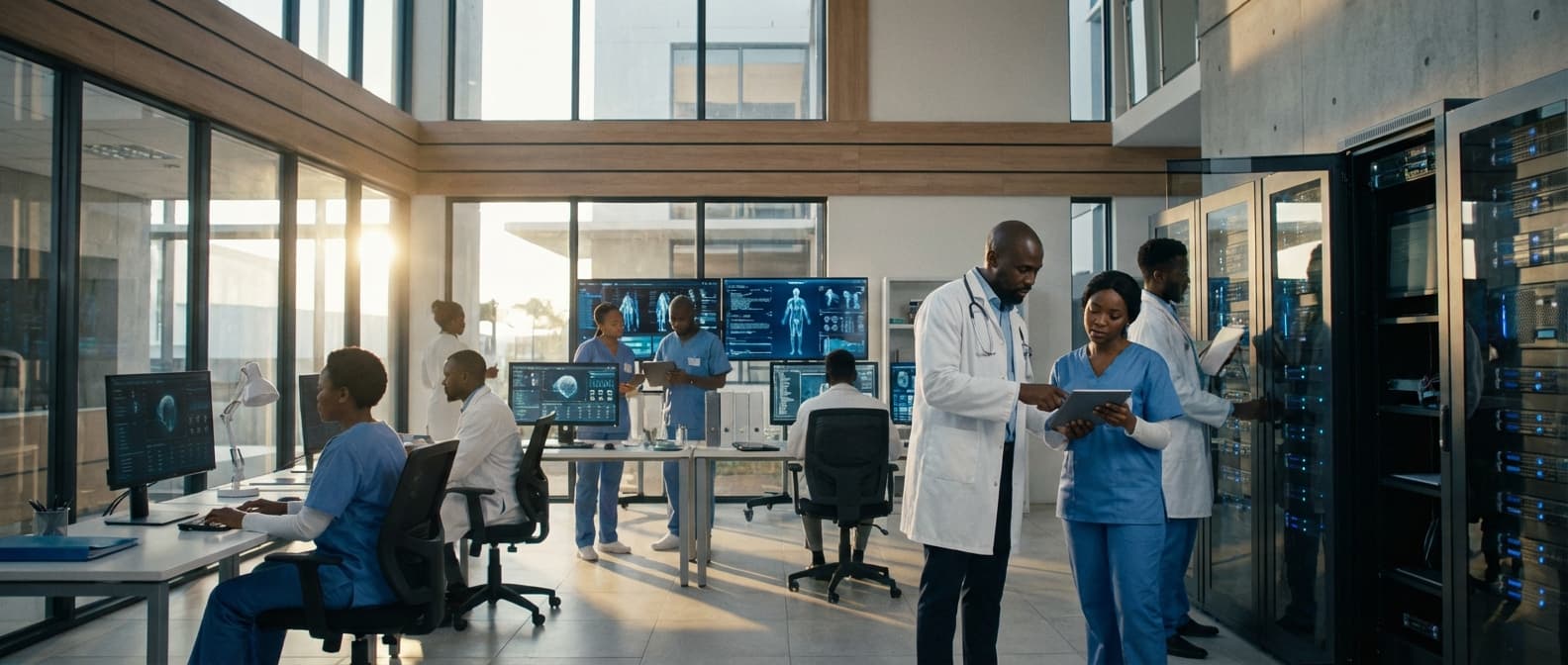
Medical IT Consultation in Kenya
Engineering Excellence & Technical Support
Strategic technology consulting to optimize healthcare operations, streamline workflows, and integrate cutting-edge medical information systems. High-standard technical execution following OEM protocols and local regulatory frameworks.
Streamlining Healthcare Operations
We optimize EMR/EHR systems, improve data security, and implement efficient telemedicine solutions, reducing administrative burden and enhancing patient care delivery for Kenyan healthcare providers.
Robust Cybersecurity for Patient Data
Our expertise in implementing advanced cybersecurity protocols ensures the protection of sensitive patient health information, safeguarding against breaches and maintaining compliance with Kenyan data privacy regulations.
Scalable IT Infrastructure for Growth
We design and deploy robust, scalable IT infrastructures, including cloud migration and network optimization, empowering Kenyan hospitals and clinics to adapt to evolving technological needs and expand their services.
What Is Medical It Consultation In Kenya?
Medical IT Consultation in Kenya refers to the provision of specialized advisory services focused on the intersection of information technology and healthcare delivery within the Kenyan context. This service encompasses the strategic planning, implementation, optimization, and management of IT systems and infrastructure within medical organizations to enhance operational efficiency, improve patient care outcomes, ensure data security and compliance, and support clinical decision-making. It addresses the unique challenges and opportunities present in the Kenyan healthcare landscape, including resource constraints, regulatory frameworks, and the adoption of emerging technologies.
| Who Needs Medical IT Consultation? | Typical Use Cases | ||||||||
|---|---|---|---|---|---|---|---|---|---|
| Hospitals (Public and Private): To modernize their IT infrastructure, implement EHR systems, improve patient management, and enhance data analytics capabilities. | Clinics and Health Centers: To establish or upgrade their IT systems for patient registration, appointment scheduling, basic record-keeping, and potentially connect with larger referral networks. | Diagnostic Laboratories: To implement LIS for efficient sample tracking, results reporting, and integration with other healthcare systems. | Radiology Centers: To deploy PACS for digital image storage, retrieval, and efficient reporting, often requiring integration with EHRs. | Pharmacies: To implement pharmacy management systems for inventory control, prescription management, and patient medication history. | Healthcare Startups and Innovators: To design and implement IT solutions for new healthcare services, mHealth applications, or digital health platforms. | Government Health Agencies and Ministries: To develop national health IT strategies, implement public health information systems, and ensure data standardization and interoperability across the sector. | Insurance Providers (Health): To integrate with healthcare providers' systems for claims processing, verification, and fraud detection. | Medical Research Institutions: To manage research data, facilitate collaboration, and ensure data integrity and security for clinical trials. | Non-Governmental Organizations (NGOs) in Healthcare: To implement IT solutions for program management, data collection, and service delivery in underserved areas. |
| Implementation of an Electronic Health Record (EHR) system: From vendor selection to data migration and user training. | Enhancing Cybersecurity posture: Protecting patient data from breaches and complying with the Data Protection Act. | Developing a telemedicine platform: To extend healthcare services to remote or underserved populations. | Integrating disparate IT systems: To enable seamless data flow between departments or different healthcare facilities. | Optimizing IT infrastructure for cost-efficiency: Leveraging cloud computing or virtualisation technologies. | Ensuring compliance with healthcare regulations: Such as patient data privacy and reporting requirements. | Developing a data analytics strategy: To derive insights from clinical data for improved patient care and operational efficiency. | Implementing a Hospital Information System (HIS): To manage various hospital operations, including patient registration, billing, and inventory. | Setting up a robust disaster recovery and business continuity plan: To minimize downtime and data loss in case of emergencies. | Advising on the adoption of emerging technologies: Such as AI for diagnostics or IoT for remote patient monitoring. |
Key Aspects of Medical IT Consultation in Kenya
- Needs Assessment and Gap Analysis: Evaluating current IT infrastructure, workflows, and digital maturity to identify areas for improvement and alignment with organizational goals.
- System Selection and Implementation: Advising on and managing the procurement and deployment of Electronic Health Records (EHRs), Picture Archiving and Communication Systems (PACS), Laboratory Information Systems (LIS), and other healthcare-specific software.
- Infrastructure Design and Management: Planning, designing, and overseeing the implementation and maintenance of robust and secure IT infrastructure, including networks, servers, storage, and cloud solutions.
- Cybersecurity and Data Protection: Developing and implementing strategies to safeguard sensitive patient data (PHI) in compliance with Kenyan data protection laws (e.g., Data Protection Act, 2019) and international best practices.
- Interoperability and Data Exchange: Facilitating the seamless exchange of patient information between different healthcare providers and systems, crucial for coordinated care.
- Telemedicine and Remote Patient Monitoring: Advising on the deployment and integration of technologies that enable remote consultations and continuous patient monitoring.
- Compliance and Regulatory Adherence: Ensuring that IT systems and practices meet national healthcare regulations, standards, and data privacy requirements.
- IT Strategy and Roadmap Development: Creating long-term IT strategies aligned with the organization's mission, vision, and financial objectives.
- Training and Change Management: Developing and delivering training programs for healthcare professionals on new IT systems and managing the organizational change associated with technology adoption.
- Disaster Recovery and Business Continuity Planning: Establishing plans and systems to ensure the availability of critical IT services in the event of disruptions or emergencies.
- Budgeting and Cost Optimization: Providing guidance on IT investment decisions, vendor management, and strategies to optimize IT expenditure.
Who Needs Medical It Consultation In Kenya?
In Kenya's rapidly evolving healthcare landscape, the demand for specialized Medical IT consultation is soaring. Organizations grappling with outdated systems, the need for digital transformation, or the intricacies of healthcare data management can significantly benefit from expert guidance. Medical IT consultation services are crucial for ensuring seamless operations, enhanced patient care, and compliance with regulatory frameworks. This expertise helps healthcare providers navigate the complex world of technology, optimize their infrastructure, and leverage digital tools to achieve their strategic goals.
| Target Customer Type | Typical Departments Involved | Key Needs Addressed |
|---|---|---|
| Hospitals (Public & Private) | IT Department, Administration, Clinical Departments (e.g., Radiology, Pathology, Pharmacy), Finance | EHR implementation/optimization, network infrastructure upgrades, cybersecurity, telemedicine solutions, PACS integration, data analytics. |
| Clinics & Health Centers | Practice Management, Administration, Clinical Staff | Basic EHR adoption, patient scheduling systems, billing software, secure communication channels, remote patient monitoring (RPM) integration. |
| Diagnostic Laboratories & Imaging Centers | IT Department, Lab/Radiology Management, Administration | Laboratory Information Systems (LIS), Picture Archiving and Communication Systems (PACS), data integration with hospitals, secure data transfer, cloud solutions. |
| Pharmaceutical Companies | IT Department, Research & Development, Supply Chain Management | Data management for clinical trials, secure data sharing platforms, supply chain traceability solutions, regulatory compliance software. |
| Medical Device Manufacturers | IT Department, Product Development, Quality Assurance | Integration of devices with hospital IT systems, cybersecurity for connected devices, data analytics from device usage, cloud connectivity. |
| Government Health Ministries & Agencies | IT Department, Policy & Planning, Public Health Informatics | National health information systems, data standardization, public health surveillance systems, digital health strategy development, cybersecurity frameworks. |
| Health Insurance Providers | IT Department, Claims Processing, Data Analytics | Secure data exchange with healthcare providers, fraud detection systems, patient portal development, data security and privacy compliance. |
| Healthcare Startups & Innovators | Founders, Technology Team, Business Development | Building scalable IT infrastructure, cloud strategy, data security foundations, compliance readiness, integration planning with existing systems. |
Who Needs Medical IT Consultation in Kenya?
- Healthcare providers seeking to modernize their IT infrastructure.
- Organizations aiming to improve data security and patient privacy.
- Hospitals and clinics looking to implement or optimize Electronic Health Records (EHR) systems.
- Healthcare facilities preparing for digital transformation initiatives.
- Companies developing or integrating new medical technologies.
- Government health agencies requiring IT strategy and implementation support.
- Healthcare startups needing to establish a robust IT foundation.
- Organizations aiming to enhance operational efficiency through technology.
- Healthcare institutions needing to comply with data protection and healthcare regulations.
Medical It Consultation Process In Kenya
The Medical IT Consultation Process in Kenya outlines the structured approach taken by IT consulting firms to assist healthcare organizations in Kenya with their technology needs. This process is crucial for ensuring efficient, secure, and compliant medical operations. It typically begins with an initial inquiry and progresses through a series of defined stages to successful execution and ongoing support.
| Stage | Description | Key Activities | Deliverables | Typical Duration |
|---|---|---|---|---|
| Inquiry & Initial Contact | The healthcare organization expresses interest in IT consulting services. | Initial phone call/email, understanding basic needs, scheduling a meeting. | Meeting scheduled, preliminary understanding of client's general IT challenges. | 1-2 days |
| Needs Assessment & Discovery | In-depth understanding of the client's current IT infrastructure, workflows, and specific challenges. | On-site visits, interviews with stakeholders, system audits, reviewing existing documentation. | Detailed needs assessment report, identification of pain points, understanding of business objectives. | 1-2 weeks |
| Proposal Development | Formulating a tailored solution and presenting it to the client. | Defining scope of work, recommending technologies, estimating costs and timelines, risk assessment. | Comprehensive proposal document outlining services, solutions, costs, and timelines. | 1-2 weeks |
| Agreement & Contract Signing | Formalizing the partnership and terms of service. | Review of proposal, negotiation of terms, legal review, signing of contract. | Signed Service Level Agreement (SLA) or contract. | 1-2 weeks |
| Project Planning & Scoping | Detailed planning of the project's execution. | Defining project milestones, resource allocation, communication plan, detailed technical design. | Project plan, technical specifications, stakeholder matrix, communication protocols. | 1-3 weeks |
| Implementation & Deployment | Carrying out the planned IT solutions. | Software installation, hardware configuration, network setup, data migration, system integration. | Implemented IT systems and infrastructure. | Varies widely based on project complexity (weeks to months) |
| Testing & Quality Assurance | Ensuring the deployed solutions meet the required standards and functionality. | User Acceptance Testing (UAT), system integration testing, performance testing, security testing. | Test reports, bug tracking logs, sign-off on tested systems. | 1-3 weeks |
| Training & Handover | Equipping the client's staff with the knowledge to use and manage the new systems. | Developing training materials, conducting user training sessions, providing user manuals. | Trained staff, user manuals, documented system procedures. | 1-2 weeks |
| Go-Live & Post-Implementation Support | Launching the new systems and providing immediate assistance. | System launch, initial troubleshooting, addressing immediate user queries, performance monitoring. | Live IT systems, initial support tickets resolved, performance baseline established. | 1-4 weeks |
| Ongoing Monitoring & Optimization | Ensuring the systems continue to function optimally and evolve with the client's needs. | Regular system health checks, performance tuning, security updates, user feedback collection, recommending upgrades. | Performance reports, optimization recommendations, updated system documentation. | Continuous |
Medical IT Consultation Workflow Stages
- Inquiry & Initial Contact
- Needs Assessment & Discovery
- Proposal Development
- Agreement & Contract Signing
- Project Planning & Scoping
- Implementation & Deployment
- Testing & Quality Assurance
- Training & Handover
- Go-Live & Post-Implementation Support
- Ongoing Monitoring & Optimization
Medical It Consultation Cost In Kenya
Consulting on medical IT in Kenya involves a dynamic pricing structure influenced by several key factors. These factors determine the overall cost, from initial assessment to ongoing support and implementation. Understanding these elements is crucial for healthcare providers budgeting for technology upgrades, system integration, or strategic IT planning. The pricing is typically presented in Kenyan Shillings (KES) to reflect the local market.
Key pricing factors include the scope and complexity of the project, the experience and specialization of the consultant or firm, the duration of the engagement, and the specific services required. Smaller projects, like a basic network assessment, will naturally cost less than a comprehensive Electronic Health Record (EHR) system implementation. Similarly, consultants with a proven track record in healthcare IT and specific expertise in areas like cybersecurity or data analytics will command higher fees. The extent of on-site presence versus remote consultation also plays a role in the overall cost.
Consultation can range from an initial needs assessment and strategy development to detailed system design, vendor selection assistance, project management, implementation support, and post-implementation optimization. Each of these phases has its own cost implications. Furthermore, the size and type of healthcare facility (e.g., small clinic, medium-sized hospital, large hospital network) will dictate the complexity and scale of the IT needs, thereby influencing the consultation fees.
The cost of medical IT consultation in Kenya can vary significantly, but generally, expect to see price ranges reflecting different service levels and project complexities. It's always recommended to obtain detailed quotes from multiple reputable IT consulting firms specializing in the healthcare sector to ensure competitive pricing and find the best fit for your organization's unique requirements.
| Service Type/Scope | Typical Price Range (KES) | Notes |
|---|---|---|
| Initial Needs Assessment/IT Strategy Development | 30,000 - 150,000 | For small to medium-sized facilities. Includes analyzing current IT infrastructure and recommending strategic direction. |
| EHR/HIS System Feasibility Study & Vendor Selection | 80,000 - 300,000 | Covers research, requirements gathering, and shortlisting suitable systems. Price varies with complexity and number of systems evaluated. |
| Project Management for IT Implementation (per project) | 15% - 25% of total project cost or hourly rate | Hourly rates can range from 5,000 - 15,000 KES/hour. Project management fees are often a percentage of the implementation budget. |
| Network Infrastructure Assessment & Design | 40,000 - 120,000 | Focuses on network security, performance, and scalability for healthcare environments. |
| Cybersecurity Audit & Risk Assessment | 60,000 - 200,000 | Crucial for protecting sensitive patient data. Price depends on the size of the facility and data volume. |
| IT Policy Development & Compliance Review | 30,000 - 100,000 | Ensuring adherence to local and international healthcare IT regulations. |
| Cloud Migration Strategy & Planning | 50,000 - 180,000 | Assistance in migrating data and applications to cloud-based solutions. |
| Ongoing IT Support & Maintenance Advisory (Retainer) | 50,000 - 250,000+ per month | Varies significantly based on the level of support and the size of the IT infrastructure managed. |
Factors Influencing Medical IT Consultation Costs in Kenya:
- Project Scope and Complexity
- Consultant's Experience and Specialization
- Duration of Engagement
- Specific Services Required (e.g., Assessment, Implementation, Support)
- Size and Type of Healthcare Facility
- On-site vs. Remote Consultation
- Technology Stack and Vendor Landscape
- Level of Customization and Integration
- Reporting and Documentation Requirements
Affordable Medical It Consultation Options
Navigating the complexities of medical IT can be daunting, especially for smaller practices or those with budget constraints. Fortunately, several affordable medical IT consultation options exist, focusing on delivering value and implementing cost-saving strategies. Understanding "value bundles" and specific cost-saving tactics can help healthcare providers optimize their IT infrastructure without breaking the bank.
| Cost-Saving Strategy | Description | Impact on Affordability | |
|---|---|---|---|
| Managed Services Provider (MSP) Contracts | Outsourcing IT management to a specialized MSP offering bundled services. This provides access to expertise without the overhead of an in-house IT department. | Significantly reduces personnel costs, offers predictable monthly expenses, and leverages economies of scale from the MSP. | |
| Tiered Service Packages | Consultants often offer different levels of service (e.g., basic, standard, premium) at varying price points, allowing practices to choose the level that best fits their needs and budget. | Enables customization and avoids paying for services that are not required. | |
| Remote Monitoring and Management (RMM) | Utilizing tools that allow IT professionals to monitor and manage systems remotely, identifying and resolving issues before they impact operations. | Reduces the need for on-site visits (saving travel time and costs) and prevents costly downtime. | Prevents costly downtime. |
| Cloud-Based Solutions | Migrating to cloud services for data storage, applications, and communication can reduce hardware investment and maintenance costs. | Lowers upfront capital expenditure, offers scalability, and reduces physical infrastructure costs. | |
| Standardization of Hardware and Software | Adopting a consistent set of hardware and software across the practice simplifies management, training, and support, leading to lower overall IT expenditure. | Reduces complexity, streamlines troubleshooting, and allows for bulk purchasing discounts. | |
| Open-Source Software Alternatives | Exploring cost-effective open-source software for certain functions where proprietary solutions might be expensive. | Eliminates licensing fees, though implementation and support might require specialized expertise. | |
| Proactive Security Measures | Investing in robust cybersecurity solutions and training to prevent breaches is far more cost-effective than dealing with the aftermath of a security incident. | Minimizes financial losses from data breaches, fines, and reputational damage. | |
| Regular IT Audits and Assessments | Periodic reviews of IT infrastructure can identify inefficiencies, outdated systems, and areas for optimization, leading to long-term cost savings. | Helps in making informed decisions about IT investments and avoiding unnecessary expenses. |
Understanding Medical IT Consultation Value Bundles
- {"title":"What are Value Bundles?","description":"Value bundles are pre-packaged service offerings that combine multiple IT support functions and solutions into a single, predictable monthly fee. This contrasts with a purely hourly or project-based approach, which can lead to unpredictable costs."}
- {"title":"Common Components of Medical IT Value Bundles","description":"These bundles often include a combination of proactive maintenance, reactive support, cybersecurity, data backup and recovery, system monitoring, and sometimes even strategic IT planning."}
- {"title":"Benefits of Value Bundles","description":"Key benefits include predictable budgeting, reduced risk of unexpected expenses, access to a wider range of expertise, and improved overall IT efficiency. They often prioritize preventive measures, which can save significant costs in the long run by avoiding downtime and security breaches."}
- {"title":"Types of Value Bundles","description":"Bundles can range from basic support packages for essential IT functions to comprehensive solutions that cover all aspects of a practice's technology needs, including EMR/EHR support, practice management software integration, and HIPAA compliance."}
Verified Providers In Kenya
In Kenya's dynamic healthcare landscape, discerning verified healthcare providers is paramount for ensuring quality and trustworthy medical services. Franance Health stands out as a leading platform dedicated to connecting individuals with accredited and reputable healthcare professionals. This commitment to verification is not merely a formality; it underpins the trust and confidence patients place in their chosen medical practitioners. By meticulously vetting each provider, Franance Health ensures that its users have access to safe, effective, and ethical healthcare.
| Credential Type | Verification Process | Importance for Patients |
|---|---|---|
| Medical Licenses | Checked against official regulatory bodies (e.g., Kenya Medical Practitioners and Dentists Council). | Ensures providers are legally authorized to practice medicine and meet minimum competency standards. |
| Professional Qualifications | Verification of degrees, diplomas, and specialized training from recognized institutions. | Confirms that practitioners possess the necessary education and expertise for their respective fields. |
| Specialty Accreditations | Confirmation of board certifications and fellowships in specific medical specialties. | Guarantees that doctors have undergone advanced training and met rigorous standards in their area of specialization. |
| Good Standing Certificates | Obtained from professional councils to confirm no disciplinary actions or malpractice cases. | Provides assurance of ethical conduct and a history of professional integrity. |
| Experience and Practice History | Reviewed to understand the provider's track record and areas of focus. | Helps patients identify providers with relevant experience for their specific health needs. |
Why Franance Health Providers are the Best Choice
- Rigorous Credentialing: Every provider on Franance Health undergoes a stringent verification process that includes checking their medical licenses, qualifications, and professional accreditations.
- Commitment to Quality Care: Franance Health partners with professionals who demonstrate a consistent commitment to high standards of patient care, ethical practice, and continuous professional development.
- Patient-Centric Approach: Verified providers are selected for their dedication to patient well-being, clear communication, and a compassionate approach to medical treatment.
- Accessibility and Convenience: Franance Health simplifies the process of finding and booking appointments with trusted doctors, specialists, and healthcare facilities across Kenya.
- Trust and Reliability: The verification process eliminates the guesswork, allowing patients to confidently choose healthcare providers known for their expertise and integrity.
Scope Of Work For Medical It Consultation
This Scope of Work (SOW) outlines the services to be provided by [Consultant Name/Company] (hereinafter referred to as "Consultant") for [Client Name/Organization] (hereinafter referred to as "Client") concerning medical IT consultation. The objective is to assess, plan, and recommend improvements to the Client's existing medical IT infrastructure, systems, and workflows, ensuring compliance with relevant regulations and optimizing operational efficiency and patient care. The SOW details the technical deliverables, standard specifications, and overall project framework.
| Phase | Activities | Deliverables | Standard Specifications/Notes | |||
|---|---|---|---|---|---|---|
| Phase 1: Discovery & Assessment | On-site and remote assessment of existing IT infrastructure, including EMR/EHR, PACS, LIS, billing systems, network architecture, security protocols, and user hardware. | Current State Analysis Report detailing infrastructure, software, network, and security. | Inventory of all IT assets (hardware & software). Documented network topology. Security audit report. | Interviews with key stakeholders (IT, clinicians, administrators). | Review of existing IT policies and procedures. | Identification of immediate risks and vulnerabilities. |
| Phase 2: Strategy & Planning | Development of a tailored IT strategy and roadmap based on assessment findings and Client objectives. | IT Strategy & Roadmap Document. Technology recommendations report. | Alignment with organizational goals and patient care needs. Prioritization of initiatives based on impact and feasibility. | Analysis of potential technology solutions (e.g., cloud migration, telehealth platforms, data analytics tools, cybersecurity enhancements). | Budgetary estimations for proposed solutions. | |
| Phase 3: Design & Recommendation | Detailed design and recommendation for chosen IT solutions. | System Design Documents for selected technologies. Vendor evaluation criteria and shortlisted vendor recommendations. | Detailed technical specifications for hardware and software. Integration plans between systems. Disaster Recovery and Business Continuity Plan (DR/BCP) recommendations. | Cybersecurity framework and implementation plan. | Data migration strategy and plan. | |
| Phase 4: Implementation Support (Optional/As Agreed) | Assistance with the implementation of selected IT solutions. | Project management support. Technical guidance during deployment. User training materials. | Coordination with vendors. Quality assurance checks. Go-live support. | Change management plan. | ||
| Phase 5: Post-Implementation Review & Handover | Review of implemented solutions and provision of final documentation. | Post-Implementation Review Report. Final project documentation and knowledge transfer sessions. | Performance metrics evaluation. Lessons learned document. Comprehensive documentation package for Client's IT team. | On-going support recommendations. |
Project Objectives
- Assess the current state of the Client's medical IT infrastructure, including hardware, software, networks, and security.
- Identify pain points and areas for improvement in current IT systems and workflows related to patient care, data management, and regulatory compliance.
- Develop a comprehensive IT strategy and roadmap aligned with the Client's business goals and healthcare objectives.
- Recommend specific technologies, solutions, and best practices to enhance IT performance, security, and interoperability.
- Provide guidance on implementing new systems and migrating existing data, ensuring minimal disruption to operations.
- Ensure compliance with relevant healthcare regulations (e.g., HIPAA, HITECH) and industry standards.
- Facilitate knowledge transfer to Client IT staff to ensure sustainable system management.
Service Level Agreement For Medical It Consultation
This Service Level Agreement (SLA) outlines the commitment of [Consulting Company Name] ('Provider') to its client, [Client Name] ('Client'), for Medical IT Consultation services. It defines the expected response times for critical issues and the guaranteed uptime for supported systems. This SLA is an integral part of the Master Services Agreement (MSA) between the Provider and the Client.
| Service Component | Severity Level | Definition | Response Time Target | Resolution Target |
|---|---|---|---|---|
| Critical System Outage (e.g., EHR unavailable, critical patient care system down) | Level 1 (Critical) | A complete failure or severe degradation of a critical IT system that directly impacts patient care or regulatory compliance. | 15 minutes | 4 hours (initial resolution, may require ongoing effort) |
| Major System Malfunction (e.g., reporting module unavailable, non-critical workstation issues affecting multiple users) | Level 2 (High) | A significant malfunction of a core IT system or multiple non-critical issues impacting productivity for a substantial number of users. | 1 hour | 8 business hours |
| Minor System Issue (e.g., individual workstation problem, software configuration request) | Level 3 (Medium) | An isolated issue affecting a single user or a minor configuration request that does not significantly impact operations. | 4 business hours | 2 business days |
| General Inquiry / Consultation Request | Level 4 (Low) | Requests for information, advice, or non-urgent consultation. | 1 business day | 3 business days (or as agreed upon for specific projects) |
Scope of Services
- On-site and remote IT support for medical facilities.
- Consultation on electronic health record (EHR) systems.
- Network infrastructure assessment and recommendations.
- Cybersecurity best practices and implementation guidance.
- Cloud migration strategies for healthcare data.
- Compliance and regulatory adherence (e.g., HIPAA).
- IT project management for medical technology initiatives.
Frequently Asked Questions

Ready when you are
Let's scope your Medical IT Consultation in Kenya project in Kenya.

Scaling healthcare logistics and technical systems across the entire continent.