
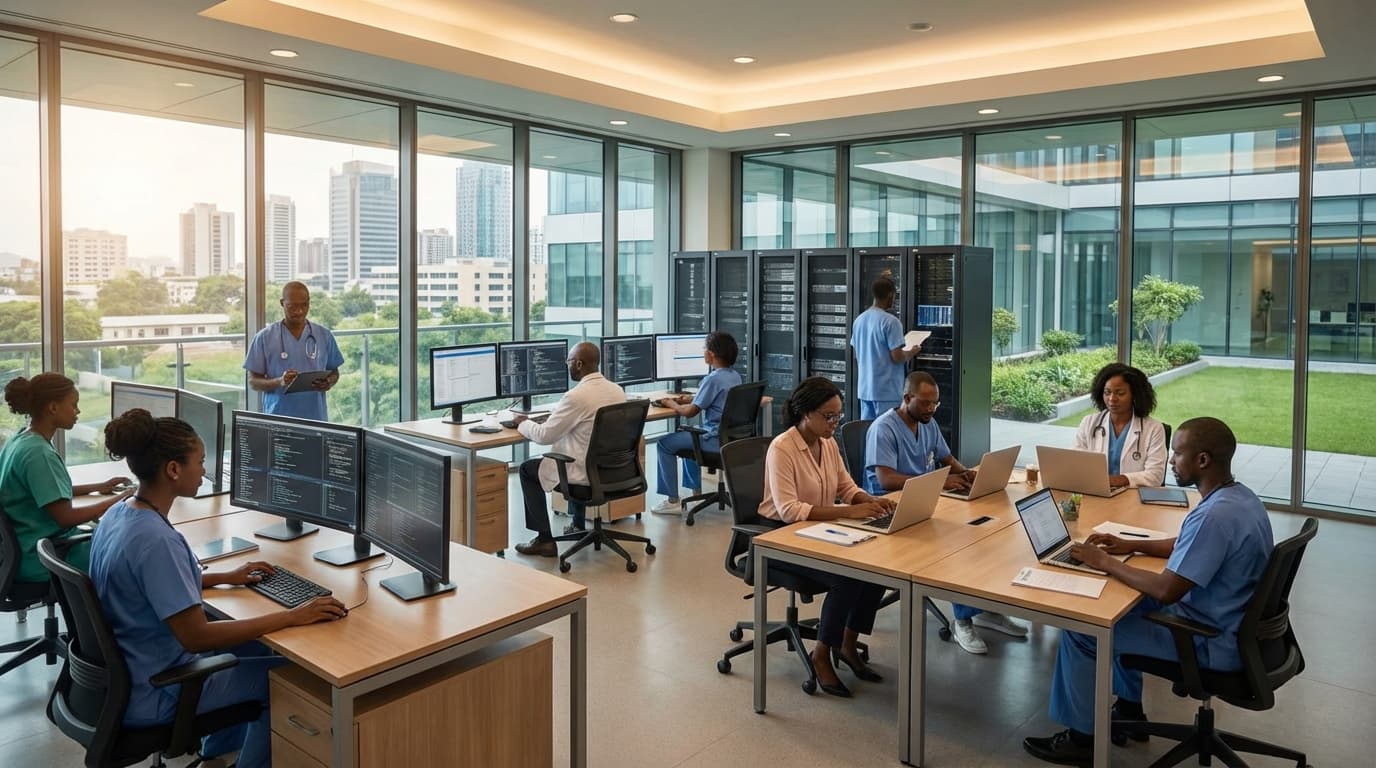
Radiology Reader & Reporting Support in Kenya
Engineering Excellence & Technical Support
Remote radiology reading and reporting services High-standard technical execution following OEM protocols and local regulatory frameworks.
AI-Powered Diagnostic Assistance
Leveraging advanced AI algorithms to provide real-time diagnostic suggestions and anomaly detection, improving accuracy and reducing turnaround time for radiology reports in Kenyan healthcare facilities.
Secure Cloud-Based Reporting Platform
A robust and secure cloud platform that facilitates seamless report generation, storage, and retrieval for radiologists across Kenya, ensuring data integrity and accessibility from any location.
Interoperable PACS Integration
Seamless integration with existing Picture Archiving and Communication Systems (PACS) throughout Kenya, enabling efficient workflow for radiologists and physicians by unifying imaging data and reporting tools.
What Is Radiology Reader & Reporting Support In Kenya?
Radiology Reader & Reporting Support in Kenya refers to a specialized outsourced service that augments the diagnostic radiology workflow for healthcare facilities. This service provides access to qualified and experienced radiologists for the interpretation of medical imaging studies (e.g., X-ray, CT, MRI, Ultrasound) and the subsequent generation of comprehensive, actionable diagnostic reports. The primary objective is to enhance turnaround times, improve diagnostic accuracy, address radiologist shortages, and ensure consistent quality of radiological assessments within the Kenyan healthcare ecosystem. This support can be delivered remotely (teleradiology) or on-site, depending on the client's infrastructure and needs.
| Stakeholder/Entity | Need for Radiology Reader & Reporting Support | Typical Use Cases |
|---|---|---|
| Hospitals (Public & Private) | Insufficient in-house radiologist capacity, high patient volumes, need for subspecialty coverage, desire to reduce radiologist burnout, improve TAT for emergency and inpatient imaging. | 24/7 emergency room imaging interpretation, routine inpatient CT/MRI/X-ray reads, specialized procedures requiring expert interpretation (e.g., interventional radiology reports), outsourced reporting for specific modalities or subspecialties. |
| Diagnostic Imaging Centers/Clinics | Limited availability of full-time radiologists, need for high-volume interpretation of outpatient scans, desire to offer a broader range of imaging services without significant capital investment in personnel. | High-volume outpatient CT, MRI, and ultrasound interpretation, providing definitive reports for referring physicians, extending service hours. |
| Referral Hospitals (Tertiary/Quaternary Care) | Need for highly specialized subspecialty interpretations beyond in-house expertise, managing complex cases requiring multi-disciplinary review. | Advanced neuroimaging interpretation for stroke or tumor cases, complex musculoskeletal or oncological imaging analysis, second opinions on challenging diagnoses. |
| Rural & Remote Healthcare Facilities | Acute shortage of radiologists, geographical isolation, inability to attract and retain specialist radiologists. | Tele-radiology services providing essential diagnostic interpretations for remote X-rays, ultrasounds, and CT scans, enabling basic diagnostic capabilities in underserved areas. |
| Radiology Groups/Practices | Managing peak workloads, covering vacation/sick leave for staff radiologists, expanding service offerings to new clients or regions. | Over-reading or second-read services, providing overflow capacity during busy periods, supporting practice expansion through remote reporting. |
Key Components of Radiology Reader & Reporting Support:
- Image Interpretation: Professional review of medical images by subspecialized or general radiologists.
- Report Generation: Creation of detailed, structured, and medically accurate diagnostic reports, often adhering to established reporting templates and guidelines.
- Subspecialty Expertise: Access to radiologists with specific expertise in areas such as neuroradiology, musculoskeletal radiology, pediatric radiology, breast imaging, interventional radiology, etc.
- Quality Assurance: Implementation of peer review and quality control processes to ensure report accuracy and consistency.
- Turnaround Time (TAT) Management: Optimization of the time from image acquisition to report delivery, crucial for timely patient management.
- Workflow Integration: Seamless integration with existing Picture Archiving and Communication Systems (PACS) and Electronic Health Records (EHR) of client facilities.
- On-Call/Emergency Support: Provision of urgent interpretations for critical findings or during off-hours.
- Reporting Software/Platform: Utilization of secure, compliant software for image viewing, report dictation/writing, and report distribution.
Who Needs Radiology Reader & Reporting Support In Kenya?
In Kenya, the demand for radiology reader and reporting support is growing, driven by an increasing need for accurate and timely diagnostic imaging interpretation. This support is crucial for a wide range of healthcare providers, from large public hospitals to private clinics and specialized imaging centers. The goal is to enhance diagnostic capabilities, improve patient outcomes, and alleviate the workload on existing radiology departments, which often face shortages of qualified radiologists.
| Customer Type | Key Departments Requiring Support | Specific Needs |
|---|---|---|
| Public Hospitals | Radiology Department, Emergency Department, Oncology, Surgery, Internal Medicine | Managing high patient load, reducing reporting turnaround time, providing subspecialty interpretations, supporting remote facilities. |
| Private Hospitals & Hospital Groups | Radiology Department, Cardiology, Neurology, Orthopedics, Oncology | Enhancing service quality, offering 24/7 reporting, improving diagnostic accuracy, expanding service offerings. |
| Specialized Medical Centers | Radiology (subspecialty), Oncology, Neurology, Cardiology, Gastroenterology | Access to highly specialized expertise (e.g., neuro-radiology, cardiac radiology), accurate diagnosis for complex cases, second opinions. |
| Imaging Centers & Diagnostic Clinics | Radiology Department, General Practice Referrals | Expediting report generation, ensuring consistency in reporting standards, managing fluctuating workloads, providing overflow support. |
| Maternity & Pediatric Hospitals | Obstetrics & Gynecology, Pediatrics, Neonatology, Radiology | Specialized interpretation of fetal ultrasounds, pediatric imaging (e.g., bone age, chest X-rays), neuroimaging in infants. |
| Rural & Remote Healthcare Facilities | General Medicine, Surgery, Emergency Medicine | Access to expert diagnosis without on-site radiologist, enabling timely treatment decisions, improving healthcare equity. |
| Telemedicine Providers | Radiology, Clinical Services | Seamless integration of reporting into telemedicine platforms, enabling remote consultations, rapid diagnostic feedback. |
Target Customers and Departments for Radiology Reader & Reporting Support in Kenya
- {"title":"Public Hospitals","description":"These often serve a large patient volume and may have limited radiology staff, especially in remote areas. They require support to manage backlog and provide consistent diagnostic services."}
- {"title":"Private Hospitals & Hospital Groups","description":"As private healthcare expands, these institutions need efficient and high-quality radiology services to maintain their competitive edge and offer comprehensive patient care."}
- {"title":"Specialized Medical Centers","description":"Institutions focusing on specific areas like oncology, cardiology, or neurology often require subspecialty radiology expertise for detailed and precise interpretations."}
- {"title":"Imaging Centers & Diagnostic Clinics","description":"Independent imaging facilities that perform a high volume of scans benefit from external support to ensure prompt reporting and maintain operational efficiency."}
- {"title":"Maternity & Pediatric Hospitals","description":"These facilities require specialized interpretation for ultrasounds, X-rays, and other imaging modalities crucial for maternal and child health."}
- {"title":"Rural & Remote Healthcare Facilities","description":"Often lacking on-site radiologists, these facilities can leverage remote reporting services to access expert interpretations, bridging the geographical gap in healthcare access."}
- {"title":"Telemedicine Providers","description":"Companies offering remote medical consultations and diagnostics integrate radiology reporting as a key component of their service offerings."}
Radiology Reader & Reporting Support Process In Kenya
The Radiology Reader & Reporting Support Process in Kenya involves a structured workflow to ensure timely and accurate interpretation of medical imaging studies and the generation of comprehensive reports. This process is crucial for patient diagnosis, treatment planning, and medical decision-making. The workflow typically begins with a radiology request and concludes with the delivery of a finalized report to the referring physician.
| Stage | Description | Key Actors | Duration (Typical) | Potential Challenges |
|---|---|---|---|---|
| Inquiry & Request Generation | A referring physician identifies the need for a radiology examination for a patient. A formal request or requisition is generated, specifying the clinical indication, patient details, and the type of imaging study required. | Referring Physician, Clinical Staff | Minutes to Hours | Incomplete or vague clinical information, incorrect patient demographics, unavailability of specialized imaging equipment. |
| Image Acquisition | The patient undergoes the specified imaging procedure (e.g., X-ray, CT scan, MRI, Ultrasound) at a radiology facility. The imaging equipment captures the necessary anatomical images. | Radiographer/Technologist, Radiologist (for guidance) | Minutes to Hours (depending on modality) | Technical issues with imaging equipment, patient cooperation, radiation safety protocols, contrast media management. |
| Image Upload & Archival | Acquired images are transferred from the imaging modality to a Picture Archiving and Communication System (PACS). Images are anonymized and stored for future access and reporting. | Radiographer/Technologist, IT Support | Minutes to Hours | PACS connectivity issues, data transfer errors, storage capacity limitations, cybersecurity threats. |
| Teleradiology/Reading Assignment | For teleradiology services, images are securely transmitted to a reading center. Cases are then assigned to available and qualified radiologists based on specialty, subspecialty, and workload. In-house facilities assign reads directly to their radiologists. | PACS Administrator, Teleradiology Platform, Radiologist Coordinator, Radiologist | Minutes to Hours | Inefficient case assignment algorithms, radiologist unavailability, bandwidth limitations for transmission, security breaches during transmission. |
| Image Interpretation (Reading) | The assigned radiologist meticulously reviews the acquired images, correlating them with the clinical information provided in the request. They identify abnormalities, measure findings, and formulate a diagnostic impression. | Radiologist | 15 Minutes to Several Hours (depending on complexity) | Suboptimal image quality, challenging or rare pathologies, radiologist fatigue, lack of complete clinical history, overlapping findings. |
| Report Generation | The radiologist dictates or types a preliminary report based on their interpretation. This report includes patient demographics, examination details, findings, impression, and recommendations. | Radiologist, Reporting Software/Dictation System | Minutes to Hours | Transcription errors, incorrect terminology, inconsistencies in findings and impression, time pressure leading to rushed reporting. |
| Report Review & Quality Assurance | A second radiologist or a senior radiologist reviews the preliminary report for accuracy, completeness, and consistency with the images. This step is crucial for quality control and patient safety. | Senior Radiologist, QA Radiologist | Minutes to Hours | Subjectivity in interpretation, reviewer fatigue, insufficient time for thorough review, lack of standardized reporting templates. |
| Report Finalization & Dispatch | Once approved, the report is finalized and transmitted electronically or in hard copy to the referring physician. Secure communication channels are often used. | Radiologist, Administrative Staff, IT Support | Minutes to Hours | Communication system failures, incorrect recipient details, delays in dispatch, challenges with electronic health record (EHR) integration. |
| Billing & Archival | The radiology service is billed to the patient or insurance provider. All images and reports are archived within the PACS and/or EHR system for future reference and legal compliance. | Billing Department, Administrative Staff, IT Support | Days to Weeks | Billing disputes, coding errors, long-term data storage costs, compliance with data retention regulations. |
Key Stages of the Radiology Reader & Reporting Support Process
- Inquiry & Request Generation
- Image Acquisition
- Image Upload & Archival
- Teleradiology/Reading Assignment
- Image Interpretation (Reading)
- Report Generation
- Report Review & Quality Assurance
- Report Finalization & Dispatch
- Billing & Archival
Radiology Reader & Reporting Support Cost In Kenya
The cost of radiology reader and reporting support in Kenya is influenced by a variety of factors, making it challenging to provide a single, definitive price range. These services are crucial for accurate diagnosis and patient care, and their pricing reflects the expertise, technology, and operational overhead involved. Understanding these factors is key for healthcare providers in Kenya when budgeting for these essential services.
| Service Component | Estimated Range (KES) | Notes |
|---|---|---|
| Basic X-ray Interpretation | KES 1,500 - 4,000 | Standard interpretations. Price can vary based on complexity (e.g., a chest X-ray vs. a skeletal survey). |
| Ultrasound Interpretation (Abdominal/Pelvic) | KES 2,500 - 6,000 | Includes abdominal, pelvic, and sometimes obstetric scans. More detailed scans can be higher. |
| CT Scan Interpretation (e.g., Head, Abdomen) | KES 5,000 - 15,000 | Depends heavily on the number of slices, contrast use, and complexity of the study. |
| MRI Scan Interpretation (e.g., Brain, Knee) | KES 7,000 - 20,000 | MRI interpretation is generally more complex and time-consuming, reflecting in the price. |
| Specialized Interpretations (e.g., Cardiac MRI, Advanced Neuroimaging) | KES 10,000 - 30,000+ | Requires highly specialized radiologists and more detailed analysis. |
| Teleradiology Service Fee (Per Study) | KES 3,000 - 10,000 | This is an overarching fee for remote reading services, often inclusive of a basic interpretation. Volume discounts are common. |
| Radiologist Consultation/Second Opinion | KES 5,000 - 15,000 | For a radiologist's expert opinion on a specific case or imaging study. |
| Urgent/STAT Reporting Surcharge | 20% - 50% of base fee | An additional charge for expedited reporting, typically within a few hours. |
Key Pricing Factors for Radiology Reader & Reporting Support in Kenya
- Volume of Studies: The sheer number of radiology scans (X-rays, CTs, MRIs, ultrasounds) to be read and reported on significantly impacts cost. Higher volumes often benefit from economies of scale, potentially leading to lower per-study rates.
- Complexity of Studies: More complex imaging modalities (e.g., advanced CT protocols, MRI sequences) or specialized areas (e.g., neuroimaging, cardiac imaging) require radiologists with higher levels of expertise and may command higher fees.
- Radiologist's Expertise and Specialization: The qualifications, years of experience, and sub-specialization of the reporting radiologist play a crucial role. Highly sought-after specialists in niche areas will naturally charge more.
- Turnaround Time (TAT) Requirements: Urgent reporting needs, such as for emergency room cases, often come with a premium due to the need for immediate attention and dedicated radiologist availability.
- Technology and Infrastructure: The cost of the PACS (Picture Archiving and Communication System) and RIS (Radiology Information System) used, as well as the reliability of internet connectivity and IT support, can influence pricing, especially for remote reading services.
- Provider Type (In-house vs. Outsourced): Whether a hospital or clinic employs its own radiologists or contracts with a third-party teleradiology service will have different cost structures. Outsourcing can sometimes be more cost-effective for smaller facilities or those facing radiologist shortages.
- Location and Operational Costs: The overhead costs associated with the provider, including staff salaries, rent (if applicable), and administrative expenses, are factored into their pricing.
- Contractual Agreements: Long-term contracts or partnerships may offer more favorable pricing compared to ad-hoc or one-off services.
- Ancillary Services: Some providers may bundle reporting with other services like preliminary readings, second opinions, or peer reviews, which can affect the overall cost.
- Quality Assurance and Accreditation: Providers adhering to stringent quality control measures and holding relevant accreditations might reflect these standards in their pricing.
Affordable Radiology Reader & Reporting Support Options
For healthcare providers seeking cost-effective solutions for radiology reading and reporting, several options exist beyond traditional in-house staffing or expensive outsourcing. Value bundles and strategic cost-saving measures can significantly reduce operational expenses while maintaining or improving the quality and turnaround time of radiology services. These strategies often involve leveraging technology, flexible staffing models, and integrated service offerings.
| Strategy | Description | Cost-Saving Mechanism | Value Proposition |
|---|---|---|---|
| Value Bundles (e.g., Integrated Teleradiology + AI) | Combining teleradiology services with AI-powered preliminary analysis and workflow tools under a single contract. | Reduced overhead, streamlined workflow, enhanced radiologist efficiency, potential for volume discounts. | Comprehensive, integrated solution offering improved turnaround times and potential for higher diagnostic accuracy at a predictable cost. |
| Tiered Reporting Services | Offering different levels of reporting based on urgency or complexity (e.g., STAT, routine, expert sub-specialty). | Optimizes radiologist time by matching complexity to reviewer skill/speed, avoids paying premium rates for routine reads. | Cost-effectiveness through differentiated service levels, ensuring appropriate expertise is applied where needed. |
| Volume-Based Pricing | Negotiating rates with teleradiology or AI vendors that decrease as the volume of studies increases. | Directly reduces the per-study cost as usage grows. | Predictable and decreasing costs for high-volume practices, incentivizing efficiency and utilization. |
| Extended Hour Coverage Packages | Purchasing overnight, weekend, or holiday coverage as a bundled package rather than on-demand. | Often more economical than per-hour rates for consistent after-hours needs. | Ensures continuous coverage without the high cost of 24/7 in-house staff, improving patient care and departmental efficiency. |
| Shared Service Models | Collaborating with other smaller practices or hospitals to share teleradiology or AI resources. | Leverages economies of scale, distributing costs across multiple entities. | Access to advanced services and specialized expertise at a fraction of the individual cost. |
| Technology Standardization and Integration | Implementing a unified PACS and reporting system that integrates seamlessly with chosen teleradiology or AI vendors. | Reduces IT complexity and maintenance costs, improves data flow efficiency, and minimizes training overhead. | Streamlined operations, reduced errors, and faster report turnaround. |
Key Affordable Radiology Reader & Reporting Support Options
- {"title":"Teleradiology Services","description":"Utilizing remote radiologists to interpret medical images. This model offers flexibility and access to a wider pool of specialists without the overhead of in-house staff. Sub-specialty coverage is often more accessible and affordable through teleradiology."}
- {"title":"Hybrid Teleradiology Models","description":"Combining in-house reads for routine cases with teleradiology for after-hours, weekends, or specialized studies. This optimizes resource allocation and can be more cost-effective than fully outsourcing or overstaffing."}
- {"title":"AI-Powered Support Tools","description":"Integrating Artificial Intelligence (AI) tools for preliminary reads, abnormality detection, and workflow prioritization. AI can act as a first-pass filter, enhancing radiologist efficiency and reducing the chance of missed findings, ultimately lowering per-study costs."}
- {"title":"Managed Radiology Services","description":"Outsourcing the entire radiology department's operations or specific functions to a third-party provider. This can encompass staffing, technology, quality assurance, and reporting, offering a predictable cost structure."}
- {"title":"Flexible Staffing and Per-Diem Radiologists","description":"Engaging radiologists on a per-case or per-hour basis, particularly useful for fluctuating workloads or specific coverage needs. This avoids the fixed costs associated with full-time employees."}
Verified Providers In Kenya
In Kenya's evolving healthcare landscape, identifying reliable and qualified medical practitioners is paramount for ensuring quality care. Verified providers stand out as a benchmark for trust and expertise. This is particularly true when considering entities like Franance Health, whose rigorous credentialing processes and commitment to patient well-being position them as a leading choice for individuals seeking top-tier medical services. Franance Health's emphasis on verification not only assures patients of the qualifications of their network but also underscores a dedication to maintaining the highest standards of medical practice across Kenya.
| Credentialing Aspect | Franance Health's Approach | Benefit to Patients |
|---|---|---|
| Licensing and Registration | Confirms active and valid medical licenses from relevant Kenyan authorities (e.g., KMPDC). | Ensures providers are legally permitted to practice and meet basic professional requirements. |
| Education and Training | Validates academic qualifications, postgraduate training, and specialized certifications. | Guarantees that practitioners possess the necessary theoretical knowledge and practical skills for their field. |
| Professional Experience | Assesses the duration and scope of clinical experience in relevant specialties. | Provides assurance of hands-on expertise and familiarity with common and complex medical cases. |
| Peer Review and Reputation | May involve gathering feedback from other healthcare professionals and reviewing professional standing. | Offers an additional layer of assurance regarding the provider's competence and ethical behavior. |
| Continuing Professional Development (CPD) | Verifies participation in ongoing learning and training to stay updated with medical advancements. | Ensures patients are treated by practitioners who are current with the latest medical knowledge and techniques. |
Why Franance Health Credentials Represent the Best Choice:
- Rigorous Verification Process: Franance Health employs a multi-faceted verification system that goes beyond basic licensing to ensure providers meet stringent criteria for competence, experience, and ethical conduct.
- Commitment to Quality: Their credentialing ensures that all associated healthcare professionals adhere to established best practices and quality standards, promoting effective and safe patient care.
- Extensive Network: Franance Health boasts a comprehensive network of verified specialists and general practitioners across various medical disciplines, offering a wide range of accessible healthcare solutions.
- Patient-Centric Approach: The verification process is designed with the patient's best interests at its core, providing peace of mind and confidence in the medical professionals they engage with.
- Continuous Monitoring: Beyond initial verification, Franance Health often engages in ongoing monitoring of provider performance and adherence to standards, ensuring sustained quality over time.
Scope Of Work For Radiology Reader & Reporting Support
This Scope of Work (SOW) outlines the requirements for providing professional radiology reading and reporting support services. The objective is to supplement existing radiology department capabilities, ensuring timely and accurate interpretation of medical imaging studies. This includes reading a defined volume of studies, generating comprehensive diagnostic reports, and adhering to established clinical and technical standards.
| Deliverable | Description | Standard Specifications | Key Performance Indicator (KPI) |
|---|---|---|---|
| Radiology Interpretation Reports | Comprehensive reports detailing findings and impressions for each interpreted study. | Reports must be structured, clearly written, include all relevant findings, and be formatted according to the client's established template. Must include diagnosis, differential diagnoses, and recommendations where appropriate. Adherence to standardized radiology reporting nomenclature (e.g., BI-RADS, PI-RADS). | Accuracy of reports (measured by peer review or audit), Completeness of reports (all requested information present). |
| Turnaround Time (TAT) for Reports | Time elapsed from study assignment to final report availability. | Standard TAT targets to be defined per modality and urgency (e.g., STAT exams < 1 hour, routine exams < 24 hours). Specific targets will be negotiated and documented. | Percentage of reports delivered within specified TAT (e.g., >95% within TAT). |
| Critical Finding Communication | Timely notification of urgent or critical findings to the referring physician or designated clinical personnel. | Protocols for identifying and communicating critical findings will be established. Communication method (phone call, secure message) and documentation requirements will be specified. | Percentage of critical findings communicated within the defined timeframe. |
| Quality Assurance (QA) & Peer Review | Participation in the client's QA program, including peer review of reports. | Adherence to the client's QA protocols and feedback mechanisms. Individual performance metrics will be tracked and discussed. | Quality scores from peer review, reduction in report discrepancies. |
| System & Workflow Integration | Seamless integration with the client's PACS, RIS, and EHR systems. | Must be able to efficiently navigate and utilize the provided systems for image review and reporting. User accounts and access credentials will be provisioned by the client. Adherence to all IT security policies. | Successful system login and utilization, minimal technical support requests related to system usage. |
Key Responsibilities and Deliverables
- Review and interpret assigned radiology imaging studies (e.g., X-ray, CT, MRI, Ultrasound, Mammography, Nuclear Medicine) according to established clinical protocols and best practices.
- Generate clear, concise, and accurate diagnostic reports for each interpreted study, including findings, impressions, and recommendations.
- Communicate critical findings promptly to referring physicians or appropriate clinical staff as per established protocols.
- Participate in case conferences or tumor boards as required and agreed upon.
- Maintain compliance with all relevant regulatory requirements (e.g., HIPAA, ACR guidelines).
- Adhere to established turnaround times (TAT) for report generation.
- Utilize the designated Picture Archiving and Communication System (PACS) and Electronic Health Record (EHR) systems for image viewing and reporting.
- Provide ongoing feedback on workflow efficiency and potential areas for improvement.
- Maintain professional credentialing and licensure in good standing.
Service Level Agreement For Radiology Reader & Reporting Support
This Service Level Agreement (SLA) outlines the guaranteed response times and uptime for the Radiology Reader & Reporting Support service. This agreement ensures that our clients receive timely assistance and consistent availability for their radiology workflow needs.
| Service Component | Severity Level | Response Time Guarantee | Resolution Time Target | Uptime Guarantee |
|---|---|---|---|---|
| Radiology Reader & Reporting Systems (Core Functionality) | Critical (System Down/Major Impact) | 15 minutes | 2 hours | 99.9% |
| Radiology Reader & Reporting Systems (Core Functionality) | High (Significant Degradation) | 30 minutes | 4 hours | 99.9% |
| Radiology Reader & Reporting Systems (Core Functionality) | Medium (Minor Impact/Workaround Available) | 1 hour | 8 business hours | 99.9% |
| Radiology Reader & Reporting Systems (Core Functionality) | Low (Informational/Request) | 4 business hours | 2 business days | N/A (Not directly impacting uptime) |
| Ancillary Reporting Tools (e.g., template editors, non-critical integrations) | Critical (System Down/Major Impact) | 1 hour | 4 hours | 99.5% |
| Ancillary Reporting Tools (e.g., template editors, non-critical integrations) | High (Significant Degradation) | 2 hours | 8 business hours | 99.5% |
| Ancillary Reporting Tools (e.g., template editors, non-critical integrations) | Medium (Minor Impact/Workaround Available) | 4 business hours | 3 business days | 99.5% |
Key Service Components
- Radiology Reader Support: Assistance with the functionality, troubleshooting, and optimization of radiology reading software and hardware.
- Reporting Support: Technical support for radiology reporting software, dictation systems, and integration with Electronic Health Records (EHRs).
- Response Time: The maximum time allowed for the support team to acknowledge and begin working on a reported issue.
- Uptime Guarantee: The percentage of time the supported systems are expected to be available and operational.
Frequently Asked Questions

Ready when you are
Let's scope your Radiology Reader & Reporting Support in Kenya project in Kenya.

Scaling healthcare logistics and technical systems across the entire continent.