
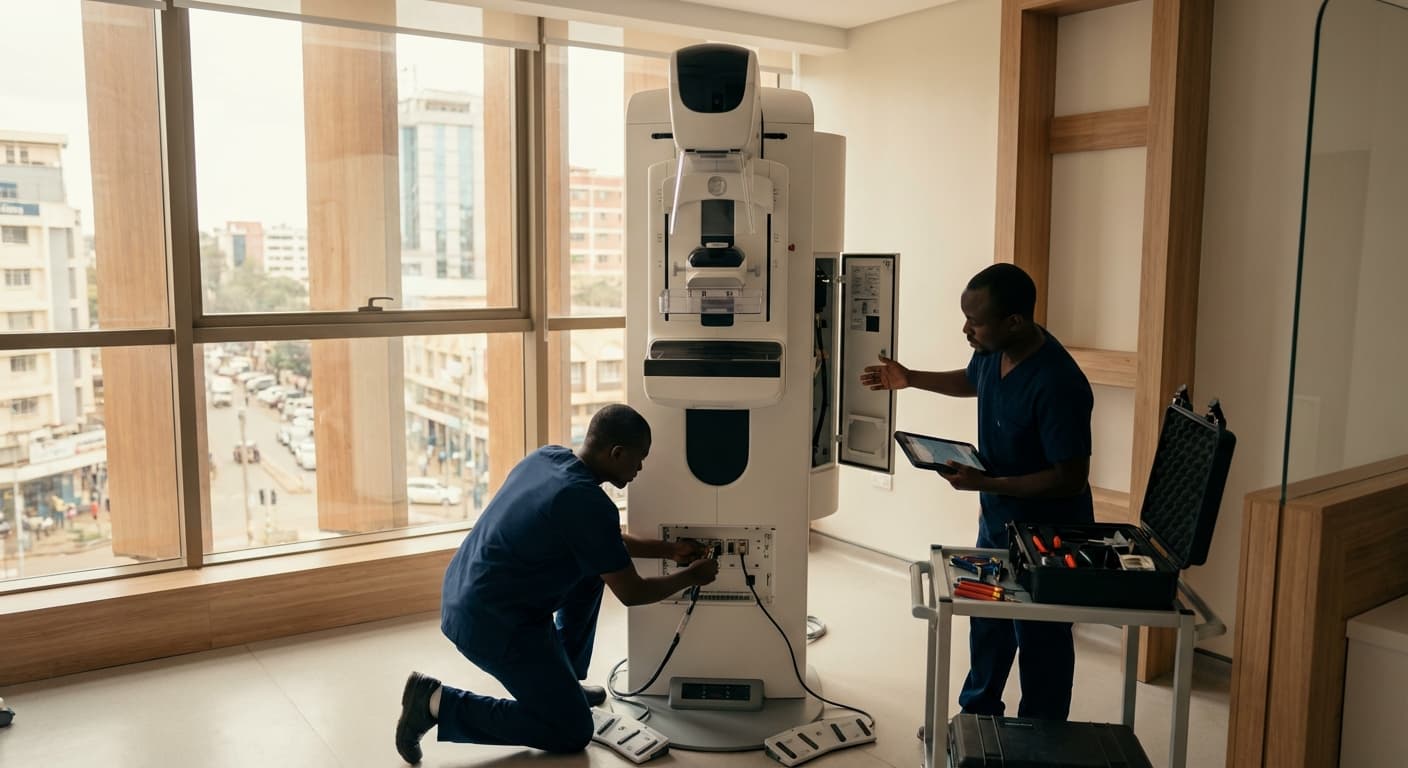
Mammography Installation Service in Kenya
Engineering Excellence & Technical Support
Mammography Installation Service High-standard technical execution following OEM protocols and local regulatory frameworks.
Certified Technicians for Precision Installation
Our team comprises highly skilled and certified technicians with extensive experience in installing the latest mammography equipment. We ensure meticulous calibration and optimal positioning for accurate diagnostics, adhering to international standards and local healthcare regulations in Kenya.
End-to-End Project Management & Commissioning
We offer comprehensive installation services from site assessment and preparation to full system commissioning. Our project management ensures a smooth, efficient, and timely installation process, minimizing disruption to your facility and guaranteeing your mammography unit is fully operational and compliant.
Post-Installation Support & Training
Beyond installation, we provide robust post-installation support and comprehensive training for your radiographers and technicians. This ensures optimal utilization of the new mammography system, enhanced diagnostic capabilities, and a seamless integration into your clinic's workflow across Kenya.
What Is Mammography Installation Service In Kenya?
Mammography Installation Service in Kenya refers to the comprehensive process of setting up, configuring, and integrating mammography imaging systems within healthcare facilities in Kenya. This service ensures that the medical equipment is operational, calibrated, and compliant with relevant regulatory standards, thereby enabling accurate and reliable breast cancer screening and diagnostic procedures. It encompasses a range of technical activities, from site preparation and equipment placement to system testing, radiation safety compliance, and initial user training.
| Who Needs Mammography Installation Service? | Typical Use Cases | |||
|---|---|---|---|---|
| Hospitals and Medical Centers: Both public and private healthcare institutions establishing new radiology departments or upgrading existing mammography facilities. | Diagnostic Imaging Clinics: Specialized clinics focusing on radiology services that require dedicated mammography equipment for routine screenings and diagnostic procedures. | Rural Health Centers and Outreach Programs: Facilities aiming to improve access to breast cancer screening in underserved areas, requiring mobile or fixed mammography units. | Research Institutions: Organizations conducting studies related to breast imaging technologies, diagnostic accuracy, or epidemiology, requiring precise and reliable mammography systems. | Government Health Initiatives: Public health programs focused on early detection of breast cancer, necessitating the deployment of mammography equipment across various healthcare settings. |
| Routine Breast Cancer Screening: Installing systems to facilitate regular mammographic examinations for asymptomatic individuals as part of population-based screening programs. | Diagnostic Mammography: Setting up units for investigating suspicious findings identified through screening or reported symptoms (e.g., lumps, nipple discharge). | New Facility Setup: Comprehensive installation of mammography equipment as part of the construction or expansion of a new hospital wing or diagnostic center. | Equipment Upgrade or Replacement: Installing newer generation mammography systems (e.g., digital mammography, 3D mammography/tomosynthesis) to enhance diagnostic capabilities and reduce radiation dose. | Mobile Mammography Units: Installation and integration of mammography equipment in vehicles for mobile screening services targeting remote or hard-to-reach populations. |
Key Components of Mammography Installation Service:
- Site Assessment and Preparation: Evaluating the physical space, including power requirements, ventilation, shielding, and structural integrity, to ensure it meets the mammography unit's specifications.
- Equipment Delivery and Unpacking: Safe transportation and careful unboxing of the mammography system and associated components.
- Physical Installation and Assembly: Positioning and assembling the mammography unit, including the X-ray tube, detector, compression paddle, and control console.
- Electrical and Network Connectivity: Connecting the system to power sources, and if applicable, integrating it with the Picture Archiving and Communication System (PACS) and Electronic Health Records (EHR) for digital image management and reporting.
- Radiation Safety Compliance: Verification and calibration of radiation output, shielding effectiveness, and adherence to national and international radiation protection guidelines. This often involves measurements and certification by qualified radiation physicists.
- System Calibration and Quality Assurance (QA): Performing detailed calibration of image acquisition parameters, contrast, resolution, and dose. QA tests are conducted to ensure consistent image quality and diagnostic accuracy.
- Software Configuration and Integration: Installing and configuring the mammography software, including image processing, display, and reporting functionalities. Integration with other hospital IT systems may also be performed.
- Initial User Training: Providing comprehensive training to radiographers, technologists, and potentially radiologists on the operation, basic maintenance, and image acquisition protocols of the new mammography system.
- Post-Installation Support and Handover: Offering initial troubleshooting, system verification, and a formal handover of the operational system to the healthcare facility.
Who Needs Mammography Installation Service In Kenya?
Mammography installation services in Kenya are essential for a wide range of healthcare facilities and organizations that aim to provide crucial breast cancer screening and diagnostic services. These services ensure that imaging equipment is set up correctly, calibrated, and integrated into existing hospital workflows for optimal performance and patient safety. The need for these specialized services spans various entities, from government-funded hospitals to private clinics and research institutions.
| Customer Type | Key Departments Involved | Primary Needs |
|---|---|---|
| Public Hospitals | Radiology Department, Biomedical Engineering, IT Department, Procurement Department | Reliable and cost-effective installation, integration with PACS, staff training, ongoing maintenance. |
| Private Hospitals and Clinics | Radiology Department, Clinical Engineering, IT Department, Administration | State-of-the-art installation, seamless integration with existing systems, patient comfort, compliance with regulatory standards. |
| Maternity and Women's Health Centers | Radiology Department, Gynecology Department, Patient Services | Specialized installation for women's health needs, efficient workflow, patient privacy and comfort. |
| Diagnostic Imaging Centers | Radiology Department, Technical Services, Quality Assurance | High-performance installation, accurate calibration, compliance with imaging standards, diverse modality integration. |
| NGOs and FBOs | Medical Services Department, Operations, Logistics | Cost-effective installation, durability in potentially challenging environments, basic operational training, accessibility. |
| Government Health Ministries | Procurement and Logistics, Health Infrastructure, Technical Support | Standardized installation protocols, large-scale deployment management, quality control, data management. |
| Research Institutions | Radiology Department, Research Division, IT and Data Management | Precision installation for research accuracy, data integration capabilities, specialized software integration. |
| Mobile Mammography Units | Biomedical Engineering, Operations, Logistics, Radiology Department | Compact and robust installation, power management, environmental control, on-site calibration and testing. |
Target Customers and Departments for Mammography Installation Service in Kenya:
- Public Hospitals: These are often the primary providers of healthcare for the majority of the Kenyan population. They require reliable mammography services to offer accessible screening programs, especially in underserved areas.
- Private Hospitals and Clinics: Many private healthcare providers in Kenya are investing in advanced diagnostic imaging technology, including mammography, to cater to a growing demand for high-quality healthcare services and to attract a discerning patient base.
- Maternity and Women's Health Centers: Facilities specifically focused on women's health are prime candidates for mammography installation, as it's a core component of comprehensive breast health management.
- Diagnostic Imaging Centers: Standalone diagnostic imaging centers that offer a range of radiology services will require professional installation to ensure the mammography unit performs optimally and meets industry standards.
- Non-Governmental Organizations (NGOs) and Faith-Based Organizations (FBOs): Many NGOs and FBOs operate healthcare facilities, particularly in rural and remote regions. They often rely on specialized installation services to set up vital medical equipment for community health initiatives.
- Government Health Ministries and Departments: National and county health departments may oversee the procurement and installation of mammography units in public facilities across the country, necessitating professional project management and installation.
- Research Institutions and Universities with Medical Schools: These entities may require mammography installations for research purposes, training medical professionals, and conducting epidemiological studies related to breast cancer.
- Mobile Mammography Units: For outreach programs and screening camps, mobile units require specialized installation and integration of mammography equipment within a mobile platform, ensuring functionality and safety on the go.
Mammography Installation Service Process In Kenya
This document outlines the typical workflow for a mammography installation service process in Kenya, from the initial customer inquiry to the final execution and handover. The process ensures a smooth, compliant, and efficient installation of mammography equipment in healthcare facilities.
| Stage | Description | Key Activities | Responsible Parties | Deliverables/Outcomes |
|---|---|---|---|---|
| The process begins when a healthcare facility expresses interest in acquiring and installing a mammography unit. | Customer contacts the service provider, discusses requirements (type of mammography, budget, existing infrastructure), and initial consultation. | Healthcare Facility (Client), Service Provider Sales/Consultant | Understanding of client needs, preliminary product recommendations. |
| A thorough assessment of the intended installation site to ensure it meets all technical and regulatory requirements. | Site visit, assessment of space, power supply, ventilation, radiation shielding needs, network connectivity, and existing infrastructure. Identification of any necessary civil works. | Service Provider Technical Team, Healthcare Facility Facilities Manager | Detailed site assessment report, identification of prerequisites, potential challenges, and required modifications. |
| Based on the needs assessment and site survey, a formal proposal and agreement are prepared. | Preparation of a detailed quotation (equipment, installation, training, warranty). Negotiation of terms, pricing, payment schedules, and service level agreements (SLAs). Signing of the contract. | Service Provider Sales/Management, Healthcare Facility Management/Procurement | Formal quotation, signed contract, agreed-upon terms and conditions. |
| Ordering the mammography equipment and arranging for its safe and timely delivery to Kenya. | Placing order with the manufacturer, managing import documentation, customs clearance, and arranging for transportation to the healthcare facility. | Service Provider Procurement/Logistics Department, Customs Agents | Procured equipment, cleared customs, ready for delivery. |
| Ensuring the installation site is fully prepared according to the site survey recommendations before equipment arrival. | Completion of any required civil works (e.g., radiation shielding, structural modifications), electrical upgrades, ventilation system installation, and HVAC setup. Verifying access routes for equipment. | Healthcare Facility Facilities Department, Contractors (if applicable), Service Provider (oversight) | Site ready for installation, all prerequisite infrastructure in place. |
| The mammography unit and its accessories are transported to the facility and carefully unpacked. | Safe transportation of equipment to the site. Careful unpacking and inspection of all components for any damage during transit. | Service Provider Logistics/Installation Team, Healthcare Facility Representative | Equipment safely delivered and inspected. |
| The core of the process where the mammography unit is assembled and connected by certified technicians. | Assembly of the mammography system, connection to power, network, and any other required utilities. Following manufacturer's installation manuals and local safety regulations. | Service Provider Certified Installation Engineers | Mammography unit physically installed and assembled. |
| Ensuring the equipment operates precisely and safely according to manufacturer specifications and regulatory standards. | Performing initial calibration of the system, running diagnostic tests, quality assurance (QA) tests, and ensuring optimal image quality and radiation safety. Verification against international and local standards. | Service Provider Application Specialists/Engineers, Radiation Protection Board (if required) | Calibrated and fully functional mammography system, QA reports, compliance verification. |
| Providing comprehensive training to the end-users and officially handing over the installed equipment. | Training for radiographers, radiologists, and relevant technical staff on system operation, image acquisition, basic troubleshooting, and daily QA procedures. Formal handover of the equipment with all documentation (manuals, warranty, test reports). | Service Provider Application Specialists, Healthcare Facility Clinical and Technical Staff | Trained personnel, comprehensive user manuals, warranty certificates, acceptance documentation. |
| Ongoing support to ensure the continued optimal performance of the mammography unit. | Provision of warranty services, scheduled preventive maintenance, troubleshooting, and repair services as per the SLA. Regular system checks and updates. | Service Provider Technical Support Team, Service Provider Maintenance Engineers | Ongoing operational efficiency, minimized downtime, continued compliance. |
Mammography Installation Service Process in Kenya
- Initial Inquiry and Needs Assessment
- Site Survey and Technical Evaluation
- Quotation and Contract Negotiation
- Procurement and Logistics
- Pre-installation Preparation
- Equipment Delivery and Unpacking
- Installation and Assembly
- Calibration and Testing
- Training and Handover
- Post-installation Support and Maintenance
Mammography Installation Service Cost In Kenya
Installing a mammography machine is a complex process that involves more than just physically placing the equipment. Several factors influence the overall cost in Kenya, ranging from the type of technology to the location and specific service provider. Understanding these elements is crucial for healthcare facilities budgeting for this essential diagnostic tool.
| Service Component | Estimated Price Range (KES) | Notes |
|---|---|---|
| Basic Digital Mammography (2D) Installation | 800,000 - 1,500,000 | Includes standard installation, calibration, and basic training. Site preparation costs are additional. |
| Digital Mammography with Tomosynthesis (3D) Installation | 1,200,000 - 2,500,000+ | Higher end of the spectrum due to advanced technology. May include more comprehensive training and support. |
| Site Preparation (Radiation Shielding, Electrical, etc.) | 200,000 - 800,000+ | Highly variable depending on existing infrastructure and required modifications. |
| Comprehensive Training (Radiographers & Technicians) | 100,000 - 300,000 | Can be per session or a full program. Varies by complexity of the system. |
| Initial Warranty & Basic Service Package (1 Year) | Included in machine cost or 5-10% of machine price annually thereafter | Essential for ensuring operational continuity. Extended warranties are available. |
| On-site Technical Support & Troubleshooting | 30,000 - 70,000 per visit (plus parts) | For issues arising after the initial warranty period. |
Key Pricing Factors for Mammography Installation in Kenya:
- Type of Mammography Technology: Digital mammography (2D and 3D/Tomosynthesis) is generally more expensive to install than older analog systems due to the advanced technology and specialized components. 3D mammography, offering superior detection rates, commands a higher installation cost.
- Machine Brand and Model: Reputable global brands often have higher upfront costs but may offer better reliability, advanced features, and comprehensive service packages. The specific model chosen, based on imaging capabilities and intended use, also impacts the price.
- Site Preparation and Infrastructure: This includes modifications to the installation room, such as reinforced flooring, appropriate ventilation, radiation shielding (lead lining), adequate electrical supply, and specialized cooling systems. The extent of these modifications significantly affects the total cost.
- Installation Labor and Expertise: The complexity of the installation, the experience of the technicians, and the duration of the process all contribute to labor costs. Specialized knowledge is required for high-end digital systems.
- Calibration and Testing: Professional calibration and rigorous testing by certified engineers are essential to ensure the machine operates accurately and safely. This is a non-negotiable part of the installation process and incurs costs.
- Training of Personnel: Comprehensive training for radiographers and technicians on operating the new mammography system, including image acquisition and post-processing, is often bundled with installation or offered as a separate service, adding to the overall expenditure.
- Warranty and Service Agreements: The length and scope of the warranty and any post-installation service contracts are important considerations. Longer and more comprehensive agreements will naturally increase the initial cost but can provide long-term value.
- Geographical Location within Kenya: Installation costs can vary slightly depending on the location. Access to remote areas may incur higher transportation and logistical costs for the installation team and equipment.
- Third-Party Integrations: If the mammography system needs to integrate with existing Picture Archiving and Communication Systems (PACS) or Electronic Health Records (EHR), additional software configuration and IT support costs may apply.
- Additional Accessories and Peripherals: This could include specialized workstations for image review, printers, or other accessories that enhance the functionality of the mammography unit.
Affordable Mammography Installation Service Options
Finding affordable mammography installation services is crucial for healthcare facilities, balancing the need for advanced diagnostic equipment with budget constraints. This service involves the professional setup and integration of mammography machines into existing clinical environments. Value bundles and strategic cost-saving measures can significantly reduce the overall expenditure while ensuring a high-quality installation.
| Cost-Saving Strategy | Description | Potential Benefits |
|---|---|---|
| Value Bundles | Providers offering comprehensive packages that include installation, training, and initial maintenance at a discounted rate compared to à la carte services. Often bundled with equipment purchase or lease agreements. | Reduced overall cost, streamlined vendor management, predictable budgeting, access to integrated services. |
| Phased Installation | Breaking down the installation into manageable stages, allowing facilities to budget and manage cash flow more effectively. May be suitable for larger or multi-site installations. | Improved budget control, less disruption to operations, staggered expenditure. |
| Off-Peak Scheduling | Negotiating installation during non-peak hours or slower periods for the facility to minimize operational downtime and potential lost revenue. May also offer reduced labor rates from installers. | Minimized disruption to patient care, potentially lower labor costs, greater flexibility in scheduling. |
| Used or Refurbished Equipment with Installation Packages | Purchasing pre-owned or refurbished mammography units often comes with discounted installation services that are still professional and warrantied. | Significant upfront equipment cost savings, combined with more affordable installation. |
| Negotiating Long-Term Service Agreements | Securing installation as part of a longer-term service and maintenance contract can lead to better pricing on both components. | Cost predictability, potential for bundled discounts, ongoing support. |
| In-House Preparation (where feasible) | Performing basic site preparation tasks (e.g., clearing space, minor electrical checks) with internal staff can reduce the installer's labor time and cost, provided it doesn't compromise safety or compliance. | Reduced labor costs for installation, greater control over preparation timeline. |
| Multiple Vendor Quotes | Obtaining detailed quotes from several reputable installation service providers to compare pricing, scope of work, and included services. | Competitive pricing, identification of best value, ensures thorough understanding of offerings. |
Key Components of Mammography Installation Services
- Site assessment and preparation (e.g., structural modifications, electrical upgrades, radiation shielding).
- Equipment delivery and uncrating.
- Mechanical and electrical hook-up of the mammography unit.
- Calibration and performance testing to ensure accuracy and safety.
- Integration with PACS (Picture Archiving and Communication System) and RIS (Radiology Information System).
- Staff training on equipment operation and basic troubleshooting.
- Post-installation support and warranty.
Verified Providers In Kenya
In the dynamic Kenyan healthcare landscape, identifying reliable and high-quality service providers is paramount. Franance Health stands out as a beacon of trust and excellence, offering a comprehensive network of verified healthcare professionals and facilities. Their stringent credentialing process ensures that every provider within their network meets the highest standards of medical expertise, ethical practice, and patient care. This dedication to verification translates directly into superior patient outcomes and peace of mind for those seeking medical services. Choosing Franance Health means opting for a healthcare experience that prioritizes safety, competence, and compassionate treatment.
| Provider Type | Franance Health Verification | Key Benefits for Patients |
|---|---|---|
| Doctors (General Practitioners & Specialists) | Verified medical licenses, board certifications, and peer reviews. | Accurate diagnoses, effective treatment plans, and ethical medical practice. |
| Hospitals & Clinics | Accreditation status, quality improvement initiatives, and patient safety protocols. | Access to state-of-the-art facilities, comprehensive medical services, and a safe care environment. |
| Laboratories & Diagnostic Centers | Accreditation by relevant bodies and quality control measures for testing. | Reliable and accurate diagnostic results for informed medical decisions. |
| Pharmacies | Valid operating licenses and adherence to pharmaceutical dispensing standards. | Access to authentic medications and professional pharmaceutical advice. |
Why Franance Health Providers are the Best Choice:
- Rigorous Vetting Process: Franance Health employs a multi-stage verification system that scrutinizes medical licenses, educational qualifications, professional experience, and criminal background checks.
- Commitment to Quality Standards: Providers adhere to established national and international quality benchmarks for healthcare delivery and patient safety.
- Patient-Centric Approach: Verified providers are committed to patient well-being, ethical conduct, and transparent communication.
- Access to Specialized Care: The network includes a diverse range of specialists, ensuring you can find the right expert for your specific health needs.
- Technology Integration: Many Franance Health providers leverage modern medical technology for accurate diagnosis and effective treatment.
Scope Of Work For Mammography Installation Service
This Scope of Work (SOW) outlines the requirements for the professional installation of a new mammography system at [Client Facility Name]. The scope includes the delivery, uncrating, assembly, calibration, testing, and commissioning of the specified mammography equipment. It also details the technical deliverables and standard specifications to ensure the system operates at optimal performance and meets all regulatory requirements.
| Task ID | Description | Deliverables | Standard Specifications / Requirements | Acceptance Criteria |
|---|---|---|---|---|
| 1.0 | Site Preparation Verification | Pre-installation Checklist Completion, Site Readiness Report | Room dimensions, power requirements, environmental controls (temperature, humidity), radiation shielding verification, network connectivity, floor load capacity, door access. | All pre-installation requirements met as per manufacturer's guidelines and project plan. |
| 2.0 | Equipment Delivery and Uncrating | Delivery Confirmation, Uncrating Report | Secure and professional uncrating, inspection for shipping damage, verification of all components against packing list. | No visible damage to equipment. All components present and accounted for. |
| 3.0 | System Assembly and Installation | Installed Mammography System, Installation Completion Certificate | Professional assembly of all system components (gantry, detector, workstation, console, etc.) according to manufacturer's detailed instructions. Secure mounting and alignment. | System fully assembled and structurally sound. All connections made as per documentation. |
| 4.0 | Power Up and Initial Configuration | System Powered On, Basic Configuration Log | Safe and controlled power-up of the system. Initial software configuration and network setup. | System powers on without errors. Basic network connectivity established. |
| 5.0 | System Calibration and Alignment | Calibration Reports, Alignment Verification Data | Performed by certified manufacturer-trained technicians. Includes tube calibration, detector calibration, geometric alignment, geometric accuracy. | Calibration parameters within manufacturer's tolerances. Geometric accuracy meets specified limits (e.g., <1mm deviation). |
| 6.0 | Performance Testing and Quality Assurance (QA) | QA Test Reports, Image Quality Assessment Data, Dose Reports | Tests include: resolution, contrast, signal-to-noise ratio (SNR), uniformity, artifact detection, dose measurement (entrance surface dose/average glandular dose), ACR phantom testing. | All QA parameters meet or exceed ACR standards and manufacturer specifications. Image quality is diagnostically acceptable. |
| 7.0 | Integration with PACS/RIS | Successful DICOM Conformance Statement, Test Images on PACS | Verification of DICOM connectivity and interoperability with the Picture Archiving and Communication System (PACS) and Radiology Information System (RIS). | Images successfully transmitted to PACS/RIS. Patient demographic information correctly associated. |
| 8.0 | Radiation Safety Survey | Radiation Safety Survey Report | Performed by a qualified medical physicist to ensure compliance with radiation protection regulations. Includes leakage radiation, scattered radiation levels. | Radiation levels within permissible limits as per local and national regulations. |
| 9.0 | User Training | Training Material, Training Attendance Record, Post-Training Competency Assessment | Comprehensive training for radiographers and technologists on system operation, image acquisition techniques, quality control procedures, and basic troubleshooting. | Staff demonstrate competency in operating the system for routine clinical use. |
| 10.0 | Documentation and Handover | Final Installation Report, System Manuals, Warranty Information, Service Contact List | All required documentation provided. System handover to facility staff with clear understanding of responsibilities. | All documentation complete, accurate, and delivered. Formal sign-off by authorized client representative. |
Key Objectives
- Ensure safe and efficient installation of the mammography system.
- Verify system functionality and performance against manufacturer specifications.
- Achieve regulatory compliance for diagnostic imaging equipment.
- Provide comprehensive documentation and training for facility staff.
- Minimize downtime of clinical operations during the installation process.
Service Level Agreement For Mammography Installation Service
This Service Level Agreement (SLA) outlines the guaranteed response times and uptime for the Mammography Installation Service provided by [Your Company Name] to [Client Name]. This SLA is effective from [Start Date] to [End Date].
| Service Component | Response Time Guarantee | Uptime Guarantee |
|---|---|---|
| Initial Installation & Configuration | 4 business hours | N/A (One-time service) |
| Software Updates & Patches | 2 business days | N/A (Scheduled maintenance) |
| System Performance Monitoring | Continuous (Automated) | 99.5% |
| Hardware Malfunction (Critical) | 8 business hours (for initial diagnosis and dispatch) | 99.5% (excluding downtime due to hardware issues beyond our direct control) |
| Hardware Malfunction (Non-Critical) | 24 business hours (for initial diagnosis and dispatch) | 99.5% (excluding downtime due to hardware issues beyond our direct control) |
Key Performance Indicators (KPIs)
- Response Time: The time elapsed from when a service request is officially logged by [Client Name] until [Your Company Name] acknowledges the request and initiates troubleshooting or deployment.
- Uptime Guarantee: The percentage of scheduled operational time during which the installed mammography system is functional and available for use, excluding scheduled maintenance.
Frequently Asked Questions

Ready when you are
Let's scope your Mammography Installation Service in Kenya project in Kenya.

Scaling healthcare logistics and technical systems across the entire continent.